Athira.Sugathan et al Int. Journal of Engineering Research and Applications www.ijera.com
ISSN : 2248-9622, Vol. 4, Issue 5( Version 7), May 2014, pp.11-17
www.ijera.com 11 | P a g e
Attributed Relational Graph Based Feature Extraction of Body
Poses In Indian Classical Dance Bharathanatyam
Athira. Sugathan*
, Suganya. R**
*
(Department of Computer Science, Amrita Vishwa Vidhyapeetham, Coimbatore -641 112)
**
(Department of Computer Science, Amrita Vishwa Vidhyapeetham, Coimbatore -641 112)
ABSTRACT
Articulated body pose estimation in computer vision is an important problem because of convolution of the
models. It is useful in real time applications such as surveillance camera, computer games, human computer
interaction etc. Feature extraction is the main part in pose estimation which helps for a successful classification.
In this paper, we propose a system for extracting the features from the relational graph of articulated upper body
poses of basic Bharatanatyam steps, each performed by different persons of different experiences and size. Our
method has the ability to extract features from an attributed relational graph from challenging images with
background clutters, clothing diversity, illumination etc. The system starts with skeletonization process which
determines the human pose and increases the smoothness using B-Spline approach. Attributed relational graph is
generated and the geometrical features are extracted for the correct discrimination between shapes that can be
useful for classification and annotation of dance poses. We evaluate our approach experimentally on 2D images
of basic Bharatanatyam poses.
Keywords – Attributed relational graph, feature extraction, skeletonization
I. Introduction
The main goal of the work is to extract
geometrical features from the attributed relational
graph of the 2D dance pose in images that are under
uncontrolled imaging conditions. Features like
orientation, length of branches, strength, and vector
position of each node are extracting from the graph
for classification. The uncontrolled images will have
background clutter, diversity in clothing, illumination
and the object may appear at any orientation and
scale. In Bharatanatyam, each person’s appearance is
unconstrained, as he or she can wear any kind of
bharathanatyam dresses, with high complex designs
and colours/textures.
Bharatanatyam is the most popular classical
dance which has 3 main aspects namely Nritta, Nritya,
and Natya ie; poses, shorthand sign languages and
facial expressions. This work involves only superior
body poses ie; upper body poses of basic
bharathanatyam poses of unique persons from 2D
images to evaluate the similarity. The basic step of
Bharathanatyam is called ADAVU. An adavu is the
combination of standing posture, hand symbols and
leg positions. Here, we are concentrating only on
poses and short hand signs of basic dance steps. We
built skeletonization and attributed relational graph
prior to the feature extraction of dance poses from 2D
images. Skeleton of a human structure is the powerful
tool for efficient shape matching and it helps to
understand both the shape and topology of object.
Thinning and pruning methods included in
skeletonization where thinning method makes the
skeleton into a single pixel structure and pruning
method removes the unwanted branches presented in
the thinned skeleton. B-spline approach is a set of
continuous cubic spline curves which is used to get
smoothed skeleton. The attributed relational graph is
generated to find the geometrical features by setting
the nodes in each endpoint, joint points and vertex
points. The vectors of each nodes in the graph ie; the
(x, y) position of each nodes, length of each branch,
strength and orientation of the object are taken as the
features for extraction. This allows us to leads to more
correct discrimination between shapes by matching
the geometrical features between the training data and
testing data using a classifier. The experiments
performed using 110 images of different
bharatanatyam poses of different persons taken by
HTC camera of 8 megapixel and downloaded 83
images of hand mudhras and poses of bharatanatyam
from http://www.dreamstime.com /photosimages/
exponent/bharatanatyam-dance.html. The work of
recognizing dance action has a lot of practical
applications that includes the software for the study
and understanding of Indian classical dance
Bharathanatyam.
RESEARCH ARTICLE OPEN ACCESS
Athira.Sugathan et al Int. Journal of Engineering Research and Applications www.ijera.com
ISSN : 2248-9622, Vol. 4, Issue 5( Version 7), May 2014, pp.11-17
www.ijera.com 12 | P a g e
Fig.1.Basic pose
The next sections include literature survey,
proposed method and obtained results. In Section II
we describe competitive approaches related to our
methods. Section III presents details of our method,
while Section IV presents the experimental results
using input images. Also, we discuss some limitations
and contributions of our work atlast.
II. Literature Survey
Apratim Sharma et al. [1] proposed a
method to find the group of poses and classify the
action sequences of Bharathanatyam steps in real
time using kinect. Skeletonization of each pose is
obtained and joint angles are computed based on the
orientation of every joint in the form of rotation
matrices based on its orientation and scale. Cluster all
the poses and histogram of poses is used as a feature
vector for classification. The methods used here are
good in real-time kinect videos but not good in
images.
Marcin Eichner et al. [2] introduced Human
Pose Co-estimation where many people in the image
are in a common pose and estimate their poses
jointly. This method demonstrated a weakly
supervised learning of poses that is from images but
not from manual annotations. Dictionary of poses can
be generated from the annotated colored stickmen in
the human body parts and each pose class is
represented by its prototypes. Direct model is used in
this method where it finds a single prototype and all
local poses are equal to it.
Bangpeng Yao et al. [3], proposed a method
of object detection that provides better human pose
estimation and human pose estimation improves the
accuracy of detecting the objects by considering the
mutual context. Poses are obtained by clustering the
configurations of human body parts. First denote the
annotation of human body parts in an image and then
align the annotations. Use hierarchical clustering with
the maximum linkage measure to obtain a set of
clusters. This method describes the human object
interaction and needs to annotate the human body
parts and objects in each training image. In this work,
weakly supervised or unsupervised approach to
understand human-object interaction activities is not
used.
Ling Shao et al. [4] proposed a method for
human action recognition from silhouettes that
combines the advantages of both local and global
representations. First, bounding box is normalized to
reduce the dimension of each frame and remove the
variations of translation and scale. The normalized
silhouettes are used as the features in each frame by
extending the set of features model. The 2D
silhouette mask is converted to 1D mask from each
feature vector by scanning it from top to bottom. So,
each frame is represented as the binary element
vector and the length is taken as the multiplication of
both row and column. This is not an effective
method to encode correlations of action descriptors.
M. Andriluka et al. [5], proposed a method
to develop a generic model for human detection and
pose estimation that allows to detect highly
articulated human body parts and to estimate their
poses. A pictorial structure model is created and the
parts are obtained using the part detector. The mean
relative joint position is learned using maximum
likelihood estimation. A fully connected graphical
model for representing articulations which uses
discriminative part detectors is proposed.
C. Di Ruberto et al. [6], proposed a method
to use the skeleton of objects in the images in
computer vision and pattern recognition where the
object features are needed for classification.
Skeletonization method is used here to get a model of
the graph that leads to more correct representation of
shapes by an attributed graph matching algorithm.
The features like joint positions, edge positions,
length are taken as the features in this method. This
work fails to get more accurate graph model and fails
to get the better determination between shapes while
attributed graph matching process.
III. Proposed method
The architecture of the system is shown in
the figure 2.
Fig.2.Proposed system architecture
3.1. Skeletonization
Skeleton of a human structure is a good
representation of human pose. The reason for
obtaining the skeleton of an object is that it is easier
Athira.Sugathan et al Int. Journal of Engineering Research and Applications www.ijera.com
ISSN : 2248-9622, Vol. 4, Issue 5( Version 7), May 2014, pp.11-17
www.ijera.com 13 | P a g e
to analyze than the original image and also
maintaining the essential properties of the original
image. Given an input binary image of poses and
short hand signs (mudhras), skeletonization changes
non-skeletal object pixels into background pixels.
Different skeletonization techniques are used to get a
skeleton. Some of them preserve topology while
others preserve geometry of the original object. To
accurately preserve both topology and geometry from
2-D images, thinning algorithm is used.
3.1.1 Thinning Algorithm
Thinning algorithm preserves both
topological and geometrical properties of object from
2D images. It retains the topology of the original
object and forces the skeleton to be in the middle of
the object and also preserves the end points of the
original image. A morphological thinning operation
is used here, which is used to remove the foreground
pixels from binary images. It results in a single pixel
line thick and connected skeleton of the input image
which is useful for shape description. The input
image is thinned with a series of structuring elements
and the object is reduced to a set of one pixel width
connected lines. The skeleton is considered as a
connected graph therefore each vertex is considered
as an endpoint or junction points and each edge is
considered as curve points. The end points, junction
points and curve points of skeleton are detected
which is important for the structural description.
Skeleton is obtained by translating the origin of the
structuring element to each possible pixel position in
the image and comparing it with the underlying
image pixels. If foreground and background pixels in
the structuring element exactly match the pixels in
the image, pixel underneath the origin of the
structuring element is set to the background.
Otherwise, there is no change further.
Image A is thinned by a structuring element B and it
is defined in terms of the hit-or-miss transform:
AⓩB = A− (A⊗B) = A∩ (A⊗B) c (1)
Thinning of image A by a sequence of structuring
elements:
Aⓩ{B} = (... ((AⓩB1) ⓩB2)...) ⓩBn (2)
The process is to thin A by structuring
element B1, then thin the result with structuring
element B2 and repeated until A is thinned with one
pass of Bn. The entire process is repeated until no
further changes occur.
3.1.2 Pruning Algorithm
Pruning algorithm is an essential component
for skeletonization after thinning. The skeleton of an
object often contains both spurious and rough
branches due to the boundary irregularities. To
eliminate spurs on a skeleton a morphological
pruning transformation is applied. It starts at the end
points and recursively removes a given number of
points from each branch proceeds until stability is
reached. Assume that the length of the spur
component is within a specific number of pixels.
Proposed algorithm has a size E for the pruning is
equal to 4% of the skeleton length. First partition the
skeleton into branch parts by subtracting the junction
points from it to eliminate only the branches with
distance E from an end point. By using a
morphological reconstruction method, remove the
branches that containing end points only. Then
remove all the branches containing lesser pixels than
E. The remaining branches with junction points and
the branches that were not reconstructed from end
points are united and obtained a pruned skeleton.
3.1.3 Smoothened Skeleton
In skeletal representation, to improve the
smoothness and to reduce the amount of unwanted
data, a set of continuous spline curves is used. It
approximates the unnecessary branches of the
original skeleton. Such a continuous representation
allows us to compute the graph more easily and
accurately. B-spline curves are piecewise
polynomials that are defined by knots and points (ti ,
yi). In this work we used cubic spline curves with
degree 3. Given the nodes ti and control points Vi the
piecewise cubic B-spline curve is given by:
    ii i VtBtS  3
(3)
Here, Bi
3
is the piecewise cubic B-spline. The control
points Vi have both x and y components, and the
curve is defined as
     
        





   i i
iiii
i
ii
t
y
t
x ytBxtBVtBSStS 333
,, (4)
The x and y components of the curve are
separately multiplied by B-splines, and the resulting
set of (x, y) points gives a curve. A B-spline curve
actually needs more nodes than control points and it
is not defined over the entire interval ],[ 1 mtt where
m is the number of knots. Instead, for a cubic B-
spline curve, the number of control points is m – 4,
and the curve is defined over ]3,[ 4 mtt .
3.2 Attributed Graph
Skeleton can be represented as graph with
end points and junction points as vertices and
branches as edges. An attributed relational graph is
built and used as a structural object for classification
by means of graph matching. Attributed graph has set
of nodes which are union of end points and junction
points and set of edges which are represented by
skeleton branches. It is partitioned into number of
skeletal branches Si(x),i=1,2…N. The graph is
represented by adjacency matrices and for each
relation type it have different adjacency matrix.
Athira.Sugathan et al Int. Journal of Engineering Research and Applications www.ijera.com
ISSN : 2248-9622, Vol. 4, Issue 5( Version 7), May 2014, pp.11-17
www.ijera.com 14 | P a g e
Weights are chosen to associate with the graph that
links both geometrical and topological features.
The arrangements of skeleton branches can
be obtained by skeletal branch orientation. The angle
between the horizontal axis and the axis by the least
second moment is the angle of object.







 
0220
1 11
2
tan
2
1


 (5)
Where, µij is the second moments that are computed
over the nodes of the spline curves and forming
approximated skeleton. The rate of change of the
tangent vector in terms of arc length along with the
curve is defined as the curvature of a curve. The
planar curve c(t) = (x(t), y(t)) is not parameterized
with respect to arc length, therefore its curvature is:
 
2
3
''
''''''
22
||




 


yx
yxyx
tk (6)
With x’
=dx/dt and y’
=dy/dt. si(t) is the spline which
we used to represent Si(x) that is differentiable twice
and can evaluate k(t).
3.3 Feature Extraction
The main part of pose estimation is the feature
extraction which helps for the correct discrimination
between shapes of the objects. In this work the
weights like angle, feature vector, length of the
branches, strength etc are taken as features and
extracted. Feature vector is taken as a feature for
extraction. Each node position is obtained as (x,y)
coordinates and the nodes for every object of same
shape will be in the same (x,y) position in the graph.
The graph window is normalized into a fixed size for
the finding the node position. Angle of an object is
calculated by the least second moment of inertia and
the horizontal axis. This gives the correct orientation
of all the branches from the junction points. Angle is
a good feature which gives the exact position of each
branches and it is easy for classification. Each of the
curves si(t) has a length λi has been computed by the
classical formula for the arc length and the integral
has been numerically calculated.
   
dt
dt
ds
dt
ds i
t
t
i
i
ni
22
21
0

















  (7)
The ratio between the length λi of the branch and the
euclidean distance between the extreme points gives
the strength of the skeleton branch.
   
     
 2
0
2
0
ii
mi
ii
mi
i
i
yyxx 


 (8)
Where a0
(i)
=(x0
(i)
,y0
(i)
) and ami
(i)
=(xmi
(i)
,ymi
(i)
) are the
extreme points of Si(x).
A graph is modeled whose set of links is
represented through the set of vector of weights with
an object O with a skeleton X partitioned in N parts,
is modeled by a graph:
E= {(mi, θi, λi,σi)} i=1, 2 ….N (9)
IV. Experimental result
The experiments are performed using the
dataset of 2-D images of different basic steps of
Indian classical dance Bharathanatyam. It includes
110 RGB images of basic bharathanatyam poses of
different people of unique experiences and size that
are taken by normal HTC camera of 8 megapixels
and downloaded 83 images of hand mudhras and
poses of bharatanatyam from http://www.dream
stime.com/photosimages/exponent/bharatanatyam-
dance.html. The images used in this project are of
plain background, so there is no background clutter
present. Every image has only one person present in
it.
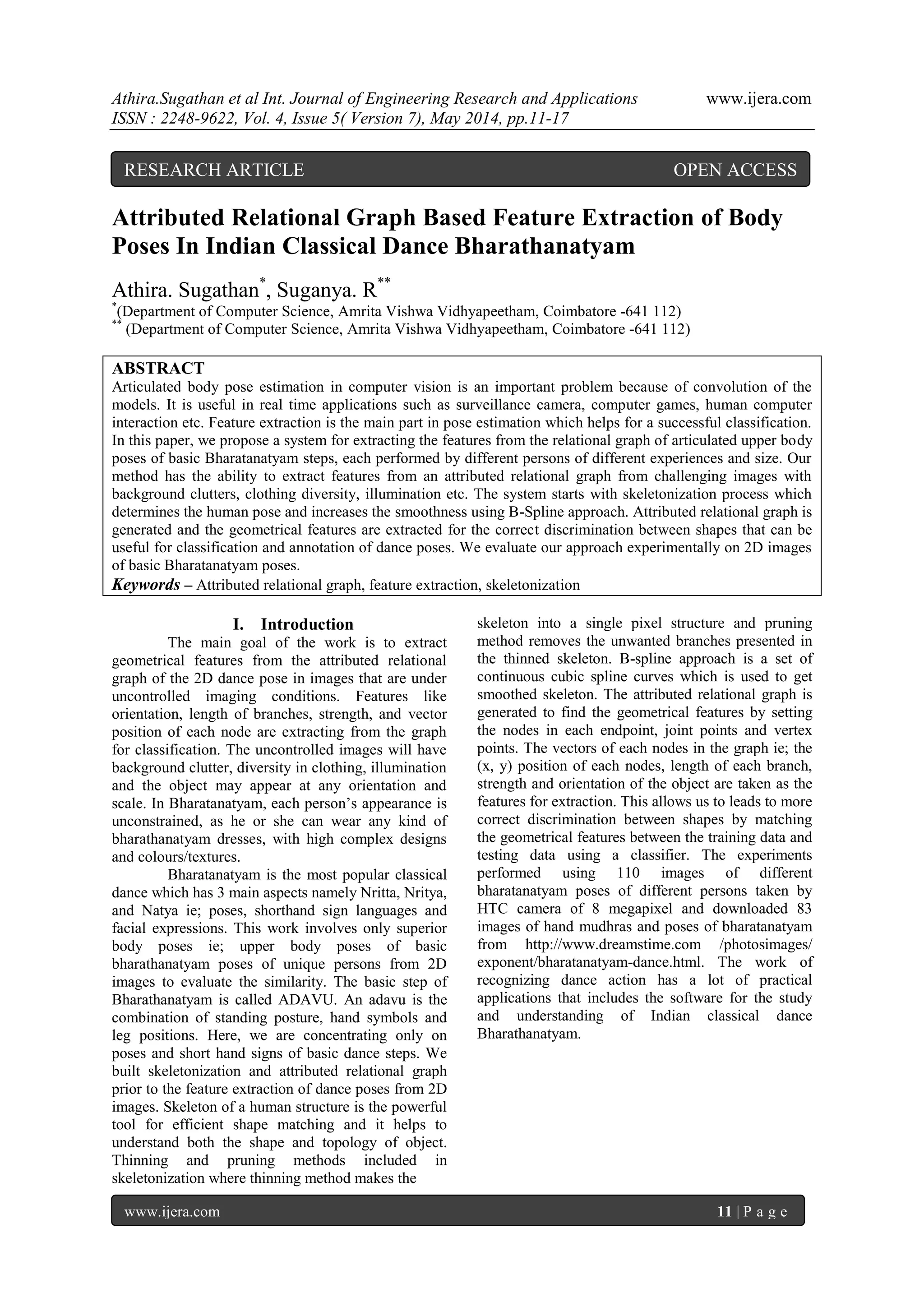
Fig.3.Input Image
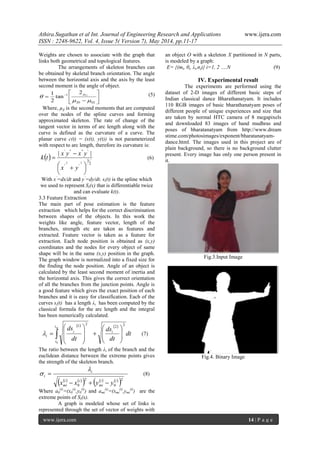
Fig.4. Binary Image
Athira.Sugathan et al Int. Journal of Engineering Research and Applications www.ijera.com
ISSN : 2248-9622, Vol. 4, Issue 5( Version 7), May 2014, pp.11-17
www.ijera.com 15 | P a g e
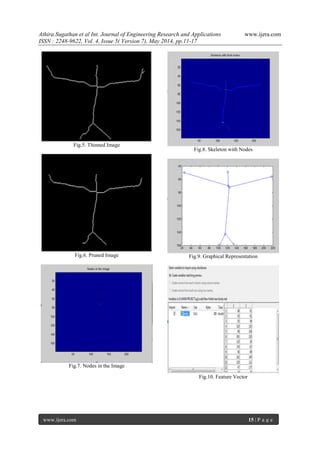
Fig.5. Thinned Image
Fig.6. Pruned Image
Fig.7. Nodes in the Image
Fig.8. Skeleton with Nodes
Fig.9. Graphical Representation
Fig.10. Feature Vector
Athira.Sugathan et al Int. Journal of Engineering Research and Applications www.ijera.com
ISSN : 2248-9622, Vol. 4, Issue 5( Version 7), May 2014, pp.11-17
www.ijera.com 16 | P a g e
Fig.11. Angle Feature Extraction
Fig.12. Length
Fig.13. Strength
V. Conclusion
In this work a method is proposed to
increase the quality of skeleton of human object in 2-
D images of Indian classical dance- Bharathanatyam.
A morphological skeleton of a binary image is
created to enhance the skeleton quality in order to
find more efficient features for classification. This
allows finding a graph model with more attributes. In
this method the skeleton characteristic points is
represented as an attributed relational graph to model
the skeleton. The future research will include finding
a more accurate graph model, allowing the
determination of more efficient attributes for the
nodes and the edges. Next work includes
classification and annotation of the poses and hand
mudhras where it can leads to an automatic
application for studying Bharathanatyam. In this
work the basic steps of unique person is considered
and evaluated.
References
[1] Apratim Sharma under the guidance of Dr.
Amitabha Mukerjee, ”Recognising
Bharatanatyam Dance Sequences using
RGB-D Data”, A Thesis Submitted in Partial
Fulfillment of the Requirements for the
Degree of Master of Technology from Indian
Institute of Technology,Kanpur,2013.
[2] Marcin Eichner and Vittorio Ferrari,
“Human Pose Co-Estimation and
Applications”, Proceedings of the IEEE
Transactions on Pattern Analysis and
Machine Intelligence, Vol. 34, No. 11,
November 2012 pp. 2282 – 2288.
[3] Bangpeng Yao and Li Fei-Fei, “Recognizing
Human-Object Interactions in Still Images
by Modeling the Mutual Context of Objects
and Human Poses”, Proceedings of the
IEEE Transaction on Pattern Analysis and
machine
intelligence,Vol.34,No.9,2012,pp.1691-
1703.
[4] Di Wu and Ling Shao, “Silhouette Analysis-
Based Action Recognition Via Exploiting
Human Poses,” Proceedings of the IEEE
transactions on circuits and systems for
video technology, vol. 23, no. 2, February
2013.
[5] M. Andriluka, S. Roth, and B. Schiele,
“Pictorial Structures Revisited, People
Detection and Articulated Pose
Estimation,” Proceedings of the IEEE
Conference of Computer Vision and Pattern
Recognition, 2009, Vol.pp.1014 - 1021.
[6] C. Di Ruberto, G.Rodriguez, “Recognition
of shapes by morphological attributed
relational graphs, ”Proceedings of the IEEE
Conference of Computer Vision and Pattern
Recognition,2004 ,37 ,1 ,Vol.pp.21-31.
[7] C. Di Ruberto and A.G. Dempster, “Attributed
skeleton graphs using mathematical
Athira.Sugathan et al Int. Journal of Engineering Research and Applications www.ijera.com
ISSN : 2248-9622, Vol. 4, Issue 5( Version 7), May 2014, pp.11-17
www.ijera.com 17 | P a g e
morphology”, Electronics Letters, vol.37
num.27 (2001) 1325–1327.
[8] C. Di Ruberto, “Matching and Recognition
of Shapes by Morphological Attributed
Relational Graphs”, submitted 2002.
[9] S. Gold and A. Rangarajan, “A graduated
assignment algorithm for graph matching”,
Proceedings of the IEEE Transaction on
Pattern Analysis and Machine Intelligence,
vol. 18 num. 4 (1996) 377–388.
[10] S. Gold and A. Rangarajan, “Graph
matching by graduated assignment”,
Proceedings of the IEEE Computer Society
Conference on Computer Vision and Pattern
Recognition 1996, IEEE Computer Society
(1996), 239–244.
[11] Yanshu Zhu, Feng Sun, Yi-King Choi, Bert,
Juettler, WenpingWang, “Spline
Approximation to Medial Axis”,
arXiv:1307.0118v1[cs.GR]29,June 2013.
[12] K.J Maccallum and J.M Zhang, “Curve-
Smoothing Techniques Using B-Splines”,
The Computer Journal, Vol.29, No.6, 1986.
[13] B. Jang and R.T. Chen, “Analysis of
thinning algorithms using mathematical
morphology”, IEEE Transaction on Pattern
Analysis and Machine Intelligence, vol. 12
num. 6 (1990) 541–551.
[14] Salim Jouili and Salvatore Tabbone, “Grap
Matching based on Node Signatures”,
published in "7th IAPR-TC-15 Workshop on
Graph-based Representations in Pattern
Recognition-GbRPR 2009 5534 (2009) 154-
163",pp154-163,SpringerVerlag Berlin,
Heidelberg ©2009.

C045071117

  • 1.
    Athira.Sugathan et alInt. Journal of Engineering Research and Applications www.ijera.com ISSN : 2248-9622, Vol. 4, Issue 5( Version 7), May 2014, pp.11-17 www.ijera.com 11 | P a g e Attributed Relational Graph Based Feature Extraction of Body Poses In Indian Classical Dance Bharathanatyam Athira. Sugathan* , Suganya. R** * (Department of Computer Science, Amrita Vishwa Vidhyapeetham, Coimbatore -641 112) ** (Department of Computer Science, Amrita Vishwa Vidhyapeetham, Coimbatore -641 112) ABSTRACT Articulated body pose estimation in computer vision is an important problem because of convolution of the models. It is useful in real time applications such as surveillance camera, computer games, human computer interaction etc. Feature extraction is the main part in pose estimation which helps for a successful classification. In this paper, we propose a system for extracting the features from the relational graph of articulated upper body poses of basic Bharatanatyam steps, each performed by different persons of different experiences and size. Our method has the ability to extract features from an attributed relational graph from challenging images with background clutters, clothing diversity, illumination etc. The system starts with skeletonization process which determines the human pose and increases the smoothness using B-Spline approach. Attributed relational graph is generated and the geometrical features are extracted for the correct discrimination between shapes that can be useful for classification and annotation of dance poses. We evaluate our approach experimentally on 2D images of basic Bharatanatyam poses. Keywords – Attributed relational graph, feature extraction, skeletonization I. Introduction The main goal of the work is to extract geometrical features from the attributed relational graph of the 2D dance pose in images that are under uncontrolled imaging conditions. Features like orientation, length of branches, strength, and vector position of each node are extracting from the graph for classification. The uncontrolled images will have background clutter, diversity in clothing, illumination and the object may appear at any orientation and scale. In Bharatanatyam, each person’s appearance is unconstrained, as he or she can wear any kind of bharathanatyam dresses, with high complex designs and colours/textures. Bharatanatyam is the most popular classical dance which has 3 main aspects namely Nritta, Nritya, and Natya ie; poses, shorthand sign languages and facial expressions. This work involves only superior body poses ie; upper body poses of basic bharathanatyam poses of unique persons from 2D images to evaluate the similarity. The basic step of Bharathanatyam is called ADAVU. An adavu is the combination of standing posture, hand symbols and leg positions. Here, we are concentrating only on poses and short hand signs of basic dance steps. We built skeletonization and attributed relational graph prior to the feature extraction of dance poses from 2D images. Skeleton of a human structure is the powerful tool for efficient shape matching and it helps to understand both the shape and topology of object. Thinning and pruning methods included in skeletonization where thinning method makes the skeleton into a single pixel structure and pruning method removes the unwanted branches presented in the thinned skeleton. B-spline approach is a set of continuous cubic spline curves which is used to get smoothed skeleton. The attributed relational graph is generated to find the geometrical features by setting the nodes in each endpoint, joint points and vertex points. The vectors of each nodes in the graph ie; the (x, y) position of each nodes, length of each branch, strength and orientation of the object are taken as the features for extraction. This allows us to leads to more correct discrimination between shapes by matching the geometrical features between the training data and testing data using a classifier. The experiments performed using 110 images of different bharatanatyam poses of different persons taken by HTC camera of 8 megapixel and downloaded 83 images of hand mudhras and poses of bharatanatyam from http://www.dreamstime.com /photosimages/ exponent/bharatanatyam-dance.html. The work of recognizing dance action has a lot of practical applications that includes the software for the study and understanding of Indian classical dance Bharathanatyam. RESEARCH ARTICLE OPEN ACCESS
  • 2.
    Athira.Sugathan et alInt. Journal of Engineering Research and Applications www.ijera.com ISSN : 2248-9622, Vol. 4, Issue 5( Version 7), May 2014, pp.11-17 www.ijera.com 12 | P a g e Fig.1.Basic pose The next sections include literature survey, proposed method and obtained results. In Section II we describe competitive approaches related to our methods. Section III presents details of our method, while Section IV presents the experimental results using input images. Also, we discuss some limitations and contributions of our work atlast. II. Literature Survey Apratim Sharma et al. [1] proposed a method to find the group of poses and classify the action sequences of Bharathanatyam steps in real time using kinect. Skeletonization of each pose is obtained and joint angles are computed based on the orientation of every joint in the form of rotation matrices based on its orientation and scale. Cluster all the poses and histogram of poses is used as a feature vector for classification. The methods used here are good in real-time kinect videos but not good in images. Marcin Eichner et al. [2] introduced Human Pose Co-estimation where many people in the image are in a common pose and estimate their poses jointly. This method demonstrated a weakly supervised learning of poses that is from images but not from manual annotations. Dictionary of poses can be generated from the annotated colored stickmen in the human body parts and each pose class is represented by its prototypes. Direct model is used in this method where it finds a single prototype and all local poses are equal to it. Bangpeng Yao et al. [3], proposed a method of object detection that provides better human pose estimation and human pose estimation improves the accuracy of detecting the objects by considering the mutual context. Poses are obtained by clustering the configurations of human body parts. First denote the annotation of human body parts in an image and then align the annotations. Use hierarchical clustering with the maximum linkage measure to obtain a set of clusters. This method describes the human object interaction and needs to annotate the human body parts and objects in each training image. In this work, weakly supervised or unsupervised approach to understand human-object interaction activities is not used. Ling Shao et al. [4] proposed a method for human action recognition from silhouettes that combines the advantages of both local and global representations. First, bounding box is normalized to reduce the dimension of each frame and remove the variations of translation and scale. The normalized silhouettes are used as the features in each frame by extending the set of features model. The 2D silhouette mask is converted to 1D mask from each feature vector by scanning it from top to bottom. So, each frame is represented as the binary element vector and the length is taken as the multiplication of both row and column. This is not an effective method to encode correlations of action descriptors. M. Andriluka et al. [5], proposed a method to develop a generic model for human detection and pose estimation that allows to detect highly articulated human body parts and to estimate their poses. A pictorial structure model is created and the parts are obtained using the part detector. The mean relative joint position is learned using maximum likelihood estimation. A fully connected graphical model for representing articulations which uses discriminative part detectors is proposed. C. Di Ruberto et al. [6], proposed a method to use the skeleton of objects in the images in computer vision and pattern recognition where the object features are needed for classification. Skeletonization method is used here to get a model of the graph that leads to more correct representation of shapes by an attributed graph matching algorithm. The features like joint positions, edge positions, length are taken as the features in this method. This work fails to get more accurate graph model and fails to get the better determination between shapes while attributed graph matching process. III. Proposed method The architecture of the system is shown in the figure 2. Fig.2.Proposed system architecture 3.1. Skeletonization Skeleton of a human structure is a good representation of human pose. The reason for obtaining the skeleton of an object is that it is easier
  • 3.
    Athira.Sugathan et alInt. Journal of Engineering Research and Applications www.ijera.com ISSN : 2248-9622, Vol. 4, Issue 5( Version 7), May 2014, pp.11-17 www.ijera.com 13 | P a g e to analyze than the original image and also maintaining the essential properties of the original image. Given an input binary image of poses and short hand signs (mudhras), skeletonization changes non-skeletal object pixels into background pixels. Different skeletonization techniques are used to get a skeleton. Some of them preserve topology while others preserve geometry of the original object. To accurately preserve both topology and geometry from 2-D images, thinning algorithm is used. 3.1.1 Thinning Algorithm Thinning algorithm preserves both topological and geometrical properties of object from 2D images. It retains the topology of the original object and forces the skeleton to be in the middle of the object and also preserves the end points of the original image. A morphological thinning operation is used here, which is used to remove the foreground pixels from binary images. It results in a single pixel line thick and connected skeleton of the input image which is useful for shape description. The input image is thinned with a series of structuring elements and the object is reduced to a set of one pixel width connected lines. The skeleton is considered as a connected graph therefore each vertex is considered as an endpoint or junction points and each edge is considered as curve points. The end points, junction points and curve points of skeleton are detected which is important for the structural description. Skeleton is obtained by translating the origin of the structuring element to each possible pixel position in the image and comparing it with the underlying image pixels. If foreground and background pixels in the structuring element exactly match the pixels in the image, pixel underneath the origin of the structuring element is set to the background. Otherwise, there is no change further. Image A is thinned by a structuring element B and it is defined in terms of the hit-or-miss transform: AⓩB = A− (A⊗B) = A∩ (A⊗B) c (1) Thinning of image A by a sequence of structuring elements: Aⓩ{B} = (... ((AⓩB1) ⓩB2)...) ⓩBn (2) The process is to thin A by structuring element B1, then thin the result with structuring element B2 and repeated until A is thinned with one pass of Bn. The entire process is repeated until no further changes occur. 3.1.2 Pruning Algorithm Pruning algorithm is an essential component for skeletonization after thinning. The skeleton of an object often contains both spurious and rough branches due to the boundary irregularities. To eliminate spurs on a skeleton a morphological pruning transformation is applied. It starts at the end points and recursively removes a given number of points from each branch proceeds until stability is reached. Assume that the length of the spur component is within a specific number of pixels. Proposed algorithm has a size E for the pruning is equal to 4% of the skeleton length. First partition the skeleton into branch parts by subtracting the junction points from it to eliminate only the branches with distance E from an end point. By using a morphological reconstruction method, remove the branches that containing end points only. Then remove all the branches containing lesser pixels than E. The remaining branches with junction points and the branches that were not reconstructed from end points are united and obtained a pruned skeleton. 3.1.3 Smoothened Skeleton In skeletal representation, to improve the smoothness and to reduce the amount of unwanted data, a set of continuous spline curves is used. It approximates the unnecessary branches of the original skeleton. Such a continuous representation allows us to compute the graph more easily and accurately. B-spline curves are piecewise polynomials that are defined by knots and points (ti , yi). In this work we used cubic spline curves with degree 3. Given the nodes ti and control points Vi the piecewise cubic B-spline curve is given by:     ii i VtBtS  3 (3) Here, Bi 3 is the piecewise cubic B-spline. The control points Vi have both x and y components, and the curve is defined as                        i i iiii i ii t y t x ytBxtBVtBSStS 333 ,, (4) The x and y components of the curve are separately multiplied by B-splines, and the resulting set of (x, y) points gives a curve. A B-spline curve actually needs more nodes than control points and it is not defined over the entire interval ],[ 1 mtt where m is the number of knots. Instead, for a cubic B- spline curve, the number of control points is m – 4, and the curve is defined over ]3,[ 4 mtt . 3.2 Attributed Graph Skeleton can be represented as graph with end points and junction points as vertices and branches as edges. An attributed relational graph is built and used as a structural object for classification by means of graph matching. Attributed graph has set of nodes which are union of end points and junction points and set of edges which are represented by skeleton branches. It is partitioned into number of skeletal branches Si(x),i=1,2…N. The graph is represented by adjacency matrices and for each relation type it have different adjacency matrix.
  • 4.
    Athira.Sugathan et alInt. Journal of Engineering Research and Applications www.ijera.com ISSN : 2248-9622, Vol. 4, Issue 5( Version 7), May 2014, pp.11-17 www.ijera.com 14 | P a g e Weights are chosen to associate with the graph that links both geometrical and topological features. The arrangements of skeleton branches can be obtained by skeletal branch orientation. The angle between the horizontal axis and the axis by the least second moment is the angle of object.          0220 1 11 2 tan 2 1    (5) Where, µij is the second moments that are computed over the nodes of the spline curves and forming approximated skeleton. The rate of change of the tangent vector in terms of arc length along with the curve is defined as the curvature of a curve. The planar curve c(t) = (x(t), y(t)) is not parameterized with respect to arc length, therefore its curvature is:   2 3 '' '''''' 22 ||         yx yxyx tk (6) With x’ =dx/dt and y’ =dy/dt. si(t) is the spline which we used to represent Si(x) that is differentiable twice and can evaluate k(t). 3.3 Feature Extraction The main part of pose estimation is the feature extraction which helps for the correct discrimination between shapes of the objects. In this work the weights like angle, feature vector, length of the branches, strength etc are taken as features and extracted. Feature vector is taken as a feature for extraction. Each node position is obtained as (x,y) coordinates and the nodes for every object of same shape will be in the same (x,y) position in the graph. The graph window is normalized into a fixed size for the finding the node position. Angle of an object is calculated by the least second moment of inertia and the horizontal axis. This gives the correct orientation of all the branches from the junction points. Angle is a good feature which gives the exact position of each branches and it is easy for classification. Each of the curves si(t) has a length λi has been computed by the classical formula for the arc length and the integral has been numerically calculated.     dt dt ds dt ds i t t i i ni 22 21 0                    (7) The ratio between the length λi of the branch and the euclidean distance between the extreme points gives the strength of the skeleton branch.            2 0 2 0 ii mi ii mi i i yyxx     (8) Where a0 (i) =(x0 (i) ,y0 (i) ) and ami (i) =(xmi (i) ,ymi (i) ) are the extreme points of Si(x). A graph is modeled whose set of links is represented through the set of vector of weights with an object O with a skeleton X partitioned in N parts, is modeled by a graph: E= {(mi, θi, λi,σi)} i=1, 2 ….N (9) IV. Experimental result The experiments are performed using the dataset of 2-D images of different basic steps of Indian classical dance Bharathanatyam. It includes 110 RGB images of basic bharathanatyam poses of different people of unique experiences and size that are taken by normal HTC camera of 8 megapixels and downloaded 83 images of hand mudhras and poses of bharatanatyam from http://www.dream stime.com/photosimages/exponent/bharatanatyam- dance.html. The images used in this project are of plain background, so there is no background clutter present. Every image has only one person present in it. Fig.3.Input Image Fig.4. Binary Image
  • 5.
    Athira.Sugathan et alInt. Journal of Engineering Research and Applications www.ijera.com ISSN : 2248-9622, Vol. 4, Issue 5( Version 7), May 2014, pp.11-17 www.ijera.com 15 | P a g e Fig.5. Thinned Image Fig.6. Pruned Image Fig.7. Nodes in the Image Fig.8. Skeleton with Nodes Fig.9. Graphical Representation Fig.10. Feature Vector
  • 6.
    Athira.Sugathan et alInt. Journal of Engineering Research and Applications www.ijera.com ISSN : 2248-9622, Vol. 4, Issue 5( Version 7), May 2014, pp.11-17 www.ijera.com 16 | P a g e Fig.11. Angle Feature Extraction Fig.12. Length Fig.13. Strength V. Conclusion In this work a method is proposed to increase the quality of skeleton of human object in 2- D images of Indian classical dance- Bharathanatyam. A morphological skeleton of a binary image is created to enhance the skeleton quality in order to find more efficient features for classification. This allows finding a graph model with more attributes. In this method the skeleton characteristic points is represented as an attributed relational graph to model the skeleton. The future research will include finding a more accurate graph model, allowing the determination of more efficient attributes for the nodes and the edges. Next work includes classification and annotation of the poses and hand mudhras where it can leads to an automatic application for studying Bharathanatyam. In this work the basic steps of unique person is considered and evaluated. References [1] Apratim Sharma under the guidance of Dr. Amitabha Mukerjee, ”Recognising Bharatanatyam Dance Sequences using RGB-D Data”, A Thesis Submitted in Partial Fulfillment of the Requirements for the Degree of Master of Technology from Indian Institute of Technology,Kanpur,2013. [2] Marcin Eichner and Vittorio Ferrari, “Human Pose Co-Estimation and Applications”, Proceedings of the IEEE Transactions on Pattern Analysis and Machine Intelligence, Vol. 34, No. 11, November 2012 pp. 2282 – 2288. [3] Bangpeng Yao and Li Fei-Fei, “Recognizing Human-Object Interactions in Still Images by Modeling the Mutual Context of Objects and Human Poses”, Proceedings of the IEEE Transaction on Pattern Analysis and machine intelligence,Vol.34,No.9,2012,pp.1691- 1703. [4] Di Wu and Ling Shao, “Silhouette Analysis- Based Action Recognition Via Exploiting Human Poses,” Proceedings of the IEEE transactions on circuits and systems for video technology, vol. 23, no. 2, February 2013. [5] M. Andriluka, S. Roth, and B. Schiele, “Pictorial Structures Revisited, People Detection and Articulated Pose Estimation,” Proceedings of the IEEE Conference of Computer Vision and Pattern Recognition, 2009, Vol.pp.1014 - 1021. [6] C. Di Ruberto, G.Rodriguez, “Recognition of shapes by morphological attributed relational graphs, ”Proceedings of the IEEE Conference of Computer Vision and Pattern Recognition,2004 ,37 ,1 ,Vol.pp.21-31. [7] C. Di Ruberto and A.G. Dempster, “Attributed skeleton graphs using mathematical
  • 7.
    Athira.Sugathan et alInt. Journal of Engineering Research and Applications www.ijera.com ISSN : 2248-9622, Vol. 4, Issue 5( Version 7), May 2014, pp.11-17 www.ijera.com 17 | P a g e morphology”, Electronics Letters, vol.37 num.27 (2001) 1325–1327. [8] C. Di Ruberto, “Matching and Recognition of Shapes by Morphological Attributed Relational Graphs”, submitted 2002. [9] S. Gold and A. Rangarajan, “A graduated assignment algorithm for graph matching”, Proceedings of the IEEE Transaction on Pattern Analysis and Machine Intelligence, vol. 18 num. 4 (1996) 377–388. [10] S. Gold and A. Rangarajan, “Graph matching by graduated assignment”, Proceedings of the IEEE Computer Society Conference on Computer Vision and Pattern Recognition 1996, IEEE Computer Society (1996), 239–244. [11] Yanshu Zhu, Feng Sun, Yi-King Choi, Bert, Juettler, WenpingWang, “Spline Approximation to Medial Axis”, arXiv:1307.0118v1[cs.GR]29,June 2013. [12] K.J Maccallum and J.M Zhang, “Curve- Smoothing Techniques Using B-Splines”, The Computer Journal, Vol.29, No.6, 1986. [13] B. Jang and R.T. Chen, “Analysis of thinning algorithms using mathematical morphology”, IEEE Transaction on Pattern Analysis and Machine Intelligence, vol. 12 num. 6 (1990) 541–551. [14] Salim Jouili and Salvatore Tabbone, “Grap Matching based on Node Signatures”, published in "7th IAPR-TC-15 Workshop on Graph-based Representations in Pattern Recognition-GbRPR 2009 5534 (2009) 154- 163",pp154-163,SpringerVerlag Berlin, Heidelberg ©2009.