CVs

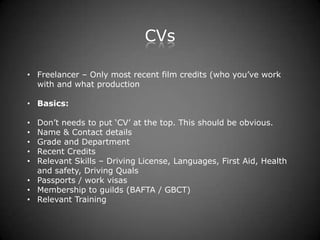
• Freelancer – Only most recent film credits (who you’ve work
  with and what production

• Basics:

• Don’t needs to put ‘CV’ at the top. This should be obvious.
• Name & Contact details
• Grade and Department
• Recent Credits
• Relevant Skills – Driving License, Languages, First Aid, Health
  and safety, Driving Quals
• Passports / work visas
• Membership to guilds (BAFTA / GBCT)
• Relevant Training
CVs
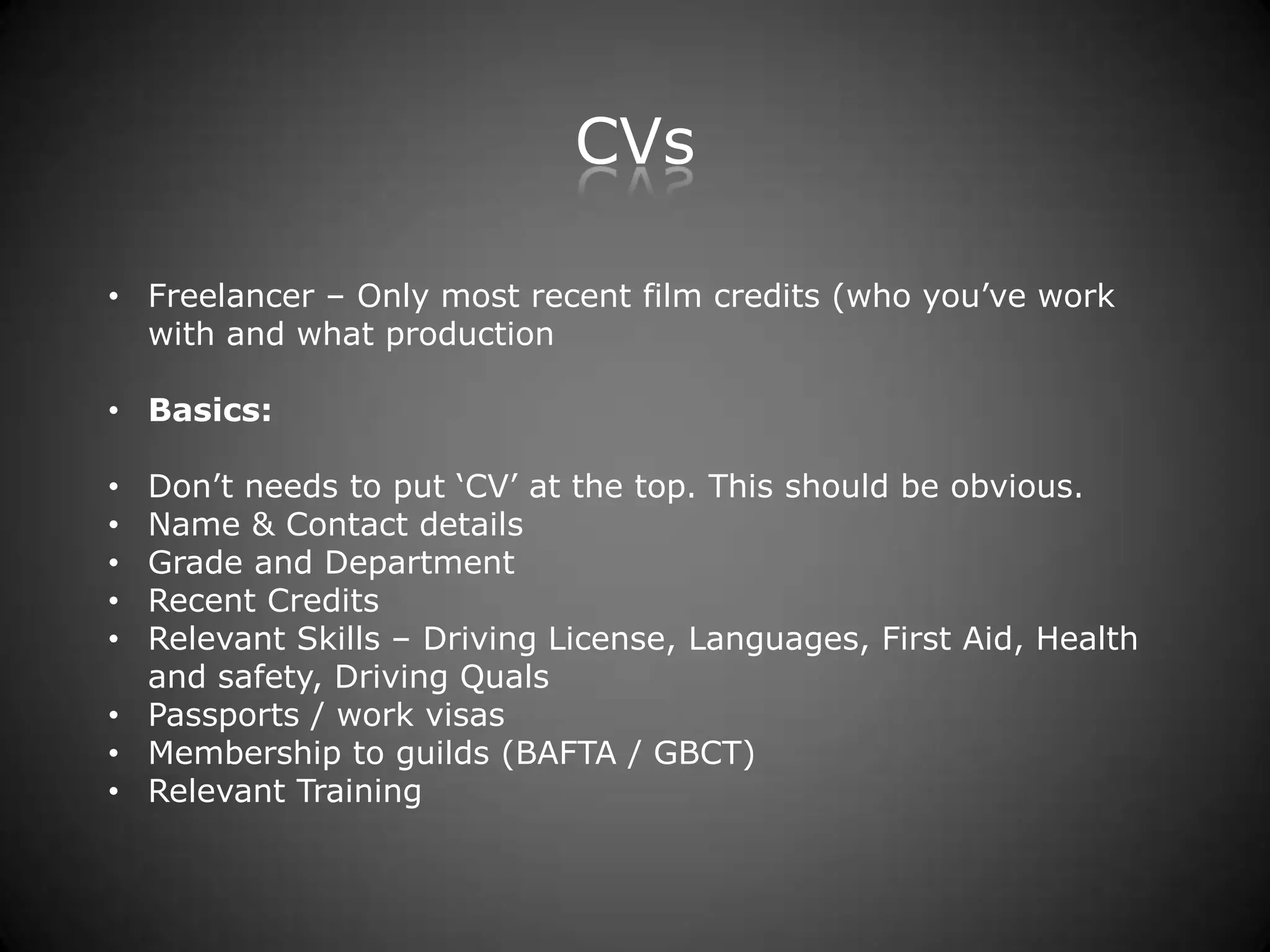
•   Make sure that your name, grade, department and contact numbers
    are clearly visible

•   Be honest about what you've done and the level you are at

•   Put credits in chronological order

•   If you don’t have credits, put down any relevant experience

•   Two pages max

•   Decent paper

•   Attach a covering letter

•   Make it relevant – always revisit a CV for every job you are applying
    for

•   If you’re sending a CV to someone who is not expecting it, either
    inform said person or apologies for unsolicited mail
Personal Statements
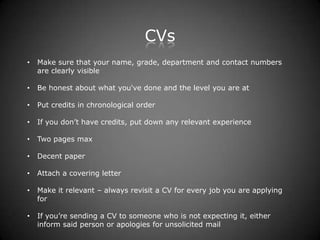
• Uni:


• Demonstrate your enthusiasm and commitment

• Explain why you want to study the course

• Might be used at the interview stage so remember the content

• Undergraduate Admissions Manager at Nottingham Uni: “These
  types of skills are the basics that academics will expect from
  someone at this level of education. Incorrect spelling, poor
  grammar and punctuation can make a poor impression on the
  reader. For courses such as English, these skills are of
  paramount importance.’

• Sentences no more than 20 words long
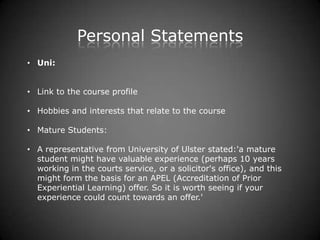
Personal Statements
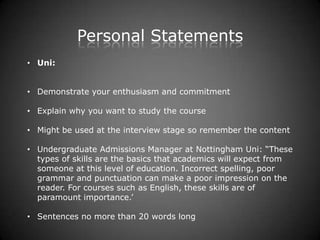
• Uni:


• Link to the course profile

• Hobbies and interests that relate to the course

• Mature Students:

• A representative from University of Ulster stated:'a mature
  student might have valuable experience (perhaps 10 years
  working in the courts service, or a solicitor's office), and this
  might form the basis for an APEL (Accreditation of Prior
  Experiential Learning) offer. So it is worth seeing if your
  experience could count towards an offer.'
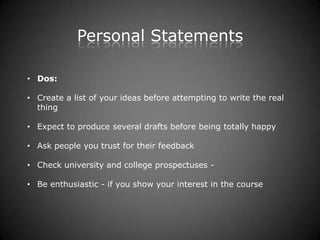
Personal Statements

• Dos:

• Create a list of your ideas before attempting to write the real
  thing

• Expect to produce several drafts before being totally happy

• Ask people you trust for their feedback

• Check university and college prospectuses -

• Be enthusiastic - if you show your interest in the course
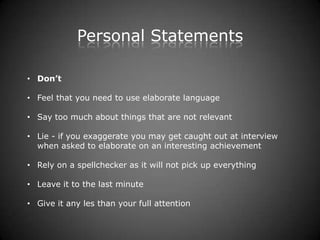
Personal Statements

• Don’t

• Feel that you need to use elaborate language

• Say too much about things that are not relevant

• Lie - if you exaggerate you may get caught out at interview
  when asked to elaborate on an interesting achievement

• Rely on a spellchecker as it will not pick up everything

• Leave it to the last minute

• Give it any les than your full attention
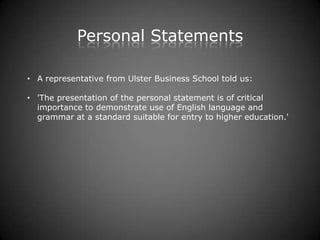
Personal Statements

• A representative from Ulster Business School told us:

• 'The presentation of the personal statement is of critical
  importance to demonstrate use of English language and
  grammar at a standard suitable for entry to higher education.'

CVs and Personal Statements (TV Y2)

  • 1.
    CVs • Freelancer –Only most recent film credits (who you’ve work with and what production • Basics: • Don’t needs to put ‘CV’ at the top. This should be obvious. • Name & Contact details • Grade and Department • Recent Credits • Relevant Skills – Driving License, Languages, First Aid, Health and safety, Driving Quals • Passports / work visas • Membership to guilds (BAFTA / GBCT) • Relevant Training
  • 2.
    CVs • Make sure that your name, grade, department and contact numbers are clearly visible • Be honest about what you've done and the level you are at • Put credits in chronological order • If you don’t have credits, put down any relevant experience • Two pages max • Decent paper • Attach a covering letter • Make it relevant – always revisit a CV for every job you are applying for • If you’re sending a CV to someone who is not expecting it, either inform said person or apologies for unsolicited mail
  • 3.
    Personal Statements • Uni: •Demonstrate your enthusiasm and commitment • Explain why you want to study the course • Might be used at the interview stage so remember the content • Undergraduate Admissions Manager at Nottingham Uni: “These types of skills are the basics that academics will expect from someone at this level of education. Incorrect spelling, poor grammar and punctuation can make a poor impression on the reader. For courses such as English, these skills are of paramount importance.’ • Sentences no more than 20 words long
  • 4.
    Personal Statements • Uni: •Link to the course profile • Hobbies and interests that relate to the course • Mature Students: • A representative from University of Ulster stated:'a mature student might have valuable experience (perhaps 10 years working in the courts service, or a solicitor's office), and this might form the basis for an APEL (Accreditation of Prior Experiential Learning) offer. So it is worth seeing if your experience could count towards an offer.'
  • 5.
    Personal Statements • Dos: •Create a list of your ideas before attempting to write the real thing • Expect to produce several drafts before being totally happy • Ask people you trust for their feedback • Check university and college prospectuses - • Be enthusiastic - if you show your interest in the course
  • 6.
    Personal Statements • Don’t •Feel that you need to use elaborate language • Say too much about things that are not relevant • Lie - if you exaggerate you may get caught out at interview when asked to elaborate on an interesting achievement • Rely on a spellchecker as it will not pick up everything • Leave it to the last minute • Give it any les than your full attention
  • 7.
    Personal Statements • Arepresentative from Ulster Business School told us: • 'The presentation of the personal statement is of critical importance to demonstrate use of English language and grammar at a standard suitable for entry to higher education.'