INTRODUCTION TO C++
Presented By- HARSHSHARMA
 Introduction to C++
 General Formof C++
 C++ Keywords
 C++ Identifiers
 C++ Comments
 C++ Compiler Directives
 Programming Style
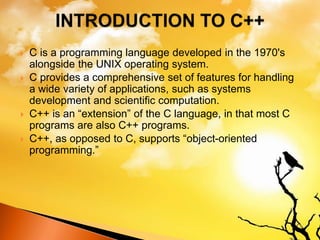
 C is a programming language developed in the 1970's
alongside the UNIX operating system.
 C provides a comprehensive set of features for handling
a wide variety of applications, such as systems
development and scientific computation.
 C++ is an “extension” of the C language, in that most C
programs are also C++ programs.
 C++, as opposed to C, supports “object-oriented
programming.”
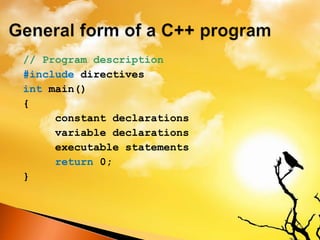
// Program description
#include directives
int main()
{
constant declarations
variable declarations
executable statements
return 0;
}
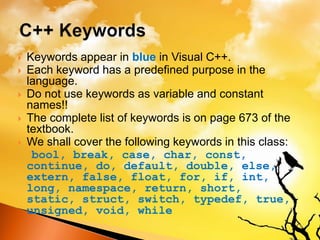
 Keywords appear in blue in Visual C++.
 Each keyword has a predefined purpose in the
language.
 Do not use keywords as variable and constant
names!!
 The complete list of keywords is on page 673 of the
textbook.
 We shall cover the following keywords in this class:
bool, break, case, char, const,
continue, do, default, double, else,
extern, false, float, for, if, int,
long, namespace, return, short,
static, struct, switch, typedef, true,
unsigned, void, while
 Peter: Hey Frank, I just learned how to add two numbers together.
 Frank: Cool!
 Peter : Give me the first number.
 Frank: 2.
 Peter : Ok, and give me the second number.
 Frank: 5.
 Peter : Ok, here's the answer: 2 + 5 = 7.
 Frank: Wow! You are amazing!
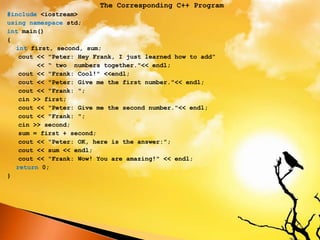
The Corresponding C++ Program
#include <iostream>
using namespace std;
int main()
{
int first, second, sum;
cout << "Peter: Hey Frank, I just learned how to add”
<< “ two numbers together."<< endl;
cout << "Frank: Cool!" <<endl;
cout << "Peter: Give me the first number."<< endl;
cout << "Frank: ";
cin >> first;
cout << "Peter: Give me the second number."<< endl;
cout << "Frank: ";
cin >> second;
sum = first + second;
cout << "Peter: OK, here is the answer:";
cout << sum << endl;
cout << "Frank: Wow! You are amazing!" << endl;
return 0;
}
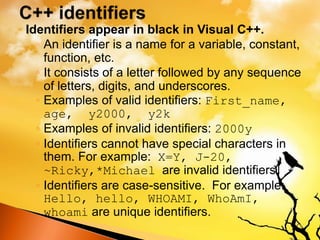
Identifiers appear in black in Visual C++.
◦ An identifier is a name for a variable, constant,
function, etc.
◦ It consists of a letter followed by any sequence
of letters, digits, and underscores.
◦ Examples of valid identifiers: First_name,
age, y2000, y2k
◦ Examples of invalid identifiers: 2000y
◦ Identifiers cannot have special characters in
them. For example: X=Y, J-20,
~Ricky,*Michael are invalid identifiers.
◦ Identifiers are case-sensitive. For example:
Hello, hello, WHOAMI, WhoAmI,
whoami are unique identifiers.
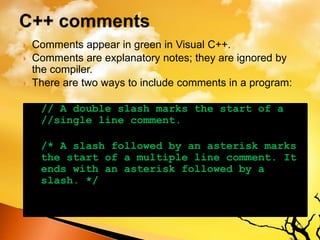
 Comments appear in green in Visual C++.
 Comments are explanatory notes; they are ignored by
the compiler.
 There are two ways to include comments in a program:
// A double slash marks the start of a
//single line comment.
/* A slash followed by an asterisk marks
the start of a multiple line comment. It
ends with an asterisk followed by a
slash. */
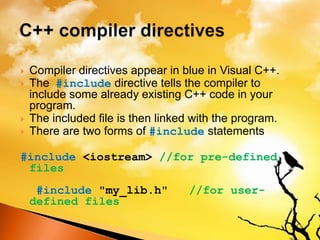
 Compiler directives appear in blue in Visual C++.
 The #include directive tells the compiler to
include some already existing C++ code in your
program.
 The included file is then linked with the program.
 There are two forms of #include statements:
#include <iostream> //for pre-defined
files
#include "my_lib.h" //for user-
defined files
C++ is a free-format language, which means that:
 Extra blanks (spaces) or tabs before or after
identifiers/operators are ignored.
 Blank lines are ignored by the compiler just like
comments.
 Code can be indented in any way.
 There can be more than one statement on a single line.
 A single statement can continue over several lines.
In order to improve the readability of your program, use
the following conventions:
 Start the program with a header that tells what the
program does.
 Use meaningful variable names.
 Document each variable declaration with a comment
telling what the variable is used for.

C Programming- Harsh Sharma

  • 1.
  • 2.
     Introduction toC++  General Formof C++  C++ Keywords  C++ Identifiers  C++ Comments  C++ Compiler Directives  Programming Style
  • 3.
     C isa programming language developed in the 1970's alongside the UNIX operating system.  C provides a comprehensive set of features for handling a wide variety of applications, such as systems development and scientific computation.  C++ is an “extension” of the C language, in that most C programs are also C++ programs.  C++, as opposed to C, supports “object-oriented programming.”
  • 4.
    // Program description #includedirectives int main() { constant declarations variable declarations executable statements return 0; }
  • 5.
     Keywords appearin blue in Visual C++.  Each keyword has a predefined purpose in the language.  Do not use keywords as variable and constant names!!  The complete list of keywords is on page 673 of the textbook.  We shall cover the following keywords in this class: bool, break, case, char, const, continue, do, default, double, else, extern, false, float, for, if, int, long, namespace, return, short, static, struct, switch, typedef, true, unsigned, void, while
  • 6.
     Peter: HeyFrank, I just learned how to add two numbers together.  Frank: Cool!  Peter : Give me the first number.  Frank: 2.  Peter : Ok, and give me the second number.  Frank: 5.  Peter : Ok, here's the answer: 2 + 5 = 7.  Frank: Wow! You are amazing!
  • 7.
    The Corresponding C++Program #include <iostream> using namespace std; int main() { int first, second, sum; cout << "Peter: Hey Frank, I just learned how to add” << “ two numbers together."<< endl; cout << "Frank: Cool!" <<endl; cout << "Peter: Give me the first number."<< endl; cout << "Frank: "; cin >> first; cout << "Peter: Give me the second number."<< endl; cout << "Frank: "; cin >> second; sum = first + second; cout << "Peter: OK, here is the answer:"; cout << sum << endl; cout << "Frank: Wow! You are amazing!" << endl; return 0; }
  • 8.
    Identifiers appear inblack in Visual C++. ◦ An identifier is a name for a variable, constant, function, etc. ◦ It consists of a letter followed by any sequence of letters, digits, and underscores. ◦ Examples of valid identifiers: First_name, age, y2000, y2k ◦ Examples of invalid identifiers: 2000y ◦ Identifiers cannot have special characters in them. For example: X=Y, J-20, ~Ricky,*Michael are invalid identifiers. ◦ Identifiers are case-sensitive. For example: Hello, hello, WHOAMI, WhoAmI, whoami are unique identifiers.
  • 9.
     Comments appearin green in Visual C++.  Comments are explanatory notes; they are ignored by the compiler.  There are two ways to include comments in a program: // A double slash marks the start of a //single line comment. /* A slash followed by an asterisk marks the start of a multiple line comment. It ends with an asterisk followed by a slash. */
  • 10.
     Compiler directivesappear in blue in Visual C++.  The #include directive tells the compiler to include some already existing C++ code in your program.  The included file is then linked with the program.  There are two forms of #include statements: #include <iostream> //for pre-defined files #include "my_lib.h" //for user- defined files
  • 11.
    C++ is afree-format language, which means that:  Extra blanks (spaces) or tabs before or after identifiers/operators are ignored.  Blank lines are ignored by the compiler just like comments.  Code can be indented in any way.  There can be more than one statement on a single line.  A single statement can continue over several lines.
  • 12.
    In order toimprove the readability of your program, use the following conventions:  Start the program with a header that tells what the program does.  Use meaningful variable names.  Document each variable declaration with a comment telling what the variable is used for.