DR NIJALINGAPPA 
FELLOW IN RADIOLOGY 
TNMC AND NAIR HOSPITAL 
MUMBAI
 Neurovascular compression syndrome 
(NVCS) refers to a group of disorders in 
which an aberrant or tortuous vessel 
causes nerve compression with 
subsequent hyperexcitation and 
neuropathy.
 Vascular compression syndrome has 
been described as a causative etiology 
for cranial nerves III, V, VII, VIII, and IX. 
 Controversy exists, however, because of 
the normal intimate apposition of nerves 
and vasculature around the brainstem 
and the frequency with which it is seen in 
asymptomatic patients.
 largest (thickest) cranial nerve 
 The roots emerge from the lateral mid-pons and travel 
anteriorly through the pre-pontine cistern. 
 Enters middle cranial fossa by passing beneath 
tentorium at the apex of the petrous temporal bone 
& passes through an opening in the dura called the 
porus trigeminus to enter the Meckel’s (trigeminal) 
cave.
Trigeminal nerve course and branches
 Meckel (trigeminal) cave is a CSF-containing pouch 
in the middle cranial fossa which is continuous with 
the pre-pontine sub-archnoid space. 
 Pia covers the CN 5 in Meckel’s cave. 
 Because the trigeminal nerve is large and its course 
proceeds straight forward from the lateral pons, it is 
easy to recognize on most MR images.
Trigeminal nerve. 
FIESTA MR image shows the sensory (arrowhead) and motor (large 
arrow) roots of the trigeminal nerve where they cross the prepontine 
cistern and enter the Meckel cave (small arrows).
 In the Meckel cave, the nerve forms a mesh-like 
web that can be visualized only with high-resolution 
imaging. 
 Along the anterior aspect of the cavity, the 
trigeminal nerve forms the trigeminal (Gasserian / 
Semilunar) ganglion before splitting into three 
subdivisions. 
Imaging pitfall – 
 Trigeminal ganglion lacks blood-nerve barrier, so 
normally enhances in post contrast images.
 The ophthalmic (V1) and maxillary (V2) divisions of 
the nerve move medially into the cavernous sinus 
and exit the skull through the superior orbital fissure 
and foramen rotundum, respectively. 
 The mandibular division (V3), which includes the 
motor branches, exits the skull inferiorly through the 
foramen ovale.
Trigeminal nerve. 
FIESTA image at the level of the Meckel cave shows the complex web of 
trigeminal nerve branches (arrows), which coalesce anteriorly to form the 
Gasserian ganglion.
 Sagittal T2 MR along line of proximal trigeminal nerve shows the 
preganglionic segment between the root entry zone in the 
lateral pons and the trigeminal ganglion in the anteroinferior 
Meckel cave. 
 The cerebrospinal fluid within Meckel cave communicates with 
prepontine cistern through the porus trigeminus.
 abrupt unilateral shock like facial pain localized to 
the sensory supply areas of the trigeminal nerve 
(CNV) lasting seconds to minutes.
 Slight female predominance 
› Female 5.9 per 100,000 
› Male 3.4 per 100,000 
› More than 70% of patients with TN are over 
50 years of age at the time onset 
 Right side affected slightly more often 
 Occasional familial occurrences 
 Slightly elevated risk associated with HTN 
and multiple sclerosis
 The most frequent cause of TN is a mechanical 
irritation of the nerve caused by neurovascular 
contact—the neurovascular compression 
syndrome (NVCS) 
 It is widely believed that compression at 
vulnerable sites only—those in the so-called root 
entry or exit zone of the nerve—causes NVCS. 
 Most investigators define the root entry or exit 
zone as the region extending from the nerve’s 
point of entry into or exit from the brainstem to 
the point of transition from the central myelin 
(derived from the oligodendroglia) to the 
peripheral myelin (derived from Schwann cells)
 Demyelination of the sensory fibers of 
the CNV due to neurovascular 
compression at the root entry or exit 
zone is widely regarded as the 
underlying pathomechanism 
 others being multiple sclerosis / 
neoplasms / other space occupying 
lesions in the vicinity.
Anterior inferior cerebellar artery, a branch 
of the same, vertebral artery, superior 
cerebellar arteries are usually responsible 
for this syndrome. 
Commonest area of the 
contact is 
root entry zone 
of preganglionic segment 
of the trigeminal nerve.
 The reference-standard treatment for 
refractive TN caused by NVCS is 
microvascular decompression. 
 Preoperatively, high-spatial-resolution 
magnetic resonance (MR) imaging is 
performed to detect the neurovascular 
contact and exclude other causes of TN.
 MRI along with MRA is considered as an 
ideal modality for delineation of the 
vessels. 
 MR constructive interference in steady 
state (CISS) 3D and 
 arterial magnetic resonance 
angiography time of flight 3D(MRA TOF)
 While interpreting the imaging data, one 
has to take into account that a 
neurovascular contact can also be 
present in the form of an anatomic 
variant in healthy subjects or on the 
unaffected side in patients with TN
 The following MRI classification system for 
neurovascular compression has been 
proposed to aid in surgical planning. 
 - Type I: Point compression where a limited 
segment of the nerve is in contact with the 
vessel. 
 - Type II: Longitudinal compression in which 
the nerve and vessel traverse parallel to each 
other. 
 - Type III: A vascular loop encircling the nerve. 
 - Type IV: The nerve contour is deformed 
and/or thinned.
 Grooving, distortion, or deviation of the 
trigeminal root, which has been reported 
to be more specific for idiopathic 
trigeminal neuralgia
 In E Lang et al, study ,, 
 Vessel–TREZ contact was categorised as 
‘‘true positive’’ if a contact between an 
artery or a vein and the TREZ was 
observed on the symptomatic side. 
 Vessel–TREZ contact was categorised as 
‘‘true negative’’ if no contact was 
observed between an artery or a vein 
and the TREZ on the asymptomatic side
 Axial (a) fast imaging employing steady-state image and (b) contrast-enhanced 
MR angiographic maximum intensity projection of prepontine 
fossa in 43-year-old woman show TN involving second branch of CNV. 
Another, less obvious example of neurovascular conflict is shown in right CNV 
(short arrow). Arterial loop of superior cerebellar artery (long arrow) crosses 
right CNV in middle of cisternal course. Neurovascular conflict was confirmed 
with surgery. Basilar artery (*) is seen in a.
•Images in a 63-year-old man with trigeminal neuralgia, with 
NVC caused by the superior cerebellar artery. 
•Two adjacent transverse 3D CISS MR images show that the 
superior cerebellar artery (short arrow) has compressed the REZ 
of the right trigeminal nerve (long arrow) at the medial site.
 The average diameter of the unaffected 
trigeminal nerve has been estimated on 
transverse MR images to be 4 mm, with the 
range being 2–6 mm . 
 In the majority of cases, there is atrophy of the 
nerve tissue which is secondary to chronic 
compression of the nerve by aging and 
tortuous vessels along the course of the nerve 
after its point of exit from the brainstem. 
 Up to 42% of symptomatic nerves have gross 
atrophy.
Trigeminal neuralgia. 
Male patient with left facial pain. Axial FIESTA image (A) and sagittal 
reconstruction (B) show that the root entry zone of the left trigeminal 
nerve is thinned and displaced by an adjacent vessel (thick white 
arrow points to the nerve and thin white arrow points to the vessel)
Juergen Lutz et al 
FA was significantly lower (P = .004) on the 
trigeminal neuralgia-affected side 
(mean FA, 0.203) than on the 
contralateral side (mean FA, 0.239).
 Paulo Roberto Lacerda Leal ,et al
C. Herweh,et al 
 Reversibility of abnormally low FA values 
was demonstrated in one patient 
successfully treated with microvascular 
decompression. 
 controls did not show a difference 
between both sides,
These findings indicate that diffusion-tensor 
imaging FA measurement enables in 
vivo visualization of the microstructural 
changes of the CNV in these patients 
Degeneration of white matter tracts 
results in a reduction in FA due to a loss of 
the directionality of diffusion and 
An increase in ADC that are due to 
diffusivity being averaged in all spatial 
directions as a result of the loss of myelin 
and axonal membranes
 Trigeminal tractography accurately 
detected the radiosurgical target. 
 Radiosurgery resulted in 47% drop in FA 
values at the target with no significant 
change in FA outside the target, 
demonstrating highly focal changes 
after treatment.
Tractography outlines detailed FA changes in the trigeminal nerve after GKRS treatment. 
Panels A–D depict the trigeminal nerve tracts pre and post-treatment for 
subjects S1(A,B) and S2 (C,D). 
The area between the yellow and blue arrows delineates the cisternal 
segment, with the yellow arrow being proximal to the brainstem and the blue 
arrow distal. The red arrow denotes the target area, which corresponds to the 
region where the greatest change in FA was observed. In S1, FA change affects 
primarily the outlying fibers of the nerve, while for S2, FA changes are seen in the 
inferior portion of the cisternal segment of the trigeminal nerve.
 Tractography was more sensitive 
than conventional gadolinium-enhanced 
post-treatment MR, 
since FA changes were detected 
regardless of trigeminal nerve 
enhancement. 
 In subjects with long term follow-up, 
recovery of FA/RD correlated with pain 
recurrence.
Figure 5. Tractography can detect changes in the trigeminal nerve in the absence of post-treatment 
gadolinium enhancement: Panels A to E delineate FA changes seen after treatment. 
Subject S2 did not show post-treatment MR gadolinium enhancement. 
Panel A shows location of radiosurgical target during treatment planning. 
Panels B, C depict post-treatment MR and lack of gadolinium-enhancement 
(yellow arrowhead). Reconstructed trigeminal tracts are 
shown in panel D (pre-treatment) and E (post-treatment), with clear FA 
changes in the target area (blue arrowhead).
 The facial and vestibulocochlear nerves have similar 
cisternal and canalicular courses . 
 They both emerge from the lateral aspect of the 
lower border of the pons and traverse the 
cerebellopontine angle cistern at an oblique angle. 
 There, they may be in close proximity to the anterior 
inferior cerebellar artery.
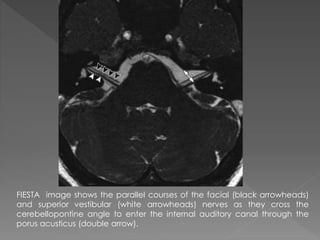
FIESTA image shows the parallel courses of the facial (black arrowheads) 
and superior vestibular (white arrowheads) nerves as they cross the 
cerebellopontine angle to enter the internal auditory canal through the 
porus acusticus (double arrow).
Facial & vestibulocochlear nerves 
Facial nerve is anterior & superior to vestibulocochlear nerve within CPA& lAC. 
The anteroinferior cerebellar artery loop is a constant fixture in the normal 
anatomy of the CPA & lAC area.
 Vestibulocochlear NVCS is symptomatic 
vascular compression of cranial nerve 
VIII. 
 Clinical symptoms are often non-specific 
including tinnitus, vertigo, and 
sensineural hearing loss. 
 In decreasing order of frequency, vessels 
indicated in NVCS include the anterior 
inferior cerebellar artery, posterior inferior 
cerebellar artery, and vertebral artery.
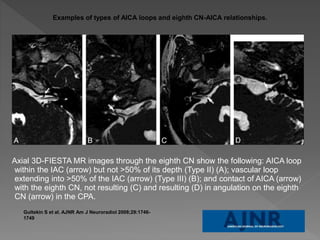
 type I, lying only in the CPA but not 
entering the internal auditory canal 
(IAC); 
 type II, entering but not extending >50% 
of the length of the IAC and 
 type III, extending >50% of the IAC
Examples of types of AICA loops and eighth CN-AICA relationships. 
Axial 3D-FIESTA MR images through the eighth CN show the following: AICA loop 
within the IAC (arrow) but not >50% of its depth (Type II) (A); vascular loop 
extending into >50% of the IAC (arrow) (Type III) (B); and contact of AICA (arrow) 
with the eighth CN, not resulting (C) and resulting (D) in angulation on the eighth 
CN (arrow) in the CPA. 
Gultekin S et al. AJNR Am J Neuroradiol 2008;29:1746- 
1749
Glossopharyngeal 
nerve emerges from the 
lateral medulla into the 
lateral 
cerebellomedullary 
cistern, above the 
vagus nerve and at the 
level of the facial 
nerve. 
The vagus 
nerve comprises two 
roots that emerge 
from the side of the 
medulla, from a 
groove called the 
posterolateral sulcus.
The glossopharyngeal nerve (CN9), vagus nerve (CNl0) and bulbar accessory 
nerve (CNll) all exit the medulla laterally 
CN9 is the most cephalad of these. With routine MR imaging it is not possible to see 
these three cranial nerves individually. 
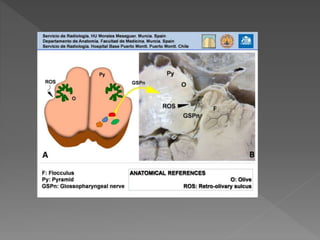
In the upper medulla the vagus nerve is well seen leaving the brainstem via the 
postolivary sulcus. The glossopharyngeal nerve is seen more laterally as it has 
already exited the brainstem above the vagus nerve.
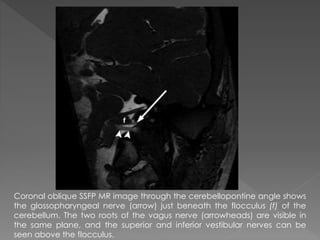
Coronal oblique SSFP MR image through the cerebellopontine angle shows 
the glossopharyngeal nerve (arrow) just beneath the flocculus (f) of the 
cerebellum. The two roots of the vagus nerve (arrowheads) are visible in 
the same plane, and the superior and inferior vestibular nerves can be 
seen above the flocculus.
 Glossopharyngeal neuralgia, or 
vagoglossopharyngeal neuralgia, is a 
cranial nerve hyperactivity pain 
syndrome leading to severe, transient, 
sharp pain in the ear, base of the 
tongue, tonsillar fossa, or beneath the 
angle of the jaw corresponding to the 
distributions of the auricular and 
pharyngeal branches of cranial nerves IX 
and X.
The presence of neurovascular contact on either side of 
the brain stem was evaluated by using the following 
criteria: 
 Upper and lower borders of the root-entry zone were 
determined by uppermost and lowest fibers of the 
IX/X nerve bundle entering the medulla. 
 The anterior border of the root-entry zone was 
defined as the transition of the olivary convexity to 
the concavity of the retro-olivary sulcus, 
 and the posterolateral border was located at the 
junction of parenchymal brain tissue to individual 
nerve fibers
 most common offending vessel has been 
reported to be the 
 posterior inferior cerebellar artery (PICA), 
 followed by the vertebral artery, 
 the anterior inferior cerebellar artery (AICA), 
 and other vessels or combinations of vessels
Axial CISS (A) and axial fast imaging 
with steady-state precession 
source images (B) are shown. 
The left IX/X nerve bundle is clearly 
visible (large white arrowhead on left 
side, A). 
Left vertebral artery is marked by black 
arrow (A), and 
anterior border of retro-olivary sulcus is 
marked by white arrow (B). 
Left descending posterior inferior 
cerebellar artery (PICA)impinges 
on the retroolivary sulcus, as 
indicated by small black (A) and white 
(B)arrowheads.
Axial CISS, axial fast 
imaging with steady-state 
precession source 
images, and 3D MIP. 
there is dominating left 
vertebral artery with sharp 
angle at level of 
pontomedullary junction 
(white arrow, C). 
Left vertebral artery 
shows brain stem contact 
within left retro-olivary 
sulcus (black arrow A; 
white arrow, B). 
Thin white arrow in panel 
A indicates nerve bundle.

Imaging in Neurovascular conflicts [Neurovascular compression syndrome ]

  • 1.
    DR NIJALINGAPPA FELLOWIN RADIOLOGY TNMC AND NAIR HOSPITAL MUMBAI
  • 2.
     Neurovascular compressionsyndrome (NVCS) refers to a group of disorders in which an aberrant or tortuous vessel causes nerve compression with subsequent hyperexcitation and neuropathy.
  • 3.
     Vascular compressionsyndrome has been described as a causative etiology for cranial nerves III, V, VII, VIII, and IX.  Controversy exists, however, because of the normal intimate apposition of nerves and vasculature around the brainstem and the frequency with which it is seen in asymptomatic patients.
  • 4.
     largest (thickest)cranial nerve  The roots emerge from the lateral mid-pons and travel anteriorly through the pre-pontine cistern.  Enters middle cranial fossa by passing beneath tentorium at the apex of the petrous temporal bone & passes through an opening in the dura called the porus trigeminus to enter the Meckel’s (trigeminal) cave.
  • 5.
  • 6.
     Meckel (trigeminal)cave is a CSF-containing pouch in the middle cranial fossa which is continuous with the pre-pontine sub-archnoid space.  Pia covers the CN 5 in Meckel’s cave.  Because the trigeminal nerve is large and its course proceeds straight forward from the lateral pons, it is easy to recognize on most MR images.
  • 7.
    Trigeminal nerve. FIESTAMR image shows the sensory (arrowhead) and motor (large arrow) roots of the trigeminal nerve where they cross the prepontine cistern and enter the Meckel cave (small arrows).
  • 8.
     In theMeckel cave, the nerve forms a mesh-like web that can be visualized only with high-resolution imaging.  Along the anterior aspect of the cavity, the trigeminal nerve forms the trigeminal (Gasserian / Semilunar) ganglion before splitting into three subdivisions. Imaging pitfall –  Trigeminal ganglion lacks blood-nerve barrier, so normally enhances in post contrast images.
  • 9.
     The ophthalmic(V1) and maxillary (V2) divisions of the nerve move medially into the cavernous sinus and exit the skull through the superior orbital fissure and foramen rotundum, respectively.  The mandibular division (V3), which includes the motor branches, exits the skull inferiorly through the foramen ovale.
  • 10.
    Trigeminal nerve. FIESTAimage at the level of the Meckel cave shows the complex web of trigeminal nerve branches (arrows), which coalesce anteriorly to form the Gasserian ganglion.
  • 12.
     Sagittal T2MR along line of proximal trigeminal nerve shows the preganglionic segment between the root entry zone in the lateral pons and the trigeminal ganglion in the anteroinferior Meckel cave.  The cerebrospinal fluid within Meckel cave communicates with prepontine cistern through the porus trigeminus.
  • 13.
     abrupt unilateralshock like facial pain localized to the sensory supply areas of the trigeminal nerve (CNV) lasting seconds to minutes.
  • 14.
     Slight femalepredominance › Female 5.9 per 100,000 › Male 3.4 per 100,000 › More than 70% of patients with TN are over 50 years of age at the time onset  Right side affected slightly more often  Occasional familial occurrences  Slightly elevated risk associated with HTN and multiple sclerosis
  • 15.
     The mostfrequent cause of TN is a mechanical irritation of the nerve caused by neurovascular contact—the neurovascular compression syndrome (NVCS)  It is widely believed that compression at vulnerable sites only—those in the so-called root entry or exit zone of the nerve—causes NVCS.  Most investigators define the root entry or exit zone as the region extending from the nerve’s point of entry into or exit from the brainstem to the point of transition from the central myelin (derived from the oligodendroglia) to the peripheral myelin (derived from Schwann cells)
  • 18.
     Demyelination ofthe sensory fibers of the CNV due to neurovascular compression at the root entry or exit zone is widely regarded as the underlying pathomechanism  others being multiple sclerosis / neoplasms / other space occupying lesions in the vicinity.
  • 19.
    Anterior inferior cerebellarartery, a branch of the same, vertebral artery, superior cerebellar arteries are usually responsible for this syndrome. Commonest area of the contact is root entry zone of preganglionic segment of the trigeminal nerve.
  • 20.
     The reference-standardtreatment for refractive TN caused by NVCS is microvascular decompression.  Preoperatively, high-spatial-resolution magnetic resonance (MR) imaging is performed to detect the neurovascular contact and exclude other causes of TN.
  • 21.
     MRI alongwith MRA is considered as an ideal modality for delineation of the vessels.  MR constructive interference in steady state (CISS) 3D and  arterial magnetic resonance angiography time of flight 3D(MRA TOF)
  • 22.
     While interpretingthe imaging data, one has to take into account that a neurovascular contact can also be present in the form of an anatomic variant in healthy subjects or on the unaffected side in patients with TN
  • 23.
     The followingMRI classification system for neurovascular compression has been proposed to aid in surgical planning.  - Type I: Point compression where a limited segment of the nerve is in contact with the vessel.  - Type II: Longitudinal compression in which the nerve and vessel traverse parallel to each other.  - Type III: A vascular loop encircling the nerve.  - Type IV: The nerve contour is deformed and/or thinned.
  • 24.
     Grooving, distortion,or deviation of the trigeminal root, which has been reported to be more specific for idiopathic trigeminal neuralgia
  • 25.
     In ELang et al, study ,,  Vessel–TREZ contact was categorised as ‘‘true positive’’ if a contact between an artery or a vein and the TREZ was observed on the symptomatic side.  Vessel–TREZ contact was categorised as ‘‘true negative’’ if no contact was observed between an artery or a vein and the TREZ on the asymptomatic side
  • 27.
     Axial (a)fast imaging employing steady-state image and (b) contrast-enhanced MR angiographic maximum intensity projection of prepontine fossa in 43-year-old woman show TN involving second branch of CNV. Another, less obvious example of neurovascular conflict is shown in right CNV (short arrow). Arterial loop of superior cerebellar artery (long arrow) crosses right CNV in middle of cisternal course. Neurovascular conflict was confirmed with surgery. Basilar artery (*) is seen in a.
  • 28.
    •Images in a63-year-old man with trigeminal neuralgia, with NVC caused by the superior cerebellar artery. •Two adjacent transverse 3D CISS MR images show that the superior cerebellar artery (short arrow) has compressed the REZ of the right trigeminal nerve (long arrow) at the medial site.
  • 29.
     The averagediameter of the unaffected trigeminal nerve has been estimated on transverse MR images to be 4 mm, with the range being 2–6 mm .  In the majority of cases, there is atrophy of the nerve tissue which is secondary to chronic compression of the nerve by aging and tortuous vessels along the course of the nerve after its point of exit from the brainstem.  Up to 42% of symptomatic nerves have gross atrophy.
  • 30.
    Trigeminal neuralgia. Malepatient with left facial pain. Axial FIESTA image (A) and sagittal reconstruction (B) show that the root entry zone of the left trigeminal nerve is thinned and displaced by an adjacent vessel (thick white arrow points to the nerve and thin white arrow points to the vessel)
  • 36.
    Juergen Lutz etal FA was significantly lower (P = .004) on the trigeminal neuralgia-affected side (mean FA, 0.203) than on the contralateral side (mean FA, 0.239).
  • 37.
     Paulo RobertoLacerda Leal ,et al
  • 38.
    C. Herweh,et al  Reversibility of abnormally low FA values was demonstrated in one patient successfully treated with microvascular decompression.  controls did not show a difference between both sides,
  • 39.
    These findings indicatethat diffusion-tensor imaging FA measurement enables in vivo visualization of the microstructural changes of the CNV in these patients Degeneration of white matter tracts results in a reduction in FA due to a loss of the directionality of diffusion and An increase in ADC that are due to diffusivity being averaged in all spatial directions as a result of the loss of myelin and axonal membranes
  • 40.
     Trigeminal tractographyaccurately detected the radiosurgical target.  Radiosurgery resulted in 47% drop in FA values at the target with no significant change in FA outside the target, demonstrating highly focal changes after treatment.
  • 42.
    Tractography outlines detailedFA changes in the trigeminal nerve after GKRS treatment. Panels A–D depict the trigeminal nerve tracts pre and post-treatment for subjects S1(A,B) and S2 (C,D). The area between the yellow and blue arrows delineates the cisternal segment, with the yellow arrow being proximal to the brainstem and the blue arrow distal. The red arrow denotes the target area, which corresponds to the region where the greatest change in FA was observed. In S1, FA change affects primarily the outlying fibers of the nerve, while for S2, FA changes are seen in the inferior portion of the cisternal segment of the trigeminal nerve.
  • 43.
     Tractography wasmore sensitive than conventional gadolinium-enhanced post-treatment MR, since FA changes were detected regardless of trigeminal nerve enhancement.  In subjects with long term follow-up, recovery of FA/RD correlated with pain recurrence.
  • 44.
    Figure 5. Tractographycan detect changes in the trigeminal nerve in the absence of post-treatment gadolinium enhancement: Panels A to E delineate FA changes seen after treatment. Subject S2 did not show post-treatment MR gadolinium enhancement. Panel A shows location of radiosurgical target during treatment planning. Panels B, C depict post-treatment MR and lack of gadolinium-enhancement (yellow arrowhead). Reconstructed trigeminal tracts are shown in panel D (pre-treatment) and E (post-treatment), with clear FA changes in the target area (blue arrowhead).
  • 46.
     The facialand vestibulocochlear nerves have similar cisternal and canalicular courses .  They both emerge from the lateral aspect of the lower border of the pons and traverse the cerebellopontine angle cistern at an oblique angle.  There, they may be in close proximity to the anterior inferior cerebellar artery.
  • 47.
    FIESTA image showsthe parallel courses of the facial (black arrowheads) and superior vestibular (white arrowheads) nerves as they cross the cerebellopontine angle to enter the internal auditory canal through the porus acusticus (double arrow).
  • 48.
    Facial & vestibulocochlearnerves Facial nerve is anterior & superior to vestibulocochlear nerve within CPA& lAC. The anteroinferior cerebellar artery loop is a constant fixture in the normal anatomy of the CPA & lAC area.
  • 49.
     Vestibulocochlear NVCSis symptomatic vascular compression of cranial nerve VIII.  Clinical symptoms are often non-specific including tinnitus, vertigo, and sensineural hearing loss.  In decreasing order of frequency, vessels indicated in NVCS include the anterior inferior cerebellar artery, posterior inferior cerebellar artery, and vertebral artery.
  • 50.
     type I,lying only in the CPA but not entering the internal auditory canal (IAC);  type II, entering but not extending >50% of the length of the IAC and  type III, extending >50% of the IAC
  • 51.
    Examples of typesof AICA loops and eighth CN-AICA relationships. Axial 3D-FIESTA MR images through the eighth CN show the following: AICA loop within the IAC (arrow) but not >50% of its depth (Type II) (A); vascular loop extending into >50% of the IAC (arrow) (Type III) (B); and contact of AICA (arrow) with the eighth CN, not resulting (C) and resulting (D) in angulation on the eighth CN (arrow) in the CPA. Gultekin S et al. AJNR Am J Neuroradiol 2008;29:1746- 1749
  • 52.
    Glossopharyngeal nerve emergesfrom the lateral medulla into the lateral cerebellomedullary cistern, above the vagus nerve and at the level of the facial nerve. The vagus nerve comprises two roots that emerge from the side of the medulla, from a groove called the posterolateral sulcus.
  • 53.
    The glossopharyngeal nerve(CN9), vagus nerve (CNl0) and bulbar accessory nerve (CNll) all exit the medulla laterally CN9 is the most cephalad of these. With routine MR imaging it is not possible to see these three cranial nerves individually. In the upper medulla the vagus nerve is well seen leaving the brainstem via the postolivary sulcus. The glossopharyngeal nerve is seen more laterally as it has already exited the brainstem above the vagus nerve.
  • 54.
    Coronal oblique SSFPMR image through the cerebellopontine angle shows the glossopharyngeal nerve (arrow) just beneath the flocculus (f) of the cerebellum. The two roots of the vagus nerve (arrowheads) are visible in the same plane, and the superior and inferior vestibular nerves can be seen above the flocculus.
  • 55.
     Glossopharyngeal neuralgia,or vagoglossopharyngeal neuralgia, is a cranial nerve hyperactivity pain syndrome leading to severe, transient, sharp pain in the ear, base of the tongue, tonsillar fossa, or beneath the angle of the jaw corresponding to the distributions of the auricular and pharyngeal branches of cranial nerves IX and X.
  • 56.
    The presence ofneurovascular contact on either side of the brain stem was evaluated by using the following criteria:  Upper and lower borders of the root-entry zone were determined by uppermost and lowest fibers of the IX/X nerve bundle entering the medulla.  The anterior border of the root-entry zone was defined as the transition of the olivary convexity to the concavity of the retro-olivary sulcus,  and the posterolateral border was located at the junction of parenchymal brain tissue to individual nerve fibers
  • 59.
     most commonoffending vessel has been reported to be the  posterior inferior cerebellar artery (PICA),  followed by the vertebral artery,  the anterior inferior cerebellar artery (AICA),  and other vessels or combinations of vessels
  • 60.
    Axial CISS (A)and axial fast imaging with steady-state precession source images (B) are shown. The left IX/X nerve bundle is clearly visible (large white arrowhead on left side, A). Left vertebral artery is marked by black arrow (A), and anterior border of retro-olivary sulcus is marked by white arrow (B). Left descending posterior inferior cerebellar artery (PICA)impinges on the retroolivary sulcus, as indicated by small black (A) and white (B)arrowheads.
  • 61.
    Axial CISS, axialfast imaging with steady-state precession source images, and 3D MIP. there is dominating left vertebral artery with sharp angle at level of pontomedullary junction (white arrow, C). Left vertebral artery shows brain stem contact within left retro-olivary sulcus (black arrow A; white arrow, B). Thin white arrow in panel A indicates nerve bundle.

Editor's Notes

  • #45 Panel A shows location of radiosurgical target during treatment planning. Panels B, C depict post-treatment MR and lack of gadolinium-enhancement (yellow arrowhead). Reconstructed trigeminal tracts are shown in panel D (pre-treatment) and E (post-treatment), with clear FA changes in the target area (blue arrowhead).
  • #52 Examples of types of AICA loops and eighth CN-AICA relationships. Axial 3D-FIESTA MR images through the eighth CN show the following: AICA loop within the IAC (arrow) but not >50% of its depth (Type II) (A); vascular loop extending into >50% of the IAC (arrow) (Type III) (B); and contact of AICA (arrow) with the eighth CN, not resulting (C) and resulting (D) in angulation on the eighth CN (arrow) in the CPA.
  • #59 Glossopharyngeal nerve (GSPn). A) Axial fast spin-echo T2-Weighted brain MRI at the level of the medulla oblongata. GSPn exit. The nuclear origin of the GSPn cannot be depicted with conventional cross-sectional imaging techniques. However, the nerve altogether with the vagus and spinal nerves can be visualised exiting behind the bulbar olive, at the retro-olivary sulcus. From that point, the nerve runs laterally and anteriorly. B) Coronal fast spin-echo T2-Weighted brain MRI at the level of the brain stem. The same anatomical references in the medulla oblongata can be identified in a anterior-posterior sequence of images.