C Language (More)
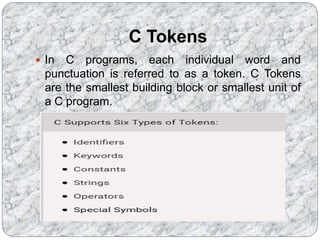
C Tokens
 In C programs, each individual word and
punctuation is referred to as a token. C Tokens
are the smallest building block or smallest unit of
a C program.
C Identifiers
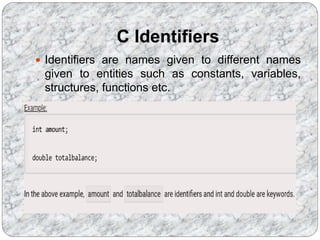
 Identifiers are names given to different names
given to entities such as constants, variables,
structures, functions etc.
Rule for Naming Identifiers
 An identifier can only have alphanumeric
characters (a-z , A-Z , 0-9) (i.e. letters & digits) and
underscore( _ ) symbol.
 Identifier names must be unique
 The first character must be an alphabet or
underscore.
 You cannot use a keyword as identifiers.
 Only first thirty-one (31) characters are significant.
 Must not contain white spaces.
 Identifiers are case-sensitive.
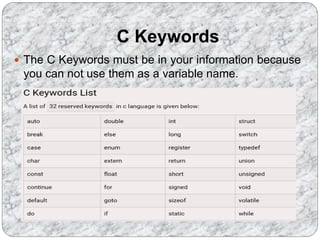
C Keywords
 The C Keywords must be in your information because
you can not use them as a variable name.
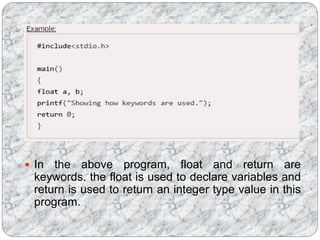
 In the above program, float and return are
keywords. the float is used to declare variables and
return is used to return an integer type value in this
program.
C Constants
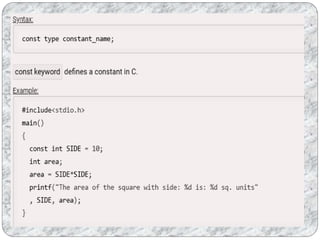
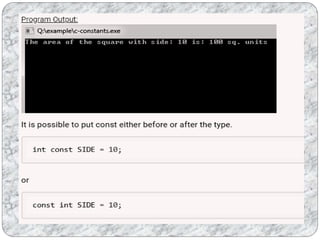
 Constants are like a variable, except that their value
never changes during execution once defined.
 C Constants is a most basic and important part of C
programming language. Constants in C are the fixed
values that are used in a program, and its value
remains the same during the entire execution of the
program.
 Constants are also called literals.
 Constants can be any of the data types.
 It is considered best practice to define constants
using only upper-case names.
Constants Types in C
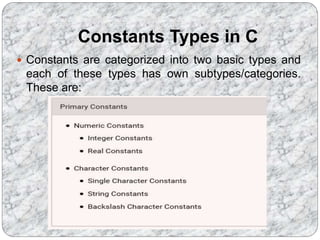
 Constants are categorized into two basic types and
each of these types has own subtypes/categories.
These are:
Numeric Constants
 Integer Constants: It's referring to a sequence of
digits. Integers are of three types:
1. Decimal Integer
2. Octal Integer
3. Hexadecimal Integer
Example: 15, -265, 0, 99818, +25, 045, 0X6
 Real Constant: The numbers containing fractional
parts like 99.25 are called real or floating points
constant.
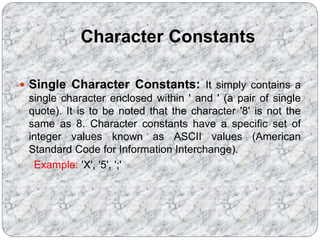
Character Constants
 Single Character Constants: It simply contains a
single character enclosed within ' and ' (a pair of single
quote). It is to be noted that the character '8' is not the
same as 8. Character constants have a specific set of
integer values known as ASCII values (American
Standard Code for Information Interchange).
Example: 'X', '5', ';'
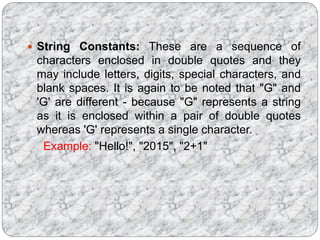
 String Constants: These are a sequence of
characters enclosed in double quotes and they
may include letters, digits, special characters, and
blank spaces. It is again to be noted that "G" and
'G' are different - because "G" represents a string
as it is enclosed within a pair of double quotes
whereas 'G' represents a single character.
Example: "Hello!", "2015", "2+1"
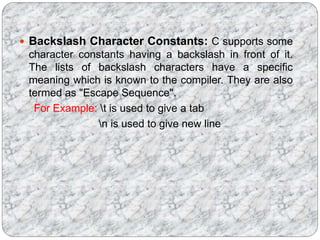
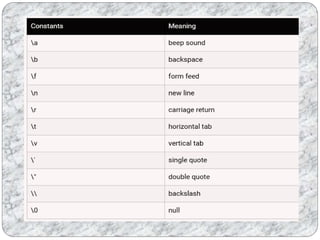
 Backslash Character Constants: C supports some
character constants having a backslash in front of it.
The lists of backslash characters have a specific
meaning which is known to the compiler. They are also
termed as "Escape Sequence".
For Example: t is used to give a tab
n is used to give new line
Thank You

C language (more)

  • 1.
  • 2.
    C Tokens  InC programs, each individual word and punctuation is referred to as a token. C Tokens are the smallest building block or smallest unit of a C program.
  • 3.
    C Identifiers  Identifiersare names given to different names given to entities such as constants, variables, structures, functions etc.
  • 4.
    Rule for NamingIdentifiers  An identifier can only have alphanumeric characters (a-z , A-Z , 0-9) (i.e. letters & digits) and underscore( _ ) symbol.  Identifier names must be unique  The first character must be an alphabet or underscore.  You cannot use a keyword as identifiers.  Only first thirty-one (31) characters are significant.  Must not contain white spaces.  Identifiers are case-sensitive.
  • 5.
    C Keywords  TheC Keywords must be in your information because you can not use them as a variable name.
  • 6.
     In theabove program, float and return are keywords. the float is used to declare variables and return is used to return an integer type value in this program.
  • 7.
    C Constants  Constantsare like a variable, except that their value never changes during execution once defined.  C Constants is a most basic and important part of C programming language. Constants in C are the fixed values that are used in a program, and its value remains the same during the entire execution of the program.  Constants are also called literals.  Constants can be any of the data types.  It is considered best practice to define constants using only upper-case names.
  • 10.
    Constants Types inC  Constants are categorized into two basic types and each of these types has own subtypes/categories. These are:
  • 11.
    Numeric Constants  IntegerConstants: It's referring to a sequence of digits. Integers are of three types: 1. Decimal Integer 2. Octal Integer 3. Hexadecimal Integer Example: 15, -265, 0, 99818, +25, 045, 0X6  Real Constant: The numbers containing fractional parts like 99.25 are called real or floating points constant.
  • 12.
    Character Constants  SingleCharacter Constants: It simply contains a single character enclosed within ' and ' (a pair of single quote). It is to be noted that the character '8' is not the same as 8. Character constants have a specific set of integer values known as ASCII values (American Standard Code for Information Interchange). Example: 'X', '5', ';'
  • 13.
     String Constants:These are a sequence of characters enclosed in double quotes and they may include letters, digits, special characters, and blank spaces. It is again to be noted that "G" and 'G' are different - because "G" represents a string as it is enclosed within a pair of double quotes whereas 'G' represents a single character. Example: "Hello!", "2015", "2+1"
  • 14.
     Backslash CharacterConstants: C supports some character constants having a backslash in front of it. The lists of backslash characters have a specific meaning which is known to the compiler. They are also termed as "Escape Sequence". For Example: t is used to give a tab n is used to give new line
  • 16.