LITERALS
Name : Abija P R
Class: 2nd year computer science
1
LITERALSA
 NUMERIC LITERALS
• INTEGER LITERALS
• REAL LITERALS
 BOOLEAN LITERALS
 CHARACTER LITERALS
• SINGLE CHARACTER LITERALS
• STRING LITERALS
2
LITERALS
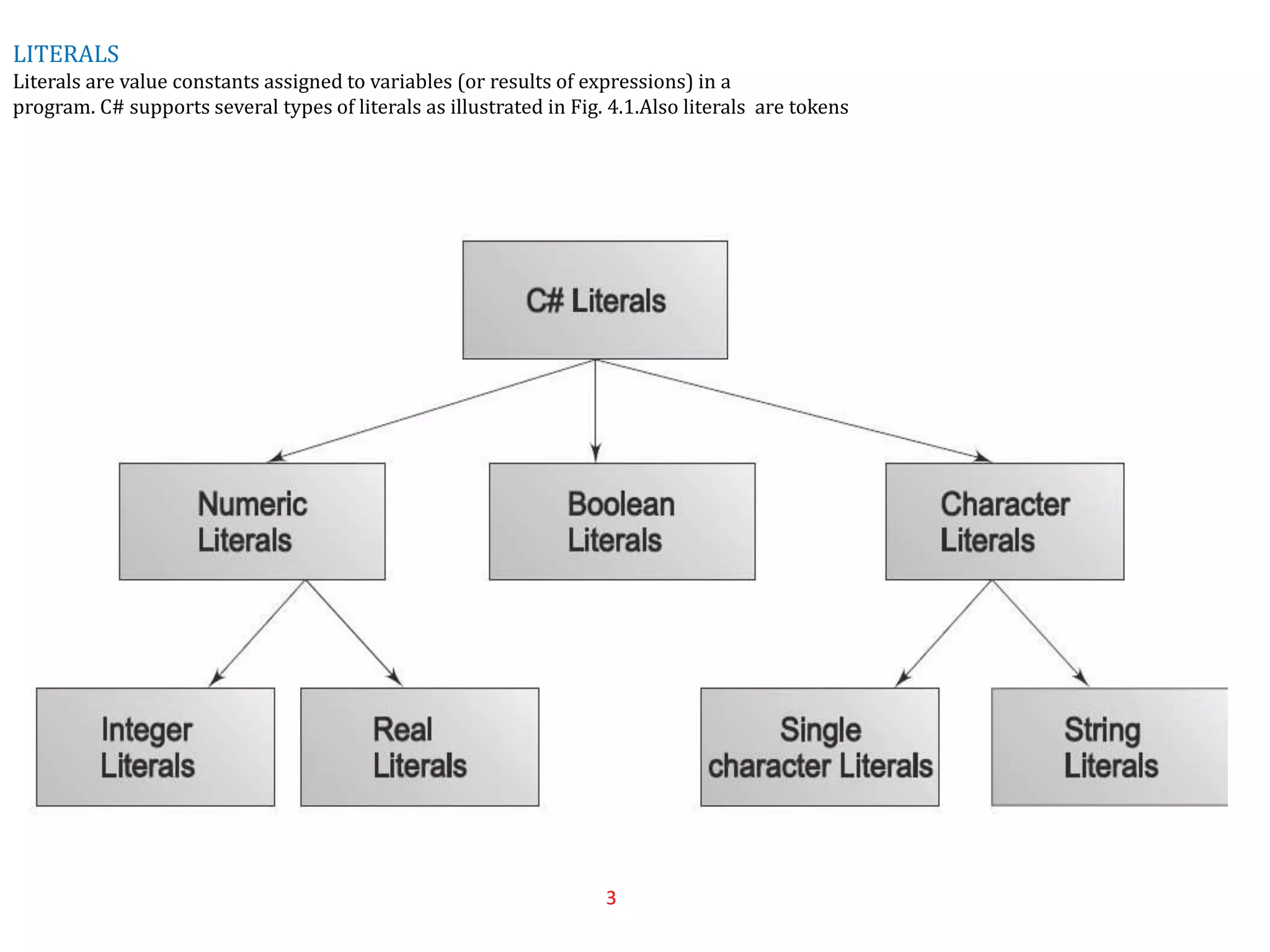
Literals are value constants assigned to variables (or results of expressions) in a
program. C# supports several types of literals as illustrated in Fig. 4.1.Also literals are tokens
3
Numeric literals
•Integer Literals
An integer literal refers to a sequence of digits. There are two types of integers,
namely, decimal integers and hexadecimal integers.
Decimal integers consist of a set of digits, 0 through 9, preceded by an optional minus
sign. Valid examples of decimal integer literals are:
123 -321 0 654321
Embedded spaces, commas and non-digit characters are not permitted between digits.
For example, 15 750 20,000 $1000 are illegal numbers.
A sequence of digits preceded by 0x or 0X is considered as a hexadecimal integer (hex
integer). It may also include alphabets A through F or ‘a’ through ‘f’. A letter A
through F represents the numbers 10 through 15. Following are the examples of valid
hex integers. 0X2 0X9F 0Xbcd 0x
4
•Real Literals
Integer literals are inadequate to represent quantities that vary continuously, such as distances, heights, temperatures, prices
and so on. These quantities are represented by numbers containing fractional parts like 17.548. Such numbers are called
real (or floating point) numbers. Further examples of real literals are:
0.0083 -0.75 435.36
These numbers are shown in decimal notation, having a whole number followed by a
decimal point and the fractional part, which is an integer. It is possible that the number
may not have digits before the decimal point, or digits after the decimal point. That is,
215. .95 -.71 are all valid real literals.
 Boolean literals
There are two Boolean literal values:
false
true
They are used as values of relational expressions.
5
Character literals
• Single Character Literals
A single-character literal (or simply character constant) contains a single character
enclosed within a pair of single quote marks. Example of character in the examples
above constants are: ‘5’ ‘X’ ‘;’ ‘ ‘ Note that the character constant ‘5’ is not the same
as the number 5. The last constant in the example above is blank space
• String Literals
A string literal is a sequence of characters enclosed between double quotes.The
characters may be alphabets, digits, special characters and blank spaces. Examples
are:
“Hello C#” “2001” “WELL DONE” “?...!” “5+3” “X”
6
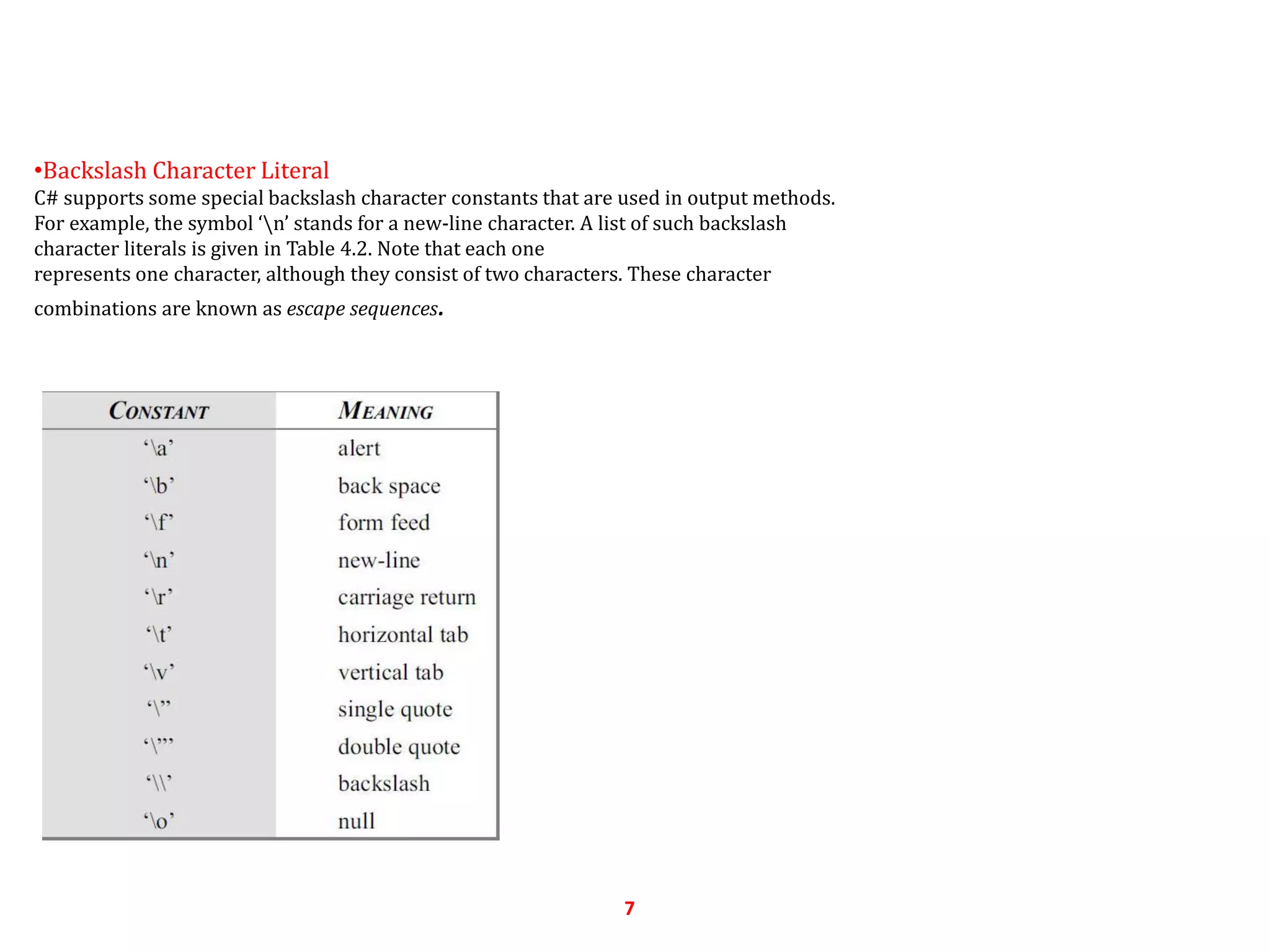
•Backslash Character Literal
C# supports some special backslash character constants that are used in output methods.
For example, the symbol ‘n’ stands for a new-line character. A list of such backslash
character literals is given in Table 4.2. Note that each one
represents one character, although they consist of two characters. These character
combinations are known as escape sequences.
7
Program 4.2 prints the various numeric literals available in C#, such as Integer,
Double and Exponential.
8

Literals in C#

  • 1.
    LITERALS Name : AbijaP R Class: 2nd year computer science 1
  • 2.
    LITERALSA  NUMERIC LITERALS •INTEGER LITERALS • REAL LITERALS  BOOLEAN LITERALS  CHARACTER LITERALS • SINGLE CHARACTER LITERALS • STRING LITERALS 2
  • 3.
    LITERALS Literals are valueconstants assigned to variables (or results of expressions) in a program. C# supports several types of literals as illustrated in Fig. 4.1.Also literals are tokens 3
  • 4.
    Numeric literals •Integer Literals Aninteger literal refers to a sequence of digits. There are two types of integers, namely, decimal integers and hexadecimal integers. Decimal integers consist of a set of digits, 0 through 9, preceded by an optional minus sign. Valid examples of decimal integer literals are: 123 -321 0 654321 Embedded spaces, commas and non-digit characters are not permitted between digits. For example, 15 750 20,000 $1000 are illegal numbers. A sequence of digits preceded by 0x or 0X is considered as a hexadecimal integer (hex integer). It may also include alphabets A through F or ‘a’ through ‘f’. A letter A through F represents the numbers 10 through 15. Following are the examples of valid hex integers. 0X2 0X9F 0Xbcd 0x 4
  • 5.
    •Real Literals Integer literalsare inadequate to represent quantities that vary continuously, such as distances, heights, temperatures, prices and so on. These quantities are represented by numbers containing fractional parts like 17.548. Such numbers are called real (or floating point) numbers. Further examples of real literals are: 0.0083 -0.75 435.36 These numbers are shown in decimal notation, having a whole number followed by a decimal point and the fractional part, which is an integer. It is possible that the number may not have digits before the decimal point, or digits after the decimal point. That is, 215. .95 -.71 are all valid real literals.  Boolean literals There are two Boolean literal values: false true They are used as values of relational expressions. 5
  • 6.
    Character literals • SingleCharacter Literals A single-character literal (or simply character constant) contains a single character enclosed within a pair of single quote marks. Example of character in the examples above constants are: ‘5’ ‘X’ ‘;’ ‘ ‘ Note that the character constant ‘5’ is not the same as the number 5. The last constant in the example above is blank space • String Literals A string literal is a sequence of characters enclosed between double quotes.The characters may be alphabets, digits, special characters and blank spaces. Examples are: “Hello C#” “2001” “WELL DONE” “?...!” “5+3” “X” 6
  • 7.
    •Backslash Character Literal C#supports some special backslash character constants that are used in output methods. For example, the symbol ‘n’ stands for a new-line character. A list of such backslash character literals is given in Table 4.2. Note that each one represents one character, although they consist of two characters. These character combinations are known as escape sequences. 7
  • 8.
    Program 4.2 printsthe various numeric literals available in C#, such as Integer, Double and Exponential. 8