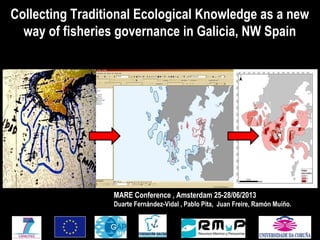
MARE Conference , Amsterdam 25-28/06/2013
Duarte Fernández-Vidal , Pablo Pita, Juan Freire, Ramón Muíño.
Collecting Traditional Ecological Knowledge as a new
way of fisheries governance in Galicia, NW Spain
Different spatial management
strategies have been
implemented in Galicia on the
last years.
Background
… to TURFs and co-
management for some
invertebrates…
… and MPA were introduced.
Background
Many fishers are interested in
expanding TURF model.
GAP2 Case of Study in Galicia
Benthic habitats (topography, substrates and vegetation beds).
Resource/stock distribution.
Fishing grounds location.
Initial needs,
Scientific spatial knowledge on the area is limited or non-existent.
problems,
Fishers’ ecological knowledge (TEK) could provide spatial information in a way
that is both quick and cost-efficient.
and solutions
Every knowledge is true when it allows make projects and get adaptations
(Fourez, 1994)
Using ethnographic tools to discover and record TEK.
Using TEK to map the coastal ecosystems.
Making TEK available by GIS tools.
Translating TEK cartography into scientific knowledge.
Steps
A bottom-up approachA bottom-up approach
Experimental approach
to management
Experimental approach
to management
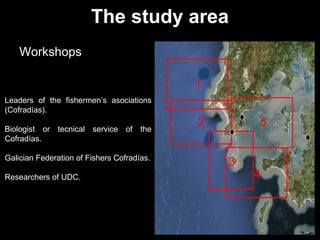
Leaders of the fishermen’s asociations
(Cofradías).
Biologist or tecnical service of the
Cofradías.
Galician Federation of Fishers Cofradías.
Researchers of UDC.
Workshops
The study area
Building collaboration
Defining groups to collect TEK
General interview (25’):
Technical aspects of vessels.
Fleet and gear seasonal distribution.
Target species.
Commercial revenues.
Tools on ecosystem and species
mapping
Semi-structured interviews
(90’-120’):
Vessel spatial distribution.
Target species distribution.
Gears used over last annual fishing
cycle.
Fishing grounds.
Description of seabed.
Nursery habitats.
Relationships between species and
habitats.
Tools on ecosystem and species
mapping
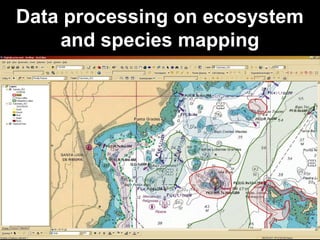
Data processing on ecosystem
and species mapping
Weighting fisher’s data on seabed
Value 1: low activity.
Value 2: medium activity and purse seiners.
Value 3: high activity, divers and shell-fishers.
Data processing on ecosystem
mapping
Validating the cartographies
Data processing on ecosystem
and species mapping
What we learned
Fishermen involved in other co-management projects more willing to
participate.
Clear products generates greater involvement.
Key involvement of Technical Assistance.
We prefer small but diverse than large and non-cohesive.
Trust is increased if the products are owned by the fishers.
www.recursosmarinos.net/gap2
www.gap2.eu
gap2galicia@gmail.com
Contact information GAP2:

Collecting Traditional Ecological Knowledge as a new way of fisheries governance in Galicia, NW Spain

  • 1.
    MARE Conference ,Amsterdam 25-28/06/2013 Duarte Fernández-Vidal , Pablo Pita, Juan Freire, Ramón Muíño. Collecting Traditional Ecological Knowledge as a new way of fisheries governance in Galicia, NW Spain
  • 2.
    Different spatial management strategieshave been implemented in Galicia on the last years. Background
  • 3.
    … to TURFsand co- management for some invertebrates… … and MPA were introduced. Background
  • 4.
    Many fishers areinterested in expanding TURF model. GAP2 Case of Study in Galicia
  • 5.
    Benthic habitats (topography,substrates and vegetation beds). Resource/stock distribution. Fishing grounds location. Initial needs,
  • 6.
    Scientific spatial knowledgeon the area is limited or non-existent. problems,
  • 7.
    Fishers’ ecological knowledge(TEK) could provide spatial information in a way that is both quick and cost-efficient. and solutions Every knowledge is true when it allows make projects and get adaptations (Fourez, 1994)
  • 8.
    Using ethnographic toolsto discover and record TEK. Using TEK to map the coastal ecosystems. Making TEK available by GIS tools. Translating TEK cartography into scientific knowledge. Steps A bottom-up approachA bottom-up approach Experimental approach to management Experimental approach to management
  • 9.
    Leaders of thefishermen’s asociations (Cofradías). Biologist or tecnical service of the Cofradías. Galician Federation of Fishers Cofradías. Researchers of UDC. Workshops The study area
  • 10.
  • 11.
    Defining groups tocollect TEK
  • 12.
    General interview (25’): Technicalaspects of vessels. Fleet and gear seasonal distribution. Target species. Commercial revenues. Tools on ecosystem and species mapping
  • 13.
    Semi-structured interviews (90’-120’): Vessel spatialdistribution. Target species distribution. Gears used over last annual fishing cycle. Fishing grounds. Description of seabed. Nursery habitats. Relationships between species and habitats. Tools on ecosystem and species mapping
  • 15.
    Data processing onecosystem and species mapping
  • 16.
    Weighting fisher’s dataon seabed Value 1: low activity. Value 2: medium activity and purse seiners. Value 3: high activity, divers and shell-fishers. Data processing on ecosystem mapping
  • 17.
    Validating the cartographies Dataprocessing on ecosystem and species mapping
  • 21.
    What we learned Fishermeninvolved in other co-management projects more willing to participate. Clear products generates greater involvement. Key involvement of Technical Assistance. We prefer small but diverse than large and non-cohesive. Trust is increased if the products are owned by the fishers.
  • 22.

Editor's Notes

  • #3 From traditional top-down management…
  • #4 Territorial Use Rights for some invertebrate species.
  • #5 The fishers’ associations are interested in expanding the TURF model to all of the resources exploited and to the whole fleet. The idea is to establish a management plan with special regulations and management rules and bodies.
  • #6 These new approaches need spatial information on ecosystems
  • #8 Universalizable, adaptativo porque es flexible. Está preadaptado para ser usado como conocimiento científco.
  • #11 How we build the collaboration in the project: Public communication: we formally presented the project, in a participative way. We generated discussions, identified strengths and potential conflicts between the fishers and between fishers and scientists. Equality: every fishers and every association was important for us, we tried to work with same number of fishers in each association. Decision making, we listened to the fishers proposals and we reached a final consensus on the planning. Participation: we asked for the fishers that really wanted to collaborate. Representatives of the fishers organizations selected them. By this, may be we didn’t controlled this, but we increased trust. Empowerment: fisher became active and proactive part of the work, very important for the following works.
  • #12 S-fisheries: from small boats to purse seiners (semi-industrial). Metiers: intrinsic flexibility. To 5 different gears by vessel operating in different times of the year. Partivipative social tools: interviews and discussion groups. Cheap and fast. Annual fishing cycle: we covered the different efforts along the year. No management plans: we are particulary interested in the fisheries with no management plans.
  • #13 25 Structured general interview by scientists.
  • #14 Interviews (19 fishers). Cambados (6). Aguiño (6). Ribeira (7).
  • #16 Digitalizing data on seabed and species
  • #18 Discussion groups. You can imagine that the habitat distribution is more accurate that the marine charts because it is actualized. We showed the cartography to fishers not involved in the original interviews and they were surprised on the quality.
  • #19 What is important here is: Physical results but also the social procesess. We achieved a great sintony with the fishers. The fishers have a negotiation tool that empowers them democratizing the relations with administration and solving potential conflicts.
  • #22 Participation varied between 100% in the interviews and 70% in the validation workshops. Technical Assistances: facilitating relationships between fishermen and scientists all over the process. They involved new young fishers that were not in the initial groups. It is more productive and easier for working with small, diverse and cohesive groups than large and non-cohesive groups. The administration has not participated in this phase of the project. The information is owned fishing associations and this have contributed to the quality and truth of the outstanding data that the fishers delivered and we collected. The gap between fisher and scientists is very small now.