1
C++ Advanced
Features
Trenton Computer Festival
March 15, 2014
Michael P. Redlich
@mpredli
about.me/mpredli/
Sunday, March 16, 14
Who’s Mike?
• BS in CS from
• “Petrochemical Research Organization”
• Ai-Logix, Inc. (now AudioCodes)
• Amateur Computer Group of New Jersey
• Publications
• Presentations
2
Sunday, March 16, 14
Objectives
• Overloaded Operators
• Templates
• Exception Handling
• Namespaces
• Introduction to the Standard Template
Library (STL)
3
Sunday, March 16, 14
Overloaded Operators
4
Sunday, March 16, 14
What are Overloaded
Operators?
• Define basic operations for objects of user-
defined types
• as if they were built-in types
• Often referred to as “syntactic sugar”
5
Sunday, March 16, 14
6
// String.h - a simple string class
class String {
private:
char *string;
public:
String(char const *str) {
string = new char[strlen(str) + 1];
strcpy(string,str);
}
~String(void) {
delete[] string;
}
char *getString(void) const {
return string;
}
};
Sunday, March 16, 14
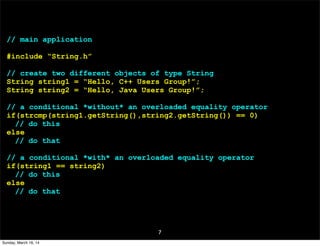
7
// main application
#include “String.h”
// create two different objects of type String
String string1 = “Hello, C++ Users Group!”;
String string2 = “Hello, Java Users Group!”;
// a conditional *without* an overloaded equality operator
if(strcmp(string1.getString(),string2.getString()) == 0)
// do this
else
// do that
// a conditional *with* an overloaded equality operator
if(string1 == string2)
// do this
else
// do that
Sunday, March 16, 14
Overloaded Operators
(1)
• An overloaded operator has the form:
• T [class::]operatorω(paramList)
8
Sunday, March 16, 14
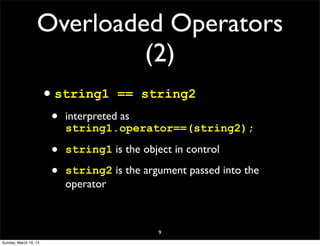
Overloaded Operators
(2)
•string1 == string2
• interpreted as
string1.operator==(string2);
• string1 is the object in control
• string2 is the argument passed into the
operator
9
Sunday, March 16, 14
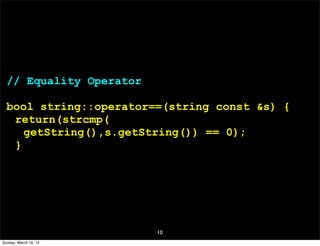
10
// Equality Operator
bool string::operator==(string const &s) {
return(strcmp(
getString(),s.getString()) == 0);
}
Sunday, March 16, 14
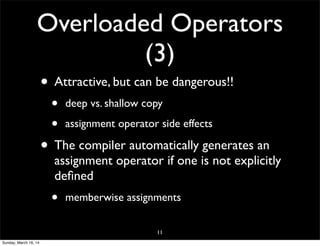
Overloaded Operators
(3)
• Attractive, but can be dangerous!!
• deep vs. shallow copy
• assignment operator side effects
• The compiler automatically generates an
assignment operator if one is not explicitly
defined
• memberwise assignments
11
Sunday, March 16, 14
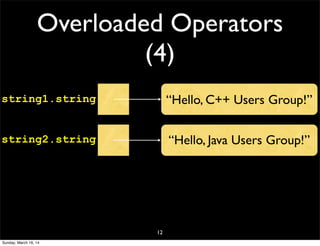
Overloaded Operators
(4)
12
“Hello, C++ Users Group!”
“Hello, Java Users Group!”
string1.string
string2.string
Sunday, March 16, 14
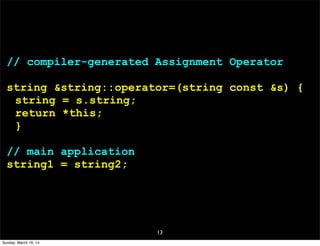
13
// compiler-generated Assignment Operator
string &string::operator=(string const &s) {
string = s.string;
return *this;
}
// main application
string1 = string2;
Sunday, March 16, 14
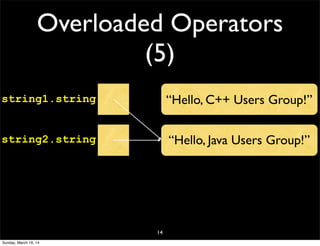
Overloaded Operators
(5)
14
“Hello, C++ Users Group!”
“Hello, Java Users Group!”
string1.string
string2.string
Sunday, March 16, 14
15
// user-defined Assignment Operator
string &string::operator=(string const &s) {
delete[] string;
string = new char[strlen(s) + 1];
strcpy(string,s);
return *this;
}
// application
string1 = string2;
Sunday, March 16, 14
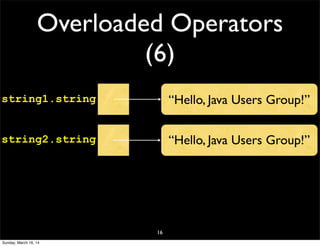
Overloaded Operators
(6)
16
“Hello, Java Users Group!”
string1.string
string2.string
Sunday, March 16, 14
Overloaded Operators
(7)
17
Operators Than Can Be OverloadedOperators Than Can Be OverloadedOperators Than Can Be OverloadedOperators Than Can Be OverloadedOperators Than Can Be OverloadedOperators Than Can Be OverloadedOperators Than Can Be OverloadedOperators Than Can Be OverloadedOperators Than Can Be OverloadedOperators Than Can Be Overloaded
+ - * / % ^ & | ~ !
= < > += -+ *= /= %= ^= &=
|= << >> >>= <<= != <= >= &&
|| ++ -- ‘ ->* -> () []
ne
w
de
le
te
Sunday, March 16, 14
Overloaded Operators
(8)
18
Operators That Cannot Be OverloadedOperators That Cannot Be OverloadedOperators That Cannot Be OverloadedOperators That Cannot Be Overloaded
. .* :: ?:
Sunday, March 16, 14
Overloaded Operators
(9)
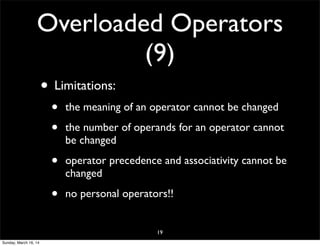
• Limitations:
• the meaning of an operator cannot be changed
• the number of operands for an operator cannot
be changed
• operator precedence and associativity cannot be
changed
• no personal operators!!
19
Sunday, March 16, 14
Templates
20
Sunday, March 16, 14
What are Templates?
• Used for generic programming
• Two kinds:
• class templates
• member function templates
21
Sunday, March 16, 14
Templates (1)
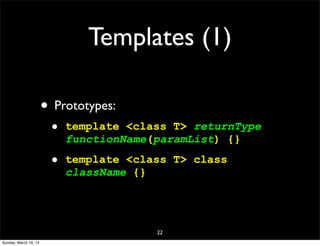
• Prototypes:
• template <class T> returnType
functionName(paramList) {}
• template <class T> class
className {}
22
Sunday, March 16, 14
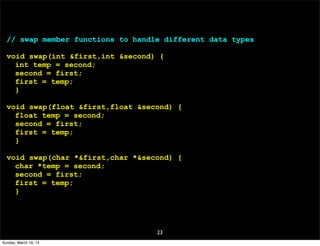
23
// swap member functions to handle different data types
void swap(int &first,int &second) {
int temp = second;
second = first;
first = temp;
}
void swap(float &first,float &second) {
float temp = second;
second = first;
first = temp;
}
void swap(char *&first,char *&second) {
char *temp = second;
second = first;
first = temp;
}
Sunday, March 16, 14
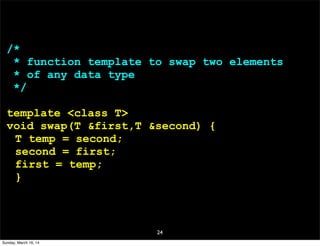
24
/*
* function template to swap two elements
* of any data type
*/
template <class T>
void swap(T &first,T &second) {
T temp = second;
second = first;
first = temp;
}
Sunday, March 16, 14
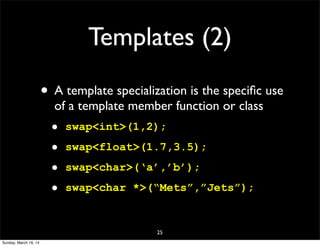
Templates (2)
• A template specialization is the specific use
of a template member function or class
• swap<int>(1,2);
• swap<float>(1.7,3.5);
• swap<char>(‘a’,’b’);
• swap<char *>(“Mets”,”Jets”);
25
Sunday, March 16, 14
Exception Handling
26
Sunday, March 16, 14
What is Exception
Handling?
• A more robust method for handling errors
than fastidiously checking for error codes
• error code checking is tedious and can obscure
program logic
27
Sunday, March 16, 14
Exception Handling (1)
• Throw Expression:
• raises the exception
• Try Block:
• contains a throw expression or a member
function that throws an exception
28
Sunday, March 16, 14
Exception Handling (2)
• Catch Clause(s):
• handles the exception
• defined immediately after the try block
• multiple catch clauses allowed
• no implicit data type conversions
• catch(...) catches any exception type
29
Sunday, March 16, 14
C++ Exception Model
• Destructors invoked for all live objects as
the stack “unwinds”
• Exception Specification
• specify what type of exception(s) a member
function will throw
• Termination vs. Resumption semantics
30
Sunday, March 16, 14
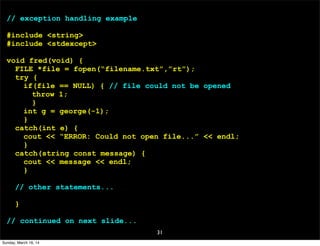
31
// exception handling example
#include <string>
#include <stdexcept>
void fred(void) {
FILE *file = fopen(“filename.txt”,”rt”);
try {
if(file == NULL) { // file could not be opened
throw 1;
}
int g = george(-1);
}
catch(int e) {
cout << “ERROR: Could not open file...” << endl;
}
catch(string const message) {
cout << message << endl;
}
// other statements...
}
// continued on next slide...
Sunday, March 16, 14
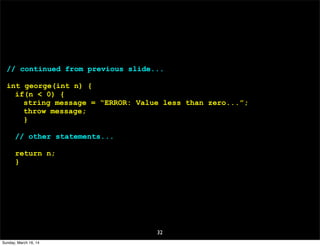
32
// continued from previous slide...
int george(int n) {
if(n < 0) {
string message = “ERROR: Value less than zero...”;
throw message;
}
// other statements...
return n;
}
Sunday, March 16, 14
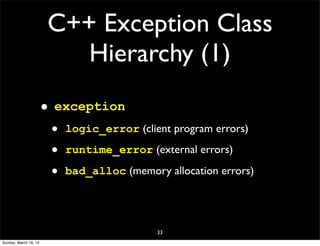
C++ Exception Class
Hierarchy (1)
• exception
• logic_error (client program errors)
• runtime_error (external errors)
• bad_alloc (memory allocation errors)
33
Sunday, March 16, 14
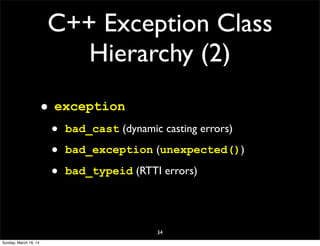
C++ Exception Class
Hierarchy (2)
• exception
• bad_cast (dynamic casting errors)
• bad_exception (unexpected())
• bad_typeid (RTTI errors)
34
Sunday, March 16, 14
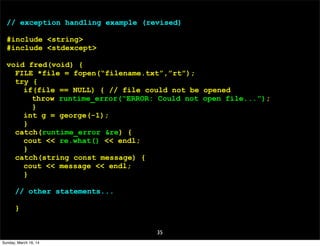
35
// exception handling example (revised)
#include <string>
#include <stdexcept>
void fred(void) {
FILE *file = fopen(“filename.txt”,”rt”);
try {
if(file == NULL) { // file could not be opened
throw runtime_error(“ERROR: Could not open file...”);
}
int g = george(-1);
}
catch(runtime_error &re) {
cout << re.what() << endl;
}
catch(string const message) {
cout << message << endl;
}
// other statements...
}
Sunday, March 16, 14
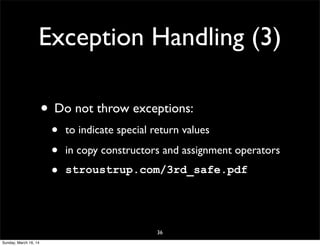
Exception Handling (3)
• Do not throw exceptions:
• to indicate special return values
• in copy constructors and assignment operators
• stroustrup.com/3rd_safe.pdf
36
Sunday, March 16, 14
Namespaces
37
Sunday, March 16, 14
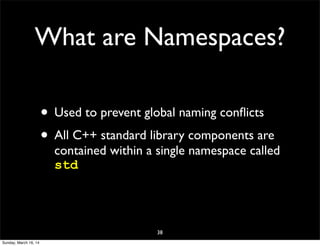
What are Namespaces?
• Used to prevent global naming conflicts
• All C++ standard library components are
contained within a single namespace called
std
38
Sunday, March 16, 14
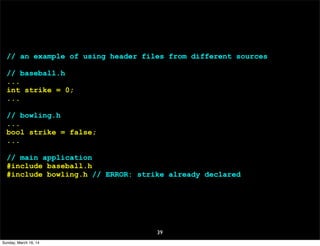
39
// an example of using header files from different sources
// baseball.h
...
int strike = 0;
...
// bowling.h
...
bool strike = false;
...
// main application
#include baseball.h
#include bowling.h // ERROR: strike already declared
Sunday, March 16, 14
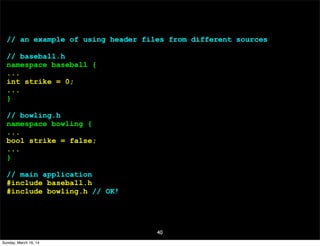
40
// an example of using header files from different sources
// baseball.h
namespace baseball {
...
int strike = 0;
...
}
// bowling.h
namespace bowling {
...
bool strike = false;
...
}
// main application
#include baseball.h
#include bowling.h // OK!
Sunday, March 16, 14
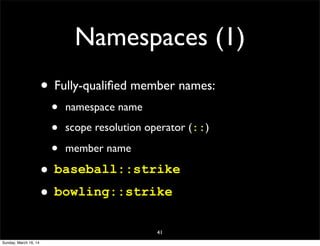
Namespaces (1)
• Fully-qualified member names:
• namespace name
• scope resolution operator (::)
• member name
• baseball::strike
• bowling::strike
41
Sunday, March 16, 14
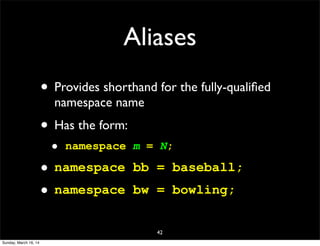
Aliases
• Provides shorthand for the fully-qualified
namespace name
• Has the form:
• namespace m = N;
• namespace bb = baseball;
• namespace bw = bowling;
42
Sunday, March 16, 14
Using Directive
• Provides access to all members of a
namespace without having to write the
fully-qualified namespace member names
• Has the form:
• using namespace N;
• using namespace baseball;
• using namespace bowling;
43
Sunday, March 16, 14
Using Declaration
• Provides access to individual members of a
namespace without having to write the
fully-qualified namespace member names
• Has the form:
• using N::m;
• using baseball::strike;
• using bowling::strike;
44
Sunday, March 16, 14
Standard Template
Library (STL)
45
Sunday, March 16, 14
What is the STL?
• A subset of Standard C++
• First developed by HP Labs in 1994
• Three main parts:
• containers
• iterators
• algorithms
46
Sunday, March 16, 14
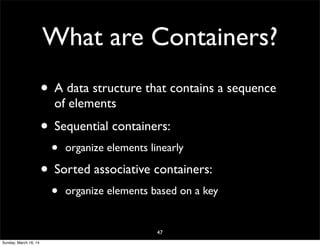
What are Containers?
• A data structure that contains a sequence
of elements
• Sequential containers:
• organize elements linearly
• Sorted associative containers:
• organize elements based on a key
47
Sunday, March 16, 14
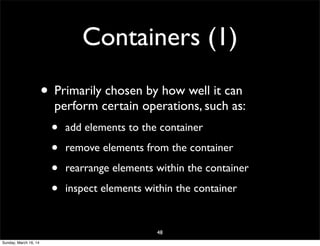
Containers (1)
• Primarily chosen by how well it can
perform certain operations, such as:
• add elements to the container
• remove elements from the container
• rearrange elements within the container
• inspect elements within the container
48
Sunday, March 16, 14
Containers (2)
49
vector deque list set/map
insert O(n) O(n) O(1) O(nlogn)
prepend O(n) O(1) O(1) O(nlogn)
find O(n) O(n) O(n) O(nlogn)
X[i] O(1) O(1) O(n) O(n)
pointers 0 1 2 3
Sunday, March 16, 14
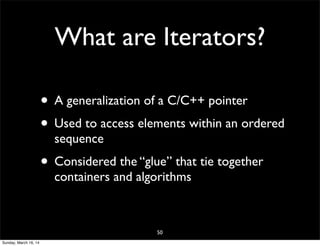
What are Iterators?
• A generalization of a C/C++ pointer
• Used to access elements within an ordered
sequence
• Considered the “glue” that tie together
containers and algorithms
50
Sunday, March 16, 14
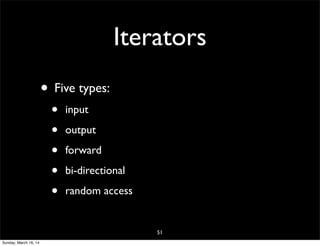
Iterators
• Five types:
• input
• output
• forward
• bi-directional
• random access
51
Sunday, March 16, 14
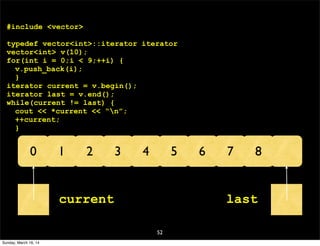
52
#include <vector>
typedef vector<int>::iterator iterator
vector<int> v(10);
for(int i = 0;i < 9;++i) {
v.push_back(i);
}
iterator current = v.begin();
iterator last = v.end();
while(current != last) {
cout << *current << “n”;
++current;
}
0 1 2 3 4 5 6 7 8
current last
Sunday, March 16, 14
What are Algorithms?
• Perform various operations on containers
such as:
• searching
• sorting
• transforming
53
Sunday, March 16, 14
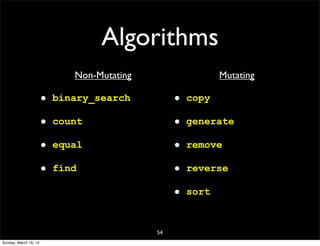
Algorithms
• Non-Mutating
• binary_search
• count
• equal
• find
• Mutating
• copy
• generate
• remove
• reverse
• sort
54
Sunday, March 16, 14
Popular C++
Compilers
55
• Embarcadero C++ Builder XE5
• embarcadero.com/products/
cbuilder
• MicrosoftVisual C++
• microsoft.com
• Open Watcom 1.9
• openwatcom.org
Sunday, March 16, 14
Local C++ User
Groups
• ACGNJ C++ Users Group
• facilitated by Bruce Arnold
• acgnj.barnold.us
56
Sunday, March 16, 14
Further Reading (1)
57
• C & C++ Code Capsules
• Chuck Allison
• freshsources.com
• The C++ Programming Language
• Bjarne Stroustrup
• stroustrup.com/4th.html
Sunday, March 16, 14
Further Reading (2)
58
• The Annotated C++ Reference Manual
• Margaret Ellis and Bjarne Stroustrup
• stroustrup.com/arm.html
• 1997 C++ Public Review Document
• C++ ISO JTC1/SC22/WG21 Committee
• open-std.org/jtc1/sc22/open/
n2356
Sunday, March 16, 14
Upcoming Events (1)
• Trenton Computer Festival
• March 14-15, 2014
• tcf-nj.org
• Emerging Technologies for the Enterprise
• April 22-23, 2014
• phillyemergingtech.com
59
Sunday, March 16, 14
60
Upcoming Events (2)
Sunday, March 16, 14
61
Thanks!
mike@redlich.net
@mpredli
javasig.org
Sunday, March 16, 14

C++ Advanced Features (TCF 2014)

  • 1.
    1 C++ Advanced Features Trenton ComputerFestival March 15, 2014 Michael P. Redlich @mpredli about.me/mpredli/ Sunday, March 16, 14
  • 2.
    Who’s Mike? • BSin CS from • “Petrochemical Research Organization” • Ai-Logix, Inc. (now AudioCodes) • Amateur Computer Group of New Jersey • Publications • Presentations 2 Sunday, March 16, 14
  • 3.
    Objectives • Overloaded Operators •Templates • Exception Handling • Namespaces • Introduction to the Standard Template Library (STL) 3 Sunday, March 16, 14
  • 4.
  • 5.
    What are Overloaded Operators? •Define basic operations for objects of user- defined types • as if they were built-in types • Often referred to as “syntactic sugar” 5 Sunday, March 16, 14
  • 6.
    6 // String.h -a simple string class class String { private: char *string; public: String(char const *str) { string = new char[strlen(str) + 1]; strcpy(string,str); } ~String(void) { delete[] string; } char *getString(void) const { return string; } }; Sunday, March 16, 14
  • 7.
    7 // main application #include“String.h” // create two different objects of type String String string1 = “Hello, C++ Users Group!”; String string2 = “Hello, Java Users Group!”; // a conditional *without* an overloaded equality operator if(strcmp(string1.getString(),string2.getString()) == 0) // do this else // do that // a conditional *with* an overloaded equality operator if(string1 == string2) // do this else // do that Sunday, March 16, 14
  • 8.
    Overloaded Operators (1) • Anoverloaded operator has the form: • T [class::]operatorω(paramList) 8 Sunday, March 16, 14
  • 9.
    Overloaded Operators (2) •string1 ==string2 • interpreted as string1.operator==(string2); • string1 is the object in control • string2 is the argument passed into the operator 9 Sunday, March 16, 14
  • 10.
    10 // Equality Operator boolstring::operator==(string const &s) { return(strcmp( getString(),s.getString()) == 0); } Sunday, March 16, 14
  • 11.
    Overloaded Operators (3) • Attractive,but can be dangerous!! • deep vs. shallow copy • assignment operator side effects • The compiler automatically generates an assignment operator if one is not explicitly defined • memberwise assignments 11 Sunday, March 16, 14
  • 12.
    Overloaded Operators (4) 12 “Hello, C++Users Group!” “Hello, Java Users Group!” string1.string string2.string Sunday, March 16, 14
  • 13.
    13 // compiler-generated AssignmentOperator string &string::operator=(string const &s) { string = s.string; return *this; } // main application string1 = string2; Sunday, March 16, 14
  • 14.
    Overloaded Operators (5) 14 “Hello, C++Users Group!” “Hello, Java Users Group!” string1.string string2.string Sunday, March 16, 14
  • 15.
    15 // user-defined AssignmentOperator string &string::operator=(string const &s) { delete[] string; string = new char[strlen(s) + 1]; strcpy(string,s); return *this; } // application string1 = string2; Sunday, March 16, 14
  • 16.
    Overloaded Operators (6) 16 “Hello, JavaUsers Group!” “Hello, Java Users Group!” string1.string string2.string Sunday, March 16, 14
  • 17.
    Overloaded Operators (7) 17 Operators ThanCan Be OverloadedOperators Than Can Be OverloadedOperators Than Can Be OverloadedOperators Than Can Be OverloadedOperators Than Can Be OverloadedOperators Than Can Be OverloadedOperators Than Can Be OverloadedOperators Than Can Be OverloadedOperators Than Can Be OverloadedOperators Than Can Be Overloaded + - * / % ^ & | ~ ! = < > += -+ *= /= %= ^= &= |= << >> >>= <<= != <= >= && || ++ -- ‘ ->* -> () [] ne w de le te Sunday, March 16, 14
  • 18.
    Overloaded Operators (8) 18 Operators ThatCannot Be OverloadedOperators That Cannot Be OverloadedOperators That Cannot Be OverloadedOperators That Cannot Be Overloaded . .* :: ?: Sunday, March 16, 14
  • 19.
    Overloaded Operators (9) • Limitations: •the meaning of an operator cannot be changed • the number of operands for an operator cannot be changed • operator precedence and associativity cannot be changed • no personal operators!! 19 Sunday, March 16, 14
  • 20.
  • 21.
    What are Templates? •Used for generic programming • Two kinds: • class templates • member function templates 21 Sunday, March 16, 14
  • 22.
    Templates (1) • Prototypes: •template <class T> returnType functionName(paramList) {} • template <class T> class className {} 22 Sunday, March 16, 14
  • 23.
    23 // swap memberfunctions to handle different data types void swap(int &first,int &second) { int temp = second; second = first; first = temp; } void swap(float &first,float &second) { float temp = second; second = first; first = temp; } void swap(char *&first,char *&second) { char *temp = second; second = first; first = temp; } Sunday, March 16, 14
  • 24.
    24 /* * function templateto swap two elements * of any data type */ template <class T> void swap(T &first,T &second) { T temp = second; second = first; first = temp; } Sunday, March 16, 14
  • 25.
    Templates (2) • Atemplate specialization is the specific use of a template member function or class • swap<int>(1,2); • swap<float>(1.7,3.5); • swap<char>(‘a’,’b’); • swap<char *>(“Mets”,”Jets”); 25 Sunday, March 16, 14
  • 26.
  • 27.
    What is Exception Handling? •A more robust method for handling errors than fastidiously checking for error codes • error code checking is tedious and can obscure program logic 27 Sunday, March 16, 14
  • 28.
    Exception Handling (1) •Throw Expression: • raises the exception • Try Block: • contains a throw expression or a member function that throws an exception 28 Sunday, March 16, 14
  • 29.
    Exception Handling (2) •Catch Clause(s): • handles the exception • defined immediately after the try block • multiple catch clauses allowed • no implicit data type conversions • catch(...) catches any exception type 29 Sunday, March 16, 14
  • 30.
    C++ Exception Model •Destructors invoked for all live objects as the stack “unwinds” • Exception Specification • specify what type of exception(s) a member function will throw • Termination vs. Resumption semantics 30 Sunday, March 16, 14
  • 31.
    31 // exception handlingexample #include <string> #include <stdexcept> void fred(void) { FILE *file = fopen(“filename.txt”,”rt”); try { if(file == NULL) { // file could not be opened throw 1; } int g = george(-1); } catch(int e) { cout << “ERROR: Could not open file...” << endl; } catch(string const message) { cout << message << endl; } // other statements... } // continued on next slide... Sunday, March 16, 14
  • 32.
    32 // continued fromprevious slide... int george(int n) { if(n < 0) { string message = “ERROR: Value less than zero...”; throw message; } // other statements... return n; } Sunday, March 16, 14
  • 33.
    C++ Exception Class Hierarchy(1) • exception • logic_error (client program errors) • runtime_error (external errors) • bad_alloc (memory allocation errors) 33 Sunday, March 16, 14
  • 34.
    C++ Exception Class Hierarchy(2) • exception • bad_cast (dynamic casting errors) • bad_exception (unexpected()) • bad_typeid (RTTI errors) 34 Sunday, March 16, 14
  • 35.
    35 // exception handlingexample (revised) #include <string> #include <stdexcept> void fred(void) { FILE *file = fopen(“filename.txt”,”rt”); try { if(file == NULL) { // file could not be opened throw runtime_error(“ERROR: Could not open file...”); } int g = george(-1); } catch(runtime_error &re) { cout << re.what() << endl; } catch(string const message) { cout << message << endl; } // other statements... } Sunday, March 16, 14
  • 36.
    Exception Handling (3) •Do not throw exceptions: • to indicate special return values • in copy constructors and assignment operators • stroustrup.com/3rd_safe.pdf 36 Sunday, March 16, 14
  • 37.
  • 38.
    What are Namespaces? •Used to prevent global naming conflicts • All C++ standard library components are contained within a single namespace called std 38 Sunday, March 16, 14
  • 39.
    39 // an exampleof using header files from different sources // baseball.h ... int strike = 0; ... // bowling.h ... bool strike = false; ... // main application #include baseball.h #include bowling.h // ERROR: strike already declared Sunday, March 16, 14
  • 40.
    40 // an exampleof using header files from different sources // baseball.h namespace baseball { ... int strike = 0; ... } // bowling.h namespace bowling { ... bool strike = false; ... } // main application #include baseball.h #include bowling.h // OK! Sunday, March 16, 14
  • 41.
    Namespaces (1) • Fully-qualifiedmember names: • namespace name • scope resolution operator (::) • member name • baseball::strike • bowling::strike 41 Sunday, March 16, 14
  • 42.
    Aliases • Provides shorthandfor the fully-qualified namespace name • Has the form: • namespace m = N; • namespace bb = baseball; • namespace bw = bowling; 42 Sunday, March 16, 14
  • 43.
    Using Directive • Providesaccess to all members of a namespace without having to write the fully-qualified namespace member names • Has the form: • using namespace N; • using namespace baseball; • using namespace bowling; 43 Sunday, March 16, 14
  • 44.
    Using Declaration • Providesaccess to individual members of a namespace without having to write the fully-qualified namespace member names • Has the form: • using N::m; • using baseball::strike; • using bowling::strike; 44 Sunday, March 16, 14
  • 45.
  • 46.
    What is theSTL? • A subset of Standard C++ • First developed by HP Labs in 1994 • Three main parts: • containers • iterators • algorithms 46 Sunday, March 16, 14
  • 47.
    What are Containers? •A data structure that contains a sequence of elements • Sequential containers: • organize elements linearly • Sorted associative containers: • organize elements based on a key 47 Sunday, March 16, 14
  • 48.
    Containers (1) • Primarilychosen by how well it can perform certain operations, such as: • add elements to the container • remove elements from the container • rearrange elements within the container • inspect elements within the container 48 Sunday, March 16, 14
  • 49.
    Containers (2) 49 vector dequelist set/map insert O(n) O(n) O(1) O(nlogn) prepend O(n) O(1) O(1) O(nlogn) find O(n) O(n) O(n) O(nlogn) X[i] O(1) O(1) O(n) O(n) pointers 0 1 2 3 Sunday, March 16, 14
  • 50.
    What are Iterators? •A generalization of a C/C++ pointer • Used to access elements within an ordered sequence • Considered the “glue” that tie together containers and algorithms 50 Sunday, March 16, 14
  • 51.
    Iterators • Five types: •input • output • forward • bi-directional • random access 51 Sunday, March 16, 14
  • 52.
    52 #include <vector> typedef vector<int>::iteratoriterator vector<int> v(10); for(int i = 0;i < 9;++i) { v.push_back(i); } iterator current = v.begin(); iterator last = v.end(); while(current != last) { cout << *current << “n”; ++current; } 0 1 2 3 4 5 6 7 8 current last Sunday, March 16, 14
  • 53.
    What are Algorithms? •Perform various operations on containers such as: • searching • sorting • transforming 53 Sunday, March 16, 14
  • 54.
    Algorithms • Non-Mutating • binary_search •count • equal • find • Mutating • copy • generate • remove • reverse • sort 54 Sunday, March 16, 14
  • 55.
    Popular C++ Compilers 55 • EmbarcaderoC++ Builder XE5 • embarcadero.com/products/ cbuilder • MicrosoftVisual C++ • microsoft.com • Open Watcom 1.9 • openwatcom.org Sunday, March 16, 14
  • 56.
    Local C++ User Groups •ACGNJ C++ Users Group • facilitated by Bruce Arnold • acgnj.barnold.us 56 Sunday, March 16, 14
  • 57.
    Further Reading (1) 57 •C & C++ Code Capsules • Chuck Allison • freshsources.com • The C++ Programming Language • Bjarne Stroustrup • stroustrup.com/4th.html Sunday, March 16, 14
  • 58.
    Further Reading (2) 58 •The Annotated C++ Reference Manual • Margaret Ellis and Bjarne Stroustrup • stroustrup.com/arm.html • 1997 C++ Public Review Document • C++ ISO JTC1/SC22/WG21 Committee • open-std.org/jtc1/sc22/open/ n2356 Sunday, March 16, 14
  • 59.
    Upcoming Events (1) •Trenton Computer Festival • March 14-15, 2014 • tcf-nj.org • Emerging Technologies for the Enterprise • April 22-23, 2014 • phillyemergingtech.com 59 Sunday, March 16, 14
  • 60.
  • 61.