• It shows good knowledge of
  the language
• It checks ones ability to use
  language skills in the real
  world
• Helps to apply for visas to
  work or study abroad (in the
  UK or Australia)
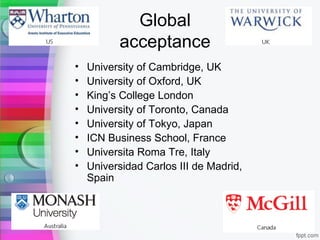
Global
          acceptance
•   University of Cambridge, UK
•   University of Oxford, UK
•   King’s College London
•   University of Toronto, Canada
•   University of Tokyo, Japan
•   ICN Business School, France
•   Universita Roma Tre, Italy
•   Universidad Carlos III de Madrid,
    Spain
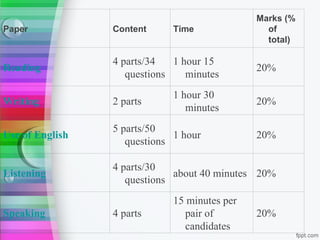
Marks (%
Paper            Content      Time               of
                                                 total)

                 4 parts/34   1 hour 15
Reading                                        20%
                    questions    minutes
                              1 hour 30
Writing          2 parts                       20%
                                 minutes
                 5 parts/50
Use of English                1 hour           20%
                    questions

                 4 parts/30
Listening                     about 40 minutes 20%
                    questions
                              15 minutes per
Speaking         4 parts         pair of       20%
                                 candidates
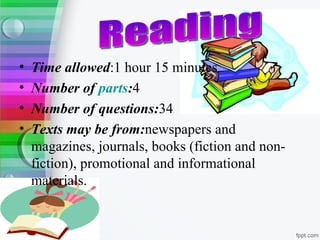
•   Time allowed:1 hour 15 minutes
•   Number of parts:4
•   Number of questions:34
•   Texts may be from:newspapers and
    magazines, journals, books (fiction and non-
    fiction), promotional and informational
    materials.
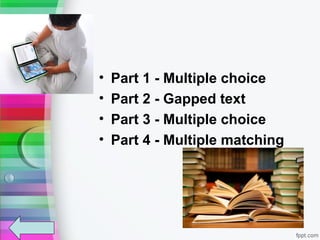
•   Part 1 - Multiple choice
•   Part 2 - Gapped text
•   Part 3 - Multiple choice
•   Part 4 - Multiple matching
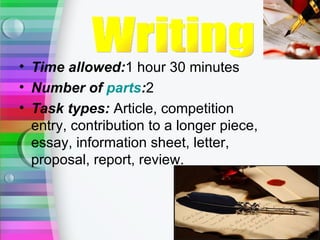
• Time allowed:1 hour 30 minutes
• Number of parts:2
• Task types: Article, competition
  entry, contribution to a longer piece,
  essay, information sheet, letter,
  proposal, report, review.
• Part 1 Some material to read which may include material
  taken from advertisements, extracts from letters, emails,
  postcards, diaries, short articles, etc. You may have to
  write an article, a report, a proposal or a letter.
• Part 2 A choice of four questions. You have to read
  some input material which describes a situation, and
  write one of the following: an article, a competition entry,
  a contribution to a longer piece, an essay, an information
  sheet, a letter, a proposal, a report, or a review.
• Time allowed:1 hour
• Number of parts:5
• Number of
  questions:50
•   Part 1 - Multiple-choice cloze
•   Part 2 - Open cloze
•   Part 3 - Word formation
•   Part 4 - Gap sentences
•   Part 5 - Key word
    transformations
• Time allowed:about 40
  minutes
• Number of parts:4
• Recordings may be from:
  monologues: announcements,
  radio broadcasts, speeches,
  talks, lectures, anecdotes, etc.
  or interacting speakers: radio
  broadcasts, interviews,
  discussions, etc.
•   Part 1 - Multiple choice
•   Part 2 - Sentence completion
•   Part 3 - Multiple choice
•   Part 4 - Multiple matching
• Time allowed:15 minutes per pair of
  candidates
• Number of parts:4
• You will have to talk:with the examiner
                     with the other candidate
                     on your own
• Part 1 (Interview) Conversation between the candidates
  and the interlocutor. The examiner asks questions and
  you may have to give information about your interests,
  studies, careers, etc.
• Part 2 (Long turn) You are given from two to five
  photographs and asked to talk about them. You have to
  speak for one minute without interruption. Then the
  candidates receive a different set of photographs and
  you have to listen and comment when they have finished
  speaking.
• Part 3 (Collaborative task) Conversation with a
  candidate. You are given some pictures and a task to do.
  You have to talk with the candidate and make a decision.
• Part 4 (Discussion) Further discussion with a candidate
  based on the topics or issues raised in the task in Part 3.
  The interlocutor asks each of you some questions and
  you discuss them with the candidate.
• Score
  Is based on your total score in all five
  papers and is shown as a number
  between 0 and 100.
• Grade
  There are set scores for each grade:
•   80–100 C2
•   75–79 C1
•   60–74 C1
•   45–59 CEFR Level B2
• http://
  cambridge-english-advanced.cambridgeesol.
  /
• SAMPLES to take you chance
• Learn more
CAE

CAE

  • 2.
    • It showsgood knowledge of the language • It checks ones ability to use language skills in the real world • Helps to apply for visas to work or study abroad (in the UK or Australia)
  • 3.
    Global acceptance • University of Cambridge, UK • University of Oxford, UK • King’s College London • University of Toronto, Canada • University of Tokyo, Japan • ICN Business School, France • Universita Roma Tre, Italy • Universidad Carlos III de Madrid, Spain
  • 5.
    Marks (% Paper Content Time of total) 4 parts/34 1 hour 15 Reading 20% questions minutes 1 hour 30 Writing 2 parts 20% minutes 5 parts/50 Use of English 1 hour 20% questions 4 parts/30 Listening about 40 minutes 20% questions 15 minutes per Speaking 4 parts pair of 20% candidates
  • 6.
    Time allowed:1 hour 15 minutes • Number of parts:4 • Number of questions:34 • Texts may be from:newspapers and magazines, journals, books (fiction and non- fiction), promotional and informational materials.
  • 7.
    Part 1 - Multiple choice • Part 2 - Gapped text • Part 3 - Multiple choice • Part 4 - Multiple matching
  • 8.
    • Time allowed:1hour 30 minutes • Number of parts:2 • Task types: Article, competition entry, contribution to a longer piece, essay, information sheet, letter, proposal, report, review.
  • 9.
    • Part 1Some material to read which may include material taken from advertisements, extracts from letters, emails, postcards, diaries, short articles, etc. You may have to write an article, a report, a proposal or a letter. • Part 2 A choice of four questions. You have to read some input material which describes a situation, and write one of the following: an article, a competition entry, a contribution to a longer piece, an essay, an information sheet, a letter, a proposal, a report, or a review.
  • 10.
    • Time allowed:1hour • Number of parts:5 • Number of questions:50
  • 11.
    Part 1 - Multiple-choice cloze • Part 2 - Open cloze • Part 3 - Word formation • Part 4 - Gap sentences • Part 5 - Key word transformations
  • 12.
    • Time allowed:about40 minutes • Number of parts:4 • Recordings may be from: monologues: announcements, radio broadcasts, speeches, talks, lectures, anecdotes, etc. or interacting speakers: radio broadcasts, interviews, discussions, etc.
  • 13.
    Part 1 - Multiple choice • Part 2 - Sentence completion • Part 3 - Multiple choice • Part 4 - Multiple matching
  • 14.
    • Time allowed:15minutes per pair of candidates • Number of parts:4 • You will have to talk:with the examiner with the other candidate on your own
  • 15.
    • Part 1(Interview) Conversation between the candidates and the interlocutor. The examiner asks questions and you may have to give information about your interests, studies, careers, etc. • Part 2 (Long turn) You are given from two to five photographs and asked to talk about them. You have to speak for one minute without interruption. Then the candidates receive a different set of photographs and you have to listen and comment when they have finished speaking.
  • 16.
    • Part 3(Collaborative task) Conversation with a candidate. You are given some pictures and a task to do. You have to talk with the candidate and make a decision. • Part 4 (Discussion) Further discussion with a candidate based on the topics or issues raised in the task in Part 3. The interlocutor asks each of you some questions and you discuss them with the candidate.
  • 17.
    • Score Is based on your total score in all five papers and is shown as a number between 0 and 100. • Grade There are set scores for each grade:
  • 18.
    80–100 C2 • 75–79 C1 • 60–74 C1 • 45–59 CEFR Level B2
  • 19.
    • http:// cambridge-english-advanced.cambridgeesol. / • SAMPLES to take you chance • Learn more