

Copyright © 2013 Big Visible Solutions
Leading Through
Environment Design
Michael Hamman, Principal Agile Consultant (mhamman@bigvisible.com)
George Schlitz, Principal, Founder (gschlitz@bigvisible.com)
Copyright © 2013 Big Visible Solutions
If	
  you	
  	
  want	
  to	
  	
  build	
  a	
  ship,	
  	
  don't	
  drum	
  up	
  
the	
  people	
  to	
  gather	
  wood,	
  divide	
  the	
  work,	
  
and	
  give	
  orders.	
  Instead,	
  teach	
  them	
  to	
  yearn	
  
for	
  the	
  	
  vast	
  and	
  endless	
  sea.	
  
-­‐-­‐Antoine	
  De	
  Saint-­‐Exupery,	
  	
  
Author	
  of	
  The	
  Li'le	
  Prince	
  
2	
  
Copyright © 2013 Big Visible Solutions
3	
  
Brief Recap of Last Webinar…..
Copyright © 2013 Big Visible Solutions
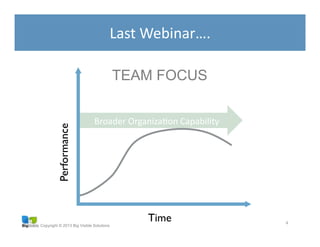
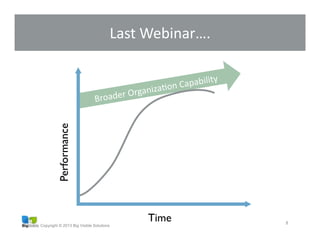
Broader	
  OrganizaGon	
  Capability	
  
Last	
  Webinar….	
  
4	
  
Time
Performance
TEAM FOCUS
Copyright © 2013 Big Visible Solutions
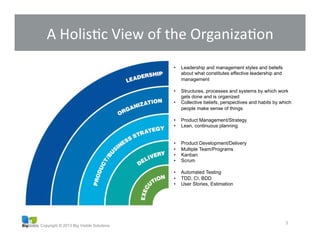
A	
  HolisGc	
  View	
  of	
  the	
  OrganizaGon	
  
5	
  
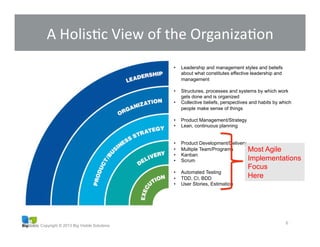
•  Leadership and management styles and beliefs
about what constitutes effective leadership and
management
•  Structures, processes and systems by which work
gets done and is organized
•  Collective beliefs, perspectives and habits by which
people make sense of things
•  Product Management/Strategy
•  Lean, continuous planning
•  Product Development/Delivery
•  Multiple Team/Programs
•  Kanban
•  Scrum
•  Automated Testing
•  TDD, CI, BDD
•  User Stories, Estimation
Copyright © 2013 Big Visible Solutions
A	
  HolisGc	
  View	
  of	
  the	
  OrganizaGon	
  
6	
  
•  Leadership and management styles and beliefs
about what constitutes effective leadership and
management
•  Structures, processes and systems by which work
gets done and is organized
•  Collective beliefs, perspectives and habits by which
people make sense of things
•  Product Management/Strategy
•  Lean, continuous planning
•  Product Development/Delivery
•  Multiple Team/Programs
•  Kanban
•  Scrum
•  Automated Testing
•  TDD, CI, BDD
•  User Stories, Estimation
Most Agile
Implementations
Focus
Here
Copyright © 2013 Big Visible Solutions
Last	
  Webinar….	
  
7	
  
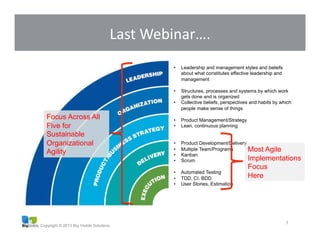
•  Leadership and management styles and beliefs
about what constitutes effective leadership and
management
•  Structures, processes and systems by which work
gets done and is organized
•  Collective beliefs, perspectives and habits by which
people make sense of things
•  Product Management/Strategy
•  Lean, continuous planning
•  Product Development/Delivery
•  Multiple Team/Programs
•  Kanban
•  Scrum
•  Automated Testing
•  TDD, CI, BDD
•  User Stories, Estimation
Most Agile
Implementations
Focus
Here
Focus Across All
Five for
Sustainable
Organizational
Agility
Copyright © 2013 Big Visible Solutions
Broader	
  OrganizaGon	
  Capability	
  
Last	
  Webinar….	
  
8	
  
Time
Performance
Copyright © 2013 Big Visible Solutions
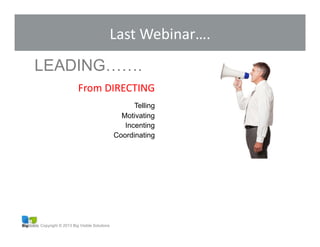
From	
  DIRECTING	
  
#	
  3:	
  Shifting	
  The	
  Paradigm…	
  
Telling
Motivating
Incenting
Coordinating
Last	
  Webinar….	
  
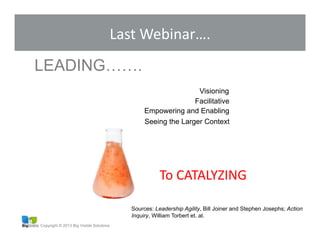
LEADING…….
Copyright © 2013 Big Visible Solutions
#	
  3:	
  Shifting	
  The	
  Paradigm…	
  
To	
  CATALYZING	
  
Sources: Leadership Agility, Bill Joiner and Stephen Josephs; Action
Inquiry, William Torbert et. al.
Visioning
Facilitative
Empowering and Enabling
Seeing the Larger Context
Last	
  Webinar….	
  
LEADING…….
Copyright © 2013 Big Visible Solutions
11
Designing Environments: A
Foundational Practice of Catalytic
Leadership
Last	
  Webinar….	
  
Copyright © 2013 Big Visible Solutions
12	
  
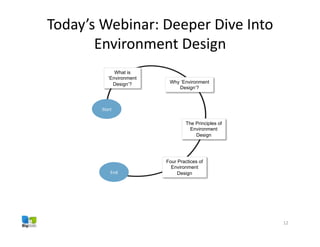
What is
‘Environment
Design’? Why ‘Environment
Design’?
The Principles of
Environment
Design
Four Practices of
Environment
Design
Start	
  
End	
  
Today’s	
  Webinar:	
  Deeper	
  Dive	
  Into	
  
Environment	
  Design	
  
Copyright © 2013 Big Visible Solutions
13	
  
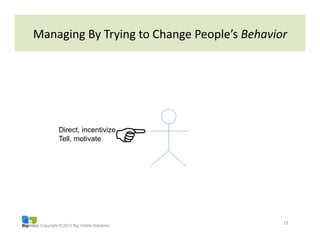
Managing	
  By	
  Trying	
  to	
  Change	
  People’s	
  Behavior	
  
Direct, incentivize,
Tell, motivate
Copyright © 2013 Big Visible Solutions
14	
  
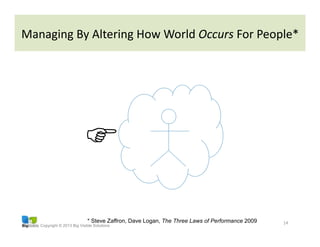
Managing	
  By	
  Altering	
  How	
  World	
  Occurs	
  For	
  People*	
  
* Steve Zaffron, Dave Logan, The Three Laws of Performance 2009
Copyright © 2013 Big Visible Solutions
15	
  
Managing	
  Through	
  the	
  Design	
  of	
  Environments	
  
Copyright © 2013 Big Visible Solutions
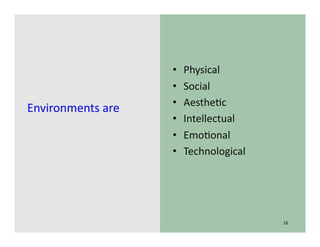
Environments	
  are	
  
•  Physical	
  
•  Social	
  
•  AestheGc	
  
•  Intellectual	
  
•  EmoGonal	
  
•  Technological	
  
16	
  
Copyright © 2013 Big Visible Solutions
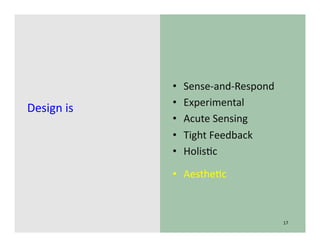
Design	
  is	
  
•  Sense-­‐and-­‐Respond	
  
•  Experimental	
  
•  Acute	
  Sensing	
  
•  Tight	
  Feedback	
  
•  HolisGc	
  
17	
  
•  AestheGc	
  
Copyright © 2013 Big Visible Solutions
“Design	
  is	
  a	
  baale	
  between	
  losing	
  the	
  dream	
  
but	
  naming	
  the	
  thing,	
  and	
  losing	
  the	
  name	
  
while	
  keeping	
  the	
  dream	
  that	
  sGrs	
  others	
  to	
  
make	
  the	
  dream	
  happen”	
  
-­‐-­‐	
  Karl	
  Weick	
  
18	
  
Copyright © 2013 Big Visible Solutions
19	
  
Why Environment Design?
Copyright © 2013 Big Visible Solutions
Why	
  the	
  Term	
  ‘Environment	
  Design’	
  
20	
  
•  Thomas Leonard, Coach Training
•  The Portable Coach
•  Systems Thinking
10 years ago – started to bring this approach into
my coaching work with large companies
Copyright © 2013 Big Visible Solutions
Why	
  the	
  Term	
  ‘Environment	
  Design’	
  
21	
  
•  New agile teams got up to speed faster
•  Managers were better able to manage
appropriately
•  Organizational challenges came to be easier to
resolve
•  People self-organized around creating (and
asking for) what they needed to facilitate
desirable agile change.
Copyright © 2013 Big Visible Solutions
22	
  
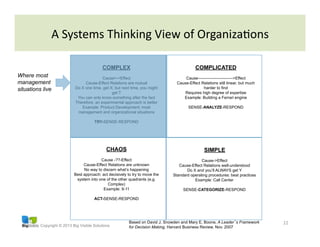
A	
  Systems	
  Thinking	
  View	
  of	
  OrganizaGons	
  
SIMPLE
Cause->Effect
Cause-Effect Relations well-understood
Do X and you’ll ALWAYS get Y
Standard operating procedures: best practices
Example: Call Center
SENSE-CATEGORIZE-RESPOND
COMPLICATED
Cause-------------------------->Effect
Cause-Effect Relations still linear, but much
harder to find
Requires high degree of expertise
Example: Building a Ferrari engine
SENSE-ANALYZE-RESPOND
COMPLEX
Cause<->Effect
Cause-Effect Relations are mutual
Do X one time, get X; but next time, you might
get T
You can only know something after the fact
Therefore, an experimental approach is better
Example: Product Development; most
management and organizational situations
TRY-SENSE-RESPOND
CHAOS
Cause -??-Effect
Cause-Effect Relations are unknown
No way to discern what’s happening
Best approach: act decisively to try to move the
system into one of the other quadrants (e.g.
Complex)
Example: 9-11
ACT-SENSE-RESPOND
Based on David J. Snowden and Mary E. Boone, A Leader’s Framework
for Decision Making, Harvard Business Review, Nov. 2007
Where most
management
situations live
Copyright © 2013 Big Visible Solutions
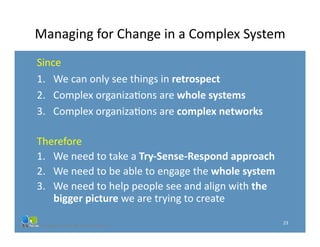
Managing	
  for	
  Change	
  in	
  a	
  Complex	
  System	
  
Since	
  
1.  We	
  can	
  only	
  see	
  things	
  in	
  retrospect	
  
2.  Complex	
  organizaGons	
  are	
  whole	
  systems	
  
3.  Complex	
  organizaGons	
  are	
  complex	
  networks	
  
23	
  
Therefore	
  
1.  We	
  need	
  to	
  take	
  a	
  Try-­‐Sense-­‐Respond	
  approach	
  
2.  We	
  need	
  to	
  be	
  able	
  to	
  engage	
  the	
  whole	
  system	
  
3.  We	
  need	
  to	
  help	
  people	
  see	
  and	
  align	
  with	
  the	
  
bigger	
  picture	
  we	
  are	
  trying	
  to	
  create	
  
Copyright © 2013 Big Visible Solutions
24	
  
Managing	
  for	
  Change	
  in	
  a	
  Complex	
  System	
  Is	
  
About	
  Building	
  InsGtuGonal	
  Capability	
  
Copyright © 2013 Big Visible Solutions
25	
  
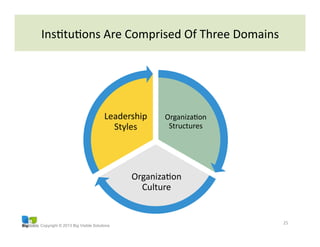
OrganizaGon	
  
Structures	
  
OrganizaGon	
  
Culture	
  
Leadership	
  
Styles	
  
InsGtuGons	
  Are	
  Comprised	
  Of	
  Three	
  Domains	
  
Copyright © 2013 Big Visible Solutions
26	
  
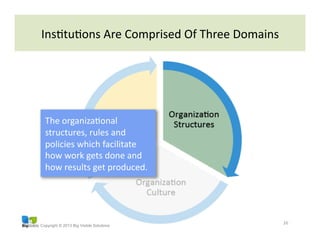
The	
  organizaGonal	
  
structures,	
  rules	
  and	
  
policies	
  which	
  facilitate	
  
how	
  work	
  gets	
  done	
  and	
  
how	
  results	
  get	
  produced.	
  
InsGtuGons	
  Are	
  Comprised	
  Of	
  Three	
  Domains	
  
Copyright © 2013 Big Visible Solutions
27	
  
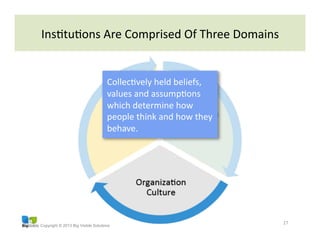
CollecGvely	
  held	
  beliefs,	
  
values	
  and	
  assumpGons	
  
which	
  determine	
  how	
  
people	
  think	
  and	
  how	
  they	
  
behave.	
  
InsGtuGons	
  Are	
  Comprised	
  Of	
  Three	
  Domains	
  
Copyright © 2013 Big Visible Solutions
28	
  
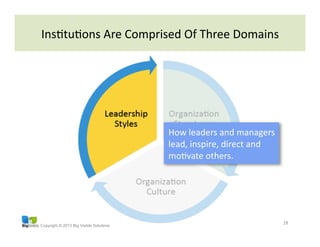
How	
  leaders	
  and	
  managers	
  
lead,	
  inspire,	
  direct	
  and	
  
moGvate	
  others.	
  
InsGtuGons	
  Are	
  Comprised	
  Of	
  Three	
  Domains	
  
Copyright © 2013 Big Visible Solutions
29	
  
By	
  building	
  insGtuGonal	
  capability	
  we	
  are	
  
effecGvely	
  crahing	
  the	
  environment	
  in	
  which	
  
people	
  live	
  and	
  work.	
  
Copyright © 2013 Big Visible Solutions
But,	
  why	
  the	
  Term	
  ‘Environment	
  Design’	
  
30	
  
Copyright © 2013 Big Visible Solutions
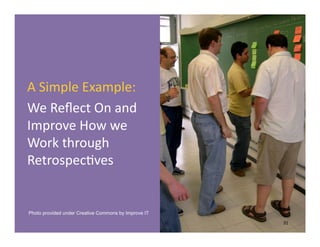
A	
  Simple	
  Example:	
  
We	
  Reflect	
  On	
  and	
  
Improve	
  How	
  we	
  
Work	
  through	
  
RetrospecGves	
  
31	
  
Photo provided under Creative Commons by Improve IT
Copyright © 2013 Big Visible Solutions
32	
  
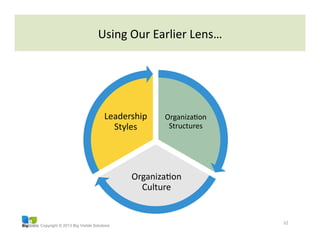
OrganizaGon	
  
Structures	
  
OrganizaGon	
  
Culture	
  
Leadership	
  
Styles	
  
Using	
  Our	
  Earlier	
  Lens…	
  
Copyright © 2013 Big Visible Solutions
33	
  
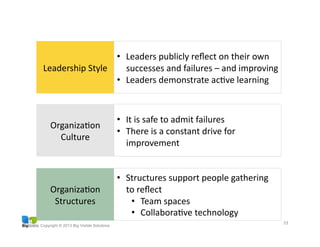
OrganizaGon	
  
Culture	
  
Leadership	
  Style	
  
•  Leaders	
  publicly	
  reflect	
  on	
  their	
  own	
  
successes	
  and	
  failures	
  –	
  and	
  improving	
  
•  Leaders	
  demonstrate	
  acGve	
  learning	
  
•  It	
  is	
  safe	
  to	
  admit	
  failures	
  
•  There	
  is	
  a	
  constant	
  drive	
  for	
  
improvement	
  
OrganizaGon	
  
Structures	
  
•  Structures	
  support	
  people	
  gathering	
  
to	
  reflect	
  
•  Team	
  spaces	
  
•  CollaboraGve	
  technology	
  
Copyright © 2013 Big Visible Solutions
34	
  
•  Leaders	
  and	
  managers	
  hypothesize	
  
capabiliGes	
  which	
  are	
  likely	
  to	
  lead	
  to	
  the	
  
realizaGon	
  of	
  declared	
  insGtuGonal	
  
outcomes	
  and	
  goals.	
  
Copyright © 2013 Big Visible Solutions
For	
  Example	
  
35	
  
Outmaneuver	
  the	
  
compeGGon	
  by	
  implemenGng	
  
high-­‐value	
  product	
  features	
  
faster	
  than	
  they	
  do	
  
Goal	
  
We	
  are	
  able	
  to	
  experiment	
  
with	
  new	
  product	
  ideas,	
  
quickly	
  idenGfying	
  what	
  is	
  
worth	
  invesGng	
  in	
  and	
  what	
  
is	
  not	
  
Capability	
  
•  Leaders	
  support	
  experimentaGon	
  <L>	
  
•  Fast	
  failures	
  are	
  celebrated	
  <C>	
  
•  Org	
  structures	
  facilitate	
  
experimentaGon	
  <S>	
  
•  Lean	
  startup	
  vocabulary	
  is	
  used	
  <C>	
  
Environment	
  
Design	
  
Copyright © 2013 Big Visible Solutions
36	
  
Practices of Environment Design
Copyright © 2013 Big Visible Solutions
37	
  
Empower/Enable
‘Champions’
TackletheBig
Elephants
Improving Org’l
Conditions
Orient Shared Vision
PracGces	
  of	
  Environment	
  Design	
  
ENVIRONMENT
Copyright © 2013 Big Visible Solutions 38
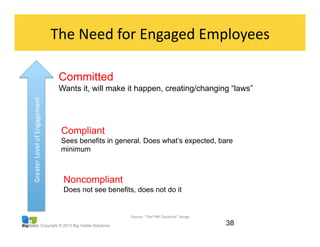
Committed
Wants it, will make it happen, creating/changing “laws”
Greater	
  Level	
  of	
  Engagement	
  
Source: “The Fifth Discipline” Senge
Commitment	
  Levels…	
  
Compliant
Sees benefits in general. Does what’s expected, bare
minimum
Noncompliant
Does not see benefits, does not do it
The	
  Need	
  for	
  Engaged	
  Employees	
  
Copyright © 2013 Big Visible Solutions
39	
  
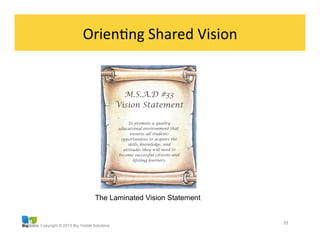
OrienGng	
  Shared	
  Vision	
  
The Laminated Vision Statement
Copyright © 2013 Big Visible Solutions
Is	
  Declaring	
  a	
  Vision	
  Enough?	
  
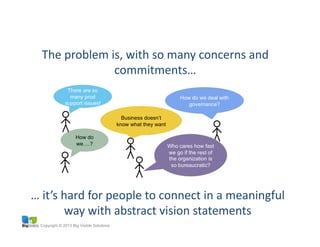
The	
  problem	
  is,	
  with	
  so	
  many	
  concerns	
  and	
  
commitments…	
  
…	
  it’s	
  hard	
  for	
  people	
  to	
  connect	
  in	
  a	
  meaningful	
  
way	
  with	
  abstract	
  vision	
  statements	
  
Copyright © 2013 Big Visible Solutions
Is	
  Declaring	
  a	
  Vision	
  Enough?	
  
Declare	
  vision,	
  
Champion.	
  
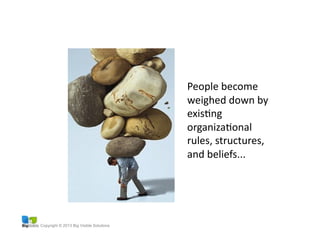
People	
  become	
  
weighed	
  down	
  by	
  
exisGng	
  
organizaGonal	
  
rules,	
  structures,	
  
and	
  beliefs...	
  
Copyright © 2013 Big Visible Solutions
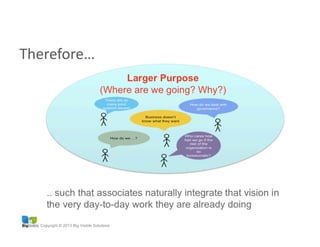
Rather	
  Than	
  Promoting	
  a	
  
Declared	
  Vision	
  	
  
Agile	
  Leaders	
  Orient	
  Associates	
  
Around	
  a	
  Shared	
  Vision	
  
Therefore…	
  
Copyright © 2013 Big Visible Solutions
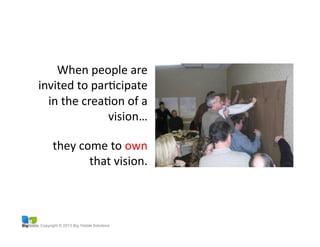
When	
  people	
  are	
  
invited	
  to	
  parGcipate	
  
in	
  the	
  creaGon	
  of	
  a	
  
vision…	
  
they	
  come	
  to	
  own	
  
that	
  vision.	
  
Copyright © 2013 Big Visible Solutions
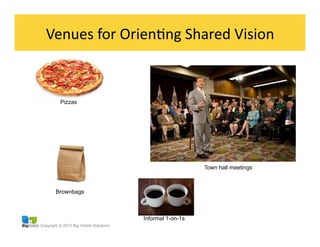
Venues	
  for	
  OrienGng	
  Shared	
  Vision	
  
Brownbags
Pizzas
Town hall meetings
Informal 1-on-1s
Copyright © 2013 Big Visible Solutions
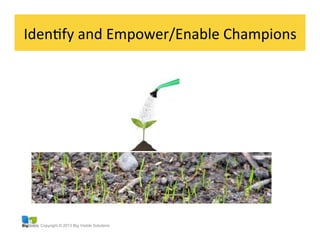
IdenGfy	
  and	
  Empower/Enable	
  Champions	
  
Copyright © 2013 Big Visible Solutions
IdenGfy	
  and	
  Empower/Enable	
  Champions	
  
Copyright © 2013 Big Visible Solutions
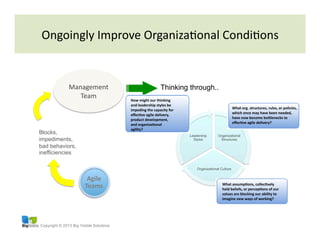
Thinking through..
Ongoingly	
  Improve	
  OrganizaGonal	
  CondiGons	
  
Agile	
  
Teams	
  
Blocks,
impediments,
bad behaviors,
inefficiencies
Management	
  
Team	
   How	
  might	
  our	
  thinking	
  
and	
  leadership	
  styles	
  be	
  
impeding	
  the	
  capacity	
  for	
  
effecGve	
  agile	
  delivery,	
  
product	
  development,	
  
and	
  organizaGonal	
  
agility?	
  
What	
  assumpGons,	
  collecGvely	
  
held	
  beliefs,	
  or	
  percepGons	
  of	
  our	
  
values	
  are	
  blocking	
  our	
  ability	
  to	
  
imagine	
  new	
  ways	
  of	
  working?	
  
What	
  org.	
  structures,	
  rules,	
  or	
  policies,	
  
which	
  once	
  may	
  have	
  been	
  needed,	
  
have	
  now	
  become	
  boKlenecks	
  to	
  
effecGve	
  agile	
  delivery?	
  
Copyright © 2013 Big Visible Solutions
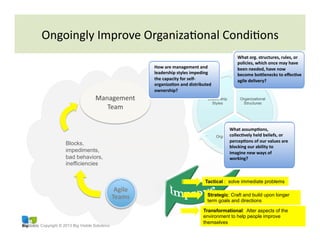
Ongoingly	
  Improve	
  OrganizaGonal	
  CondiGons	
  
ORGANIZATIONAL
ENVIRONMENT
Agile	
  
Teams	
  
Blocks,
impediments,
bad behaviors,
inefficiencies
Management	
  
Team	
  
Agile	
  Leadership	
  Principles	
  
How	
  are	
  management	
  and	
  
leadership	
  styles	
  impeding	
  
the	
  capacity	
  for	
  self-­‐
organizaGon	
  and	
  distributed	
  
ownership?	
  
What	
  assumpGons,	
  
collecGvely	
  held	
  beliefs,	
  or	
  
percepGons	
  of	
  our	
  values	
  are	
  
blocking	
  our	
  ability	
  to	
  
imagine	
  new	
  ways	
  of	
  
working?	
  
What	
  org.	
  structures,	
  rules,	
  or	
  
policies,	
  which	
  once	
  may	
  have	
  
been	
  needed,	
  have	
  now	
  
become	
  boKlenecks	
  to	
  effecGve	
  
agile	
  delivery?	
  
Tactical : solve immediate problems
Strategic: Craft and build upon longer
term goals and directions
Transformational: Alter aspects of the
environment to help people improve
themselves
Copyright © 2013 Big Visible Solutions
Tackle	
  the	
  Big	
  Elephants	
  
Copyright © 2013 Big Visible Solutions
Next: Transformation Beyond Agile Teams,
Part III
Copyright © 2013 Big Visible Solutions
THANK YOU!!

Leading and Managing Through the Design of Environments

  • 1.
    Copyright © 2013Big Visible Solutions Leading Through Environment Design Michael Hamman, Principal Agile Consultant (mhamman@bigvisible.com) George Schlitz, Principal, Founder (gschlitz@bigvisible.com)
  • 2.
    Copyright © 2013Big Visible Solutions If  you    want  to    build  a  ship,    don't  drum  up   the  people  to  gather  wood,  divide  the  work,   and  give  orders.  Instead,  teach  them  to  yearn   for  the    vast  and  endless  sea.   -­‐-­‐Antoine  De  Saint-­‐Exupery,     Author  of  The  Li'le  Prince   2  
  • 3.
    Copyright © 2013Big Visible Solutions 3   Brief Recap of Last Webinar…..
  • 4.
    Copyright © 2013Big Visible Solutions Broader  OrganizaGon  Capability   Last  Webinar….   4   Time Performance TEAM FOCUS
  • 5.
    Copyright © 2013Big Visible Solutions A  HolisGc  View  of  the  OrganizaGon   5   •  Leadership and management styles and beliefs about what constitutes effective leadership and management •  Structures, processes and systems by which work gets done and is organized •  Collective beliefs, perspectives and habits by which people make sense of things •  Product Management/Strategy •  Lean, continuous planning •  Product Development/Delivery •  Multiple Team/Programs •  Kanban •  Scrum •  Automated Testing •  TDD, CI, BDD •  User Stories, Estimation
  • 6.
    Copyright © 2013Big Visible Solutions A  HolisGc  View  of  the  OrganizaGon   6   •  Leadership and management styles and beliefs about what constitutes effective leadership and management •  Structures, processes and systems by which work gets done and is organized •  Collective beliefs, perspectives and habits by which people make sense of things •  Product Management/Strategy •  Lean, continuous planning •  Product Development/Delivery •  Multiple Team/Programs •  Kanban •  Scrum •  Automated Testing •  TDD, CI, BDD •  User Stories, Estimation Most Agile Implementations Focus Here
  • 7.
    Copyright © 2013Big Visible Solutions Last  Webinar….   7   •  Leadership and management styles and beliefs about what constitutes effective leadership and management •  Structures, processes and systems by which work gets done and is organized •  Collective beliefs, perspectives and habits by which people make sense of things •  Product Management/Strategy •  Lean, continuous planning •  Product Development/Delivery •  Multiple Team/Programs •  Kanban •  Scrum •  Automated Testing •  TDD, CI, BDD •  User Stories, Estimation Most Agile Implementations Focus Here Focus Across All Five for Sustainable Organizational Agility
  • 8.
    Copyright © 2013Big Visible Solutions Broader  OrganizaGon  Capability   Last  Webinar….   8   Time Performance
  • 9.
    Copyright © 2013Big Visible Solutions From  DIRECTING   #  3:  Shifting  The  Paradigm…   Telling Motivating Incenting Coordinating Last  Webinar….   LEADING…….
  • 10.
    Copyright © 2013Big Visible Solutions #  3:  Shifting  The  Paradigm…   To  CATALYZING   Sources: Leadership Agility, Bill Joiner and Stephen Josephs; Action Inquiry, William Torbert et. al. Visioning Facilitative Empowering and Enabling Seeing the Larger Context Last  Webinar….   LEADING…….
  • 11.
    Copyright © 2013Big Visible Solutions 11 Designing Environments: A Foundational Practice of Catalytic Leadership Last  Webinar….  
  • 12.
    Copyright © 2013Big Visible Solutions 12   What is ‘Environment Design’? Why ‘Environment Design’? The Principles of Environment Design Four Practices of Environment Design Start   End   Today’s  Webinar:  Deeper  Dive  Into   Environment  Design  
  • 13.
    Copyright © 2013Big Visible Solutions 13   Managing  By  Trying  to  Change  People’s  Behavior   Direct, incentivize, Tell, motivate
  • 14.
    Copyright © 2013Big Visible Solutions 14   Managing  By  Altering  How  World  Occurs  For  People*   * Steve Zaffron, Dave Logan, The Three Laws of Performance 2009
  • 15.
    Copyright © 2013Big Visible Solutions 15   Managing  Through  the  Design  of  Environments  
  • 16.
    Copyright © 2013Big Visible Solutions Environments  are   •  Physical   •  Social   •  AestheGc   •  Intellectual   •  EmoGonal   •  Technological   16  
  • 17.
    Copyright © 2013Big Visible Solutions Design  is   •  Sense-­‐and-­‐Respond   •  Experimental   •  Acute  Sensing   •  Tight  Feedback   •  HolisGc   17   •  AestheGc  
  • 18.
    Copyright © 2013Big Visible Solutions “Design  is  a  baale  between  losing  the  dream   but  naming  the  thing,  and  losing  the  name   while  keeping  the  dream  that  sGrs  others  to   make  the  dream  happen”   -­‐-­‐  Karl  Weick   18  
  • 19.
    Copyright © 2013Big Visible Solutions 19   Why Environment Design?
  • 20.
    Copyright © 2013Big Visible Solutions Why  the  Term  ‘Environment  Design’   20   •  Thomas Leonard, Coach Training •  The Portable Coach •  Systems Thinking 10 years ago – started to bring this approach into my coaching work with large companies
  • 21.
    Copyright © 2013Big Visible Solutions Why  the  Term  ‘Environment  Design’   21   •  New agile teams got up to speed faster •  Managers were better able to manage appropriately •  Organizational challenges came to be easier to resolve •  People self-organized around creating (and asking for) what they needed to facilitate desirable agile change.
  • 22.
    Copyright © 2013Big Visible Solutions 22   A  Systems  Thinking  View  of  OrganizaGons   SIMPLE Cause->Effect Cause-Effect Relations well-understood Do X and you’ll ALWAYS get Y Standard operating procedures: best practices Example: Call Center SENSE-CATEGORIZE-RESPOND COMPLICATED Cause-------------------------->Effect Cause-Effect Relations still linear, but much harder to find Requires high degree of expertise Example: Building a Ferrari engine SENSE-ANALYZE-RESPOND COMPLEX Cause<->Effect Cause-Effect Relations are mutual Do X one time, get X; but next time, you might get T You can only know something after the fact Therefore, an experimental approach is better Example: Product Development; most management and organizational situations TRY-SENSE-RESPOND CHAOS Cause -??-Effect Cause-Effect Relations are unknown No way to discern what’s happening Best approach: act decisively to try to move the system into one of the other quadrants (e.g. Complex) Example: 9-11 ACT-SENSE-RESPOND Based on David J. Snowden and Mary E. Boone, A Leader’s Framework for Decision Making, Harvard Business Review, Nov. 2007 Where most management situations live
  • 23.
    Copyright © 2013Big Visible Solutions Managing  for  Change  in  a  Complex  System   Since   1.  We  can  only  see  things  in  retrospect   2.  Complex  organizaGons  are  whole  systems   3.  Complex  organizaGons  are  complex  networks   23   Therefore   1.  We  need  to  take  a  Try-­‐Sense-­‐Respond  approach   2.  We  need  to  be  able  to  engage  the  whole  system   3.  We  need  to  help  people  see  and  align  with  the   bigger  picture  we  are  trying  to  create  
  • 24.
    Copyright © 2013Big Visible Solutions 24   Managing  for  Change  in  a  Complex  System  Is   About  Building  InsGtuGonal  Capability  
  • 25.
    Copyright © 2013Big Visible Solutions 25   OrganizaGon   Structures   OrganizaGon   Culture   Leadership   Styles   InsGtuGons  Are  Comprised  Of  Three  Domains  
  • 26.
    Copyright © 2013Big Visible Solutions 26   The  organizaGonal   structures,  rules  and   policies  which  facilitate   how  work  gets  done  and   how  results  get  produced.   InsGtuGons  Are  Comprised  Of  Three  Domains  
  • 27.
    Copyright © 2013Big Visible Solutions 27   CollecGvely  held  beliefs,   values  and  assumpGons   which  determine  how   people  think  and  how  they   behave.   InsGtuGons  Are  Comprised  Of  Three  Domains  
  • 28.
    Copyright © 2013Big Visible Solutions 28   How  leaders  and  managers   lead,  inspire,  direct  and   moGvate  others.   InsGtuGons  Are  Comprised  Of  Three  Domains  
  • 29.
    Copyright © 2013Big Visible Solutions 29   By  building  insGtuGonal  capability  we  are   effecGvely  crahing  the  environment  in  which   people  live  and  work.  
  • 30.
    Copyright © 2013Big Visible Solutions But,  why  the  Term  ‘Environment  Design’   30  
  • 31.
    Copyright © 2013Big Visible Solutions A  Simple  Example:   We  Reflect  On  and   Improve  How  we   Work  through   RetrospecGves   31   Photo provided under Creative Commons by Improve IT
  • 32.
    Copyright © 2013Big Visible Solutions 32   OrganizaGon   Structures   OrganizaGon   Culture   Leadership   Styles   Using  Our  Earlier  Lens…  
  • 33.
    Copyright © 2013Big Visible Solutions 33   OrganizaGon   Culture   Leadership  Style   •  Leaders  publicly  reflect  on  their  own   successes  and  failures  –  and  improving   •  Leaders  demonstrate  acGve  learning   •  It  is  safe  to  admit  failures   •  There  is  a  constant  drive  for   improvement   OrganizaGon   Structures   •  Structures  support  people  gathering   to  reflect   •  Team  spaces   •  CollaboraGve  technology  
  • 34.
    Copyright © 2013Big Visible Solutions 34   •  Leaders  and  managers  hypothesize   capabiliGes  which  are  likely  to  lead  to  the   realizaGon  of  declared  insGtuGonal   outcomes  and  goals.  
  • 35.
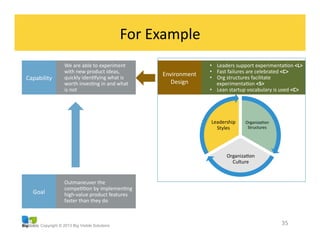
    Copyright © 2013Big Visible Solutions For  Example   35   Outmaneuver  the   compeGGon  by  implemenGng   high-­‐value  product  features   faster  than  they  do   Goal   We  are  able  to  experiment   with  new  product  ideas,   quickly  idenGfying  what  is   worth  invesGng  in  and  what   is  not   Capability   •  Leaders  support  experimentaGon  <L>   •  Fast  failures  are  celebrated  <C>   •  Org  structures  facilitate   experimentaGon  <S>   •  Lean  startup  vocabulary  is  used  <C>   Environment   Design  
  • 36.
    Copyright © 2013Big Visible Solutions 36   Practices of Environment Design
  • 37.
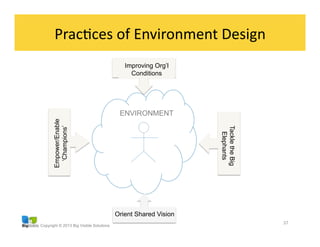
    Copyright © 2013Big Visible Solutions 37   Empower/Enable ‘Champions’ TackletheBig Elephants Improving Org’l Conditions Orient Shared Vision PracGces  of  Environment  Design   ENVIRONMENT
  • 38.
    Copyright © 2013Big Visible Solutions 38 Committed Wants it, will make it happen, creating/changing “laws” Greater  Level  of  Engagement   Source: “The Fifth Discipline” Senge Commitment  Levels…   Compliant Sees benefits in general. Does what’s expected, bare minimum Noncompliant Does not see benefits, does not do it The  Need  for  Engaged  Employees  
  • 39.
    Copyright © 2013Big Visible Solutions 39   OrienGng  Shared  Vision   The Laminated Vision Statement
  • 40.
    Copyright © 2013Big Visible Solutions Is  Declaring  a  Vision  Enough?   The  problem  is,  with  so  many  concerns  and   commitments…   …  it’s  hard  for  people  to  connect  in  a  meaningful   way  with  abstract  vision  statements  
  • 41.
    Copyright © 2013Big Visible Solutions Is  Declaring  a  Vision  Enough?   Declare  vision,   Champion.   People  become   weighed  down  by   exisGng   organizaGonal   rules,  structures,   and  beliefs...  
  • 42.
    Copyright © 2013Big Visible Solutions Rather  Than  Promoting  a   Declared  Vision     Agile  Leaders  Orient  Associates   Around  a  Shared  Vision   Therefore…  
  • 43.
    Copyright © 2013Big Visible Solutions When  people  are   invited  to  parGcipate   in  the  creaGon  of  a   vision…   they  come  to  own   that  vision.  
  • 44.
    Copyright © 2013Big Visible Solutions Venues  for  OrienGng  Shared  Vision   Brownbags Pizzas Town hall meetings Informal 1-on-1s
  • 45.
    Copyright © 2013Big Visible Solutions IdenGfy  and  Empower/Enable  Champions  
  • 46.
    Copyright © 2013Big Visible Solutions IdenGfy  and  Empower/Enable  Champions  
  • 47.
    Copyright © 2013Big Visible Solutions Thinking through.. Ongoingly  Improve  OrganizaGonal  CondiGons   Agile   Teams   Blocks, impediments, bad behaviors, inefficiencies Management   Team   How  might  our  thinking   and  leadership  styles  be   impeding  the  capacity  for   effecGve  agile  delivery,   product  development,   and  organizaGonal   agility?   What  assumpGons,  collecGvely   held  beliefs,  or  percepGons  of  our   values  are  blocking  our  ability  to   imagine  new  ways  of  working?   What  org.  structures,  rules,  or  policies,   which  once  may  have  been  needed,   have  now  become  boKlenecks  to   effecGve  agile  delivery?  
  • 48.
    Copyright © 2013Big Visible Solutions Ongoingly  Improve  OrganizaGonal  CondiGons   ORGANIZATIONAL ENVIRONMENT Agile   Teams   Blocks, impediments, bad behaviors, inefficiencies Management   Team   Agile  Leadership  Principles   How  are  management  and   leadership  styles  impeding   the  capacity  for  self-­‐ organizaGon  and  distributed   ownership?   What  assumpGons,   collecGvely  held  beliefs,  or   percepGons  of  our  values  are   blocking  our  ability  to   imagine  new  ways  of   working?   What  org.  structures,  rules,  or   policies,  which  once  may  have   been  needed,  have  now   become  boKlenecks  to  effecGve   agile  delivery?   Tactical : solve immediate problems Strategic: Craft and build upon longer term goals and directions Transformational: Alter aspects of the environment to help people improve themselves
  • 49.
    Copyright © 2013Big Visible Solutions Tackle  the  Big  Elephants  
  • 50.
    Copyright © 2013Big Visible Solutions Next: Transformation Beyond Agile Teams, Part III
  • 51.
    Copyright © 2013Big Visible Solutions THANK YOU!!