

Making money sensetips and ideas to help your family prosperBuying a Home
Am I Ready To Buy A Home?Important questions to consider if you think buying a house is right for you…Do you have a steady income?Have you been employed on a regular basis for 2-3 years?Is your income reliable?Do you have a credit history?Do you have a good record of paying your bills?Will you be able to pay your bills and other debts?Do you have the ability to make the mortgage payment every month, plus handle additional costs for taxes, insurance, maintenance and repairs?Do you have money saved for a down payment and closing costs?1Source: www.practicalmoneyskills.com
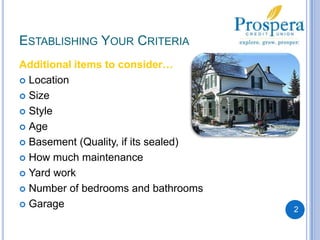
Establishing Your Criteria2Additional items to consider…LocationSizeStyle AgeBasement (Quality, if its sealed)How much maintenanceYard workNumber of bedrooms and bathroomsGarage
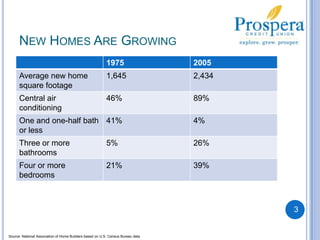
New Homes Are Growing3Source: National Association of Home Builders based on U.S. Census Bureau data
Can I Afford A HousePre-Qualification: informal way to find out how much you can afford.Pre-Approval: commitment from lender to provide you with funds.Debt to Income (DTI) ratio: your monthly expenses compared to your monthly gross income.Front-end ratio: lenders usually require the principal, interest, taxes, and insurance (PITI) or your housing expenses to be less than or equal to 28% to 30% of your monthly gross income.Back-end ratio: lenders usually require housing expenses plus long-term debt (credit cards, student loans and car loans) to be less than or equal to 33% to 36% of your monthly gross income.5
Let The House Hunting Begin1. Select a real estate agent or do it yourself82% of home sales are the result of agent connectionsBest way to find a real estate agentReferralContact the selling- agent who has the listingWebsiteAdvertising Services offered by a real estate agentPricingSell or buy your houseOpen houseshttp://www.inhouserealty.com/2. Make an offer/strike a deal3. Prepare for closing 4. Close the deal6
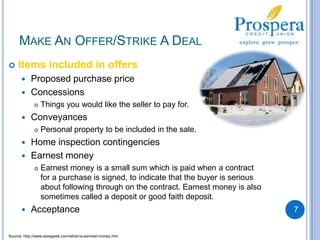
Make An Offer/Strike A DealItems included in offersProposed purchase priceConcessionsThings you would like the seller to pay for.ConveyancesPersonal property to be included in the sale.Home inspection contingenciesEarnest moneyEarnest money is a small sum which is paid when a contract for a purchase is signed, to indicate that the buyer is serious about following through on the contract. Earnest money is also sometimes called a deposit or good faith deposit.Acceptance 7Source: http://www.wisegeek.com/what-is-earnest-money.htm
Prepare For Closing Good Faith EstimateYour lender is required to provide you with a good-faith estimate of the fees due at closing. This document is supposed to be provided to you within three days of applying for a loan. Closing fees cover almost every expense associated with your home loan. Because closing costs typically amount to between 3 percent and 5 percent of the sale price, it is best to wait until you receive the good-faith estimate before committing to a loan. Closing costsEstimate about $1200 on average for closing costs.  Also remember that your closing costs and down payment must be certified funds, it cannot be rolled into the mortgage loan.Hiring a home inspector Never forgo a professional inspection.Schedule your home inspection when you can be there.Every house needs an inspection.No home can “fail” a home inspection.Obtain homeowners insurance8Source: http://www.bankrate.com/finance/mortgages/the-good-faith-estimate-1.aspx
Basic Mortgage OptionsBi-weeklySave money over the term of your mortgage by making mortgage payments bi-weekly instead of monthly. ARMWant lower monthly payments? Adjustable Rate Mortgages usually offer lower rates than fixed rate loans making your monthly payments lower. (Rates are subject to change as market conditions fluctuate.) FixedIf security is what you want, your rate and payments will remain the same for the life of the loan with Fixed Rate Mortgages. BalloonA Balloon Mortgage is unique because it has a short term but is amortized over 25 or 30 years. This means you pay a combination of interest and principle each month. The balance of the loan is then paid in full at the end of the term. The rate is fixed for the term of the loan. This type of mortgage generally carries a lower rate than 15 or 30-year fixed rate mortgages. 9Source: http://www.myprospera.com/personal_loans/mortgages.asp
Other Mortgage OptionsVA- For Veterans, no down payment, no primary mortgage insurance.Interest-Only – Pay interest for specified number of years.  Then principal and interest (3-10 years).Option ARM – Choose among several payment options:Traditional payment (principal & interest) rate starts lowInterest only paymentMinimum or limited payment Options ARMs are concentrated in areas such as California and Florida that have seen some of the biggest home-price downturns.70-80% of option ARM borrowers go with the minimum payment option.10
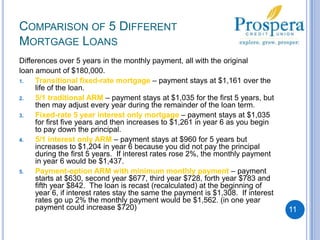
Comparison of 5 Different Mortgage LoansDifferences over 5 years in the monthly payment, all with the original loan amount of $180,000.Transitional fixed-rate mortgage – payment stays at $1,161 over the life of the loan.5/1 traditional ARM – payment stays at $1,035 for the first 5 years, but then may adjust every year during the remainder of the loan term.Fixed-rate 5 year interest only mortgage – payment stays at $1,035 for first five years and then increases to $1,261 in year 6 as you begin to pay down the principal.5/1 interest only ARM – payment stays at $960 for 5 years but increases to $1,204 in year 6 because you did not pay the principal during the first 5 years.  If interest rates rose 2%, the monthly payment in year 6 would be $1,437.Payment-option ARM with minimum monthly payment – payment starts at $630, second year $677, third year $728, forth year $783 and fifth year $842.  The loan is recast (recalculated) at the beginning of year 6, if interest rates stay the same the payment is $1,308.  If interest rates go up 2% the monthly payment would be $1,562. (in one year payment could increase $720)11
12 Ways To Lower Your Homeowners Insurance CostsShop aroundRaise your deductibleDon’t confuse what you paid for your house with rebuilding costsBuy your home and auto policies from the same insurerMake your home more disaster resistantImprove your home securitySeek out other discountsMaintain a good credit recordStay with the same insurerReview limits in your policy and the value of your possessions at least once a yearLook for private insurance if you are in a government planWhen you’re buying a home, consider the cost of homeowners insuranceTo read the article in full go to http://www.pueblo.gsa.gov/cic_text/housing/12ways/12ways.htm12
For more information:920.882.4800www.myprospera.comFor more great financial tips and news follow us on Twitter and facebook!http://twitter.com/MyProsperahttp://facebook.com/

Buying A Home

  • 1.
    Making money sensetipsand ideas to help your family prosperBuying a Home
  • 2.
    Am I ReadyTo Buy A Home?Important questions to consider if you think buying a house is right for you…Do you have a steady income?Have you been employed on a regular basis for 2-3 years?Is your income reliable?Do you have a credit history?Do you have a good record of paying your bills?Will you be able to pay your bills and other debts?Do you have the ability to make the mortgage payment every month, plus handle additional costs for taxes, insurance, maintenance and repairs?Do you have money saved for a down payment and closing costs?1Source: www.practicalmoneyskills.com
  • 3.
    Establishing Your Criteria2Additionalitems to consider…LocationSizeStyle AgeBasement (Quality, if its sealed)How much maintenanceYard workNumber of bedrooms and bathroomsGarage
  • 4.
    New Homes AreGrowing3Source: National Association of Home Builders based on U.S. Census Bureau data
  • 5.
    Can I AffordA HousePre-Qualification: informal way to find out how much you can afford.Pre-Approval: commitment from lender to provide you with funds.Debt to Income (DTI) ratio: your monthly expenses compared to your monthly gross income.Front-end ratio: lenders usually require the principal, interest, taxes, and insurance (PITI) or your housing expenses to be less than or equal to 28% to 30% of your monthly gross income.Back-end ratio: lenders usually require housing expenses plus long-term debt (credit cards, student loans and car loans) to be less than or equal to 33% to 36% of your monthly gross income.5
  • 6.
    Let The HouseHunting Begin1. Select a real estate agent or do it yourself82% of home sales are the result of agent connectionsBest way to find a real estate agentReferralContact the selling- agent who has the listingWebsiteAdvertising Services offered by a real estate agentPricingSell or buy your houseOpen houseshttp://www.inhouserealty.com/2. Make an offer/strike a deal3. Prepare for closing 4. Close the deal6
  • 7.
    Make An Offer/StrikeA DealItems included in offersProposed purchase priceConcessionsThings you would like the seller to pay for.ConveyancesPersonal property to be included in the sale.Home inspection contingenciesEarnest moneyEarnest money is a small sum which is paid when a contract for a purchase is signed, to indicate that the buyer is serious about following through on the contract. Earnest money is also sometimes called a deposit or good faith deposit.Acceptance 7Source: http://www.wisegeek.com/what-is-earnest-money.htm
  • 8.
    Prepare For ClosingGood Faith EstimateYour lender is required to provide you with a good-faith estimate of the fees due at closing. This document is supposed to be provided to you within three days of applying for a loan. Closing fees cover almost every expense associated with your home loan. Because closing costs typically amount to between 3 percent and 5 percent of the sale price, it is best to wait until you receive the good-faith estimate before committing to a loan. Closing costsEstimate about $1200 on average for closing costs. Also remember that your closing costs and down payment must be certified funds, it cannot be rolled into the mortgage loan.Hiring a home inspector Never forgo a professional inspection.Schedule your home inspection when you can be there.Every house needs an inspection.No home can “fail” a home inspection.Obtain homeowners insurance8Source: http://www.bankrate.com/finance/mortgages/the-good-faith-estimate-1.aspx
  • 9.
    Basic Mortgage OptionsBi-weeklySavemoney over the term of your mortgage by making mortgage payments bi-weekly instead of monthly. ARMWant lower monthly payments? Adjustable Rate Mortgages usually offer lower rates than fixed rate loans making your monthly payments lower. (Rates are subject to change as market conditions fluctuate.) FixedIf security is what you want, your rate and payments will remain the same for the life of the loan with Fixed Rate Mortgages. BalloonA Balloon Mortgage is unique because it has a short term but is amortized over 25 or 30 years. This means you pay a combination of interest and principle each month. The balance of the loan is then paid in full at the end of the term. The rate is fixed for the term of the loan. This type of mortgage generally carries a lower rate than 15 or 30-year fixed rate mortgages. 9Source: http://www.myprospera.com/personal_loans/mortgages.asp
  • 10.
    Other Mortgage OptionsVA-For Veterans, no down payment, no primary mortgage insurance.Interest-Only – Pay interest for specified number of years. Then principal and interest (3-10 years).Option ARM – Choose among several payment options:Traditional payment (principal & interest) rate starts lowInterest only paymentMinimum or limited payment Options ARMs are concentrated in areas such as California and Florida that have seen some of the biggest home-price downturns.70-80% of option ARM borrowers go with the minimum payment option.10
  • 11.
    Comparison of 5Different Mortgage LoansDifferences over 5 years in the monthly payment, all with the original loan amount of $180,000.Transitional fixed-rate mortgage – payment stays at $1,161 over the life of the loan.5/1 traditional ARM – payment stays at $1,035 for the first 5 years, but then may adjust every year during the remainder of the loan term.Fixed-rate 5 year interest only mortgage – payment stays at $1,035 for first five years and then increases to $1,261 in year 6 as you begin to pay down the principal.5/1 interest only ARM – payment stays at $960 for 5 years but increases to $1,204 in year 6 because you did not pay the principal during the first 5 years. If interest rates rose 2%, the monthly payment in year 6 would be $1,437.Payment-option ARM with minimum monthly payment – payment starts at $630, second year $677, third year $728, forth year $783 and fifth year $842. The loan is recast (recalculated) at the beginning of year 6, if interest rates stay the same the payment is $1,308. If interest rates go up 2% the monthly payment would be $1,562. (in one year payment could increase $720)11
  • 12.
    12 Ways ToLower Your Homeowners Insurance CostsShop aroundRaise your deductibleDon’t confuse what you paid for your house with rebuilding costsBuy your home and auto policies from the same insurerMake your home more disaster resistantImprove your home securitySeek out other discountsMaintain a good credit recordStay with the same insurerReview limits in your policy and the value of your possessions at least once a yearLook for private insurance if you are in a government planWhen you’re buying a home, consider the cost of homeowners insuranceTo read the article in full go to http://www.pueblo.gsa.gov/cic_text/housing/12ways/12ways.htm12
  • 13.
    For more information:920.882.4800www.myprospera.comFormore great financial tips and news follow us on Twitter and facebook!http://twitter.com/MyProsperahttp://facebook.com/