Welcome to...
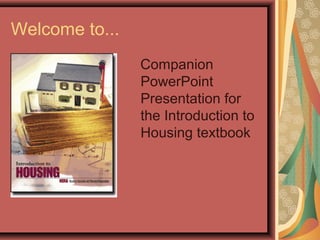
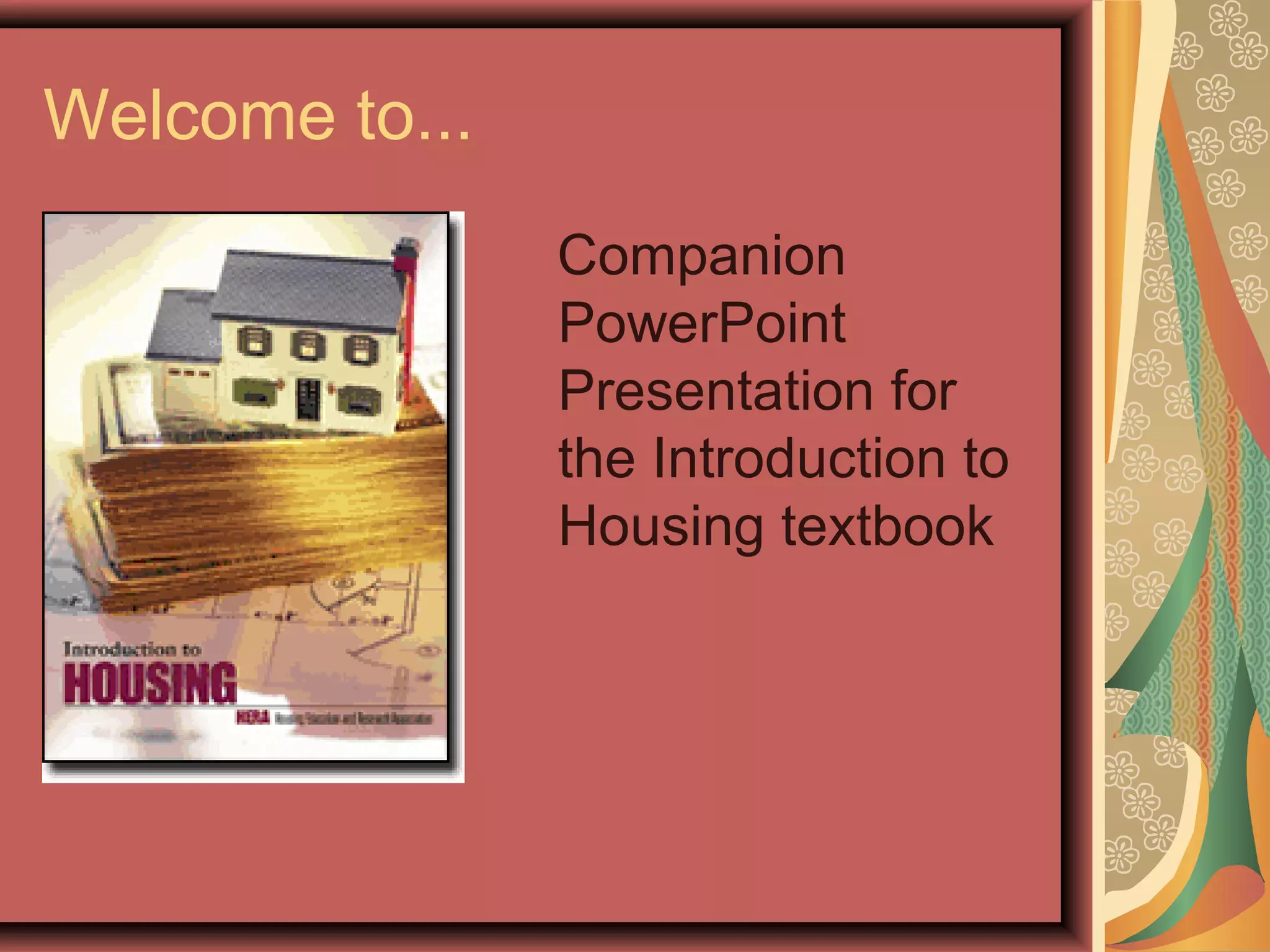
Companion
PowerPoint
Presentation for
the Introduction to
Housing textbook
Homeownership
Quick Facts
Homeownership has both benefits &
drawbacks. It is not always the best option
at a time.
Buying your first house needs preparing &
preserving.
Prepare a guidelines to help you store for a
house.
Prequalify for home financing to see how
much house you are able.
There are several govt applications for first-
time & low- to moderate-income real estate
customers.
Homeownership: The American
Dream
Purchasing a home is one of the most
important choices children can make.
It has serious economical &
psychological effects and is a main
issue with the United states desire.
Advantages
Pressured benefits plan because your
home loan major expenses are
maintained as value in the home
Usually a good long-term investment–
value will most likely improve
eventually
Deduct residence taxation & interest
rates from earnings tax
Over time home become less
expensive in "real" dollars
As value develops, you can step up
to a bigger house or lend against your
house (home value loan) to fund
large purchases
Homeownership can improve a
family's sense of control over their
lifestyles & atmosphere, as well as
improve more powerful group
connections
You can personalize the home to
match special needs & tastes
Disadvantages
Per month installments (principal,
interest, taxation & insurance) may be
higher than lease payments
You must pay for normal servicing &
frequent repairs
Owning is less versatile than renting;
most first-time real estate customers
live in a house for 7 years
Like any financial commitment, there
is no assurance that value boosts
What Do We Want? (Professional
Builder magazine, 2006)
Boomers (age 41-60)
Per month installments (principal, interest,
taxation & insurance) may be higher than
lease payments
You must pay for normal servicing &
frequent repairs
Owning is less versatile than renting; most
first-time real estate customers live in a
house for 7 years
Like any financial commitment, there is no
assurance that value boosts
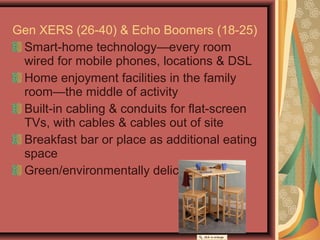
Gen XERS (26-40) & Echo Boomers (18-25)
Smart-home technology—every room
wired for mobile phones, locations & DSL
Home enjoyment facilities in the family
room—the middle of activity
Built-in cabling & conduits for flat-screen
TVs, with cables & cables out of site
Breakfast bar or place as additional eating
space
Green/environmentally delicate features
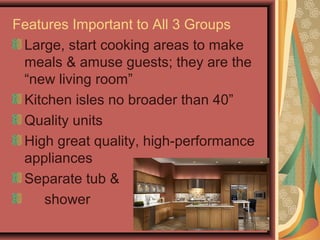
Features Important to All 3 Groups
Large, start cooking areas to make
meals & amuse guests; they are the
“new living room”
Kitchen isles no broader than 40”
Quality units
High great quality, high-performance
appliances
Separate tub &
shower
Prepare for Homeownership
Buying your first house includes
planning & saving—attend a real
estate customer education and
learning category to help you get
ready for homeownership
Possible obstacles:
High Cost
Discover options to the conventional
single-family separated house:
apartment, manufactured house, or
older house (generally can afford a
house 2.5 times total yearly income)
Credit
Pay off your financial troubles & wait
significant buys until after you buy a
home
Get a duplicate of your credit rating
file to see if any issues exist
www.equifax.com
If your credit score is not great,
check out subprime loans
Downpayment
Most traditional mortgages--20% of
the amount
However, there are methods to
lessen downpayments to the 0 to 5%
range:
--government-insured loans
--local real estate
organizations & creditors may have
applications for first-time home
buyers
--curtail your investing & ask relatives
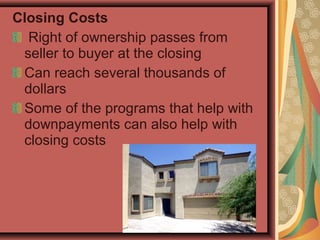
Closing Costs
Right of ownership passes from
seller to buyer at the closing
Can reach several thousands of
dollars
Some of the programs that help with
downpayments can also help with
closing costs
Long-term Affordability
Per month major, attention, residence
taxation & insurance (PITI) expenses
No more than 28% of your total
monthly earnings should go to PITI
(front-end ratio)
Monthly PITI expenses plus any other
long-term debts expenses should not
surpass 36% of your total monthly
earnings (back-end ratio)
Also need a support to protect
servicing & repairs
Project
You have been provided two tasks,
one in Fitzgibbons, MS, and the other
in LA. Go to appropriate property
Websites & select two similar houses.
Explain each house such as its price
& functions, and fix an image. Given
that 28% of your earnings can go
towards real property, how much
would you have to generate to
manage each home? Which would
you choose?
Initial Selection of Homes
Once you are economically prepared to
purchase a home, identify one that fits your
principles, needs, wants & price range
Where to look?
--Real property part of a nearby
newspaper
--Real property consumer books
--Real property Web websites
--Driving, bike riding & strolling
through neighborhoods
--Stop at model/open homes
Select a Real Estate Agent
Select a representative to help filter
your choices
Agents are a valuable source of
information because they are familiar
with property in a specific area
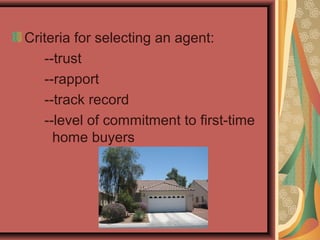
Criteria for selecting an agent:
--trust
--rapport
--track record
--level of commitment to first-time
home buyers
As you consider different homes,
evaluate each based on values,
needs, wants & financial issues
Be flexible, realistic & responsible—
Your first home will most likely not
be your dream home
Develop a checklist:
Can you & your family be happy
living in this home?
House Hunting Checklist
(Ideas of what to include, but your list must be
personalized based on your needs)
Is the area safe?
Are the houses in the area
maintained?
Does the home have enough rooms
& bathrooms?
Is there sufficient storage area
space?
Are there top quality educational
institutions in the area?
Is the place of the home and group
convenient?
Is there a property owners
association?
Is the area quiet?
Does the floor-plan match your
lifestyle?
Is the home power efficient?
Is the garden easy to worry for?
What group solutions are available?
Are the equipment & accessories
adequate?
What are the common servicing
expenses for the house?
How great are regional residence
taxes?
Obtain Financing
When you store for a home, also
store for home financing
Get pre-qualified so you have a better
idea of budget (price range of houses
that you can afford)
Mortgage creditors include:
professional financial institutions,
benefits & loan organizations,
creditors & credit unions
Two possibilities for low- and
moderate-income home buyers are:
Fannie Mae's Community Home
Buyers Program
Freddie Mac's Affordable Gold
Program
Government agencies—
FHA
VA
RHS
State housing & finance authority
Besides downpayment, carefully
compare mortgage options based on
these criteria:
Annual percentage rate (APR)
Total yearly cost of a mortgage as a
percentage of the loan amount
Includes the contract interest rate,
mortgage insurance & points (each
point equals 1% of the loan amount)
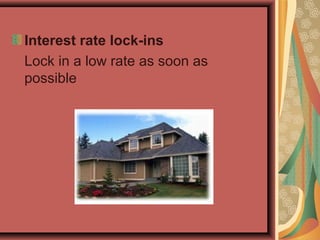
Interest rate lock-ins
Lock in a low rate as soon as
possible
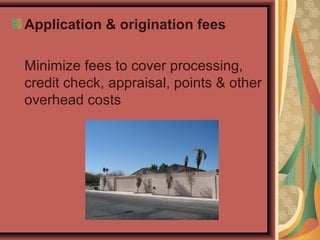
Application & origination fees
Minimize fees to cover processing,
credit check, appraisal, points & other
overhead costs
Term
For most first-time home buyers a 30-year
term to pay off the mortgage is appropriate
Determine if you want a fixed or adjustable
rate mortgage
A fixed rate mortgage
Loans are fully amortized with a fixed
interest rate for the entire term -- both the
principal & interest are paid off at the end
of the loan
An adjustable rate mortgage (ARM)
Interest rate adjusted periodically,
usually every 1, 3, or 5 years based
on an index written into the loan
agreement
Might initially get a lower interest rate,
but future increases may mean higher
monthly payments
Negotiate and Enter Into Contract
Buy offer
Offer is typically given to the property
broker who provides it to the supplier
(earnest money)
Get a home examination report--a
certified examiner provides an
purpose viewpoint about home’s
condition
Purchase contract
Loan Approval
Obtain actual financing for home
Lender will ask about your income,
expenses, history of credit score,
employment, & the terms of purchase
offer
You complete form & pay a software
fee, pay for a credit score file &
appraisal, receive an estimate of
settlement costs & truth-in-lending
statement Loan processing occurs
Closing
Final step is the closing, a meeting
between you, your lender, the seller &
other interested parties
Review & sign loan documents
Exchange of documents between
buyer, seller & lender
Disbursement of funds
You receive the deed to the property
& join the ranks of homeowners!
Potential Difficulties
Discrimination
Against the law—Fair Housing Act
Fair housing—several consumer laws
or acts prohibiting discrimination
Subprime & predatory lending
Credit affected debtors can benefit with
a subprime mortgage
Predatory lending comprises of unjust
or violent loans, including a number
of aggressive methods
Postpurchase Concerns
Keeping up with servicing & maintenance
(avoid an costly crisis)
Create a servicing fund
Remodeling & improvements—make
advised choices in picking the venture,
specialist, or determining to do it yourself
Refinancing—may be a wise idea when
interest levels go down
Foreclosure prevention
Loss minimization resources such as a
loan modification

House Buying Guides | Kim Solveson

  • 1.
  • 2.
  • 3.
    Quick Facts Homeownership hasboth benefits & drawbacks. It is not always the best option at a time. Buying your first house needs preparing & preserving. Prepare a guidelines to help you store for a house. Prequalify for home financing to see how much house you are able. There are several govt applications for first- time & low- to moderate-income real estate customers.
  • 4.
    Homeownership: The American Dream Purchasinga home is one of the most important choices children can make. It has serious economical & psychological effects and is a main issue with the United states desire.
  • 5.
    Advantages Pressured benefits planbecause your home loan major expenses are maintained as value in the home Usually a good long-term investment– value will most likely improve eventually Deduct residence taxation & interest rates from earnings tax Over time home become less expensive in "real" dollars
  • 6.
    As value develops,you can step up to a bigger house or lend against your house (home value loan) to fund large purchases Homeownership can improve a family's sense of control over their lifestyles & atmosphere, as well as improve more powerful group connections You can personalize the home to match special needs & tastes
  • 7.
    Disadvantages Per month installments(principal, interest, taxation & insurance) may be higher than lease payments You must pay for normal servicing & frequent repairs Owning is less versatile than renting; most first-time real estate customers live in a house for 7 years Like any financial commitment, there is no assurance that value boosts
  • 8.
    What Do WeWant? (Professional Builder magazine, 2006) Boomers (age 41-60) Per month installments (principal, interest, taxation & insurance) may be higher than lease payments You must pay for normal servicing & frequent repairs Owning is less versatile than renting; most first-time real estate customers live in a house for 7 years Like any financial commitment, there is no assurance that value boosts
  • 9.
    Gen XERS (26-40)& Echo Boomers (18-25) Smart-home technology—every room wired for mobile phones, locations & DSL Home enjoyment facilities in the family room—the middle of activity Built-in cabling & conduits for flat-screen TVs, with cables & cables out of site Breakfast bar or place as additional eating space Green/environmentally delicate features
  • 10.
    Features Important toAll 3 Groups Large, start cooking areas to make meals & amuse guests; they are the “new living room” Kitchen isles no broader than 40” Quality units High great quality, high-performance appliances Separate tub & shower
  • 11.
    Prepare for Homeownership Buyingyour first house includes planning & saving—attend a real estate customer education and learning category to help you get ready for homeownership Possible obstacles: High Cost Discover options to the conventional single-family separated house: apartment, manufactured house, or older house (generally can afford a house 2.5 times total yearly income)
  • 12.
    Credit Pay off yourfinancial troubles & wait significant buys until after you buy a home Get a duplicate of your credit rating file to see if any issues exist www.equifax.com If your credit score is not great, check out subprime loans
  • 13.
    Downpayment Most traditional mortgages--20%of the amount However, there are methods to lessen downpayments to the 0 to 5% range: --government-insured loans --local real estate organizations & creditors may have applications for first-time home buyers --curtail your investing & ask relatives
  • 14.
    Closing Costs Right ofownership passes from seller to buyer at the closing Can reach several thousands of dollars Some of the programs that help with downpayments can also help with closing costs
  • 15.
    Long-term Affordability Per monthmajor, attention, residence taxation & insurance (PITI) expenses No more than 28% of your total monthly earnings should go to PITI (front-end ratio) Monthly PITI expenses plus any other long-term debts expenses should not surpass 36% of your total monthly earnings (back-end ratio) Also need a support to protect servicing & repairs
  • 16.
    Project You have beenprovided two tasks, one in Fitzgibbons, MS, and the other in LA. Go to appropriate property Websites & select two similar houses. Explain each house such as its price & functions, and fix an image. Given that 28% of your earnings can go towards real property, how much would you have to generate to manage each home? Which would you choose?
  • 17.
    Initial Selection ofHomes Once you are economically prepared to purchase a home, identify one that fits your principles, needs, wants & price range Where to look? --Real property part of a nearby newspaper --Real property consumer books --Real property Web websites --Driving, bike riding & strolling through neighborhoods --Stop at model/open homes
  • 18.
    Select a RealEstate Agent Select a representative to help filter your choices Agents are a valuable source of information because they are familiar with property in a specific area
  • 19.
    Criteria for selectingan agent: --trust --rapport --track record --level of commitment to first-time home buyers
  • 20.
    As you considerdifferent homes, evaluate each based on values, needs, wants & financial issues Be flexible, realistic & responsible— Your first home will most likely not be your dream home Develop a checklist: Can you & your family be happy living in this home?
  • 21.
    House Hunting Checklist (Ideasof what to include, but your list must be personalized based on your needs) Is the area safe? Are the houses in the area maintained? Does the home have enough rooms & bathrooms? Is there sufficient storage area space? Are there top quality educational institutions in the area?
  • 22.
    Is the placeof the home and group convenient? Is there a property owners association? Is the area quiet? Does the floor-plan match your lifestyle? Is the home power efficient? Is the garden easy to worry for? What group solutions are available?
  • 23.
    Are the equipment& accessories adequate? What are the common servicing expenses for the house? How great are regional residence taxes?
  • 24.
    Obtain Financing When youstore for a home, also store for home financing Get pre-qualified so you have a better idea of budget (price range of houses that you can afford) Mortgage creditors include: professional financial institutions, benefits & loan organizations, creditors & credit unions
  • 25.
    Two possibilities forlow- and moderate-income home buyers are: Fannie Mae's Community Home Buyers Program Freddie Mac's Affordable Gold Program Government agencies— FHA VA RHS State housing & finance authority
  • 26.
    Besides downpayment, carefully comparemortgage options based on these criteria: Annual percentage rate (APR) Total yearly cost of a mortgage as a percentage of the loan amount Includes the contract interest rate, mortgage insurance & points (each point equals 1% of the loan amount)
  • 27.
    Interest rate lock-ins Lockin a low rate as soon as possible
  • 28.
    Application & originationfees Minimize fees to cover processing, credit check, appraisal, points & other overhead costs
  • 29.
    Term For most first-timehome buyers a 30-year term to pay off the mortgage is appropriate Determine if you want a fixed or adjustable rate mortgage A fixed rate mortgage Loans are fully amortized with a fixed interest rate for the entire term -- both the principal & interest are paid off at the end of the loan
  • 30.
    An adjustable ratemortgage (ARM) Interest rate adjusted periodically, usually every 1, 3, or 5 years based on an index written into the loan agreement Might initially get a lower interest rate, but future increases may mean higher monthly payments
  • 31.
    Negotiate and EnterInto Contract Buy offer Offer is typically given to the property broker who provides it to the supplier (earnest money) Get a home examination report--a certified examiner provides an purpose viewpoint about home’s condition Purchase contract
  • 32.
    Loan Approval Obtain actualfinancing for home Lender will ask about your income, expenses, history of credit score, employment, & the terms of purchase offer You complete form & pay a software fee, pay for a credit score file & appraisal, receive an estimate of settlement costs & truth-in-lending statement Loan processing occurs
  • 33.
    Closing Final step isthe closing, a meeting between you, your lender, the seller & other interested parties Review & sign loan documents Exchange of documents between buyer, seller & lender Disbursement of funds You receive the deed to the property & join the ranks of homeowners!
  • 34.
    Potential Difficulties Discrimination Against thelaw—Fair Housing Act Fair housing—several consumer laws or acts prohibiting discrimination Subprime & predatory lending Credit affected debtors can benefit with a subprime mortgage Predatory lending comprises of unjust or violent loans, including a number of aggressive methods
  • 35.
    Postpurchase Concerns Keeping upwith servicing & maintenance (avoid an costly crisis) Create a servicing fund Remodeling & improvements—make advised choices in picking the venture, specialist, or determining to do it yourself Refinancing—may be a wise idea when interest levels go down Foreclosure prevention Loss minimization resources such as a loan modification