Presentation  on Decision making & Organising
Decision making Decision making is an essential part of the every function of management . It is a process of selection of a particular action out of various alternatives.  “ No business can survive without decision making.” Whatever a manager does , he does through decision making. - By Peter Drucker
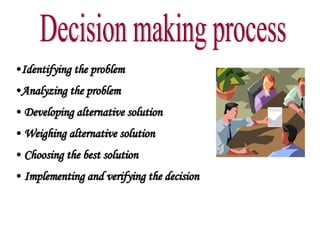
Decision making process Identifying the problem Analyzing the problem Developing alternative solution Weighing alternative solution Choosing the best solution Implementing and verifying the decision
Policies Policies are not simple statements , they have certain purpose behind them. They are the guidelines on the general limits within which the members of an enterprise act.
Types of Policies Originated policies Traditional policies Policy by flat Externally imposed policies
Principles for the formulation of  Policies Policies should aim at contributing to the achievement of enterprise objectives Policies should be definite and in writing Policies should be flexible and stable Lower level policies should be derived from high level policies Policies should be fair and equitable Policies should be periodically reviewed and modified
Strategies Strategies are the major part of an organization for the achievement of its objectives in an uncertain and competitive environment. Strategy may be  defined as any decision or behaviour which , after taking into account the probable or actual actions , policies and strategies of competitors , suppliers , government , trade unions is aimed at achieving organizational goals.  For example: Marketing strategy Personnel strategy Union relations strategy
Types of strategies External Economic strategies External Social strategies Internal Organizational strategies
Organising After the objectives of the enterprise have been determined, the next logical step in the managerial process is organising .
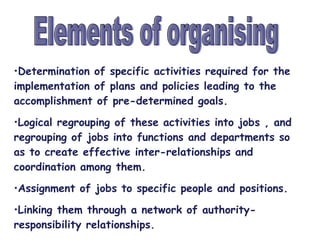
Elements of organising Determination of specific activities required for the implementation of plans and policies leading to the accomplishment of pre-determined goals. Logical regrouping of these activities into jobs , and regrouping of jobs into functions and departments so as to create effective inter-relationships and coordination among them. Assignment of jobs to specific people and positions. Linking them through a network of authority-responsibility relationships.
The End

Decision Making

  • 1.
    Presentation onDecision making & Organising
  • 2.
    Decision making Decisionmaking is an essential part of the every function of management . It is a process of selection of a particular action out of various alternatives. “ No business can survive without decision making.” Whatever a manager does , he does through decision making. - By Peter Drucker
  • 3.
    Decision making processIdentifying the problem Analyzing the problem Developing alternative solution Weighing alternative solution Choosing the best solution Implementing and verifying the decision
  • 4.
    Policies Policies arenot simple statements , they have certain purpose behind them. They are the guidelines on the general limits within which the members of an enterprise act.
  • 5.
    Types of PoliciesOriginated policies Traditional policies Policy by flat Externally imposed policies
  • 6.
    Principles for theformulation of Policies Policies should aim at contributing to the achievement of enterprise objectives Policies should be definite and in writing Policies should be flexible and stable Lower level policies should be derived from high level policies Policies should be fair and equitable Policies should be periodically reviewed and modified
  • 7.
    Strategies Strategies arethe major part of an organization for the achievement of its objectives in an uncertain and competitive environment. Strategy may be defined as any decision or behaviour which , after taking into account the probable or actual actions , policies and strategies of competitors , suppliers , government , trade unions is aimed at achieving organizational goals. For example: Marketing strategy Personnel strategy Union relations strategy
  • 8.
    Types of strategiesExternal Economic strategies External Social strategies Internal Organizational strategies
  • 9.
    Organising After theobjectives of the enterprise have been determined, the next logical step in the managerial process is organising .
  • 10.
    Elements of organisingDetermination of specific activities required for the implementation of plans and policies leading to the accomplishment of pre-determined goals. Logical regrouping of these activities into jobs , and regrouping of jobs into functions and departments so as to create effective inter-relationships and coordination among them. Assignment of jobs to specific people and positions. Linking them through a network of authority-responsibility relationships.
  • 11.