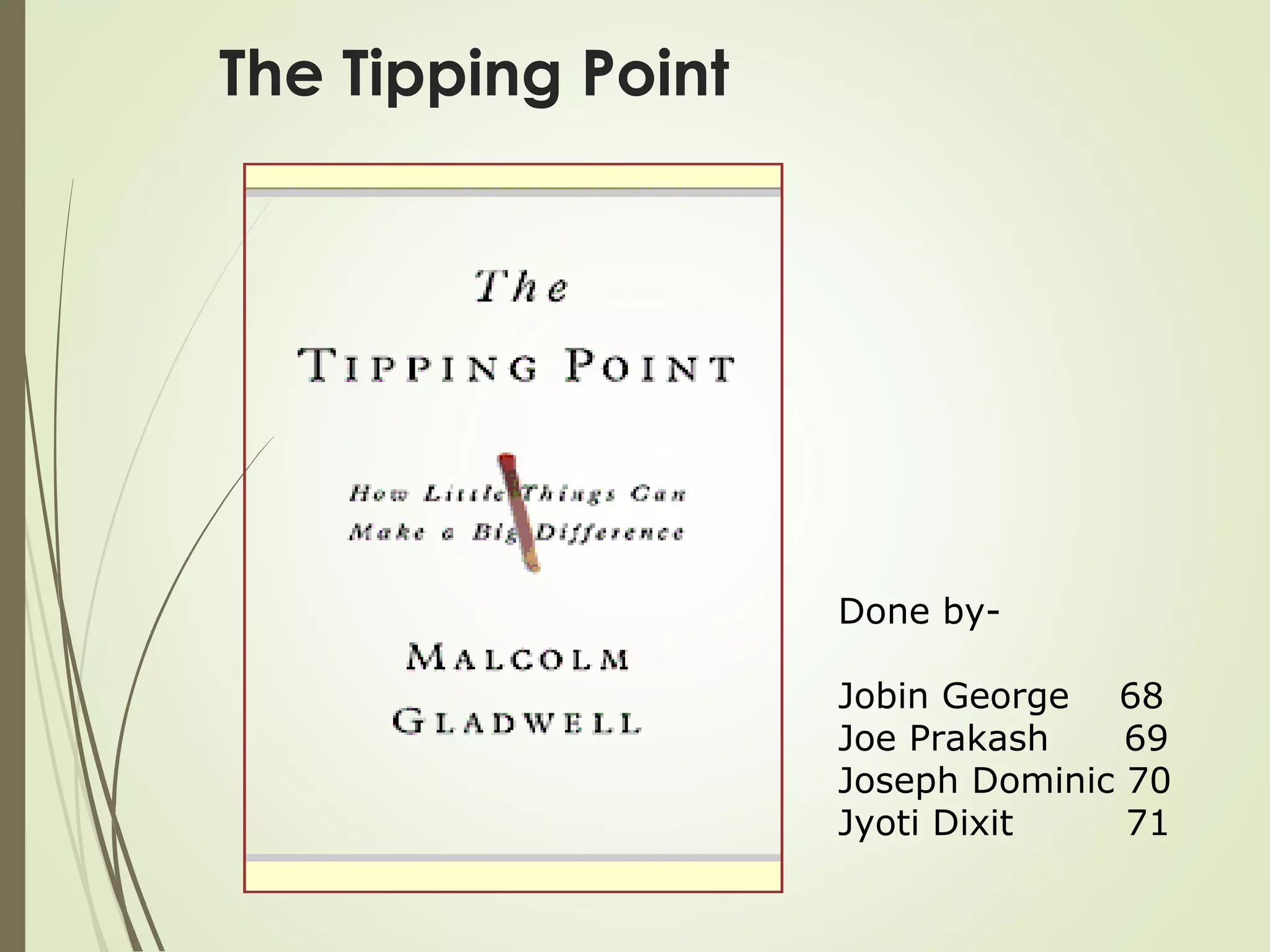
The Tipping Point
Done by-
Jobin George 68
Joe Prakash 69
Joseph Dominic 70
Jyoti Dixit 71
2
WHAT IS TIPPING POINT?
 The tipping point is that magic moment when an idea, trend, or
social behaviour crosses a threshold and subsequently spreads with
incredible speed through society.
 Just as a sick individual in a crowded store can start an epidemic of
the flu, so too can a small but precisely targeted push start a
fashion trend or cause the popularity of a new restaurant to take off
overnight, or cause crime or drug use to taper off.
 In The Tipping Point, Gladwell shows how very minor
adjustments in products and ideas can make them more likely to
become immensely popular.
 He reveals how easy it is to cause group behaviour to tip in a
desired direction by making small changes in the immediate
environment.
Three Agents of Change (Epidemic)
1. The Law of the Few
Hush puppies
80% of the problem created by 20 % of the people
Baltimore – syphilis
2. The Stickiness Factor
Pneumocystic carinii pneumonia – Goudsmith – Hospital for midwives –
Swedish Barrack – Coal miner - Husband – Wife – child-
unsterilized needles and syringes
Winston tip cigarette(1954) – “Winston tastes good like a cigarette
should”
3. The Power of Context
1964 – kitty Genovese – social psychologists – 38 witness – Abe
Rosenthal – New York times
These provide a direction for how to go about reaching a
tipping point.
1. The Law of the Few:
 An epidemic begins when a few highly infectious individuals become viral
vectors for a product or idea by adopting it themselves and spreading the word.
 Stanley Milgram – 160 people – Omaha – Nebraska – who work in Boston live in
Sharon, Massachusetts – six degree of separation – stockbroker.
 Connection happens through known people.
 Sesame Street
 subway shooter Bernie Goetz
 Economists often talk about the 80/20 Principle,
which is the idea that in any situation roughly 80 percent
of the 'work' will be done by 20 percent of the participants
 Connectors - There are the connectors, networked
people who know seemingly everyone and who
can make or break reputations on their word alone
56% - Personal connection found their job
18.8% - Formal means (Advertisements)
20% applied directly
 Mavens - There are the mavens, people who
acquire such detailed knowledge of a product that
others turn to them repeatedly for advice
 Salesmen - Then there are the salesmen, those
whose enthusiasm for a product can send its sales
spiralling upward.
2. Stickiness Factor
 This refers to a unique quality that compels the phenomenon
to “stick” in the minds of the public and influence their
future behavior.
 Straightforward
 The real stickiness factor is to get the attention of the
consumers to stop, read and remember.
Implication
 The Tipping Point is that we should develop products
to fit this ‘sticky’ profile, because these are the critical
success factors that can have a massive impact on
sales.
3. The Power of Context
(Part 1)
 Bernie Goetz and the Rise and Fall of New York city
crime.
 Epidemics are sensitive to conditions and circumstances
of the time and places in which they occur. This is
called the Power of Context.
 It is not clear that crime follows the rule of epidemics.
 ‘Broken Windows Theory’
 Power of Context says you don’t have to solve the big
problems to solve crime.
3. The Power of Context
(Part 2)
 Unexpected success of Rebecca Wells novel:
‘Divine Secrets of the Ya-Ya Sisterhood’.
 Groups play a critical role in social epidemics.
 Small, close-knit groups have the power to
magnify the epidemic potential of a message or
idea
 Rule of 150
 Case of Gore Associates.
Case Study
 Airwalk – Skateboarders
 Bruce Ryan and Weal Gross Analysis – Hybrid Seed – Greene
Country – Iowa – 1930
 Chasm (Early adopters & Early majority)
 Psychology of rumour – sociologists Gordon Allport
 Man becomes spy
 Asian became Chinese
 Sightseeing became espionage
 Guidebook became camera
Al Crispo
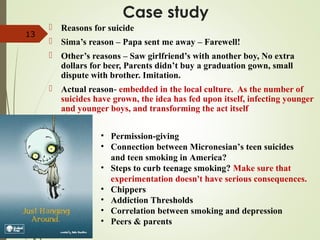
Case study
 Reasons for suicide
 Sima’s reason – Papa sent me away – Farewell!
 Other’s reasons – Saw girlfriend’s with another boy, No extra
dollars for beer, Parents didn’t buy a graduation gown, small
dispute with brother. Imitation.
 Actual reason- embedded in the local culture. As the number of
suicides have grown, the idea has fed upon itself, infecting younger
and younger boys, and transforming the act itself
13
• Permission-giving
• Connection between Micronesian’s teen suicides
and teen smoking in America?
• Steps to curb teenage smoking? Make sure that
experimentation doesn't have serious consequences.
• Chippers
• Addiction Thresholds
• Correlation between smoking and depression
• Peers & parents
CONCLUSION:
 Merely by manipulating the size of a group, we can dramatically improve its
receptivity to new ideas.
 By tinkering with the presentation of information, we can significantly
improve its stickiness.
 Finding and reaching those few people who hold so much social power, we
can shape the course of social epidemics
 Tipping point are a reaffirmation of the potential for change and the power of
intelligent action.
“World around you may seem like immovable - but its not, with the
slight push in just the right place – it can be tipped”
THANK YOU

The Tipping point

  • 1.
    The Tipping Point Doneby- Jobin George 68 Joe Prakash 69 Joseph Dominic 70 Jyoti Dixit 71
  • 2.
    2 WHAT IS TIPPINGPOINT?  The tipping point is that magic moment when an idea, trend, or social behaviour crosses a threshold and subsequently spreads with incredible speed through society.  Just as a sick individual in a crowded store can start an epidemic of the flu, so too can a small but precisely targeted push start a fashion trend or cause the popularity of a new restaurant to take off overnight, or cause crime or drug use to taper off.  In The Tipping Point, Gladwell shows how very minor adjustments in products and ideas can make them more likely to become immensely popular.  He reveals how easy it is to cause group behaviour to tip in a desired direction by making small changes in the immediate environment.
  • 3.
    Three Agents ofChange (Epidemic) 1. The Law of the Few Hush puppies 80% of the problem created by 20 % of the people Baltimore – syphilis 2. The Stickiness Factor Pneumocystic carinii pneumonia – Goudsmith – Hospital for midwives – Swedish Barrack – Coal miner - Husband – Wife – child- unsterilized needles and syringes Winston tip cigarette(1954) – “Winston tastes good like a cigarette should” 3. The Power of Context 1964 – kitty Genovese – social psychologists – 38 witness – Abe Rosenthal – New York times These provide a direction for how to go about reaching a tipping point.
  • 4.
    1. The Lawof the Few:  An epidemic begins when a few highly infectious individuals become viral vectors for a product or idea by adopting it themselves and spreading the word.  Stanley Milgram – 160 people – Omaha – Nebraska – who work in Boston live in Sharon, Massachusetts – six degree of separation – stockbroker.  Connection happens through known people.  Sesame Street  subway shooter Bernie Goetz  Economists often talk about the 80/20 Principle, which is the idea that in any situation roughly 80 percent of the 'work' will be done by 20 percent of the participants
  • 5.
     Connectors -There are the connectors, networked people who know seemingly everyone and who can make or break reputations on their word alone 56% - Personal connection found their job 18.8% - Formal means (Advertisements) 20% applied directly  Mavens - There are the mavens, people who acquire such detailed knowledge of a product that others turn to them repeatedly for advice  Salesmen - Then there are the salesmen, those whose enthusiasm for a product can send its sales spiralling upward.
  • 6.
    2. Stickiness Factor This refers to a unique quality that compels the phenomenon to “stick” in the minds of the public and influence their future behavior.  Straightforward  The real stickiness factor is to get the attention of the consumers to stop, read and remember.
  • 8.
    Implication  The TippingPoint is that we should develop products to fit this ‘sticky’ profile, because these are the critical success factors that can have a massive impact on sales.
  • 9.
    3. The Powerof Context (Part 1)  Bernie Goetz and the Rise and Fall of New York city crime.  Epidemics are sensitive to conditions and circumstances of the time and places in which they occur. This is called the Power of Context.  It is not clear that crime follows the rule of epidemics.  ‘Broken Windows Theory’  Power of Context says you don’t have to solve the big problems to solve crime.
  • 10.
    3. The Powerof Context (Part 2)  Unexpected success of Rebecca Wells novel: ‘Divine Secrets of the Ya-Ya Sisterhood’.  Groups play a critical role in social epidemics.  Small, close-knit groups have the power to magnify the epidemic potential of a message or idea  Rule of 150  Case of Gore Associates.
  • 11.
    Case Study  Airwalk– Skateboarders  Bruce Ryan and Weal Gross Analysis – Hybrid Seed – Greene Country – Iowa – 1930  Chasm (Early adopters & Early majority)  Psychology of rumour – sociologists Gordon Allport  Man becomes spy  Asian became Chinese  Sightseeing became espionage  Guidebook became camera Al Crispo
  • 13.
    Case study  Reasonsfor suicide  Sima’s reason – Papa sent me away – Farewell!  Other’s reasons – Saw girlfriend’s with another boy, No extra dollars for beer, Parents didn’t buy a graduation gown, small dispute with brother. Imitation.  Actual reason- embedded in the local culture. As the number of suicides have grown, the idea has fed upon itself, infecting younger and younger boys, and transforming the act itself 13 • Permission-giving • Connection between Micronesian’s teen suicides and teen smoking in America? • Steps to curb teenage smoking? Make sure that experimentation doesn't have serious consequences. • Chippers • Addiction Thresholds • Correlation between smoking and depression • Peers & parents
  • 14.
    CONCLUSION:  Merely bymanipulating the size of a group, we can dramatically improve its receptivity to new ideas.  By tinkering with the presentation of information, we can significantly improve its stickiness.  Finding and reaching those few people who hold so much social power, we can shape the course of social epidemics  Tipping point are a reaffirmation of the potential for change and the power of intelligent action. “World around you may seem like immovable - but its not, with the slight push in just the right place – it can be tipped”
  • 15.