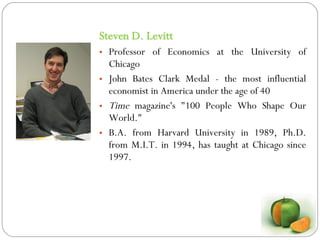
Steven D. Levitt   Professor of Economics at the University of Chicago John Bates Clark Medal - the most influential economist in America under the age of 40 Time  magazine's "100 People Who Shape Our World."  B.A. from Harvard University in 1989, Ph.D. from M.I.T. in 1994, has taught at Chicago since 1997.
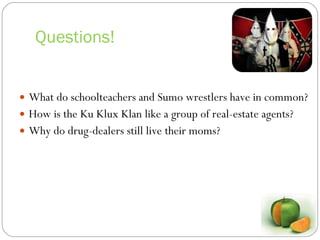
Questions! What do schoolteachers and Sumo wrestlers have in common? How is the Ku Klux Klan like a group of real-estate agents? Why do drug-dealers still live their moms?
Concepts in ‘Freakonomics’ Incentives are the cornerstone of economic life The  conventional wisdom  is often wrong Dramatic effects often have distant, even subtle, causes Experts use their informational advantage to serve their own agenda Knowing what to measure and how to measure it makes life simpler
What we shall discuss: Incentives ‘ Snob’ effect Information Asymmetry Correlation v/s Causation Conventional Wisdom ‘ Winner take all’ labour market
Incentives
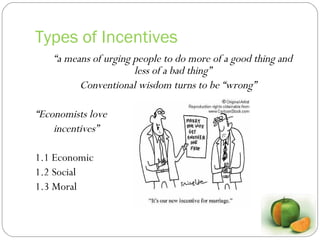
Types of Incentives “ a means of urging people to do more of a good thing and less of a bad thing” Conventional wisdom turns to be “wrong” “ Economists love incentives” 1.1 Economic 1.2 Social 1.3 Moral
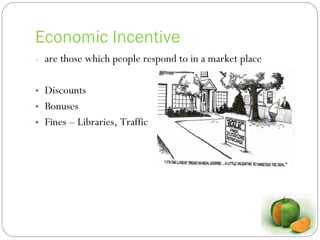
Economic Incentive are those which people respond to in a market place Discounts Bonuses Fines – Libraries, Traffic
Social Incentive “ Urge people to do things in a way that is accepted by all” Consequences of  Social Networks in Workplace Presence of friends affects productivity Workers conform to a norm Overall effect on firm performance? Parallel can be drawn upon on CGPA
Moral Incentive “ Appealing to the sense of a person’s right vs wrong” Advertising Donations CSR
Why People Cheat “ Something worth having is something worth cheating for” Examples of cheating Class Teachers Sumo Wrestlers Not Always True Bagel Example
Conflicting Incentives What do you expect to happen when a fine is imposed on parents who do not pick up their children from the day care centre on time?
 
Snob Effect
Snob Effect “ Desire to own exclusive or unique goods” Demand increased with price Art, Designer Clothes, Sports Cars, Stamps, Coins Mac users Tooth-whitening products  Starbucks Organic food Hybrid cars
Information Asymmetry
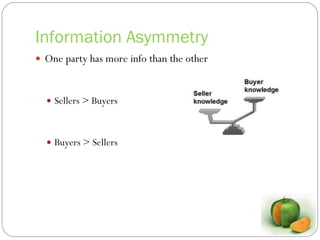
Information Asymmetry One party has more info than the other Sellers > Buyers Buyers > Sellers
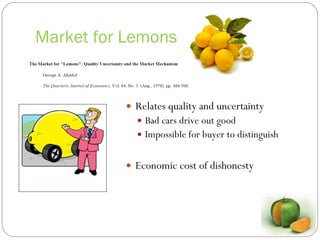
Market for Lemons Relates quality and uncertainty Bad cars drive out good Impossible for buyer to distinguish Economic cost of dishonesty
Other examples.. Insurance market for the elderly Credit market in rural India Local moneylender v/s Banks
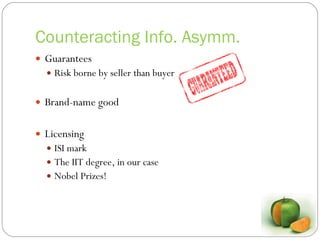
Counteracting Info. Asymm. Guarantees Risk borne by seller than buyer Brand-name good Licensing ISI mark The IIT degree, in our case Nobel Prizes!
Correlation & Causation
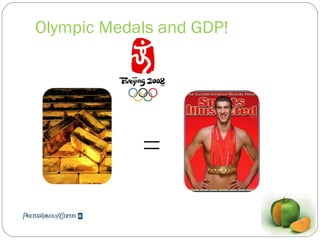
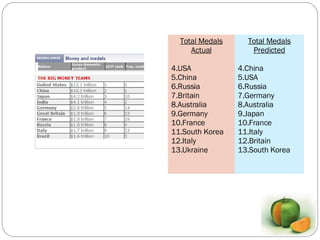
Olympic Medals and GDP! =
Factors Population GDP Influence of Soviet Union Political importance of sports Host or not? “ Home-advantage” Medals in the previous editions
 
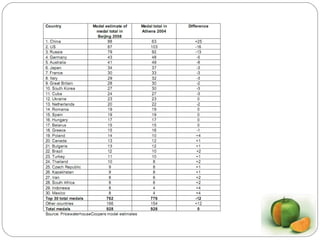
Total Medals Actual USA China Russia Britain  Australia Germany France South Korea Italy Ukraine Total Medals Predicted China USA Russia Germany Australia Japan France Italy Britain South Korea
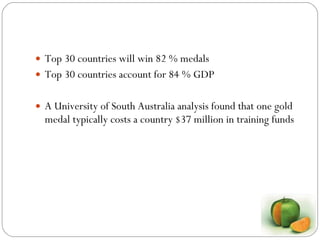
Top 30 countries will win 82 % medals Top 30 countries account for 84 % GDP A University of South Australia analysis found that one gold medal typically costs a country $37 million in training funds
Conventional Wisdom
Conventional Wisdom Explanations that are generally accepted as true Conventional Wisdom is not necessarily true
Creation of Conventional Wisdom Often, conventional wisdom is generated by experts and journalists Advertising is a great tool for creating conventional wisdom
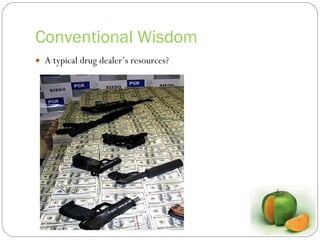
Conventional Wisdom A typical drug dealer’s resources?
In Reality Most of the people involved in illicit drug trade earn less than the minimum wage and have legitimate jobs to supplement their earnings It is also a highly dangerous job A drug dealing gang is very similar to a capitalist enterprise like McDonald’s
Why do it then? To succeed in an extremely competitive field Every street dealer aspires to one day reach the top of the pyramid This constitutes a “Winner-take-all” market
Winner-take-all Market
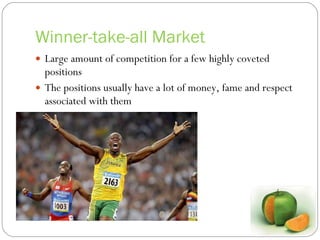
Winner-take-all Market Large amount of competition for a few highly coveted positions The positions usually have a lot of money, fame and respect associated with them
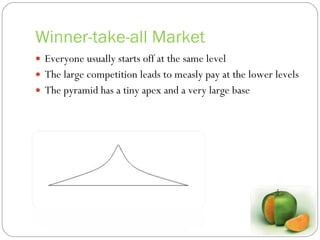
Winner-take-all Market Everyone usually starts off at the same level  The large competition leads to measly pay at the lower levels The pyramid has a tiny apex and a very large base
The tragedy of the commons If there is only one player in a winner-take-all market, adding a second player might significantly improve the market output But if there are already a large number, adding more players will only marginally increase the market output and these players will contribute less to the economy than if they were in some other field
Winner-take-all Market Once a firm in such a market gets a considerable lead it is very difficult for other firms to catch-up Case-in-point – Google: The search engine market has zero switching cost Google had a better product than others and this gave them a huge market lead Even if it has a marginally better product now users will not switch their preferred search engine Even if the competitors have an identical product now, they still have to overcome the “brand perception gap” Economic and social forces form a positive feedback loop for the leader
Education Number of students applying to a University depends on the ranking of the University The better students go to the higher ranked universities A positive feedback loop is formed
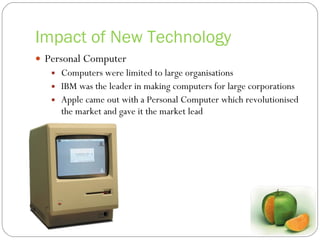
Impact of New Technology Personal Computer Computers were limited to large organisations IBM was the leader in making computers for large corporations Apple came out with a Personal Computer which  revolutionised  the market and gave it the market lead
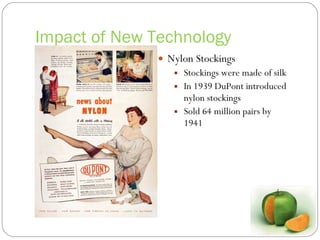
Impact of New Technology Nylon Stockings Stockings were made of silk In 1939 DuPont introduced nylon stockings Sold 64 million pairs by 1941
References Freakonomics by Steven Levitt and Stephen Dubner Higher Education: The Ultimate Winner-Take-All Market? by Robert H. Frank The Market for “Lemons” by George A Akerlof, 1970 Modelling Olympic Performance by PWC, June 2008 DailyTech ingrimayne.com www.skrenta.com economistsview.typepad.com www.edmunds.com www.marketoracle.co.uk
M N Varun  ED05B010 Karthik M  ED05B012 Vikas Shenoy  ED05B026

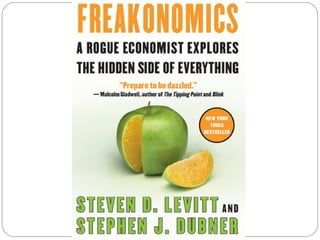
Freakonomics - Concepts and Application

  • 1.
  • 2.
  • 3.
    Steven D. Levitt Professor of Economics at the University of Chicago John Bates Clark Medal - the most influential economist in America under the age of 40 Time magazine's "100 People Who Shape Our World." B.A. from Harvard University in 1989, Ph.D. from M.I.T. in 1994, has taught at Chicago since 1997.
  • 4.
    Questions! What doschoolteachers and Sumo wrestlers have in common? How is the Ku Klux Klan like a group of real-estate agents? Why do drug-dealers still live their moms?
  • 5.
    Concepts in ‘Freakonomics’Incentives are the cornerstone of economic life The conventional wisdom is often wrong Dramatic effects often have distant, even subtle, causes Experts use their informational advantage to serve their own agenda Knowing what to measure and how to measure it makes life simpler
  • 6.
    What we shalldiscuss: Incentives ‘ Snob’ effect Information Asymmetry Correlation v/s Causation Conventional Wisdom ‘ Winner take all’ labour market
  • 7.
  • 8.
    Types of Incentives“ a means of urging people to do more of a good thing and less of a bad thing” Conventional wisdom turns to be “wrong” “ Economists love incentives” 1.1 Economic 1.2 Social 1.3 Moral
  • 9.
    Economic Incentive arethose which people respond to in a market place Discounts Bonuses Fines – Libraries, Traffic
  • 10.
    Social Incentive “Urge people to do things in a way that is accepted by all” Consequences of Social Networks in Workplace Presence of friends affects productivity Workers conform to a norm Overall effect on firm performance? Parallel can be drawn upon on CGPA
  • 11.
    Moral Incentive “Appealing to the sense of a person’s right vs wrong” Advertising Donations CSR
  • 12.
    Why People Cheat“ Something worth having is something worth cheating for” Examples of cheating Class Teachers Sumo Wrestlers Not Always True Bagel Example
  • 13.
    Conflicting Incentives Whatdo you expect to happen when a fine is imposed on parents who do not pick up their children from the day care centre on time?
  • 14.
  • 15.
  • 16.
    Snob Effect “Desire to own exclusive or unique goods” Demand increased with price Art, Designer Clothes, Sports Cars, Stamps, Coins Mac users Tooth-whitening products Starbucks Organic food Hybrid cars
  • 17.
  • 18.
    Information Asymmetry Oneparty has more info than the other Sellers > Buyers Buyers > Sellers
  • 19.
    Market for LemonsRelates quality and uncertainty Bad cars drive out good Impossible for buyer to distinguish Economic cost of dishonesty
  • 20.
    Other examples.. Insurancemarket for the elderly Credit market in rural India Local moneylender v/s Banks
  • 21.
    Counteracting Info. Asymm.Guarantees Risk borne by seller than buyer Brand-name good Licensing ISI mark The IIT degree, in our case Nobel Prizes!
  • 22.
  • 23.
  • 24.
    Factors Population GDPInfluence of Soviet Union Political importance of sports Host or not? “ Home-advantage” Medals in the previous editions
  • 25.
  • 26.
    Total Medals ActualUSA China Russia Britain Australia Germany France South Korea Italy Ukraine Total Medals Predicted China USA Russia Germany Australia Japan France Italy Britain South Korea
  • 27.
    Top 30 countrieswill win 82 % medals Top 30 countries account for 84 % GDP A University of South Australia analysis found that one gold medal typically costs a country $37 million in training funds
  • 28.
  • 29.
    Conventional Wisdom Explanationsthat are generally accepted as true Conventional Wisdom is not necessarily true
  • 30.
    Creation of ConventionalWisdom Often, conventional wisdom is generated by experts and journalists Advertising is a great tool for creating conventional wisdom
  • 31.
    Conventional Wisdom Atypical drug dealer’s resources?
  • 32.
    In Reality Mostof the people involved in illicit drug trade earn less than the minimum wage and have legitimate jobs to supplement their earnings It is also a highly dangerous job A drug dealing gang is very similar to a capitalist enterprise like McDonald’s
  • 33.
    Why do itthen? To succeed in an extremely competitive field Every street dealer aspires to one day reach the top of the pyramid This constitutes a “Winner-take-all” market
  • 34.
  • 35.
    Winner-take-all Market Largeamount of competition for a few highly coveted positions The positions usually have a lot of money, fame and respect associated with them
  • 36.
    Winner-take-all Market Everyoneusually starts off at the same level The large competition leads to measly pay at the lower levels The pyramid has a tiny apex and a very large base
  • 37.
    The tragedy ofthe commons If there is only one player in a winner-take-all market, adding a second player might significantly improve the market output But if there are already a large number, adding more players will only marginally increase the market output and these players will contribute less to the economy than if they were in some other field
  • 38.
    Winner-take-all Market Oncea firm in such a market gets a considerable lead it is very difficult for other firms to catch-up Case-in-point – Google: The search engine market has zero switching cost Google had a better product than others and this gave them a huge market lead Even if it has a marginally better product now users will not switch their preferred search engine Even if the competitors have an identical product now, they still have to overcome the “brand perception gap” Economic and social forces form a positive feedback loop for the leader
  • 39.
    Education Number ofstudents applying to a University depends on the ranking of the University The better students go to the higher ranked universities A positive feedback loop is formed
  • 40.
    Impact of NewTechnology Personal Computer Computers were limited to large organisations IBM was the leader in making computers for large corporations Apple came out with a Personal Computer which revolutionised the market and gave it the market lead
  • 41.
    Impact of NewTechnology Nylon Stockings Stockings were made of silk In 1939 DuPont introduced nylon stockings Sold 64 million pairs by 1941
  • 42.
    References Freakonomics bySteven Levitt and Stephen Dubner Higher Education: The Ultimate Winner-Take-All Market? by Robert H. Frank The Market for “Lemons” by George A Akerlof, 1970 Modelling Olympic Performance by PWC, June 2008 DailyTech ingrimayne.com www.skrenta.com economistsview.typepad.com www.edmunds.com www.marketoracle.co.uk
  • 43.
    M N Varun ED05B010 Karthik M ED05B012 Vikas Shenoy ED05B026