TIPPING POINT
By Malcolm Gladwell
Abbreviated Summation
AHaller
THREE RULES
THAT CREATE A TIPPING POINT
• The Law of the Few – the unique nature
of the messenger
• The Stickiness Factor – it must acquire
remembrance
• Power of Context
THE LAW OF THE
FEW
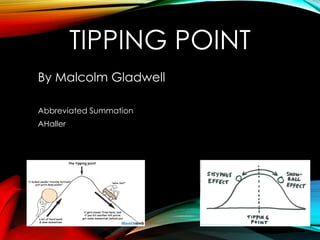
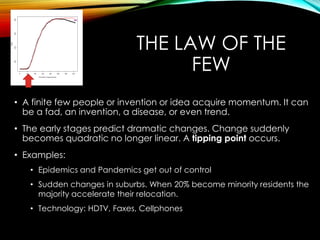
• A finite few people or invention or idea acquire momentum. It can
be a fad, an invention, a disease, or even trend.
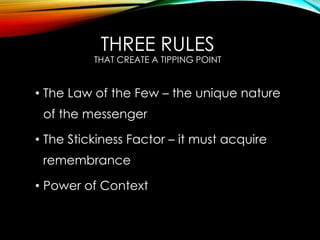
• The early stages predict dramatic changes. Change suddenly
becomes quadratic no longer linear. A tipping point occurs.
• Examples:
• Epidemics and Pandemics get out of control
• Sudden changes in suburbs. When 20% become minority residents the
majority accelerate their relocation.
• Technology: HDTV, Faxes, Cellphones
THE LAW OF THE FEW
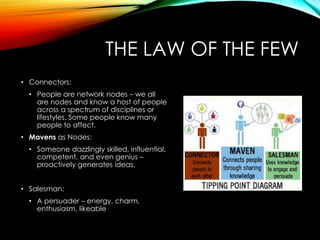
• Connectors:
• People are network nodes – we all
are nodes and know a host of people
across a spectrum of disciplines or
lifestyles. Some people know many
people to affect.
• Mavens as Nodes:
• Someone dazzlingly skilled, influential,
competent, and even genius –
proactively generates ideas.
• Salesman:
• A persuader – energy, charm,
enthusiasm, likeable
THE STICKINESS FACTOR
THE RIDDANCE FACTOR
• Make it hard to remove or forget
• In diseases due to mutations – become strain
resistant
• In business have a catchy slogan
• In politics ignite a lingering discontent
• The quality of delivery given by the messenger
makes it stick.
• Respond – a coupon, a map, hours of
operation, a gift if they act, state an imminent
threat with conviction
THE POWER OF CONTEXT
Individuals versus Groups Reaction
In Small Groups people act in ways that large
groups do not
Example - Cries for Help or Fire
Welsey’s Establishing Groups
One can be in a community of about 150
Broken Window theory: Reverse a (crime
wave)epidemic by early intervention
THE POWER OF CONTEXT
Ultimately an immunity sets in that creates the stage
for to process to level off and become extinguished.
Example
Flu of 1918 an immunity developed

Tipping point

  • 1.
    TIPPING POINT By MalcolmGladwell Abbreviated Summation AHaller
  • 2.
    THREE RULES THAT CREATEA TIPPING POINT • The Law of the Few – the unique nature of the messenger • The Stickiness Factor – it must acquire remembrance • Power of Context
  • 3.
    THE LAW OFTHE FEW • A finite few people or invention or idea acquire momentum. It can be a fad, an invention, a disease, or even trend. • The early stages predict dramatic changes. Change suddenly becomes quadratic no longer linear. A tipping point occurs. • Examples: • Epidemics and Pandemics get out of control • Sudden changes in suburbs. When 20% become minority residents the majority accelerate their relocation. • Technology: HDTV, Faxes, Cellphones
  • 4.
    THE LAW OFTHE FEW • Connectors: • People are network nodes – we all are nodes and know a host of people across a spectrum of disciplines or lifestyles. Some people know many people to affect. • Mavens as Nodes: • Someone dazzlingly skilled, influential, competent, and even genius – proactively generates ideas. • Salesman: • A persuader – energy, charm, enthusiasm, likeable
  • 5.
    THE STICKINESS FACTOR THERIDDANCE FACTOR • Make it hard to remove or forget • In diseases due to mutations – become strain resistant • In business have a catchy slogan • In politics ignite a lingering discontent • The quality of delivery given by the messenger makes it stick. • Respond – a coupon, a map, hours of operation, a gift if they act, state an imminent threat with conviction
  • 6.
    THE POWER OFCONTEXT Individuals versus Groups Reaction In Small Groups people act in ways that large groups do not Example - Cries for Help or Fire Welsey’s Establishing Groups One can be in a community of about 150 Broken Window theory: Reverse a (crime wave)epidemic by early intervention
  • 7.
    THE POWER OFCONTEXT Ultimately an immunity sets in that creates the stage for to process to level off and become extinguished. Example Flu of 1918 an immunity developed