Business Retention and Expansion Guide


                     Teamwork Arkansas – Entergy’s Office of Economic Development
                                                             425 West Capitol Avenue
                                                                             27th Floor
                                                                Little Rock, AR 72201
                                              Phone 888.301.5861 • Fax 501.377.4448
                                                         www.teamworkarkansas.com
Table of Contents
   Acknowledgements……………………………………………………………………………….………....1
   Executive Summary………………………………………………………………………………………….2
   Objectives of a Business Retention and Expansion Program……………………………………………3
   Five Phase Approach to Creating a Successful Business Retention and Expansion Program……….4

   Chapter 1: The Importance of Business Retention and Expansion…………………...……………7
   The Need for A Business Retention & Expansion (BR&E) Strategy.......................................................7
   Multiplier Effect of Existing Businesses ....................................................................................................8
   Definition of Business Retention & Expansion.........................................................................................9
   Benefits of a Strong BR&E Program ........................................................................................................9

   Chapter 2: Building Your Business Advancement Team (BAT)…………………………………...12
   Choosing the Players ............................................................................................................................. 12
   The Launch............................................................................................................................................. 14
   Training the Team .................................................................................................................................. 15
   The Use of Volunteers ........................................................................................................................... 15

   Chapter 3: Building Relationships......................................................................………………….....16
   Portfolio Management............................................................................................................................ 16
   Visits to Corporate Office ....................................................................................................................... 17
   Visits to Local Plant and Locally Owned Businesses ........................................................................... 18
   Industrial Recognition Programs............................................................................................................ 18
   Designing a Process Around Relationship Building.............................................................................. 20

   Chapter 4: Information Gathering........................................................……………………………….22
   Purpose of Information Gathering ......................................................................................................... 22
   Preparing the BAT for Information Gathering........................................................................................ 22
   Designing a Strategic Survey Instrument.............................................................................................. 25
   Training the Interviewers........................................................................................................................ 26

   Chapter 5: Industry Analysis....................................................................…………………………….29
   Components of an Industry Analysis..................................................................................................... 29
   Industry Analysis Sample Outline.......................................................................................................... 31
   Research Tools ...................................................................................................................................... 32

   Chapter 6: Data Analysis: Creating the Early Warning System……………………………………34
   Data Tracking Tool................................................................................................................................. 34
   Root Causes........................................................................................................................................... 35
   Early Warning Indicators........................................................................................................................ 35
   Benefits of an Early Warning System.................................................................................................... 37

   Chapter 7: Problem Solving: Keeping the Jobs in Your Community……………………………..38
   Workforce Development ........................................................................................................................ 39
   Identifying Financial Resources............................................................................................................. 40
   Technical and Managerial Assistance................................................................................................... 40
   Government Relations ........................................................................................................................... 41
Technology Transfer .............................................................................................................................. 42
Chapter 8: Business Development Initiatives……………………………………………………...…44
Federal Procurement ............................................................................................................................. 44
State Procurement ................................................................................................................................. 44
Export Promotion.................................................................................................................................... 45
Match Market Analyses.......................................................................................................................... 45
Executive Roundtable ............................................................................................................................ 45
Management Seminars.......................................................................................................................... 46
Revolving Loan Fund ............................................................................................................................. 46
Chapter 9: Performance Measurement and Communication………………………………………47
Developing Performance Goals............................................................................................................. 47
Communicating with Stakeholders ........................................................................................................ 48
Communication Strategy........................................................................................................................ 49
Communication Tools ............................................................................................................................ 49

Appendix A: Resources………………………………………………………………………………….51
Literature on Business Retention and Expansion................................................................................. 51
Company Information............................................................................................................................. 51
Industry Information................................................................................................................................ 52
Workforce Development ........................................................................................................................ 53
Arkansas Community Colleges and Technical Institutes...................................................................... 54
Financial Resources............................................................................................................................... 55
Technical and Managerial Assistance................................................................................................... 55
Technology Transfer .............................................................................................................................. 55
Government Incentives .......................................................................................................................... 55
Survey Tools........................................................................................................................................... 56

Appendix B: Sample Database and Industry Surveys………………… ……………………….….57
B U S I N E S S   R E T E N T I O N   A N D   E X P A N S I O N   G U I D E


Acknowledgements
Entergy-Arkansas’ Office of Economic Development is pleased to have sponsored the
development of this Business Retention & Expansion guidebook for Arkansas
communities. The guidebook was originally launched in 2005 with input and assistance
from the following individuals:

    Ines Polonius, Executive Director, alt.Consulting

    Arkansas Economic Development Commission

    Dr. Ron Swager, CEcD, Director, Center for Economic Development Education,
    University of Arkansas at Little Rock, Institute of Economic Advancement

    Dr. Robert Pittman, Associate Professor, Community & Economic Development,
    University of Central Arkansas and Executive Director, Community Development
    Institute

    Jerry Adams, Sr. Vice President, Portfolio & Servicing, Arkansas Capital
    Corporation

    Stephen Lease, Coordinator, Arkansas Association of Two Year Colleges
    Workforce Training Consortium and Associate Vice Chancellor for Government
    Relations, University of Arkansas at Fort Smith

A special thanks goes to these individuals and agencies for providing valuable feedback
during the drafting of this guide.

In addition, recognition and appreciation is extended to the following Arkansas pilot
communities who volunteered their time, resources and expertise in testing the
effectiveness of this guide.

    Harrison

    Phillips County

    Searcy


                                                 1
B U S I N E S S   R E T E N T I O N   A N D   E X P A N S I O N   G U I D E


Executive Summary
A community’s economic health is dependent on the number and quality of jobs
provided by employers in the community. Good jobs keep residents living in rural
towns. Jobs allow residents to purchase property [and pay property taxes]. The
disposable income from jobs allows residents to shop more [and pay sales taxes]. It is
not surprising that community leaders have been intrigued by the concept of recruiting
jobs to a community by attracting a large employer. However, the competition for such
corporate partners is fierce. Major corporations are not building new facilities in the
United States at the same rate they once did. Studies from across the country have
demonstrated that the overwhelming majority of all new jobs in small towns come from
existing business expansion.

Today, forward thinking community leaders all across Arkansas are embracing a strong
Business Retention and Expansion (BR&E) strategy. A successful BR&E program
provides community leaders with advanced warning about problems that may lead to
business or plant closures. This guide provides a list of advanced warning signs that will
enable proactive intervention and creative solutions to retain employers in the
community. BR&E also encourages community leaders to identify new opportunities for
businesses in the community and support them in expanding, creating new jobs.

In rural Logan County, West Virginia, economic development officials followed the
procedures recommended by the BR&E program when they received early warning of a
potential plant closure. They were able to save the 50 existing jobs and create an
additional 25 jobs. BR&E efforts across the country have demonstrated that
communities can keep jobs as well as encourage job growth.

Through BR&E economic developers take on the mindset of a “portfolio manager.”
The employers in the community make up their portfolio. Portfolio managers in the
stock market, just like in small or medium size towns, research the industries in which
their companies operate to gain insight into the challenges and opportunities they face.
With this information, the portfolio manager in a small town can identify resources to
assist the company in addressing its problems or attaining its growth potential.

Business Retention involves (1) building a solid relationship with the business owner or
plant manager of the employers in the community, (2) regularly collecting data on both
the company and industry, (3) analyzing and tracking the collected data in order to
predict its behavior, (4) assisting the company in solving problems that may cause them
to move or close, (5) looking for opportunities – as a portfolio manager would – to grow
the businesses in their communities.

This guide provides the necessary instructions to design and maintain a successful
Business Retention and Expansion program in order to save and grow jobs in small and
medium size towns throughout Arkansas.


                                                 2
B U S I N E S S   R E T E N T I O N    A N D   E X P A N S I O N     G U I D E


Objectives of a BR&E Program


A successful BR&E strategy serves the following key purposes1 :


    1. To demonstrate to existing firms that the community appreciates
         their contribution to the local economy

    2. To encourage expansion that leads to sustainable job growth

    3. To help businesses solve their problems and challenges

    4. To assist local businesses in gaining awareness of available resources

    5. To develop collaborative relationships for participating in
         comprehensive long-range retention and expansion activities

    6. To build the community capacity and cooperation to sustain growth
         and development activities

    7. To provide better information and understanding for all local leaders
         of the strengths and weaknesses of the business climate.


There is no better marketing strategy than the demonstration of a
successful and thriving business climate!


1Department of Applied Economics University of Minnesota, Business Retention and Expansion Strategies
Program, October 2002, p. 1.


                                                   3
B U S I N E S S   R E T E N T I O N   A N D   E X P A N S I O N   G U I D E


Five Phase Approach to Creating a
Successful BR&E Program
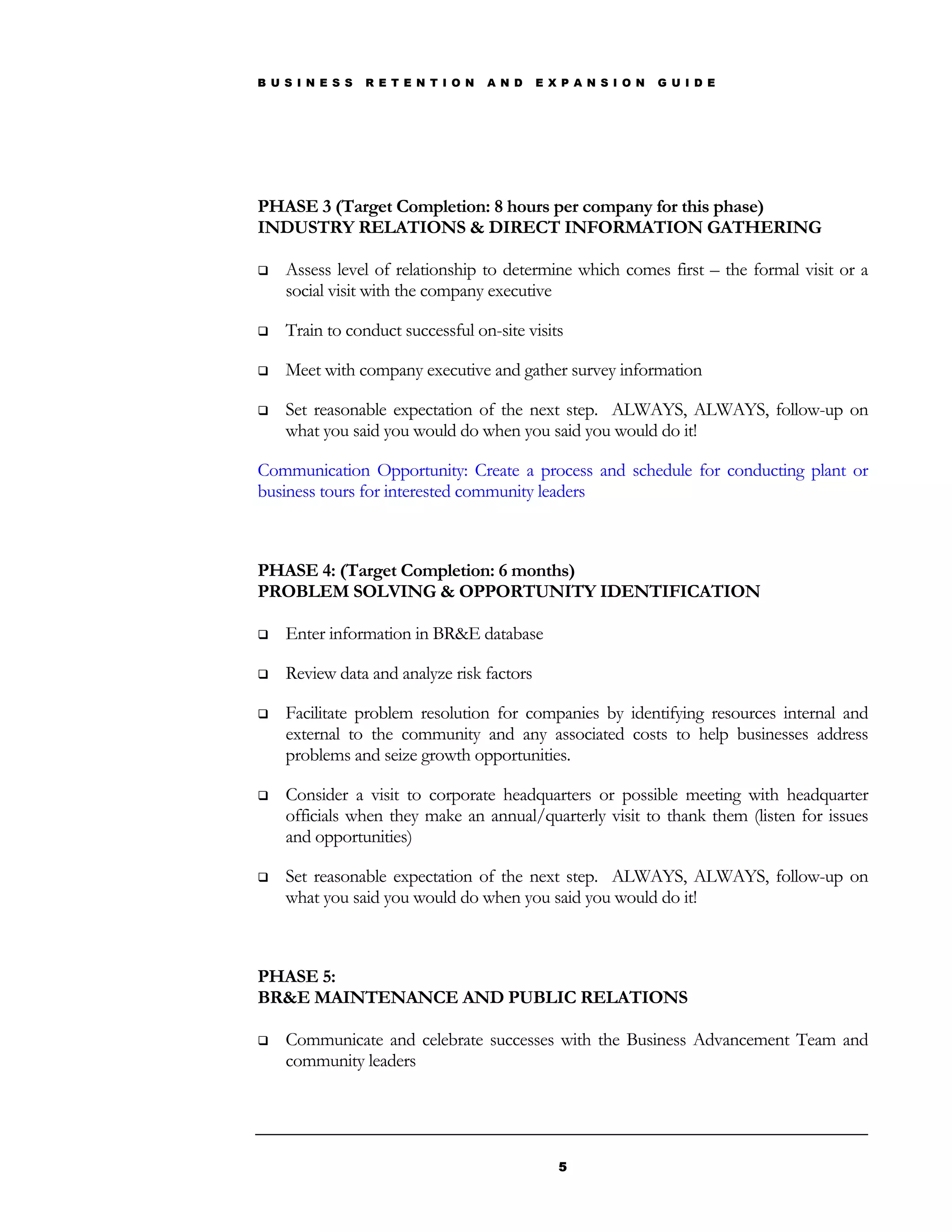
Each of these phases and the terminology used are explained in detail later in the guide.


PHASE 1 (Target Completion: 60 days)
ORGANIZATION

   Sell BR&E program to organization

   Identify Business Advancement Team champion

   Recruit Business Advancement Team members (depending on resources available,
    use of volunteers is optional)

   Educate Business Advancement Team members on BR&E objectives and strategy

   Determine roles and responsibilities

   Establish goals and timeline for achieving them

   Identify key partners and local resources

Communication Opportunity: Promote new BR&E strategy internally to the
organization


PHASE 2 (Target Completion: 60-90 days depending on size of community)
BACKGROUND        INFORMATION           GATHERING         &    DATABASE
CREATION

   Identify most valuable employers to be part of BR&E effort

   Solicit company information from Business Advancement Team members and other
    local partners

   Research company & industry specific information

   Develop survey instrument (see examples in Appendix B)

   Create BR&E database to house data (see example in Appendix B)

Communication Opportunity: Launch the BR&E effort with media coverage to present
the benefits of the new strategy


                                                 4
B U S I N E S S   R E T E N T I O N   A N D   E X P A N S I O N   G U I D E


PHASE 3 (Target Completion: 8 hours per company for this phase)
INDUSTRY RELATIONS & DIRECT INFORMATION GATHERING

   Assess level of relationship to determine which comes first – the formal visit or a
    social visit with the company executive

   Train to conduct successful on-site visits

   Meet with company executive and gather survey information

   Set reasonable expectation of the next step. ALWAYS, ALWAYS, follow-up on
    what you said you would do when you said you would do it!

Communication Opportunity: Create a process and schedule for conducting plant or
business tours for interested community leaders


PHASE 4: (Target Completion: 6 months)
PROBLEM SOLVING & OPPORTUNITY IDENTIFICATION

   Enter information in BR&E database

   Review data and analyze risk factors

   Facilitate problem resolution for companies by identifying resources internal and
    external to the community and any associated costs to help businesses address
    problems and seize growth opportunities.

   Consider a visit to corporate headquarters or possible meeting with headquarter
    officials when they make an annual/quarterly visit to thank them (listen for issues
    and opportunities)

   Set reasonable expectation of the next step. ALWAYS, ALWAYS, follow-up on
    what you said you would do when you said you would do it!


PHASE 5:
BR&E MAINTENANCE AND PUBLIC RELATIONS

   Communicate and celebrate successes with the Business Advancement Team and
    community leaders


                                                 5
B U S I N E S S   R E T E N T I O N   A N D   E X P A N S I O N   G U I D E


   Business Advancement Team meets regularly based on goals and timeline
    established during Phase 1.

   Re-evaluate goals – BR&E is an on-going process


                                                 6
I M P O R T A N C E          O F    B U S I N E S S       R E T E N T I O N   A N D   E X P A N S I O N


                                                                                         1
                                                                                         Chapter


The Importance of Business
Retention and Expansion

The Need for a Business Retention & Expansion
(BR&E) Strategy


M
                  ANY small and medium size towns in Arkansas have seen a loss of jobs
                  since the beginning of the recent economic recession. A large percentage of
                  these jobs were lost due to the closure or relocation of manufacturing
                  facilities.

A community’s natural reaction to such events is to work on recruiting new
corporations that will use existing buildings and provide hundreds of new jobs. The
competition for such corporate partners is fierce. Major corporations are not building
new facilities in the United States at the same rate they once did. Some communities
invest all of their limited resources in attracting outside corporations while overlooking
the biggest source of new jobs.

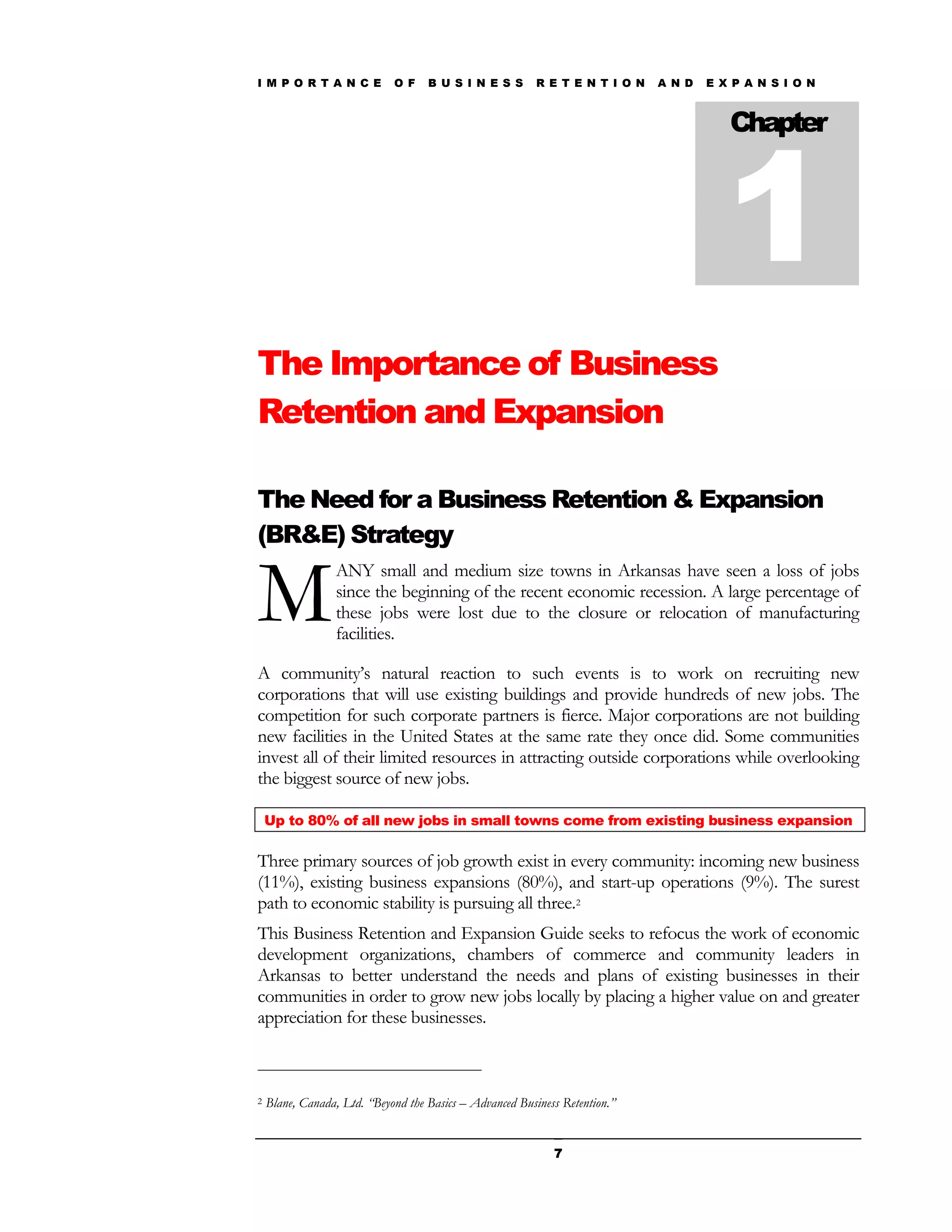
    Up to 80% of all new jobs in small towns come from existing business expansion

Three primary sources of job growth exist in every community: incoming new business
(11%), existing business expansions (80%), and start-up operations (9%). The surest
path to economic stability is pursuing all three.2
This Business Retention and Expansion Guide seeks to refocus the work of economic
development organizations, chambers of commerce and community leaders in
Arkansas to better understand the needs and plans of existing businesses in their
communities in order to grow new jobs locally by placing a higher value on and greater
appreciation for these businesses.


2   Blane, Canada, Ltd. “Beyond the Basics – Advanced Business Retention.”


                                                             7
I M P O R T A N C E       O F   B U S I N E S S    R E T E N T I O N    A N D    E X P A N S I O N


Multiplier Effect of Existing Businesses
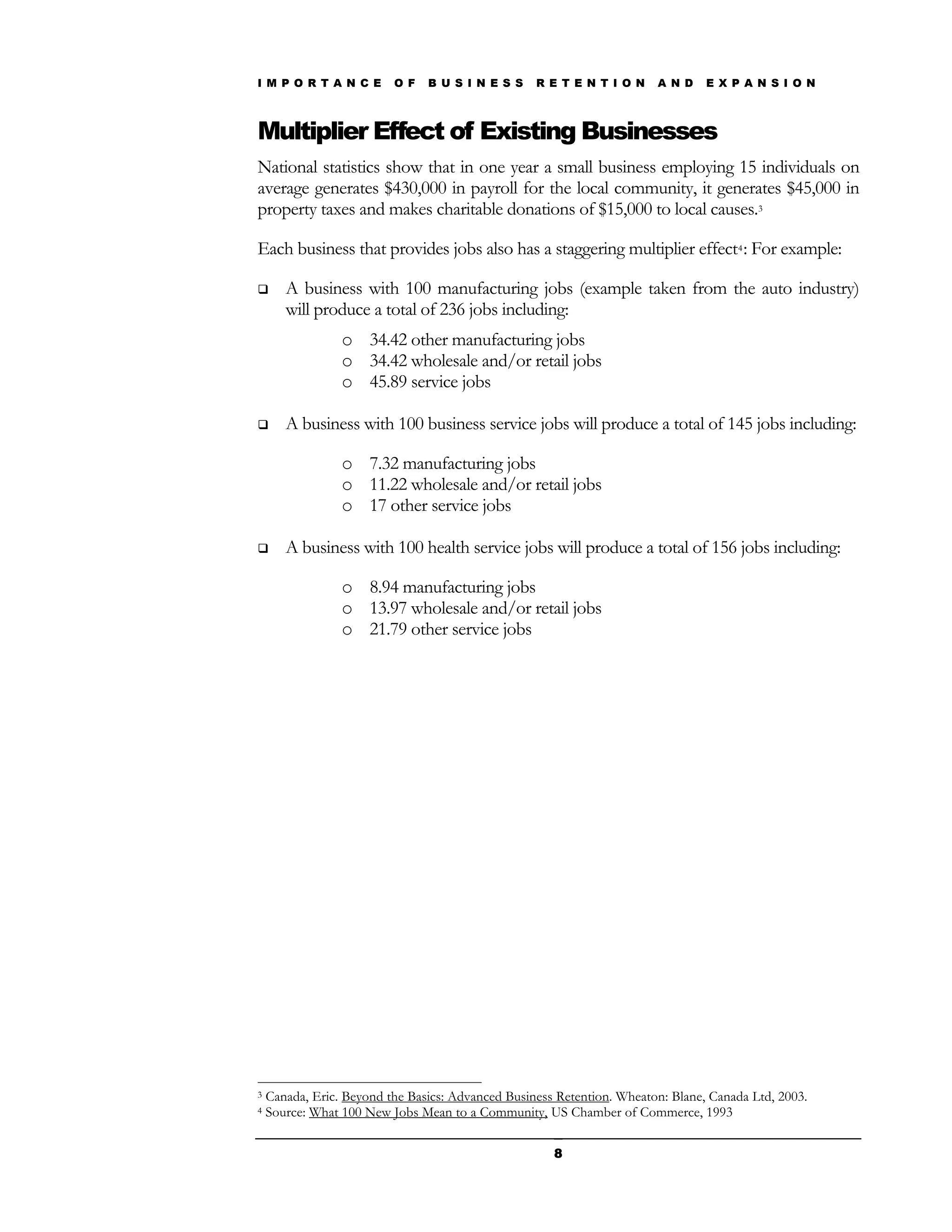
National statistics show that in one year a small business employing 15 individuals on
average generates $430,000 in payroll for the local community, it generates $45,000 in
property taxes and makes charitable donations of $15,000 to local causes.3

Each business that provides jobs also has a staggering multiplier effect4 : For example:

      A business with 100 manufacturing jobs (example taken from the auto industry)
       will produce a total of 236 jobs including:
                 o 34.42 other manufacturing jobs
                 o 34.42 wholesale and/or retail jobs
                 o 45.89 service jobs

      A business with 100 business service jobs will produce a total of 145 jobs including:

                 o 7.32 manufacturing jobs
                 o 11.22 wholesale and/or retail jobs
                 o 17 other service jobs

      A business with 100 health service jobs will produce a total of 156 jobs including:

                 o 8.94 manufacturing jobs
                 o 13.97 wholesale and/or retail jobs
                 o 21.79 other service jobs


3   Canada, Eric. Beyond the Basics: Advanced Business Retention. Wheaton: Blane, Canada Ltd, 2003.
4   Source: What 100 New Jobs Mean to a Community, US Chamber of Commerce, 1993

                                                      8
I M P O R T A N C E      O F   B U S I N E S S   R E T E N T I O N   A N D   E X P A N S I O N


                     Definition of Business Retention & Expansion
                     A Business Retention and Expansion (BR&E) Program is a long-term, systematic
                     approach to:

                           The early detection and identification of problems that could cause employers to
                            leave a community

                           Identify opportunities to help companies expand in the community

                           Build relationships with individual company executives to promote a sense of
                            loyalty

                     It is, to a large degree, employing a “portfolio mindset” through regular data collection,
                     analysis and proactive response to business issues. It is a consistent, multi-year effort
                     that forms a key part of a sound economic development strategy.5


                     Benefits of a Strong BR&E Program
                     There are other benefits to growing jobs locally through a strong retention and
                     expansion strategy:


                     Less than 10% of business closures result from business failures. More than 90%
                     are caused by movement of work through mergers, consolidation, restructuring
                     and deliberate decisions to relocate businesses.6


Influence            When considering an expansion, most companies also consider other locations as a
Expansion Plans of   means of achieving their objectives at the lowest possible cost. Community leaders
Existing             must stay informed and make every effort to ensure that these changes and expansions
Businesses           benefit their communities.


Be Prepared for      An effective retention strategy keeps community leaders informed about possible
Change               changes that existing businesses may be planning. If these plans involve a reduction in
                     jobs, it gives the community advanced notice and time to prepare.


Types of Jobs        While corporations relocating to a new community often bring highly skilled employees
                     with them, locally owned businesses are more likely to hire individuals from the
                     community and provide them with the necessary skills training.


                     5   Canada, Beyond the Basics: Advanced Business Retention
                     6   Source: Illinois Department of Commerce & Community Affairs

                                                                         9
I M P O R T A N C E   O F   B U S I N E S S   R E T E N T I O N   A N D   E X P A N S I O N


No Need for          An existing business that is already happy and successful in your town may not have to
Expensive            be swayed to expand with as many incentives.7 If the business is growing profitably, it
Incentives           may really want to expand in its current location and add jobs naturally. Ensuring a
                     business’ financial and market health becomes key.


Attract Outside      A strong, visible BR&E strategy sends a message to prospective new businesses that a
Small Businesses     positive climate exists for growth and prosperity in the town.8 An “Entrepreneur
to Community         Friendly” environment may motivate local residents to start business ventures and may
                     attract small businesses to locate in your town instead of a nearby city or town.


Create Better        Communities working to support local businesses often find these companies develop
Corporate Citizens   a greater sense of commitment to the community, are more active in community affairs
                     and are more generous in their contributions to local civic groups and events.


                     7Teamwork Arkansas Entergy. Taking Care of Business. p.2.
                     8Wagner and Forman, How to Create Jobs Now and Beyond 2000. Brookline: The Wagner Group, 2000,
                     p.19.

                                                                     10
I M P O R T A N C E    O F   B U S I N E S S    R E T E N T I O N     A N D   E X P A N S I O N


                                        Case Study:

    Wecare, Arkansas and the Search for New Jobs                                                     9


The small town of Wecare, AR, watched as its local automotive parts manufacturer
closed its plant. The employees had heard that headquarters in Ohio decided to
manufacture the parts being built in Wecare at an existing plant in Michigan.

The day the plant officially closed and the padlock was placed on the chain link fence,
the executive director of the chamber of commerce, chamber board members and the
mayor met. No one knew where to start the conversation.

The mayor wondered, “Did any one see this coming?” The director of the chamber
explained that he had found out about the closing two weeks ago when his uncle had
heard the rumor at the plant.

No one understood why operations were being consolidated in Michigan where labor
costs are much higher than in Arkansas. What motivated them? Is there something the
town could have done to prevent this?

Everyone had known Jim, the former plant manager. He was the mayor’s hunting
buddy. But no one had ever met the new manager that came in from Ohio to replace
Jim three years ago. The new manager had not returned any of the chamber director’s
phone calls and was difficult to pin down for a meeting.

How will Wecare replace the 120 jobs that were lost?

By the end of the evening, the group decided to launch a campaign to attract a new
manufacturer to Wecare. First, they would need to clean up the town. Then……

While the group met at the chamber, a number of local businesses owners met
informally at a local restaurant to discuss how long they could keep their doors open
after the closing of the automotive parts plant.


9Case Study developed by alt.Consulting 2004 based on a composite of experiences gained from working with
communities throughout the Mississippi Delta Region.


                                                   11
B U I L D I N G   Y O U R   B U S I N E S S   A D V A N C E M E N T   T E A M


                                                                                              2
                                                                                               Chapter


                   Building Your Business
                   Advancement Team
                   A successful BR&E program does not rely on one paid professional, but on a host
                   of individuals and resources at the state and local level. The size of your
                   community and the expertise within your organization may be the best determinate
                   for how to organize your BR&E efforts. While this guidebook focuses on the use
                   of a team approach made up primarily of volunteers (i.e. the Business
                   Advancement Team), some organizations may determine that the Chamber, the
                   Economic Development professional, or a full-time BR&E staffer can lead the
                   effort and utilize external resources on an as-needed basis. Which ever method
                   you choose to use, the same five-phase approach to creating a successful BR&E
                   program still applies. Whether your BR&E program is organized with a volunteer
                   team (Business Advancement Team) or with one leader that utilizes other
                   stakeholders as backup support when necessary, you still need problem solvers to
                   help address issues identified by local business and industry. Those problem
                   solvers could include individuals from local and state governmental entities,
                   utilities and educational institutions as illustrated in this section of the guidebook.

                   Choosing the Players
                   The ideal Business Advancement Team is a relatively small group. While volunteers
                   may be added to help with certain parts of the BR&E strategy, this group manages the
                   process, evaluates the data and takes steps to solve problems that may be impacting
                   existing businesses in the community, pulling in subject matter experts where needed.

Natural Fit with   The BR&E strategy, much like the industrial recruitment strategy, is a natural fit with
Chamber of         the mission of the local chamber of commerce and/or economic development
Commerce or        organization. The staff of these organizations often has more credibility with local
Economic           businesses than government employees or private individuals.
Development
Organization       If the chamber or the economic development organization has a paid Executive
                   Director, this person often becomes the natural leader of the BR&E program. The
                   board members from either of these organizations make a great pool of volunteers

                                                                   12
B U I L D I N G      R E L A T I O N S H I P S


                   since they presumably represent local businesses. In fact, the respective board members
                   may consider creating a BR&E Standing Committee to ensure program continuation
                   beyond the leadership of one or two people and beyond the terms of local political
                   leaders. It is important, however, for the BR&E activities to focus on existing
                   businesses in the community and not only on chamber/economic development
                   members. In fact, a strong BR&E program attracts new members to the
                   chamber/economic development organization as they see the value of a strong entity
                   that represents their interests.

                   The “at large” membership of the chamber of commerce can also serve as key
                   personnel in the program with respect to collecting the necessary industry and business
                   data.

Economic           A non-profit Economic Development Corporation (EDC) may also be a natural leader
Development        for a BR&E program, given its economic development focus. Its tax-exempt status
Corporation        may be helpful when raising funds for a BR&E effort. Both the staff and board of
                   EDCs can serve as key volunteers.

Local Government   An effective Business Advancement Team includes a high-ranking member of local
                   government. In some cities the local government itself drives the BR&E effort. Other
                   cities have created public-private organizations where city officials work hand-in-hand
                   with private sector groups. Economic development staff often has day-to-day contact
                   with local utility representatives, top elected/appointed officials and can get problems
                   resolved more quickly.10 However, if the local government leads the BR&E effort, it
                   can easily become politicized. This may lead to a loss of effectiveness, make it subject to
                   politically driven budget cuts or force the program to be aborted with a change in
                   leadership.

County             The county government is just as dependent on the health of local businesses as are
Government         local governments. The county may provide key personnel resources that may
                   otherwise not be available in the community. While county officials/employees make
                   great members of Business Advancement Teams, county driven BR&E efforts are
                   usually less effective than those led by the local community.

Local Business     In some towns and cities, businesses have already taken the initiative to organize
Organizations      themselves. For example, they may have Main Street programs, local retailers’
                   associations, minority business associations or a manufacturing roundtable. It is key to
                   involve representatives from each of these groups in the BR&E effort. Often these
                   groups collect data on their members, have already identified challenges and
                   opportunities in the local community and may be working on possible solutions.


                   10   International Economic Development Council. Business Retention and Expansion. 2002, p.22.


                                                                        13
B U I L D I N G   R E L A T I O N S H I P S


Utility Companies   Utility companies in Arkansas are interested in supporting the BR&E efforts of local
                    communities. As local businesses grow, they tend to consume more electricity, gas and
                    water. Having a local representative from the utility company on the Business
                    Advancement Team will link the effort to company resources as well as leverage
                    existing relationships that the utility company has developed with local industry leaders.

                    Some utilities provide consulting services to communities interested in operating
                    successful BR&E programs. Communities vary widely in their level of economic
                    development opportunity, expertise and resources. Because of this, the services offered
                    to each community also vary. The delivery of services is evolving to meet the changing
                    needs of each community. A list of critical business health indicators and early warning
                    signs of business failure are provided via the CD that accompanies this guidebook.

Educators           Educators have a vested interest in providing the workforce training and education
                    needed by local business, if they are to grow and succeed in a community. Some
                    companies and organizations consider colleges or universities as truly “neutral turf” and
                    are more comfortable with university or college staff facilitating meetings.


                    The Launch
                    In creating the Business Advancement Team, the community must decide where to
                    house the program (chamber of commerce, local ED organization, local government,
                    etc.). It must then make one person responsible for leading the effort. Consistent
                    leadership is key. Together with the leader, at least five team members are selected to
                    participate. Each member receives a clear job description that describes the program
                    and defines his/her role.

                    Once the team is in place, there should be an official launch of the BR&E program
                    with a small reception and media announcements explaining the importance of the
                    effort (See Chapter 9). This will sensitize local business owners to the program and
                    make it easier for BAT members to contact them. It will also make the community
                    aware of the importance of the effort.

                    The BAT develops a schedule for implementing the BR&E program. Use the “Five
                    Phase Approach to Creating a Successful BR&E Program” found at the beginning of
                    this guide as the starting point for developing the schedule. The BAT conducts a
                    designated training session for its members (See next section).

                    It is recommended that the BAT meet based on need to check in with members on
                    their progress, discuss opportunities and challenges that have been identified through
                    the process and develop solutions for addressing problems referenced by businesses.


                                                                  14
B U I L D I N G   R E L A T I O N S H I P S


Training the Team
Each BAT member joins the team with a different background and varying levels of
expertise. It is important to provide practical training that will allow members to be
effective and enjoy their work.

A training session can be structured around the following elements:

            Understanding this training manual

            Inviting an expert speaker on BR&E

            Invite an expert speaker on business development to gain a better
             understanding of the interrelated issues that impact business growth and
             decline

            Invite someone from a surrounding town that is implementing a successful
             BR&E program and ask them to share lessons learned

            Conduct mock interviews to practice using the survey tools and interacting
             with business managers


The Use of Volunteers
If necessary, the Business Advancement Team may choose to utilize volunteers to
gather and enter data. Each volunteer should be assigned a mentor (member of BAT)
to discuss findings and answer questions. Volunteers should also receive some formal
training in conducting interviews and the importance of the data they are gathering.
(See Chapter 4).


                                              15
B U I L D I N G   R E L A T I O N S H I P S


                                                                     3
                                                                     Chapter


Building Relationships

Portfolio Management
The Business Advancement Team functions like a portfolio manager of a mutual or
investment fund. In order to manage a profitable portfolio, the manager:

     1. Must be qualified, compensated, given the time and resources, and be
        customer-driven

     2. Diversifies his/her risk by spreading the funds over a number of healthy
        companies.

     3. Gathers and analyzes data regularly about (a) the strategic direction of the
        companies in the portfolio, (b) trends in the industries that impact those
        companies and (c) issues that they may be facing.

     4. Prioritizes his/her research efforts based on the relative percentage that any
        one company represents within the fund.

In the local community, the portfolio is made up of the employers in town. If a
community has only one or two large employers, it must work on diversifying the
portfolio by growing other small businesses and helping local residents start businesses.
By building close personal relationships with company managers and systematically
gathering and analyzing data about the companies, the BAT stays informed about the
strategic direction, industry trends and problems faced by the employers.

  While the BAT must pay attention to all employers, it must invest its time
  wisely in building strong relationships with its largest and most critical
  employers.

The BAT has one strong advantage over a portfolio manager of an investment fund.
Through strong relationships, the BAT can actually influence the decisions made by
companies and can work to address problems that may be negatively impacting the
company thus helping it to stay and expand in the community.

                                              16
B U I L D I N G      R E L A T I O N S H I P S


Corporations don’t make decisions, people do! Get to know the people.                 11


In building those relationships it is critical to remember that corporations are nothing
but a formal collection of human beings. While profitability is a key in corporate
decision-making, managers are human. They enjoy knowing that their work matters,
they are appreciated in the community and the community cares about the well being of
their plants and businesses. Building close relationships will prompt managers to share
key business information and directions that will assist the BAT in doing its job
effectively. And, in the case where a company has to make a choice about where to
close a facility, your community will be more than just an address or bricks and mortar.


Visits to Corporate Office
Decisions about whether to consolidate, move or expand a plant are typically made at
corporate headquarters and not at the local plant level. It is essential for the BAT to
build relationships with senior level executives at the headquarters.

Visits to corporate offices should be conducted once every one to two years or when a
change in management has taken place. A change in leadership often signals that the
company is heading in a new direction or needs to drastically reduce expenses. It is
important for the BAT to understand the company’s strategic direction so that it can
prepare the community for any changes that may be on the horizon while at the same
time influencing decision makers to maintain or expand their operations in the
community.

Additionally, consideration should be given to hosting an event for the company when
senior management from the corporate office visits the local plant.

       Never visit corporate headquarters without advising the local manager first.

Ask the local manager, if there are any issues that should not be raised with corporate
executives.12 Equally important is the monitoring of the corporation’s website and
financial reports (if publicly traded). Each BAT member should be assigned to monitor
the website of one or two key employers in order to look for changes in management
and read reports and press releases about the company.

Reviewing trade magazines or industry publications such as Standard and Poor’s
Industry Survey’s could provide some insight as to national trends on issues that might
be affecting the corporation. It is recommended that BAT representatives be provided
with some background information on the industry prior to a corporate headquarters
visit or meeting with the corporate executives.


11   Canada, Eric. Beyond the Basics: Advanced Business Retention, p. 92.

12   Ibid., p. 96


                                                       17
B U I L D I N G      R E L A T I O N S H I P S


                     Visits to Local Plant and Locally Owned
                     Businesses


                                  Successful BR&E programs are based on personal contact.


                     A scheduled visitation program can establish an atmosphere of trust between
                     management and the Business Advancement Team.13 Each visit to the local plant
                     needs to accomplish three purposes:

                            1. Build a strong relationship with the local plant manager (the best possible
                               advocate on behalf of the interests of the community).

                            2. Collect important data about the needs, future direction and overall health of
                               the company (Please see Chapter 4).

                            3. Express community’s appreciation for the company’s contributions.


                     Industrial Recognition Programs
                     Industrial recognition programs create bonds between businesses and the community
                     but also provide a needed service to the businesses involved. Companies need to
                     maintain a positive reputation to attract the best possible employees, sell their products
                     and garner political support. An industrial recognition program not only expresses the
                     community’s appreciation but also raises community awareness about their companies,
                     enhancing their reputation, and educating the community at large on broader economic
                     development issues and the need for a pro-active economic development program.

Appreciation Event   Many communities have mastered the “annual industry appreciation dinner.”
                     Unfortunately, their BR&E strategy usually ends there. The appreciation event needs to
                     become an integral part of a more comprehensive strategy.

                     An appreciation dinner may be a small event bringing top managers of one company
                     together with the BAT and other community leaders. It may be a big event for all large
                     employers in the town. It may also be a community-wide banquet at which industries
                     receive special awards and recognition. This could be an opportune time to bring in a
                     good and recognizable speaker. Appreciation events are one of the best ways to
                     involve volunteers from the community in BR&E.

                     13   Teamwork Entergy. Taking Care of Business. p. 5.


                                                                             18
B U I L D I N G   R E L A T I O N S H I P S


Product Exhibit   Businesses are always looking for marketing opportunities. A large, permanent product
                  display case in a place that draws public attention allows the local businesses to show
                  off their products and services. Product exhibits can be located at city hall, the chamber
                  of commerce, the local hotel, the local restaurant, the commuter airport building, or the
                  foyer of the local community college. Planning the rotating exhibit gives the BAT an
                  opportunity to interact with industry managers, further deepening their relationship.

                  A prominent display case also becomes a focal point for outside businesses considering
                  the town for their new location. It communicates the special relationship between
                  businesses and the community.


Plant Tours       A plant tour is a good means of highlighting the contributions of a particular business
                  to the community. The plant tour provides an important opportunity for the BAT to
                  work closely with the plant manager. The BAT should offer to take care of the
                  organizational details such as publicizing the event, managing RSVPs, and handling on-
                  site crowd control. Depending on the available resources for BR&E efforts, the BAT
                  may ask the company to make a financial contribution to defray the cost of marketing,
                  refreshments, etc.

                  Plant tours are an excellent way to educate and involve local elected officials and the
                  media (newspaper, radio stations and local cable channels). This will create positive
                  press for the company while also emphasizing the importance of the BR&E activities
                  and of keeping large employers in town.

                  During the plant tour the business’ impact on the community should be clearly
                  communicated through visual aids and/or handouts and speeches focusing on:

                              Number of jobs
                              Starting wage
                              Total payroll
                              Property taxes paid
                              Contributions to local organizations
                              Volunteer activities of staff and management
                              Items and services that they purchase from other local businesses
                              Awards or recognition received by company


Community         Chapter 9 discusses the importance of the community website in the BR&E effort. The
Website           community website can be an important tool to highlight the “business of the month,”
                  providing the company with positive publicity.


                                                                19
B U I L D I N G   R E L A T I O N S H I P S


Designing a Process around Relationship Building

While building close relationships with business leaders is critical to the success of the
BR&E strategy, the BAT cannot invest all of its limited resources in this phase of the
process. While developing the action plan for the BR&E strategy, it may want to
consider:

            Integrating a schedule for visits to businesses into the BAT’s overall action
             plan. Annual visits may not be enough! It’s about building the relationship.
             (For example, the BAT may want to visit with a new plant manager or to
             verify “rumors” about changes at the company, etc.)
            Creating a list of employers whose headquarters are not within the local
             community and determine which headquarters to visit during the next year.
            Determining the top ten largest employers and focusing appreciation
             events on a different employer each month.
            Planning for the creation of a product display case and determine
             companies to present for a period of two to three months at a time.


                                              20
B U I L D I N G   R E L A T I O N S H I P S


                           Case Study Continued:

                              Is Help on the Way?


On Page 11, you read a shocking story about Wecare, AR and the loss of its auto parts
plant in 2003. The following is one strategy that Wecare could have taken in response
to the plant closure. Please evaluate, if this is the most effective strategy for the town.

The day that the director of the chamber of commerce heard about the company’s
decision, he immediately contacted the Arkansas Economic Development Commission
to inform them of the plant closure. He applied for a $500,000 grant from AEDC to
assist the town in recruiting another large employer and preparing a site for a
corporation that did not want to use the auto parts plant. He was informed that such
funds were limited.

Next he called the town’s state representative to ask her to mobilize a consultant to
assist in the recruiting effort. The representative really did not know where to start in
identifying the right assistance but promised some outside help.

He started making a list of all of the areas that the outside consultants would need to
address:

   Representing the town at international trade shows

   Identifying a corporation that could utilize the existing space

   Developing a brochure highlighting all of the advantages of the town

   Researching the available tax incentives

   Developing a strategy for utilizing the existing auto parts plant

The chamber director had done all that he could do and now it was just a matter of
waiting for the assistance he had requested.


                                              21
I N F O R M A T I O N   G A T H E R I N G


                                                                                           4
                                                                                            Chapter


                    Information Gathering
                    The success of the “portfolio manager” depends on the accuracy of the information
                    that (s)he is gathering about the companies in the community. The information
                    gathering is not a one-time event but a continuous part of the work of the Business
                    Advancement Team. Once the BAT is formed and this phase of the process starts, it
                    may be surprising how much information on various employers BAT members and
                    their resource partners already have.


                    Purpose of Information Gathering
                    The efforts in gathering information from local employers must accomplish the
                    following goals:

                                Determine the company’s satisfaction with its location in the community
                                Assist in predicting company behavior (expansion, plant closing, relocation)
                                Identify problems faced by the employer that require outside assistance
                                Identify growth opportunities
                                Understand the industry, and its trends, in which the company functions
                                 (See Chapter 5)


                    Preparing the BAT for Information Gathering
                    In order to facilitate the research process, the BAT needs to lay the foundation by:

Identifying all     The first step is for the BAT to create a list of all of the employers in the town. While it
businesses in the   is critical to focus on the employers located in the town, it is equally important to
region              engage large employers to which local residents commute for work. For each company
                    determine: 1) contact information – including headquarters and company ownership;
                    2) size in terms of sales dollars; 3) number of employees; 4) website address and 5)
                    company’s industry.


                                                                 22
I N F O R M A T I O N   G A T H E R I N G


                    Resources:

                                GoLeads Provides a list of all companies in a specific geographic area
                                 (requires low monthly subscription and can be cancelled anytime)
                                 www.goleads.com

                                Thomas Register (requires free registration, online searches of databases are
                                 free) http://www.thomasregister.com

                                U.S. Securities and Exchange Commission provides all company filings for
                                 publicly trAEDC companies (free)
                                 http://www.sec.gov/edgar/searchedgar/companysearch.html

                                Dun and Bradstreet (requires paid subscription)
                                 http://smallbusiness.dnb.com

                                Hoovers Online (requires paid subscription)
                                    www.hoovers.com

                                Ward’s Business Directory ($95 fee per 1000 listings of businesses, can be
                                 sorted by zip code and a number of other criteria) www.dm2lists.com

                                Local Chamber of Commerce may have this information for its members.

                                Arkansas Economic Development Commission www.1800arkansas.com

                                Standard & Poor’s Register (subscription)

                                Lexis Nexis at www.nexis.com (subscription)

                                Information USA

                                American Manufacturers Directory (subscription)

                                Harris Information Source offers affordable access to detailed, site-specific
                                 information on every U.S. manufacturing location and important service
                                 firms nationwide. www.harrisinfo.com

Setting Goals and   Once the Business Advancement Team has determined the “universe” of all of the
Criteria            employers in the targeted geographic area, it needs to determine how many businesses
                    it will survey via on-site visits and how many companies will fill out a mail survey or
                    other survey method. It then needs to set a clear goal of how many on-site surveys to
                    conduct each month.

                    With this target number in mind, the BAT sets criteria to determine which businesses
                    to visit. Examples of criteria may include:


                                                                23
I N F O R M A T I O N    G A T H E R I N G


                                  1.   Largest employers
                                  2.   Employers with headquarters elsewhere
                                  3.   Largest companies as measured by sales dollars
                                  4.   Employers that have recently moved into the community
                                  5.   Employers that have experienced a recent change in management
                                  6.   Employers that are rumored to be experiencing difficulties
                                  7.   Focus on industries that are in decline or experiencing growth

                      One BAT member is assigned to each selected company and a schedule is developed.
                      BAT members are accountable for setting up and conducting interviews with the
                      assigned companies. The BAT leader should review the schedule during each team
                      meeting. Consideration should be given to the timing of other business/industry
                      surveys being conducted on a state-wide basis so that the community-based effort is
                      not overshadowed.


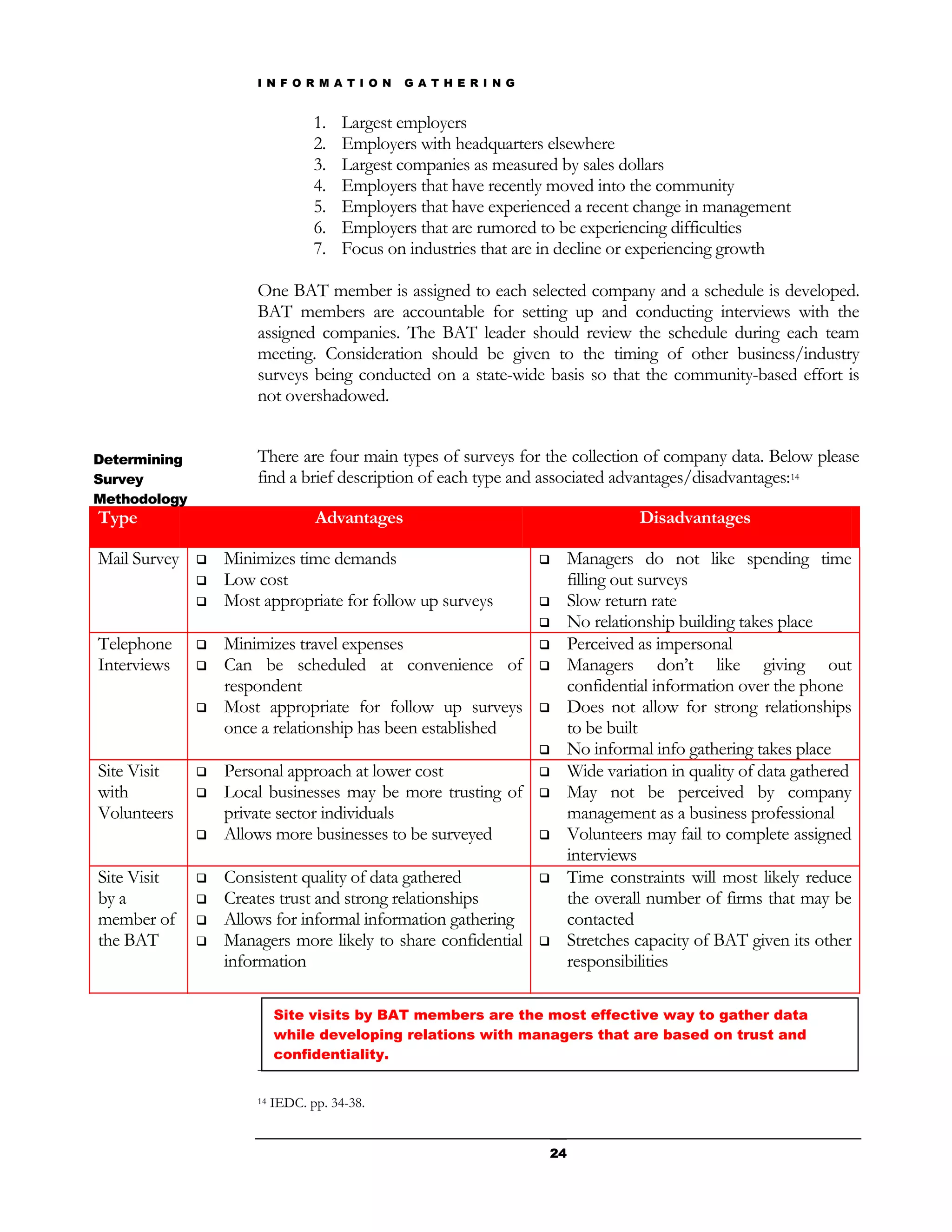
Determining           There are four main types of surveys for the collection of company data. Below please
Survey                find a brief description of each type and associated advantages/disadvantages:14
Methodology
Type                              Advantages                                      Disadvantages

Mail Survey      Minimizes time demands                               Managers do not like spending time
                 Low cost                                              filling out surveys
                 Most appropriate for follow up surveys               Slow return rate
                                                                       No relationship building takes place
Telephone        Minimizes travel expenses                            Perceived as impersonal
Interviews       Can be scheduled at convenience of                   Managers don’t like giving out
                  respondent                                            confidential information over the phone
                 Most appropriate for follow up surveys               Does not allow for strong relationships
                  once a relationship has been established              to be built
                                                                       No informal info gathering takes place
Site Visit       Personal approach at lower cost                      Wide variation in quality of data gathered
with             Local businesses may be more trusting of             May not be perceived by company
Volunteers        private sector individuals                            management as a business professional
                 Allows more businesses to be surveyed                Volunteers may fail to complete assigned
                                                                        interviews
Site Visit       Consistent quality of data gathered                  Time constraints will most likely reduce
by a             Creates trust and strong relationships                the overall number of firms that may be
member of        Allows for informal information gathering             contacted
the BAT          Managers more likely to share confidential           Stretches capacity of BAT given its other
                  information                                           responsibilities

                           Site visits by BAT members are the most effective way to gather data
                           while developing relations with managers that are based on trust and
                           confidentiality.


                      14   IEDC. pp. 34-38.


                                                                   24
I N F O R M A T I O N   G A T H E R I N G


A combination of the methodologies may be the best approach.

            On-site visit by member of the BAT for companies that meet criteria

            Mail survey for all other businesses that BAT will not be able to interview
             in the first year

            Phone interviews for follow-up surveys

Instead of using paper-based, mail surveys, the BAT may want to use an online survey
format. Online surveys are easier to fill out and are automatically tabulated. One such
resource can be found at www.hostedsurvey.com. This is a fee-based service,
dependent on the number of responses. There is a discount for non-profit
organizations. A second tool to create online surveys is www.surveymonkey.com. This
service requires a fee-based monthly subscription.


Designing a Strategic Survey Instrument
The BAT develops a separate survey instrument for each type of information gathering
(pre-interview data gathering, visit to corporate headquarters, visit to local plant, follow-
up survey, mail survey).

  The on-site survey should not spend time confirming information that can be
  gathered elsewhere.


Prior to scheduling a site visit the following data should be evaluated:

            Thorough analysis of company website
            Financial statements (10K filings) of publicly traded companies
            Industry trends (See Chapter 5)

Appendix B contains a series of survey instruments utilized by other organizations in
their BR&E and their business development efforts. The BAT may want to choose
questions from existing surveys or customize their own.

An on-site survey should not require more than 30 to 45 minutes to administer

Once a strong relationship has been established with a plant manager or business
owner, the BAT may want to create a one-page quantitative survey to be distributed
and filled out in advance of future visits. This will allow site visits to focus on strategic
issues and make more efficient use of everyone’s time.


                                             25
I N F O R M A T I O N     G A T H E R I N G


In developing any survey tool the focus must be on making questions strategic. A study
of BR&E programs demonstrated that only 12% of questions posed in a typical survey
provided significant strategic value. For example, 57% of the surveys reviewed asked
questions of no strategic value.15 Chapter 6 provides a list of key indicators that can
predict whether a company is in decline or will expand. The questions included in the
survey should ask for information that speaks to these indicators. The CD
accompanying this guide includes a database to be used for tracking the data over time.
It is based on the key indicators discussed in Chapter 6 and can also be utilized as a
guide in creating questions for the survey instrument.

Each question chosen for the survey should correspond to one of the following criteria
in order to ensure that it is strategic in nature:

              1. Location Related Question: It identifies a specific problem or it
                 allows the company to rate its overall satisfaction with the community.
              2. Predictive Question: It assesses management’s attitudes toward the
                 company’s growth potential.
              3. Problem Identification Question: It identifies any internal problems
                 that the company may be experiencing that may impact its future plans.
              4. Industry Intelligence Question: It identifies trends within the
                 company’s industry regarding demand, product innovation and
                 competition.
              5. Company Intelligence Question: It gathers information about the
                 company’s markets, activities and plans.


Training the Interviewers
The BAT will need to decide whether only BAT members conduct company interviews
or whether they will involve volunteers from the private sector, local college professors,
economic development experts at the utility company and/or community leaders. Since
few people have extensive experience in conducting interviews, it is essential to offer
training to everyone involved in the industrial surveys.

Confidentiality
Most business owners and managers are reluctant to share business information. In
order to obtain the information necessary for a successful BR&E effort, owners and
managers must be assured of the confidentiality of the data. This must be explained in
an introductory letter as well as by the interviewer.

The BAT must be fully committed to confidentiality in order for the BR&E to be able
to gain accurate data and the respect of the business community. The BAT leader needs
to remind members of the confidentiality issue at every meeting. In rural communities,


 Canada, Eric. “Locked in the Twilight Zone: Business Retention Fails the Strategic Value Test! Economic
15

Development Review. Wheaton: Blane, Canada Ltd., 1996.


                                                    26
I N F O R M A T I O N   G A T H E R I N G


it is easy to identify a company by certain characteristics. Changing the name will do
little to ensure confidentiality.

    Keeping business data confidential is key for the success of all BR&E efforts.

Several measures need to be built into the collection and analysis process to ensure
confidentiality:

    The interviewer will record information but will not discuss any part of the
     interview with anyone but the BAT.
    Each business is assigned a code that will be used to track the business data over
     time. Only the BAT has access to the list of businesses to which the codes
     correspond.
    Any information to be published will be in a collective form and will not single out
     any individual company.

Companies may also ask interviewers to sign confidentiality agreements. These are
legally binding and should be reviewed carefully.


Training Session
The training session may want to focus on the following areas:

     1.   Overview of the BR&E Program and importance of information gathering
     2.   Review of the importance of confidentiality
     3.   Overview of the survey form
     4.   Reviewing interviewing tips
     5.   Mock interviews and role playing, involving all participants


                                            27
I N F O R M A T I O N   G A T H E R I N G


                              Interviewing Tips
   Be punctual! Arrive 10 minutes ahead of your scheduled appointment time. If you
    are unsure where the business is located, call ahead and obtain directions. If you
    plan to accomplish several interviews in one day, be sure to allow adequate travel
    time between each business.

   Dress in proper business attire. Conservative business attire helps to reinforce the
    notion that the BR&E program is a serious, on-going initiative.

   Make sure that the business owner or manager understands the confidentiality
    provisions of the survey.

   Conduct the interview in a conference room or some other setting that will be free
    from interruptions by the owners/manager’s staff or telephone.

   Always have an extra copy of the questionnaire on hand to give to the business
    owner or manager.

   Establish good rapport with the business owner or manager by thanking them at
    the outset for the agreeing to take time out of his/her busy schedule to participate.

   You are an ambassador of the BR&E program. Always complement the business
    owner on his or her venture. Keep critical opinions to yourself. You are not there as
    a consultant. You are there to gather data.

   If the interviewee has a problem (s)he wants to discuss, it is best to let him/her talk
    about it early in the interview so that the interviewer can make note of it and move
    forward with the survey questions.

   The interviewee sets the tone and the pace of the interview.

   Do not push the owner/manager to answer a question with which they are not
    comfortable.

   An on-site survey should not require more than 30 to 45 minutes to administer

   Take a paper copy of the Early Warning Indicators included in the BR&E
    Database form that can be found as part of this guide.

   Avoid using the survey like a checklist during the visit. Guide the discussion and
    allow the conversation to unfold naturally.

   Listen more, talk less.


                                            28
I N D U S T R Y    A N A L Y S I S


                                                                                                       5
                                                                                                       Chapter


                    Industry Analysis
                    The largest employer in your hometown is not working in a vacuum. It is part of a
                    larger industry, whose trends impact its performance. It is, therefore, critical for the
                    BAT to develop and maintain a good understanding of the trends in a company’s
                    industry. Changes in the industry will undoubtedly impact the company in your
                    community and its decisions whether to maintain, grow or close its facility.

                    In order to make the on-site interaction more valuable, it is helpful to understand a
                    company’s industry prior to the interview. An industry analysis is a type of business
                    research that focuses on the status of an industry or an industrial sector. A complete
                    industrial analysis usually includes a review of an industry’s recent performance, its
                    current status, and the outlook for the future.

                    It is important to track developments in the industry over time. A sudden change or
                    decline in the industry may force the company in your town to respond rapidly by
                    cutting jobs or relocating.


                    Components of an Industry Analysis
                    The industry analysis needs to address the following key points:16

Industry Size and   Determine the size of the industry in terms of total sales revenue. It is important to
Trends              determine whether the industry is growing or declining. What is causing this trend?
                    What trends are expected in the coming years? How does this impact the company in
                    your town? Provide a general explanation of the distribution system for products and
                    services in the targeted industry.

                    Understand how technology is changing this industry. Is there technology that has
                    become standard in this industry? The on-site visit can then help determine if the
                    company has access to this technology and is able to compete.


                    16 This framework is based on Michael Porter’s Five Forces Analysis which was originally published in

                    Competitive Strategy: Techniques for Analyzing Industries and Competitors. New York: Free Press, 1980.


                                                                       29
I N D U S T R Y   A N A L Y S I S


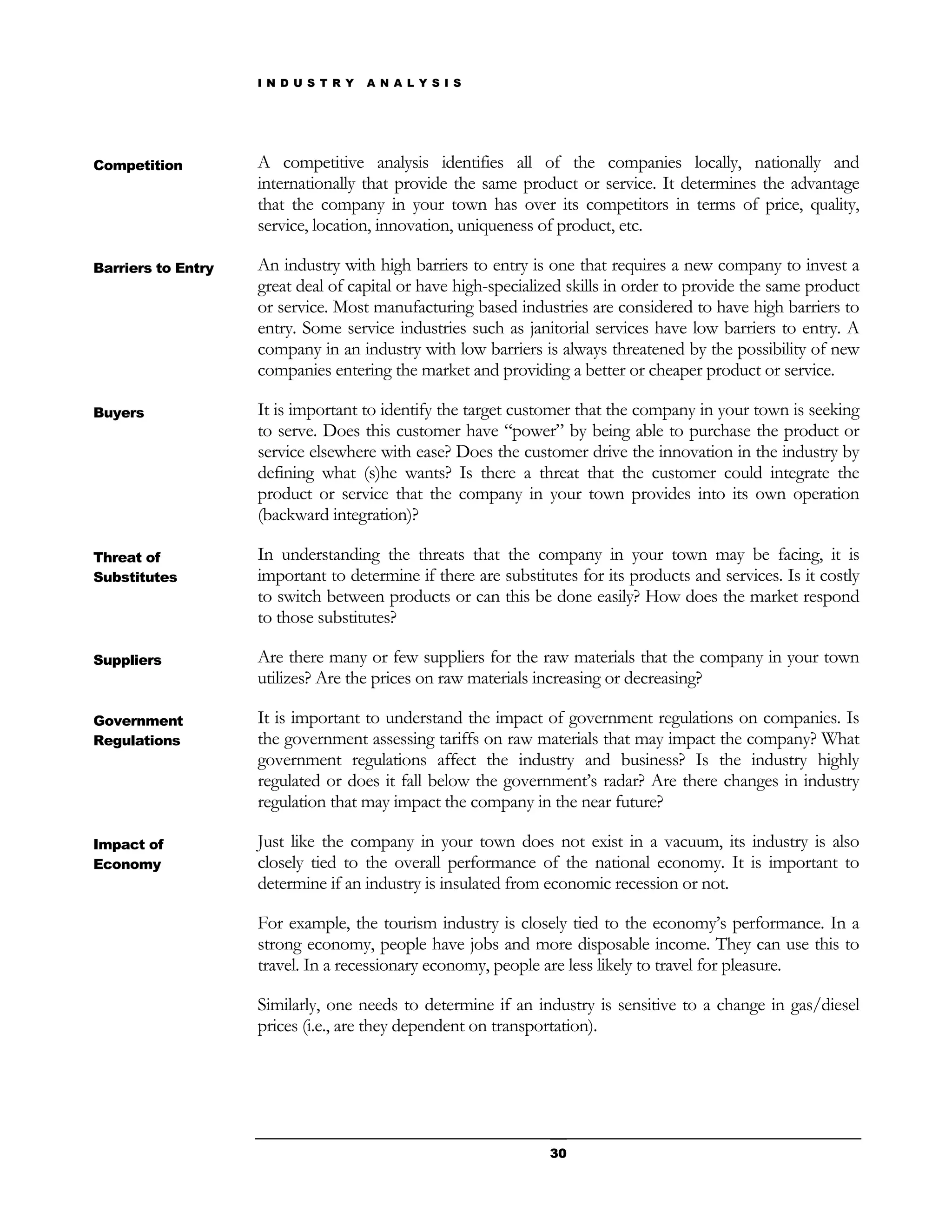
Competition         A competitive analysis identifies all of the companies locally, nationally and
                    internationally that provide the same product or service. It determines the advantage
                    that the company in your town has over its competitors in terms of price, quality,
                    service, location, innovation, uniqueness of product, etc.

Barriers to Entry   An industry with high barriers to entry is one that requires a new company to invest a
                    great deal of capital or have high-specialized skills in order to provide the same product
                    or service. Most manufacturing based industries are considered to have high barriers to
                    entry. Some service industries such as janitorial services have low barriers to entry. A
                    company in an industry with low barriers is always threatened by the possibility of new
                    companies entering the market and providing a better or cheaper product or service.

Buyers              It is important to identify the target customer that the company in your town is seeking
                    to serve. Does this customer have “power” by being able to purchase the product or
                    service elsewhere with ease? Does the customer drive the innovation in the industry by
                    defining what (s)he wants? Is there a threat that the customer could integrate the
                    product or service that the company in your town provides into its own operation
                    (backward integration)?

Threat of           In understanding the threats that the company in your town may be facing, it is
Substitutes         important to determine if there are substitutes for its products and services. Is it costly
                    to switch between products or can this be done easily? How does the market respond
                    to those substitutes?

Suppliers           Are there many or few suppliers for the raw materials that the company in your town
                    utilizes? Are the prices on raw materials increasing or decreasing?

Government          It is important to understand the impact of government regulations on companies. Is
Regulations         the government assessing tariffs on raw materials that may impact the company? What
                    government regulations affect the industry and business? Is the industry highly
                    regulated or does it fall below the government’s radar? Are there changes in industry
                    regulation that may impact the company in the near future?

Impact of           Just like the company in your town does not exist in a vacuum, its industry is also
Economy             closely tied to the overall performance of the national economy. It is important to
                    determine if an industry is insulated from economic recession or not.

                    For example, the tourism industry is closely tied to the economy’s performance. In a
                    strong economy, people have jobs and more disposable income. They can use this to
                    travel. In a recessionary economy, people are less likely to travel for pleasure.

                    Similarly, one needs to determine if an industry is sensitive to a change in gas/diesel
                    prices (i.e., are they dependent on transportation).


                                                                30
I N D U S T R Y   A N A L Y S I S


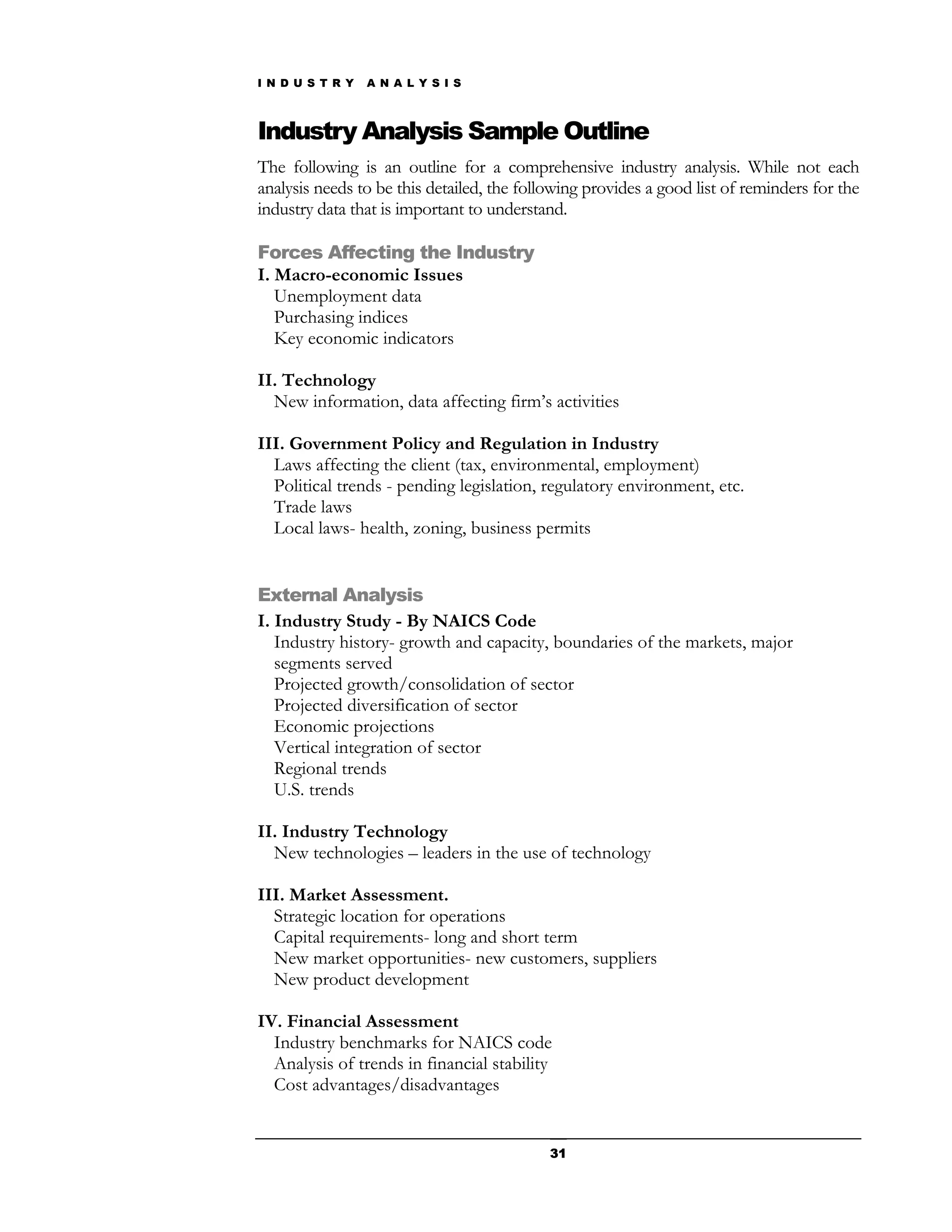
Industry Analysis Sample Outline
The following is an outline for a comprehensive industry analysis. While not each
analysis needs to be this detailed, the following provides a good list of reminders for the
industry data that is important to understand.

Forces Affecting the Industry
I. Macro-economic Issues
   Unemployment data
   Purchasing indices
   Key economic indicators

II. Technology
  New information, data affecting firm’s activities

III. Government Policy and Regulation in Industry
  Laws affecting the client (tax, environmental, employment)
  Political trends - pending legislation, regulatory environment, etc.
  Trade laws
  Local laws- health, zoning, business permits


External Analysis
I. Industry Study - By NAICS Code
   Industry history- growth and capacity, boundaries of the markets, major
   segments served
   Projected growth/consolidation of sector
   Projected diversification of sector
   Economic projections
   Vertical integration of sector
   Regional trends
   U.S. trends

II. Industry Technology
  New technologies – leaders in the use of technology

III. Market Assessment.
  Strategic location for operations
  Capital requirements- long and short term
  New market opportunities- new customers, suppliers
  New product development

IV. Financial Assessment
  Industry benchmarks for NAICS code
  Analysis of trends in financial stability
  Cost advantages/disadvantages


                                            31
I N D U S T R Y   A N A L Y S I S


VI. Suppliers
  Vendor relationships
  Switching costs of suppliers
  Volume determinants

VII. Competitive Analysis- intensity of rivalry
  Product difference in competition
  Diversity of competitors
  Objectives and strategies
  Vulnerabilities of competition
  Potential new entrants in the market

VIII. Customer Analysis
  Bargaining leverage
  Volume issues
  Price sensitivity
  Brand identity
  Incentives
  Buyer-end user chain

Research Tools
There is a great deal of industry information available on the Internet. A search by
industry name may be the best start. There are also a number of specific websites that
provide industry data. Some information is free, some sites require a subscription, and
other sites require a payment per industry or report. Some sites provide a free trial,
which may be enough to collect the necessary industry data.

Another great place to start an industry analysis is with the trade association to which
the company in your town belongs. It may be best to ask the manager about his/her
affiliation to a trade association. The trade association website will provide good, basic
information about the industry and may provide reports for a fee.

    1. Bureau of Economic Analysis is an agency of the U.S. Department of
       Commerce and provides statistical information on every identifiable industry in
       the United States. Free information at www.bea.doc.gov.

    2. Census Bureau Provides detailed statistics on many products and materials in
       the manufacturing, mining, and construction industries. The reports are
       available as HTML, PDF, and worksheet files. www.census.gov

        Other industries are covered on the Economy Overview page.

    3. Business.com covers over 28 industries, from accounting to utilities.
       Business.com provides a directory of industry web sites. www.business.com

    4. First Research is an on-line research tool ($99 per industry report).
       http://industryprofiles.1stresearch.com

                                           32
I N D U S T R Y   A N A L Y S I S


    5. Hoovers Online provides Overview and analysis of over 45 industries. Each
       snapshot includes statistics, links to companies in each industry, and a jargon
       list. www.hoovers.com (requires paid subscription)

    6. Value Line Investment Survey, Standard Edition provides a concise one or
       two-page industry commentary in the beginning of each industry section. The
       commentaries are updated often.

    7. Dun & Bradstreet Industry Handbook provides a fairly complete analysis
       (including an overview, statistics, ratios, company directories and rankings,
       associations, and more) for chemicals and pharmaceuticals, computers and
       software, broadcasting and telecommunications, construction and agriculture,
       entertainment and hospitality, and insurance and health/medical services.

    8. Fast Company Magazine provides good business resources. Entering the
       name of the desired industry in the search engine will provide both articles as
       well as useful links to other sources of industry information.
       www.fastcompany.com

    9. Inc. Magazine provides an archive of articles on a number of industries. It has
       its own search engine. http://www.inc.com

    10. Standard & Poor’s Industry Surveys provide in-depth studies, background
        information, analysis, vital facts, figures, forecasts and trends on 52 U.S.
        industries. Surveys are updated semi-annually (requires paid subscription).

    11. Lexis Nexis provides information to legal, corporate, government and
        academic markets, and publishes legal, tax and regulatory information, via
        online hardcopy print and CD-ROM formats (requires paid subscription).

    12. American Manufacturer’s Directory provides information on more than
        150,000 organizations with 20 or more employees. This directory is excellent
        for prospecting, direct mail, telemarketing, market research, planning, business
        reference, and credit decisions (requires paid subscription).

    13. Harris Infosource provides sales and marketing information to
        manufacturing, technology and service firms nationwide (requires paid
        subscription).

    14. DemographicsNow.com provides reports and interactive mapping for all
        levels of U.S. geographies (requires paid subscription).

Check with your local economic development partners to determine who subscribes to
databases and sources of industry information (some are identified above) that can be
of assistance in collecting industry data.


                                          33
P R O B L E M   S O L V I N G


                                                                                           6
                                                                                           Chapter


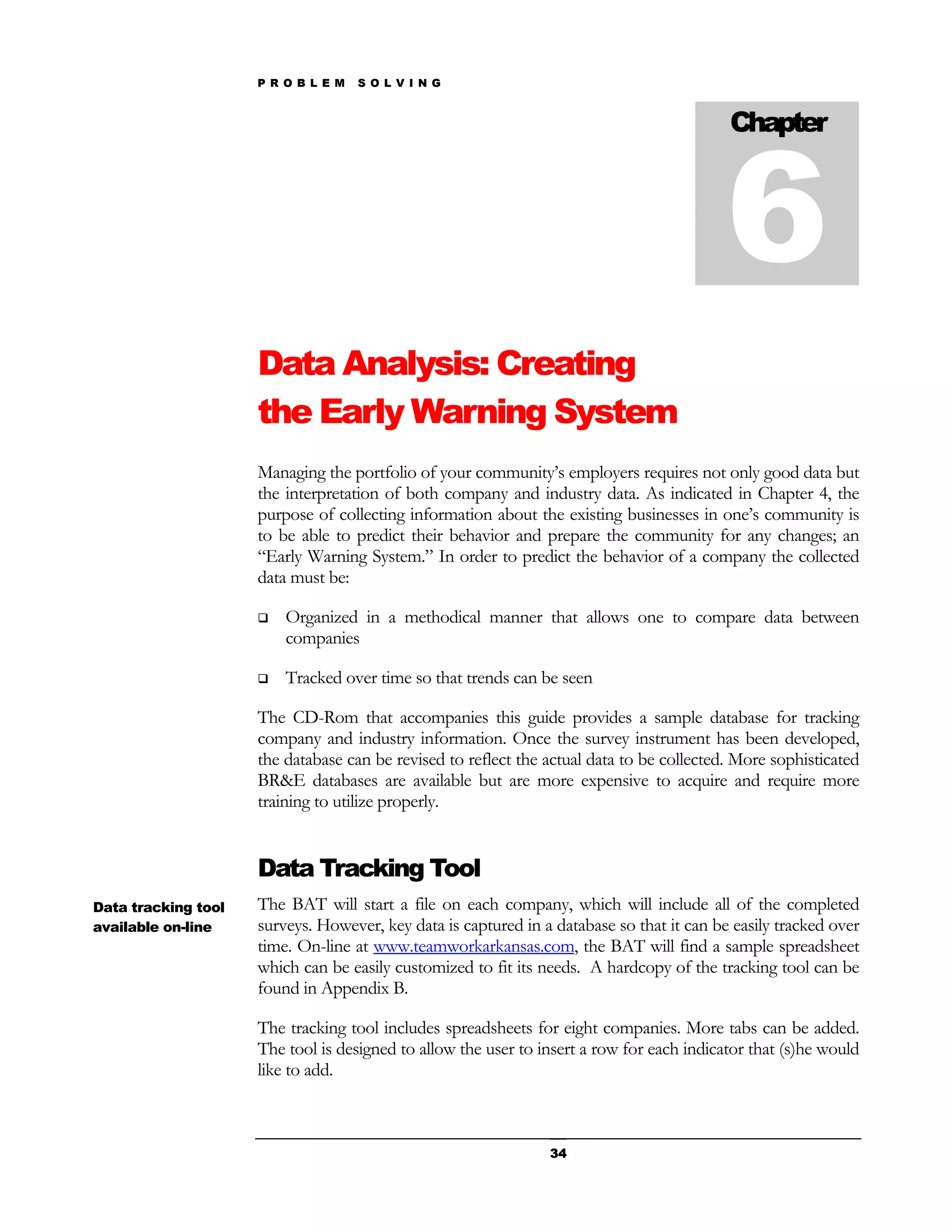
                     Data Analysis: Creating
                     the Early Warning System
                     Managing the portfolio of your community’s employers requires not only good data but
                     the interpretation of both company and industry data. As indicated in Chapter 4, the
                     purpose of collecting information about the existing businesses in one’s community is
                     to be able to predict their behavior and prepare the community for any changes; an
                     “Early Warning System.” In order to predict the behavior of a company the collected
                     data must be:

                        Organized in a methodical manner that allows one to compare data between
                         companies

                        Tracked over time so that trends can be seen

                     The CD-Rom that accompanies this guide provides a sample database for tracking
                     company and industry information. Once the survey instrument has been developed,
                     the database can be revised to reflect the actual data to be collected. More sophisticated
                     BR&E databases are available but are more expensive to acquire and require more
                     training to utilize properly.


                     Data Tracking Tool
Data tracking tool   The BAT will start a file on each company, which will include all of the completed
available on-line    surveys. However, key data is captured in a database so that it can be easily tracked over
                     time. On-line at www.teamworkarkansas.com, the BAT will find a sample spreadsheet
                     which can be easily customized to fit its needs. A hardcopy of the tracking tool can be
                     found in Appendix B.

                     The tracking tool includes spreadsheets for eight companies. More tabs can be added.
                     The tool is designed to allow the user to insert a row for each indicator that (s)he would
                     like to add.


                                                                34
P R O B L E M      S O L V I N G


Root Causes
Analysis of the company information gathered needs to determine the root causes of
the problems discovered during an information gathering session. Often business
owners themselves may not fully understand the actual causes and the BR&E process
may provide them with great insight.

For example, an employer may indicate that they cannot expand because they are
lacking the necessary working capital. While the initial reaction might be that this
company requires a working capital loan, the root cause may be that the company does
not have a proper collection system in place or is carrying large amounts of obsolete
inventory that is tying up cash.

While the problem cannot be solved during the interview, the root cause needs to be
identified (see p. 40 for technical assistance). By providing the company with technical
assistance to develop a collection system and/or inventory management system, the
problem can be resolved. The company is then in a position to expand and hire more
workers.


Early Warning Indicators                     17


The BAT may want to develop an “Early Warning System” by identifying key
indicators that may predict a company’s decline (or expansion). A review of existing
BR&E programs across the country provided the following list of sample indicators.
Please note that these indicators are reflected in the Data Tracking Tool provided with
this guidebook on-line at www.teamworkarkansas.com:

      Declining sales [If decline continues, company will need to reduce workforce.]

      Declining employment [Company may be looking to wind down operations in your
       community.]

      Gradual corporate downsizing [As headquarters pull management staff to other
       locations, the plant in your community loses significance and is not targeted for
       expansion.]

      Obsolete buildings [Company is no longer making investments in the facility
       indicating that the long-term strategy is to shut it down.]

      Recent ownership change [New owners may not be as committed to your
       community and choose to shut the plant or operation down.]

      Merger or Buy-Out [New management will look to consolidate operations and may
       decide to shut the plant in your community down.]


17   IEDC, p.54.


                                             35
P R O B L E M   S O L V I N G


   Older product lines [Company may continue to produce products until they
    become obsolete and then shut plant down.]

   Excess capacity [In some cases this may indicate that the company is poised for
    growth, it may also indicate that the company has lost business and will have
    trouble carrying its overhead costs leading to a financial decline.]

   Recruitment of employees is a problem [Company may be looking to move facility
    out of Arkansas, closer to a metropolitan area where highly skilled individuals are
    more readily available.]

   Other facilities producing the same product or service [Increased competition will
    lower prices and profits which may require the company to reduce costs and lay off
    workers.]

   Facility expansion plans in another community [Company is moving some of its
    activity to another community and may eventually shut down facility in your
    community.]

   Lease of property [Company is not ready to make a long term commitment to your
    community by not purchasing land and building.]

   Older equipment and technology [Company is no longer making investments in the
    facility indicating that the long-term strategy is to shut it down.]

   Low barriers to entry [Competitors can enter market quickly and take market share,
    making it more difficult for the company to compete.]

   Company has no competitive advantage [A company that is a “follower” and has
    little advantage in the market place must compete on price which makes it more
    vulnerable.]

   Company has an increasing number of competitors [As competitors enter the
    market, there is downward pressure on prices making it more difficult for a
    company to meet its costs.]

   There are new substitutes for the product [Even though they are not exactly like the
    product, the substitutes draw customers away from the company causing a decrease
    in sales.]

   Loss of longstanding supplier contracts/relationships [Company may struggle to
    replace revenue previously generated from these contracts and may need to reduce
    workforce.]

   Competitors are moving plants overseas [Competitors will decrease their prices,
    forcing company to do the same even though their labor costs remain the same.]

   Unbearable regulatory burdens [Company is looking for another location including
    overseas where doing business is easier and cheaper.]

                                          36
P R O B L E M   S O L V I N G


Benefits of an Early Warning System
Your community’s “portfolio manager” uses the Early Warning System to pursue an
aggressive, bold proactive strategy to protect the jobs in the community. Through
advance notification of possible problems, the BAT is in a position to pursue one or
more of the following strategies:

   Use its relationship with the local manager to confirm the indicators: Is the
    company planning a change?

   Influence the company’s management in its decision making process in such a way
    as to keep as many jobs in the community as possible

   Provide incentives to the company to expand in the local community instead of
    moving elsewhere

   Coordinate outside resources and allies that may help the company solve some of
    its problems

   Prepare the community for the upcoming change by providing retraining programs
    and assisting entrepreneurial minded employees in starting their own businesses

   Organize an employee-buy-out of the company through an Employee Stock
    Ownership Program (ESOP). Legislation governing the ESOP process no longer
    requires employees to invest their own cash or collateral in the process making this
    an option even in low-wealth communities.

                                A Success Story
    In Pulaski County, Arkansas, the Business Retention and Expansion effort is
    led by the Little Rock Regional Chamber of Commerce, in partnership with
    each local community’s economic developer. Over the course of several years,
    relationships were developed during site visits between local plant managers
    and BR&E representatives. These meetings encouraged open dialogue to
    identify issues and develop creative solutions. Therefore, it was no surprise
    that the plant manager of an existing high-tech manufacturer contacted the
    BR&E representative first when the company needed help. In April 2009,
    local and state economic developers became the first responders when they
    learned that without assistance to help the company purchase new equipment,
    it would be in jeopardy of losing a production line and 30 employees. The
    local BR&E team followed procedures recommended by the BR&E program
    and involved key partners early in the process to help secure the equipment
    and save 30 jobs. Furthermore, the additional investment in the production
    line helped to solidify the necessity of this plant’s current location with its
    corporate headquarter executives.


                                          37
P R O B L E M   S O L V I N G


                                                                                          7
                                                                                          Chapter


                    Problem Solving: Keeping and Growing
                    the Jobs in Your Community
                    The ultimate goal of any successful BR&E effort is to maintain and expand the number
                    of available jobs in a community by helping companies solve the problems that may be
                    leading to decline and providing the necessary support to help other companies expand.


                         It is the concrete solutions to the issues raised during an interview or
                           survey that will begin to build the credibility of the BR&E strategy.


                    Furthermore, it is the proactive and creative identification of growth opportunities that
                    will create buy-in for the strategy among business owners and managers.

                      The Business Advancement Team is in a unique position to advocate for
                      change, bring different organizations together and create a pro-business
                      environment in the community.


                    In order to assist local employers in addressing problems, they must first be tracked
                    carefully. Each BAT member is trained to identify problems as well as growth
                    opportunities. These problems are tracked in the database. Issues impacting one
                    employer usually affect other employers as well. The BAT develops a strategy and
                    schedule for addressing those problems that impact the greatest number of employers
                    first. The database tracks the BAT’s action in solving employers’ problems or assisting
                    an employer with an expansion plan.

Addressing Issues   The BAT can be instrumental in ensuring that a community has adequate sites for
in the Community    expansion. The BAT may help in negotiating with local property owners to obtain a lot
                    adjacent to current operations. It may also identify all potential sites for ownership,
                    price, soil analysis, availability of utilities and plant maps. Often companies seeking to


                                                               38
P R O B L E M      S O L V I N G


              expand will consider moving into an available building to save start-up time and money
              while avoiding construction problems.18

              An expanding company may require an extension of utility services. The BAT may
              identify engineering services to conduct an analysis to determine if the projected
              demand can be met or requires additional resources.

Workforce     Many employers in small and medium size towns in Arkansas have a difficult time
Development   hiring qualified workers, supervisors and managers. There are a number of roles that
              the BAT can play to address this issue.

              The BAT can function as the intermediary between the employer and the local
              workforce development program.

              The Arkansas Association of Two-Year Colleges has developed a WorkForce Training
              Consortium that involves 22 two-year colleges across the state that combined provide
              over 500 customized Business and Industry training courses. More information can be
              found at http://www.aatyc.org/workforce_training/

              In Appendix A, please find a list of all of the community colleges and technical
              institutes in Arkansas.

              The Arkansas Economic Development Commission has four Business Retention and
              Expansion Representatives on staff to address the specific training needs experienced
              by an Arkansas employer.

              The state also provides financial incentives for training workers. For more information
              please visit: http://www.1800arkansas.com/Incentives/Customized_Training.htm.

              Furthermore, contact information for local workforce development boards can be
              found at www.arworks.org/local.html.

              By working closely with the plant manager, the BAT can identify the skills required to
              fill current needs or future positions. It can then work with the local workforce
              development program to identify individuals and provide them with skill specific
              training to prepare them for work at the targeted business.

              The BAT can conduct local wage and labor surveys to guide the employer in
              determining the wages that need to be paid in order to prevent good local employees
              from leaving the company.

              The employer may be eligible to receive free, customized training for future and
              existing employees through the Business and Industry Training Program operated by
              the Arkansas Economic Development Commission. Detailed information is available at
              www.arkansasedc.com/business-development/incentives/customized-training.aspx .


              18   Teamwork Entergy, p. 21


                                                        39
P R O B L E M   S O L V I N G


Identifying
                Expanding businesses often require working capital and equipment financing to pursue
Financial       their expansion plans. At risk businesses stand to benefit from the refinancing of
Resources       existing debt to create some working capital and to reduce the burden of debt service.
                The BAT may want to become a centralized source of information on financing
                options. It may want to make this information available through a brochure or on its
                website.

                The BAT may also want to include local banks in the BR&E efforts from the start.
                Having a local bank participate in a business loan makes it much easier for a business
                lender not located in the community to participate in the loan.

                Many small and medium sized towns have untapped resources in the form of individual
                wealth. Individuals in Arkansas rarely invest in local businesses because they do not
                understand the process, do not want to deal with a flood of requests and fear turning
                someone down. The BAT can play a key role in developing an Angel Investor Network
                (AIN) in the community. An AIN protects the identity of the individual investor,
                allows multiple investors to share in the risk of a particular deal and can help investors
                distinguish between a good and a risky deal. For more information on starting an AIN
                visit www.investorscircle.net.

Technical and   One of the best ways to help employers solve problems is to connect them to technical
Managerial      assistance providers that are equipped to tackle internal business issues.
Assistance
                The BAT may be helpful by identifying private sector consulting firms willing to travel
                to your town to assist a company. The BAT will first need to ensure if the company is
                in financial position to pay for this assistance.

                The BAT may also consider connecting the employer with resources at alt.Consulting, a
                non-profit organization dedicated to BR&E across Arkansas by providing on-site,
                management assistance to employers in rural communities. alt.Consulting specializes in
                the turnaround of manufacturing companies but can also help companies in the service,
                distribution or retail sectors grow their businesses. While alt.Consulting charges a
                below-market fee for its services, it can also identify subsidy dollars through a network
                of partners or can finance the fee at 0% interest over two years. For a detailed list of
                services provided please visit, www.altconsulting.org.

                For engineering assistance, the BAT may want to contact the Arkansas Manufacturing
                Solutions (AMS), a program of the Arkansas Science & Technology Authority. AMS is
                charged with providing technical and engineering assistance to manufacturers in
                Arkansas. By helping individual manufacturers, the network assists the surrounding
                communities and the entire state. For more information, please visit
                www.mfgsolutions.org.

                A variety of technical assistance resources are also available through the University of
                Arkansas Economic Development Institute. UAEDI is a voluntary collection of (1)
                University of Arkansas faculty, staff, students and administrators and (2) external
                partners, all who have a personal and/or professional interest in enhancing the
                economic and social well-being of the people of Arkansas. Their website


                                                           40
P R O B L E M      S O L V I N G


             www.uaedi.cast.uark.edu provides links to a number of helpful resources including the
             Arkansas Entrepreneurial Resource Database.

Government   The BAT can also be instrumental in helping businesses navigate government
Relations    regulations and assisting them in taking advantage of government incentives. In order
             to help businesses meet governmental requirements the BAT can act as mediator by
             taking responsibility for:19

                   Keeping a record of all government-related problems
                   Keeping a listing of best contacts within agencies
                   Keeping a listing of consultants who can resolve regulatory problems
                   Ensuring local government cooperation with industry operations

             Arkansas provides a number of tax incentive programs for companies doing business in
             Arkansas. Some incentives require negotiations with the Arkansas Economic
             Development Commission:

                   Advantage Arkansas (Income Tax Credit) – job creation based on the payroll
                    of new, full-time, permanent employees hired as a result of the project.
                   Tax Back (Sales and Use Tax Refund) – on building materials and taxable
                    machinery and equipment associated with the approved project.
                   InvestArk (Sales and Use Tax Credit) – investment of $5 million or more in
                    expansion, equipment, modernization or new construction.
                   Create Rebate Program (Payroll Rebate) – minimum payroll of $2 million for
                    full-time employees required
                   ArkPlus (Income Tax Credit) - provides tax credits of 10% of the total
                    investment in a new location or expansion project. ArkPlus requires both a
                    minimum investment and a minimum payroll of new, full-time, permanent
                    employees hired as a result of the project, depending on the tier in which the
                    business locates.
                   Incentives for businesses that qualify as "targeted businesses" may qualify for
                    three special incentives designed to help new, knowledge-based businesses in their
                    early years.
                   Research and Development – for research conducted at Arkansas colleges or
                    universities
                   Child Care Facility Tax Incentive – for employers who provide child care for
                    their employees
                   Customized Training Incentives – payment of instructional costs for new
                    employee
                   Recycling Equipment Tax Credit – purchase of equipment used for recycling
                   Motion Picture Incentive – motion picture production business spending more
                    than $500,000 in six months
                   Tourism Development – Minimum project cost of $1 million, hiring of
                    employees


             19   Teamwork Entergy, p. 27


                                                          41
P R O B L E M   S O L V I N G


             For more information about each of these incentive programs, please contact the
             Arkansas Economic Development Commission or visit:
             www.arkansasedc.com/Incentives.

             Finding a comprehensive list of federal tax incentives for businesses is more difficult. A
             Certified Public Accountant may advise the BAT on current incentives. A place to
             begin the research is the IRS tax Form 3800 which lists a number of business tax credits
             and references the IRS documents that provide more information. To find out more,
             go to www.irs.gov, under “Forms & Publications Search” type in 3800.

Technology   One opportunity to identify growth opportunities for local businesses is to assist
Transfer     companies in commercializing research conducted by an Arkansas-based college or
             university. Most federal agencies provide Small Business Innovation Research (SBIR)
             grants that provide funds to conduct a thorough feasibility study and seed capital to set
             up the necessary production processes. This can help spawn new businesses or add
             product lines for existing companies. General information about SBIR and related
             programs can be found at http://www.sba.gov/sbir/indexsbir-sttr.html.

             The University of Arkansas Economic Development Institute (mentioned above) seeks
             to partner the university’s research with entrepreneurs across the state. The University
             of Arkansas Capabilities Data Base (UACDB), accessible through
             www.uaedi.cast.uark.edu, lists entities within the university system conducting research
             that may have strong market potential.


                                                        42
P R O B L E M   S O L V I N G


                                 Case Study:

                      Saving Jobs in Wecare, AR
On Pages 11 and 21 you read about the issues that the town of Wecare, AR faces with
respect to its largest employer, AutoParts USA. We now turn back the clock.

During a regularly scheduled plant visit, the plant manager (Keith) mentioned that
corporate headquarters had given a newly introduced auto part to its Michigan
operation to produce. The Wecare plant had not received a new product to produce in
years.

Chris, the leader of the Business Advancement Team, was troubled by this news. He
invited Keith out to dinner to do some brainstorming. Keith loved his job and loved
living in Wecare. By the end of the evening, Keith and Chris agreed that they would
research some third-party products that the plant could produce. Keith had explained
that a third-party product is usually developed by another company that may not have
the capability to actually manufacture it.

Chris spent hours researching and got a bit frustrated at not finding something suitable
for the Wecare plant’s equipment capabilities. A few days later he conducted another
site visit on his schedule with Tidy Lawn, a company that sells high-end lawn mowing
equipment to golf courses across the country. Larry T. Idy, the business owner and life-
long resident of Wecare, shared with Chris that he could not fill his orders on time
because the manufacturer of the primary line of lawn mowers in Missouri was in
financial trouble. He was concerned that the Missouri company might file for Chapter
11 protection soon. Here was the opportunity, Chris thought.

Chris invited Keith to look at the lawn mowers currently being sold. Keith and Chris
visited the AutoPart USA headquarters to discuss the future of the Wecare plant. They
were able to confirm Keith’s worst fears. In response, Chris presented a proposal for
the auto-parts manufacturer to purchase the patent and production rights of the lawn
mower manufacturer in Missouri. Chris could mobilize resources to help re-train
employees and find financing for any additional equipment that may be necessary.

The CFO shared with Chris that they had made a number of investments in related
industries that made financial sense. Now Chris and Keith were on a mission. They
hired a consultant and an engineer to help them determine the additional equipment
they would need. The consultant helped them develop financial projections that
demonstrated a strong profit for this new venture.

Can Wecare save the 120 jobs at the AutoParts USA plant and the 10 sales and clerical
positions at Tidy Lawn?


                                          43
B U S I N E S S   D E V E L O P M E N T   I N I T I A T I V E S


                                                                                          8
                                                                                          Chapter


                    Business Development Initiatives
                    As the BR&E effort matures in a community, it usually results in additional business
                    development initiatives that strengthen existing businesses, encourage the start up of
                    new businesses and attract small businesses from outside the community to relocate
                    there. Through these initiatives, the BR&E effort focuses on growing jobs by
                    connecting existing businesses with new sales opportunities as well as assistance in
                    improving management systems that enable companies to grow profitably.

                    While the field of business development is extensive, the following provides a number
                    of initiatives implemented by established BR&E programs around the country:

Federal             One growth strategy worth promoting with local employers is the pursuit of federal
Procurement         contracts. While building a business only on government contracts is dangerous, using
                    government contracts in order to grow sales is often a feasible way to expand and
                    create jobs. The BAT can be instrumental in identifying opportunities for local
                    employers to pursue.

                    The single government point-of-entry (GPE) for Federal government procurement
                    opportunities over $25,000 can be found at www.fedbizopps.gov.

                    The Arkansas Procurement Assistance Center provides government contracting
                    assistance to the businesses of Arkansas. APAC is an outreach program of the
                    University of Arkansas Cooperative Extension Service (CES). For more information
                    visit www.arbusinesses.org/APAC or call APAC at (501) 671-2393.

State Procurement   The state of Arkansas prefers to work with Arkansas based vendors or companies that
                    provide jobs to Arkansans. State procurement opportunities can be found at
                    www.arkansas.gov/dfa/purchasing. The site allows for on-line vendor registrations and
                    the downloading of bids.

                    Please note: Depending on the employer’s available working capital, the BAT may
                    assist the business in obtaining contract financing since actual federal and state payment
                    terms are often longer than those given to private sector customers and may create cash
                    flow problems.


                                                                   44
B U S I N E S S    D E V E L O P M E N T       I N I T I A T I V E S


Export Promotion   Few locally owned small businesses in Arkansas export their products. For some
                   companies, dealing with foreign customers seems to be beyond their reach. However,
                   with some guidance from the U.S. Department of Commerce, local employers whose
                   products have a clear competitive advantage can grow their sales by accessing foreign
                   markets.

                   The U.S. Department of Commerce also provides assistance to businesses
                   interested in exporting their products through the U.S. Commercial Service. The
                   service offers four ways to grow international sales:
                            world-class market research
                            trade events that promote your product or service to qualified buyers
                            introductions to qualified buyers and distributors
                            counseling through every step of the export process
                   Additional information about each of these services can be found at
                   www.export.gov.
                   The Small Business Administration in cooperation with the Export-Import Bank
                   offers the Export Working Capital Program (EWCP), designed to provide short-
                   term working capital to exporters. More information is available at www.sba.gov.


 Match Market
                   Once the BAT becomes comfortable with the manufacturing and service capabilities of
 Analyses          local employers, they can provide match-market analyses. These in-depth analyses look
                   at existing and new products and “match” them to market demand. The study may
                   demonstrate geographic markets to target. More importantly, it becomes the first step
                   in the feasibility study for a new product launch. It can also help prioritize products
                   based on the quantifiable market demand for those items. A market match analysis is
                   one way to encourage local industry to launch new products, leading to an expansion of
                   their local facility. A thorough match market analysis may require outside assistance
                   through private consultants or university resources.

 Executive         An Executive Roundtable is a monthly gathering of business owners to: (1) build a
 Roundtable        network of business owners in the community; (2) share management experience; (3)
                   learn from expert speakers; and (4) solve business problems faced by participating
                   businesses. These roundtables require a convener who ensures that meetings happen,
                   coordinate speakers and facilitate the meetings. The BAT can function as such a
                   convener and, thereby, create a forum to collect information about local employers
                   while providing resources to help them address business issues.20


                   20The Executive Roundtable concept was introduced to small towns in Arkansas by alt.Consulting through
                   the financial support of Southern Financial Partners. For more information please visit www.altconsulting.org


                                                                        45
B U S I N E S S   D E V E L O P M E N T   I N I T I A T I V E S


Management       While the Executive Roundtables serve as a good forum for management seminars, the
Seminars         BAT may want to provide quarterly seminars that focus on specific growth related
                 topics such as export promotion, marketing strategy, strategic planning, financing
                 growth, and OSHA regulations. It will be important to survey business owners and
                 managers to assess their needs.

Revolving Loan   Many communities across the nation have created revolving loan funds (RLFs) to
Fund             provide a permanent pool of financing in support of economic development and
                 business expansion efforts. Revolving loan funds are an excellent means of assisting
                 local employers to finance their growth or sustain their operations in the short term
                 until they can increase revenues. RLFs can be capitalized through community block
                 grants, the USDA Intermediary Relending Program (IRP) and Economic Development
                 Administration Title IX program. By ensuring repayment of principal and interest,
                 funds usually only need to be raised at the beginning of the RLF.


                                                                46
P E R F O R M A N C E   M E A S U R E M E N T   A N D   C O M M U N I C A T I O N


                                                                         9
                                                                         Chapter


Performance Measurement
and Communication
As with any community based effort, BR&E must measure its performance and
communicate its successes to the community. It is critical for every BR&E effort to:

   Create clear performance objectives

   Create community awareness for the importance of BR&E

   Keep stakeholders aware of activities

   Communicate the results of the BR&E work

   Share credit for successes with partners involved in the BR&E effort


Developing Performance Goals
Prior to communicating the BR&E strategy to the community, it is important for the
BAT to create clear and measurable goals for the first 12 months of the initiative. The
BAT needs to differentiate between:

   Results: Anything that comes about as a direct consequence of an action or process.

   Outcomes: The way something turns out - the end product.

While the desired outcomes include the retention and creation of jobs, the BR&E
effort cannot be held directly responsible for the actual jobs. The goals need to focus
on the results that will be the direct consequences of their work (i.e., number of
industry interviews conducted, number of plant tours organized, etc.).

The goals need to be measurable in order to create an environment of accountability.
Any community resident should be able to measure whether the BR&E has reached its
goals or not. Measurable goals should address the following areas:

                                            47
P E R F O R M A N C E   M E A S U R E M E N T   A N D   C O M M U N I C A T I O N


   Number of new jobs created through expansion efforts

   Amount of expansion capital invested by businesses

   Number of jobs saved through retention efforts

   Number of new businesses in the community

   Additional income generated by companies surveyed

   Additional tax revenue generated in town, city and county

   Outside dollars and/or incentive dollars attracted to community

   Number of on-site industry interviews

   Number of plant tours organized

   Number of identified problems resolved

   Percent increase in employers’ satisfaction with the community

Clear performance goals will not only focus the efforts of the BR&E but also
communicate BR&E as a serious, new strategy.

Every six months, the BAT needs to review its progress on the performance goals. At
the end of 12 months, it needs to set new performance goals for the next phase of its
strategy.


Communicating with Stakeholders
Before developing a communication strategy, the BAT may want to define the
stakeholders of the BR&E strategy. A stakeholder is anyone who has an interest in a
particular decision, either as individuals or representatives of a group. This includes
people who influence a decision, or can influence it, as well as those affected by it.

Stakeholders for a BR&E strategy in a small or medium size town may include:

   Individuals employed by local plants and businesses
   Local business owners
   Managers of plants owned by corporations not located in the community
   Elected officials
   City manager
   Property owners
   Utility companies serving the community
   Banks serving the community
   Workforce development efforts


                                            48
P E R F O R M A N C E   M E A S U R E M E N T   A N D   C O M M U N I C A T I O N


                     Communication Strategy
                     Once the stakeholders have been identified, the BAT develops a communication
                     strategy to continuously create awareness about its importance and its efforts in the
                     community. It may be helpful to include the owners/managers of the local media (radio
                     station, newspaper, cable station) in the BAT efforts to ensure that they are supportive
                     of any public service announcements and press releases. Furthermore, the BAT may
                     want to make one person on the team responsible for the implementation of the
                     communication strategy.

                     A BR&E communication strategy includes three parts:

Announcing the       In order to orchestrate a successful launch of the BR&E strategy, the BAT may want to
Launch               hold an open, community wide reception to: (1) explain the strategy, (2) highlight the
                     performance goals, (3) introduce the members of the BAT and (4) recognize the
                     employers in the community. These same four elements need to be communicated
                     through the media.

Regular              During regularly held BAT meetings, the team determines which aspects of their work
Communication        to highlight in the media. Announcements focus on special events and
                     accomplishments while maintaining strict confidentiality about matters internal to the
                     employers actively participating in the program.

Highlight Positive   In order to create momentum for BR&E, it is important to communicate all of the
Outcomes             successes (outcomes) related to the effort, no matter how small. This may include the
                     decision of a business to expand, new jobs added by an existing business, a new
                     resource identified by the BAT to support business development and the start-up of a
                     new venture with job creation potential.


                     Communication Tools
                     To implement the communication strategy, there are a number of communication tools
                     at the BAT’s disposal. These include:

Newspaper            Good relationships with the newspaper editors ensure that press releases can be placed
                     quickly and effectively to communicate successes and stop rumors.

Radio Station        The BAT negotiates with the radio stations to run public service announcements or
                     conduct interviews with members of the BAT for local programming. It is important to
                     keep in mind that different radio stations serve different markets even within a small
                     community.

Local Cable          The local cable station provides a community bulletin board. Small businesses report
Station              that advertising on the local cable station increases their sales significantly. Likewise, the
                     BAT can use the local cable to announce events and provide regular monthly updates.


                                                                  49
P E R F O R M A N C E   M E A S U R E M E N T   A N D   C O M M U N I C A T I O N


Community    Many towns have a website. It can be an effective tool to communicate with
Website      stakeholders located in and outside of town. A website can market the town to
             businesses looking to relocate, while at the same time keeping the town aware of the
             progress made by BR&E. The website can also be used to highlight a “business of the
             month.” It can provide links to the websites of businesses located in the town and
             function much like an “Internet mall” for these companies.

Electronic
             Through email, the BAT can target its communication with stakeholders, particularly
Newsletter   those located outside of town that may not have access to the local media. A monthly
             electronic newsletter is a fast and efficient means of announcing BR&E events as well
             as providing monthly progress reports. Newsletters can also be published on the
             website.

Brochure     For the launch, the BAT may consider a simple three-fold brochure to explain the
             BR&E initiative and its performance goals. For a sample brochure, please visit
             www.wvu.edu/~agexten/crd/bre.htm.


                                                         50
R E S O U R C E S


                                                                   Appendix


                                                                     A
Resources
The following is a compilation of resources cited throughout this guide for easier
access. Resources are listed by the type of information that can be gathered through the
use of that publication or website.

Resources listed in this guide include:


Literature on Business Retention and Expansion
           Canada, Eric. Beyond the Basics: Advanced Business Retention.
            Wheaton: Blane, Canada Ltd, 2003.
           Canada, Eric. “Locked in the Twilight Zone: Business Retention Fails
            the Strategic Value Test! Economic Development Review. Wheaton:
            Blane, Canada Ltd., 1996.
           Department of Applied Economics University of Minnesota, Business
            Retention and Expansion Strategies Program, October 2002.
           International Economic Development Council. Business Retention and
            Expansion. 2002.
           Porter, Michael, Competitive Strategy: Techniques for Analyzing
            Industries and Competitors. New York: Free Press, 1980.
           Teamwork Arkansas Entergy. Taking Care of Business.
           Wagner and Forman, How to Create Jobs Now and Beyond 2000.
            Brookline: The Wagner Group, 2000.
           What 100 New Jobs Mean to a Community, US Chamber of
            Commerce, 1993.


Company Information
           GoLeads at www.goleads.com Provides list of all companies in a specific
            geographic area (requires low monthly subscription and can be cancelled
            anytime)


                                          51
R E S O U R C E S


           Thomas Register http://www.thomasregister.com               (requires     free
            registration, online searches of databases are free)
           U.S. Securities and Exchange Commission at
            http://www.sec.gov/edgar/searchedgar/companysearch.html provides all
            company filings for publicly trAEDC companies (free)
           Dun and Bradstreet http://smallbusiness.dnb.com (requires paid
            subscription)
           Hoovers Online at www.hoovers.com (requires paid subscription)
           Ward’s Business Directory at www.dm2lists.com ($95 fee per 1000 listings
            of businesses, can be sorted by zip code and a number of other criteria)
           Local Chamber of Commerce may have this information for its members.
           Arkansas Economic Development Commission www.arkansased.com
Obtaining access to a number of databases and can be of assistance in this process.
           Standard & Poor’s Register (subscription)
           Lexis Nexis at www.nexis.com (subscription)
           Information USA
           American Manufacturers Directory (subscription)
           Harris Information Source offers affordable access to detailed, site-specific
            information on every U.S. manufacturing location and important service
            firms nationwide. www.harrisinfo.com


Industry Information
           Bureau of Economic Analysis is an agency of the U.S. Department of
            Commerce and provides statistical information on every identifiable
            industry in the United States. Free information www.bea.doc.gov
           Census Bureau Provides detailed statistics on many products and
            materials in the manufacturing, mining, and construction industries. The
            reports are available as HTML, PDF, and worksheet files. www.census.gov
           Other industries are covered on the Economy Overview page.
           Business.com covers over 28 industries, from accounting to utilities.
            Business.com provides a directory of industry web sites.
            www.business.com
           First Research is an on-line research tool at
            http://industryprofiles.1stresearch.com ($99 per industry report)
           Hoovers Online provides Overview and analysis of over 45 industries.
            Each snapshot includes statistics, links to companies in each industry, and a
            jargon list. www.hoovers.com (requires paid subscription)

                                          52
R E S O U R C E S


           Value Line Investment Survey, Standard Edition provides a concise
            one or two-page industry commentary in the beginning of each industry
            section. The commentaries are updated often.
           Dun & Bradstreet Industry Handbook provides a fairly complete
            analysis (including an overview, statistics, ratios, company directories and
            rankings, associations, and more) for chemicals and pharmaceuticals,
            computers and software, broadcasting and telecommunications,
            construction and agriculture, entertainment and hospitality, and insurance
            and health/medical services.
           Fast Company Magazine provides good business resources. Entering the
            name of the desired industry in the search engine will provide both articles
            as well as useful links to other sources of industry information.
            www.fastcompany.com
           Inc. Magazine provides an archive of articles on a number of industries.
            It has its own search engine. http://www.inc.com
           Standard & Poor’s Industry Surveys provide in-depth studies,
            background information, analysis, vital facts, figures, forecasts and trends
            on 52 U.S. industries. Surveys are updated semi-annually (requires paid
            subscription).
           Lexis Nexis provides information to legal, corporate, government and
            academic markets, and publishes legal, tax and regulatory information, via
            online hardcopy print and CD-ROM formats (requires paid subscription).
           American Manufacturer’s Directory provides information on more than
            150,000 organizations with 20 or more employees. This directory is
            excellent for prospecting, direct mail, telemarketing, market research,
            planning, business reference, and credit decisions (requires paid
            subscription).
           Harris Infosource provides sales and marketing information to
            manufacturing, technology and service firms nationwide (requires paid
            subscription).
           DemographicsNow.com provides reports and interactive mapping for all
            levels of U.S. geographies (requires paid subscription).


Workforce Development
           http://www.aatyc.org/workforce_training/ provides information about
            the Workforce Training Consortium, involving 23 two-year colleges that
            provide 500 customized Business and Industry training courses.
            http://www.arkansasedc.com/Incentives/Customized_Training.htm
            provides information about The Arkansas Economic Development
            Commission’s training coordinators that can address specific training needs
            experienced by an Arkansas employer.


                                          53
R E S O U R C E S


           www.arworks.org/local.html provides contact information for local
            workforce development boards.
           www.sedc.org provides detailed information on conducting wage and labor
            surveys


Arkansas Community Colleges and Technical
Institutes
       American InterContinental University Online
       Capella University
       DeVry University Online
       FMU Online
       ITT Technical Institute - Little Rock, Arkansas
       ITT Technical Institute - Online
       Jones International University Online
       Kaplan University - Online School
       Kennedy-Western University
       University of Phoenix Online
       Westwood College of Technology - Online
       American College of Computer and Information Sciences
       Arkansas Valley Technical Institute
       Arkansas State University - Beebe
       Arkansas State University - Newport
       Arkansas State University - Mountain Home
       Arkansas State University - Searcy
       Cossatot Technical College
       Cotton Boll Technical Institute
       Crowley's Ridge Technical Institute
       Delta Technical Institute
       East Arkansas Community College
       Garland County Community College
       Great Rivers Technical Institute
       Mid-South Community College
       Mississippi County Community College
       North Arkansas Community Technical College
       Northwest Arkansas Community College
       Northwest Technical Institute
       Ouachita Technical College
       Ozarka Technical College
       Pulaski Technical College
       Quapaw Technical
       Ozarka Technical College
       Rich Mountain Community College
       South Arkansas Community College
       Southeast Arkansas College
       Southern Arkansas University Tech
       U of A Community College at Batesville
       U of A Community College at Hope
       U of A Community College at Morrilton


                                        54
R E S O U R C E S


Financial Resources
           www.investorscircle.net provides information on how to start an Angel
            Investor Network (AIN) to leverage local capital in a community.
           www.arkansas.gov/adfa/ provides low-cost financing for low to moderate
            income housing development, small industries, government, education,
            agricultural business enterprise & health care.
           www.arcapital.com specializes in secured long-term financing to Arkansas’
            small and medium sized businesses. Arkansas Capital Corporation bridges
            the gap between the level of funding a business needs and what it is able to
            obtain through traditional banking sources.


Technical and Managerial Assistance
           www.altconsulting.org provides a list of services provided by
            alt.Consulting, a non-profit organization that provides one-on-one
            managerial assistance to rural-based businesses in Arkansas.
           www.mfgsolutions.org provides information about the Arkansas
            Manufacturing Solutions that provides technical and engineering assistance
            to manufacturers.
           www.uaedi.cast.uark.edu provides access to a database of management
            resources associated with the University of Arkansas Economic
            Development Institute.


Technology Transfer

           http://www.sba.gov/sbir/indexsbir-sttr.html provides general information
            about the Small Business Innovation Research (SBIR) grant program.
           www.uaedi.cast.uark.edu lists entities within the University of Arkansas
            system that conduct research that may have market potential.


Government Incentives
           http://www.irs.gov/ provides access to the Internal Revenue Service Form
            3800 which lists federal tax incentives.

Detailed information about the tax incentives provided by the State of Arkansas can be
found at http://www.arkansasedc.com/Incentives. The incentives include:

               Advantage Arkansas (Income Tax Credit)
               Tax Back (Sales and Use Tax Refund)
               InvestArk (Sales and Use Tax Credit)
               Create Rebate Program (Payroll Rebate)

                                          55
R E S O U R C E S


               ArkPlus (Income Tax Credit)
               Incentives for business that qualify as “targeted businesses”
               Research and Development – conducted at Arkansas universities
               Child Care Facility Tax Incentive
               Customized Training Incentives
               Recycling Equipment Tax Credit
               Motion Picture Incentive
               Tourism Development
               Tuition Reimbursement Tax Credit

           www.fedbizopps.gov is the single government point-of-entry (GPE) for
            Federal government procurement opportunities over $25,000.
           www.arkansas.gov/dfa/purchasing allows for on-line vendor registrations
            and the downloading of bids for the state of Arkansas.
           www.arbusinesses.org/APAC provides contracting assistance to the
            businesses of Arkansas. For more information visit or call APAC at (501)
            671-2393.
           www.export.gov provides information on government assistance for
            businesses seeking to export their products abroad.
           www.sba.gov provides a host of resources for business development
            including the Export Working Capital Program (EWCP).


Survey Tools
            www.hostedsurvey.com is one resource for creating on-line surveys that
            can automatically tabulate the results. This is a fee-based service.
           www.surveymonkey.com allows anyone to create professional online
            surveys quickly and easily. This is a fee-based service, dependent on a
            monthly subscription.


                                           56
S A M P L E   D A T A B A S E   A N D   I N D U S T R Y   S U R V E Y S


                                                                          Appendix


                                                                          B
Sample Database and
Industry Surveys
In this appendix you can find an embedded Excel Workbook that can be easily
customized for tracking the results of your industry surveys. You will only see a
portion of the spreadsheet in printed format. If you are viewing this document in
Word, double click on the spreadsheet to open it (www.teamworkarkansas.com). The
workbook is also located in a separate Excel document online labeled [BR&E Tracking
Database.xls].

Sample industry surveys are also available online at www.teamworkarkansas.com from
industry surveys used by BR&E initiatives around the country. The database and these
surveys are intended as a guide in creating and customizing instruments that fit the
needs of your community. Survey examples are continuously added to this site as they
become available.


                                               57
Business Retention and Expansion Database
Collecting current data is an important tool in working to support the growth of existing business and industry in our s tate.
The Arkansas Economic Development Commission encourages you to share the data collected from your community
with them. This information will be considered confidential. It is proprietary and protected under current FOI regulations
making it unavailable to the public.
Instructions:
For each of the indicators below, please rate the company based on t he information provided in the survey.
1= Indicator does not apply to this company
2= Indicator applies somewhat to this company
3= Indicator applies to this company
4= Survey answers closely reflect this indicator

Type of Indicator:
Growth = "5" is a positive indicator suggesting that company may be adding jobs. "1" indicates decline
Risk = "5" indicates that company requires follow-up to ensure that the indicator is not causing the
        company to close down or l eave
Stable = "5" indicates that company is stable but not necessarily in a position to grow "1" indicates instability
Declining = "5" is a negat ive indcator suggesting that the company may have to close or move its plant
        in the near future. "1" is positive indicating stability and even growth potential.

**Indicators highlighted in yellow are those most important to capture**


Company Name:                                                                           Phone:
Address:                                                                                Fax:
City:                                                                                   Email:
State:                                                                                  Website:
ZIP                                                                                     Manager:

Company Data
Year
Date of Interview
                                                                                                                     Type of
                                           Indicator                                                                Indicator


         1          Company has acquired another company                                                             Growth
                    Last major equipment purchase for the facility was
         2                                                                                                           Growth
                    within the past 12 months
                    An equipment purchase is planned for the next twelve
         3                                                                                                           Growth
                    months
         4          Annual budget for capital investment grows every year                                            Growth

         5          Company has kept pace with initial sales projections                                             Growth

         6          Sales are increasing                                                                             Growth

         7          Total full-time employment is increasing                                                         Growth
                    Company has introduced a new product or service
         8                                                                                                           Growth
                    within past 6 months
         9          Company has a large and diverse customer base                                                    Stable

        10          Gross margin for product or service is increasing                                                Stable

        11          Company operates an e-c ommerce website                                                          Stable

        12          Company utilizes email and website technology                                                    Stable

        13          Company has stable relationships with its vendors                                                Stable
Business retention expansion_guidebook

Business retention expansion_guidebook

  • 1.
    Business Retention andExpansion Guide  Teamwork Arkansas – Entergy’s Office of Economic Development 425 West Capitol Avenue 27th Floor Little Rock, AR 72201 Phone 888.301.5861 • Fax 501.377.4448 www.teamworkarkansas.com
  • 2.
    Table of Contents Acknowledgements……………………………………………………………………………….………....1 Executive Summary………………………………………………………………………………………….2 Objectives of a Business Retention and Expansion Program……………………………………………3 Five Phase Approach to Creating a Successful Business Retention and Expansion Program……….4 Chapter 1: The Importance of Business Retention and Expansion…………………...……………7 The Need for A Business Retention & Expansion (BR&E) Strategy.......................................................7 Multiplier Effect of Existing Businesses ....................................................................................................8 Definition of Business Retention & Expansion.........................................................................................9 Benefits of a Strong BR&E Program ........................................................................................................9 Chapter 2: Building Your Business Advancement Team (BAT)…………………………………...12 Choosing the Players ............................................................................................................................. 12 The Launch............................................................................................................................................. 14 Training the Team .................................................................................................................................. 15 The Use of Volunteers ........................................................................................................................... 15 Chapter 3: Building Relationships......................................................................………………….....16 Portfolio Management............................................................................................................................ 16 Visits to Corporate Office ....................................................................................................................... 17 Visits to Local Plant and Locally Owned Businesses ........................................................................... 18 Industrial Recognition Programs............................................................................................................ 18 Designing a Process Around Relationship Building.............................................................................. 20 Chapter 4: Information Gathering........................................................……………………………….22 Purpose of Information Gathering ......................................................................................................... 22 Preparing the BAT for Information Gathering........................................................................................ 22 Designing a Strategic Survey Instrument.............................................................................................. 25 Training the Interviewers........................................................................................................................ 26 Chapter 5: Industry Analysis....................................................................…………………………….29 Components of an Industry Analysis..................................................................................................... 29 Industry Analysis Sample Outline.......................................................................................................... 31 Research Tools ...................................................................................................................................... 32 Chapter 6: Data Analysis: Creating the Early Warning System……………………………………34 Data Tracking Tool................................................................................................................................. 34 Root Causes........................................................................................................................................... 35 Early Warning Indicators........................................................................................................................ 35 Benefits of an Early Warning System.................................................................................................... 37 Chapter 7: Problem Solving: Keeping the Jobs in Your Community……………………………..38 Workforce Development ........................................................................................................................ 39 Identifying Financial Resources............................................................................................................. 40 Technical and Managerial Assistance................................................................................................... 40 Government Relations ........................................................................................................................... 41
  • 3.
    Technology Transfer ..............................................................................................................................42 Chapter 8: Business Development Initiatives……………………………………………………...…44 Federal Procurement ............................................................................................................................. 44 State Procurement ................................................................................................................................. 44 Export Promotion.................................................................................................................................... 45 Match Market Analyses.......................................................................................................................... 45 Executive Roundtable ............................................................................................................................ 45 Management Seminars.......................................................................................................................... 46 Revolving Loan Fund ............................................................................................................................. 46 Chapter 9: Performance Measurement and Communication………………………………………47 Developing Performance Goals............................................................................................................. 47 Communicating with Stakeholders ........................................................................................................ 48 Communication Strategy........................................................................................................................ 49 Communication Tools ............................................................................................................................ 49 Appendix A: Resources………………………………………………………………………………….51 Literature on Business Retention and Expansion................................................................................. 51 Company Information............................................................................................................................. 51 Industry Information................................................................................................................................ 52 Workforce Development ........................................................................................................................ 53 Arkansas Community Colleges and Technical Institutes...................................................................... 54 Financial Resources............................................................................................................................... 55 Technical and Managerial Assistance................................................................................................... 55 Technology Transfer .............................................................................................................................. 55 Government Incentives .......................................................................................................................... 55 Survey Tools........................................................................................................................................... 56 Appendix B: Sample Database and Industry Surveys………………… ……………………….….57
  • 4.
    B U SI N E S S R E T E N T I O N A N D E X P A N S I O N G U I D E Acknowledgements Entergy-Arkansas’ Office of Economic Development is pleased to have sponsored the development of this Business Retention & Expansion guidebook for Arkansas communities. The guidebook was originally launched in 2005 with input and assistance from the following individuals: Ines Polonius, Executive Director, alt.Consulting Arkansas Economic Development Commission Dr. Ron Swager, CEcD, Director, Center for Economic Development Education, University of Arkansas at Little Rock, Institute of Economic Advancement Dr. Robert Pittman, Associate Professor, Community & Economic Development, University of Central Arkansas and Executive Director, Community Development Institute Jerry Adams, Sr. Vice President, Portfolio & Servicing, Arkansas Capital Corporation Stephen Lease, Coordinator, Arkansas Association of Two Year Colleges Workforce Training Consortium and Associate Vice Chancellor for Government Relations, University of Arkansas at Fort Smith A special thanks goes to these individuals and agencies for providing valuable feedback during the drafting of this guide. In addition, recognition and appreciation is extended to the following Arkansas pilot communities who volunteered their time, resources and expertise in testing the effectiveness of this guide. Harrison Phillips County Searcy 1
  • 5.
    B U SI N E S S R E T E N T I O N A N D E X P A N S I O N G U I D E Executive Summary A community’s economic health is dependent on the number and quality of jobs provided by employers in the community. Good jobs keep residents living in rural towns. Jobs allow residents to purchase property [and pay property taxes]. The disposable income from jobs allows residents to shop more [and pay sales taxes]. It is not surprising that community leaders have been intrigued by the concept of recruiting jobs to a community by attracting a large employer. However, the competition for such corporate partners is fierce. Major corporations are not building new facilities in the United States at the same rate they once did. Studies from across the country have demonstrated that the overwhelming majority of all new jobs in small towns come from existing business expansion. Today, forward thinking community leaders all across Arkansas are embracing a strong Business Retention and Expansion (BR&E) strategy. A successful BR&E program provides community leaders with advanced warning about problems that may lead to business or plant closures. This guide provides a list of advanced warning signs that will enable proactive intervention and creative solutions to retain employers in the community. BR&E also encourages community leaders to identify new opportunities for businesses in the community and support them in expanding, creating new jobs. In rural Logan County, West Virginia, economic development officials followed the procedures recommended by the BR&E program when they received early warning of a potential plant closure. They were able to save the 50 existing jobs and create an additional 25 jobs. BR&E efforts across the country have demonstrated that communities can keep jobs as well as encourage job growth. Through BR&E economic developers take on the mindset of a “portfolio manager.” The employers in the community make up their portfolio. Portfolio managers in the stock market, just like in small or medium size towns, research the industries in which their companies operate to gain insight into the challenges and opportunities they face. With this information, the portfolio manager in a small town can identify resources to assist the company in addressing its problems or attaining its growth potential. Business Retention involves (1) building a solid relationship with the business owner or plant manager of the employers in the community, (2) regularly collecting data on both the company and industry, (3) analyzing and tracking the collected data in order to predict its behavior, (4) assisting the company in solving problems that may cause them to move or close, (5) looking for opportunities – as a portfolio manager would – to grow the businesses in their communities. This guide provides the necessary instructions to design and maintain a successful Business Retention and Expansion program in order to save and grow jobs in small and medium size towns throughout Arkansas. 2
  • 6.
    B U SI N E S S R E T E N T I O N A N D E X P A N S I O N G U I D E Objectives of a BR&E Program A successful BR&E strategy serves the following key purposes1 : 1. To demonstrate to existing firms that the community appreciates their contribution to the local economy 2. To encourage expansion that leads to sustainable job growth 3. To help businesses solve their problems and challenges 4. To assist local businesses in gaining awareness of available resources 5. To develop collaborative relationships for participating in comprehensive long-range retention and expansion activities 6. To build the community capacity and cooperation to sustain growth and development activities 7. To provide better information and understanding for all local leaders of the strengths and weaknesses of the business climate. There is no better marketing strategy than the demonstration of a successful and thriving business climate! 1Department of Applied Economics University of Minnesota, Business Retention and Expansion Strategies Program, October 2002, p. 1. 3
  • 7.
    B U SI N E S S R E T E N T I O N A N D E X P A N S I O N G U I D E Five Phase Approach to Creating a Successful BR&E Program Each of these phases and the terminology used are explained in detail later in the guide. PHASE 1 (Target Completion: 60 days) ORGANIZATION  Sell BR&E program to organization  Identify Business Advancement Team champion  Recruit Business Advancement Team members (depending on resources available, use of volunteers is optional)  Educate Business Advancement Team members on BR&E objectives and strategy  Determine roles and responsibilities  Establish goals and timeline for achieving them  Identify key partners and local resources Communication Opportunity: Promote new BR&E strategy internally to the organization PHASE 2 (Target Completion: 60-90 days depending on size of community) BACKGROUND INFORMATION GATHERING & DATABASE CREATION  Identify most valuable employers to be part of BR&E effort  Solicit company information from Business Advancement Team members and other local partners  Research company & industry specific information  Develop survey instrument (see examples in Appendix B)  Create BR&E database to house data (see example in Appendix B) Communication Opportunity: Launch the BR&E effort with media coverage to present the benefits of the new strategy 4
  • 8.
    B U SI N E S S R E T E N T I O N A N D E X P A N S I O N G U I D E PHASE 3 (Target Completion: 8 hours per company for this phase) INDUSTRY RELATIONS & DIRECT INFORMATION GATHERING  Assess level of relationship to determine which comes first – the formal visit or a social visit with the company executive  Train to conduct successful on-site visits  Meet with company executive and gather survey information  Set reasonable expectation of the next step. ALWAYS, ALWAYS, follow-up on what you said you would do when you said you would do it! Communication Opportunity: Create a process and schedule for conducting plant or business tours for interested community leaders PHASE 4: (Target Completion: 6 months) PROBLEM SOLVING & OPPORTUNITY IDENTIFICATION  Enter information in BR&E database  Review data and analyze risk factors  Facilitate problem resolution for companies by identifying resources internal and external to the community and any associated costs to help businesses address problems and seize growth opportunities.  Consider a visit to corporate headquarters or possible meeting with headquarter officials when they make an annual/quarterly visit to thank them (listen for issues and opportunities)  Set reasonable expectation of the next step. ALWAYS, ALWAYS, follow-up on what you said you would do when you said you would do it! PHASE 5: BR&E MAINTENANCE AND PUBLIC RELATIONS  Communicate and celebrate successes with the Business Advancement Team and community leaders 5
  • 9.
    B U SI N E S S R E T E N T I O N A N D E X P A N S I O N G U I D E  Business Advancement Team meets regularly based on goals and timeline established during Phase 1.  Re-evaluate goals – BR&E is an on-going process 6
  • 10.
    I M PO R T A N C E O F B U S I N E S S R E T E N T I O N A N D E X P A N S I O N 1 Chapter The Importance of Business Retention and Expansion The Need for a Business Retention & Expansion (BR&E) Strategy M ANY small and medium size towns in Arkansas have seen a loss of jobs since the beginning of the recent economic recession. A large percentage of these jobs were lost due to the closure or relocation of manufacturing facilities. A community’s natural reaction to such events is to work on recruiting new corporations that will use existing buildings and provide hundreds of new jobs. The competition for such corporate partners is fierce. Major corporations are not building new facilities in the United States at the same rate they once did. Some communities invest all of their limited resources in attracting outside corporations while overlooking the biggest source of new jobs. Up to 80% of all new jobs in small towns come from existing business expansion Three primary sources of job growth exist in every community: incoming new business (11%), existing business expansions (80%), and start-up operations (9%). The surest path to economic stability is pursuing all three.2 This Business Retention and Expansion Guide seeks to refocus the work of economic development organizations, chambers of commerce and community leaders in Arkansas to better understand the needs and plans of existing businesses in their communities in order to grow new jobs locally by placing a higher value on and greater appreciation for these businesses. 2 Blane, Canada, Ltd. “Beyond the Basics – Advanced Business Retention.” 7
  • 11.
    I M PO R T A N C E O F B U S I N E S S R E T E N T I O N A N D E X P A N S I O N Multiplier Effect of Existing Businesses National statistics show that in one year a small business employing 15 individuals on average generates $430,000 in payroll for the local community, it generates $45,000 in property taxes and makes charitable donations of $15,000 to local causes.3 Each business that provides jobs also has a staggering multiplier effect4 : For example:  A business with 100 manufacturing jobs (example taken from the auto industry) will produce a total of 236 jobs including: o 34.42 other manufacturing jobs o 34.42 wholesale and/or retail jobs o 45.89 service jobs  A business with 100 business service jobs will produce a total of 145 jobs including: o 7.32 manufacturing jobs o 11.22 wholesale and/or retail jobs o 17 other service jobs  A business with 100 health service jobs will produce a total of 156 jobs including: o 8.94 manufacturing jobs o 13.97 wholesale and/or retail jobs o 21.79 other service jobs 3 Canada, Eric. Beyond the Basics: Advanced Business Retention. Wheaton: Blane, Canada Ltd, 2003. 4 Source: What 100 New Jobs Mean to a Community, US Chamber of Commerce, 1993 8
  • 12.
    I M PO R T A N C E O F B U S I N E S S R E T E N T I O N A N D E X P A N S I O N Definition of Business Retention & Expansion A Business Retention and Expansion (BR&E) Program is a long-term, systematic approach to:  The early detection and identification of problems that could cause employers to leave a community  Identify opportunities to help companies expand in the community  Build relationships with individual company executives to promote a sense of loyalty It is, to a large degree, employing a “portfolio mindset” through regular data collection, analysis and proactive response to business issues. It is a consistent, multi-year effort that forms a key part of a sound economic development strategy.5 Benefits of a Strong BR&E Program There are other benefits to growing jobs locally through a strong retention and expansion strategy: Less than 10% of business closures result from business failures. More than 90% are caused by movement of work through mergers, consolidation, restructuring and deliberate decisions to relocate businesses.6 Influence When considering an expansion, most companies also consider other locations as a Expansion Plans of means of achieving their objectives at the lowest possible cost. Community leaders Existing must stay informed and make every effort to ensure that these changes and expansions Businesses benefit their communities. Be Prepared for An effective retention strategy keeps community leaders informed about possible Change changes that existing businesses may be planning. If these plans involve a reduction in jobs, it gives the community advanced notice and time to prepare. Types of Jobs While corporations relocating to a new community often bring highly skilled employees with them, locally owned businesses are more likely to hire individuals from the community and provide them with the necessary skills training. 5 Canada, Beyond the Basics: Advanced Business Retention 6 Source: Illinois Department of Commerce & Community Affairs 9
  • 13.
    I M PO R T A N C E O F B U S I N E S S R E T E N T I O N A N D E X P A N S I O N No Need for An existing business that is already happy and successful in your town may not have to Expensive be swayed to expand with as many incentives.7 If the business is growing profitably, it Incentives may really want to expand in its current location and add jobs naturally. Ensuring a business’ financial and market health becomes key. Attract Outside A strong, visible BR&E strategy sends a message to prospective new businesses that a Small Businesses positive climate exists for growth and prosperity in the town.8 An “Entrepreneur to Community Friendly” environment may motivate local residents to start business ventures and may attract small businesses to locate in your town instead of a nearby city or town. Create Better Communities working to support local businesses often find these companies develop Corporate Citizens a greater sense of commitment to the community, are more active in community affairs and are more generous in their contributions to local civic groups and events. 7Teamwork Arkansas Entergy. Taking Care of Business. p.2. 8Wagner and Forman, How to Create Jobs Now and Beyond 2000. Brookline: The Wagner Group, 2000, p.19. 10
  • 14.
    I M PO R T A N C E O F B U S I N E S S R E T E N T I O N A N D E X P A N S I O N Case Study: Wecare, Arkansas and the Search for New Jobs 9 The small town of Wecare, AR, watched as its local automotive parts manufacturer closed its plant. The employees had heard that headquarters in Ohio decided to manufacture the parts being built in Wecare at an existing plant in Michigan. The day the plant officially closed and the padlock was placed on the chain link fence, the executive director of the chamber of commerce, chamber board members and the mayor met. No one knew where to start the conversation. The mayor wondered, “Did any one see this coming?” The director of the chamber explained that he had found out about the closing two weeks ago when his uncle had heard the rumor at the plant. No one understood why operations were being consolidated in Michigan where labor costs are much higher than in Arkansas. What motivated them? Is there something the town could have done to prevent this? Everyone had known Jim, the former plant manager. He was the mayor’s hunting buddy. But no one had ever met the new manager that came in from Ohio to replace Jim three years ago. The new manager had not returned any of the chamber director’s phone calls and was difficult to pin down for a meeting. How will Wecare replace the 120 jobs that were lost? By the end of the evening, the group decided to launch a campaign to attract a new manufacturer to Wecare. First, they would need to clean up the town. Then…… While the group met at the chamber, a number of local businesses owners met informally at a local restaurant to discuss how long they could keep their doors open after the closing of the automotive parts plant. 9Case Study developed by alt.Consulting 2004 based on a composite of experiences gained from working with communities throughout the Mississippi Delta Region. 11
  • 15.
    B U IL D I N G Y O U R B U S I N E S S A D V A N C E M E N T T E A M 2 Chapter Building Your Business Advancement Team A successful BR&E program does not rely on one paid professional, but on a host of individuals and resources at the state and local level. The size of your community and the expertise within your organization may be the best determinate for how to organize your BR&E efforts. While this guidebook focuses on the use of a team approach made up primarily of volunteers (i.e. the Business Advancement Team), some organizations may determine that the Chamber, the Economic Development professional, or a full-time BR&E staffer can lead the effort and utilize external resources on an as-needed basis. Which ever method you choose to use, the same five-phase approach to creating a successful BR&E program still applies. Whether your BR&E program is organized with a volunteer team (Business Advancement Team) or with one leader that utilizes other stakeholders as backup support when necessary, you still need problem solvers to help address issues identified by local business and industry. Those problem solvers could include individuals from local and state governmental entities, utilities and educational institutions as illustrated in this section of the guidebook. Choosing the Players The ideal Business Advancement Team is a relatively small group. While volunteers may be added to help with certain parts of the BR&E strategy, this group manages the process, evaluates the data and takes steps to solve problems that may be impacting existing businesses in the community, pulling in subject matter experts where needed. Natural Fit with The BR&E strategy, much like the industrial recruitment strategy, is a natural fit with Chamber of the mission of the local chamber of commerce and/or economic development Commerce or organization. The staff of these organizations often has more credibility with local Economic businesses than government employees or private individuals. Development Organization If the chamber or the economic development organization has a paid Executive Director, this person often becomes the natural leader of the BR&E program. The board members from either of these organizations make a great pool of volunteers 12
  • 16.
    B U IL D I N G R E L A T I O N S H I P S since they presumably represent local businesses. In fact, the respective board members may consider creating a BR&E Standing Committee to ensure program continuation beyond the leadership of one or two people and beyond the terms of local political leaders. It is important, however, for the BR&E activities to focus on existing businesses in the community and not only on chamber/economic development members. In fact, a strong BR&E program attracts new members to the chamber/economic development organization as they see the value of a strong entity that represents their interests. The “at large” membership of the chamber of commerce can also serve as key personnel in the program with respect to collecting the necessary industry and business data. Economic A non-profit Economic Development Corporation (EDC) may also be a natural leader Development for a BR&E program, given its economic development focus. Its tax-exempt status Corporation may be helpful when raising funds for a BR&E effort. Both the staff and board of EDCs can serve as key volunteers. Local Government An effective Business Advancement Team includes a high-ranking member of local government. In some cities the local government itself drives the BR&E effort. Other cities have created public-private organizations where city officials work hand-in-hand with private sector groups. Economic development staff often has day-to-day contact with local utility representatives, top elected/appointed officials and can get problems resolved more quickly.10 However, if the local government leads the BR&E effort, it can easily become politicized. This may lead to a loss of effectiveness, make it subject to politically driven budget cuts or force the program to be aborted with a change in leadership. County The county government is just as dependent on the health of local businesses as are Government local governments. The county may provide key personnel resources that may otherwise not be available in the community. While county officials/employees make great members of Business Advancement Teams, county driven BR&E efforts are usually less effective than those led by the local community. Local Business In some towns and cities, businesses have already taken the initiative to organize Organizations themselves. For example, they may have Main Street programs, local retailers’ associations, minority business associations or a manufacturing roundtable. It is key to involve representatives from each of these groups in the BR&E effort. Often these groups collect data on their members, have already identified challenges and opportunities in the local community and may be working on possible solutions. 10 International Economic Development Council. Business Retention and Expansion. 2002, p.22. 13
  • 17.
    B U IL D I N G R E L A T I O N S H I P S Utility Companies Utility companies in Arkansas are interested in supporting the BR&E efforts of local communities. As local businesses grow, they tend to consume more electricity, gas and water. Having a local representative from the utility company on the Business Advancement Team will link the effort to company resources as well as leverage existing relationships that the utility company has developed with local industry leaders. Some utilities provide consulting services to communities interested in operating successful BR&E programs. Communities vary widely in their level of economic development opportunity, expertise and resources. Because of this, the services offered to each community also vary. The delivery of services is evolving to meet the changing needs of each community. A list of critical business health indicators and early warning signs of business failure are provided via the CD that accompanies this guidebook. Educators Educators have a vested interest in providing the workforce training and education needed by local business, if they are to grow and succeed in a community. Some companies and organizations consider colleges or universities as truly “neutral turf” and are more comfortable with university or college staff facilitating meetings. The Launch In creating the Business Advancement Team, the community must decide where to house the program (chamber of commerce, local ED organization, local government, etc.). It must then make one person responsible for leading the effort. Consistent leadership is key. Together with the leader, at least five team members are selected to participate. Each member receives a clear job description that describes the program and defines his/her role. Once the team is in place, there should be an official launch of the BR&E program with a small reception and media announcements explaining the importance of the effort (See Chapter 9). This will sensitize local business owners to the program and make it easier for BAT members to contact them. It will also make the community aware of the importance of the effort. The BAT develops a schedule for implementing the BR&E program. Use the “Five Phase Approach to Creating a Successful BR&E Program” found at the beginning of this guide as the starting point for developing the schedule. The BAT conducts a designated training session for its members (See next section). It is recommended that the BAT meet based on need to check in with members on their progress, discuss opportunities and challenges that have been identified through the process and develop solutions for addressing problems referenced by businesses. 14
  • 18.
    B U IL D I N G R E L A T I O N S H I P S Training the Team Each BAT member joins the team with a different background and varying levels of expertise. It is important to provide practical training that will allow members to be effective and enjoy their work. A training session can be structured around the following elements:  Understanding this training manual  Inviting an expert speaker on BR&E  Invite an expert speaker on business development to gain a better understanding of the interrelated issues that impact business growth and decline  Invite someone from a surrounding town that is implementing a successful BR&E program and ask them to share lessons learned  Conduct mock interviews to practice using the survey tools and interacting with business managers The Use of Volunteers If necessary, the Business Advancement Team may choose to utilize volunteers to gather and enter data. Each volunteer should be assigned a mentor (member of BAT) to discuss findings and answer questions. Volunteers should also receive some formal training in conducting interviews and the importance of the data they are gathering. (See Chapter 4). 15
  • 19.
    B U IL D I N G R E L A T I O N S H I P S 3 Chapter Building Relationships Portfolio Management The Business Advancement Team functions like a portfolio manager of a mutual or investment fund. In order to manage a profitable portfolio, the manager: 1. Must be qualified, compensated, given the time and resources, and be customer-driven 2. Diversifies his/her risk by spreading the funds over a number of healthy companies. 3. Gathers and analyzes data regularly about (a) the strategic direction of the companies in the portfolio, (b) trends in the industries that impact those companies and (c) issues that they may be facing. 4. Prioritizes his/her research efforts based on the relative percentage that any one company represents within the fund. In the local community, the portfolio is made up of the employers in town. If a community has only one or two large employers, it must work on diversifying the portfolio by growing other small businesses and helping local residents start businesses. By building close personal relationships with company managers and systematically gathering and analyzing data about the companies, the BAT stays informed about the strategic direction, industry trends and problems faced by the employers. While the BAT must pay attention to all employers, it must invest its time wisely in building strong relationships with its largest and most critical employers. The BAT has one strong advantage over a portfolio manager of an investment fund. Through strong relationships, the BAT can actually influence the decisions made by companies and can work to address problems that may be negatively impacting the company thus helping it to stay and expand in the community. 16
  • 20.
    B U IL D I N G R E L A T I O N S H I P S Corporations don’t make decisions, people do! Get to know the people. 11 In building those relationships it is critical to remember that corporations are nothing but a formal collection of human beings. While profitability is a key in corporate decision-making, managers are human. They enjoy knowing that their work matters, they are appreciated in the community and the community cares about the well being of their plants and businesses. Building close relationships will prompt managers to share key business information and directions that will assist the BAT in doing its job effectively. And, in the case where a company has to make a choice about where to close a facility, your community will be more than just an address or bricks and mortar. Visits to Corporate Office Decisions about whether to consolidate, move or expand a plant are typically made at corporate headquarters and not at the local plant level. It is essential for the BAT to build relationships with senior level executives at the headquarters. Visits to corporate offices should be conducted once every one to two years or when a change in management has taken place. A change in leadership often signals that the company is heading in a new direction or needs to drastically reduce expenses. It is important for the BAT to understand the company’s strategic direction so that it can prepare the community for any changes that may be on the horizon while at the same time influencing decision makers to maintain or expand their operations in the community. Additionally, consideration should be given to hosting an event for the company when senior management from the corporate office visits the local plant. Never visit corporate headquarters without advising the local manager first. Ask the local manager, if there are any issues that should not be raised with corporate executives.12 Equally important is the monitoring of the corporation’s website and financial reports (if publicly traded). Each BAT member should be assigned to monitor the website of one or two key employers in order to look for changes in management and read reports and press releases about the company. Reviewing trade magazines or industry publications such as Standard and Poor’s Industry Survey’s could provide some insight as to national trends on issues that might be affecting the corporation. It is recommended that BAT representatives be provided with some background information on the industry prior to a corporate headquarters visit or meeting with the corporate executives. 11 Canada, Eric. Beyond the Basics: Advanced Business Retention, p. 92. 12 Ibid., p. 96 17
  • 21.
    B U IL D I N G R E L A T I O N S H I P S Visits to Local Plant and Locally Owned Businesses Successful BR&E programs are based on personal contact. A scheduled visitation program can establish an atmosphere of trust between management and the Business Advancement Team.13 Each visit to the local plant needs to accomplish three purposes: 1. Build a strong relationship with the local plant manager (the best possible advocate on behalf of the interests of the community). 2. Collect important data about the needs, future direction and overall health of the company (Please see Chapter 4). 3. Express community’s appreciation for the company’s contributions. Industrial Recognition Programs Industrial recognition programs create bonds between businesses and the community but also provide a needed service to the businesses involved. Companies need to maintain a positive reputation to attract the best possible employees, sell their products and garner political support. An industrial recognition program not only expresses the community’s appreciation but also raises community awareness about their companies, enhancing their reputation, and educating the community at large on broader economic development issues and the need for a pro-active economic development program. Appreciation Event Many communities have mastered the “annual industry appreciation dinner.” Unfortunately, their BR&E strategy usually ends there. The appreciation event needs to become an integral part of a more comprehensive strategy. An appreciation dinner may be a small event bringing top managers of one company together with the BAT and other community leaders. It may be a big event for all large employers in the town. It may also be a community-wide banquet at which industries receive special awards and recognition. This could be an opportune time to bring in a good and recognizable speaker. Appreciation events are one of the best ways to involve volunteers from the community in BR&E. 13 Teamwork Entergy. Taking Care of Business. p. 5. 18
  • 22.
    B U IL D I N G R E L A T I O N S H I P S Product Exhibit Businesses are always looking for marketing opportunities. A large, permanent product display case in a place that draws public attention allows the local businesses to show off their products and services. Product exhibits can be located at city hall, the chamber of commerce, the local hotel, the local restaurant, the commuter airport building, or the foyer of the local community college. Planning the rotating exhibit gives the BAT an opportunity to interact with industry managers, further deepening their relationship. A prominent display case also becomes a focal point for outside businesses considering the town for their new location. It communicates the special relationship between businesses and the community. Plant Tours A plant tour is a good means of highlighting the contributions of a particular business to the community. The plant tour provides an important opportunity for the BAT to work closely with the plant manager. The BAT should offer to take care of the organizational details such as publicizing the event, managing RSVPs, and handling on- site crowd control. Depending on the available resources for BR&E efforts, the BAT may ask the company to make a financial contribution to defray the cost of marketing, refreshments, etc. Plant tours are an excellent way to educate and involve local elected officials and the media (newspaper, radio stations and local cable channels). This will create positive press for the company while also emphasizing the importance of the BR&E activities and of keeping large employers in town. During the plant tour the business’ impact on the community should be clearly communicated through visual aids and/or handouts and speeches focusing on:  Number of jobs  Starting wage  Total payroll  Property taxes paid  Contributions to local organizations  Volunteer activities of staff and management  Items and services that they purchase from other local businesses  Awards or recognition received by company Community Chapter 9 discusses the importance of the community website in the BR&E effort. The Website community website can be an important tool to highlight the “business of the month,” providing the company with positive publicity. 19
  • 23.
    B U IL D I N G R E L A T I O N S H I P S Designing a Process around Relationship Building While building close relationships with business leaders is critical to the success of the BR&E strategy, the BAT cannot invest all of its limited resources in this phase of the process. While developing the action plan for the BR&E strategy, it may want to consider:  Integrating a schedule for visits to businesses into the BAT’s overall action plan. Annual visits may not be enough! It’s about building the relationship. (For example, the BAT may want to visit with a new plant manager or to verify “rumors” about changes at the company, etc.)  Creating a list of employers whose headquarters are not within the local community and determine which headquarters to visit during the next year.  Determining the top ten largest employers and focusing appreciation events on a different employer each month.  Planning for the creation of a product display case and determine companies to present for a period of two to three months at a time. 20
  • 24.
    B U IL D I N G R E L A T I O N S H I P S Case Study Continued: Is Help on the Way? On Page 11, you read a shocking story about Wecare, AR and the loss of its auto parts plant in 2003. The following is one strategy that Wecare could have taken in response to the plant closure. Please evaluate, if this is the most effective strategy for the town. The day that the director of the chamber of commerce heard about the company’s decision, he immediately contacted the Arkansas Economic Development Commission to inform them of the plant closure. He applied for a $500,000 grant from AEDC to assist the town in recruiting another large employer and preparing a site for a corporation that did not want to use the auto parts plant. He was informed that such funds were limited. Next he called the town’s state representative to ask her to mobilize a consultant to assist in the recruiting effort. The representative really did not know where to start in identifying the right assistance but promised some outside help. He started making a list of all of the areas that the outside consultants would need to address:  Representing the town at international trade shows  Identifying a corporation that could utilize the existing space  Developing a brochure highlighting all of the advantages of the town  Researching the available tax incentives  Developing a strategy for utilizing the existing auto parts plant The chamber director had done all that he could do and now it was just a matter of waiting for the assistance he had requested. 21
  • 25.
    I N FO R M A T I O N G A T H E R I N G 4 Chapter Information Gathering The success of the “portfolio manager” depends on the accuracy of the information that (s)he is gathering about the companies in the community. The information gathering is not a one-time event but a continuous part of the work of the Business Advancement Team. Once the BAT is formed and this phase of the process starts, it may be surprising how much information on various employers BAT members and their resource partners already have. Purpose of Information Gathering The efforts in gathering information from local employers must accomplish the following goals:  Determine the company’s satisfaction with its location in the community  Assist in predicting company behavior (expansion, plant closing, relocation)  Identify problems faced by the employer that require outside assistance  Identify growth opportunities  Understand the industry, and its trends, in which the company functions (See Chapter 5) Preparing the BAT for Information Gathering In order to facilitate the research process, the BAT needs to lay the foundation by: Identifying all The first step is for the BAT to create a list of all of the employers in the town. While it businesses in the is critical to focus on the employers located in the town, it is equally important to region engage large employers to which local residents commute for work. For each company determine: 1) contact information – including headquarters and company ownership; 2) size in terms of sales dollars; 3) number of employees; 4) website address and 5) company’s industry. 22
  • 26.
    I N FO R M A T I O N G A T H E R I N G Resources:  GoLeads Provides a list of all companies in a specific geographic area (requires low monthly subscription and can be cancelled anytime) www.goleads.com  Thomas Register (requires free registration, online searches of databases are free) http://www.thomasregister.com  U.S. Securities and Exchange Commission provides all company filings for publicly trAEDC companies (free) http://www.sec.gov/edgar/searchedgar/companysearch.html  Dun and Bradstreet (requires paid subscription) http://smallbusiness.dnb.com  Hoovers Online (requires paid subscription) www.hoovers.com  Ward’s Business Directory ($95 fee per 1000 listings of businesses, can be sorted by zip code and a number of other criteria) www.dm2lists.com  Local Chamber of Commerce may have this information for its members.  Arkansas Economic Development Commission www.1800arkansas.com  Standard & Poor’s Register (subscription)  Lexis Nexis at www.nexis.com (subscription)  Information USA  American Manufacturers Directory (subscription)  Harris Information Source offers affordable access to detailed, site-specific information on every U.S. manufacturing location and important service firms nationwide. www.harrisinfo.com Setting Goals and Once the Business Advancement Team has determined the “universe” of all of the Criteria employers in the targeted geographic area, it needs to determine how many businesses it will survey via on-site visits and how many companies will fill out a mail survey or other survey method. It then needs to set a clear goal of how many on-site surveys to conduct each month. With this target number in mind, the BAT sets criteria to determine which businesses to visit. Examples of criteria may include: 23
  • 27.
    I N FO R M A T I O N G A T H E R I N G 1. Largest employers 2. Employers with headquarters elsewhere 3. Largest companies as measured by sales dollars 4. Employers that have recently moved into the community 5. Employers that have experienced a recent change in management 6. Employers that are rumored to be experiencing difficulties 7. Focus on industries that are in decline or experiencing growth One BAT member is assigned to each selected company and a schedule is developed. BAT members are accountable for setting up and conducting interviews with the assigned companies. The BAT leader should review the schedule during each team meeting. Consideration should be given to the timing of other business/industry surveys being conducted on a state-wide basis so that the community-based effort is not overshadowed. Determining There are four main types of surveys for the collection of company data. Below please Survey find a brief description of each type and associated advantages/disadvantages:14 Methodology Type Advantages Disadvantages Mail Survey  Minimizes time demands  Managers do not like spending time  Low cost filling out surveys  Most appropriate for follow up surveys  Slow return rate  No relationship building takes place Telephone  Minimizes travel expenses  Perceived as impersonal Interviews  Can be scheduled at convenience of  Managers don’t like giving out respondent confidential information over the phone  Most appropriate for follow up surveys  Does not allow for strong relationships once a relationship has been established to be built  No informal info gathering takes place Site Visit  Personal approach at lower cost  Wide variation in quality of data gathered with  Local businesses may be more trusting of  May not be perceived by company Volunteers private sector individuals management as a business professional  Allows more businesses to be surveyed  Volunteers may fail to complete assigned interviews Site Visit  Consistent quality of data gathered  Time constraints will most likely reduce by a  Creates trust and strong relationships the overall number of firms that may be member of  Allows for informal information gathering contacted the BAT  Managers more likely to share confidential  Stretches capacity of BAT given its other information responsibilities Site visits by BAT members are the most effective way to gather data while developing relations with managers that are based on trust and confidentiality. 14 IEDC. pp. 34-38. 24
  • 28.
    I N FO R M A T I O N G A T H E R I N G A combination of the methodologies may be the best approach.  On-site visit by member of the BAT for companies that meet criteria  Mail survey for all other businesses that BAT will not be able to interview in the first year  Phone interviews for follow-up surveys Instead of using paper-based, mail surveys, the BAT may want to use an online survey format. Online surveys are easier to fill out and are automatically tabulated. One such resource can be found at www.hostedsurvey.com. This is a fee-based service, dependent on the number of responses. There is a discount for non-profit organizations. A second tool to create online surveys is www.surveymonkey.com. This service requires a fee-based monthly subscription. Designing a Strategic Survey Instrument The BAT develops a separate survey instrument for each type of information gathering (pre-interview data gathering, visit to corporate headquarters, visit to local plant, follow- up survey, mail survey). The on-site survey should not spend time confirming information that can be gathered elsewhere. Prior to scheduling a site visit the following data should be evaluated:  Thorough analysis of company website  Financial statements (10K filings) of publicly traded companies  Industry trends (See Chapter 5) Appendix B contains a series of survey instruments utilized by other organizations in their BR&E and their business development efforts. The BAT may want to choose questions from existing surveys or customize their own. An on-site survey should not require more than 30 to 45 minutes to administer Once a strong relationship has been established with a plant manager or business owner, the BAT may want to create a one-page quantitative survey to be distributed and filled out in advance of future visits. This will allow site visits to focus on strategic issues and make more efficient use of everyone’s time. 25
  • 29.
    I N FO R M A T I O N G A T H E R I N G In developing any survey tool the focus must be on making questions strategic. A study of BR&E programs demonstrated that only 12% of questions posed in a typical survey provided significant strategic value. For example, 57% of the surveys reviewed asked questions of no strategic value.15 Chapter 6 provides a list of key indicators that can predict whether a company is in decline or will expand. The questions included in the survey should ask for information that speaks to these indicators. The CD accompanying this guide includes a database to be used for tracking the data over time. It is based on the key indicators discussed in Chapter 6 and can also be utilized as a guide in creating questions for the survey instrument. Each question chosen for the survey should correspond to one of the following criteria in order to ensure that it is strategic in nature: 1. Location Related Question: It identifies a specific problem or it allows the company to rate its overall satisfaction with the community. 2. Predictive Question: It assesses management’s attitudes toward the company’s growth potential. 3. Problem Identification Question: It identifies any internal problems that the company may be experiencing that may impact its future plans. 4. Industry Intelligence Question: It identifies trends within the company’s industry regarding demand, product innovation and competition. 5. Company Intelligence Question: It gathers information about the company’s markets, activities and plans. Training the Interviewers The BAT will need to decide whether only BAT members conduct company interviews or whether they will involve volunteers from the private sector, local college professors, economic development experts at the utility company and/or community leaders. Since few people have extensive experience in conducting interviews, it is essential to offer training to everyone involved in the industrial surveys. Confidentiality Most business owners and managers are reluctant to share business information. In order to obtain the information necessary for a successful BR&E effort, owners and managers must be assured of the confidentiality of the data. This must be explained in an introductory letter as well as by the interviewer. The BAT must be fully committed to confidentiality in order for the BR&E to be able to gain accurate data and the respect of the business community. The BAT leader needs to remind members of the confidentiality issue at every meeting. In rural communities, Canada, Eric. “Locked in the Twilight Zone: Business Retention Fails the Strategic Value Test! Economic 15 Development Review. Wheaton: Blane, Canada Ltd., 1996. 26
  • 30.
    I N FO R M A T I O N G A T H E R I N G it is easy to identify a company by certain characteristics. Changing the name will do little to ensure confidentiality. Keeping business data confidential is key for the success of all BR&E efforts. Several measures need to be built into the collection and analysis process to ensure confidentiality:  The interviewer will record information but will not discuss any part of the interview with anyone but the BAT.  Each business is assigned a code that will be used to track the business data over time. Only the BAT has access to the list of businesses to which the codes correspond.  Any information to be published will be in a collective form and will not single out any individual company. Companies may also ask interviewers to sign confidentiality agreements. These are legally binding and should be reviewed carefully. Training Session The training session may want to focus on the following areas: 1. Overview of the BR&E Program and importance of information gathering 2. Review of the importance of confidentiality 3. Overview of the survey form 4. Reviewing interviewing tips 5. Mock interviews and role playing, involving all participants 27
  • 31.
    I N FO R M A T I O N G A T H E R I N G Interviewing Tips  Be punctual! Arrive 10 minutes ahead of your scheduled appointment time. If you are unsure where the business is located, call ahead and obtain directions. If you plan to accomplish several interviews in one day, be sure to allow adequate travel time between each business.  Dress in proper business attire. Conservative business attire helps to reinforce the notion that the BR&E program is a serious, on-going initiative.  Make sure that the business owner or manager understands the confidentiality provisions of the survey.  Conduct the interview in a conference room or some other setting that will be free from interruptions by the owners/manager’s staff or telephone.  Always have an extra copy of the questionnaire on hand to give to the business owner or manager.  Establish good rapport with the business owner or manager by thanking them at the outset for the agreeing to take time out of his/her busy schedule to participate.  You are an ambassador of the BR&E program. Always complement the business owner on his or her venture. Keep critical opinions to yourself. You are not there as a consultant. You are there to gather data.  If the interviewee has a problem (s)he wants to discuss, it is best to let him/her talk about it early in the interview so that the interviewer can make note of it and move forward with the survey questions.  The interviewee sets the tone and the pace of the interview.  Do not push the owner/manager to answer a question with which they are not comfortable.  An on-site survey should not require more than 30 to 45 minutes to administer  Take a paper copy of the Early Warning Indicators included in the BR&E Database form that can be found as part of this guide.  Avoid using the survey like a checklist during the visit. Guide the discussion and allow the conversation to unfold naturally.  Listen more, talk less. 28
  • 32.
    I N DU S T R Y A N A L Y S I S 5 Chapter Industry Analysis The largest employer in your hometown is not working in a vacuum. It is part of a larger industry, whose trends impact its performance. It is, therefore, critical for the BAT to develop and maintain a good understanding of the trends in a company’s industry. Changes in the industry will undoubtedly impact the company in your community and its decisions whether to maintain, grow or close its facility. In order to make the on-site interaction more valuable, it is helpful to understand a company’s industry prior to the interview. An industry analysis is a type of business research that focuses on the status of an industry or an industrial sector. A complete industrial analysis usually includes a review of an industry’s recent performance, its current status, and the outlook for the future. It is important to track developments in the industry over time. A sudden change or decline in the industry may force the company in your town to respond rapidly by cutting jobs or relocating. Components of an Industry Analysis The industry analysis needs to address the following key points:16 Industry Size and Determine the size of the industry in terms of total sales revenue. It is important to Trends determine whether the industry is growing or declining. What is causing this trend? What trends are expected in the coming years? How does this impact the company in your town? Provide a general explanation of the distribution system for products and services in the targeted industry. Understand how technology is changing this industry. Is there technology that has become standard in this industry? The on-site visit can then help determine if the company has access to this technology and is able to compete. 16 This framework is based on Michael Porter’s Five Forces Analysis which was originally published in Competitive Strategy: Techniques for Analyzing Industries and Competitors. New York: Free Press, 1980. 29
  • 33.
    I N DU S T R Y A N A L Y S I S Competition A competitive analysis identifies all of the companies locally, nationally and internationally that provide the same product or service. It determines the advantage that the company in your town has over its competitors in terms of price, quality, service, location, innovation, uniqueness of product, etc. Barriers to Entry An industry with high barriers to entry is one that requires a new company to invest a great deal of capital or have high-specialized skills in order to provide the same product or service. Most manufacturing based industries are considered to have high barriers to entry. Some service industries such as janitorial services have low barriers to entry. A company in an industry with low barriers is always threatened by the possibility of new companies entering the market and providing a better or cheaper product or service. Buyers It is important to identify the target customer that the company in your town is seeking to serve. Does this customer have “power” by being able to purchase the product or service elsewhere with ease? Does the customer drive the innovation in the industry by defining what (s)he wants? Is there a threat that the customer could integrate the product or service that the company in your town provides into its own operation (backward integration)? Threat of In understanding the threats that the company in your town may be facing, it is Substitutes important to determine if there are substitutes for its products and services. Is it costly to switch between products or can this be done easily? How does the market respond to those substitutes? Suppliers Are there many or few suppliers for the raw materials that the company in your town utilizes? Are the prices on raw materials increasing or decreasing? Government It is important to understand the impact of government regulations on companies. Is Regulations the government assessing tariffs on raw materials that may impact the company? What government regulations affect the industry and business? Is the industry highly regulated or does it fall below the government’s radar? Are there changes in industry regulation that may impact the company in the near future? Impact of Just like the company in your town does not exist in a vacuum, its industry is also Economy closely tied to the overall performance of the national economy. It is important to determine if an industry is insulated from economic recession or not. For example, the tourism industry is closely tied to the economy’s performance. In a strong economy, people have jobs and more disposable income. They can use this to travel. In a recessionary economy, people are less likely to travel for pleasure. Similarly, one needs to determine if an industry is sensitive to a change in gas/diesel prices (i.e., are they dependent on transportation). 30
  • 34.
    I N DU S T R Y A N A L Y S I S Industry Analysis Sample Outline The following is an outline for a comprehensive industry analysis. While not each analysis needs to be this detailed, the following provides a good list of reminders for the industry data that is important to understand. Forces Affecting the Industry I. Macro-economic Issues Unemployment data Purchasing indices Key economic indicators II. Technology New information, data affecting firm’s activities III. Government Policy and Regulation in Industry Laws affecting the client (tax, environmental, employment) Political trends - pending legislation, regulatory environment, etc. Trade laws Local laws- health, zoning, business permits External Analysis I. Industry Study - By NAICS Code Industry history- growth and capacity, boundaries of the markets, major segments served Projected growth/consolidation of sector Projected diversification of sector Economic projections Vertical integration of sector Regional trends U.S. trends II. Industry Technology New technologies – leaders in the use of technology III. Market Assessment. Strategic location for operations Capital requirements- long and short term New market opportunities- new customers, suppliers New product development IV. Financial Assessment Industry benchmarks for NAICS code Analysis of trends in financial stability Cost advantages/disadvantages 31
  • 35.
    I N DU S T R Y A N A L Y S I S VI. Suppliers Vendor relationships Switching costs of suppliers Volume determinants VII. Competitive Analysis- intensity of rivalry Product difference in competition Diversity of competitors Objectives and strategies Vulnerabilities of competition Potential new entrants in the market VIII. Customer Analysis Bargaining leverage Volume issues Price sensitivity Brand identity Incentives Buyer-end user chain Research Tools There is a great deal of industry information available on the Internet. A search by industry name may be the best start. There are also a number of specific websites that provide industry data. Some information is free, some sites require a subscription, and other sites require a payment per industry or report. Some sites provide a free trial, which may be enough to collect the necessary industry data. Another great place to start an industry analysis is with the trade association to which the company in your town belongs. It may be best to ask the manager about his/her affiliation to a trade association. The trade association website will provide good, basic information about the industry and may provide reports for a fee. 1. Bureau of Economic Analysis is an agency of the U.S. Department of Commerce and provides statistical information on every identifiable industry in the United States. Free information at www.bea.doc.gov. 2. Census Bureau Provides detailed statistics on many products and materials in the manufacturing, mining, and construction industries. The reports are available as HTML, PDF, and worksheet files. www.census.gov Other industries are covered on the Economy Overview page. 3. Business.com covers over 28 industries, from accounting to utilities. Business.com provides a directory of industry web sites. www.business.com 4. First Research is an on-line research tool ($99 per industry report). http://industryprofiles.1stresearch.com 32
  • 36.
    I N DU S T R Y A N A L Y S I S 5. Hoovers Online provides Overview and analysis of over 45 industries. Each snapshot includes statistics, links to companies in each industry, and a jargon list. www.hoovers.com (requires paid subscription) 6. Value Line Investment Survey, Standard Edition provides a concise one or two-page industry commentary in the beginning of each industry section. The commentaries are updated often. 7. Dun & Bradstreet Industry Handbook provides a fairly complete analysis (including an overview, statistics, ratios, company directories and rankings, associations, and more) for chemicals and pharmaceuticals, computers and software, broadcasting and telecommunications, construction and agriculture, entertainment and hospitality, and insurance and health/medical services. 8. Fast Company Magazine provides good business resources. Entering the name of the desired industry in the search engine will provide both articles as well as useful links to other sources of industry information. www.fastcompany.com 9. Inc. Magazine provides an archive of articles on a number of industries. It has its own search engine. http://www.inc.com 10. Standard & Poor’s Industry Surveys provide in-depth studies, background information, analysis, vital facts, figures, forecasts and trends on 52 U.S. industries. Surveys are updated semi-annually (requires paid subscription). 11. Lexis Nexis provides information to legal, corporate, government and academic markets, and publishes legal, tax and regulatory information, via online hardcopy print and CD-ROM formats (requires paid subscription). 12. American Manufacturer’s Directory provides information on more than 150,000 organizations with 20 or more employees. This directory is excellent for prospecting, direct mail, telemarketing, market research, planning, business reference, and credit decisions (requires paid subscription). 13. Harris Infosource provides sales and marketing information to manufacturing, technology and service firms nationwide (requires paid subscription). 14. DemographicsNow.com provides reports and interactive mapping for all levels of U.S. geographies (requires paid subscription). Check with your local economic development partners to determine who subscribes to databases and sources of industry information (some are identified above) that can be of assistance in collecting industry data. 33
  • 37.
    P R OB L E M S O L V I N G 6 Chapter Data Analysis: Creating the Early Warning System Managing the portfolio of your community’s employers requires not only good data but the interpretation of both company and industry data. As indicated in Chapter 4, the purpose of collecting information about the existing businesses in one’s community is to be able to predict their behavior and prepare the community for any changes; an “Early Warning System.” In order to predict the behavior of a company the collected data must be:  Organized in a methodical manner that allows one to compare data between companies  Tracked over time so that trends can be seen The CD-Rom that accompanies this guide provides a sample database for tracking company and industry information. Once the survey instrument has been developed, the database can be revised to reflect the actual data to be collected. More sophisticated BR&E databases are available but are more expensive to acquire and require more training to utilize properly. Data Tracking Tool Data tracking tool The BAT will start a file on each company, which will include all of the completed available on-line surveys. However, key data is captured in a database so that it can be easily tracked over time. On-line at www.teamworkarkansas.com, the BAT will find a sample spreadsheet which can be easily customized to fit its needs. A hardcopy of the tracking tool can be found in Appendix B. The tracking tool includes spreadsheets for eight companies. More tabs can be added. The tool is designed to allow the user to insert a row for each indicator that (s)he would like to add. 34
  • 38.
    P R OB L E M S O L V I N G Root Causes Analysis of the company information gathered needs to determine the root causes of the problems discovered during an information gathering session. Often business owners themselves may not fully understand the actual causes and the BR&E process may provide them with great insight. For example, an employer may indicate that they cannot expand because they are lacking the necessary working capital. While the initial reaction might be that this company requires a working capital loan, the root cause may be that the company does not have a proper collection system in place or is carrying large amounts of obsolete inventory that is tying up cash. While the problem cannot be solved during the interview, the root cause needs to be identified (see p. 40 for technical assistance). By providing the company with technical assistance to develop a collection system and/or inventory management system, the problem can be resolved. The company is then in a position to expand and hire more workers. Early Warning Indicators 17 The BAT may want to develop an “Early Warning System” by identifying key indicators that may predict a company’s decline (or expansion). A review of existing BR&E programs across the country provided the following list of sample indicators. Please note that these indicators are reflected in the Data Tracking Tool provided with this guidebook on-line at www.teamworkarkansas.com:  Declining sales [If decline continues, company will need to reduce workforce.]  Declining employment [Company may be looking to wind down operations in your community.]  Gradual corporate downsizing [As headquarters pull management staff to other locations, the plant in your community loses significance and is not targeted for expansion.]  Obsolete buildings [Company is no longer making investments in the facility indicating that the long-term strategy is to shut it down.]  Recent ownership change [New owners may not be as committed to your community and choose to shut the plant or operation down.]  Merger or Buy-Out [New management will look to consolidate operations and may decide to shut the plant in your community down.] 17 IEDC, p.54. 35
  • 39.
    P R OB L E M S O L V I N G  Older product lines [Company may continue to produce products until they become obsolete and then shut plant down.]  Excess capacity [In some cases this may indicate that the company is poised for growth, it may also indicate that the company has lost business and will have trouble carrying its overhead costs leading to a financial decline.]  Recruitment of employees is a problem [Company may be looking to move facility out of Arkansas, closer to a metropolitan area where highly skilled individuals are more readily available.]  Other facilities producing the same product or service [Increased competition will lower prices and profits which may require the company to reduce costs and lay off workers.]  Facility expansion plans in another community [Company is moving some of its activity to another community and may eventually shut down facility in your community.]  Lease of property [Company is not ready to make a long term commitment to your community by not purchasing land and building.]  Older equipment and technology [Company is no longer making investments in the facility indicating that the long-term strategy is to shut it down.]  Low barriers to entry [Competitors can enter market quickly and take market share, making it more difficult for the company to compete.]  Company has no competitive advantage [A company that is a “follower” and has little advantage in the market place must compete on price which makes it more vulnerable.]  Company has an increasing number of competitors [As competitors enter the market, there is downward pressure on prices making it more difficult for a company to meet its costs.]  There are new substitutes for the product [Even though they are not exactly like the product, the substitutes draw customers away from the company causing a decrease in sales.]  Loss of longstanding supplier contracts/relationships [Company may struggle to replace revenue previously generated from these contracts and may need to reduce workforce.]  Competitors are moving plants overseas [Competitors will decrease their prices, forcing company to do the same even though their labor costs remain the same.]  Unbearable regulatory burdens [Company is looking for another location including overseas where doing business is easier and cheaper.] 36
  • 40.
    P R OB L E M S O L V I N G Benefits of an Early Warning System Your community’s “portfolio manager” uses the Early Warning System to pursue an aggressive, bold proactive strategy to protect the jobs in the community. Through advance notification of possible problems, the BAT is in a position to pursue one or more of the following strategies:  Use its relationship with the local manager to confirm the indicators: Is the company planning a change?  Influence the company’s management in its decision making process in such a way as to keep as many jobs in the community as possible  Provide incentives to the company to expand in the local community instead of moving elsewhere  Coordinate outside resources and allies that may help the company solve some of its problems  Prepare the community for the upcoming change by providing retraining programs and assisting entrepreneurial minded employees in starting their own businesses  Organize an employee-buy-out of the company through an Employee Stock Ownership Program (ESOP). Legislation governing the ESOP process no longer requires employees to invest their own cash or collateral in the process making this an option even in low-wealth communities. A Success Story In Pulaski County, Arkansas, the Business Retention and Expansion effort is led by the Little Rock Regional Chamber of Commerce, in partnership with each local community’s economic developer. Over the course of several years, relationships were developed during site visits between local plant managers and BR&E representatives. These meetings encouraged open dialogue to identify issues and develop creative solutions. Therefore, it was no surprise that the plant manager of an existing high-tech manufacturer contacted the BR&E representative first when the company needed help. In April 2009, local and state economic developers became the first responders when they learned that without assistance to help the company purchase new equipment, it would be in jeopardy of losing a production line and 30 employees. The local BR&E team followed procedures recommended by the BR&E program and involved key partners early in the process to help secure the equipment and save 30 jobs. Furthermore, the additional investment in the production line helped to solidify the necessity of this plant’s current location with its corporate headquarter executives. 37
  • 41.
    P R OB L E M S O L V I N G 7 Chapter Problem Solving: Keeping and Growing the Jobs in Your Community The ultimate goal of any successful BR&E effort is to maintain and expand the number of available jobs in a community by helping companies solve the problems that may be leading to decline and providing the necessary support to help other companies expand. It is the concrete solutions to the issues raised during an interview or survey that will begin to build the credibility of the BR&E strategy. Furthermore, it is the proactive and creative identification of growth opportunities that will create buy-in for the strategy among business owners and managers. The Business Advancement Team is in a unique position to advocate for change, bring different organizations together and create a pro-business environment in the community. In order to assist local employers in addressing problems, they must first be tracked carefully. Each BAT member is trained to identify problems as well as growth opportunities. These problems are tracked in the database. Issues impacting one employer usually affect other employers as well. The BAT develops a strategy and schedule for addressing those problems that impact the greatest number of employers first. The database tracks the BAT’s action in solving employers’ problems or assisting an employer with an expansion plan. Addressing Issues The BAT can be instrumental in ensuring that a community has adequate sites for in the Community expansion. The BAT may help in negotiating with local property owners to obtain a lot adjacent to current operations. It may also identify all potential sites for ownership, price, soil analysis, availability of utilities and plant maps. Often companies seeking to 38
  • 42.
    P R OB L E M S O L V I N G expand will consider moving into an available building to save start-up time and money while avoiding construction problems.18 An expanding company may require an extension of utility services. The BAT may identify engineering services to conduct an analysis to determine if the projected demand can be met or requires additional resources. Workforce Many employers in small and medium size towns in Arkansas have a difficult time Development hiring qualified workers, supervisors and managers. There are a number of roles that the BAT can play to address this issue. The BAT can function as the intermediary between the employer and the local workforce development program. The Arkansas Association of Two-Year Colleges has developed a WorkForce Training Consortium that involves 22 two-year colleges across the state that combined provide over 500 customized Business and Industry training courses. More information can be found at http://www.aatyc.org/workforce_training/ In Appendix A, please find a list of all of the community colleges and technical institutes in Arkansas. The Arkansas Economic Development Commission has four Business Retention and Expansion Representatives on staff to address the specific training needs experienced by an Arkansas employer. The state also provides financial incentives for training workers. For more information please visit: http://www.1800arkansas.com/Incentives/Customized_Training.htm. Furthermore, contact information for local workforce development boards can be found at www.arworks.org/local.html. By working closely with the plant manager, the BAT can identify the skills required to fill current needs or future positions. It can then work with the local workforce development program to identify individuals and provide them with skill specific training to prepare them for work at the targeted business. The BAT can conduct local wage and labor surveys to guide the employer in determining the wages that need to be paid in order to prevent good local employees from leaving the company. The employer may be eligible to receive free, customized training for future and existing employees through the Business and Industry Training Program operated by the Arkansas Economic Development Commission. Detailed information is available at www.arkansasedc.com/business-development/incentives/customized-training.aspx . 18 Teamwork Entergy, p. 21 39
  • 43.
    P R OB L E M S O L V I N G Identifying Expanding businesses often require working capital and equipment financing to pursue Financial their expansion plans. At risk businesses stand to benefit from the refinancing of Resources existing debt to create some working capital and to reduce the burden of debt service. The BAT may want to become a centralized source of information on financing options. It may want to make this information available through a brochure or on its website. The BAT may also want to include local banks in the BR&E efforts from the start. Having a local bank participate in a business loan makes it much easier for a business lender not located in the community to participate in the loan. Many small and medium sized towns have untapped resources in the form of individual wealth. Individuals in Arkansas rarely invest in local businesses because they do not understand the process, do not want to deal with a flood of requests and fear turning someone down. The BAT can play a key role in developing an Angel Investor Network (AIN) in the community. An AIN protects the identity of the individual investor, allows multiple investors to share in the risk of a particular deal and can help investors distinguish between a good and a risky deal. For more information on starting an AIN visit www.investorscircle.net. Technical and One of the best ways to help employers solve problems is to connect them to technical Managerial assistance providers that are equipped to tackle internal business issues. Assistance The BAT may be helpful by identifying private sector consulting firms willing to travel to your town to assist a company. The BAT will first need to ensure if the company is in financial position to pay for this assistance. The BAT may also consider connecting the employer with resources at alt.Consulting, a non-profit organization dedicated to BR&E across Arkansas by providing on-site, management assistance to employers in rural communities. alt.Consulting specializes in the turnaround of manufacturing companies but can also help companies in the service, distribution or retail sectors grow their businesses. While alt.Consulting charges a below-market fee for its services, it can also identify subsidy dollars through a network of partners or can finance the fee at 0% interest over two years. For a detailed list of services provided please visit, www.altconsulting.org. For engineering assistance, the BAT may want to contact the Arkansas Manufacturing Solutions (AMS), a program of the Arkansas Science & Technology Authority. AMS is charged with providing technical and engineering assistance to manufacturers in Arkansas. By helping individual manufacturers, the network assists the surrounding communities and the entire state. For more information, please visit www.mfgsolutions.org. A variety of technical assistance resources are also available through the University of Arkansas Economic Development Institute. UAEDI is a voluntary collection of (1) University of Arkansas faculty, staff, students and administrators and (2) external partners, all who have a personal and/or professional interest in enhancing the economic and social well-being of the people of Arkansas. Their website 40
  • 44.
    P R OB L E M S O L V I N G www.uaedi.cast.uark.edu provides links to a number of helpful resources including the Arkansas Entrepreneurial Resource Database. Government The BAT can also be instrumental in helping businesses navigate government Relations regulations and assisting them in taking advantage of government incentives. In order to help businesses meet governmental requirements the BAT can act as mediator by taking responsibility for:19  Keeping a record of all government-related problems  Keeping a listing of best contacts within agencies  Keeping a listing of consultants who can resolve regulatory problems  Ensuring local government cooperation with industry operations Arkansas provides a number of tax incentive programs for companies doing business in Arkansas. Some incentives require negotiations with the Arkansas Economic Development Commission:  Advantage Arkansas (Income Tax Credit) – job creation based on the payroll of new, full-time, permanent employees hired as a result of the project.  Tax Back (Sales and Use Tax Refund) – on building materials and taxable machinery and equipment associated with the approved project.  InvestArk (Sales and Use Tax Credit) – investment of $5 million or more in expansion, equipment, modernization or new construction.  Create Rebate Program (Payroll Rebate) – minimum payroll of $2 million for full-time employees required  ArkPlus (Income Tax Credit) - provides tax credits of 10% of the total investment in a new location or expansion project. ArkPlus requires both a minimum investment and a minimum payroll of new, full-time, permanent employees hired as a result of the project, depending on the tier in which the business locates.  Incentives for businesses that qualify as "targeted businesses" may qualify for three special incentives designed to help new, knowledge-based businesses in their early years.  Research and Development – for research conducted at Arkansas colleges or universities  Child Care Facility Tax Incentive – for employers who provide child care for their employees  Customized Training Incentives – payment of instructional costs for new employee  Recycling Equipment Tax Credit – purchase of equipment used for recycling  Motion Picture Incentive – motion picture production business spending more than $500,000 in six months  Tourism Development – Minimum project cost of $1 million, hiring of employees 19 Teamwork Entergy, p. 27 41
  • 45.
    P R OB L E M S O L V I N G For more information about each of these incentive programs, please contact the Arkansas Economic Development Commission or visit: www.arkansasedc.com/Incentives. Finding a comprehensive list of federal tax incentives for businesses is more difficult. A Certified Public Accountant may advise the BAT on current incentives. A place to begin the research is the IRS tax Form 3800 which lists a number of business tax credits and references the IRS documents that provide more information. To find out more, go to www.irs.gov, under “Forms & Publications Search” type in 3800. Technology One opportunity to identify growth opportunities for local businesses is to assist Transfer companies in commercializing research conducted by an Arkansas-based college or university. Most federal agencies provide Small Business Innovation Research (SBIR) grants that provide funds to conduct a thorough feasibility study and seed capital to set up the necessary production processes. This can help spawn new businesses or add product lines for existing companies. General information about SBIR and related programs can be found at http://www.sba.gov/sbir/indexsbir-sttr.html. The University of Arkansas Economic Development Institute (mentioned above) seeks to partner the university’s research with entrepreneurs across the state. The University of Arkansas Capabilities Data Base (UACDB), accessible through www.uaedi.cast.uark.edu, lists entities within the university system conducting research that may have strong market potential. 42
  • 46.
    P R OB L E M S O L V I N G Case Study: Saving Jobs in Wecare, AR On Pages 11 and 21 you read about the issues that the town of Wecare, AR faces with respect to its largest employer, AutoParts USA. We now turn back the clock. During a regularly scheduled plant visit, the plant manager (Keith) mentioned that corporate headquarters had given a newly introduced auto part to its Michigan operation to produce. The Wecare plant had not received a new product to produce in years. Chris, the leader of the Business Advancement Team, was troubled by this news. He invited Keith out to dinner to do some brainstorming. Keith loved his job and loved living in Wecare. By the end of the evening, Keith and Chris agreed that they would research some third-party products that the plant could produce. Keith had explained that a third-party product is usually developed by another company that may not have the capability to actually manufacture it. Chris spent hours researching and got a bit frustrated at not finding something suitable for the Wecare plant’s equipment capabilities. A few days later he conducted another site visit on his schedule with Tidy Lawn, a company that sells high-end lawn mowing equipment to golf courses across the country. Larry T. Idy, the business owner and life- long resident of Wecare, shared with Chris that he could not fill his orders on time because the manufacturer of the primary line of lawn mowers in Missouri was in financial trouble. He was concerned that the Missouri company might file for Chapter 11 protection soon. Here was the opportunity, Chris thought. Chris invited Keith to look at the lawn mowers currently being sold. Keith and Chris visited the AutoPart USA headquarters to discuss the future of the Wecare plant. They were able to confirm Keith’s worst fears. In response, Chris presented a proposal for the auto-parts manufacturer to purchase the patent and production rights of the lawn mower manufacturer in Missouri. Chris could mobilize resources to help re-train employees and find financing for any additional equipment that may be necessary. The CFO shared with Chris that they had made a number of investments in related industries that made financial sense. Now Chris and Keith were on a mission. They hired a consultant and an engineer to help them determine the additional equipment they would need. The consultant helped them develop financial projections that demonstrated a strong profit for this new venture. Can Wecare save the 120 jobs at the AutoParts USA plant and the 10 sales and clerical positions at Tidy Lawn? 43
  • 47.
    B U SI N E S S D E V E L O P M E N T I N I T I A T I V E S 8 Chapter Business Development Initiatives As the BR&E effort matures in a community, it usually results in additional business development initiatives that strengthen existing businesses, encourage the start up of new businesses and attract small businesses from outside the community to relocate there. Through these initiatives, the BR&E effort focuses on growing jobs by connecting existing businesses with new sales opportunities as well as assistance in improving management systems that enable companies to grow profitably. While the field of business development is extensive, the following provides a number of initiatives implemented by established BR&E programs around the country: Federal One growth strategy worth promoting with local employers is the pursuit of federal Procurement contracts. While building a business only on government contracts is dangerous, using government contracts in order to grow sales is often a feasible way to expand and create jobs. The BAT can be instrumental in identifying opportunities for local employers to pursue. The single government point-of-entry (GPE) for Federal government procurement opportunities over $25,000 can be found at www.fedbizopps.gov. The Arkansas Procurement Assistance Center provides government contracting assistance to the businesses of Arkansas. APAC is an outreach program of the University of Arkansas Cooperative Extension Service (CES). For more information visit www.arbusinesses.org/APAC or call APAC at (501) 671-2393. State Procurement The state of Arkansas prefers to work with Arkansas based vendors or companies that provide jobs to Arkansans. State procurement opportunities can be found at www.arkansas.gov/dfa/purchasing. The site allows for on-line vendor registrations and the downloading of bids. Please note: Depending on the employer’s available working capital, the BAT may assist the business in obtaining contract financing since actual federal and state payment terms are often longer than those given to private sector customers and may create cash flow problems. 44
  • 48.
    B U SI N E S S D E V E L O P M E N T I N I T I A T I V E S Export Promotion Few locally owned small businesses in Arkansas export their products. For some companies, dealing with foreign customers seems to be beyond their reach. However, with some guidance from the U.S. Department of Commerce, local employers whose products have a clear competitive advantage can grow their sales by accessing foreign markets. The U.S. Department of Commerce also provides assistance to businesses interested in exporting their products through the U.S. Commercial Service. The service offers four ways to grow international sales:  world-class market research  trade events that promote your product or service to qualified buyers  introductions to qualified buyers and distributors  counseling through every step of the export process Additional information about each of these services can be found at www.export.gov. The Small Business Administration in cooperation with the Export-Import Bank offers the Export Working Capital Program (EWCP), designed to provide short- term working capital to exporters. More information is available at www.sba.gov. Match Market Once the BAT becomes comfortable with the manufacturing and service capabilities of Analyses local employers, they can provide match-market analyses. These in-depth analyses look at existing and new products and “match” them to market demand. The study may demonstrate geographic markets to target. More importantly, it becomes the first step in the feasibility study for a new product launch. It can also help prioritize products based on the quantifiable market demand for those items. A market match analysis is one way to encourage local industry to launch new products, leading to an expansion of their local facility. A thorough match market analysis may require outside assistance through private consultants or university resources. Executive An Executive Roundtable is a monthly gathering of business owners to: (1) build a Roundtable network of business owners in the community; (2) share management experience; (3) learn from expert speakers; and (4) solve business problems faced by participating businesses. These roundtables require a convener who ensures that meetings happen, coordinate speakers and facilitate the meetings. The BAT can function as such a convener and, thereby, create a forum to collect information about local employers while providing resources to help them address business issues.20 20The Executive Roundtable concept was introduced to small towns in Arkansas by alt.Consulting through the financial support of Southern Financial Partners. For more information please visit www.altconsulting.org 45
  • 49.
    B U SI N E S S D E V E L O P M E N T I N I T I A T I V E S Management While the Executive Roundtables serve as a good forum for management seminars, the Seminars BAT may want to provide quarterly seminars that focus on specific growth related topics such as export promotion, marketing strategy, strategic planning, financing growth, and OSHA regulations. It will be important to survey business owners and managers to assess their needs. Revolving Loan Many communities across the nation have created revolving loan funds (RLFs) to Fund provide a permanent pool of financing in support of economic development and business expansion efforts. Revolving loan funds are an excellent means of assisting local employers to finance their growth or sustain their operations in the short term until they can increase revenues. RLFs can be capitalized through community block grants, the USDA Intermediary Relending Program (IRP) and Economic Development Administration Title IX program. By ensuring repayment of principal and interest, funds usually only need to be raised at the beginning of the RLF. 46
  • 50.
    P E RF O R M A N C E M E A S U R E M E N T A N D C O M M U N I C A T I O N 9 Chapter Performance Measurement and Communication As with any community based effort, BR&E must measure its performance and communicate its successes to the community. It is critical for every BR&E effort to:  Create clear performance objectives  Create community awareness for the importance of BR&E  Keep stakeholders aware of activities  Communicate the results of the BR&E work  Share credit for successes with partners involved in the BR&E effort Developing Performance Goals Prior to communicating the BR&E strategy to the community, it is important for the BAT to create clear and measurable goals for the first 12 months of the initiative. The BAT needs to differentiate between:  Results: Anything that comes about as a direct consequence of an action or process.  Outcomes: The way something turns out - the end product. While the desired outcomes include the retention and creation of jobs, the BR&E effort cannot be held directly responsible for the actual jobs. The goals need to focus on the results that will be the direct consequences of their work (i.e., number of industry interviews conducted, number of plant tours organized, etc.). The goals need to be measurable in order to create an environment of accountability. Any community resident should be able to measure whether the BR&E has reached its goals or not. Measurable goals should address the following areas: 47
  • 51.
    P E RF O R M A N C E M E A S U R E M E N T A N D C O M M U N I C A T I O N  Number of new jobs created through expansion efforts  Amount of expansion capital invested by businesses  Number of jobs saved through retention efforts  Number of new businesses in the community  Additional income generated by companies surveyed  Additional tax revenue generated in town, city and county  Outside dollars and/or incentive dollars attracted to community  Number of on-site industry interviews  Number of plant tours organized  Number of identified problems resolved  Percent increase in employers’ satisfaction with the community Clear performance goals will not only focus the efforts of the BR&E but also communicate BR&E as a serious, new strategy. Every six months, the BAT needs to review its progress on the performance goals. At the end of 12 months, it needs to set new performance goals for the next phase of its strategy. Communicating with Stakeholders Before developing a communication strategy, the BAT may want to define the stakeholders of the BR&E strategy. A stakeholder is anyone who has an interest in a particular decision, either as individuals or representatives of a group. This includes people who influence a decision, or can influence it, as well as those affected by it. Stakeholders for a BR&E strategy in a small or medium size town may include:  Individuals employed by local plants and businesses  Local business owners  Managers of plants owned by corporations not located in the community  Elected officials  City manager  Property owners  Utility companies serving the community  Banks serving the community  Workforce development efforts 48
  • 52.
    P E RF O R M A N C E M E A S U R E M E N T A N D C O M M U N I C A T I O N Communication Strategy Once the stakeholders have been identified, the BAT develops a communication strategy to continuously create awareness about its importance and its efforts in the community. It may be helpful to include the owners/managers of the local media (radio station, newspaper, cable station) in the BAT efforts to ensure that they are supportive of any public service announcements and press releases. Furthermore, the BAT may want to make one person on the team responsible for the implementation of the communication strategy. A BR&E communication strategy includes three parts: Announcing the In order to orchestrate a successful launch of the BR&E strategy, the BAT may want to Launch hold an open, community wide reception to: (1) explain the strategy, (2) highlight the performance goals, (3) introduce the members of the BAT and (4) recognize the employers in the community. These same four elements need to be communicated through the media. Regular During regularly held BAT meetings, the team determines which aspects of their work Communication to highlight in the media. Announcements focus on special events and accomplishments while maintaining strict confidentiality about matters internal to the employers actively participating in the program. Highlight Positive In order to create momentum for BR&E, it is important to communicate all of the Outcomes successes (outcomes) related to the effort, no matter how small. This may include the decision of a business to expand, new jobs added by an existing business, a new resource identified by the BAT to support business development and the start-up of a new venture with job creation potential. Communication Tools To implement the communication strategy, there are a number of communication tools at the BAT’s disposal. These include: Newspaper Good relationships with the newspaper editors ensure that press releases can be placed quickly and effectively to communicate successes and stop rumors. Radio Station The BAT negotiates with the radio stations to run public service announcements or conduct interviews with members of the BAT for local programming. It is important to keep in mind that different radio stations serve different markets even within a small community. Local Cable The local cable station provides a community bulletin board. Small businesses report Station that advertising on the local cable station increases their sales significantly. Likewise, the BAT can use the local cable to announce events and provide regular monthly updates. 49
  • 53.
    P E RF O R M A N C E M E A S U R E M E N T A N D C O M M U N I C A T I O N Community Many towns have a website. It can be an effective tool to communicate with Website stakeholders located in and outside of town. A website can market the town to businesses looking to relocate, while at the same time keeping the town aware of the progress made by BR&E. The website can also be used to highlight a “business of the month.” It can provide links to the websites of businesses located in the town and function much like an “Internet mall” for these companies. Electronic Through email, the BAT can target its communication with stakeholders, particularly Newsletter those located outside of town that may not have access to the local media. A monthly electronic newsletter is a fast and efficient means of announcing BR&E events as well as providing monthly progress reports. Newsletters can also be published on the website. Brochure For the launch, the BAT may consider a simple three-fold brochure to explain the BR&E initiative and its performance goals. For a sample brochure, please visit www.wvu.edu/~agexten/crd/bre.htm. 50
  • 54.
    R E SO U R C E S Appendix A Resources The following is a compilation of resources cited throughout this guide for easier access. Resources are listed by the type of information that can be gathered through the use of that publication or website. Resources listed in this guide include: Literature on Business Retention and Expansion  Canada, Eric. Beyond the Basics: Advanced Business Retention. Wheaton: Blane, Canada Ltd, 2003.  Canada, Eric. “Locked in the Twilight Zone: Business Retention Fails the Strategic Value Test! Economic Development Review. Wheaton: Blane, Canada Ltd., 1996.  Department of Applied Economics University of Minnesota, Business Retention and Expansion Strategies Program, October 2002.  International Economic Development Council. Business Retention and Expansion. 2002.  Porter, Michael, Competitive Strategy: Techniques for Analyzing Industries and Competitors. New York: Free Press, 1980.  Teamwork Arkansas Entergy. Taking Care of Business.  Wagner and Forman, How to Create Jobs Now and Beyond 2000. Brookline: The Wagner Group, 2000.  What 100 New Jobs Mean to a Community, US Chamber of Commerce, 1993. Company Information  GoLeads at www.goleads.com Provides list of all companies in a specific geographic area (requires low monthly subscription and can be cancelled anytime) 51
  • 55.
    R E SO U R C E S  Thomas Register http://www.thomasregister.com (requires free registration, online searches of databases are free)  U.S. Securities and Exchange Commission at http://www.sec.gov/edgar/searchedgar/companysearch.html provides all company filings for publicly trAEDC companies (free)  Dun and Bradstreet http://smallbusiness.dnb.com (requires paid subscription)  Hoovers Online at www.hoovers.com (requires paid subscription)  Ward’s Business Directory at www.dm2lists.com ($95 fee per 1000 listings of businesses, can be sorted by zip code and a number of other criteria)  Local Chamber of Commerce may have this information for its members.  Arkansas Economic Development Commission www.arkansased.com Obtaining access to a number of databases and can be of assistance in this process.  Standard & Poor’s Register (subscription)  Lexis Nexis at www.nexis.com (subscription)  Information USA  American Manufacturers Directory (subscription)  Harris Information Source offers affordable access to detailed, site-specific information on every U.S. manufacturing location and important service firms nationwide. www.harrisinfo.com Industry Information  Bureau of Economic Analysis is an agency of the U.S. Department of Commerce and provides statistical information on every identifiable industry in the United States. Free information www.bea.doc.gov  Census Bureau Provides detailed statistics on many products and materials in the manufacturing, mining, and construction industries. The reports are available as HTML, PDF, and worksheet files. www.census.gov  Other industries are covered on the Economy Overview page.  Business.com covers over 28 industries, from accounting to utilities. Business.com provides a directory of industry web sites. www.business.com  First Research is an on-line research tool at http://industryprofiles.1stresearch.com ($99 per industry report)  Hoovers Online provides Overview and analysis of over 45 industries. Each snapshot includes statistics, links to companies in each industry, and a jargon list. www.hoovers.com (requires paid subscription) 52
  • 56.
    R E SO U R C E S  Value Line Investment Survey, Standard Edition provides a concise one or two-page industry commentary in the beginning of each industry section. The commentaries are updated often.  Dun & Bradstreet Industry Handbook provides a fairly complete analysis (including an overview, statistics, ratios, company directories and rankings, associations, and more) for chemicals and pharmaceuticals, computers and software, broadcasting and telecommunications, construction and agriculture, entertainment and hospitality, and insurance and health/medical services.  Fast Company Magazine provides good business resources. Entering the name of the desired industry in the search engine will provide both articles as well as useful links to other sources of industry information. www.fastcompany.com  Inc. Magazine provides an archive of articles on a number of industries. It has its own search engine. http://www.inc.com  Standard & Poor’s Industry Surveys provide in-depth studies, background information, analysis, vital facts, figures, forecasts and trends on 52 U.S. industries. Surveys are updated semi-annually (requires paid subscription).  Lexis Nexis provides information to legal, corporate, government and academic markets, and publishes legal, tax and regulatory information, via online hardcopy print and CD-ROM formats (requires paid subscription).  American Manufacturer’s Directory provides information on more than 150,000 organizations with 20 or more employees. This directory is excellent for prospecting, direct mail, telemarketing, market research, planning, business reference, and credit decisions (requires paid subscription).  Harris Infosource provides sales and marketing information to manufacturing, technology and service firms nationwide (requires paid subscription).  DemographicsNow.com provides reports and interactive mapping for all levels of U.S. geographies (requires paid subscription). Workforce Development  http://www.aatyc.org/workforce_training/ provides information about the Workforce Training Consortium, involving 23 two-year colleges that provide 500 customized Business and Industry training courses.  http://www.arkansasedc.com/Incentives/Customized_Training.htm provides information about The Arkansas Economic Development Commission’s training coordinators that can address specific training needs experienced by an Arkansas employer. 53
  • 57.
    R E SO U R C E S  www.arworks.org/local.html provides contact information for local workforce development boards.  www.sedc.org provides detailed information on conducting wage and labor surveys Arkansas Community Colleges and Technical Institutes  American InterContinental University Online  Capella University  DeVry University Online  FMU Online  ITT Technical Institute - Little Rock, Arkansas  ITT Technical Institute - Online  Jones International University Online  Kaplan University - Online School  Kennedy-Western University  University of Phoenix Online  Westwood College of Technology - Online  American College of Computer and Information Sciences  Arkansas Valley Technical Institute  Arkansas State University - Beebe  Arkansas State University - Newport  Arkansas State University - Mountain Home  Arkansas State University - Searcy  Cossatot Technical College  Cotton Boll Technical Institute  Crowley's Ridge Technical Institute  Delta Technical Institute  East Arkansas Community College  Garland County Community College  Great Rivers Technical Institute  Mid-South Community College  Mississippi County Community College  North Arkansas Community Technical College  Northwest Arkansas Community College  Northwest Technical Institute  Ouachita Technical College  Ozarka Technical College  Pulaski Technical College  Quapaw Technical  Ozarka Technical College  Rich Mountain Community College  South Arkansas Community College  Southeast Arkansas College  Southern Arkansas University Tech  U of A Community College at Batesville  U of A Community College at Hope  U of A Community College at Morrilton 54
  • 58.
    R E SO U R C E S Financial Resources  www.investorscircle.net provides information on how to start an Angel Investor Network (AIN) to leverage local capital in a community.  www.arkansas.gov/adfa/ provides low-cost financing for low to moderate income housing development, small industries, government, education, agricultural business enterprise & health care.  www.arcapital.com specializes in secured long-term financing to Arkansas’ small and medium sized businesses. Arkansas Capital Corporation bridges the gap between the level of funding a business needs and what it is able to obtain through traditional banking sources. Technical and Managerial Assistance  www.altconsulting.org provides a list of services provided by alt.Consulting, a non-profit organization that provides one-on-one managerial assistance to rural-based businesses in Arkansas.  www.mfgsolutions.org provides information about the Arkansas Manufacturing Solutions that provides technical and engineering assistance to manufacturers.  www.uaedi.cast.uark.edu provides access to a database of management resources associated with the University of Arkansas Economic Development Institute. Technology Transfer  http://www.sba.gov/sbir/indexsbir-sttr.html provides general information about the Small Business Innovation Research (SBIR) grant program.  www.uaedi.cast.uark.edu lists entities within the University of Arkansas system that conduct research that may have market potential. Government Incentives  http://www.irs.gov/ provides access to the Internal Revenue Service Form 3800 which lists federal tax incentives. Detailed information about the tax incentives provided by the State of Arkansas can be found at http://www.arkansasedc.com/Incentives. The incentives include:  Advantage Arkansas (Income Tax Credit)  Tax Back (Sales and Use Tax Refund)  InvestArk (Sales and Use Tax Credit)  Create Rebate Program (Payroll Rebate) 55
  • 59.
    R E SO U R C E S  ArkPlus (Income Tax Credit)  Incentives for business that qualify as “targeted businesses”  Research and Development – conducted at Arkansas universities  Child Care Facility Tax Incentive  Customized Training Incentives  Recycling Equipment Tax Credit  Motion Picture Incentive  Tourism Development  Tuition Reimbursement Tax Credit  www.fedbizopps.gov is the single government point-of-entry (GPE) for Federal government procurement opportunities over $25,000.  www.arkansas.gov/dfa/purchasing allows for on-line vendor registrations and the downloading of bids for the state of Arkansas.  www.arbusinesses.org/APAC provides contracting assistance to the businesses of Arkansas. For more information visit or call APAC at (501) 671-2393.  www.export.gov provides information on government assistance for businesses seeking to export their products abroad.  www.sba.gov provides a host of resources for business development including the Export Working Capital Program (EWCP). Survey Tools  www.hostedsurvey.com is one resource for creating on-line surveys that can automatically tabulate the results. This is a fee-based service.  www.surveymonkey.com allows anyone to create professional online surveys quickly and easily. This is a fee-based service, dependent on a monthly subscription. 56
  • 60.
    S A MP L E D A T A B A S E A N D I N D U S T R Y S U R V E Y S Appendix B Sample Database and Industry Surveys In this appendix you can find an embedded Excel Workbook that can be easily customized for tracking the results of your industry surveys. You will only see a portion of the spreadsheet in printed format. If you are viewing this document in Word, double click on the spreadsheet to open it (www.teamworkarkansas.com). The workbook is also located in a separate Excel document online labeled [BR&E Tracking Database.xls]. Sample industry surveys are also available online at www.teamworkarkansas.com from industry surveys used by BR&E initiatives around the country. The database and these surveys are intended as a guide in creating and customizing instruments that fit the needs of your community. Survey examples are continuously added to this site as they become available. 57
  • 61.
    Business Retention andExpansion Database Collecting current data is an important tool in working to support the growth of existing business and industry in our s tate. The Arkansas Economic Development Commission encourages you to share the data collected from your community with them. This information will be considered confidential. It is proprietary and protected under current FOI regulations making it unavailable to the public. Instructions: For each of the indicators below, please rate the company based on t he information provided in the survey. 1= Indicator does not apply to this company 2= Indicator applies somewhat to this company 3= Indicator applies to this company 4= Survey answers closely reflect this indicator Type of Indicator: Growth = "5" is a positive indicator suggesting that company may be adding jobs. "1" indicates decline Risk = "5" indicates that company requires follow-up to ensure that the indicator is not causing the company to close down or l eave Stable = "5" indicates that company is stable but not necessarily in a position to grow "1" indicates instability Declining = "5" is a negat ive indcator suggesting that the company may have to close or move its plant in the near future. "1" is positive indicating stability and even growth potential. **Indicators highlighted in yellow are those most important to capture** Company Name: Phone: Address: Fax: City: Email: State: Website: ZIP Manager: Company Data Year Date of Interview Type of Indicator Indicator 1 Company has acquired another company Growth Last major equipment purchase for the facility was 2 Growth within the past 12 months An equipment purchase is planned for the next twelve 3 Growth months 4 Annual budget for capital investment grows every year Growth 5 Company has kept pace with initial sales projections Growth 6 Sales are increasing Growth 7 Total full-time employment is increasing Growth Company has introduced a new product or service 8 Growth within past 6 months 9 Company has a large and diverse customer base Stable 10 Gross margin for product or service is increasing Stable 11 Company operates an e-c ommerce website Stable 12 Company utilizes email and website technology Stable 13 Company has stable relationships with its vendors Stable