NC SMALL BUSINESS
                                            TECHNOLOG
                                                    OGY
                                        AND TECHNOLOGY
                                        DEVELOPMENT
                                        DEVELOPMENT
                                        CENTER


      Star t-Up
           Resource Guide
                               k

Starting a business in North Carolina
Publication Data


                © 1997 by the University of North Carolina’s
                             Small Business and Technology Development Center
                             5 West Hargett Street, Suite 600
                             Raleigh, North Carolina 27601-1348
                             Phone 919/715-7272 or 800/258-0862 (in NC only)


                    All rights reserved. No part of this publication may be reproduced,
           stored in a retrieval system, or transmitted in any form and by any means—
           electronic, mechanical, photocopying, recording, or otherwise—without the prior
           written permission of the publisher.


           Revised edition
           January 2002


                                     This material is based on work supported by the US Small
                                     Business Administration (SBA). Any opinions, findings,
                                     conclusions, or recommendations expressed are those of the
                                     author(s) and do not necessarily reflect the views of the SBA.
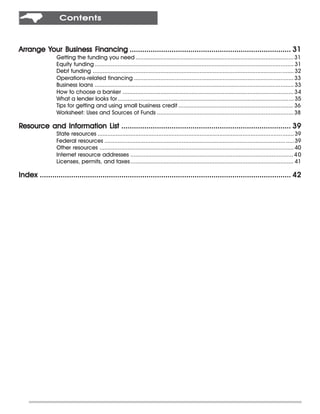
Contents


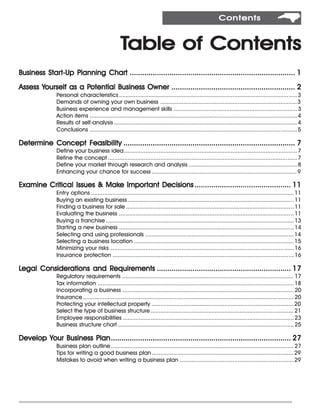
                                                   Table of Contents
         Start-Up           Chart
Business Star t-Up Planning Chart ............................................................................... 1
       Yourself      Potential
Assess Yourself as a Potential Business Owner ........................................................... 2
               Personal characteristics ............................................................................................................ 3
               Demands of owning your own business ...................................................................................3
               Business experience and management skills ...........................................................................3
               Action items ..............................................................................................................................4
               Results of self-analysis ............................................................................................................... 4
               Conclusions ..............................................................................................................................5

                  Feasibility
Determine Concept Feasibility .................................................................................. 7
               Define your business idea.........................................................................................................7
               Refine the concept ...................................................................................................................7
               Define your market through research and analysis ..................................................................8
               Enhancing your chance for success ........................................................................................ 9

                          Make Important
Examine Critical Issues & Make Impor tant Decisions .............................................. 11
               Entry options ........................................................................................................................... 11
               Buying an existing business..................................................................................................... 11
               Finding a business for sale ......................................................................................................11
               Evaluating the business .......................................................................................................... 11
               Buying a franchise .................................................................................................................. 13
               Starting a new business .......................................................................................................... 14
               Selecting and using professionals .......................................................................................... 14
               Selecting a business location ................................................................................................. 15
               Minimizing your risks ................................................................................................................16
               Insurance protection .............................................................................................................. 16

Legal Considerations and Requirements ................................................................ 17
                         Requirements
               Regulatory requirements ........................................................................................................ 17
               Tax information ....................................................................................................................... 18
               Incorporating a business ........................................................................................................ 20
               Insurance ................................................................................................................................ 20
               Protecting your intellectual property ...................................................................................... 20
               Select the type of business structure ....................................................................................... 21
               Employee responsibilities ........................................................................................................ 23
               Business structure chart ........................................................................................................... 25

        Your          Plan......................................................................................
Develop Your Business Plan ...................................................................................... 27
               Business plan outline ............................................................................................................... 27
               Tips for writing a good business plan ...................................................................................... 29
               Mistakes to avoid when writing a business plan ..................................................................... 29
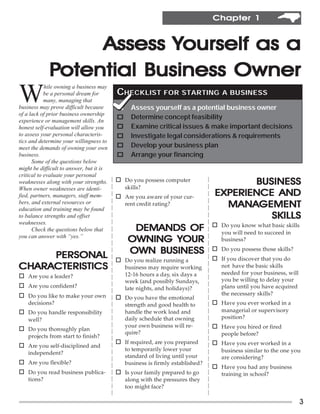
Contents


        Your          Financing
Arrange Your Business Financing ............................................................................. 31
                 Getting the funding you need ................................................................................................ 31
                 Equity funding ......................................................................................................................... 31
                 Debt funding .......................................................................................................................... 32
                 Operations-related financing ................................................................................................. 33
                 Business loans ......................................................................................................................... 33
                 How to choose a banker ........................................................................................................ 34
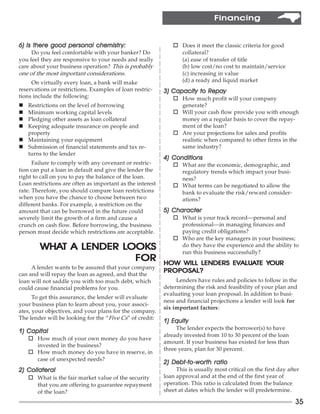
                 What a lender looks for........................................................................................................... 35
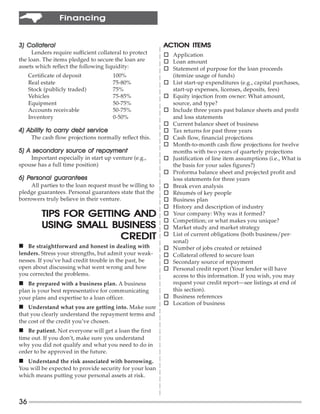
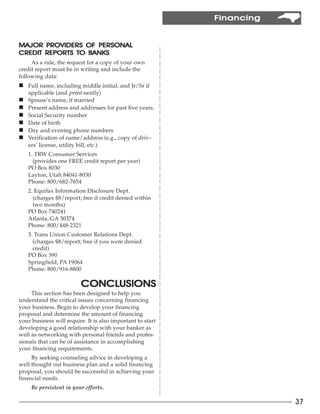
                 Tips for getting and using small business credit ...................................................................... 36
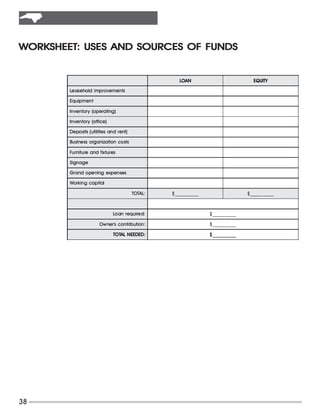
                 Worksheet: Uses and Sources of Funds ................................................................................... 38

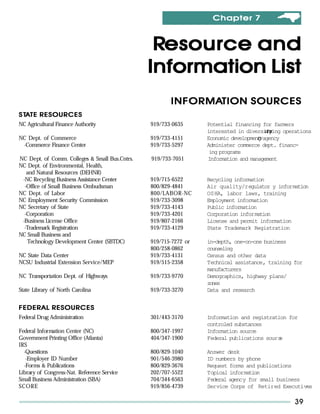
Resource and Information List ................................................................................. 39
                 State resources ....................................................................................................................... 39
                 Federal resources ...................................................................................................................39
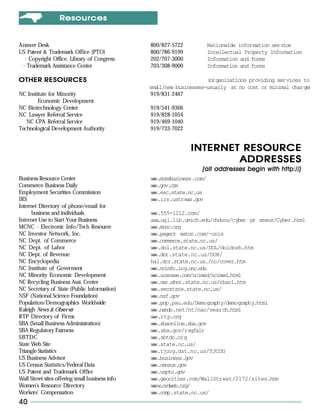
                 Other resources ...................................................................................................................... 40
                 Internet resource addresses ................................................................................................... 4 0
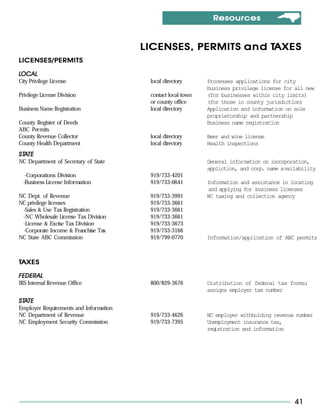
                 Licenses, permits, and taxes ................................................................................................... 41

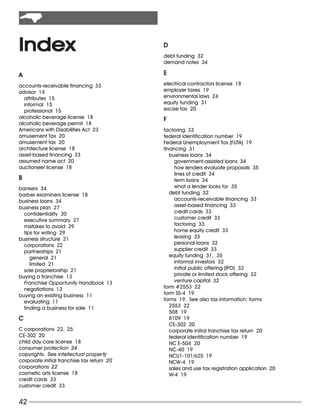
Index ........................................................................................................................ 42
Welcome


                                                   Introduction

                             S
                                   mall businesses are vital to the growth and development of
                                   communities throughout our state. They bring innovative
                                   products and service to the marketplace and provide a
                             range of opportunities and jobs for North Carolina workers. Over
                             the years, our state has made investments in business
                             development support resources such as the Small Business and
                             Technology Development Center, the North Carolina
                             Biotechnology Center, and the Technological Development
                             Authority.

                             Today, as a result of our investments in small businesses and the
                             successes of entrepreneurs, North Carolina is known worldwide
                             as an excellent location to start and operate a business. It is my
                             hope that our state can build on our record of past success. Let
The Honorable
Michael F Easley
         .                   us continue to work together to make North Carolina a great
Governor of North Carolina   place to develop and grow businesses.
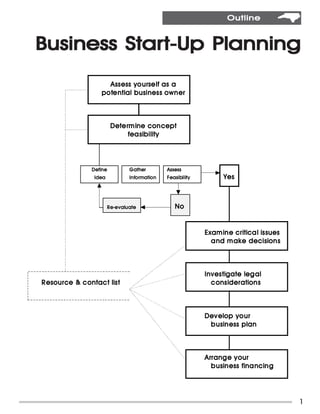
Outline


Business Start-Up Planning
                    Assess yourself as a
                  potential business owner


                         Determine concept
                              feasibility


               Define           Gather        Assess
                Idea            Information   Feasibility        Yes


                        Re-evaluate              No


                                                            Examine critical issues
                                                              and make decisions


                                                            Investigate legal
R esource & contact list                                      considerations


                                                            Develop your
                                                             business plan


                                                            Arrange your
                                                              business financing


                                                                                      1
2
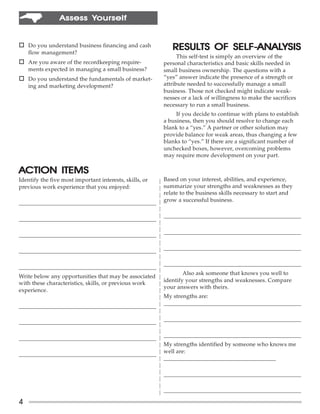
Chapter 1


                  Assess Yourself as a
             Potential Business Owner
W
            hile owning a business may
            be a personal dream for       CHECKLIST FOR STARTING                   A BUSINESS
            many, managing that
business may prove difficult because      o     Assess yourself as a potential business owner
of a lack of prior business ownership
                                          o     Determine concept feasibility
experience or management skills. An
honest self-evaluation will allow you     o     Examine critical issues & make important decisions
to assess your personal characteris-      o     Investigate legal considerations & requirements
tics and determine your willingness to
meet the demands of owning your own       o     Develop your business plan
business.                                 o     Arrange your financing
      Some of the questions below
might be difficult to answer, but it is
critical to evaluate your personal
weaknesses along with your strengths.     o Do you possess computer
                                              skills?
                                                                                        BUSINESS
When owner weaknesses are identi-
fied, partners, managers, staff mem-      o Are you aware of your cur-           EXPERIENCE AND
bers, and external resources or
education and training may be found
                                              rent credit rating?                  MANAGEMENT
                                                                                   MANAGEMENT
to balance strengths and offset                                                            SKILLS
weaknesses.                                                                     o Do you know what basic skills
      Check the questions below that            DEMANDS OF                         you will need to succeed in
you can answer with “yes.”
                                               OWNING YOUR                         business?

     PERSONAL                                  OWN BUSINESS                     o Do you possess those skills?
                                          o Do you realize running a            o If you discover that you do
CHARACTERISTICS
CHARACTERISTICS                               business may require working         not have the basic skills
                                              12-16 hours a day, six days a        needed for your business, will
o Are you a leader?
                                              week (and possibly Sundays,          you be willing to delay your
o Are you confident?                          late nights, and holidays)?          plans until you have acquired
o Do you like to make your own                                                     the necessary skills?
                                          o Do you have the emotional
    decisions?                                strength and good health to       o Have you ever worked in a
o Do you handle responsibility                handle the work load and             managerial or supervisory
    well?                                     daily schedule that owning           position?
                                              your own business will re-        o Have you hired or fired
o Do you thoroughly plan
                                              quire?                               people before?
    projects from start to finish?
                                          o If required, are you prepared       o Have you ever worked in a
o Are you self-disciplined and
                                              to temporarily lower your            business similar to the one you
    independent?
                                              standard of living until your        are considering?
o Are you flexible?                           business is firmly established?
                                                                                o Have you had any business
o Do you read business publica-           o Is your family prepared to go          training in school?
    tions?                                    along with the pressures they
                                              too might face?

                                                                                                                    3
Yourself
                 Assess Yourself


o Do you understand business financing and cash
    flow management?
                                                             RESULTS OF SELF-ANALYSIS
                                                             RESULTS    SELF-ANALYSIS
                                                               This self-test is simply an overview of the
o Are you aware of the recordkeeping require-            personal characteristics and basic skills needed in
    ments expected in managing a small business?         small business ownership. The questions with a
o Do you understand the fundamentals of market-          “yes” answer indicate the presence of a strength or
    ing and marketing development?                       attribute needed to successfully manage a small
                                                         business. Those not checked might indicate weak-
                                                         nesses or a lack of willingness to make the sacrifices
                                                         necessary to run a small business.
                                                              If you decide to continue with plans to establish
                                                         a business, then you should resolve to change each
                                                         blank to a “yes.” A partner or other solution may
                                                         provide balance for weak areas, thus changing a few
                                                         blanks to “yes.” If there are a significant number of
                                                         unchecked boxes, however, overcoming problems
                                                         may require more development on your part.

ACTION ITEMS
Identify the five most important interests, skills, or   Based on your interest, abilities, and experience,
previous work experience that you enjoyed:               summarize your strengths and weaknesses as they
                                                         relate to the business skills necessary to start and
                                                         grow a successful business.
______________________________________________
 _____________________________________________

                                                         ______________________________________________
                                                          _____________________________________________
______________________________________________
 _____________________________________________

                                                         ______________________________________________
                                                          _____________________________________________
______________________________________________
 _____________________________________________

                                                         ______________________________________________
                                                          _____________________________________________
______________________________________________
 _____________________________________________

                                                         ______________________________________________
                                                          _____________________________________________
______________________________________________
 _____________________________________________
                                                                 Also ask someone that knows you well to
Write below any opportunities that may be associated
                                                         identify your strengths and weaknesses. Compare
with these characteristics, skills, or previous work
                                                         your answers with theirs.
experience.
                                                         My strengths are:
                                                         ______________________________________________________________________________
______________________________________________
 _____________________________________________

                                                         ______________________________________________
                                                          _____________________________________________
______________________________________________
 _____________________________________________

                                                         ______________________________________________
                                                          _____________________________________________
______________________________________________
 _____________________________________________
                                                         My strengths identified by someone who knows me
                                                         well are:
______________________________________________
 _____________________________________________
                                                         _______________________________________

                                                         ______________________________________________
                                                          _____________________________________________

                                                         ______________________________________________
                                                          _____________________________________________

4
Yourself
                                                                 Assess Yourself


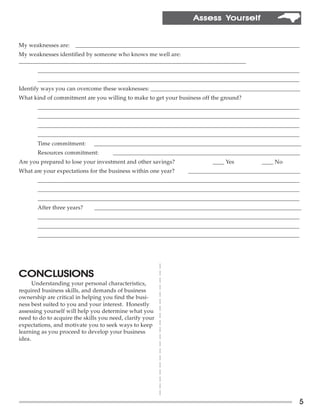
My weaknesses are:    ______________________________________________________________________________
My weaknesses identified by someone who knows me well are:
_______________________________________________________________________________
       ___________________________________________________________________________________________
       ___________________________________________________________________________________________
Identify ways you can overcome these weaknesses: ____________________________________________________
What kind of commitment are you willing to make to get your business off the ground?
       ___________________________________________________________________________________________
       ___________________________________________________________________________________________
       ___________________________________________________________________________________________
       ___________________________________________________________________________________________
       Time commitment:       ________________________________________________________________________
       Resources commitment:          _________________________________________________________________
Are you prepared to lose your investment and other savings?              ____ Yes        ____ No
What are your expectations for the business within one year?    _______________________________________
       ___________________________________________________________________________________________
       ___________________________________________________________________________________________
       ___________________________________________________________________________________________
       After three years?     ________________________________________________________________________
       ___________________________________________________________________________________________
       ___________________________________________________________________________________________
       ___________________________________________________________________________________________


CONCLUSIONS
CONCLUSIONS
      Understanding your personal characteristics,
required business skills, and demands of business
ownership are critical in helping you find the busi-
ness best suited to you and your interest. Honestly
assessing yourself will help you determine what you
need to do to acquire the skills you need, clarify your
expectations, and motivate you to seek ways to keep
learning as you proceed to develop your business
idea.


                                                                                                      5
6
Chapter 2


                                Determine Concept
                                         Feasibility
M
          any questions must be
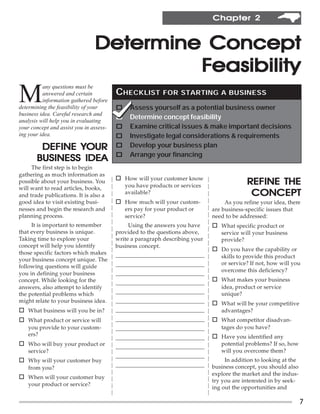
          answered and certain           CHECKLIST         FOR STARTING A BUSINESS
          information gathered before
determining the feasibility of your      o    Assess yourself as a potential business owner
business idea. Careful research and
                                         o    Determine concept feasibility
analysis will help you in evaluating
your concept and assist you in assess-   o    Examine critical issues & make important decisions
ing your idea.                           o    Investigate legal considerations & requirements
               YOUR
        DEFINE YOUR                      o    Develop your business plan
                                         o
       BUSINESS IDEA                          Arrange your financing
     The first step is to begin
gathering as much information as
                                         o How will your customer know
possible about your business. You
                                             you have products or services                REFINE THE
will want to read articles, books,
and trade publications. It is also a
                                             available?                                    CONCEPT
good idea to visit existing busi-        o How much will your custom-             As you refine your idea, there
nesses and begin the research and            ers pay for your product or     are business-specific issues that
planning process.                            service?                        need to be addressed:
     It is important to remember              Using the answers you have     o What specific product or
that every business is unique.           provided to the questions above,       service will your business
Taking time to explore your              write a paragraph describing your      provide?
concept will help you identify           business concept.
                                                                             o Do you have the capability or
those specific factors which makes       _________________________________      skills to provide this product
your business concept unique. The
                                         _________________________________      or service? If not, how will you
following questions will guide
                                                                                overcome this deficiency?
you in defining your business            _________________________________
concept. While looking for the           _________________________________   o What makes your business
answers, also attempt to identify                                               idea, product or service
the potential problems which             _________________________________      unique?
might relate to your business idea.      _________________________________   o What will be your competitive
o What business will you be in?          _________________________________      advantages?
o What product or service will           _________________________________   o What competitor disadvan-
    you provide to your custom-          _________________________________      tages do you have?
    ers?                                                                     o Have you identified any
                                         _________________________________
o Who will buy your product or           _________________________________      potential problems? If so, how
    service?                                                                    will you overcome them?
                                         _________________________________
o Why will your customer buy                                                      In addition to looking at the
                                         _________________________________   business concept, you should also
    from you?
                                                                             explore the market and the indus-
o When will your customer buy
                                                                             try you are interested in by seek-
    your product or service?
                                                                             ing out the opportunities and

                                                                                                                  7
Feasibility
                 Concept Feasibility


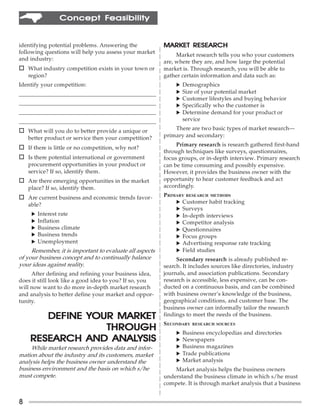
identifying potential problems. Answering the            MARKET RESEARCH
following questions will help you assess your market
                                                              Market research tells you who your customers
and industry:
                                                         are, where they are, and how large the potential
o What industry competition exists in your town or       market is. Through research, you will be able to
    region?                                              gather certain information and data such as:
Identify your competition:                                    u   Demographics
__________________________________________________            u   Size of your potential market
                                                              u   Customer lifestyles and buying behavior
__________________________________________________            u   Specifically who the customer is
__________________________________________________            u   Determine demand for your product or
__________________________________________________                service

o What will you do to better provide a unique or             There are two basic types of market research—
    better product or service then your competition?     primary and secondary:
                                                              Primary research is research gathered first-hand
o If there is little or no competition, why not?
                                                         through techniques like surveys, questionnaires,
o Is there potential international or government         focus groups, or in-depth interview. Primary research
    procurement opportunities in your product or         can be time consuming and possibly expensive.
    service? If so, identify them.                       However, it provides the business owner with the
o Are there emerging opportunities in the market         opportunity to hear customer feedback and act
    place? If so, identify them.                         accordingly.

o Are current business and economic trends favor-        PRIMARY RESEARCH METHODS
                                                             u Customer habit tracking
    able?
                                                             u Surveys
     u   Interest rate                                       u In-depth interviews
     u   Inflation                                           u Competitor analysis
     u   Business climate                                    u Questionnaires
     u   Business trends                                     u Focus groups
     u   Unemployment                                        u Advertising response rate tracking
     Remember, it is important to evaluate all aspects       u Field studies
of your business concept and to continually balance           Secondary research is already published re-
your ideas against reality.                              search. It includes sources like directories, industry
     After defining and refining your business idea,     journals, and association publications. Secondary
does it still look like a good idea to you? If so, you   research is accessible, less expensive, can be con-
will now want to do more in-depth market research        ducted on a continuous basis, and can be combined
and analysis to better define your market and oppor-     with business owner’s knowledge of the business,
tunity.                                                  geographical conditions, and customer base. The
                                                         business owner can informally tailor the research
              YOUR
       DEFINE YOUR MARKET                                findings to meet the needs of the business.

                 THROUGH
                                                         S ECONDARY   RESEARCH SOURCES

                                                              u   Business encyclopedias and directories
                  ANALYSIS
    RESEARCH AND ANALYSIS                                     u   Newspapers
     While market research provides data and infor-           u   Business magazines
mation about the industry and its customers, market           u   Trade publications
analysis helps the business owner understand the              u   Market analysis
business environment and the basis on which s/he             Market analysis helps the business owners
must compete.                                            understand the business climate in which s/he must
                                                         compete. It is through market analysis that a business


8
Feasibility
                                                         Concept Feasibility


owner determines if a certain business or industry
provides an attractive opportunity.
    Market analysis provides competitive analysis
which includes:
n Industry analysis: evaluates the industry’s overall
opportunity and attractiveness including ease of
entry, availability of substitutes, and buyer/supplier
issues
n Competitor analysis: who are the primary com-
petitors, and what are their strengths and weak-
nesses.
n Your business analysis: identifies strengths,
weaknesses, opportunities, and threats within your
identified market.

                     YOUR
          ENHANCING YOUR
       CHANCE FOR SUCCESS
     There are always risks in starting a new busi-
ness. As a business owner, you will want to lower
your risks by incorporating the following ideas into
your start-up plan:
o Plan ahead.
o Make sure you have experience in management
   and in the type of business you want to start.
o Try to best use your strengths and interest in the
   most appropriate way.
o Make decisions based on facts or reliable informa-
   tion. Don’t make hasty decisions.
o Make sure your family is supportive and under-
   stands the emotional support needed during the
   start-up phase or when things get difficult.
o Be persistent, and DON’T GIVE UP!


                                                                               9
Notes


10
Chapter 3


      Examine Critical Issues &
     Make Important Decisions
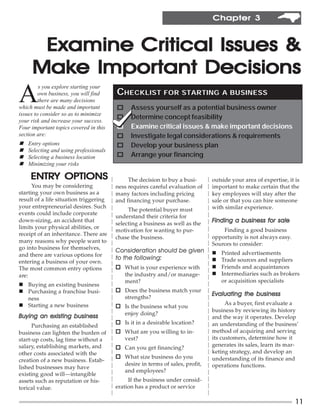
A
         s you explore starting your
         own business, you will find    CHECKLIST FOR STARTING                    A BUSINESS
         there are many decisions
which must be made and important        o     Assess yourself as a potential business owner
issues to consider so as to minimize
                                        o     Determine concept feasibility
your risk and increase your success.
Four important topics covered in this   o     Examine critical issues & make important decisions
section are:                            o     Investigate legal considerations & requirements
n   Entry options                       o     Develop your business plan
n   Selecting and using professionals
n   Selecting a business location       o     Arrange your financing
n   Minimizing your risks

     ENTRY OPTIONS
     ENTRY                                   The decision to buy a busi-      outside your area of expertise, it is
      You may be considering            ness requires careful evaluation of   important to make certain that the
starting your own business as a         many factors including pricing        key employees will stay after the
result of a life situation triggering   and financing your purchase.          sale or that you can hire someone
your entrepreneurial desires. Such                                            with similar experience.
                                             The potential buyer must
events could include corporate
                                        understand their criteria for
down-sizing, an accident that
                                        selecting a business as well as the   Finding a business for sale
limits your physical abilities, or
                                        motivation for wanting to pur-            Finding a good business
receipt of an inheritance. There are
                                        chase the business.                   opportunity is not always easy.
many reasons why people want to
                                                                              Sources to consider:
go into business for themselves,
                                        Consideration should be given         n   Printed advertisements
and there are various options for
                                        to the following:
                                                        :                     n   Trade sources and suppliers
entering a business of your own.
The most common entry options           o What is your experience with        n   Friends and acquaintances
are:                                      the industry and/or manage-         n   Intermediaries such as brokers
                                          ment?                                   or acquisition specialists
n Buying an existing business
n Purchasing a franchise busi-          o Does the business match your
                                          strengths?
                                                                              Evaluating the business
  ness
n Starting a new business                                                           As a buyer, first evaluate a
                                        o Is the business what you
                                                                              business by reviewing its history
                                          enjoy doing?
Buying an existing business                                                   and the way it operates. Develop
                                        o Is it in a desirable location?      an understanding of the business’
      Purchasing an established
business can lighten the burden of      o What are you willing to in-         method of acquiring and serving
start-up costs, lag time without a        vest?                               its customers, determine how it
salary, establishing markets, and                                             generates its sales, learn its mar-
                                        o Can you get financing?
other costs associated with the                                               keting strategy, and develop an
                                        o What size business do you           understanding of its finance and
creation of a new business. Estab-
                                          desire in terms of sales, profit,   operations functions.
lished businesses may have
                                          and employees?
existing good will—intangible
assets such as reputation or his-            If the business under consid-
torical value.                          eration has a product or service

                                                                                                                 11
Issues and Decisions


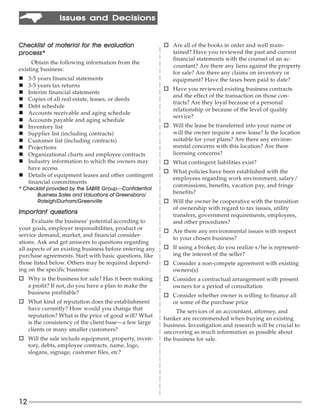
Checklist of material for the evaluation                  o Are all of the books in order and well main-
process*                                                    tained? Have you reviewed the past and current
                                                            financial statements with the counsel of an ac-
     Obtain the following information from the
                                                            countant? Are there any liens against the property
existing business:
                                                            for sale? Are there any claims on inventory or
n 3-5 years financial statements                            equipment? Have the taxes been paid to date?
n 3-5 years tax returns
                                                          o Have you reviewed existing business contracts
n Interim financial statements
                                                            and the effect of the transaction on those con-
n Copies of all real estate, leases, or deeds
                                                            tracts? Are they loyal because of a personal
n Debt schedule
                                                            relationship or because of the level of quality
n Accounts receivable and aging schedule
                                                            service?
n Accounts payable and aging schedule
n Inventory list                                          o Will the lease be transferred into your name or
n Supplier list (including contracts)                       will the owner require a new lease? Is the location
n Customer list (including contracts)                       suitable for your plans? Are there any environ-
n Projections                                               mental concerns with this location? Are there
n Organizational charts and employee contracts              licensing concerns?
n Industry information to which the owners may            o What contingent liabilities exist?
  have access
                                                          o What policies have been established with the
n Details of equipment leases and other contingent
                                                            employees regarding work environment, salary/
  financial commitments
                                                            commissions, benefits, vacation pay, and fringe
* Checklist provided by the SABRE Group—Confidential
       Business Sales and Valuations of Greensboro/
                                                            benefits?
       Raleigh/Durham/Greenville                          o Will the owner be cooperative with the transition
                                                            of ownership with regard to tax issues, utility
Impor tant questions
Important                                                   transfers, government requirements, employees,
      Evaluate the business’ potential according to         and other procedures?
your goals, employer responsibilities, product or         o Are there any environmental issues with respect
service demand, market, and financial consider-
                                                            to your chosen business?
ations. Ask and get answers to questions regarding
all aspects of an existing business before entering any   o If using a broker, do you realize s/he is represent-
purchase agreements. Start with basic questions, like       ing the interest of the seller?
those listed below. Others may be required depend-        o Consider a non-compete agreement with existing
ing on the specific business:                               owners(s)
o Why is the business for sale? Has it been making        o Consider a contractual arrangement with present
  a profit? If not, do you have a plan to make the          owners for a period of consultation
  business profitable?                                    o Consider whether owner is willing to finance all
o What kind of reputation does the establishment            or some of the purchase price
  have currently? How would you change that                    The services of an accountant, attorney, and
  reputation? What is the price of good will? What        banker are recommended when buying an existing
  is the consistency of the client base—a few large       business. Investigation and research will be crucial to
  clients or many smaller customers?                      uncovering as much information as possible about
o Will the sale include equipment, property, inven-       the business for sale.
  tory, debts, employee contracts, name, logo,
  slogans, signage, customer files, etc?


12
Issues and Decisions


BUYING A FRANCHISE
     Franchising has emerged as a popular way for potential business owners to start a new business. A
franchise offers advantages in name and product recognition, proven operation procedures as well as volume
purchasing power. In this arrangement, the provider, or franchisor, contracts with you, the franchisee, to give
you the right to sell or distribute a service or product under the franchisor’s system in a particular area. As
with any opportunity, both advantages and disadvantages must be examined before a decision to invest is
made.


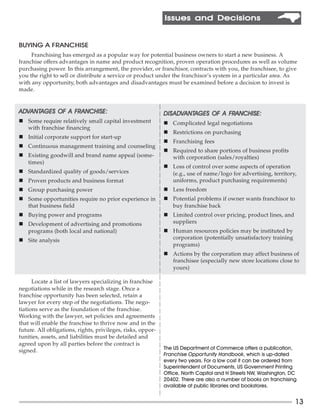
ADVANTAGES OF A FRANCHISE:
ADVANTAGES      FRANCHISE:                                   DIS ADVANTAGES OF A FRANCHISE:
                                                             DISAD ANTAGES
                                                                 ADV             FRANCHISE:
n Some require relatively small capital investment           n Complicated legal negotiations
  with franchise financing
                                                             n Restrictions on purchasing
n Initial corporate support for start-up
                                                             n Franchising fees
n Continuous management training and counseling
                                                             n Required to share portions of business profits
n Existing goodwill and brand name appeal (some-               with corporation (sales/royalties)
  times)
                                                             n Loss of control over some aspects of operation
n Standardized quality of goods/services                       (e.g., use of name/logo for advertising, territory,
n Proven products and business format                          uniforms, product purchasing requirements)
n Group purchasing power                                     n Less freedom
n Some opportunities require no prior experience in          n Potential problems if owner wants franchisor to
  that business field                                          buy franchise back
n Buying power and programs                                  n Limited control over pricing, product lines, and
n Development of advertising and promotions                    suppliers
  programs (both local and national)                         n Human resources policies may be instituted by
n Site analysis                                                corporation (potentially unsatisfactory training
                                                               programs)
                                                             n Actions by the corporation may affect business of
                                                               franchisee (especially new store locations close to
                                                               yours)

      Locate a list of lawyers specializing in franchise
negotiations while in the research stage. Once a
franchise opportunity has been selected, retain a
lawyer for every step of the negotiations. The nego-
tiations serve as the foundation of the franchise.
Working with the lawyer, set policies and agreements
that will enable the franchise to thrive now and in the
future. All obligations, rights, privileges, risks, oppor-
tunities, assets, and liabilities must be detailed and
agreed upon by all parties before the contract is
                                                             The US Department of Commerce offers a publication,
signed.
                                                             Franchise Opportunity Handbook, which is up-dated
                                                             every two years. For a low cost it can be ordered from
                                                             Superintendent of Documents, US Government Printing
                                                             Office, North Capitol and H Streets NW, Washington, DC
                                                             20402. There are also a number of books on franchising
                                                             available at public libraries and bookstores.


                                                                                                                  13
Issues and Decisions


STARTING A NEW BUSINESS
STARTING                                                   Most banks today will require you to personally
                                                           guarantee the corporate loans for start-up businesses.
     Starting your own business can be a very excit-
                                                           Consequently, all your assets will be at risk.
ing endeavor. It allows you great freedom and oppor-
tunity to explore and develop your own business                 You might ask, “How do I know what kind of
idea. It is an opportunity for you to exercise your        business to start?” or “How are businesses formed?”
creativity and thinking ability to do the following:       Business ideas emerge in may ways. Examples are:
n    Research your business idea                           n Finding and meeting an unfulfilled market need
n    Develop a strategy                                    n Building a business on an existing customer
n    Determine your marketing approach                       relationship
n    Address key operational issues
                                                           n Spinning off a business based on your experience
n    Make your own decisions
                                                             and knowledge
n    Develop your business idea from the ground up
                                                           n Capitalizing on a new invention or technology
     Successfully starting your own business can
provide a sense of accomplishment and satisfaction         n Growing a part-time business or hobby into a full
in knowing you did it yourself. However, if the              time opportunity
business fails, you must assume all the liabilities and        You must decide what kind of business you
emotional strain that goes with it. There are many         want to start. It is also important to examine yourself
misconceptions surrounding owning one’s own                and decide what you want from the business.
business. Consider the following common miscon-
                                                                Keep in mind that starting a business requires
ceptions:
                                                           careful thought and planning. Many aspects of the
n I will be my own boss. Being your own boss does          business must be considered including legal issues,
not mean you can play golf or go fishing anytime you       financing, marketing concerns, employee relations,
want. Reality is, the business and your customers          accounting procedures, equipment purchases, and
become your boss and can demand 50-65 hours per            location.
week.
                                                                Research, preparation, organization, and plan-
n I can get rich overnight. Small business and free        ning are critical in a start-up venture to minimize risk
enterprise provides a great opportunity to build           and enhance your chance for success. Contact your
wealth; however, it will take time. Studies indicate       small business assistance providers to assist you
that more than a third of small businesses that grow       during this critical time (see Resource List).
significantly, do so after ten or more years of exist-
ence.
                                                                    SELECTING AND USING
n I can expect immediate income from my business.
This is not likely. Generally, it takes 6-12 months                       PROFESSIONALS
before a new business can start to pay the owner a              Starting your own business involves many
decent salary. You should have a cash reserve or           decisions which often times seem overwhelming. It
savings to provide financial support for you and your      has been shown that there is a strong correlation
family during the start-up phase.                          between using outside professionals and business
n I can start my business with little or no money.         success. In today’s business world, where many new
Poor capitalization is one of the major causes of          businesses fail within the first five years, it only
business failure. Lack of capital results in negative      makes sense to increase your chances for success by
cash flow which can result in poor business decisions      seeking the broad experience and expertise that
and serious credit problems.                               professional resources and advisors can provide.
                                                           Outside advisors assist you in making decisions
n I will incorporate and use other people’s money.         based on facts, not wishful thinking. They can also
Many books and articles have been written about            provide a reality check and give you insight in start-
OPM (other people’s money). It is difficult to borrow      ing and guiding your business.
your way to wealth as a new business. The corporate
shield probably will not protect you in case of failure.


14
Issues and Decisions


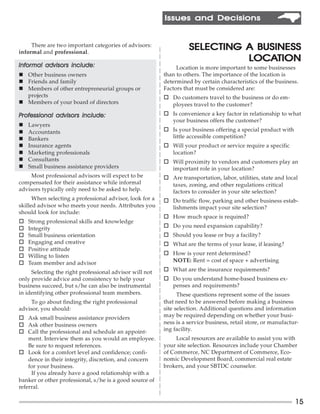
     There are two important categories of advisors:
informal and professional.
                                                                    SELECTING A BUSINESS
                                                                              LOCATION
                                                                              LOCATION
Informal advisors include:                                     Location is more important to some businesses
n Other business owners                                   than to others. The importance of the location is
n Friends and family                                      determined by certain characteristics of the business.
n Members of other entrepreneurial groups or              Factors that must be considered are:
  projects                                                o Do customers travel to the business or do em-
n Members of your board of directors                        ployees travel to the customer?
Professional advisors include:                            o Is convenience a key factor in relationship to what
                                                            your business offers the customer?
n   Lawyers
n   Accountants                                           o Is your business offering a special product with
n   Bankers                                                 little accessible competition?
n   Insurance agents                                      o Will your product or service require a specific
n   Marketing professionals                                 location?
n   Consultants                                           o Will proximity to vendors and customers play an
n   Small business assistance providers                     important role in your location?
     Most professional advisors will expect to be         o Are transportation, labor, utilities, state and local
compensated for their assistance while informal             taxes, zoning, and other regulations critical
advisors typically only need to be asked to help.           factors to consider in your site selection?
      When selecting a professional advisor, look for a   o Do traffic flow, parking and other business estab-
skilled advisor who meets your needs. Attributes you        lishments impact your site selection?
should look for include:
                                                          o How much space is required?
o   Strong professional skills and knowledge
o   Integrity                                             o Do you need expansion capability?
o   Small business orientation                            o Should you lease or buy a facility?
o   Engaging and creative                                 o What are the terms of your lease, if leasing?
o   Positive attitude
o   Willing to listen                                     o How is your rent determined?
o   Team member and advisor                                 NOTE: Rent = cost of space + advertising

     Selecting the right professional advisor will not    o What are the insurance requirements?
only provide advice and consistency to help your          o Do you understand home-based business ex-
business succeed, but s/he can also be instrumental         penses and requirements?
in identifying other professional team members.                 These questions represent some of the issues
     To go about finding the right professional           that need to be answered before making a business
advisor, you should:                                      site selection. Additional questions and information
o Ask small business assistance providers                 may be required depending on whether your busi-
o Ask other business owners                               ness is a service business, retail store, or manufactur-
o Call the professional and schedule an appoint-          ing facility.
    ment. Interview them as you would an employee.             Local resources are available to assist you with
    Be sure to request references.                        your site selection. Resources include your Chamber
o Look for a comfort level and confidence; confi-         of Commerce, NC Department of Commerce, Eco-
    dence in their integrity, discretion, and concern     nomic Development Board, commercial real estate
    for your business.                                    brokers, and your SBTDC counselor.
     If you already have a good relationship with a
banker or other professional, s/he is a good source of
referral.

                                                                                                                15
Issues and Decisions


                  YOUR
       MINIMIZING YOUR RISKS                                                                     TO DO
     Risks abound in the business world. As an
entrepreneur, you will want to protect your interest         List below the things you must now consider in
and minimize your risk from the beginning.              order to buy and existing business, start a business,
                                                        or purchase a franchise.
     The time to address these important issues is
during the planning stage. Advice of professionals in
accounting, insurance, banking, and law will help
you make decisions to best minimize your risks and
to identify your best protection options.

INSURANCE PROTECTION
     Insurance protection is an important consider-
ation in minimizing risk. Oftentimes business owners
lack expertise when it comes to insurance needs.
Basic steps in developing an insurance program are:
o    Review your current coverage
o    Identify your insurance needs
o    Develop a plan (including the cost)
o    Seek professional advice
     Most businesses will require the following types
of insurance:
n   Fire insurance
n   Liability insurance
n   Automobile insurance
n   Worker’s compensation insurance
      Depending on the type of business you are
starting, other coverage you may need includes:
n   Business interruption insurance
n   Crime insurance
n   Group life insurance
n   Key man insurance
n   Disability insurance
n   Bonding
     Most banks require insurance as a condition of
their loan.


16
Chapter 4


       Legal Considerations and
                  Requirements
A
        s an entrepreneur, it is your
        responsibility to ensure that       C HECKLIST FOR STARTING A BUSINESS
        your business is properly
complying with state and federal                   Assess yourself as a potential business owner
regulatory requirements, registra-
                                                   Determine concept feasibility
tion, permits, licenses, and employer
responsibilities. Stiff penalties may              Examine critical issues & make important decisions
be assessed against you and/or                     Investigate legal considerations & requirements
your company if you are found in
violation of certain government                    Develop your business plan
requirements. This section will                    Arrange your financing
address three primary legal consid-
erations:
    Regulatory requirements
                                            PERMITS                                     PERMITS
    Legal structure of your business
    Employee responsibility                       Most new small businesses are               For information regarding state
                                            unlikely to require any federal permit or   licenses, contact:
                                            license to operate unless they are              Business License Information
                                            engaged in:
     REGULATORY
     REGULATORY                                                                             NC Secretary of State
                                                 Rendering investment advice                919/807-2166 (in Raleigh) or
   REQUIREMENTS                                  Preparing meat products                        800/228-8443
                                                 Selling alcohol, tobacco, and              110 South Blount Street
PERMITS, LICENSES, AND                      firearms                                        Raleigh, NC 27601
REGULA
REGULATIONS                                      Federal permits or licenses are            http://www.secretary.state.nc.us/blio/
      Most businesses are required to            also necessary to start some               default.asp
obtain some kind of license or per-         large-scale operations in                       The services provided by this
mit—city, state, and/or federal. Certain    regulated industries, such as:                  office include:
types of businesses may be required to           Radio or television stations               Individualized assistance from
obtain special permits from local health         Common carriers (telephone                 counselors in identifying
authorities, building inspectors, and       companies)                                      appropriate licenses and
police/fire departments. The business            Produce drugs or biological                permits
owner should take steps to ensure that      products                                        Customized information
the business does not violate any zoning         Consult an attorney regarding              packages including applica-
regulations or ordinances regarding              regulatory requirements.               tions and instructions on
hazardous activities. Mistakes in obtain-        Although a prospective busi-           applying for licenses and
ing the proper permits and licenses can     ness may not strictly fit in one            permits
be expensive, at best.                      of these categories, it is impor-               Resource center for informa-
                                            tant that you make certain that                 tion on over 600 business
FEDERAL LICENSES AND                        no federal regulations apply                    licenses and permits
                                            before starting your business.                    To determine liability for license
                                              TA
                                            S TATE LICENSES AND                         fees/taxes, contact:


                                                                                                                                 17
L egal Issues


     NC Department of Revenue                                      In some cities, zoning and other related requirements must
     License and Excise Tax Division                               be approved before you can obtain a license. If the business
     501 North Wilmington Street                                   is not located in a city, county privilege licenses may be
     PO Box 25000                                                  applicable. The business should contact the County Licensing
     Raleigh, NC 27640                                             Office.
     919/733-3673
     Web site: w w.dor.state.nc.us/DOR/
                w                                                  Zoning
                                                                         The inspections or Planning Department, city or county,
SPECIAL LICENSES AND PERMITS                                       determines if a business location is zoned correctly for the
     In certain instances, such as contractors’ licenses and       proposed business type. Some areas are not zoned for
bonding, day care certificates of competency, etc., you will       commercial businesses, therefore, inquiries need to be made
need to obtain specific industry licenses and permits. The         before establishing a business. Some home-based businesses
Business License Information office should be able to help         are required to have a Home Occupation Use Permit.
you in this area, or refer to the numbers listed below:            Others qualify as a “limited use business” that does not
Business License Information                 919/807-2166 or       require a permit.
                                             800/228-8443
Alcoholic Beverage License                   919/733-3641          Signs
Alcoholic Beverage Permit                    919/779-0700                Sign sizes and locations are regulated within city or
Rest Home License                            919/733-2855          county limits and are determined by the Inspection or
Architecture License                         919/733-9544          Planning Department. Contact the city or county prior to
Auctioneer License                           919/733-2182          design and construction of a business sign to ensure it meets
Barber Examiners License                     919/733-3650          the regulations.
Cosmetic Arts License                        919/790-8460
Electrical Contractors License               919/733-9042          TAX INFORMATION
                                                                       INFORMATION
General Contractors License                  919/571-4183               The SBTDC does not provide tax counseling.
Mortuary Science License                     919/733-9380
Plumbing & Heating Contractors               919/733-9350          Income taxes
Real Estate                                  919/733-9580
                                                                         Every business entity is responsible for federal and state
Nursing Home or                              919/733-2342
                                                                   income taxes. If your business is a sole proprietorship,
  Home Health Facility
                                                                   partnership, S corporation, or limited liability corporation
Child Day Care License                       919/733-4801
                                                                   (LLC), pre-tax income is taxed by reporting it on your
     This represents only a partial list. To verify the require-   individual return.
ments for your business, contact the Business License Infor-
                                                                         If your business is a regular corporation, it will be
mation Office at 800/228-8443 or in Raleigh at 807-2166.
                                                                   subject to corporate income taxes. Different report forms
        LOCAL
CITY OR LOCAL LICENSES AND                                         are required for different types of organizations.
PERMITS                                                                 All federal tax forms may be obtained from:
      Business owners need to explore local licenses and                Internal Revenue Service
permit requirements and, in some cases, special licenses                320 Federal Place
which may be required (such as for alcohol, amusement, or               Greensboro, NC 27401
child care)                                                             800/829-1040 (information/assistance/forms)
                                                                        Web site: w w.irs.ustreas.gov/
                                                                                   w
      These licenses include privilege licenses, occupational
licenses, and other miscellaneous licenses. Contact the Tax        IRS Numbers
Collector’s Office in the county in which the business will be     Forms & Publications               800/829-3676
located for more information.                                      Questions                          800/829-1040
                                                                   Tele-Tax                           800/829-4477
Privilege License                                                       Call and ask for a “Getting Started” package for the
     All for-profit businesses located within city limits must
have a privilege license before beginning business operations.

18
Legal Issues


particular type of business organization your are starting. You       919/733-7395
will receive a form SS-4 which you should file to obtain a            Web site: w w.esc.state.nc.us
                                                                                 w
federal identification number. This ID number is needed           Filing
only if you plan to hire employees.                                     Employee portions of the federal/state income taxes
       State tax forms and requirements may be obtained by        and the Social Security tax, must be remitted along with the
calling:                                                          employer portion to the federal and state taxing authorities,
    NC Department of Revenue919/733-3166                          following the schedules provided by the agencies. You must
     (all tax departments and forms)                              also complete quarterly returns for submitting payroll
                                                                  information to the federal and state agencies. An explanation
      You can obtain your state identification number by          of these reports should be included in information you
calling 919/733-4626. A state identification number is            receive from the IRS, the NC Department of Revenue, and
required only if employees are to be hired. Otherwise, send       the Employment Security Commission.
quarterly payment with tax form, NC-40. Note that filing
estimated federal and state income taxes during the taxable       Sales and use tax, retail/wholesale licenses
year may prevent penalties from being assessed.
                                                                       All retail operators must collect sales tax. To find out
Payroll taxes                                                     what to remit and how to avoid tax on wholesale purchases,
                                                                  contact:
Employee Taxes
      There are several types of payroll taxes. As an em-             North Carolina Department of Revenue
ployer, you must withhold taxes on behalf of your employ-             Sales Tax Division
ees. These taxes are collected by you and are employee                501 North Wilmington Street
contributions. They include the following:                            PO Box 25000
                                                                      Raleigh, NC 27640
    Federal income tax                                                919/733-3661
    State income tax                                                  Web site:www.dor.state.nc.us/DOR/
    Social Security (FICA) tax (employee portion)
                                                                        Wholesalers: If your business is that of distribution
      Employees must complete forms W-4 and NC W-4                and you do not sell to the end-user or consumer, you should
before you can determine the amount to withhold for               obtain a wholesale license.
federal and state income taxes from their salaries (Form
8109). Social Security is determined by a legislated percentage   Other state taxes
which may be obtained through the Internal Revenue Service
publications.                                                         NC Department of Revenue
                                                                      501 North Wilmington Street
Employer Taxes                                                        PO Box 25000
      The second type of payroll taxes involve your expense           Raleigh, NC 27640
as an employer. These are taxes that you, the employer, pay           919/733-3661
and include the following:                                            Web site: w w.dor.state.nc.us/DOR/
                                                                                 w
    Social Security (FICA) tax (employer portion)                 Amusement Tax                             919/733-3673
    Federal Unemployment Tax (FUTA)—form 508                      Excise Tax:
    State Unemployment Tax (SUTA)—Unemploy-                         Cigarettes                              919/733-3673
    ment Acct# (form NCU1-101/625)                                  Soft Drinks                             919/733-3673
     The IRS “Getting Started” package will include infor-        Franchise Tax                             919/733-3166
mation on submitting your portion of FICA and federal               Corps. Initial Franchise Tax Return
unemployment tax.                                                          —Form CE-302
     Each new business should contact the Employment              Fuel Tax                                  919/733-3409
Security Commission at the address for information on             Installment Paper                         919/733-7548
unemployment taxes:
    Employment Security Commission
    700 Wade Avenue
    Raleigh, NC 27605

                                                                                                                             19
L egal Issues


  Dealer Tax                                                            Workersí Compensation
Intangibles Tax                                     919/733-4147         Workers’ Compensation is a form of insurance for
Taxpayer Assistance                                 919/733-4684   employees. Due to your potential legal liability for job-related
    Application for Sales and Use Tax Registration &               accidents, Workers’ Comp is strongly recommended for all
Annual Whole License—Form NC E-504                                 businesses. If you are a sole proprietorship, partnership,
     Local Taxes: List Tangible Property Tax (as of 1              LLC, estate, or trust, you are required by law to carry
January 1996) Tax Listing Form                                     coverage once you have three employees (in addition to the
                                                                   business operators/controlers). If you are incorporated, you
INCORPORATING A BUSINESS
INCORPORATING                                                      must carry coverage once you have three people (including
                                                                   corporate officers) in the corporation. There are exceptions
     Corporations Division                                         to these rules: for instance, if you run an agricultural opera-
     North Carolina Secretary of State                             tion, you must carry Workers’ Comp coverage when you
     300 North Salisbury Street                                    employ ten or more regular, non-seasonal employees. For
     Raleigh, NC 27603                                             specific information, contact your insurance agent, attorney,
     919/733-4201                                                  or:
     Web site: w w.secstate.state.nc.us/secstate/
                 w
         c rp.htm
          o                                                            Workers’ Compensation
                                                                       430 North Salisbury Street
      Call and request either “NC Business Corporation                 Raleigh, NC 27611
Guidelines” (which will explain how to incorporate your                800/688-8349 or w w.comp.state.nc.us
                                                                                         w
business in North Carolina) or “NC Non-Profit Corpora-
tion Guidelines.”                                                  PROTECTING INTELLECTUAL PROPERTY
ASSUMED NAME ACT                                                          When you begin your business, your ideas and know-
                                                                   how may be some of your most valuable assets. Patents,
      If you decide that your company will be a sole propri-       trademarks, copyrights, and trade secrets, together, are called
etorship or partnership, and you wish to use a name other          intellectual property. The wise business owner will review his
than your own name, you must perform a name search at the          own company’s activities in each of these areas, list possible
County Registrar of Deeds to see if the name of your               assets that should be protected, and evaluate their commer-
company is already being used.                                     cial importance to the company. With small business assis-
                                                                   tance providers, the business owner can develop a realistic
INSURANCE                                                          plan and budget for the company’s intellectual property
     There are four types of insurance that are generally          issues.
considered essential for small businesses:
      Hazard (includes fire, wind, water, theft)                   Resources
                                                                   Web site                                   ww.uspto.gov
                                                                                                               w
     Fire insurance will compensate you for the loss of            US Patent & Trademark Office               800/786-9199
and damage to your business property by fire.                      Copyright Office                           202/707-3000
      Liability insurance will help protect you against suits      Trademark Assistance Center (NC)           703/308-9000
for physical damages done to someone on your property              NC Dept. of Commerce                       919/733-4151
and for liabilities arising for the use of the products or          (business names)
services your company sells.
    Other protections: directors, crime (robbery, burglary,
employee vandalism, business interruption, key person).
      Auto insurance, either private or business, is required
by law for any vehicle used for business purposes. Before
buying any insurance, consider the risks that should be
covered, compare costs from the different companies, and
get professional advice from an insurance agent.


20
Legal Issues


                                                                                    In a general partnership, each partner is held person-
               SELECT THE TYPE OF                                            ally liable for all debts, taxes, and other claims against the
              BUSINESS STRUCTURE                                             partnership.
       There are several forms of business structures for you to consider.         A limited partnership has both general partners and
Selecting the business entity which is right for you will involve tax,       limited partners. It restricts the amount of personal liability to
businessandestateplanning,andfinancialconsiderations. In this section,       a limited partner. It allows investors to contribute but will
we discuss the various structures and identify the advantages and            expose them to a limited amount of liability AND manage-
disadvantages of each. The legal structure you choose will determine the     ment control. A limited partner is only personally liable up to
organization,debt liability, and tax requirementsaswell as other             the amount of investment made.
aspects of business questions.
                                                                             ADVANTAGES OF PARTNERSHIPS:
                                                                             ADVANTAGES    PAR
                                                                                            ARTNERSHIPS:
SOLE PROPRIETORSHIP                                                              Simplest form of business for two or more owners
       Sole proprietorship means that one person indepen-                        Business can be established with minimal formal
dently owns and operates an unincorporated business for                      documentation (However, it is recommended that
profit. The business is considered an extension of the owner                 partnerships have a formal written agreement
rather than as a separate legal entity. For tax purposes, the                with provisions for death, disability, liability,
profits/losses of the business are combined with other                       compensation, benefits, and dissolution)
owner income sources.                                                            Profits and losses belong to the partners
                                                                                 Partners have freedom to operate the business on
ADVANTAGES OF SOLE PROPRIETORSHIPS:
ADVANTAGES                                                                   behalf of the partnership (i.e., they can hire/fire
    Simplest form of ownership to establish and                              employees, borrow money, or enter into contracts)
operate                                                                          No income tax on partnership entity (it’s passed
    One owner                                                                on to individual partners)
    Owner has complete control over management                                   Buy/sell agreements
    decisions and policies                                                       Availability of resources/skills from all partners
    Use of all profits at the discretion of the owner                            Limited liability partners enjoy lower risks
    Limited paperwork to state and federal agencies                          DIS ADVANTAGES OF PARTNERSHIPS:
                                                                             DISAD ANTAGES
                                                                                 ADV           PAR
                                                                                                ARTNERSHIPS:
    All losses are incurred by the owner (owner’s                                  General partners liable for all debts and actions of
income directly linked to success/failure of                                 the partnership (joint and several liability)
business)                                                                          Limitations apply to raising investor capital (e.g.,
DISADVANTAGES OF SOLE PROPRIETORSHIPS:
DISAD ANTAGES
   ADV                                                                       all investors would be partners)
    All management decisions—staffing, policies,                                   Responsibilities and actions of partners, if not
problems—must be handled by owner                                            specifically written out, can overlap or contradict
    Owner personally liable for all debts, taxes, and                        one another
    claims incurred by the business                                                Partnership income added to other sources of
    May be difficult to raise capital (i.e., will depend                           income and taxed at owner’s personal tax rate
on owner’s credit history)                                                         Complications with taxes arise if fiscal year varies
    Continuity of business disrupted by owner death                          from calendar year
or disability                                                                      Partnership entity lacks perpetual existence in the
    Combined with other income sources, profits                              event of death, disability, or withdrawal of a
taxed at owner’s individual tax rate                                         partner (provisions must be made in advance)

PARTNERSHIP                                                                  CORPORATIONS
                                                                             CORPORATIONS
     A partnership is a legally recognized entity between two                      There are three types of corporations: subchapters S, C
or more people who agree to contribute money, labor,                         corporations, and limited liability companies. The major
property, or skills and share in the business profits, losses,               differences are centered around taxation, initial profitability,
and management decisions. There are two types of partner-                    shareholder compensation, and deductibility of fringe benefit
ships—general and limited.                                                   payments. After completion of the incorporation process, a
                                                                             corporation is automatically classified as a C corporation by
                                                                             the IRS. Board of Director approval is required, and a form

                                                                                                                                           21
L egal Issues


must be submitted to the IRS to change the status to sub-           Subchapter S corporation requirements
chapter S corporation. This action must occur within the first
                                                                        It must be a domestic corporation
75 days of incorporating the business. Use IRS form #2553.
                                                                        It must not have more than 75 shareholders (if
      A corporation is a legal entity that exists under the             stock is purchased jointly, a husband and wife are
authority of state law and separate from the people who                 considered one shareholder)
own, manage, and control its operations. Corporations                   Citizens or resident aliens must own all stock
acquire assets, incur debt, pay taxes, enter into contracts, sue/       It must have individuals, estates, and certain trusts as
are sued, have perpetual existence, and issue shares of stock           shareholders
as evidence of ownership.                                               It must have only one class of stock
      To incorporate, articles of incorporation are filed with          It must have an election with all shareholders present
the Secretary of State’s office. These articles define the
structure of the business (including its business purpose,          ADVANTAGES OF SUBCHAPTER S
                                                                    ADVANTAGES
amount of capital stock authorized, number of shares, and           CORPORA
                                                                    CORPORATIONS:
organization of a board of directors). The responsibility of            Limited liability
the board of directors is to create by-laws and oversee                 Avoids double taxation
major corporate policies and practices.                                 Retains advantages of a corporation with respect to
                                                                        business obligations
ADVANTAGES OF CORPORATIONS:
ADVANTAGES    CORPORA                                                   Maintain status of corporation with assets and
      Can provide a single business owner with limited                  unlimited life separate from its owners
liability                                                               Owners can participate in management
      Separate legal entity (with rights and responsibili-              No restrictions on the right to transfer ownership
ties of a legal “person”)
                                                                    DIS ADVANTAGES OF SUBCHAPTER S
                                                                    DISAD ANTAGES
                                                                        ADV
      Limited liability for owners/shareholders
      Transferability of ownership (i.e., shareholders
                                                                    CORPORA
                                                                    CORPORATIONS:
                                                                        75 or fewer stockholders; only one class of stock
      may trade or sell stock)
                                                                        Stockholders limited to individuals, estates, or trustees
      Continuity of existence beyond original founders
                                                                        Must be a domestic organization and not a member of
or shareholders
                                                                        an affiliated group
      Absence of “mutual agency” (i.e., stockholders,
                                                                        Stockholders limited to citizens or resident aliens of the
      acting as owners, may not enter the corporation
                                                                        United States
      into contracts or agreements)
      Ability to raise large amounts of capital by issu-            LIMITED LIABILITY COMPANY (LLC)
      ing stock
                                                                           A limited liability company has a combination of
DISADVANTAGES OF CORPORATIONS:
DISAD ANTAGES
   ADV           CORPORA                                            partnership and S corporation characteristics. An LLC has
                                                                    the corporate characteristic of limited liability and the tax
     Cost related to setting up the corporation and
                                                                    advantages and flexibility of partnerships. Under the law an,
filing the required forms with the Secretary of
                                                                    L LC is considered a separate legal entity and is formed by
State’s office.
                                                                    filing Articles of Organization with the North Carolina
     Formalities required by law (e.g., maintaining
                                                                    Secretary of State. Two or more owners, or “members,”
corporate minutes, having a board of directors,
                                                                    must submit the appropriate paper work.
recording shareholder rights, maintaining corpo
rate records and filings)                                                 LLCs merit a word of caution to potential business
     Considerable organizational costs                              owners. There is a lack of public, judicial, and administrative
     May take considerable time to set-up and orga-                 authority and familiarity regarding the classification and
nize a corporation                                                  operation of an LLC. An accountant and a lawyer versed in
     Greater amount of regulation and supervision by                the legalities and organizational structure are recommended.
governmental agencies
     Corporations are subject to real estate, personal                  ADVANTAGES:
                                                                    LLC ADVANTAGES:
property, and franchise taxes                                           LLC is considered a separate legal entity
     C corporations are subject to double taxation                      Unlimited number of shareholders unlike the S-
(corporation and shareholder earnings taxed)                            corporation limit of 75

22
Legal Issues


                                                                 INSURANCE BENEFITS PLAN
     Tax benefits of a partnership (e.g., members are taxed
for profits at individual tax rates)                                  Most employees today expect some kind of benefit
     Members have management control of business without         package. There are always costs associated with these plans.
risking liability                                                We recommend you seek professional advice to help you
     Members can be individuals, partnerships, trusts, corpo-    evaluate the options available to you.
rations, or other LLCs
     Membership can be transferred (this is regulated by the
                                                                 REGULATIONS
                                                                 REGULA
Articles of Organization)                                              Limited space in this booklet prevents us from identify-
     Various capital-raising options                             ing and describing all the workplace and environmental
     Free of regulations imposed on S corporations               regulations that could potentially affect your business. A few
                                                                 common agencies you may encounter are:
    DISAD ANTAGES:
       ADV
LLC DISADVANTAGES:
     Significant cost involved                                   OSHA: The Occupation Safety and Health Act. This agency
     Requires time to file appropriate paperwork                 sets guidelines for worker safety. Failure to comply with
     Legal and accounting assistance recommended                 OSHA regulations can result in severe financial penalties.
     Requires at least two members                               Compliance with these regulations are not optional.
     Lack of familiarity by public, professional advisors,       AMERICANS WITH DISABILITIES ACT: As an
judicial, and administrative authorities                         employer, you cannot discriminate against the disabled. This
     LLC has a finite existence (30 or fewer years)              applies to your work force as well as your facilities if you are
     Congressional investigation could potentially change        open to the public. You are encouraged to get copies of the
LLC tax status                                                   regulations and determine which sections apply to your
     Lack of legal precedent (i.e., no past history indicating   business.
how a court is likely to interpret the law)                      HARASSMENT: The government and the courts are
      For more information about incorporating, a booklet        taking a strong position in trying to discourage harassment in
is available by contacting: Office of the Secretary of State,    the workplace. Harassment, including sexual harassment, can
Corporate Division, 302 Legislative Office Building, 300         take many forms. An employee policy which specifically
Salisbury Street, Raleigh, NC 27603-590 or 919/733-4201.         addresses these issues and provides for enforcement can help
                                                                 you avoid problems in this area.
                           EMPLO YEE
                           EMPLO                                 CONSUMER PROTECTION: Federal and state gov-
                                                                 ernments have passed laws to protect the consumer. These
                      RESPONSIBILITIES                           regulations affect everything from consumer credit to
      No matter what form of business you decide to enter,       warranties. The NC Attorney General’s Office can provide
if you plan to have employees you will face certain employee     information and assistance regarding these regulations.
responsibilities; including payroll taxes, unemployment taxes,
                                                                 ENVIRONMENTAL LAWS: In the past 30 years,
employee insurance and benefits, and providing a safe work
                                                                 several environmental acts have been passed which impact
place.
                                                                 virtually every business and real estate transaction. The NC
                                                                 Department of Environmental and Natural Resources has
  AYROLL TAXES     EMPLO
P AYROLL TAXES AND EMPLO YMENT
                                                                 established an ombudsman office to assist small business
TAXES                                                            with environmental issues. Their telephone number is pro-
       The Internal Revenue Service provides excellent           vided in the “Resource and Contact List” on page 39.
publications by request or from their Web site (see “Resource
and Contact List). These publications specifically address
critical tax and payroll issues that new business owners must
understand and comply with.


                                                                                                                                23
L egal Issues


TO DO


24
Legal Issues


                                    SOLE PROPRIETORSHIP            PAR TNERSHIP           CORPORATION (S OR C)       LIMITED LIABILITY CORP

PR E F E R R E D B U S I N E S S   Sole-owner business       Business with one or         Sole or multiple-owner     Sole or multiple-owner
STRUCTURE                           where taxes or           more people where             business where             business where
                                    product liability are    taxes or product liability    owner(s) need(s)           owner(s) need(s)
                                    not a concern            are not a concern             company-funded             limited liability
                                                                                           fringe benefits and        but want to be taxed
                                                                                           liability protection       as a partnership

NUMBER OF OWNERS                   One                       Two to be classified as      1-75 for S                 Two (initially, and to be
                                                             a partnership                1 for C                     classified as a
                                                                                                                      partnership)

TYPE OF OWNERS                     Individual                Any                          Limited to US residents    Any
                                                                                            and citizens and to
                                                                                            certain trusts/estates
                                                                                            (S); any (for C)

ATTRIBUTES OF ENTITY               Inseparable from owner    Inseparable from owner       Separate legal entity      Separate legal entity
                                                               but can have debt or
                                                               property in its name

MAJOR ADVANTAGES                   Inexpensive to form       Inexpensive to form          Limited liability          Limited liability as a
                                   Few administrative        Few administrative           Capital is easy to raise      corporation
                                   duties                                                   through sale of stock    Capital is easy to raise
                                                                                          Company-paid fringe           through sale of
                                                                                            benefits (C only)           interests
                                                                                          Tax savings through        Pass-through taxation
                                                                                            income splitting (C      like a partnership
                                                                                            only)                    Unlimited number of
                                                                                                                        owners

MAJOR                              No tax benefits           No tax benefits            Can be costly to form        Can be costly to form
DISADVANTAGE:                      Unlimited liability       Unlimited liability, also  More administrative          More administrative
                                   Business dissolves upon    liable for partners' acts  duties                       duties
                                    death of owner           Legally dissolves upon     S corp limited to 75
                                                              change or death of         shareholders
                                                              partner

LIABILITY AND                      Owner is responsible      Partners are responsible     C corp pays taxes and      Usually taxed as a
REPOR TING                         File Schedule C with      File form 1065                files form 1120            partnership, but can
                                   form 1040                                              S corp passes taxes         be taxed as a corp.
                                                                                           through to owners and      in some states (usually
                                                                                           files 1120S                form 1065)

DEDUCTIBILITY OF                   Losses may be used by     Partnership losses           Do not pass through to     Same as partnership
LOSSES                             owner subject to          passed through to             shareholders (C corp)
                                   passive loss rules        partners                     Passed through to
                                                              (subject to at-risk rules    shareholders (subject
                                                              and passive loss rules)      to at-risk rules) for S
                                                                                           corp

CHOICE OF FISCAL                   Calendar year             Must be same as              No restrictions (C corp)   Same as partnerships
YEAR                                                         principal partners           Must use calendar year
                                                             unless IRS consents           or show as a business
                                                                                           purpose (S corp)

COST OF FORMATION                  Nominal                   None for general             $125 filing fee            $125 filing fee
                                                              partnership                 $10 annual fee for each    $200 annual fee
                                                             $50 filing fee for limited
                                                              partnership

                                    SOLE PROPRIETORSHIP            PAR TNERSHIP           CORPORATION (S OR C)       LIMITED LIABILITY CORP


                                                                                                                                             25
Notes


26
Chapter 5


  Develop Your Business Plan

A
         n effective business plan
         serves at least four useful       CHECKLIST FOR STARTING                     A BUSINESS
         purposes:
1) It helps you focus your ideas;          o     Assess yourself as a potential business owner
2) It creates a track for you to follow
                                           o     Determine concept feasibility
in the early stages of business growth;
3) It creates benchmarks against           o     Examine critical issues & make important decisions
which you can measure progress; and        o     Investigate legal considerations & requirements
4) It provides a document for attract-
ing equity or debt financing.              o     Develop your business plan
       The business plan brings to-        o     Arrange your financing
gether the goals, plans, strategies,
and resources of a business. By
developing a comprehensive plan
prior to commencement of operations,       A. Name of company                     B. Answer as many of the follow
it can minimize risk and may save you      B. Company address                     ing questions as are appropriate:
from significant financial and profes-     C. Company phone numbers                   1. What business are you in?
sional losses resulting from an            D. Logo (if you have one)                      (a) merchandising
unprofitable business.                     E. Names, titles, and addresses of             (b) manufacturing
       There are many different sugges-    owners                                         (c) wholesale
tions for organizing and presenting a      F. Month and year in which the                 (d) service
business plan. Organize and prepare        plan was completed                         2. What is the nature of your
your plan so that it meets your style      G. Indicate that the plan is “Confi-           product(s) or service(s)
and needs as well as the needs of          dential”                                   3. What will be special about
those who will read it.                                                                   your business?
       Following are the elements that     II. TABLE OF CONTENTS                  C. What market do you intend to
are important in a comprehensive and                                              serve?
detailed plan. Let this serve as a step-                  SUMMARY
                                           III. EXECUTIVE SUMMARY                     1. What is the total market
by-step guide to help you gather and       A brief, one-page summary repre-           2. What is your expected
evaluate your thoughts and develop         senting the various sections of                share?
your plan.                                 your business plan. Address the        D. How can you serve the market
                                           following questions and add
               PLAN
      BUSINESS PL AN                       additional information that will
                                                                                  better than your competition?
                                                                                  E. Present status of the business:
            OUTLINE                        help you achieve your goals.
                                                                                  start-up, expansion of growing
                                           (NOTE: The executive summary is        concern, or take over of an existing
   COVER PAGE
I. COVER PAGE                              written last, but is the most impor-   business?
Name, address, and phone num-              tant part of your plan.)
                                                                                  F. If you will be doing any contract
ber of business
                                           IV. BACKGROUND
                                           IV. BACKGROUND                         work, what are the terms? Refer-
Give your plan a professional                                                     ence any firm contracts and
                                           INFORMATION
                                           INFORMATION
appearance by typing it on high-                                                  include them as supporting
quality paper and placing it in a          A. Business concept                    documents.
vinyl or cardstock binder.                     1. mission statement
                                               2. goals and objectives of         G. Do you have letters of intent
                                                   business                       from prospective suppliers?
                                               3. description of business
                                                                                                                     27
Business Plan


Add for Existing Business:
                         :                                 D. Market strategies
                                                              1. market positioning
H. What is the history of the business?
                                                              2. marketing tactics
I. Why does the owner wish to sell at this time?              3. packaging
J. If the business is declining, why? How can you             4. pricing
turn it around?                                               5. promotion
K. How will your management make the business                 6. distribution
                                                              7. advertising
more profitable?
                                                              8. public relations
L. What changes do you plan to make in the busi-              9. customer service
ness?
M. What is the purchase price formula? Give break-         VII. MANAGEMENT STRUCTURE AND
down for building, improvements, equipment,                ORGANIZATION
inventory, and good will.                                  A. Legal form of ownership
NOTE: If your business will be a seasonal business,        B. Management and personnel
make sure the seasonality is reflected in your narra-          1. How does your background and business
tive and financial projections with appropriate foot-              experience help you in this business?
notes.                                                         2. Describe your management team
                                                               3. Identify their strengths and weaknesses?
V. DESCRIPTION OF PRODUCTS OR                                  4. What will be their duties and responsibilities?
SERVICES                                                       5. Do you have job descriptions that clearly define
A. Features of proposed products/services                          their duties?
B. Describe benefits to your customer                          6. Are there additional resources available to your
C. Intellectual property and proprietary rights issues             business?
D. Productions plan                                            7. Will you have to train people and at what cost?
E. Future products/services                                C. Describe your organizational structure, and in-
                                                           clude a brief description of who does what (include
               PLAN
VI. THE MARKET PLAN                                        an organizational chart, if necessary)
A. Description of industry                                 D. Are there additional resources or advisors?
   1. background of industry
   2. current and future trends                                           OPERATIONS
                                                           VIII. BUSINESS OPERATIONS
   3. business fit in industry
                                                           A. Business location
B. Your market                                                 1. What is your business address and why did
    1. customer profile and target market                          you choose that location?
    2. description of your trade area                          2. Will the building be leased or owned?
    3. size of your market                                     3. What are the terms and length of the lease
    4. market potential                                            contract?
    5. trends                                                  4. What renovations will be needed and at what
C. Competition                                                     cost?
    1. direct competition                                      5. Describe the neighborhood (e.g., stable, chang-
    2. indirect competition                                        ing, improving, deteriorating)
    3. evaluation of competition                               6. What other kinds of businesses are in the area?
    4. your competitive advantage
         (a) Briefly describe your competition and tell
                 how their operations are similar AND
                 dissimilar to yours.
         (b) What is your unique selling proposition,
                 and how will you use it to control your
                 market share?

28
Business Plan


B. Licenses and permits                                  TIPS FOR WRITING A GOOD BUSINESS
    1. Is your business name registered with the         PL AN
         Secretary of State and/or local county Regis-
         trar of Deeds?
                                                         o Keep it simple and focused
    2. How will you be affected by local zoning          o Make it easy to read
         regulations?                                    o Use understandable language, a layout that is
    3. What other licenses or permits will you be            pleasing to the eye, and charts or graphs to
         required to obtain?                                 explain difficult concepts.
                                                         o Be objective
              PLAN
IX. FINANCIAL PL AN                                      o Review the plan with the critical eye of an out-
A. Start-up investment requirements                          sider who doesn’t know your business and isn’t
    1. Start-up costs                                        committed to the business.
    2. Business needs/capital equipment list             o Be honest
    3. Source and application of funds statement         o Acknowledge your weaknesses as well as your
                                                             strengths.
B. Cash flow projections
    1. Estimate of sales and expenses
                                                         o Review and revise the document regularly
    2. Assumptions                                       o Consider your business plan a “living” docu-
    3. Projected income statement                            ment. Schedule periodic revisions to keep it
        (a) detail by month for the first year               current.
        (b) detail by quarter for the second year        o Get your staff to participate in the development of
        (c) notes of explanation and assumptions             the plan
    4. Projected balance sheet (with notes of explana-         Not only will they have good ideas for improv-
    tion and assumptions)                                ing it, they will work harder to support something
    5. Break-even analysis (at what level of operation   that they helped to develop.
    do your expenses equal your sales?)
    6. Summary of financial plans and needs              MISTAKES TO AVOID WHEN CREATING A
                                                         MISTAKES     AV        CREATING
                                                                  PLAN
                                                         BUSINESS PL AN
C. For an existing business (include one or more of
the following)                                           n Submitting a “rough draft” of the business plan
    1. income statements                                     —coffee stains and crossed out words indicate to
    2. balance sheets                                        the reader the owner is not serious about the
    3. tax returns for past three years                      business—there are a number of businesses or
                                                             printers that can help the small business owner
   CONCLUSION
X. CONCLUSION                                                with professional quality presentations.
A. Statement of feasibility                              n   Out-dated historical financial information or
B. Action plan                                               industry comparisons will indicate a lack of
C. Supporting documents                                      current research and investigation on the owner’s
                                                             part
                                                         n   Unsubstantiated assumptions can undermine a
                                                             business plan. The owner must anticipate doubts
                                                             or questions about every point of the plan
                                                         n   Failure to consider potential problems will lead
                                                             the reader to view the plan as unrealistic
                                                         n   A lack of understanding of financial information
                                                             is a drawback. If an outside source is used to
                                                             prepare financial statements, the owner must
                                                             fully comprehend the information


                                                                                                             29
n Absence of any consideration of the impact of               CONFIDENTIALITY
     outside influences on the business is a problem.              The business plan contains sensitive information
     The owner needs to discuss the potential impact          about every aspect of the business and the personal
     of competitive factors as well as economic factors       financial status of all owners. Therefore, it should be
     at the time of the request.                              treated like a top secret document. All copies should
n    Difficulties will arise if there is no verification of   be consecutively numbered and strictly accounted for
     30% investment by the owner. The lender will             in writing. All recipients of the plan must sign an
     typically expect the potential owner to have at          agreement that s/he will not make copies of the plan
     least 30% equity in potential business.                  or disclose details to anyone other than financial
n    If the owner does not or cannot personally guar -        advisors. The receipt also requires that if the person is
     antee a loan, questions will arise.                      not interested in investing in the company’s future
n    Proposing unrealistic loan repayment terms. After        growth, the business plan will be returned. Distribute
     the lender evaluates the viability of a business, he     the business plan on a strict “need-to-know” basis for
     will discuss realistic loan terms.                       the protection of the business and all those involved.
n    Too much focus on collateral is a problem in the
     business plan. Even for a cash secured loan, the
     banker is looking toward projected profits for
     repayment of the loan. The emphasis should be
     on cash flow.


ACTION ITEMS
Now’s the time to complete your business plan... DO IT NOW!

_______________________________________________________________________________________________________

_______________________________________________________________________________________________________

_______________________________________________________________________________________________________

_______________________________________________________________________________________________________

_______________________________________________________________________________________________________

_______________________________________________________________________________________________________

_______________________________________________________________________________________________________

_______________________________________________________________________________________________________

_______________________________________________________________________________________________________

_______________________________________________________________________________________________________

_______________________________________________________________________________________________________

_______________________________________________________________________________________________________

_______________________________________________________________________________________________________


30
Chapter 6


                           Arrange Your Business
                                      Financing
O
         ne key to the successful start-
         up and expansion of your          CHECKLIST FOR STARTING                    A BUSINESS
         business is your ability to
adequately capitalize your company.        o     Assess yourself as a potential business owner
Raising capital is an on-going activity
                                           o     Determine concept feasibility
throughout the life of a business.
Many entrepreneurs quickly discover        o     Examine critical issues & make important decisions
finding financing is not always easy       o     Investigate legal considerations & requirements
and often results in a frustrating
experience. With proper information,       o     Develop your business plan
preparation, and planning—and              o     Arrange your financing
realistic expectations—you should be
successful in accomplishing your
financing needs.
                                           used personal savings, loans from           Sources for equity funding
         GETTING THE                       friends and relatives, or obtained
                                           consumer loans from banks or
                                                                                 include private investors, venture
                                                                                 capital firms, and friends and
                YOU
        FUNDING YOU                        mortgage companies to fund the        relatives.
                                           start-up of their companies. Only
               NEED                        19 percent relied on commercial
                                                                                      Debt Funding is simply
                                                                                 borrowing the money that you
     Where do you go to find               bank loans and only 2 percent         need to finance operations and
financing for the operation and            received money from venture           growth. Like automobile loans or
expansion of your small business?          capital firms.                        mortgages, you enter into a legal
     The answer depends on                       Once you establish a profit-    obligation to repay the amount of
several things:                            able track record, you will find      money borrowed. Debt funding,
o How much money do you                    that it’s easier to get financing,    or credit, is available from banks,
  need?                                    and then you will have a greater      non-bank institutions (such as
o What personal financial                  variety of funding sources to         asset-based lenders and broker-
  resources are you willing to             choose from.                          ages), and friends and relatives.
  invest in the business?
o How long have you been in                    EQUITY VS. DEBT                     EQUITY FUNDING
  business, and what is your
  track record?
                                                     FUNDING                          Equity financing allows
                                                                                 investors to buy shares of owner-
o How much are you willing to                   There are two basic types of     ship in your business. Equity
  give up, either in cost of credit        funding for a small business—
                                                                                 partners will require an exit
  or ownership of the company,             equity and debt. You need to          strategy.
  to get the money you need?               decide which type best suits your
                                           needs.
START CLOSE TO HOME
START CLOSE                                      Equity Funding requires that
     Most small business owners            you sell a partial interest or own-
suggest that you search “close to          ership in your company. In return
home” for funds during the early           for their money, equity investors
stages of your company. The vast           ask for a share of your profit.
majority of Inc. 500 companies

                                                                                                                  31
Financing


ADVANTAGES OF EQUITY FUNDING:
ADVANTAGES                                                       The most important factors a venture capital
n Provides capital on a permanent basis with no             firm considers are:
  requirement of repayment of principle or interest         n management team
n Increases the company’s net worth, hence im-              n ability to recover investment with substantial
  proving the financial stability of the company and           return in 5-7 years
  its ability for other debt financing                           Venture Capital is typically available to less than
n Can result in outside expertise being available for       one half of one percent of all new businesses.
  management or Board of Directors responsibilities
                                                                    Public
                                                            Initial Public Offering (IPO)
DISADVANTAGES OF EQUITY FUNDING:
DISAD ANTAGES
   ADV                                                           Most small business start-up will not consider a
n Carries a higher cost of capital; therefore, more         public offering due to the expense and registration
       expensive                                            requirements. But it can be an option for the profit-
n Dilutes ownership control of the business                 able, well-managed, growing small business. You
n Profits must be shared                                    should seek professional advice if you are consider-
                                                            ing offering your stock to the public.
n Equity capital is permanent financing and is often
       difficult to obtain
n Potential for conflict between company founder                                      DEBT FUNDING
       and investors                                             Most small businesses prefer debt funding for
n Controlling interest often becomes a critical issue       financing. The cost is usually far less, since the owner
  with the founder                                          does not give up ownership or control in how the
n Can require more detailed and timely reports              business is managed. In addition, the cost of credit is
                                                            generally far less than the return that an equity
        The types of equity partners to be considered
                                                            investor will require.
are:
                                                                 On the other hand, debt funding will be difficult
Informal investors                                          to get if the owner, or another key officer, has had
      Include family, friends, colleagues, suppliers, or    previous credit problems, or if the business is a high-
private investors often called “angels.” Private            risk venture. Debt funding usually requires that the
investors are difficult to find and will require detailed   small business owner provide collateral that can be
business plans. Investors may be identified by con-         used as a guarantee for repayment of the loan. In
tacting accountants, bankers, stockholders, venture         addition, if the business fails, the borrower is still
capitalists, or investment clubs.                           legally obligated to repay the loan.
Private or limited stock offering
     Limited offering provides an opportunity for                 TYPES OF DEBT FUNDING
your company to raise significant amounts of equity
                                                                There are three categories of debt funding that
from outside investors without the high cost and
                                                            you should be familiar with:
regulatory burden of a public offering. A limited
stock offering is still subject to some state and federal   n Personal loans
regulations. You must make sure your offering               n Operations-related financing
complies with all provisions that exempt it from the        n Business loans
public offering registration process.
Venture Capital Firms
                Firms                                                LOANS
                                                            PERSONAL LOANS
     Venture capital firms are the most risk-oriented             Funds from these sources are often the easiest
investors. Most venture capital firms have specific         for a new small business owner to obtain.
investment preferences in terms of:
                                                            Personal Bank Loans
                                                                          Loans
n business style
n minimum size investment                                        A personal bank loan is one that you obtain from
n rapid growth/high return                                  a bank and pay back in monthly installments. A
                                                            personal bank loan can either be secured (collateral is
                                                            required as a guarantee that you will repay the loan)
                                                            or unsecured (no collateral is required).
32
Financing


Loans From Life Insurance
      From                                                 Leasing
     You may be able to borrow against the cash                 Leasing is a rental arrangement that gives you
surrender value of your life insurance policy. In many     the use of an asset—such as a car or a piece of ma-
cases, an insurance company will let customers             chinery—that someone else owns. Although the total
borrow up to 95 percent of the paid-in value of a          cost of leasing will be more than purchasing the item
whole-life policy.                                         outright, this is a way to reduce the amount of up-
                                                           front money you’ll need to get your business off the
Credit Cards                                               ground.
      Although it is a more costly form of credit, your
credit card can provide ready access to cash. You          Accounts- Receivable Financing
                                                           Accounts-R           Financing
should only use this source if you have a credit limit          If you have receivables—accounts that have
high enough to cover your needs, and if you can pay        been invoiced but not yet paid—you may be able to
off the card quickly.                                      use these as collateral for a small business loan.
                                                           Lenders that offer accounts-receivable financing will
       Mortgages
Second Mor tgages (Home Equity Credit)                     generally offer between 50 and 80 percent of the total
     If you have enough equity in your home, you           invoice amounts outstanding, depending on the type
may qualify for a home equity loan or a line of credit.    of receivables and the ease of collection.
Including the first mortgage, you can generally
borrow up to 80 percent for the appraised value of         F actoring
your home. This type of borrowing may offer tax                 Instead of borrowing against your receivables,
advantages; however, if you fail to repay the loan,        factoring allows you to sell them to a financing
you are in danger of losing your home.                     source, called a factor. You will be paid a percentage
                                                           of the total value of these accounts, depending on the
Friends and Relatives
            Relatives                                      type of receivables and the ease of collection. Once
     Friends and relatives may offer financial sup-        you’ve sold the receivables, the factor will collect the
port. If you use this option, make sure to treat the       accounts and absorb any losses.
transaction in a professional manner. Pay a fair rate of
interest, sign a legal promissory note, and repay the      Asset- Based Financing
                                                           Asset-Based Financing
money as agreed.                                                You may be able to borrow money on the assets
                                                           your business owns, including the inventory and
OPERATIONS-REL ATED FINANCING
OPERATIONS-REL
     TIONS-RELA                                            other fixed assets such as plant and equipment.
     This category of financing is dependent upon          Asset-based financing can be structured as a one-time
the day-to-day operations of your business. Some of        extension of credit or as a revolving line of credit
these options are available to start-up businesses.        requiring a periodic review of the assets pledged as
                                                           collateral.
Supplier Credit
     The suppliers with whom you do business can
be a source of funds if they extend favorable credit
terms to you, such as “net 30.” The availability of this
form of credit will vary, depending on the industries
you and your vendor are in.

Customer Credit
     By getting your customers to make a deposit or
pay in advance for products or services, you can
create a form of credit. You may want to offer a
discount as an incentive for your customers to pre-
pay.


                                                                                                                 33
Financing


         LOANS
BUSINESS LOANS                                                   Government-assisted loans, like bank loans,
     This category of credit is the most traditional        usually require that the small business owner have
and widely used among businesses. Listed below are          their own money invested in the business in order to
the most common forms of business loans used by             share the risk with the lender.
small businesses:
                                                                           HOW TO CHOOSE A
Term Loans
     Loans
                                                                                    BANKER
     These are simply installment loans that are paid
                                                                  Choosing a bank, or more precisely a banker, is
back at regular intervals over a specified length of
                                                            one of the most important decisions that a new or
time. These loans are granted for a specific purpose,       young business can make. A good banking relation-
such as for working capital or an upgrade in equip-
                                                            ship can make the difference between life and death
ment. The term of the loan will depend on the use of        of a business during difficult times.
the funds, but it can range from short term (less than
one year) to long term (more than five years).                   Because the choice of a banker is such an impor-
                                                            tant decision, the new business should shop around
Demand Notes                                                before making a choice. The key watchword when
                                                            choosing a bank should be service. Specifically, some
      A demand note is a single-payment loan that is
                                                            important criteria in choosing a banker should
intended for very specific short-term needs. Al-
                                                            include:
though the contract will usually call for payment in
full within 90 to 180 days, the lender can call for (or
                                                            1) Size of the bank:
demand) repayment of the note at any time. You may               A bank that is too small may be appropriate
be asked to make periodic interest payments during
                                                            while your company is small, however, they may not
the life of the note.                                       be able to service your needs for larger loans as your
                                                            company grows. A bank that is too large may be
Lines of Credit
                                                            indifferent to your needs while your company is
      A line of credit, like a credit card, establishes a   small.
credit limit and specific terms for repaying money
that is borrowed. Lines of credit are easy to access        2) Familiarity and desire to work with small
                                                               Familiarity
and offer flexibility in managing the cash flow needs             businesses:
of a small business. Many small business owners                  Some institutions maintain policies that are
establish a line of credit as a precaution, before they     favorable to working with small business. They tend
have a real need for the money. Lines of credit are         to be more familiar with special problems of the
usually linked to short-term assets such as accounts        young and growing companies.
receivable, inventory, materials, etc.
                                                            3) How the bank will react to your problems:
Government-Assisted Loans
Government-Assisted Loans                                         Will they foreclose the first time a payment is
     There are several loan programs in which the           late, or will they be willing to give you some extra
government either directly lends to small business          time to meet your debt schedule?
owners or provides a guarantee of repayment for
other small business lenders. Government-assisted           4) Is the bank helpful:
small business loans are offered by federal agencies              Will they go out of their way for you, or are you
such as the Small Business Administration (SBA), the        just another account number?
Economic Development Administration (EDA), and
the Rural Economic and Community Development                5) Has the bank some special experience in
(previously known as the Farmers Home Administra-                 your industr y:
tion or FHA), as well as by state and local agencies.             A bank familiar with your industry is more
                                                            likely to be tolerant of your problems and familiar
                                                            with the workings of your company.


34
Financing


                          chemistry:
6) Is there good personal chemistr y:                         o Does it meet the classic criteria for good
     Do you feel comfortable with your banker? Do               collateral?
you feel they are responsive to your needs and really           (a) ease of transfer of title
care about your business operation? This is probably            (b) low cost/no cost to maintain/service
one of the most important considerations.                       (c) increasing in value
     On virtually every loan, a bank will make                  (d) a ready and liquid market
reservations or restrictions. Examples of loan restric-                   Repay
                                                           3) Capacity to Repay
tions include the following:                                  o How much profit will your company
n Restrictions on the level of borrowing                        generate?
n Minimum working capital levels                              o Will your cash flow provide you with enough
n Pledging other assets as loan collateral                      money on a regular basis to cover the repay-
n Keeping adequate insurance on people and                      ment of the loan?
  property                                                    o Are your projections for sales and profits
n Maintaining your equipment                                    realistic when compared to other firms in the
n Submission of financial statements and tax re-                same industry?
  turns to the lender
                                                           4) Conditions
      Failure to comply with any covenant or restric-         o What are the economic, demographic, and
tion can put a loan in default and give the lender the          regulatory trends which impact your busi-
right to call on you to pay the balance of the loan.            ness?
Loan restrictions are often as important as the interest      o What terms can be negotiated to allow the
rate. Therefore, you should compare loan restrictions           bank to evaluate the risk/reward consider-
when you have the chance to choose between two                  ations?
different banks. For example, a restriction on the
amount that can be borrowed in the future could            5) Character
severely limit the growth of a firm and cause a               o What is your track record—personal and
crunch on cash flow. Before borrowing, the business             professional—in managing finances and
person must decide which restrictions are acceptable.           paying credit obligations?
                                                              o Who are the key managers in your business;
        WHAT A LENDER LOOKS
        WHAT          LOOKS                                     do they have the experience and the ability to
                                                                run this business successfully?
                        FOR                                                 EVALUATE YOUR
                                                                              ALUA
                                                           HOW WILL LENDERS EVALUATE YOUR
     A lender wants to be assured that your company
                                                           PROPOSAL?
can and will repay the loan as agreed, and that the
loan will not saddle you with too much debt, which              Lenders have rules and policies to follow in the
could cause financial problems for you.                    determining the risk and feasibility of your plan and
                                                           evaluating your loan proposal. In addition to busi-
      To get this assurance, the lender will evaluate
                                                           ness and financial projections a lender will look for
your business plan to learn about you, your associ-
                                                           six important factors:
ates, your objectives, and your plans for the company.
The lender will be looking for the “Five Cs” of credit:
                                                           1) Equity
                                                                The lender expects the borrower(s) to have
1) Capital
                                                           already invested from 10 to 30 percent of the loan
    o How much of your own money do you have
                                                           amount. If your business has existed for less than
      invested in the business?
                                                           three years, plan for 30 percent.
    o How much money do you have in reserve, in
      case of unexpected needs?
                                                              Debt-to-wor
                                                                      -worth
                                                           2) Debt-to -worth ratio
2) Collateral                                                   This is usually most critical on the first day after
    o What is the fair market value of the security        loan approval and at the end of the first year of
      that you are offering to guarantee repayment         operation. This ratio is calculated from the balance
      of the loan?                                         sheet at dates which the lender will predetermine.

                                                                                                                  35
Financing


3) Collateral                                             ACTION ITEMS
     Lenders require sufficient collateral to protect     o Application
the loan. The items pledged to secure the loan are        o Loan amount
assets which reflect the following liquidity:             o Statement of purpose for the loan proceeds
     Certificate of deposit           100%                  (itemize usage of funds)
     Real estate                      75-80%              o List start-up expenditures (e.g., capital purchases,
     Stock (publicly traded)          75%                   start-up expenses, licenses, deposits, fees)
     Vehicles                         75-85%              o Equity injection from owner: What amount,
     Equipment                        50-75%                source, and type?
     Accounts receivable              50-75%              o Include three years past balance sheets and profit
     Inventory                        0-50%                 and loss statements
                                                          o Current balance sheet of business
              carry      service
4) Ability to carry debt ser vice                         o Tax returns for past three years
      The cash flow projections normally reflect this.    o Cash flow, financial projections
                                                          o Month-to-month cash flow projections for twelve
5) A secondar y source of repayment
     secondary                                              months with two years of quarterly projections
    Important especially in start up venture (e.g.,       o Justification of line item assumptions (i.e., What is
spouse has a full time position)                            the basis for your sales figures?)
                                                          o Proforma balance sheet and projected profit and
6) Personal guarantees
   Personal                                                 loss statements for three years
     All parties to the loan request must be willing to   o Break even analysis
pledge guarantees. Personal guarantees state that the     o Résumés of key people
borrowers truly believe in their venture.                 o Business plan
                                                          o History and description of industry
          TIPS FOR GETTING AND                            o Your company: Why was it formed?
                                                          o Competition; or what makes you unique?
          USING SMALL BUSINESS                            o Market study and market strategy
                         CREDIT                           o List of current obligations (both business/per-
                                                            sonal)
n Be straightforward and honest in dealing with           o Number of jobs created or retained
lenders. Stress your strengths, but admit your weak-      o Collateral offered to secure loan
nesses. If you’ve had credit trouble in the past, be      o Secondary source of repayment
open about discussing what went wrong and how             o Personal credit report (Your lender will have
you corrected the problems.                                 access to this information. If you wish, you may
n Be prepared with a business plan. A business              request your credit report—see listings at end of
plan is your best representative for communicating          this section).
your plans and expertise to a loan officer.               o Business references
                                                          o Location of business
n Understand what you are getting into. Make sure
that you clearly understand the repayment terms and
the cost of the credit you’ve chosen.
n Be patient. Not everyone will get a loan the first
time out. If you don’t, make sure you understand
why you did not qualify and what you need to do in
order to be approved in the future.
n Understand the risk associated with borrowing.
You will be expected to provide security for your loan
which means putting your personal assets at risk.


36
Financing


       PROVIDERS
MAJOR PROVIDERS OF PERSONAL
CREDIT REPORTS TO BANKS
     As a rule, the request for a copy of your own
credit report must be in writing and include the
following data:
n Full name, including middle initial, and Jr/Sr if
    applicable (and print neatly)
n   Spouse’s name, if married
n   Present address and addresses for past five years.
n   Social Security number
n   Date of birth
n   Day and evening phone numbers
n   Verification of name/address (e.g., copy of driv-
    ers’ license, utility bill, etc.)
    1. TRW Consumer Services
      (provides one FREE credit report per year)
    PO Box 8030
    Layton, Utah 84041-8030
    Phone: 800/682-7654
    2. Equifax Information Disclosure Dept.
      (charges $8/report; free if credit denied within
      two months)
    PO Box 740241
    Atlanta, GA 30374
    Phone: 800/448-2321
    3. Trans Union Customer Relations Dept.
      (charges $8/report; free if you were denied
      credit)
    PO Box 390
    Springfield, PA 19064
    Phone: 800/916-8800

                         CONCLUSIONS
                         CONCLUSIONS
     This section has been designed to help you
understand the critical issues concerning financing
your business. Begin to develop your financing
proposal and determine the amount of financing
your business will require. It is also important to start
developing a good relationship with your banker as
well as networking with personal friends and profes-
sionals that can be of assistance in accomplishing
your financing requirements.
     By seeking counseling advice in developing a
well thought out business plan and a solid financing
proposal, you should be successful in achieving your
financial needs.
     Be persistent in your efforts.

                                                                        37
WORKSHEET: USES AND SOURCES OF FUNDS
WORKSHEET:


                                                    LOAN                       EQUITY

        Leasehold improvements

        Equipment

        Inventory (operating)

        Inventory (office)

        Deposits (utilities and rent)

        Business organization costs

        Furniture and fixtures

        Signage

        Grand opening expenses

        Working capital

                                        TOTAL:   $__________                 $__________


                             Loan required:                    $__________

                      Owner's contribution:                    $__________

                             TOTAL NEEDED:                     $__________


38
Chapter 7


                                                 Resource and
                                                Information List
                                                       INFORMATION SOURCES
                                                       INFORMATION
  TA
S TATE RESOURCES
NC Agricultural Finance Authority               919/733-0635      Potential financing for farmers
                                                                                        ons
                                                                  interested in diversifying operations
NC Dept. of Commerce                            919/733-4151                         cy
                                                                  Economic development agency
 -Commerce Finance Center                       919/733-5297      Administer commerce dept. financ-
                                                                   ing programs
NC Dept. of Comm. Colleges & Small Bus.Cntrs.   919/733-7051      Information and management
NC Dept. of Environmental, Health,
   and Natural Resources (DEHNR)
 -NC Recycling Business Assistance Center       919/715-6522      Recycling information
  -Office of Small Business Ombudsman           800/829-4841      Air quality/regulator y information
NC Dept. of Labor                               800/LABOR-NC      OSHA, labor laws, training
NC Employment Security Commission               919/733-3098      Employment information
NC Secretary of State                           919/733-4143      Public information
  -Corporation                                  919/733-4201      Corporation information
 -Business License Office                       919/807-2166      License and permit information
  -Trademark Registration                       919/733-4129      State Trademark Registration
NC Small Business and
   Technology Development Center (SBTDC)        919/715-7272 or   in-depth, one-on-one business
                                                800/258-0862      counseling
NC State Data Center                            919/733-4131      Census and other data
NCSU Industrial Extension Service/MEP           919/515-2358      Technical assistance, training for
                                                                  manufacturers
NC Transportation Dept. of Highways             919/733-9770      Demographics, highway plans/
                                                                  zones
State Library of North Carolina                 919/733-3270      Data and research


FEDERAL RESOURCES
Federal Drug Administration                     301/443-3170      Information and registration for
                                                                  controled substances
Federal Information Center (NC)                 800/347-1997      Information source
Government Printing Office (Atlanta)            404/347-1900      Federal publications source
IRS
  -Questions                                    800/829-1040      Answer desk
   -Employer ID Number                          901/546-3980      ID numbers by phone
  -Forms & Publications                         800/829-3676      Request forms and publications
Library of Congress-Nat. Reference Service      202/707-5522      Topical information
Small Business Administration (SBA)             704/344-6563      Federal agency for small business
SCORE                                           919/856-4739      Service Corps of Retired Executives

                                                                                                 39
Resources


Answer Desk                                      800/827-5722           Nationwide information service
US Patent & Trademark Office (PTO)               800/786-9199           Intellectual Property Information
  - Copyright Office, Library of Congress        202/707-3000           Information and forms
 - Trademark Assistance Center                   703/308-9000           Information and forms

OTHER RESOURCES                                                       (organizations providing services to
                                                 small/new businesses—usually at no cost or minimal charg )
                                                                                                         e
NC Institute for Minority                         919/831-2467
        Economic Development
NC Biotechnology Center                          919/541-9366
NC Lawyer Referral Service                       919/828-1054
   NC CPA Referral Service                       919/469-1040
Technological Development Authority              919/733-7022


                                                                INTERNET RESOURCE
                                                                        ADDRESSES
                                                                                              http://)
                                                                    (all addresses begin with http://)
Business Resource Center                         ww.morebusiness.com/
                                                  w
Commerce Business Daily                          ww.gov. o
                                                  w     cm
Employment Securities Commission                 ww.esc.state.nc.us
                                                  w
IRS                                              ww.irs.ustreas.gov
                                                  w
Internet Directory of phone/email for
      business and individuals                   ww.555-1212.com/
                                                  w
Internet Use to Start Your Business              asa.ugl.lib.umich.edu/chdocs/cyber pr eneur/Cyber.html
MCNC - Electronic Info/Tech Resource             ww.mcnc.org
                                                  w
NC Investor Network, Inc.                        ww.pagecr eator.com/~unis
                                                  w
NC Dept. of Commerce                             ww.commerce.state.nc.us/
                                                  w
NC Dept. of Labor                                ww.dol.state.nc.us/DOL/doldosh.htm
                                                  w
NC Dept. of Revenue                              ww.dor.state.nc.us/DOR/
                                                  w
NC Encyclopedia                                  hal.dcr.state.nc.us./nc/cover.htm
NC Institute of Goverment                        ww.ncinfo.iog.unc.edu
                                                  w
NC Minority Economic Development                 ww.ucansee.com/ncimed/ncimed.html
                                                  w
NC Recycling Business Asst. Center               ww.owr.ehnr.state.nc.us/rbac1.htm
                                                  w
NC Secretary of State (Public Information)       ww.secstate.state.nc.us/
                                                  w
NSF (National Science Foundation)                ww.nsf.gov
                                                  w
Population/Demographics Worldwide                ww.pop.psu.edu/Demography/demography.html
                                                  w
Raleigh News & Observer                          ww.nando.net/nt/nao/search.html
                                                  w
RTP Directory of Firms                           w w.rtp.org
                                                  w
SBA (Small Business Administration)              ww.sbaonline.sba.gov
                                                  w
SBA Regulatory Fairness                          ww.sba.gov/regfair
                                                  w
SBTDC                                            ww.sbtdc.org
                                                  w
State Web Site                                   ww.state.nc.us/
                                                  w
Triangle Statistics                              ww.tjcog.dst.nc.us/TJCOG
                                                  w
US Business Advisor                              ww.business.gov
                                                  w
US Census Statistics/Federal Data                ww.census.gov
                                                  w
US Patent and Trademark Office                   ww.uspto.gov
                                                  w
Wall Street sites offering small business info   ww.geocities.com/WallStreet/2172/sites.htm
                                                  w
Women’s Resource Directory                       www.ordweb.org/
                                                  w
Workers’ Compensation                            ww.comp.state.nc.us/
                                                  w
40
Resources


                                                                TAXES
                                        LICENSES, PERMITS a n d TAXES
LICENSES/PERMITS

LOCAL
City Privilege License                   local directory      Processes applications for city
                                                              business privilege license for all new
Privilege License Division               contact local town   (for businesses within city limits)
                                         or county office     (for those in county jurisdiction)
Business Name Registration               local directory      Application and information on sole
                                                              proprietorship and partnership
County Register of Deeds                                      Business name registration
ABC Permits
County Revenue Collector                 local directory      Beer and wine license
County Health Department                 local directory      Health inspections
STATE
STA
NC Department of Secretary of State                           General information on incorporation,
                                                              appliction, and corp. name availability
  -Corporations Division                 919/733-4201
 -Business License Information           919/733-0641         Information and assistance in locating
                                                              and applying for business licenses
NC Dept. of Revenue                      919/733-3991         NC taxing and collection agency
NC privilege licenses                    919/733-3661
 -Sales & Use Tax Registration           919/733-3661
 -NC Wholesale License Tax Division      919/733-3661
 -License & Excise Tax Division          919/733-3673
 -Corporate Income & Franchise Tax       919/733-3166
NC State ABC Commission                  919/799-0770         Information/application of ABC permits


TAXES

FEDERAL
IRS Internal Revenue Office              800/829-3676         Distribution of federal tax forms;
                                                              assigns employer tax number
STATE
STA
Employer Requirements and Information
NC Department of Revenue                 919/733-4626         NC employer withholding revenue number
NC Employment Security Commission        919/733-7395         Unemployment insurance tax,
                                                              registration and information


                                                                                             41
Index                                       D
                                            debt funding 32
                                            demand notes 34

A                                           E
accounts-receivable financing 33            electrical contractors license 18
advisor 14                                  employer taxes 19
  attributes 15                             environmental laws 24
  informal 15                               equity funding 31
  professional 15                           excise tax 20
alcoholic beverage license 18               F
alcoholic beverage permit 18
Americans with Disabilities Act 23          factoring 33
amusement Tax 20                            federal identification number 19
amusement tax 20                            Federal Unemployment Tax (FUTA) 19
architecture license 18                     financing 31
asset-based financing 33                       business loans 34
assumed name act 20                              government-assisted loans 34
auctioneer license 18                            how lenders evaluate proposals 35
                                                 lines of credit 34
B                                                term loans 34
bankers 34                                       what a lender looks for 35
barber examiners license 18                    debt funding 32
business loans 34                                accounts-receivable financing 33
business plan 27                                 asset-based financing 33
  confidentiality 30                             credit cards 33
  executive summary 27                           customer credit 33
  mistakes to avoid 29                           factoring 33
  tips for writing 29                            home equity credit 33
business structure 21                            leasing 33
  corporations 22                                personal loans 32
  partnerships 21                                supplier credit 33
     general 21                                equity funding 31, 35
     limited 21                                  informal investors 32
  sole proprietorship 21                         initial public offering (IPO) 32
buying a franchise 13                            private or limited stock offering 32
  Franchise Opportunity Handbook 13              venture capital 32
  negotiations 13                           form #2553 22
buying an existing business 11              form SS-4 19
  evaluating 11                             forms 19. See also tax information: forms
  finding a business for sale 11               2553 22
                                               508 19
C                                              8109 19
                                               CE-302 20
C corporations 22, 25                          corporate initial franchise tax return 20
CE-302 20                                      federal identification number 19
child day care license 18                      NC E-504 20
consumer protection 24                         NC-40 19
copyrights. See intellectual property          NCU1-101/625 19
corporate initial franchise tax return 20      NCW-4 19
corporations 22                                sales and use tax registration application 20
cosmetic arts license 18                       W-4 19
credit cards 33
customer credit 33


42
Index


franchise tax 20                                          N
fuel tax 20
FUTA. See tax information: payroll taxes: Federal Unem-   NC E-504 20
     ployment Tax (FUTA)                                  NC W-4 19
                                                          NC-40 19
G                                                         NCU1-101/625 19
                                                          nursing home licensure 18
general contractors license 18
government-assisted loans 34                              O
H                                                         Occupation Safety and Health Act 23
                                                          occupational licenses 18
harassment 23
home equity credit 33                                     P
home health facility 18
home occupation use permit 18                             partnerships 21
                                                            corporations 25
I                                                               C corporations 22, 25
                                                                limited liability company (LLC) 23, 25
income taxes 18                                                 subchapter S 22, 25
incorporating                                             patents. See intellectual property
   assumed name act 20                                    permits 17
informal investors 32                                       alcoholic beverage license 18
initial public offering (IPO) 32                            alcoholic beverage permit 18
installment paper dealer tax 20                             federal permits required for 17
insurance 16                                                for architectural practices 18
   benefits plan 23                                         for auctioneers 18
   developing an insurance program 16                       for barbers 18
   loans from life insurance 33                             for child day care 18
   types of insurance 16                                    for cosmetic arts 18
      against crime 16                                      for electrical contractors 18
      automobile 16, 20                                     for general contractors 18
      business interruption 16                              for home health facilities 18
      disability 16                                         for mortuary science 18
      fire 16, 20                                           for nursing homes 18
      group life 16                                         for plumbing/heating contractors 18
      key man 16                                            for rest homes 18
      liability 16, 20                                      home occupation use permit 18
      Worker’s compensation 16, 20                          occupational licenses 18
intangibles tax 20                                          privilege licenses 18
intellectual property 20                                    real estate 18
L                                                           retail/wholesale licenses 19
                                                          personal loans 32
leasing 33                                                plumbing/heating contractors 18
licenses. See permits                                     private or limited stock offering 32
Limited liability company (LLC) 23, 25                    privilege licenses 18
location
   factors 15

M
market research 8
 primary 8
 secondary 8
mortgage, second. See financing: debt funding: home
    equity credit
mortuary science license 18


                                                                                                         43
Index


R                                                           V
real estate 18                                              venture capital 32
regulations 18
   for signs 18                                             W
   for zoning 18                                            W-4 19
   workplace and environmental 23                           wholesale license 19
      Americans With Disabilities Act 23                    Workmen’s Compensation 20
      consumer protection 24
      environmental laws 24                                 Z
      harassment 23
      Occupation Safety and Health Act 23                   zoning 18
rest home license 18
retail/wholesale licenses 19
risk 16
   insurance 16

S
S corporation 22, 25
sales and use tax 19
sales and use tax registration application 20
Social Security (FICA) tax 19
sole proprietorship 21
starting a new business 14
   misconceptions 14
State Unemployment Tax (SUTA) 19
subchapter S corporation 22
supplier credit 33
SUTA. See tax information: payroll taxes: State Unemploy-
      ment Tax (SUTA)

T
tax information 18
   excise tax 20
      cigarettes 20
      fuel tax 20
      installment paper dealer tax 20
      intangibles tax 20
      soft drinks 20
   franchise tax 20
   other
      amusement tax 20
   payroll taxes 19
      employee responsibilities 23
      employee taxes 19
      employer taxes 19
      Federal Unemployment Tax (FUTA) 19
      filing 19
      Social Security (FICA) tax 19. See tax information:
      payroll taxes: Social Security (FICA) tax
      State Unemployment Tax (SUTA) 19
   sales and use tax 19
term loans 34
trademarks. See intellectual property


44

Business startup

  • 1.
    NC SMALL BUSINESS TECHNOLOG OGY AND TECHNOLOGY DEVELOPMENT DEVELOPMENT CENTER Star t-Up Resource Guide k Starting a business in North Carolina
  • 2.
    Publication Data © 1997 by the University of North Carolina’s Small Business and Technology Development Center 5 West Hargett Street, Suite 600 Raleigh, North Carolina 27601-1348 Phone 919/715-7272 or 800/258-0862 (in NC only) All rights reserved. No part of this publication may be reproduced, stored in a retrieval system, or transmitted in any form and by any means— electronic, mechanical, photocopying, recording, or otherwise—without the prior written permission of the publisher. Revised edition January 2002 This material is based on work supported by the US Small Business Administration (SBA). Any opinions, findings, conclusions, or recommendations expressed are those of the author(s) and do not necessarily reflect the views of the SBA.
  • 3.
    Contents Table of Contents Start-Up Chart Business Star t-Up Planning Chart ............................................................................... 1 Yourself Potential Assess Yourself as a Potential Business Owner ........................................................... 2 Personal characteristics ............................................................................................................ 3 Demands of owning your own business ...................................................................................3 Business experience and management skills ...........................................................................3 Action items ..............................................................................................................................4 Results of self-analysis ............................................................................................................... 4 Conclusions ..............................................................................................................................5 Feasibility Determine Concept Feasibility .................................................................................. 7 Define your business idea.........................................................................................................7 Refine the concept ...................................................................................................................7 Define your market through research and analysis ..................................................................8 Enhancing your chance for success ........................................................................................ 9 Make Important Examine Critical Issues & Make Impor tant Decisions .............................................. 11 Entry options ........................................................................................................................... 11 Buying an existing business..................................................................................................... 11 Finding a business for sale ......................................................................................................11 Evaluating the business .......................................................................................................... 11 Buying a franchise .................................................................................................................. 13 Starting a new business .......................................................................................................... 14 Selecting and using professionals .......................................................................................... 14 Selecting a business location ................................................................................................. 15 Minimizing your risks ................................................................................................................16 Insurance protection .............................................................................................................. 16 Legal Considerations and Requirements ................................................................ 17 Requirements Regulatory requirements ........................................................................................................ 17 Tax information ....................................................................................................................... 18 Incorporating a business ........................................................................................................ 20 Insurance ................................................................................................................................ 20 Protecting your intellectual property ...................................................................................... 20 Select the type of business structure ....................................................................................... 21 Employee responsibilities ........................................................................................................ 23 Business structure chart ........................................................................................................... 25 Your Plan...................................................................................... Develop Your Business Plan ...................................................................................... 27 Business plan outline ............................................................................................................... 27 Tips for writing a good business plan ...................................................................................... 29 Mistakes to avoid when writing a business plan ..................................................................... 29
  • 4.
    Contents Your Financing Arrange Your Business Financing ............................................................................. 31 Getting the funding you need ................................................................................................ 31 Equity funding ......................................................................................................................... 31 Debt funding .......................................................................................................................... 32 Operations-related financing ................................................................................................. 33 Business loans ......................................................................................................................... 33 How to choose a banker ........................................................................................................ 34 What a lender looks for........................................................................................................... 35 Tips for getting and using small business credit ...................................................................... 36 Worksheet: Uses and Sources of Funds ................................................................................... 38 Resource and Information List ................................................................................. 39 State resources ....................................................................................................................... 39 Federal resources ...................................................................................................................39 Other resources ...................................................................................................................... 40 Internet resource addresses ................................................................................................... 4 0 Licenses, permits, and taxes ................................................................................................... 41 Index ........................................................................................................................ 42
  • 5.
    Welcome Introduction S mall businesses are vital to the growth and development of communities throughout our state. They bring innovative products and service to the marketplace and provide a range of opportunities and jobs for North Carolina workers. Over the years, our state has made investments in business development support resources such as the Small Business and Technology Development Center, the North Carolina Biotechnology Center, and the Technological Development Authority. Today, as a result of our investments in small businesses and the successes of entrepreneurs, North Carolina is known worldwide as an excellent location to start and operate a business. It is my hope that our state can build on our record of past success. Let The Honorable Michael F Easley . us continue to work together to make North Carolina a great Governor of North Carolina place to develop and grow businesses.
  • 7.
    Outline Business Start-Up Planning Assess yourself as a potential business owner Determine concept feasibility Define Gather Assess Idea Information Feasibility Yes Re-evaluate No Examine critical issues and make decisions Investigate legal R esource & contact list considerations Develop your business plan Arrange your business financing 1
  • 8.
  • 9.
    Chapter 1 Assess Yourself as a Potential Business Owner W hile owning a business may be a personal dream for CHECKLIST FOR STARTING A BUSINESS many, managing that business may prove difficult because o Assess yourself as a potential business owner of a lack of prior business ownership o Determine concept feasibility experience or management skills. An honest self-evaluation will allow you o Examine critical issues & make important decisions to assess your personal characteris- o Investigate legal considerations & requirements tics and determine your willingness to meet the demands of owning your own o Develop your business plan business. o Arrange your financing Some of the questions below might be difficult to answer, but it is critical to evaluate your personal weaknesses along with your strengths. o Do you possess computer skills? BUSINESS When owner weaknesses are identi- fied, partners, managers, staff mem- o Are you aware of your cur- EXPERIENCE AND bers, and external resources or education and training may be found rent credit rating? MANAGEMENT MANAGEMENT to balance strengths and offset SKILLS weaknesses. o Do you know what basic skills Check the questions below that DEMANDS OF you will need to succeed in you can answer with “yes.” OWNING YOUR business? PERSONAL OWN BUSINESS o Do you possess those skills? o Do you realize running a o If you discover that you do CHARACTERISTICS CHARACTERISTICS business may require working not have the basic skills 12-16 hours a day, six days a needed for your business, will o Are you a leader? week (and possibly Sundays, you be willing to delay your o Are you confident? late nights, and holidays)? plans until you have acquired o Do you like to make your own the necessary skills? o Do you have the emotional decisions? strength and good health to o Have you ever worked in a o Do you handle responsibility handle the work load and managerial or supervisory well? daily schedule that owning position? your own business will re- o Have you hired or fired o Do you thoroughly plan quire? people before? projects from start to finish? o If required, are you prepared o Have you ever worked in a o Are you self-disciplined and to temporarily lower your business similar to the one you independent? standard of living until your are considering? o Are you flexible? business is firmly established? o Have you had any business o Do you read business publica- o Is your family prepared to go training in school? tions? along with the pressures they too might face? 3
  • 10.
    Yourself Assess Yourself o Do you understand business financing and cash flow management? RESULTS OF SELF-ANALYSIS RESULTS SELF-ANALYSIS This self-test is simply an overview of the o Are you aware of the recordkeeping require- personal characteristics and basic skills needed in ments expected in managing a small business? small business ownership. The questions with a o Do you understand the fundamentals of market- “yes” answer indicate the presence of a strength or ing and marketing development? attribute needed to successfully manage a small business. Those not checked might indicate weak- nesses or a lack of willingness to make the sacrifices necessary to run a small business. If you decide to continue with plans to establish a business, then you should resolve to change each blank to a “yes.” A partner or other solution may provide balance for weak areas, thus changing a few blanks to “yes.” If there are a significant number of unchecked boxes, however, overcoming problems may require more development on your part. ACTION ITEMS Identify the five most important interests, skills, or Based on your interest, abilities, and experience, previous work experience that you enjoyed: summarize your strengths and weaknesses as they relate to the business skills necessary to start and grow a successful business. ______________________________________________ _____________________________________________ ______________________________________________ _____________________________________________ ______________________________________________ _____________________________________________ ______________________________________________ _____________________________________________ ______________________________________________ _____________________________________________ ______________________________________________ _____________________________________________ ______________________________________________ _____________________________________________ ______________________________________________ _____________________________________________ ______________________________________________ _____________________________________________ Also ask someone that knows you well to Write below any opportunities that may be associated identify your strengths and weaknesses. Compare with these characteristics, skills, or previous work your answers with theirs. experience. My strengths are: ______________________________________________________________________________ ______________________________________________ _____________________________________________ ______________________________________________ _____________________________________________ ______________________________________________ _____________________________________________ ______________________________________________ _____________________________________________ ______________________________________________ _____________________________________________ My strengths identified by someone who knows me well are: ______________________________________________ _____________________________________________ _______________________________________ ______________________________________________ _____________________________________________ ______________________________________________ _____________________________________________ 4
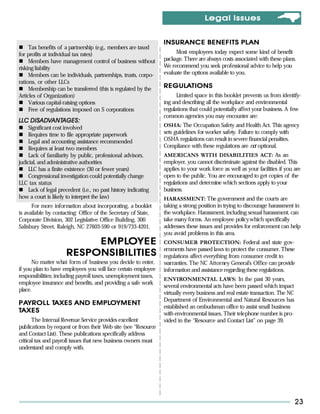

  • 11.
    Yourself Assess Yourself My weaknesses are: ______________________________________________________________________________ My weaknesses identified by someone who knows me well are: _______________________________________________________________________________ ___________________________________________________________________________________________ ___________________________________________________________________________________________ Identify ways you can overcome these weaknesses: ____________________________________________________ What kind of commitment are you willing to make to get your business off the ground? ___________________________________________________________________________________________ ___________________________________________________________________________________________ ___________________________________________________________________________________________ ___________________________________________________________________________________________ Time commitment: ________________________________________________________________________ Resources commitment: _________________________________________________________________ Are you prepared to lose your investment and other savings? ____ Yes ____ No What are your expectations for the business within one year? _______________________________________ ___________________________________________________________________________________________ ___________________________________________________________________________________________ ___________________________________________________________________________________________ After three years? ________________________________________________________________________ ___________________________________________________________________________________________ ___________________________________________________________________________________________ ___________________________________________________________________________________________ CONCLUSIONS CONCLUSIONS Understanding your personal characteristics, required business skills, and demands of business ownership are critical in helping you find the busi- ness best suited to you and your interest. Honestly assessing yourself will help you determine what you need to do to acquire the skills you need, clarify your expectations, and motivate you to seek ways to keep learning as you proceed to develop your business idea. 5
  • 12.
  • 13.
    Chapter 2 Determine Concept Feasibility M any questions must be answered and certain CHECKLIST FOR STARTING A BUSINESS information gathered before determining the feasibility of your o Assess yourself as a potential business owner business idea. Careful research and o Determine concept feasibility analysis will help you in evaluating your concept and assist you in assess- o Examine critical issues & make important decisions ing your idea. o Investigate legal considerations & requirements YOUR DEFINE YOUR o Develop your business plan o BUSINESS IDEA Arrange your financing The first step is to begin gathering as much information as o How will your customer know possible about your business. You you have products or services REFINE THE will want to read articles, books, and trade publications. It is also a available? CONCEPT good idea to visit existing busi- o How much will your custom- As you refine your idea, there nesses and begin the research and ers pay for your product or are business-specific issues that planning process. service? need to be addressed: It is important to remember Using the answers you have o What specific product or that every business is unique. provided to the questions above, service will your business Taking time to explore your write a paragraph describing your provide? concept will help you identify business concept. o Do you have the capability or those specific factors which makes _________________________________ skills to provide this product your business concept unique. The _________________________________ or service? If not, how will you following questions will guide overcome this deficiency? you in defining your business _________________________________ concept. While looking for the _________________________________ o What makes your business answers, also attempt to identify idea, product or service the potential problems which _________________________________ unique? might relate to your business idea. _________________________________ o What will be your competitive o What business will you be in? _________________________________ advantages? o What product or service will _________________________________ o What competitor disadvan- you provide to your custom- _________________________________ tages do you have? ers? o Have you identified any _________________________________ o Who will buy your product or _________________________________ potential problems? If so, how service? will you overcome them? _________________________________ o Why will your customer buy In addition to looking at the _________________________________ business concept, you should also from you? explore the market and the indus- o When will your customer buy try you are interested in by seek- your product or service? ing out the opportunities and 7
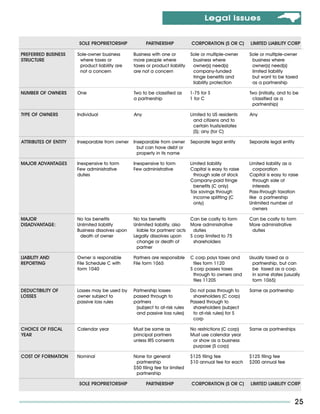
  • 14.
    Feasibility Concept Feasibility identifying potential problems. Answering the MARKET RESEARCH following questions will help you assess your market Market research tells you who your customers and industry: are, where they are, and how large the potential o What industry competition exists in your town or market is. Through research, you will be able to region? gather certain information and data such as: Identify your competition: u Demographics __________________________________________________ u Size of your potential market u Customer lifestyles and buying behavior __________________________________________________ u Specifically who the customer is __________________________________________________ u Determine demand for your product or __________________________________________________ service o What will you do to better provide a unique or There are two basic types of market research— better product or service then your competition? primary and secondary: Primary research is research gathered first-hand o If there is little or no competition, why not? through techniques like surveys, questionnaires, o Is there potential international or government focus groups, or in-depth interview. Primary research procurement opportunities in your product or can be time consuming and possibly expensive. service? If so, identify them. However, it provides the business owner with the o Are there emerging opportunities in the market opportunity to hear customer feedback and act place? If so, identify them. accordingly. o Are current business and economic trends favor- PRIMARY RESEARCH METHODS u Customer habit tracking able? u Surveys u Interest rate u In-depth interviews u Inflation u Competitor analysis u Business climate u Questionnaires u Business trends u Focus groups u Unemployment u Advertising response rate tracking Remember, it is important to evaluate all aspects u Field studies of your business concept and to continually balance Secondary research is already published re- your ideas against reality. search. It includes sources like directories, industry After defining and refining your business idea, journals, and association publications. Secondary does it still look like a good idea to you? If so, you research is accessible, less expensive, can be con- will now want to do more in-depth market research ducted on a continuous basis, and can be combined and analysis to better define your market and oppor- with business owner’s knowledge of the business, tunity. geographical conditions, and customer base. The business owner can informally tailor the research YOUR DEFINE YOUR MARKET findings to meet the needs of the business. THROUGH S ECONDARY RESEARCH SOURCES u Business encyclopedias and directories ANALYSIS RESEARCH AND ANALYSIS u Newspapers While market research provides data and infor- u Business magazines mation about the industry and its customers, market u Trade publications analysis helps the business owner understand the u Market analysis business environment and the basis on which s/he Market analysis helps the business owners must compete. understand the business climate in which s/he must compete. It is through market analysis that a business 8

  • 15.
    Feasibility Concept Feasibility owner determines if a certain business or industry provides an attractive opportunity. Market analysis provides competitive analysis which includes: n Industry analysis: evaluates the industry’s overall opportunity and attractiveness including ease of entry, availability of substitutes, and buyer/supplier issues n Competitor analysis: who are the primary com- petitors, and what are their strengths and weak- nesses. n Your business analysis: identifies strengths, weaknesses, opportunities, and threats within your identified market. YOUR ENHANCING YOUR CHANCE FOR SUCCESS There are always risks in starting a new busi- ness. As a business owner, you will want to lower your risks by incorporating the following ideas into your start-up plan: o Plan ahead. o Make sure you have experience in management and in the type of business you want to start. o Try to best use your strengths and interest in the most appropriate way. o Make decisions based on facts or reliable informa- tion. Don’t make hasty decisions. o Make sure your family is supportive and under- stands the emotional support needed during the start-up phase or when things get difficult. o Be persistent, and DON’T GIVE UP! 9
  • 16.
  • 17.
    Chapter 3 Examine Critical Issues & Make Important Decisions A s you explore starting your own business, you will find CHECKLIST FOR STARTING A BUSINESS there are many decisions which must be made and important o Assess yourself as a potential business owner issues to consider so as to minimize o Determine concept feasibility your risk and increase your success. Four important topics covered in this o Examine critical issues & make important decisions section are: o Investigate legal considerations & requirements n Entry options o Develop your business plan n Selecting and using professionals n Selecting a business location o Arrange your financing n Minimizing your risks ENTRY OPTIONS ENTRY The decision to buy a busi- outside your area of expertise, it is You may be considering ness requires careful evaluation of important to make certain that the starting your own business as a many factors including pricing key employees will stay after the result of a life situation triggering and financing your purchase. sale or that you can hire someone your entrepreneurial desires. Such with similar experience. The potential buyer must events could include corporate understand their criteria for down-sizing, an accident that selecting a business as well as the Finding a business for sale limits your physical abilities, or motivation for wanting to pur- Finding a good business receipt of an inheritance. There are chase the business. opportunity is not always easy. many reasons why people want to Sources to consider: go into business for themselves, Consideration should be given n Printed advertisements and there are various options for to the following: : n Trade sources and suppliers entering a business of your own. The most common entry options o What is your experience with n Friends and acquaintances are: the industry and/or manage- n Intermediaries such as brokers ment? or acquisition specialists n Buying an existing business n Purchasing a franchise busi- o Does the business match your strengths? Evaluating the business ness n Starting a new business As a buyer, first evaluate a o Is the business what you business by reviewing its history enjoy doing? Buying an existing business and the way it operates. Develop o Is it in a desirable location? an understanding of the business’ Purchasing an established business can lighten the burden of o What are you willing to in- method of acquiring and serving start-up costs, lag time without a vest? its customers, determine how it salary, establishing markets, and generates its sales, learn its mar- o Can you get financing? other costs associated with the keting strategy, and develop an o What size business do you understanding of its finance and creation of a new business. Estab- desire in terms of sales, profit, operations functions. lished businesses may have and employees? existing good will—intangible assets such as reputation or his- If the business under consid- torical value. eration has a product or service 11
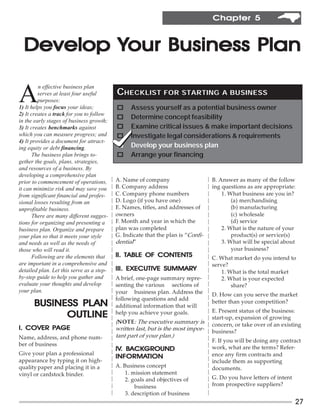
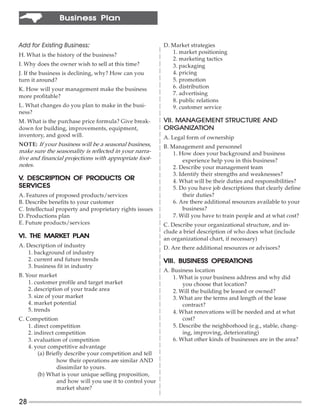
  • 18.
    Issues and Decisions Checklistof material for the evaluation o Are all of the books in order and well main- process* tained? Have you reviewed the past and current financial statements with the counsel of an ac- Obtain the following information from the countant? Are there any liens against the property existing business: for sale? Are there any claims on inventory or n 3-5 years financial statements equipment? Have the taxes been paid to date? n 3-5 years tax returns o Have you reviewed existing business contracts n Interim financial statements and the effect of the transaction on those con- n Copies of all real estate, leases, or deeds tracts? Are they loyal because of a personal n Debt schedule relationship or because of the level of quality n Accounts receivable and aging schedule service? n Accounts payable and aging schedule n Inventory list o Will the lease be transferred into your name or n Supplier list (including contracts) will the owner require a new lease? Is the location n Customer list (including contracts) suitable for your plans? Are there any environ- n Projections mental concerns with this location? Are there n Organizational charts and employee contracts licensing concerns? n Industry information to which the owners may o What contingent liabilities exist? have access o What policies have been established with the n Details of equipment leases and other contingent employees regarding work environment, salary/ financial commitments commissions, benefits, vacation pay, and fringe * Checklist provided by the SABRE Group—Confidential Business Sales and Valuations of Greensboro/ benefits? Raleigh/Durham/Greenville o Will the owner be cooperative with the transition of ownership with regard to tax issues, utility Impor tant questions Important transfers, government requirements, employees, Evaluate the business’ potential according to and other procedures? your goals, employer responsibilities, product or o Are there any environmental issues with respect service demand, market, and financial consider- to your chosen business? ations. Ask and get answers to questions regarding all aspects of an existing business before entering any o If using a broker, do you realize s/he is represent- purchase agreements. Start with basic questions, like ing the interest of the seller? those listed below. Others may be required depend- o Consider a non-compete agreement with existing ing on the specific business: owners(s) o Why is the business for sale? Has it been making o Consider a contractual arrangement with present a profit? If not, do you have a plan to make the owners for a period of consultation business profitable? o Consider whether owner is willing to finance all o What kind of reputation does the establishment or some of the purchase price have currently? How would you change that The services of an accountant, attorney, and reputation? What is the price of good will? What banker are recommended when buying an existing is the consistency of the client base—a few large business. Investigation and research will be crucial to clients or many smaller customers? uncovering as much information as possible about o Will the sale include equipment, property, inven- the business for sale. tory, debts, employee contracts, name, logo, slogans, signage, customer files, etc? 12
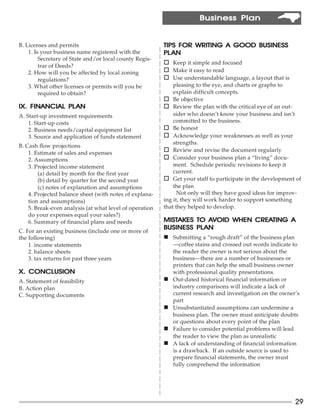
  • 19.
    Issues and Decisions BUYINGA FRANCHISE Franchising has emerged as a popular way for potential business owners to start a new business. A franchise offers advantages in name and product recognition, proven operation procedures as well as volume purchasing power. In this arrangement, the provider, or franchisor, contracts with you, the franchisee, to give you the right to sell or distribute a service or product under the franchisor’s system in a particular area. As with any opportunity, both advantages and disadvantages must be examined before a decision to invest is made. ADVANTAGES OF A FRANCHISE: ADVANTAGES FRANCHISE: DIS ADVANTAGES OF A FRANCHISE: DISAD ANTAGES ADV FRANCHISE: n Some require relatively small capital investment n Complicated legal negotiations with franchise financing n Restrictions on purchasing n Initial corporate support for start-up n Franchising fees n Continuous management training and counseling n Required to share portions of business profits n Existing goodwill and brand name appeal (some- with corporation (sales/royalties) times) n Loss of control over some aspects of operation n Standardized quality of goods/services (e.g., use of name/logo for advertising, territory, n Proven products and business format uniforms, product purchasing requirements) n Group purchasing power n Less freedom n Some opportunities require no prior experience in n Potential problems if owner wants franchisor to that business field buy franchise back n Buying power and programs n Limited control over pricing, product lines, and n Development of advertising and promotions suppliers programs (both local and national) n Human resources policies may be instituted by n Site analysis corporation (potentially unsatisfactory training programs) n Actions by the corporation may affect business of franchisee (especially new store locations close to yours) Locate a list of lawyers specializing in franchise negotiations while in the research stage. Once a franchise opportunity has been selected, retain a lawyer for every step of the negotiations. The nego- tiations serve as the foundation of the franchise. Working with the lawyer, set policies and agreements that will enable the franchise to thrive now and in the future. All obligations, rights, privileges, risks, oppor- tunities, assets, and liabilities must be detailed and agreed upon by all parties before the contract is The US Department of Commerce offers a publication, signed. Franchise Opportunity Handbook, which is up-dated every two years. For a low cost it can be ordered from Superintendent of Documents, US Government Printing Office, North Capitol and H Streets NW, Washington, DC 20402. There are also a number of books on franchising available at public libraries and bookstores. 13
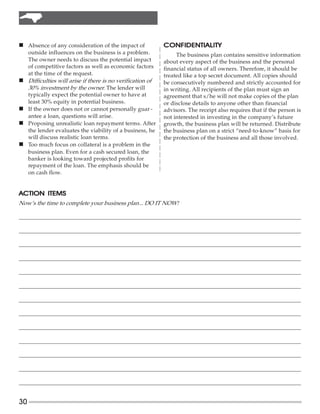
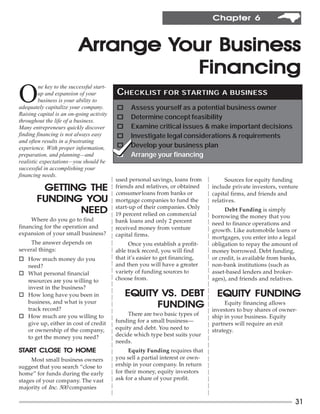
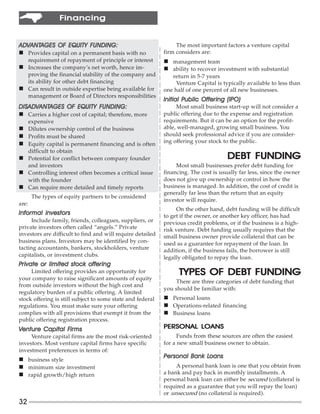
  • 20.
    Issues and Decisions STARTINGA NEW BUSINESS STARTING Most banks today will require you to personally guarantee the corporate loans for start-up businesses. Starting your own business can be a very excit- Consequently, all your assets will be at risk. ing endeavor. It allows you great freedom and oppor- tunity to explore and develop your own business You might ask, “How do I know what kind of idea. It is an opportunity for you to exercise your business to start?” or “How are businesses formed?” creativity and thinking ability to do the following: Business ideas emerge in may ways. Examples are: n Research your business idea n Finding and meeting an unfulfilled market need n Develop a strategy n Building a business on an existing customer n Determine your marketing approach relationship n Address key operational issues n Spinning off a business based on your experience n Make your own decisions and knowledge n Develop your business idea from the ground up n Capitalizing on a new invention or technology Successfully starting your own business can provide a sense of accomplishment and satisfaction n Growing a part-time business or hobby into a full in knowing you did it yourself. However, if the time opportunity business fails, you must assume all the liabilities and You must decide what kind of business you emotional strain that goes with it. There are many want to start. It is also important to examine yourself misconceptions surrounding owning one’s own and decide what you want from the business. business. Consider the following common miscon- Keep in mind that starting a business requires ceptions: careful thought and planning. Many aspects of the n I will be my own boss. Being your own boss does business must be considered including legal issues, not mean you can play golf or go fishing anytime you financing, marketing concerns, employee relations, want. Reality is, the business and your customers accounting procedures, equipment purchases, and become your boss and can demand 50-65 hours per location. week. Research, preparation, organization, and plan- n I can get rich overnight. Small business and free ning are critical in a start-up venture to minimize risk enterprise provides a great opportunity to build and enhance your chance for success. Contact your wealth; however, it will take time. Studies indicate small business assistance providers to assist you that more than a third of small businesses that grow during this critical time (see Resource List). significantly, do so after ten or more years of exist- ence. SELECTING AND USING n I can expect immediate income from my business. This is not likely. Generally, it takes 6-12 months PROFESSIONALS before a new business can start to pay the owner a Starting your own business involves many decent salary. You should have a cash reserve or decisions which often times seem overwhelming. It savings to provide financial support for you and your has been shown that there is a strong correlation family during the start-up phase. between using outside professionals and business n I can start my business with little or no money. success. In today’s business world, where many new Poor capitalization is one of the major causes of businesses fail within the first five years, it only business failure. Lack of capital results in negative makes sense to increase your chances for success by cash flow which can result in poor business decisions seeking the broad experience and expertise that and serious credit problems. professional resources and advisors can provide. Outside advisors assist you in making decisions n I will incorporate and use other people’s money. based on facts, not wishful thinking. They can also Many books and articles have been written about provide a reality check and give you insight in start- OPM (other people’s money). It is difficult to borrow ing and guiding your business. your way to wealth as a new business. The corporate shield probably will not protect you in case of failure. 14
  • 21.
    Issues and Decisions There are two important categories of advisors: informal and professional. SELECTING A BUSINESS LOCATION LOCATION Informal advisors include: Location is more important to some businesses n Other business owners than to others. The importance of the location is n Friends and family determined by certain characteristics of the business. n Members of other entrepreneurial groups or Factors that must be considered are: projects o Do customers travel to the business or do em- n Members of your board of directors ployees travel to the customer? Professional advisors include: o Is convenience a key factor in relationship to what your business offers the customer? n Lawyers n Accountants o Is your business offering a special product with n Bankers little accessible competition? n Insurance agents o Will your product or service require a specific n Marketing professionals location? n Consultants o Will proximity to vendors and customers play an n Small business assistance providers important role in your location? Most professional advisors will expect to be o Are transportation, labor, utilities, state and local compensated for their assistance while informal taxes, zoning, and other regulations critical advisors typically only need to be asked to help. factors to consider in your site selection? When selecting a professional advisor, look for a o Do traffic flow, parking and other business estab- skilled advisor who meets your needs. Attributes you lishments impact your site selection? should look for include: o How much space is required? o Strong professional skills and knowledge o Integrity o Do you need expansion capability? o Small business orientation o Should you lease or buy a facility? o Engaging and creative o What are the terms of your lease, if leasing? o Positive attitude o Willing to listen o How is your rent determined? o Team member and advisor NOTE: Rent = cost of space + advertising Selecting the right professional advisor will not o What are the insurance requirements? only provide advice and consistency to help your o Do you understand home-based business ex- business succeed, but s/he can also be instrumental penses and requirements? in identifying other professional team members. These questions represent some of the issues To go about finding the right professional that need to be answered before making a business advisor, you should: site selection. Additional questions and information o Ask small business assistance providers may be required depending on whether your busi- o Ask other business owners ness is a service business, retail store, or manufactur- o Call the professional and schedule an appoint- ing facility. ment. Interview them as you would an employee. Local resources are available to assist you with Be sure to request references. your site selection. Resources include your Chamber o Look for a comfort level and confidence; confi- of Commerce, NC Department of Commerce, Eco- dence in their integrity, discretion, and concern nomic Development Board, commercial real estate for your business. brokers, and your SBTDC counselor. If you already have a good relationship with a banker or other professional, s/he is a good source of referral. 15
  • 22.
    Issues and Decisions YOUR MINIMIZING YOUR RISKS TO DO Risks abound in the business world. As an entrepreneur, you will want to protect your interest List below the things you must now consider in and minimize your risk from the beginning. order to buy and existing business, start a business, or purchase a franchise. The time to address these important issues is during the planning stage. Advice of professionals in accounting, insurance, banking, and law will help you make decisions to best minimize your risks and to identify your best protection options. INSURANCE PROTECTION Insurance protection is an important consider- ation in minimizing risk. Oftentimes business owners lack expertise when it comes to insurance needs. Basic steps in developing an insurance program are: o Review your current coverage o Identify your insurance needs o Develop a plan (including the cost) o Seek professional advice Most businesses will require the following types of insurance: n Fire insurance n Liability insurance n Automobile insurance n Worker’s compensation insurance Depending on the type of business you are starting, other coverage you may need includes: n Business interruption insurance n Crime insurance n Group life insurance n Key man insurance n Disability insurance n Bonding Most banks require insurance as a condition of their loan. 16
  • 23.
    Chapter 4 Legal Considerations and Requirements A s an entrepreneur, it is your responsibility to ensure that C HECKLIST FOR STARTING A BUSINESS your business is properly complying with state and federal Assess yourself as a potential business owner regulatory requirements, registra- Determine concept feasibility tion, permits, licenses, and employer responsibilities. Stiff penalties may Examine critical issues & make important decisions be assessed against you and/or Investigate legal considerations & requirements your company if you are found in violation of certain government Develop your business plan requirements. This section will Arrange your financing address three primary legal consid- erations: Regulatory requirements PERMITS PERMITS Legal structure of your business Employee responsibility Most new small businesses are For information regarding state unlikely to require any federal permit or licenses, contact: license to operate unless they are Business License Information engaged in: REGULATORY REGULATORY NC Secretary of State Rendering investment advice 919/807-2166 (in Raleigh) or REQUIREMENTS Preparing meat products 800/228-8443 Selling alcohol, tobacco, and 110 South Blount Street PERMITS, LICENSES, AND firearms Raleigh, NC 27601 REGULA REGULATIONS Federal permits or licenses are http://www.secretary.state.nc.us/blio/ Most businesses are required to also necessary to start some default.asp obtain some kind of license or per- large-scale operations in The services provided by this mit—city, state, and/or federal. Certain regulated industries, such as: office include: types of businesses may be required to Radio or television stations Individualized assistance from obtain special permits from local health Common carriers (telephone counselors in identifying authorities, building inspectors, and companies) appropriate licenses and police/fire departments. The business Produce drugs or biological permits owner should take steps to ensure that products Customized information the business does not violate any zoning Consult an attorney regarding packages including applica- regulations or ordinances regarding regulatory requirements. tions and instructions on hazardous activities. Mistakes in obtain- Although a prospective busi- applying for licenses and ing the proper permits and licenses can ness may not strictly fit in one permits be expensive, at best. of these categories, it is impor- Resource center for informa- tant that you make certain that tion on over 600 business FEDERAL LICENSES AND no federal regulations apply licenses and permits before starting your business. To determine liability for license TA S TATE LICENSES AND fees/taxes, contact: 17
  • 24.
    L egal Issues NC Department of Revenue In some cities, zoning and other related requirements must License and Excise Tax Division be approved before you can obtain a license. If the business 501 North Wilmington Street is not located in a city, county privilege licenses may be PO Box 25000 applicable. The business should contact the County Licensing Raleigh, NC 27640 Office. 919/733-3673 Web site: w w.dor.state.nc.us/DOR/ w Zoning The inspections or Planning Department, city or county, SPECIAL LICENSES AND PERMITS determines if a business location is zoned correctly for the In certain instances, such as contractors’ licenses and proposed business type. Some areas are not zoned for bonding, day care certificates of competency, etc., you will commercial businesses, therefore, inquiries need to be made need to obtain specific industry licenses and permits. The before establishing a business. Some home-based businesses Business License Information office should be able to help are required to have a Home Occupation Use Permit. you in this area, or refer to the numbers listed below: Others qualify as a “limited use business” that does not Business License Information 919/807-2166 or require a permit. 800/228-8443 Alcoholic Beverage License 919/733-3641 Signs Alcoholic Beverage Permit 919/779-0700 Sign sizes and locations are regulated within city or Rest Home License 919/733-2855 county limits and are determined by the Inspection or Architecture License 919/733-9544 Planning Department. Contact the city or county prior to Auctioneer License 919/733-2182 design and construction of a business sign to ensure it meets Barber Examiners License 919/733-3650 the regulations. Cosmetic Arts License 919/790-8460 Electrical Contractors License 919/733-9042 TAX INFORMATION INFORMATION General Contractors License 919/571-4183 The SBTDC does not provide tax counseling. Mortuary Science License 919/733-9380 Plumbing & Heating Contractors 919/733-9350 Income taxes Real Estate 919/733-9580 Every business entity is responsible for federal and state Nursing Home or 919/733-2342 income taxes. If your business is a sole proprietorship, Home Health Facility partnership, S corporation, or limited liability corporation Child Day Care License 919/733-4801 (LLC), pre-tax income is taxed by reporting it on your This represents only a partial list. To verify the require- individual return. ments for your business, contact the Business License Infor- If your business is a regular corporation, it will be mation Office at 800/228-8443 or in Raleigh at 807-2166. subject to corporate income taxes. Different report forms LOCAL CITY OR LOCAL LICENSES AND are required for different types of organizations. PERMITS All federal tax forms may be obtained from: Business owners need to explore local licenses and Internal Revenue Service permit requirements and, in some cases, special licenses 320 Federal Place which may be required (such as for alcohol, amusement, or Greensboro, NC 27401 child care) 800/829-1040 (information/assistance/forms) Web site: w w.irs.ustreas.gov/ w These licenses include privilege licenses, occupational licenses, and other miscellaneous licenses. Contact the Tax IRS Numbers Collector’s Office in the county in which the business will be Forms & Publications 800/829-3676 located for more information. Questions 800/829-1040 Tele-Tax 800/829-4477 Privilege License Call and ask for a “Getting Started” package for the All for-profit businesses located within city limits must have a privilege license before beginning business operations. 18
  • 25.
    Legal Issues particular typeof business organization your are starting. You 919/733-7395 will receive a form SS-4 which you should file to obtain a Web site: w w.esc.state.nc.us w federal identification number. This ID number is needed Filing only if you plan to hire employees. Employee portions of the federal/state income taxes State tax forms and requirements may be obtained by and the Social Security tax, must be remitted along with the calling: employer portion to the federal and state taxing authorities, NC Department of Revenue919/733-3166 following the schedules provided by the agencies. You must (all tax departments and forms) also complete quarterly returns for submitting payroll information to the federal and state agencies. An explanation You can obtain your state identification number by of these reports should be included in information you calling 919/733-4626. A state identification number is receive from the IRS, the NC Department of Revenue, and required only if employees are to be hired. Otherwise, send the Employment Security Commission. quarterly payment with tax form, NC-40. Note that filing estimated federal and state income taxes during the taxable Sales and use tax, retail/wholesale licenses year may prevent penalties from being assessed. All retail operators must collect sales tax. To find out Payroll taxes what to remit and how to avoid tax on wholesale purchases, contact: Employee Taxes There are several types of payroll taxes. As an em- North Carolina Department of Revenue ployer, you must withhold taxes on behalf of your employ- Sales Tax Division ees. These taxes are collected by you and are employee 501 North Wilmington Street contributions. They include the following: PO Box 25000 Raleigh, NC 27640 Federal income tax 919/733-3661 State income tax Web site:www.dor.state.nc.us/DOR/ Social Security (FICA) tax (employee portion) Wholesalers: If your business is that of distribution Employees must complete forms W-4 and NC W-4 and you do not sell to the end-user or consumer, you should before you can determine the amount to withhold for obtain a wholesale license. federal and state income taxes from their salaries (Form 8109). Social Security is determined by a legislated percentage Other state taxes which may be obtained through the Internal Revenue Service publications. NC Department of Revenue 501 North Wilmington Street Employer Taxes PO Box 25000 The second type of payroll taxes involve your expense Raleigh, NC 27640 as an employer. These are taxes that you, the employer, pay 919/733-3661 and include the following: Web site: w w.dor.state.nc.us/DOR/ w Social Security (FICA) tax (employer portion) Amusement Tax 919/733-3673 Federal Unemployment Tax (FUTA)—form 508 Excise Tax: State Unemployment Tax (SUTA)—Unemploy- Cigarettes 919/733-3673 ment Acct# (form NCU1-101/625) Soft Drinks 919/733-3673 The IRS “Getting Started” package will include infor- Franchise Tax 919/733-3166 mation on submitting your portion of FICA and federal Corps. Initial Franchise Tax Return unemployment tax. —Form CE-302 Each new business should contact the Employment Fuel Tax 919/733-3409 Security Commission at the address for information on Installment Paper 919/733-7548 unemployment taxes: Employment Security Commission 700 Wade Avenue Raleigh, NC 27605 19
  • 26.
    L egal Issues Dealer Tax Workersí Compensation Intangibles Tax 919/733-4147 Workers’ Compensation is a form of insurance for Taxpayer Assistance 919/733-4684 employees. Due to your potential legal liability for job-related Application for Sales and Use Tax Registration & accidents, Workers’ Comp is strongly recommended for all Annual Whole License—Form NC E-504 businesses. If you are a sole proprietorship, partnership, Local Taxes: List Tangible Property Tax (as of 1 LLC, estate, or trust, you are required by law to carry January 1996) Tax Listing Form coverage once you have three employees (in addition to the business operators/controlers). If you are incorporated, you INCORPORATING A BUSINESS INCORPORATING must carry coverage once you have three people (including corporate officers) in the corporation. There are exceptions Corporations Division to these rules: for instance, if you run an agricultural opera- North Carolina Secretary of State tion, you must carry Workers’ Comp coverage when you 300 North Salisbury Street employ ten or more regular, non-seasonal employees. For Raleigh, NC 27603 specific information, contact your insurance agent, attorney, 919/733-4201 or: Web site: w w.secstate.state.nc.us/secstate/ w c rp.htm o Workers’ Compensation 430 North Salisbury Street Call and request either “NC Business Corporation Raleigh, NC 27611 Guidelines” (which will explain how to incorporate your 800/688-8349 or w w.comp.state.nc.us w business in North Carolina) or “NC Non-Profit Corpora- tion Guidelines.” PROTECTING INTELLECTUAL PROPERTY ASSUMED NAME ACT When you begin your business, your ideas and know- how may be some of your most valuable assets. Patents, If you decide that your company will be a sole propri- trademarks, copyrights, and trade secrets, together, are called etorship or partnership, and you wish to use a name other intellectual property. The wise business owner will review his than your own name, you must perform a name search at the own company’s activities in each of these areas, list possible County Registrar of Deeds to see if the name of your assets that should be protected, and evaluate their commer- company is already being used. cial importance to the company. With small business assis- tance providers, the business owner can develop a realistic INSURANCE plan and budget for the company’s intellectual property There are four types of insurance that are generally issues. considered essential for small businesses: Hazard (includes fire, wind, water, theft) Resources Web site ww.uspto.gov w Fire insurance will compensate you for the loss of US Patent & Trademark Office 800/786-9199 and damage to your business property by fire. Copyright Office 202/707-3000 Liability insurance will help protect you against suits Trademark Assistance Center (NC) 703/308-9000 for physical damages done to someone on your property NC Dept. of Commerce 919/733-4151 and for liabilities arising for the use of the products or (business names) services your company sells. Other protections: directors, crime (robbery, burglary, employee vandalism, business interruption, key person). Auto insurance, either private or business, is required by law for any vehicle used for business purposes. Before buying any insurance, consider the risks that should be covered, compare costs from the different companies, and get professional advice from an insurance agent. 20
  • 27.
    Legal Issues In a general partnership, each partner is held person- SELECT THE TYPE OF ally liable for all debts, taxes, and other claims against the BUSINESS STRUCTURE partnership. There are several forms of business structures for you to consider. A limited partnership has both general partners and Selecting the business entity which is right for you will involve tax, limited partners. It restricts the amount of personal liability to businessandestateplanning,andfinancialconsiderations. In this section, a limited partner. It allows investors to contribute but will we discuss the various structures and identify the advantages and expose them to a limited amount of liability AND manage- disadvantages of each. The legal structure you choose will determine the ment control. A limited partner is only personally liable up to organization,debt liability, and tax requirementsaswell as other the amount of investment made. aspects of business questions. ADVANTAGES OF PARTNERSHIPS: ADVANTAGES PAR ARTNERSHIPS: SOLE PROPRIETORSHIP Simplest form of business for two or more owners Sole proprietorship means that one person indepen- Business can be established with minimal formal dently owns and operates an unincorporated business for documentation (However, it is recommended that profit. The business is considered an extension of the owner partnerships have a formal written agreement rather than as a separate legal entity. For tax purposes, the with provisions for death, disability, liability, profits/losses of the business are combined with other compensation, benefits, and dissolution) owner income sources. Profits and losses belong to the partners Partners have freedom to operate the business on ADVANTAGES OF SOLE PROPRIETORSHIPS: ADVANTAGES behalf of the partnership (i.e., they can hire/fire Simplest form of ownership to establish and employees, borrow money, or enter into contracts) operate No income tax on partnership entity (it’s passed One owner on to individual partners) Owner has complete control over management Buy/sell agreements decisions and policies Availability of resources/skills from all partners Use of all profits at the discretion of the owner Limited liability partners enjoy lower risks Limited paperwork to state and federal agencies DIS ADVANTAGES OF PARTNERSHIPS: DISAD ANTAGES ADV PAR ARTNERSHIPS: All losses are incurred by the owner (owner’s General partners liable for all debts and actions of income directly linked to success/failure of the partnership (joint and several liability) business) Limitations apply to raising investor capital (e.g., DISADVANTAGES OF SOLE PROPRIETORSHIPS: DISAD ANTAGES ADV all investors would be partners) All management decisions—staffing, policies, Responsibilities and actions of partners, if not problems—must be handled by owner specifically written out, can overlap or contradict Owner personally liable for all debts, taxes, and one another claims incurred by the business Partnership income added to other sources of May be difficult to raise capital (i.e., will depend income and taxed at owner’s personal tax rate on owner’s credit history) Complications with taxes arise if fiscal year varies Continuity of business disrupted by owner death from calendar year or disability Partnership entity lacks perpetual existence in the Combined with other income sources, profits event of death, disability, or withdrawal of a taxed at owner’s individual tax rate partner (provisions must be made in advance) PARTNERSHIP CORPORATIONS CORPORATIONS A partnership is a legally recognized entity between two There are three types of corporations: subchapters S, C or more people who agree to contribute money, labor, corporations, and limited liability companies. The major property, or skills and share in the business profits, losses, differences are centered around taxation, initial profitability, and management decisions. There are two types of partner- shareholder compensation, and deductibility of fringe benefit ships—general and limited. payments. After completion of the incorporation process, a corporation is automatically classified as a C corporation by the IRS. Board of Director approval is required, and a form 21
  • 28.
    L egal Issues mustbe submitted to the IRS to change the status to sub- Subchapter S corporation requirements chapter S corporation. This action must occur within the first It must be a domestic corporation 75 days of incorporating the business. Use IRS form #2553. It must not have more than 75 shareholders (if A corporation is a legal entity that exists under the stock is purchased jointly, a husband and wife are authority of state law and separate from the people who considered one shareholder) own, manage, and control its operations. Corporations Citizens or resident aliens must own all stock acquire assets, incur debt, pay taxes, enter into contracts, sue/ It must have individuals, estates, and certain trusts as are sued, have perpetual existence, and issue shares of stock shareholders as evidence of ownership. It must have only one class of stock To incorporate, articles of incorporation are filed with It must have an election with all shareholders present the Secretary of State’s office. These articles define the structure of the business (including its business purpose, ADVANTAGES OF SUBCHAPTER S ADVANTAGES amount of capital stock authorized, number of shares, and CORPORA CORPORATIONS: organization of a board of directors). The responsibility of Limited liability the board of directors is to create by-laws and oversee Avoids double taxation major corporate policies and practices. Retains advantages of a corporation with respect to business obligations ADVANTAGES OF CORPORATIONS: ADVANTAGES CORPORA Maintain status of corporation with assets and Can provide a single business owner with limited unlimited life separate from its owners liability Owners can participate in management Separate legal entity (with rights and responsibili- No restrictions on the right to transfer ownership ties of a legal “person”) DIS ADVANTAGES OF SUBCHAPTER S DISAD ANTAGES ADV Limited liability for owners/shareholders Transferability of ownership (i.e., shareholders CORPORA CORPORATIONS: 75 or fewer stockholders; only one class of stock may trade or sell stock) Stockholders limited to individuals, estates, or trustees Continuity of existence beyond original founders Must be a domestic organization and not a member of or shareholders an affiliated group Absence of “mutual agency” (i.e., stockholders, Stockholders limited to citizens or resident aliens of the acting as owners, may not enter the corporation United States into contracts or agreements) Ability to raise large amounts of capital by issu- LIMITED LIABILITY COMPANY (LLC) ing stock A limited liability company has a combination of DISADVANTAGES OF CORPORATIONS: DISAD ANTAGES ADV CORPORA partnership and S corporation characteristics. An LLC has the corporate characteristic of limited liability and the tax Cost related to setting up the corporation and advantages and flexibility of partnerships. Under the law an, filing the required forms with the Secretary of L LC is considered a separate legal entity and is formed by State’s office. filing Articles of Organization with the North Carolina Formalities required by law (e.g., maintaining Secretary of State. Two or more owners, or “members,” corporate minutes, having a board of directors, must submit the appropriate paper work. recording shareholder rights, maintaining corpo rate records and filings) LLCs merit a word of caution to potential business Considerable organizational costs owners. There is a lack of public, judicial, and administrative May take considerable time to set-up and orga- authority and familiarity regarding the classification and nize a corporation operation of an LLC. An accountant and a lawyer versed in Greater amount of regulation and supervision by the legalities and organizational structure are recommended. governmental agencies Corporations are subject to real estate, personal ADVANTAGES: LLC ADVANTAGES: property, and franchise taxes LLC is considered a separate legal entity C corporations are subject to double taxation Unlimited number of shareholders unlike the S- (corporation and shareholder earnings taxed) corporation limit of 75 22
  • 29.
    Legal Issues INSURANCE BENEFITS PLAN Tax benefits of a partnership (e.g., members are taxed for profits at individual tax rates) Most employees today expect some kind of benefit Members have management control of business without package. There are always costs associated with these plans. risking liability We recommend you seek professional advice to help you Members can be individuals, partnerships, trusts, corpo- evaluate the options available to you. rations, or other LLCs Membership can be transferred (this is regulated by the REGULATIONS REGULA Articles of Organization) Limited space in this booklet prevents us from identify- Various capital-raising options ing and describing all the workplace and environmental Free of regulations imposed on S corporations regulations that could potentially affect your business. A few common agencies you may encounter are: DISAD ANTAGES: ADV LLC DISADVANTAGES: Significant cost involved OSHA: The Occupation Safety and Health Act. This agency Requires time to file appropriate paperwork sets guidelines for worker safety. Failure to comply with Legal and accounting assistance recommended OSHA regulations can result in severe financial penalties. Requires at least two members Compliance with these regulations are not optional. Lack of familiarity by public, professional advisors, AMERICANS WITH DISABILITIES ACT: As an judicial, and administrative authorities employer, you cannot discriminate against the disabled. This LLC has a finite existence (30 or fewer years) applies to your work force as well as your facilities if you are Congressional investigation could potentially change open to the public. You are encouraged to get copies of the LLC tax status regulations and determine which sections apply to your Lack of legal precedent (i.e., no past history indicating business. how a court is likely to interpret the law) HARASSMENT: The government and the courts are For more information about incorporating, a booklet taking a strong position in trying to discourage harassment in is available by contacting: Office of the Secretary of State, the workplace. Harassment, including sexual harassment, can Corporate Division, 302 Legislative Office Building, 300 take many forms. An employee policy which specifically Salisbury Street, Raleigh, NC 27603-590 or 919/733-4201. addresses these issues and provides for enforcement can help you avoid problems in this area. EMPLO YEE EMPLO CONSUMER PROTECTION: Federal and state gov- ernments have passed laws to protect the consumer. These RESPONSIBILITIES regulations affect everything from consumer credit to No matter what form of business you decide to enter, warranties. The NC Attorney General’s Office can provide if you plan to have employees you will face certain employee information and assistance regarding these regulations. responsibilities; including payroll taxes, unemployment taxes, ENVIRONMENTAL LAWS: In the past 30 years, employee insurance and benefits, and providing a safe work several environmental acts have been passed which impact place. virtually every business and real estate transaction. The NC Department of Environmental and Natural Resources has AYROLL TAXES EMPLO P AYROLL TAXES AND EMPLO YMENT established an ombudsman office to assist small business TAXES with environmental issues. Their telephone number is pro- The Internal Revenue Service provides excellent vided in the “Resource and Contact List” on page 39. publications by request or from their Web site (see “Resource and Contact List). These publications specifically address critical tax and payroll issues that new business owners must understand and comply with. 23
  • 30.
  • 31.
    Legal Issues SOLE PROPRIETORSHIP PAR TNERSHIP CORPORATION (S OR C) LIMITED LIABILITY CORP PR E F E R R E D B U S I N E S S Sole-owner business Business with one or Sole or multiple-owner Sole or multiple-owner STRUCTURE where taxes or more people where business where business where product liability are taxes or product liability owner(s) need(s) owner(s) need(s) not a concern are not a concern company-funded limited liability fringe benefits and but want to be taxed liability protection as a partnership NUMBER OF OWNERS One Two to be classified as 1-75 for S Two (initially, and to be a partnership 1 for C classified as a partnership) TYPE OF OWNERS Individual Any Limited to US residents Any and citizens and to certain trusts/estates (S); any (for C) ATTRIBUTES OF ENTITY Inseparable from owner Inseparable from owner Separate legal entity Separate legal entity but can have debt or property in its name MAJOR ADVANTAGES Inexpensive to form Inexpensive to form Limited liability Limited liability as a Few administrative Few administrative Capital is easy to raise corporation duties through sale of stock Capital is easy to raise Company-paid fringe through sale of benefits (C only) interests Tax savings through Pass-through taxation income splitting (C like a partnership only) Unlimited number of owners MAJOR No tax benefits No tax benefits Can be costly to form Can be costly to form DISADVANTAGE: Unlimited liability Unlimited liability, also More administrative More administrative Business dissolves upon liable for partners' acts duties duties death of owner Legally dissolves upon S corp limited to 75 change or death of shareholders partner LIABILITY AND Owner is responsible Partners are responsible C corp pays taxes and Usually taxed as a REPOR TING File Schedule C with File form 1065 files form 1120 partnership, but can form 1040 S corp passes taxes be taxed as a corp. through to owners and in some states (usually files 1120S form 1065) DEDUCTIBILITY OF Losses may be used by Partnership losses Do not pass through to Same as partnership LOSSES owner subject to passed through to shareholders (C corp) passive loss rules partners Passed through to (subject to at-risk rules shareholders (subject and passive loss rules) to at-risk rules) for S corp CHOICE OF FISCAL Calendar year Must be same as No restrictions (C corp) Same as partnerships YEAR principal partners Must use calendar year unless IRS consents or show as a business purpose (S corp) COST OF FORMATION Nominal None for general $125 filing fee $125 filing fee partnership $10 annual fee for each $200 annual fee $50 filing fee for limited partnership SOLE PROPRIETORSHIP PAR TNERSHIP CORPORATION (S OR C) LIMITED LIABILITY CORP 25
  • 32.
  • 33.
    Chapter 5 Develop Your Business Plan A n effective business plan serves at least four useful CHECKLIST FOR STARTING A BUSINESS purposes: 1) It helps you focus your ideas; o Assess yourself as a potential business owner 2) It creates a track for you to follow o Determine concept feasibility in the early stages of business growth; 3) It creates benchmarks against o Examine critical issues & make important decisions which you can measure progress; and o Investigate legal considerations & requirements 4) It provides a document for attract- ing equity or debt financing. o Develop your business plan The business plan brings to- o Arrange your financing gether the goals, plans, strategies, and resources of a business. By developing a comprehensive plan prior to commencement of operations, A. Name of company B. Answer as many of the follow it can minimize risk and may save you B. Company address ing questions as are appropriate: from significant financial and profes- C. Company phone numbers 1. What business are you in? sional losses resulting from an D. Logo (if you have one) (a) merchandising unprofitable business. E. Names, titles, and addresses of (b) manufacturing There are many different sugges- owners (c) wholesale tions for organizing and presenting a F. Month and year in which the (d) service business plan. Organize and prepare plan was completed 2. What is the nature of your your plan so that it meets your style G. Indicate that the plan is “Confi- product(s) or service(s) and needs as well as the needs of dential” 3. What will be special about those who will read it. your business? Following are the elements that II. TABLE OF CONTENTS C. What market do you intend to are important in a comprehensive and serve? detailed plan. Let this serve as a step- SUMMARY III. EXECUTIVE SUMMARY 1. What is the total market by-step guide to help you gather and A brief, one-page summary repre- 2. What is your expected evaluate your thoughts and develop senting the various sections of share? your plan. your business plan. Address the D. How can you serve the market following questions and add PLAN BUSINESS PL AN additional information that will better than your competition? E. Present status of the business: OUTLINE help you achieve your goals. start-up, expansion of growing (NOTE: The executive summary is concern, or take over of an existing COVER PAGE I. COVER PAGE written last, but is the most impor- business? Name, address, and phone num- tant part of your plan.) F. If you will be doing any contract ber of business IV. BACKGROUND IV. BACKGROUND work, what are the terms? Refer- Give your plan a professional ence any firm contracts and INFORMATION INFORMATION appearance by typing it on high- include them as supporting quality paper and placing it in a A. Business concept documents. vinyl or cardstock binder. 1. mission statement 2. goals and objectives of G. Do you have letters of intent business from prospective suppliers? 3. description of business 27
  • 34.
    Business Plan Add forExisting Business: : D. Market strategies 1. market positioning H. What is the history of the business? 2. marketing tactics I. Why does the owner wish to sell at this time? 3. packaging J. If the business is declining, why? How can you 4. pricing turn it around? 5. promotion K. How will your management make the business 6. distribution 7. advertising more profitable? 8. public relations L. What changes do you plan to make in the busi- 9. customer service ness? M. What is the purchase price formula? Give break- VII. MANAGEMENT STRUCTURE AND down for building, improvements, equipment, ORGANIZATION inventory, and good will. A. Legal form of ownership NOTE: If your business will be a seasonal business, B. Management and personnel make sure the seasonality is reflected in your narra- 1. How does your background and business tive and financial projections with appropriate foot- experience help you in this business? notes. 2. Describe your management team 3. Identify their strengths and weaknesses? V. DESCRIPTION OF PRODUCTS OR 4. What will be their duties and responsibilities? SERVICES 5. Do you have job descriptions that clearly define A. Features of proposed products/services their duties? B. Describe benefits to your customer 6. Are there additional resources available to your C. Intellectual property and proprietary rights issues business? D. Productions plan 7. Will you have to train people and at what cost? E. Future products/services C. Describe your organizational structure, and in- clude a brief description of who does what (include PLAN VI. THE MARKET PLAN an organizational chart, if necessary) A. Description of industry D. Are there additional resources or advisors? 1. background of industry 2. current and future trends OPERATIONS VIII. BUSINESS OPERATIONS 3. business fit in industry A. Business location B. Your market 1. What is your business address and why did 1. customer profile and target market you choose that location? 2. description of your trade area 2. Will the building be leased or owned? 3. size of your market 3. What are the terms and length of the lease 4. market potential contract? 5. trends 4. What renovations will be needed and at what C. Competition cost? 1. direct competition 5. Describe the neighborhood (e.g., stable, chang- 2. indirect competition ing, improving, deteriorating) 3. evaluation of competition 6. What other kinds of businesses are in the area? 4. your competitive advantage (a) Briefly describe your competition and tell how their operations are similar AND dissimilar to yours. (b) What is your unique selling proposition, and how will you use it to control your market share? 28
  • 35.
    Business Plan B. Licensesand permits TIPS FOR WRITING A GOOD BUSINESS 1. Is your business name registered with the PL AN Secretary of State and/or local county Regis- trar of Deeds? o Keep it simple and focused 2. How will you be affected by local zoning o Make it easy to read regulations? o Use understandable language, a layout that is 3. What other licenses or permits will you be pleasing to the eye, and charts or graphs to required to obtain? explain difficult concepts. o Be objective PLAN IX. FINANCIAL PL AN o Review the plan with the critical eye of an out- A. Start-up investment requirements sider who doesn’t know your business and isn’t 1. Start-up costs committed to the business. 2. Business needs/capital equipment list o Be honest 3. Source and application of funds statement o Acknowledge your weaknesses as well as your strengths. B. Cash flow projections 1. Estimate of sales and expenses o Review and revise the document regularly 2. Assumptions o Consider your business plan a “living” docu- 3. Projected income statement ment. Schedule periodic revisions to keep it (a) detail by month for the first year current. (b) detail by quarter for the second year o Get your staff to participate in the development of (c) notes of explanation and assumptions the plan 4. Projected balance sheet (with notes of explana- Not only will they have good ideas for improv- tion and assumptions) ing it, they will work harder to support something 5. Break-even analysis (at what level of operation that they helped to develop. do your expenses equal your sales?) 6. Summary of financial plans and needs MISTAKES TO AVOID WHEN CREATING A MISTAKES AV CREATING PLAN BUSINESS PL AN C. For an existing business (include one or more of the following) n Submitting a “rough draft” of the business plan 1. income statements —coffee stains and crossed out words indicate to 2. balance sheets the reader the owner is not serious about the 3. tax returns for past three years business—there are a number of businesses or printers that can help the small business owner CONCLUSION X. CONCLUSION with professional quality presentations. A. Statement of feasibility n Out-dated historical financial information or B. Action plan industry comparisons will indicate a lack of C. Supporting documents current research and investigation on the owner’s part n Unsubstantiated assumptions can undermine a business plan. The owner must anticipate doubts or questions about every point of the plan n Failure to consider potential problems will lead the reader to view the plan as unrealistic n A lack of understanding of financial information is a drawback. If an outside source is used to prepare financial statements, the owner must fully comprehend the information 29
  • 36.
    n Absence ofany consideration of the impact of CONFIDENTIALITY outside influences on the business is a problem. The business plan contains sensitive information The owner needs to discuss the potential impact about every aspect of the business and the personal of competitive factors as well as economic factors financial status of all owners. Therefore, it should be at the time of the request. treated like a top secret document. All copies should n Difficulties will arise if there is no verification of be consecutively numbered and strictly accounted for 30% investment by the owner. The lender will in writing. All recipients of the plan must sign an typically expect the potential owner to have at agreement that s/he will not make copies of the plan least 30% equity in potential business. or disclose details to anyone other than financial n If the owner does not or cannot personally guar - advisors. The receipt also requires that if the person is antee a loan, questions will arise. not interested in investing in the company’s future n Proposing unrealistic loan repayment terms. After growth, the business plan will be returned. Distribute the lender evaluates the viability of a business, he the business plan on a strict “need-to-know” basis for will discuss realistic loan terms. the protection of the business and all those involved. n Too much focus on collateral is a problem in the business plan. Even for a cash secured loan, the banker is looking toward projected profits for repayment of the loan. The emphasis should be on cash flow. ACTION ITEMS Now’s the time to complete your business plan... DO IT NOW! _______________________________________________________________________________________________________ _______________________________________________________________________________________________________ _______________________________________________________________________________________________________ _______________________________________________________________________________________________________ _______________________________________________________________________________________________________ _______________________________________________________________________________________________________ _______________________________________________________________________________________________________ _______________________________________________________________________________________________________ _______________________________________________________________________________________________________ _______________________________________________________________________________________________________ _______________________________________________________________________________________________________ _______________________________________________________________________________________________________ _______________________________________________________________________________________________________ 30
  • 37.
    Chapter 6 Arrange Your Business Financing O ne key to the successful start- up and expansion of your CHECKLIST FOR STARTING A BUSINESS business is your ability to adequately capitalize your company. o Assess yourself as a potential business owner Raising capital is an on-going activity o Determine concept feasibility throughout the life of a business. Many entrepreneurs quickly discover o Examine critical issues & make important decisions finding financing is not always easy o Investigate legal considerations & requirements and often results in a frustrating experience. With proper information, o Develop your business plan preparation, and planning—and o Arrange your financing realistic expectations—you should be successful in accomplishing your financing needs. used personal savings, loans from Sources for equity funding GETTING THE friends and relatives, or obtained consumer loans from banks or include private investors, venture capital firms, and friends and YOU FUNDING YOU mortgage companies to fund the relatives. start-up of their companies. Only NEED 19 percent relied on commercial Debt Funding is simply borrowing the money that you Where do you go to find bank loans and only 2 percent need to finance operations and financing for the operation and received money from venture growth. Like automobile loans or expansion of your small business? capital firms. mortgages, you enter into a legal The answer depends on Once you establish a profit- obligation to repay the amount of several things: able track record, you will find money borrowed. Debt funding, o How much money do you that it’s easier to get financing, or credit, is available from banks, need? and then you will have a greater non-bank institutions (such as o What personal financial variety of funding sources to asset-based lenders and broker- resources are you willing to choose from. ages), and friends and relatives. invest in the business? o How long have you been in EQUITY VS. DEBT EQUITY FUNDING business, and what is your track record? FUNDING Equity financing allows investors to buy shares of owner- o How much are you willing to There are two basic types of ship in your business. Equity give up, either in cost of credit funding for a small business— partners will require an exit or ownership of the company, equity and debt. You need to strategy. to get the money you need? decide which type best suits your needs. START CLOSE TO HOME START CLOSE Equity Funding requires that Most small business owners you sell a partial interest or own- suggest that you search “close to ership in your company. In return home” for funds during the early for their money, equity investors stages of your company. The vast ask for a share of your profit. majority of Inc. 500 companies 31
  • 38.
    Financing ADVANTAGES OF EQUITYFUNDING: ADVANTAGES The most important factors a venture capital n Provides capital on a permanent basis with no firm considers are: requirement of repayment of principle or interest n management team n Increases the company’s net worth, hence im- n ability to recover investment with substantial proving the financial stability of the company and return in 5-7 years its ability for other debt financing Venture Capital is typically available to less than n Can result in outside expertise being available for one half of one percent of all new businesses. management or Board of Directors responsibilities Public Initial Public Offering (IPO) DISADVANTAGES OF EQUITY FUNDING: DISAD ANTAGES ADV Most small business start-up will not consider a n Carries a higher cost of capital; therefore, more public offering due to the expense and registration expensive requirements. But it can be an option for the profit- n Dilutes ownership control of the business able, well-managed, growing small business. You n Profits must be shared should seek professional advice if you are consider- ing offering your stock to the public. n Equity capital is permanent financing and is often difficult to obtain n Potential for conflict between company founder DEBT FUNDING and investors Most small businesses prefer debt funding for n Controlling interest often becomes a critical issue financing. The cost is usually far less, since the owner with the founder does not give up ownership or control in how the n Can require more detailed and timely reports business is managed. In addition, the cost of credit is generally far less than the return that an equity The types of equity partners to be considered investor will require. are: On the other hand, debt funding will be difficult Informal investors to get if the owner, or another key officer, has had Include family, friends, colleagues, suppliers, or previous credit problems, or if the business is a high- private investors often called “angels.” Private risk venture. Debt funding usually requires that the investors are difficult to find and will require detailed small business owner provide collateral that can be business plans. Investors may be identified by con- used as a guarantee for repayment of the loan. In tacting accountants, bankers, stockholders, venture addition, if the business fails, the borrower is still capitalists, or investment clubs. legally obligated to repay the loan. Private or limited stock offering Limited offering provides an opportunity for TYPES OF DEBT FUNDING your company to raise significant amounts of equity There are three categories of debt funding that from outside investors without the high cost and you should be familiar with: regulatory burden of a public offering. A limited stock offering is still subject to some state and federal n Personal loans regulations. You must make sure your offering n Operations-related financing complies with all provisions that exempt it from the n Business loans public offering registration process. Venture Capital Firms Firms LOANS PERSONAL LOANS Venture capital firms are the most risk-oriented Funds from these sources are often the easiest investors. Most venture capital firms have specific for a new small business owner to obtain. investment preferences in terms of: Personal Bank Loans Loans n business style n minimum size investment A personal bank loan is one that you obtain from n rapid growth/high return a bank and pay back in monthly installments. A personal bank loan can either be secured (collateral is required as a guarantee that you will repay the loan) or unsecured (no collateral is required). 32
  • 39.
    Financing Loans From LifeInsurance From Leasing You may be able to borrow against the cash Leasing is a rental arrangement that gives you surrender value of your life insurance policy. In many the use of an asset—such as a car or a piece of ma- cases, an insurance company will let customers chinery—that someone else owns. Although the total borrow up to 95 percent of the paid-in value of a cost of leasing will be more than purchasing the item whole-life policy. outright, this is a way to reduce the amount of up- front money you’ll need to get your business off the Credit Cards ground. Although it is a more costly form of credit, your credit card can provide ready access to cash. You Accounts- Receivable Financing Accounts-R Financing should only use this source if you have a credit limit If you have receivables—accounts that have high enough to cover your needs, and if you can pay been invoiced but not yet paid—you may be able to off the card quickly. use these as collateral for a small business loan. Lenders that offer accounts-receivable financing will Mortgages Second Mor tgages (Home Equity Credit) generally offer between 50 and 80 percent of the total If you have enough equity in your home, you invoice amounts outstanding, depending on the type may qualify for a home equity loan or a line of credit. of receivables and the ease of collection. Including the first mortgage, you can generally borrow up to 80 percent for the appraised value of F actoring your home. This type of borrowing may offer tax Instead of borrowing against your receivables, advantages; however, if you fail to repay the loan, factoring allows you to sell them to a financing you are in danger of losing your home. source, called a factor. You will be paid a percentage of the total value of these accounts, depending on the Friends and Relatives Relatives type of receivables and the ease of collection. Once Friends and relatives may offer financial sup- you’ve sold the receivables, the factor will collect the port. If you use this option, make sure to treat the accounts and absorb any losses. transaction in a professional manner. Pay a fair rate of interest, sign a legal promissory note, and repay the Asset- Based Financing Asset-Based Financing money as agreed. You may be able to borrow money on the assets your business owns, including the inventory and OPERATIONS-REL ATED FINANCING OPERATIONS-REL TIONS-RELA other fixed assets such as plant and equipment. This category of financing is dependent upon Asset-based financing can be structured as a one-time the day-to-day operations of your business. Some of extension of credit or as a revolving line of credit these options are available to start-up businesses. requiring a periodic review of the assets pledged as collateral. Supplier Credit The suppliers with whom you do business can be a source of funds if they extend favorable credit terms to you, such as “net 30.” The availability of this form of credit will vary, depending on the industries you and your vendor are in. Customer Credit By getting your customers to make a deposit or pay in advance for products or services, you can create a form of credit. You may want to offer a discount as an incentive for your customers to pre- pay. 33
  • 40.
    Financing LOANS BUSINESS LOANS Government-assisted loans, like bank loans, This category of credit is the most traditional usually require that the small business owner have and widely used among businesses. Listed below are their own money invested in the business in order to the most common forms of business loans used by share the risk with the lender. small businesses: HOW TO CHOOSE A Term Loans Loans BANKER These are simply installment loans that are paid Choosing a bank, or more precisely a banker, is back at regular intervals over a specified length of one of the most important decisions that a new or time. These loans are granted for a specific purpose, young business can make. A good banking relation- such as for working capital or an upgrade in equip- ship can make the difference between life and death ment. The term of the loan will depend on the use of of a business during difficult times. the funds, but it can range from short term (less than one year) to long term (more than five years). Because the choice of a banker is such an impor- tant decision, the new business should shop around Demand Notes before making a choice. The key watchword when choosing a bank should be service. Specifically, some A demand note is a single-payment loan that is important criteria in choosing a banker should intended for very specific short-term needs. Al- include: though the contract will usually call for payment in full within 90 to 180 days, the lender can call for (or 1) Size of the bank: demand) repayment of the note at any time. You may A bank that is too small may be appropriate be asked to make periodic interest payments during while your company is small, however, they may not the life of the note. be able to service your needs for larger loans as your company grows. A bank that is too large may be Lines of Credit indifferent to your needs while your company is A line of credit, like a credit card, establishes a small. credit limit and specific terms for repaying money that is borrowed. Lines of credit are easy to access 2) Familiarity and desire to work with small Familiarity and offer flexibility in managing the cash flow needs businesses: of a small business. Many small business owners Some institutions maintain policies that are establish a line of credit as a precaution, before they favorable to working with small business. They tend have a real need for the money. Lines of credit are to be more familiar with special problems of the usually linked to short-term assets such as accounts young and growing companies. receivable, inventory, materials, etc. 3) How the bank will react to your problems: Government-Assisted Loans Government-Assisted Loans Will they foreclose the first time a payment is There are several loan programs in which the late, or will they be willing to give you some extra government either directly lends to small business time to meet your debt schedule? owners or provides a guarantee of repayment for other small business lenders. Government-assisted 4) Is the bank helpful: small business loans are offered by federal agencies Will they go out of their way for you, or are you such as the Small Business Administration (SBA), the just another account number? Economic Development Administration (EDA), and the Rural Economic and Community Development 5) Has the bank some special experience in (previously known as the Farmers Home Administra- your industr y: tion or FHA), as well as by state and local agencies. A bank familiar with your industry is more likely to be tolerant of your problems and familiar with the workings of your company. 34
  • 41.
    Financing chemistry: 6) Is there good personal chemistr y: o Does it meet the classic criteria for good Do you feel comfortable with your banker? Do collateral? you feel they are responsive to your needs and really (a) ease of transfer of title care about your business operation? This is probably (b) low cost/no cost to maintain/service one of the most important considerations. (c) increasing in value On virtually every loan, a bank will make (d) a ready and liquid market reservations or restrictions. Examples of loan restric- Repay 3) Capacity to Repay tions include the following: o How much profit will your company n Restrictions on the level of borrowing generate? n Minimum working capital levels o Will your cash flow provide you with enough n Pledging other assets as loan collateral money on a regular basis to cover the repay- n Keeping adequate insurance on people and ment of the loan? property o Are your projections for sales and profits n Maintaining your equipment realistic when compared to other firms in the n Submission of financial statements and tax re- same industry? turns to the lender 4) Conditions Failure to comply with any covenant or restric- o What are the economic, demographic, and tion can put a loan in default and give the lender the regulatory trends which impact your busi- right to call on you to pay the balance of the loan. ness? Loan restrictions are often as important as the interest o What terms can be negotiated to allow the rate. Therefore, you should compare loan restrictions bank to evaluate the risk/reward consider- when you have the chance to choose between two ations? different banks. For example, a restriction on the amount that can be borrowed in the future could 5) Character severely limit the growth of a firm and cause a o What is your track record—personal and crunch on cash flow. Before borrowing, the business professional—in managing finances and person must decide which restrictions are acceptable. paying credit obligations? o Who are the key managers in your business; WHAT A LENDER LOOKS WHAT LOOKS do they have the experience and the ability to run this business successfully? FOR EVALUATE YOUR ALUA HOW WILL LENDERS EVALUATE YOUR A lender wants to be assured that your company PROPOSAL? can and will repay the loan as agreed, and that the loan will not saddle you with too much debt, which Lenders have rules and policies to follow in the could cause financial problems for you. determining the risk and feasibility of your plan and evaluating your loan proposal. In addition to busi- To get this assurance, the lender will evaluate ness and financial projections a lender will look for your business plan to learn about you, your associ- six important factors: ates, your objectives, and your plans for the company. The lender will be looking for the “Five Cs” of credit: 1) Equity The lender expects the borrower(s) to have 1) Capital already invested from 10 to 30 percent of the loan o How much of your own money do you have amount. If your business has existed for less than invested in the business? three years, plan for 30 percent. o How much money do you have in reserve, in case of unexpected needs? Debt-to-wor -worth 2) Debt-to -worth ratio 2) Collateral This is usually most critical on the first day after o What is the fair market value of the security loan approval and at the end of the first year of that you are offering to guarantee repayment operation. This ratio is calculated from the balance of the loan? sheet at dates which the lender will predetermine. 35
  • 42.
    Financing 3) Collateral ACTION ITEMS Lenders require sufficient collateral to protect o Application the loan. The items pledged to secure the loan are o Loan amount assets which reflect the following liquidity: o Statement of purpose for the loan proceeds Certificate of deposit 100% (itemize usage of funds) Real estate 75-80% o List start-up expenditures (e.g., capital purchases, Stock (publicly traded) 75% start-up expenses, licenses, deposits, fees) Vehicles 75-85% o Equity injection from owner: What amount, Equipment 50-75% source, and type? Accounts receivable 50-75% o Include three years past balance sheets and profit Inventory 0-50% and loss statements o Current balance sheet of business carry service 4) Ability to carry debt ser vice o Tax returns for past three years The cash flow projections normally reflect this. o Cash flow, financial projections o Month-to-month cash flow projections for twelve 5) A secondar y source of repayment secondary months with two years of quarterly projections Important especially in start up venture (e.g., o Justification of line item assumptions (i.e., What is spouse has a full time position) the basis for your sales figures?) o Proforma balance sheet and projected profit and 6) Personal guarantees Personal loss statements for three years All parties to the loan request must be willing to o Break even analysis pledge guarantees. Personal guarantees state that the o Résumés of key people borrowers truly believe in their venture. o Business plan o History and description of industry TIPS FOR GETTING AND o Your company: Why was it formed? o Competition; or what makes you unique? USING SMALL BUSINESS o Market study and market strategy CREDIT o List of current obligations (both business/per- sonal) n Be straightforward and honest in dealing with o Number of jobs created or retained lenders. Stress your strengths, but admit your weak- o Collateral offered to secure loan nesses. If you’ve had credit trouble in the past, be o Secondary source of repayment open about discussing what went wrong and how o Personal credit report (Your lender will have you corrected the problems. access to this information. If you wish, you may n Be prepared with a business plan. A business request your credit report—see listings at end of plan is your best representative for communicating this section). your plans and expertise to a loan officer. o Business references o Location of business n Understand what you are getting into. Make sure that you clearly understand the repayment terms and the cost of the credit you’ve chosen. n Be patient. Not everyone will get a loan the first time out. If you don’t, make sure you understand why you did not qualify and what you need to do in order to be approved in the future. n Understand the risk associated with borrowing. You will be expected to provide security for your loan which means putting your personal assets at risk. 36
  • 43.
    Financing PROVIDERS MAJOR PROVIDERS OF PERSONAL CREDIT REPORTS TO BANKS As a rule, the request for a copy of your own credit report must be in writing and include the following data: n Full name, including middle initial, and Jr/Sr if applicable (and print neatly) n Spouse’s name, if married n Present address and addresses for past five years. n Social Security number n Date of birth n Day and evening phone numbers n Verification of name/address (e.g., copy of driv- ers’ license, utility bill, etc.) 1. TRW Consumer Services (provides one FREE credit report per year) PO Box 8030 Layton, Utah 84041-8030 Phone: 800/682-7654 2. Equifax Information Disclosure Dept. (charges $8/report; free if credit denied within two months) PO Box 740241 Atlanta, GA 30374 Phone: 800/448-2321 3. Trans Union Customer Relations Dept. (charges $8/report; free if you were denied credit) PO Box 390 Springfield, PA 19064 Phone: 800/916-8800 CONCLUSIONS CONCLUSIONS This section has been designed to help you understand the critical issues concerning financing your business. Begin to develop your financing proposal and determine the amount of financing your business will require. It is also important to start developing a good relationship with your banker as well as networking with personal friends and profes- sionals that can be of assistance in accomplishing your financing requirements. By seeking counseling advice in developing a well thought out business plan and a solid financing proposal, you should be successful in achieving your financial needs. Be persistent in your efforts. 37
  • 44.
    WORKSHEET: USES ANDSOURCES OF FUNDS WORKSHEET: LOAN EQUITY Leasehold improvements Equipment Inventory (operating) Inventory (office) Deposits (utilities and rent) Business organization costs Furniture and fixtures Signage Grand opening expenses Working capital TOTAL: $__________ $__________ Loan required: $__________ Owner's contribution: $__________ TOTAL NEEDED: $__________ 38
  • 45.
    Chapter 7 Resource and Information List INFORMATION SOURCES INFORMATION TA S TATE RESOURCES NC Agricultural Finance Authority 919/733-0635 Potential financing for farmers ons interested in diversifying operations NC Dept. of Commerce 919/733-4151 cy Economic development agency -Commerce Finance Center 919/733-5297 Administer commerce dept. financ- ing programs NC Dept. of Comm. Colleges & Small Bus.Cntrs. 919/733-7051 Information and management NC Dept. of Environmental, Health, and Natural Resources (DEHNR) -NC Recycling Business Assistance Center 919/715-6522 Recycling information -Office of Small Business Ombudsman 800/829-4841 Air quality/regulator y information NC Dept. of Labor 800/LABOR-NC OSHA, labor laws, training NC Employment Security Commission 919/733-3098 Employment information NC Secretary of State 919/733-4143 Public information -Corporation 919/733-4201 Corporation information -Business License Office 919/807-2166 License and permit information -Trademark Registration 919/733-4129 State Trademark Registration NC Small Business and Technology Development Center (SBTDC) 919/715-7272 or in-depth, one-on-one business 800/258-0862 counseling NC State Data Center 919/733-4131 Census and other data NCSU Industrial Extension Service/MEP 919/515-2358 Technical assistance, training for manufacturers NC Transportation Dept. of Highways 919/733-9770 Demographics, highway plans/ zones State Library of North Carolina 919/733-3270 Data and research FEDERAL RESOURCES Federal Drug Administration 301/443-3170 Information and registration for controled substances Federal Information Center (NC) 800/347-1997 Information source Government Printing Office (Atlanta) 404/347-1900 Federal publications source IRS -Questions 800/829-1040 Answer desk -Employer ID Number 901/546-3980 ID numbers by phone -Forms & Publications 800/829-3676 Request forms and publications Library of Congress-Nat. Reference Service 202/707-5522 Topical information Small Business Administration (SBA) 704/344-6563 Federal agency for small business SCORE 919/856-4739 Service Corps of Retired Executives 39
  • 46.
    Resources Answer Desk 800/827-5722 Nationwide information service US Patent & Trademark Office (PTO) 800/786-9199 Intellectual Property Information - Copyright Office, Library of Congress 202/707-3000 Information and forms - Trademark Assistance Center 703/308-9000 Information and forms OTHER RESOURCES (organizations providing services to small/new businesses—usually at no cost or minimal charg ) e NC Institute for Minority 919/831-2467 Economic Development NC Biotechnology Center 919/541-9366 NC Lawyer Referral Service 919/828-1054 NC CPA Referral Service 919/469-1040 Technological Development Authority 919/733-7022 INTERNET RESOURCE ADDRESSES http://) (all addresses begin with http://) Business Resource Center ww.morebusiness.com/ w Commerce Business Daily ww.gov. o w cm Employment Securities Commission ww.esc.state.nc.us w IRS ww.irs.ustreas.gov w Internet Directory of phone/email for business and individuals ww.555-1212.com/ w Internet Use to Start Your Business asa.ugl.lib.umich.edu/chdocs/cyber pr eneur/Cyber.html MCNC - Electronic Info/Tech Resource ww.mcnc.org w NC Investor Network, Inc. ww.pagecr eator.com/~unis w NC Dept. of Commerce ww.commerce.state.nc.us/ w NC Dept. of Labor ww.dol.state.nc.us/DOL/doldosh.htm w NC Dept. of Revenue ww.dor.state.nc.us/DOR/ w NC Encyclopedia hal.dcr.state.nc.us./nc/cover.htm NC Institute of Goverment ww.ncinfo.iog.unc.edu w NC Minority Economic Development ww.ucansee.com/ncimed/ncimed.html w NC Recycling Business Asst. Center ww.owr.ehnr.state.nc.us/rbac1.htm w NC Secretary of State (Public Information) ww.secstate.state.nc.us/ w NSF (National Science Foundation) ww.nsf.gov w Population/Demographics Worldwide ww.pop.psu.edu/Demography/demography.html w Raleigh News & Observer ww.nando.net/nt/nao/search.html w RTP Directory of Firms w w.rtp.org w SBA (Small Business Administration) ww.sbaonline.sba.gov w SBA Regulatory Fairness ww.sba.gov/regfair w SBTDC ww.sbtdc.org w State Web Site ww.state.nc.us/ w Triangle Statistics ww.tjcog.dst.nc.us/TJCOG w US Business Advisor ww.business.gov w US Census Statistics/Federal Data ww.census.gov w US Patent and Trademark Office ww.uspto.gov w Wall Street sites offering small business info ww.geocities.com/WallStreet/2172/sites.htm w Women’s Resource Directory www.ordweb.org/ w Workers’ Compensation ww.comp.state.nc.us/ w 40
  • 47.
    Resources TAXES LICENSES, PERMITS a n d TAXES LICENSES/PERMITS LOCAL City Privilege License local directory Processes applications for city business privilege license for all new Privilege License Division contact local town (for businesses within city limits) or county office (for those in county jurisdiction) Business Name Registration local directory Application and information on sole proprietorship and partnership County Register of Deeds Business name registration ABC Permits County Revenue Collector local directory Beer and wine license County Health Department local directory Health inspections STATE STA NC Department of Secretary of State General information on incorporation, appliction, and corp. name availability -Corporations Division 919/733-4201 -Business License Information 919/733-0641 Information and assistance in locating and applying for business licenses NC Dept. of Revenue 919/733-3991 NC taxing and collection agency NC privilege licenses 919/733-3661 -Sales & Use Tax Registration 919/733-3661 -NC Wholesale License Tax Division 919/733-3661 -License & Excise Tax Division 919/733-3673 -Corporate Income & Franchise Tax 919/733-3166 NC State ABC Commission 919/799-0770 Information/application of ABC permits TAXES FEDERAL IRS Internal Revenue Office 800/829-3676 Distribution of federal tax forms; assigns employer tax number STATE STA Employer Requirements and Information NC Department of Revenue 919/733-4626 NC employer withholding revenue number NC Employment Security Commission 919/733-7395 Unemployment insurance tax, registration and information 41
  • 48.
    Index D debt funding 32 demand notes 34 A E accounts-receivable financing 33 electrical contractors license 18 advisor 14 employer taxes 19 attributes 15 environmental laws 24 informal 15 equity funding 31 professional 15 excise tax 20 alcoholic beverage license 18 F alcoholic beverage permit 18 Americans with Disabilities Act 23 factoring 33 amusement Tax 20 federal identification number 19 amusement tax 20 Federal Unemployment Tax (FUTA) 19 architecture license 18 financing 31 asset-based financing 33 business loans 34 assumed name act 20 government-assisted loans 34 auctioneer license 18 how lenders evaluate proposals 35 lines of credit 34 B term loans 34 bankers 34 what a lender looks for 35 barber examiners license 18 debt funding 32 business loans 34 accounts-receivable financing 33 business plan 27 asset-based financing 33 confidentiality 30 credit cards 33 executive summary 27 customer credit 33 mistakes to avoid 29 factoring 33 tips for writing 29 home equity credit 33 business structure 21 leasing 33 corporations 22 personal loans 32 partnerships 21 supplier credit 33 general 21 equity funding 31, 35 limited 21 informal investors 32 sole proprietorship 21 initial public offering (IPO) 32 buying a franchise 13 private or limited stock offering 32 Franchise Opportunity Handbook 13 venture capital 32 negotiations 13 form #2553 22 buying an existing business 11 form SS-4 19 evaluating 11 forms 19. See also tax information: forms finding a business for sale 11 2553 22 508 19 C 8109 19 CE-302 20 C corporations 22, 25 corporate initial franchise tax return 20 CE-302 20 federal identification number 19 child day care license 18 NC E-504 20 consumer protection 24 NC-40 19 copyrights. See intellectual property NCU1-101/625 19 corporate initial franchise tax return 20 NCW-4 19 corporations 22 sales and use tax registration application 20 cosmetic arts license 18 W-4 19 credit cards 33 customer credit 33 42
  • 49.
    Index franchise tax 20 N fuel tax 20 FUTA. See tax information: payroll taxes: Federal Unem- NC E-504 20 ployment Tax (FUTA) NC W-4 19 NC-40 19 G NCU1-101/625 19 nursing home licensure 18 general contractors license 18 government-assisted loans 34 O H Occupation Safety and Health Act 23 occupational licenses 18 harassment 23 home equity credit 33 P home health facility 18 home occupation use permit 18 partnerships 21 corporations 25 I C corporations 22, 25 limited liability company (LLC) 23, 25 income taxes 18 subchapter S 22, 25 incorporating patents. See intellectual property assumed name act 20 permits 17 informal investors 32 alcoholic beverage license 18 initial public offering (IPO) 32 alcoholic beverage permit 18 installment paper dealer tax 20 federal permits required for 17 insurance 16 for architectural practices 18 benefits plan 23 for auctioneers 18 developing an insurance program 16 for barbers 18 loans from life insurance 33 for child day care 18 types of insurance 16 for cosmetic arts 18 against crime 16 for electrical contractors 18 automobile 16, 20 for general contractors 18 business interruption 16 for home health facilities 18 disability 16 for mortuary science 18 fire 16, 20 for nursing homes 18 group life 16 for plumbing/heating contractors 18 key man 16 for rest homes 18 liability 16, 20 home occupation use permit 18 Worker’s compensation 16, 20 occupational licenses 18 intangibles tax 20 privilege licenses 18 intellectual property 20 real estate 18 L retail/wholesale licenses 19 personal loans 32 leasing 33 plumbing/heating contractors 18 licenses. See permits private or limited stock offering 32 Limited liability company (LLC) 23, 25 privilege licenses 18 location factors 15 M market research 8 primary 8 secondary 8 mortgage, second. See financing: debt funding: home equity credit mortuary science license 18 43
  • 50.
    Index R V real estate 18 venture capital 32 regulations 18 for signs 18 W for zoning 18 W-4 19 workplace and environmental 23 wholesale license 19 Americans With Disabilities Act 23 Workmen’s Compensation 20 consumer protection 24 environmental laws 24 Z harassment 23 Occupation Safety and Health Act 23 zoning 18 rest home license 18 retail/wholesale licenses 19 risk 16 insurance 16 S S corporation 22, 25 sales and use tax 19 sales and use tax registration application 20 Social Security (FICA) tax 19 sole proprietorship 21 starting a new business 14 misconceptions 14 State Unemployment Tax (SUTA) 19 subchapter S corporation 22 supplier credit 33 SUTA. See tax information: payroll taxes: State Unemploy- ment Tax (SUTA) T tax information 18 excise tax 20 cigarettes 20 fuel tax 20 installment paper dealer tax 20 intangibles tax 20 soft drinks 20 franchise tax 20 other amusement tax 20 payroll taxes 19 employee responsibilities 23 employee taxes 19 employer taxes 19 Federal Unemployment Tax (FUTA) 19 filing 19 Social Security (FICA) tax 19. See tax information: payroll taxes: Social Security (FICA) tax State Unemployment Tax (SUTA) 19 sales and use tax 19 term loans 34 trademarks. See intellectual property 44