Business planning
BUSINESS PLAN: The executive
summary
Defining business plan
written document
describing the nature of
the business, the sales and
marketing strategy, and the
financial background, and
containing a projected
profit and loss statement .
What Are the Components of a Business
Plan?
 The formal, traditional business plan has the following
sections:
 The industry overview
 The market analysis
 Competitive analysis
 Marketing plan
 Operating plan
 Financial plan
Purpose of business plan
 Clarify direction_ describe about your business, clarify
about your product
 Future vision_ describe your goals set, growing or slowing
trends of market and innovations as your business grow
 Attract financing_ give information to the investors about
your business to attract them
 Attract team member_ a tool to attract partners, suppliers
and executive employees
 Manage company_ conveys the organizational structure of
your business, including titles of directors or officers and
their individual duties.
 To avail grant/ regulatory approval from government
Contents of business plan
Cover Page
The cover page should include the following:
A. Company Name
B. Logo and color scheme
C. Contact Person
D. Address and Phone Number
E. Date and State of Incorporation
Contents of business plan
Table of Contents and Table of Appendices _ refer the reader to the
sections and subsections of the business plan.
1. Executive Summary_
 describes the business,
 identifies the stage of the company and its strategic direction,
 describes the company's marketing plan
 discusses the background of management,
 states the company's revenue and profit expectations.
2. Body of a Business Plan
The body of the business plan should include detailed discussions of
the following subjects:
 I. Background and Purpose: history of the company. Current
Status of Company. The Product or Service Concept, Business
Objectives
Contents of business plan
 Market Analysis: Overall Industry or Market; Specific
Market Segment; competition, Sales Forecasts
 Product or Service Development: Research and
Development. Production Requirements and Process
Proprietary Features and Protections There of Quality
Assurance Measures, alternate Plans
 Marketing: Survey results. marketing strategy,
Contingency Plans
 . Financial Data: current financial position, Accounts
Payable, Accounts Receivable, Cost Control Measures,
Break-Even Analysis, Financial Ratios, Financial
Projections
Contents of business plan
 Organization Structure and Management: Key Personnel --
describe the qualifications and responsibilities of management. The
quality of management is often the key factor in obtaining debt or
equity funding. Other Personnel. Directors and Advisors,
Professional Advisors, Key Future Personnel
 Ownership: Business structure, Current Capitalization. Forecasted
Capitalization -- how much money will be sought, the form of the
proposed investment, how the funds will be used, and the
percentage of ownership to be provided in exchange for the
investment. Exit Strategy -- how and when investors will be able to
get their money out of the business
Contents of business plan
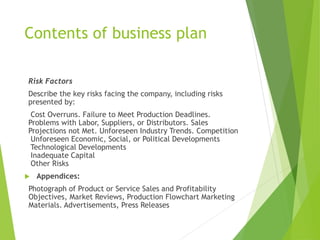
Risk Factors
Describe the key risks facing the company, including risks
presented by:
Cost Overruns. Failure to Meet Production Deadlines.
Problems with Labor, Suppliers, or Distributors. Sales
Projections not Met. Unforeseen Industry Trends. Competition
Unforeseen Economic, Social, or Political Developments
Technological Developments
Inadequate Capital
Other Risks
 Appendices:
Photograph of Product or Service Sales and Profitability
Objectives, Market Reviews, Production Flowchart Marketing
Materials. Advertisements, Press Releases
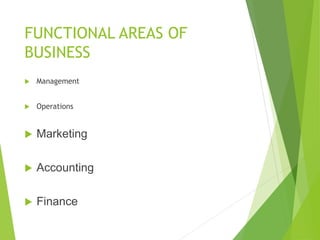
FUNCTIONAL AREAS OF
BUSINESS
 Management
 Operations
 Marketing
 Accounting
 Finance
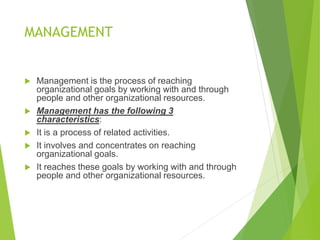
MANAGEMENT
 Management is the process of reaching
organizational goals by working with and through
people and other organizational resources.
 Management has the following 3
characteristics:
 It is a process of related activities.
 It involves and concentrates on reaching
organizational goals.
 It reaches these goals by working with and through
people and other organizational resources.
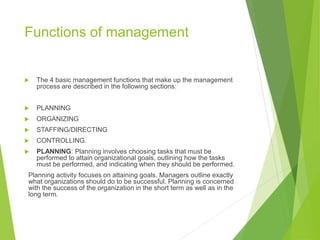
Functions of management
 The 4 basic management functions that make up the management
process are described in the following sections:
 PLANNING
 ORGANIZING
 STAFFING/DIRECTING
 CONTROLLING.
 PLANNING: Planning involves choosing tasks that must be
performed to attain organizational goals, outlining how the tasks
must be performed, and indicating when they should be performed.
Planning activity focuses on attaining goals. Managers outline exactly
what organizations should do to be successful. Planning is concerned
with the success of the organization in the short term as well as in the
long term.
STEPS IN PLANNING
1. Establishment of objectives
2. Identify resources
3. Plans actions to achieve those goals
4. Create assignments and timeline
5. Securing co operation of staff to achieve
those goals through plans
6. Follow ups of your plans
7. Alternate plans
Planning leads to Managerial success
 Managerial success depends on:
 Managerial efficiency_ use(or waste)
minimum resources
 Managerial effectiveness_ achieve goals
as fully as possible
Types of planning: strategic
planning
 Prepare mission statement_ can be one line,
should be very precise
 Core values_ ethical framework
 SWOT analysis of your company
 Set goals/ objectives/ performance targets
 Develop tactical plans and operational plans
 TACTICAL PLAN( long term plan):a long-range
strategic plan is divided into several tactical plans,
a five-year strategic plan, for instance, might be
implemented as five one-year tactical plans. E.g.
new product launch or product diversification
Types of planning
 OPERATIONAL PLAN(short term plan):
The tactical plan is then broken down into
various operational plans that provide
detailed action steps to be taken by
individuals or groups to implement the
tactical. Short term planning typically
covers time frame less than one year in
order to assist their company in moving
gradually towards its long term.
Types of planning
 CONTIGENCY PLAN: managers always
develop alternate plans to keep their activities/
business ongoing. Contingency planning can
be helpful in circumstances that call for a
change. Although managers should anticipate
changes when engaged in any of the primary
types of planning, contingency planning is
essential in moments when changes can’t be
foreseen. As the business world becomes
more complicated, contingency planning
becomes more important to engage in and
understand.
ADVANTAGES OF PLANNING
 Planning facilitates management by objectives
 Minimizes uncertainty
 Facilitates co ordination
 Improves employee’s moral
 Facilitates controlling
 Encourages innovation In the process of planning,
managers have the opportunities of suggesting ways and
means of improving performance.
 Planning is basically a decision making function which
involves creative thinking and imagination that ultimately
leads to innovation of methods and operations for growth
and prosperity of the enterprise.
LIMITATIONS OF PLANNING
 Uncertainty of future
 Costly process
 Time consuming process
 Lack of accuracy
 Difficulty in the selection of the best alternative
 Limited flexibility
 Psychological barriers

Business planning

  • 1.
    Business planning BUSINESS PLAN:The executive summary
  • 2.
    Defining business plan writtendocument describing the nature of the business, the sales and marketing strategy, and the financial background, and containing a projected profit and loss statement .
  • 3.
    What Are theComponents of a Business Plan?  The formal, traditional business plan has the following sections:  The industry overview  The market analysis  Competitive analysis  Marketing plan  Operating plan  Financial plan
  • 4.
    Purpose of businessplan  Clarify direction_ describe about your business, clarify about your product  Future vision_ describe your goals set, growing or slowing trends of market and innovations as your business grow  Attract financing_ give information to the investors about your business to attract them  Attract team member_ a tool to attract partners, suppliers and executive employees  Manage company_ conveys the organizational structure of your business, including titles of directors or officers and their individual duties.  To avail grant/ regulatory approval from government
  • 5.
    Contents of businessplan Cover Page The cover page should include the following: A. Company Name B. Logo and color scheme C. Contact Person D. Address and Phone Number E. Date and State of Incorporation
  • 6.
    Contents of businessplan Table of Contents and Table of Appendices _ refer the reader to the sections and subsections of the business plan. 1. Executive Summary_  describes the business,  identifies the stage of the company and its strategic direction,  describes the company's marketing plan  discusses the background of management,  states the company's revenue and profit expectations. 2. Body of a Business Plan The body of the business plan should include detailed discussions of the following subjects:  I. Background and Purpose: history of the company. Current Status of Company. The Product or Service Concept, Business Objectives
  • 7.
    Contents of businessplan  Market Analysis: Overall Industry or Market; Specific Market Segment; competition, Sales Forecasts  Product or Service Development: Research and Development. Production Requirements and Process Proprietary Features and Protections There of Quality Assurance Measures, alternate Plans  Marketing: Survey results. marketing strategy, Contingency Plans  . Financial Data: current financial position, Accounts Payable, Accounts Receivable, Cost Control Measures, Break-Even Analysis, Financial Ratios, Financial Projections
  • 8.
    Contents of businessplan  Organization Structure and Management: Key Personnel -- describe the qualifications and responsibilities of management. The quality of management is often the key factor in obtaining debt or equity funding. Other Personnel. Directors and Advisors, Professional Advisors, Key Future Personnel  Ownership: Business structure, Current Capitalization. Forecasted Capitalization -- how much money will be sought, the form of the proposed investment, how the funds will be used, and the percentage of ownership to be provided in exchange for the investment. Exit Strategy -- how and when investors will be able to get their money out of the business
  • 9.
    Contents of businessplan Risk Factors Describe the key risks facing the company, including risks presented by: Cost Overruns. Failure to Meet Production Deadlines. Problems with Labor, Suppliers, or Distributors. Sales Projections not Met. Unforeseen Industry Trends. Competition Unforeseen Economic, Social, or Political Developments Technological Developments Inadequate Capital Other Risks  Appendices: Photograph of Product or Service Sales and Profitability Objectives, Market Reviews, Production Flowchart Marketing Materials. Advertisements, Press Releases
  • 10.
    FUNCTIONAL AREAS OF BUSINESS Management  Operations  Marketing  Accounting  Finance
  • 11.
    MANAGEMENT  Management isthe process of reaching organizational goals by working with and through people and other organizational resources.  Management has the following 3 characteristics:  It is a process of related activities.  It involves and concentrates on reaching organizational goals.  It reaches these goals by working with and through people and other organizational resources.
  • 12.
    Functions of management The 4 basic management functions that make up the management process are described in the following sections:  PLANNING  ORGANIZING  STAFFING/DIRECTING  CONTROLLING.  PLANNING: Planning involves choosing tasks that must be performed to attain organizational goals, outlining how the tasks must be performed, and indicating when they should be performed. Planning activity focuses on attaining goals. Managers outline exactly what organizations should do to be successful. Planning is concerned with the success of the organization in the short term as well as in the long term.
  • 13.
    STEPS IN PLANNING 1.Establishment of objectives 2. Identify resources 3. Plans actions to achieve those goals 4. Create assignments and timeline 5. Securing co operation of staff to achieve those goals through plans 6. Follow ups of your plans 7. Alternate plans
  • 14.
    Planning leads toManagerial success  Managerial success depends on:  Managerial efficiency_ use(or waste) minimum resources  Managerial effectiveness_ achieve goals as fully as possible
  • 15.
    Types of planning:strategic planning  Prepare mission statement_ can be one line, should be very precise  Core values_ ethical framework  SWOT analysis of your company  Set goals/ objectives/ performance targets  Develop tactical plans and operational plans  TACTICAL PLAN( long term plan):a long-range strategic plan is divided into several tactical plans, a five-year strategic plan, for instance, might be implemented as five one-year tactical plans. E.g. new product launch or product diversification
  • 16.
    Types of planning OPERATIONAL PLAN(short term plan): The tactical plan is then broken down into various operational plans that provide detailed action steps to be taken by individuals or groups to implement the tactical. Short term planning typically covers time frame less than one year in order to assist their company in moving gradually towards its long term.
  • 17.
    Types of planning CONTIGENCY PLAN: managers always develop alternate plans to keep their activities/ business ongoing. Contingency planning can be helpful in circumstances that call for a change. Although managers should anticipate changes when engaged in any of the primary types of planning, contingency planning is essential in moments when changes can’t be foreseen. As the business world becomes more complicated, contingency planning becomes more important to engage in and understand.
  • 18.
    ADVANTAGES OF PLANNING Planning facilitates management by objectives  Minimizes uncertainty  Facilitates co ordination  Improves employee’s moral  Facilitates controlling  Encourages innovation In the process of planning, managers have the opportunities of suggesting ways and means of improving performance.  Planning is basically a decision making function which involves creative thinking and imagination that ultimately leads to innovation of methods and operations for growth and prosperity of the enterprise.
  • 19.
    LIMITATIONS OF PLANNING Uncertainty of future  Costly process  Time consuming process  Lack of accuracy  Difficulty in the selection of the best alternative  Limited flexibility  Psychological barriers