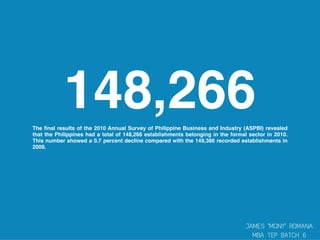
148,266The final results of the 2010 Annual Survey of Philippine Business and Industry (ASPBI) revealed
that the Philippines had a total of 148,266 establishments belonging in the formal sector in 2010.
This number showed a 0.7 percent decline compared with the 149,386 recorded establishments in
2009.
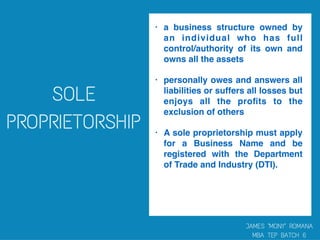
• a business structure owned by
an individual who has full
control/authority of its own and
owns all the assets
• personally owes and answers all
liabilities or suffers all losses but
enjoys all the profits to the
exclusion of others
• A sole proprietorship must apply
for a Business Name and be
registered with the Department
of Trade and Industry (DTI).
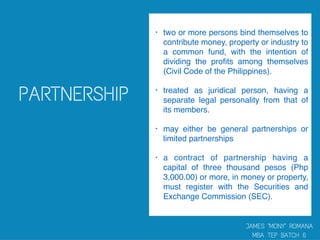
• two or more persons bind themselves to
contribute money, property or industry to
a common fund, with the intention of
dividing the profits among themselves
(Civil Code of the Philippines).
• treated as juridical person, having a
separate legal personality from that of
its members.
• may either be general partnerships or
limited partnerships
• a contract of partnership having a
capital of three thousand pesos (Php
3,000.00) or more, in money or property,
must register with the Securities and
Exchange Commission (SEC).
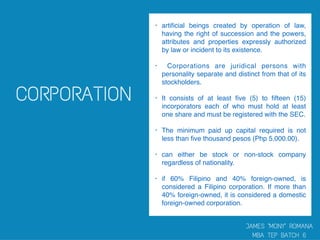
• artificial beings created by operation of law,
having the right of succession and the powers,
attributes and properties expressly authorized
by law or incident to its existence.
• Corporations are juridical persons with
personality separate and distinct from that of its
stockholders.
• It consists of at least five (5) to fifteen (15)
incorporators each of who must hold at least
one share and must be registered with the SEC.
• The minimum paid up capital required is not
less than five thousand pesos (Php 5,000.00).
• can either be stock or non-stock company
regardless of nationality.
• if 60% Filipino and 40% foreign-owned, is
considered a Filipino corporation. If more than
40% foreign-owned, it is considered a domestic
foreign-owned corporation.
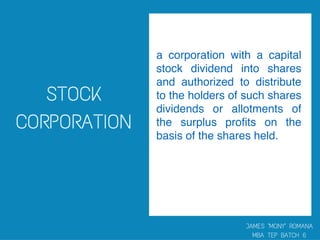
a corporation with a capital
stock dividend into shares
and authorized to distribute
to the holders of such shares
dividends or allotments of
the surplus profits on the
basis of the shares held.
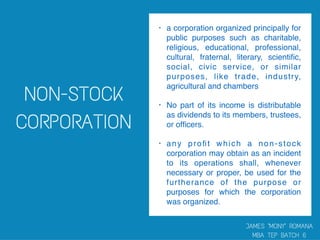
• a corporation organized principally for
public purposes such as charitable,
religious, educational, professional,
cultural, fraternal, literary, scientific,
social, civic service, or similar
purposes, like trade, industry,
agricultural and chambers
• No part of its income is distributable
as dividends to its members, trustees,
or officers.
• any profit which a non-stock
corporation may obtain as an incident
to its operations shall, whenever
necessary or proper, be used for the
furtherance of the purpose or
purposes for which the corporation
was organized.
ORGANIZED UNDER
FOREIGN LAWS
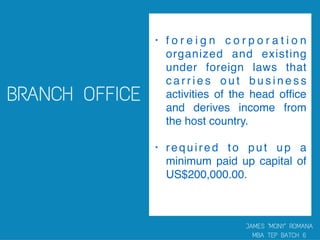
• f o r e i g n c o r p o r a t i o n
organized and existing
under foreign laws that
c a r r i e s o u t b u s i n e s s
activities of the head office
and derives income from
the host country.
• required to put up a
minimum paid up capital of
US$200,000.00. 

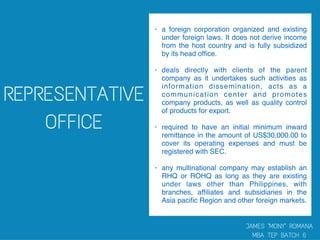
• a foreign corporation organized and existing
under foreign laws. It does not derive income
from the host country and is fully subsidized
by its head office.
• deals directly with clients of the parent
company as it undertakes such activities as
information dissemination, acts as a
communication center and promotes
company products, as well as quality control
of products for export.
• required to have an initial minimum inward
remittance in the amount of US$30,000.00 to
cover its operating expenses and must be
registered with SEC.
• any multinational company may establish an
RHQ or ROHQ as long as they are existing
under laws other than Philippines, with
branches, affiliates and subsidiaries in the
Asia pacific Region and other foreign markets.
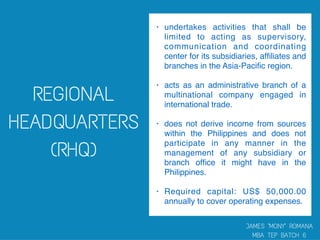
• undertakes activities that shall be
limited to acting as supervisory,
communication and coordinating
center for its subsidiaries, affiliates and
branches in the Asia-Pacific region.
• acts as an administrative branch of a
multinational company engaged in
international trade.
• does not derive income from sources
within the Philippines and does not
participate in any manner in the
management of any subsidiary or
branch office it might have in the
Philippines.
• Required capital: US$ 50,000.00
annually to cover operating expenses.
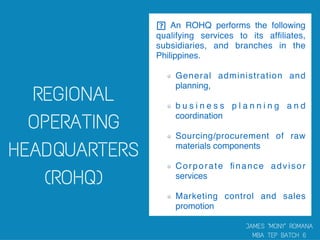
! An ROHQ performs the following
qualifying services to its affiliates,
subsidiaries, and branches in the
Philippines.
General administration and
planning,
b u s i n e s s p l a n n i n g a n d
coordination
Sourcing/procurement of raw
materials components
Corporate finance advisor
services
Marketing control and sales
promotion
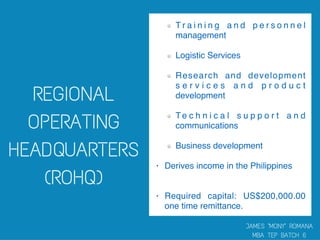
T r a i n i n g a n d p e r s o n n e l
management
Logistic Services
Research and development
s e r v i c e s a n d p r o d u c t
development
Te c h n i c a l s u p p o r t a n d
communications
Business development
• Derives income in the Philippines

• Required capital: US$200,000.00
one time remittance.

BUSINESS ORGANIZATIONS PHILIPPINES

  • 2.
    148,266The final resultsof the 2010 Annual Survey of Philippine Business and Industry (ASPBI) revealed that the Philippines had a total of 148,266 establishments belonging in the formal sector in 2010. This number showed a 0.7 percent decline compared with the 149,386 recorded establishments in 2009.
  • 3.
    • a businessstructure owned by an individual who has full control/authority of its own and owns all the assets • personally owes and answers all liabilities or suffers all losses but enjoys all the profits to the exclusion of others • A sole proprietorship must apply for a Business Name and be registered with the Department of Trade and Industry (DTI).
  • 4.
    • two ormore persons bind themselves to contribute money, property or industry to a common fund, with the intention of dividing the profits among themselves (Civil Code of the Philippines). • treated as juridical person, having a separate legal personality from that of its members. • may either be general partnerships or limited partnerships • a contract of partnership having a capital of three thousand pesos (Php 3,000.00) or more, in money or property, must register with the Securities and Exchange Commission (SEC).
  • 5.
    • artificial beingscreated by operation of law, having the right of succession and the powers, attributes and properties expressly authorized by law or incident to its existence. • Corporations are juridical persons with personality separate and distinct from that of its stockholders. • It consists of at least five (5) to fifteen (15) incorporators each of who must hold at least one share and must be registered with the SEC. • The minimum paid up capital required is not less than five thousand pesos (Php 5,000.00). • can either be stock or non-stock company regardless of nationality. • if 60% Filipino and 40% foreign-owned, is considered a Filipino corporation. If more than 40% foreign-owned, it is considered a domestic foreign-owned corporation.
  • 6.
    a corporation witha capital stock dividend into shares and authorized to distribute to the holders of such shares dividends or allotments of the surplus profits on the basis of the shares held.
  • 7.
    • a corporationorganized principally for public purposes such as charitable, religious, educational, professional, cultural, fraternal, literary, scientific, social, civic service, or similar purposes, like trade, industry, agricultural and chambers • No part of its income is distributable as dividends to its members, trustees, or officers. • any profit which a non-stock corporation may obtain as an incident to its operations shall, whenever necessary or proper, be used for the furtherance of the purpose or purposes for which the corporation was organized.
  • 8.
  • 9.
    • f or e i g n c o r p o r a t i o n organized and existing under foreign laws that c a r r i e s o u t b u s i n e s s activities of the head office and derives income from the host country. • required to put up a minimum paid up capital of US$200,000.00. 

  • 10.
    • a foreigncorporation organized and existing under foreign laws. It does not derive income from the host country and is fully subsidized by its head office. • deals directly with clients of the parent company as it undertakes such activities as information dissemination, acts as a communication center and promotes company products, as well as quality control of products for export. • required to have an initial minimum inward remittance in the amount of US$30,000.00 to cover its operating expenses and must be registered with SEC. • any multinational company may establish an RHQ or ROHQ as long as they are existing under laws other than Philippines, with branches, affiliates and subsidiaries in the Asia pacific Region and other foreign markets.
  • 11.
    • undertakes activitiesthat shall be limited to acting as supervisory, communication and coordinating center for its subsidiaries, affiliates and branches in the Asia-Pacific region. • acts as an administrative branch of a multinational company engaged in international trade. • does not derive income from sources within the Philippines and does not participate in any manner in the management of any subsidiary or branch office it might have in the Philippines. • Required capital: US$ 50,000.00 annually to cover operating expenses.
  • 12.
    ! An ROHQperforms the following qualifying services to its affiliates, subsidiaries, and branches in the Philippines. General administration and planning, b u s i n e s s p l a n n i n g a n d coordination Sourcing/procurement of raw materials components Corporate finance advisor services Marketing control and sales promotion
  • 13.
    T r ai n i n g a n d p e r s o n n e l management Logistic Services Research and development s e r v i c e s a n d p r o d u c t development Te c h n i c a l s u p p o r t a n d communications Business development • Derives income in the Philippines
 • Required capital: US$200,000.00 one time remittance.