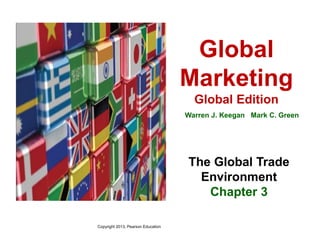
Global
Marketing
Global Edition
Warren J. Keegan Mark C. Green
The Global Trade
Environment
Chapter 3
Copyright 2013, Pearson Education
Copyright 2013, Pearson Education3-2
GATT
• General Agreement on Tariffs and Trade
– Treaty among nations to promote trade among
members established in 1947
• Handled trade disputes
• Lacked enforcement power
• Replaced by World Trade Organization in 1995
Copyright 2013, Pearson Education3-3
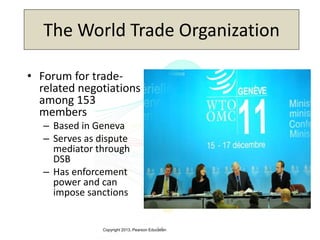
The World Trade Organization
• Forum for trade-
related negotiations
among 153
members
– Based in Geneva
– Serves as dispute
mediator through
DSB
– Has enforcement
power and can
impose sanctions
Copyright 2013, Pearson Education3-4
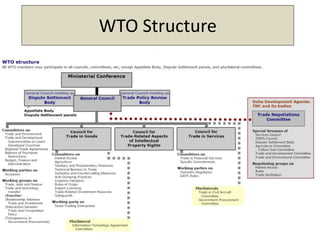
WTO Structure
Copyright 2013, Pearson Education3-5
• Many countries seek to lower barriers to trade
within their regions
• PTAs give partners special treatment and may
discriminate against others
• Over 300 PTAs have been notified to the WTO
Preferential Trade Agreements
Copyright 2013, Pearson Education
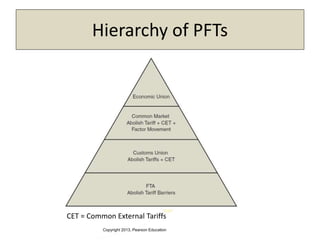
Hierarchy of PFTs
CET = Common External Tariffs
Copyright 2013, Pearson Education3-7
Free Trade Area
• Two or more countries agree to
abolish tariffs and other barriers to
trade amongst themselves
• Countries continue independent
trade policies with countries outside
agreement
• Rules of origin requirements restrict
transshipment of goods from the
country with the lowest tariff to
another
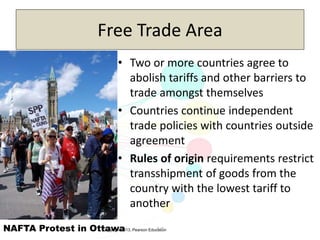
NAFTA Protest in Ottawa
Copyright 2013, Pearson Education3-8
North America—NAFTA
• Canada, United States, Mexico
• NAFTA established a free trade area in 1994
–All three nations pledge to
promote economic growth
through tariff reductions and
expanded trade and
investment
–No common external tariffs
–Restrictions on labor and
other movements remain
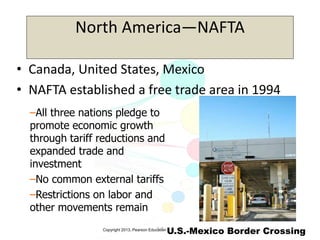
U.S.-Mexico Border Crossing
Copyright 2013, Pearson Education3-9
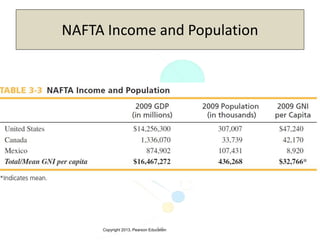
NAFTA Income and Population
Copyright 2013, Pearson Education3-10
Customs Union
• Evolution of Free Trade Area
• Includes the elimination of internal barriers to
trade (as in FTA)
• AND establishes common external barriers to
trade
• Examples: The EU and Turkey, the Andean
Community, Mercosur, CARICOM, Central
American Integration System (SICA)
Copyright 2013, Pearson Education3-11
Common Market
• Includes the elimination of internal barriers
to trade (as in free trade area)
• AND establishes common external barriers
to trade (as in customs union)
• AND allows for the free movement of
factors of production, such as labor, capital,
and information
Copyright 2013, Pearson Education3-12
Economic Union
• Includes the elimination of internal barriers to trade
(as in free trade area)
• AND establishes common external barriers to trade
(as in customs union)
• AND allows for the free movement of factors of
production, such as labor, capital, and information
(as in common market)
• AND coordinates and harmonizes economic and
social policy within the union
Copyright 2013, Pearson Education3-13
Economic Union
• Full evolution of economic union
– creation of unified central bank
– use of single currency
– common policies on issues such as agriculture,
social policy, transport, competition, mergers,
taxation
– requires extensive political unity
– would lead to a central government in time
European
Union Flag
Copyright 2013, Pearson Education3-14
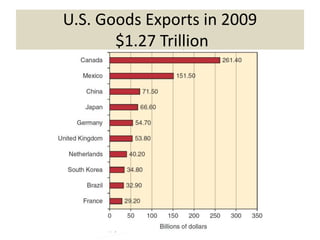
U.S. Goods Exports in 2009
$1.27 Trillion
Copyright 2013, Pearson Education3-15
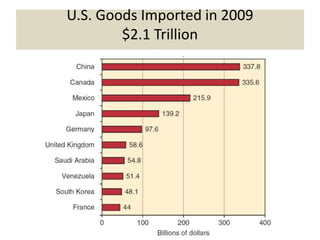
U.S. Goods Imported in 2009
$2.1 Trillion
Copyright 2013, Pearson Education3-16
Latin America: SICA, Andean Community,
Mercosur, CARICOM
• Includes the Caribbean, Central, and South
America
• History of no growth, inflation, debt, and
protectionism has given way to free markets,
open economies, and deregulation
• Some concern for further growth with the rise
of left-leaning politicians
Copyright 2013, Pearson Education 3-17
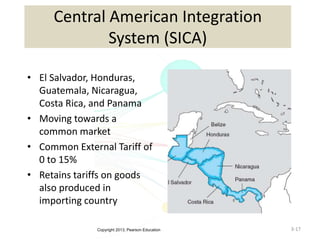
Central American Integration
System (SICA)
• El Salvador, Honduras,
Guatemala, Nicaragua,
Costa Rica, and Panama
• Moving towards a
common market
• Common External Tariff of
0 to 15%
• Retains tariffs on goods
also produced in
importing country
Copyright 2013, Pearson Education 3-18
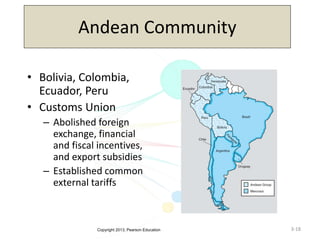
Andean Community
• Bolivia, Colombia,
Ecuador, Peru
• Customs Union
– Abolished foreign
exchange, financial
and fiscal incentives,
and export subsidies
– Established common
external tariffs
Copyright 2013, Pearson Education3-19
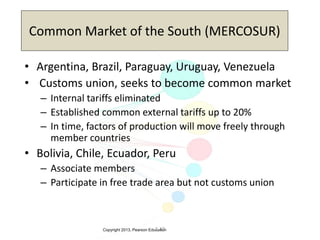
Common Market of the South (MERCOSUR)
• Argentina, Brazil, Paraguay, Uruguay, Venezuela
• Customs union, seeks to become common market
– Internal tariffs eliminated
– Established common external tariffs up to 20%
– In time, factors of production will move freely through
member countries
• Bolivia, Chile, Ecuador, Peru
– Associate members
– Participate in free trade area but not customs union
Copyright 2013, Pearson Education3-20
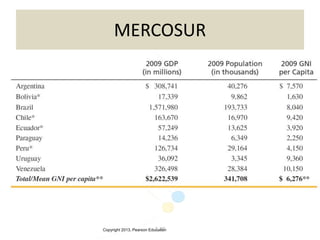
MERCOSUR
Copyright 2013, Pearson Education3-21
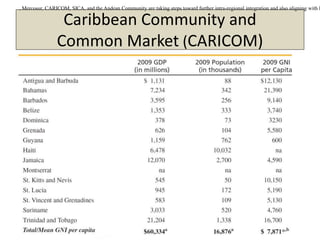
Caribbean Community and
Common Market (CARICOM)
, Mercosur, CARICOM, SICA, and the Andean Community are taking steps toward further intra-regional integration and also aligning with E
Copyright 2013, Pearson Education3-22
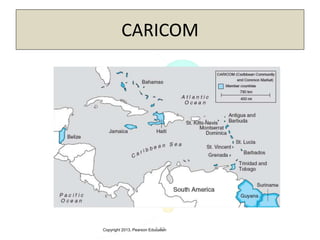
CARICOM
Copyright 2013, Pearson Education3-23
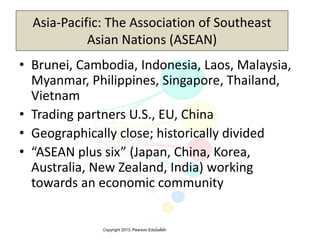
Asia-Pacific: The Association of Southeast
Asian Nations (ASEAN)
• Brunei, Cambodia, Indonesia, Laos, Malaysia,
Myanmar, Philippines, Singapore, Thailand,
Vietnam
• Trading partners U.S., EU, China
• Geographically close; historically divided
• “ASEAN plus six” (Japan, China, Korea,
Australia, New Zealand, India) working
towards an economic community
Copyright 2013, Pearson Education3-24
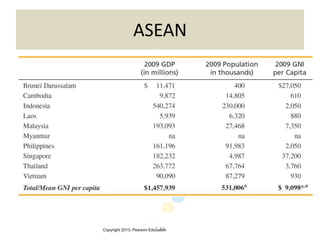
ASEAN
Copyright 2013, Pearson Education3-25
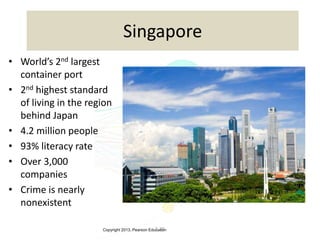
Singapore
• World’s 2nd largest
container port
• 2nd highest standard
of living in the region
behind Japan
• 4.2 million people
• 93% literacy rate
• Over 3,000
companies
• Crime is nearly
nonexistent
Copyright 2013, Pearson Education3-26
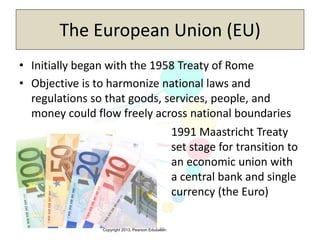
The European Union (EU)
• Initially began with the 1958 Treaty of Rome
• Objective is to harmonize national laws and
regulations so that goods, services, people, and
money could flow freely across national boundaries
1991 Maastricht Treaty
set stage for transition to
an economic union with
a central bank and single
currency (the Euro)
Copyright 2013, Pearson Education3-27
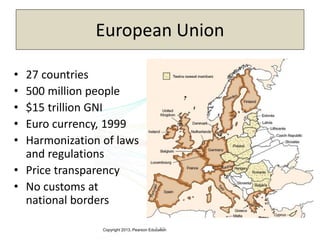
European Union
• 27 countries
• 500 million people
• $15 trillion GNI
• Euro currency, 1999
• Harmonization of laws
and regulations
• Price transparency
• No customs at
national borders
Copyright 2013, Pearson Education3-28
The Middle East
• Afghanistan, Bahrain, Cyprus, Egypt, Iran, Iraq, Israel,
Jordan, Kuwait, Lebanon, Oman, Qatar, Saudi Arabia,
Syria, the United Arab Emirates, Yemen
– Primarily Arab, some Persian and Jews
– 95% Muslim, 5% Christian and Jewish
– Oil prices drive commerce
– 25% of world’s oil in Saudi Arabia
– Arab Spring 2011
Copyright 2013, Pearson Education3-29
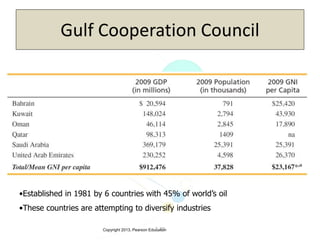
Gulf Cooperation Council
•Established in 1981 by 6 countries with 45% of world’s oil
•These countries are attempting to diversify industries
Copyright 2013, Pearson Education3-30
Africa
• 54 nations over three distinct areas
– Republic of South Africa
– North Africa
– Black Africa or sub-Saharan Africa
• Mena: Middle East and North Africa
– Viewed as a regional entity
• Regional agreements
– Economic Community of West African States
– East African Cooperation
– South African Development Community
Copyright 2013, Pearson Education3-31
Looking Ahead to Chapter 4
• Social and Cultural Environments

Ch3

  • 1.
    Global Marketing Global Edition Warren J.Keegan Mark C. Green The Global Trade Environment Chapter 3 Copyright 2013, Pearson Education
  • 2.
    Copyright 2013, PearsonEducation3-2 GATT • General Agreement on Tariffs and Trade – Treaty among nations to promote trade among members established in 1947 • Handled trade disputes • Lacked enforcement power • Replaced by World Trade Organization in 1995
  • 3.
    Copyright 2013, PearsonEducation3-3 The World Trade Organization • Forum for trade- related negotiations among 153 members – Based in Geneva – Serves as dispute mediator through DSB – Has enforcement power and can impose sanctions
  • 4.
    Copyright 2013, PearsonEducation3-4 WTO Structure
  • 5.
    Copyright 2013, PearsonEducation3-5 • Many countries seek to lower barriers to trade within their regions • PTAs give partners special treatment and may discriminate against others • Over 300 PTAs have been notified to the WTO Preferential Trade Agreements
  • 6.
    Copyright 2013, PearsonEducation Hierarchy of PFTs CET = Common External Tariffs
  • 7.
    Copyright 2013, PearsonEducation3-7 Free Trade Area • Two or more countries agree to abolish tariffs and other barriers to trade amongst themselves • Countries continue independent trade policies with countries outside agreement • Rules of origin requirements restrict transshipment of goods from the country with the lowest tariff to another NAFTA Protest in Ottawa
  • 8.
    Copyright 2013, PearsonEducation3-8 North America—NAFTA • Canada, United States, Mexico • NAFTA established a free trade area in 1994 –All three nations pledge to promote economic growth through tariff reductions and expanded trade and investment –No common external tariffs –Restrictions on labor and other movements remain U.S.-Mexico Border Crossing
  • 9.
    Copyright 2013, PearsonEducation3-9 NAFTA Income and Population
  • 10.
    Copyright 2013, PearsonEducation3-10 Customs Union • Evolution of Free Trade Area • Includes the elimination of internal barriers to trade (as in FTA) • AND establishes common external barriers to trade • Examples: The EU and Turkey, the Andean Community, Mercosur, CARICOM, Central American Integration System (SICA)
  • 11.
    Copyright 2013, PearsonEducation3-11 Common Market • Includes the elimination of internal barriers to trade (as in free trade area) • AND establishes common external barriers to trade (as in customs union) • AND allows for the free movement of factors of production, such as labor, capital, and information
  • 12.
    Copyright 2013, PearsonEducation3-12 Economic Union • Includes the elimination of internal barriers to trade (as in free trade area) • AND establishes common external barriers to trade (as in customs union) • AND allows for the free movement of factors of production, such as labor, capital, and information (as in common market) • AND coordinates and harmonizes economic and social policy within the union
  • 13.
    Copyright 2013, PearsonEducation3-13 Economic Union • Full evolution of economic union – creation of unified central bank – use of single currency – common policies on issues such as agriculture, social policy, transport, competition, mergers, taxation – requires extensive political unity – would lead to a central government in time European Union Flag
  • 14.
    Copyright 2013, PearsonEducation3-14 U.S. Goods Exports in 2009 $1.27 Trillion
  • 15.
    Copyright 2013, PearsonEducation3-15 U.S. Goods Imported in 2009 $2.1 Trillion
  • 16.
    Copyright 2013, PearsonEducation3-16 Latin America: SICA, Andean Community, Mercosur, CARICOM • Includes the Caribbean, Central, and South America • History of no growth, inflation, debt, and protectionism has given way to free markets, open economies, and deregulation • Some concern for further growth with the rise of left-leaning politicians
  • 17.
    Copyright 2013, PearsonEducation 3-17 Central American Integration System (SICA) • El Salvador, Honduras, Guatemala, Nicaragua, Costa Rica, and Panama • Moving towards a common market • Common External Tariff of 0 to 15% • Retains tariffs on goods also produced in importing country
  • 18.
    Copyright 2013, PearsonEducation 3-18 Andean Community • Bolivia, Colombia, Ecuador, Peru • Customs Union – Abolished foreign exchange, financial and fiscal incentives, and export subsidies – Established common external tariffs
  • 19.
    Copyright 2013, PearsonEducation3-19 Common Market of the South (MERCOSUR) • Argentina, Brazil, Paraguay, Uruguay, Venezuela • Customs union, seeks to become common market – Internal tariffs eliminated – Established common external tariffs up to 20% – In time, factors of production will move freely through member countries • Bolivia, Chile, Ecuador, Peru – Associate members – Participate in free trade area but not customs union
  • 20.
    Copyright 2013, PearsonEducation3-20 MERCOSUR
  • 21.
    Copyright 2013, PearsonEducation3-21 Caribbean Community and Common Market (CARICOM) , Mercosur, CARICOM, SICA, and the Andean Community are taking steps toward further intra-regional integration and also aligning with E
  • 22.
    Copyright 2013, PearsonEducation3-22 CARICOM
  • 23.
    Copyright 2013, PearsonEducation3-23 Asia-Pacific: The Association of Southeast Asian Nations (ASEAN) • Brunei, Cambodia, Indonesia, Laos, Malaysia, Myanmar, Philippines, Singapore, Thailand, Vietnam • Trading partners U.S., EU, China • Geographically close; historically divided • “ASEAN plus six” (Japan, China, Korea, Australia, New Zealand, India) working towards an economic community
  • 24.
    Copyright 2013, PearsonEducation3-24 ASEAN
  • 25.
    Copyright 2013, PearsonEducation3-25 Singapore • World’s 2nd largest container port • 2nd highest standard of living in the region behind Japan • 4.2 million people • 93% literacy rate • Over 3,000 companies • Crime is nearly nonexistent
  • 26.
    Copyright 2013, PearsonEducation3-26 The European Union (EU) • Initially began with the 1958 Treaty of Rome • Objective is to harmonize national laws and regulations so that goods, services, people, and money could flow freely across national boundaries 1991 Maastricht Treaty set stage for transition to an economic union with a central bank and single currency (the Euro)
  • 27.
    Copyright 2013, PearsonEducation3-27 European Union • 27 countries • 500 million people • $15 trillion GNI • Euro currency, 1999 • Harmonization of laws and regulations • Price transparency • No customs at national borders
  • 28.
    Copyright 2013, PearsonEducation3-28 The Middle East • Afghanistan, Bahrain, Cyprus, Egypt, Iran, Iraq, Israel, Jordan, Kuwait, Lebanon, Oman, Qatar, Saudi Arabia, Syria, the United Arab Emirates, Yemen – Primarily Arab, some Persian and Jews – 95% Muslim, 5% Christian and Jewish – Oil prices drive commerce – 25% of world’s oil in Saudi Arabia – Arab Spring 2011
  • 29.
    Copyright 2013, PearsonEducation3-29 Gulf Cooperation Council •Established in 1981 by 6 countries with 45% of world’s oil •These countries are attempting to diversify industries
  • 30.
    Copyright 2013, PearsonEducation3-30 Africa • 54 nations over three distinct areas – Republic of South Africa – North Africa – Black Africa or sub-Saharan Africa • Mena: Middle East and North Africa – Viewed as a regional entity • Regional agreements – Economic Community of West African States – East African Cooperation – South African Development Community
  • 31.
    Copyright 2013, PearsonEducation3-31 Looking Ahead to Chapter 4 • Social and Cultural Environments