Business Opportunities in
Fintech and Blockchain
BY
Dr. Saeed Al Dhaheri
Chairman,
@DDSaeed
De-centralizing the world
Removing Intermediaries
Increasing transparency
Real-time transaction processing
Smart contracts
Increased security
Reducing transaction cost
Distributed ledger technology Peer-to-peer trusted network
Etisalat Academy Blockchain Seminar, March 23, 2017
Business Opportunities in Fintech and Blockchain
Agenda
Fintech and Blockchain: review & Definitions
Benefits
Market size
applications
Types of blockchain
Ethereum vs. Hyperledger
Major world initiatives
UAE Initiatives
Business opportunities
Challenges
The Current Reality
• “The Global financial industry, network and ecosystem are in urgent need of
an overhaul of infrastructure and architecture. It is very difficult to facilitate
payments efficiently through bank systems and regulated financial networks”.
we need think of new technologies that can address current challenges and bring added values
What is fintech?
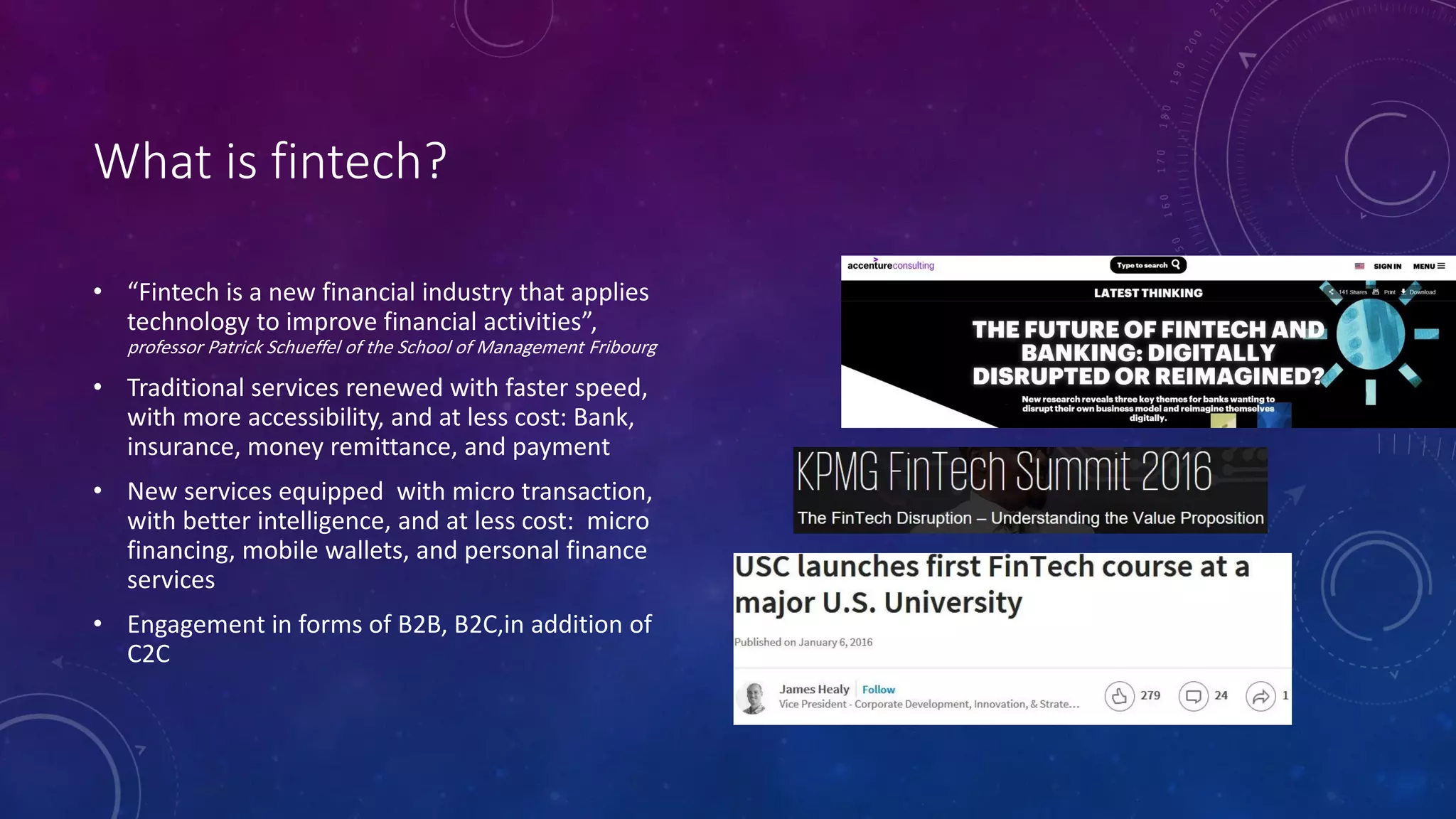
• “Fintech is a new financial industry that applies
technology to improve financial activities”,
professor Patrick Schueffel of the School of Management Fribourg
• Traditional services renewed with faster speed,
with more accessibility, and at less cost: Bank,
insurance, money remittance, and payment
• New services equipped with micro transaction,
with better intelligence, and at less cost: micro
financing, mobile wallets, and personal finance
services
• Engagement in forms of B2B, B2C,in addition of
C2C
What is Blockchain
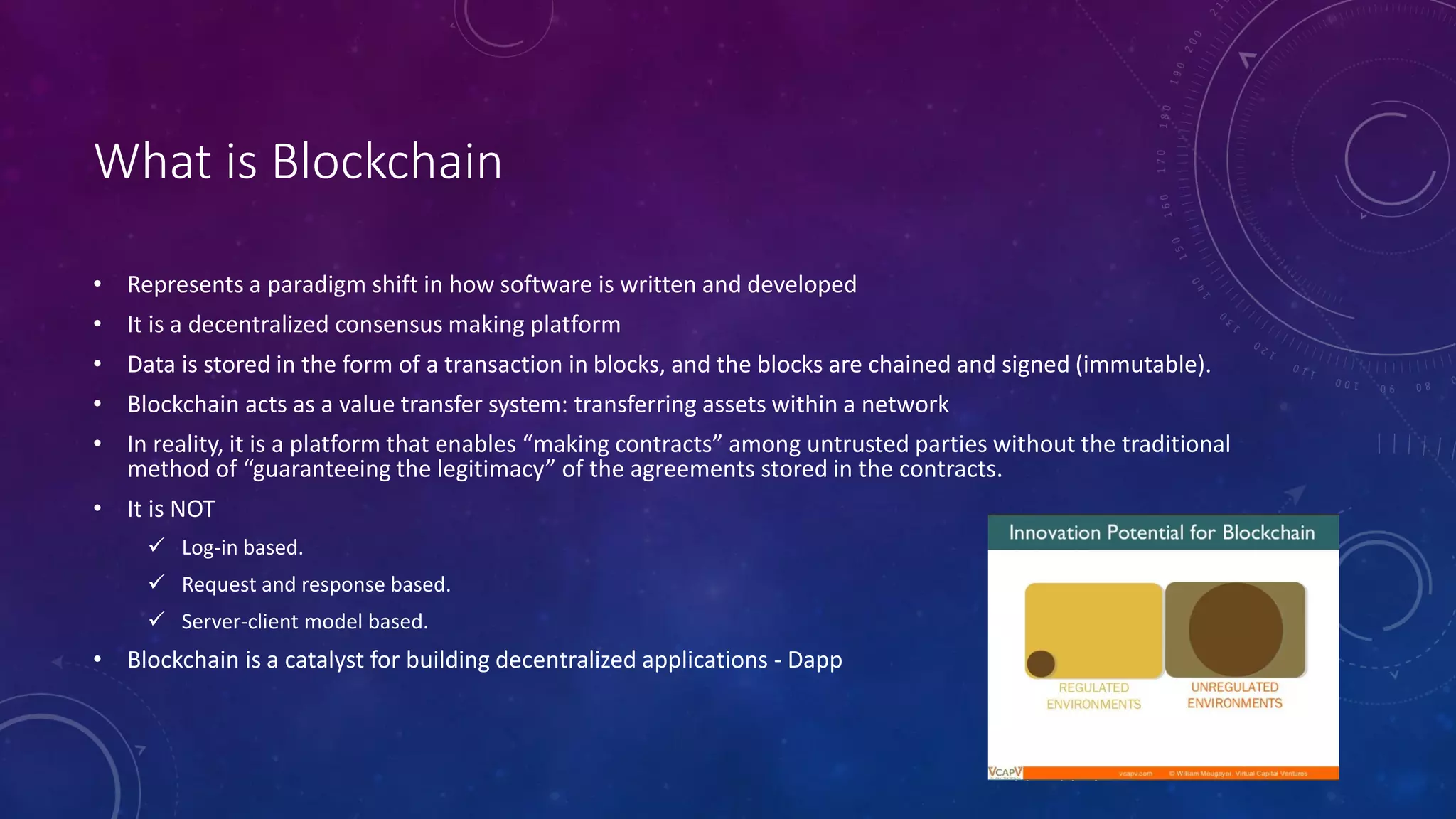
• Represents a paradigm shift in how software is written and developed
• It is a decentralized consensus making platform
• Data is stored in the form of a transaction in blocks, and the blocks are chained and signed (immutable).
• Blockchain acts as a value transfer system: transferring assets within a network
• In reality, it is a platform that enables “making contracts” among untrusted parties without the traditional
method of “guaranteeing the legitimacy” of the agreements stored in the contracts.
• It is NOT
 Log-in based.
 Request and response based.
 Server-client model based.
• Blockchain is a catalyst for building decentralized applications - Dapp
What is Blockchain
Internet of Information
TCP/IP = Communication Protocol
Revolutionized the way we exchange information
Aka information data highway
1st use case: email
Internet of value
Blockchain = value exchange protocol
Can transform business, economy & politics with smart contracts as a bases for peer-to-peer transactions
1st use case: Bitcoin
Why does this matter?
• Financial transaction requires trust to
be settled.
• The trust is usually provided by
trustworthy bodies such as
governments, central banks, or highly
reputable organizations.
• One of fundamental goals of blockchain
is to bypass the trust providers, a.k.a
intermediaries.
• Trust by technology is the new
hegemony.
• Trust by technology enables more
frequent, cheaper, and micro
transactions.
• More importantly, the new technology
can automate settlement of financial
transactions.
• Blockchain fits perfectly as the
trustworthy technology for the
purpose.
Smart Contracts
• is equivalent to a little program that you can entrust with a unit of value (as a token or money), and
rules around that value
• Assuming third-party intermediaries not needed for transaction between two or more parties
• Smart properties: digital assets (or things) that know who their owners are, and linked to the
blockchain.
• Smart contracts are the building blocks for Dapps
• Smart contracts can save the banking industry billions of dollors spent on executing contracts
Benefit of Blockchain
• Real-time processing
• Reduced transaction costs
• Increased security
• Transparency and auditability
• Fairness advantage
• Everywhere is the same
• The record is permanent
• Nobody is in charge
Blockchain: market size, vendors, and startups
IBM blockchain on Bluemix Ethereum blockchain as a service by MS Azure Rubix by Deloitte
• Market size to grow from $210 Million in 2016 to $2,3 Billion by 2021,
at a (CAGR) of 61.5% during the forecast period. Markets & Markets
• Top 3 companies leading blockchain as a service
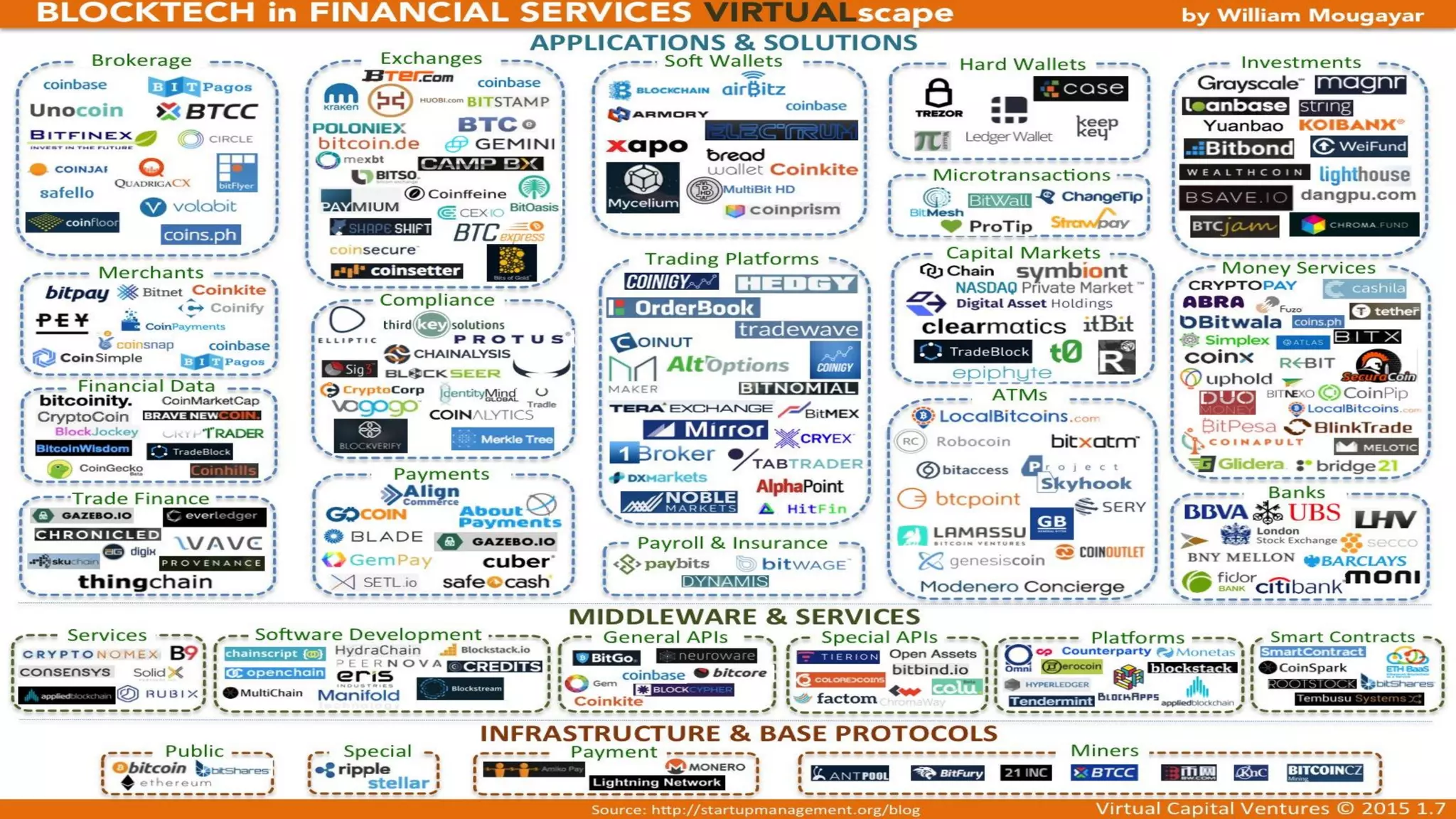
Blockchain applications: Four emerging segments
Other non-financial applications:
• Real estate and land registration (asset registry)
• Precious metals trading (asset registry)
• Secure record management (e.g, healthcare)
• Digital content (arts, music, video,,)
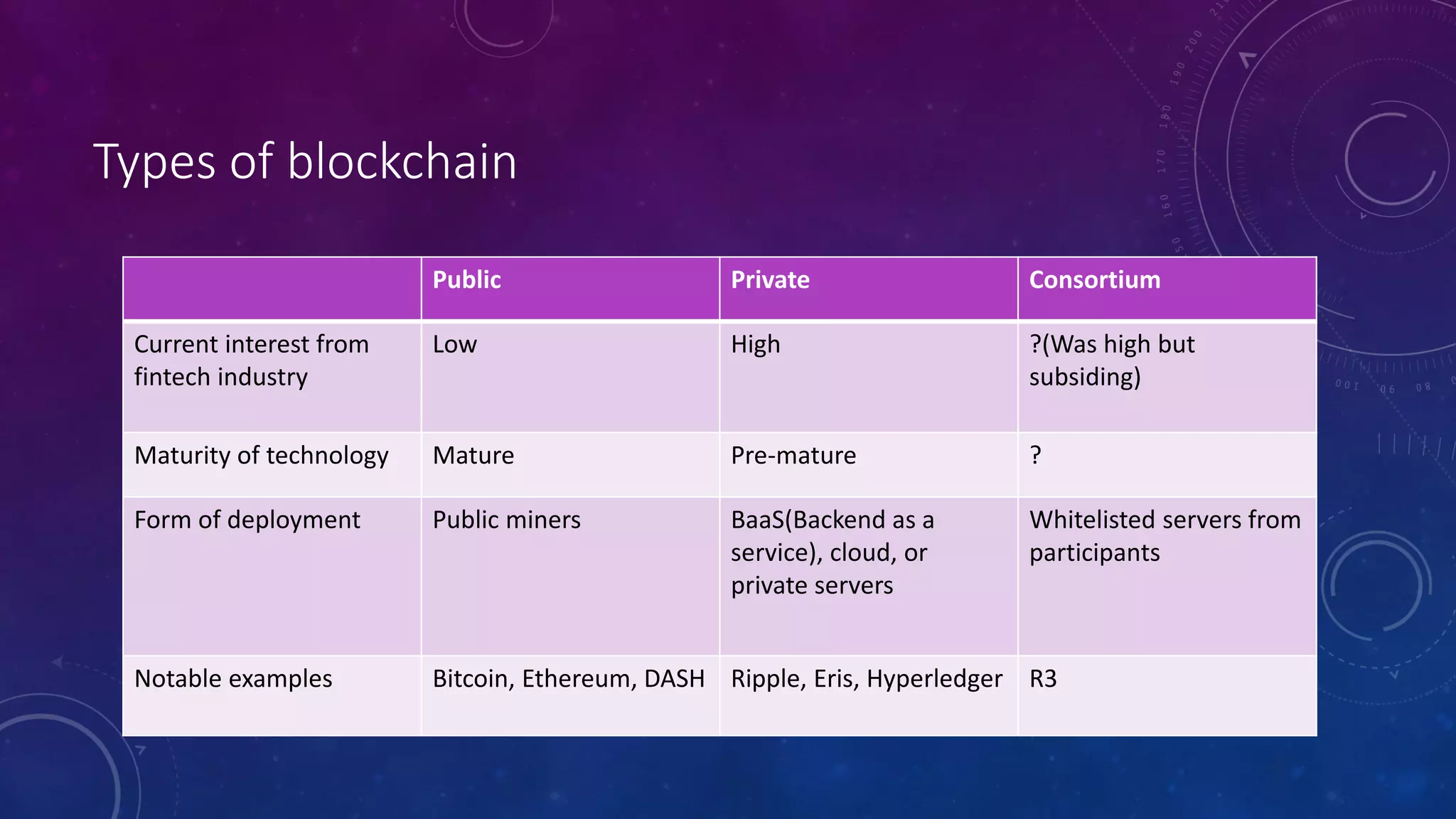
Types of blockchain
Public Private Consortium
Current interest from
fintech industry
Low High ?(Was high but
subsiding)
Maturity of technology Mature Pre-mature ?
Form of deployment Public miners BaaS(Backend as a
service), cloud, or
private servers
Whitelisted servers from
participants
Notable examples Bitcoin, Ethereum, DASH Ripple, Eris, Hyperledger R3
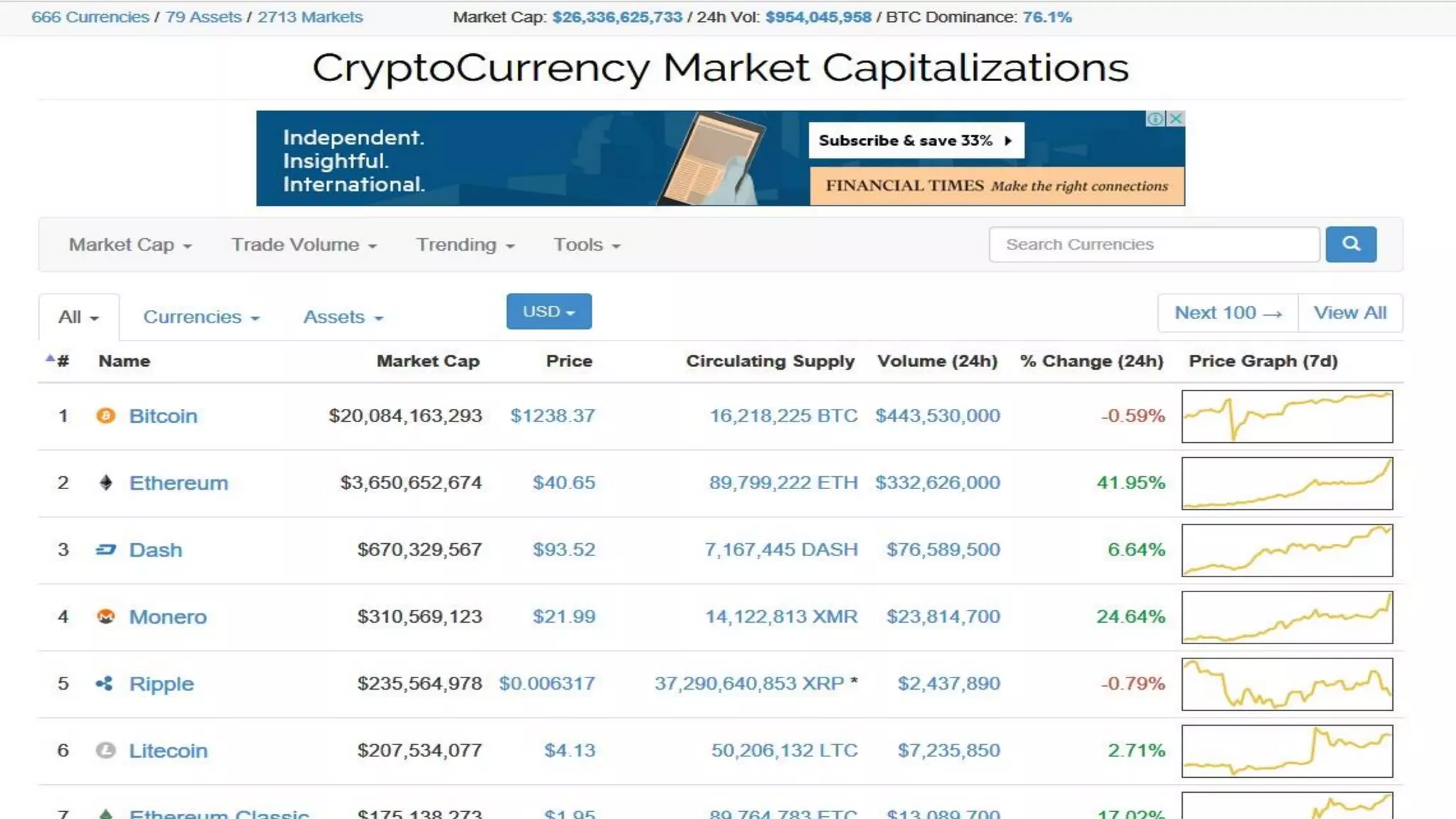
Ethereum VS. Hyper ledger
• Public
• Provide decentralized VMs
• Token: ether
• Adoption: MS partnership with Consensys
• Applications: digital signature, secure identity
systems, digital rights management for music
• Can be Permissioned ledgers: examples: RBS and JP
Morgan
• Private (permissioned blockchain)
• Cross-industry collaborative effort
• Develop open protocols and standards for
supporting blockchain
• No miners or coins
• a variety of blockchains (hyperledgers) with their
own consensus and storage models, and services.
• Members: blockchain and tech. companies and
financial institutions
• Industries: finance and healthcare
Ethereum
Major world initiatives
• Blockchain Insurance Industry Initiative B3i: Members are collaborating to explore the ability of
blockchain to increase efficiencies in the exchange of data between reinsurance and insurance
companies.
• Illinois Blockchain Initiative: a consortium of five government agencies and companies, aimed at
removing barriers for the government to build with blockchain.
• Dubai Blockchain Initiative: Aims for Dubai to become the first blockchain-powered city by 2020
• Other countries initiatives: UK, Japan, China, Singapore, Hong-kong, Estonia,,,etc
UAE Initiatives supporting blockchain
• The Blockchain Virtual GovHack
• is challenging participants to innovate their
public sectors by using blockchain technology
to tackle one of the challenges:
• Re-inventing global identity
• Reducing paper footprint
• Fighting fraud and crime
• Future of health
• Building smart cities
www.GovTechioneersRace.com
Dubai Blockchain Strategy
• Aims for Dubai to become the first blockchain-powered city by 2020
• For Dubai government to become paperless by shifting all transactions to Blockchain,
and empower Dubai Smart city experience for all
• Based on Three pillars:
 Government Efficiency: implementing blockchain technology in government services
 Industry Creation: supporting the creation of a blockchain industry through empowering start ups and businesses
 International Leadership: leading global thinking on blockchain techonolgy
• the Smart Dubai Office SDO launched Blockchain Challenge in partnership with global accelerator 1776
• aims to identify the most innovative blockchain ideas from startups around the world and bring them to Dubai
• SDO launched a city-wide effort to implement blockchain in city services
• Partnerships with IBM as a Blockchain Lead Strategic Partner, and Consensys as Blockchain City Advisor.
Dubai Blockchain Strategy
• Global Blockchain Council: A Dubai Future Foundation initiative
• highlight the implications of blockchain innovations on the future of business and finance sectors
• help UAE authorities and corporations better understand this technology
and consider its regulatory implications, and conduct pilot projects
• 46 members from the industry
• Hosting annual conference: world blockchain forum
• Proposal for a blockchain academy
• Build skilled resources and attract talents
• Establish a hub in the region
Dubai Blockchain POC Project
• Pilot Project: Trade finance and logistic solution
• Dubai customs, Dubai trade, DU, EmiratesNBD, Banco Santander, Aramix, and IBM as a technology
provider
• Blockchain solution for goods importing and re-exporting in and out of Dubai
• Using hyperledger fabric as an open source cross-industry trade finance solution and IBM infrastructure
• Aim to replace paper-based contracts with smart contracts
• This integrates all the key trade process stakeholders from ordering stage, in which the importer obtains
a letter of credit from their bank, through the intermediary stages of freight and shipping, and ending
with customs and payment clearance
Opportunities for business
• A new fintech business: UAE is a flourishing place for new fintech business. For example, Dubai
International Financial Centre(DIFC) launches ‘FinTech Hive at DIFC’, the region’s first fintech accelerator,
supported by Accenture.
• Education and training: Developing a service on blockchain requires different set of skills from legacy
technology, not to mention understanding of the blockchain technology itself. People related to
blockchain based fintech industry will need education and training at all levels ranging from operation
and management to actual coding.
• Consulting: Banks, and traditional financial institutes seek eagerly the way to ride the tide with fintech
and blockchain. They need expertise from various fields of work, such as financial engineering, business
modeling, corporate strategy, and programming, and hence consulting services.
• Engineering: Widely accepted blockchain 2.0 is not available yet, the standard set of technologies that
constitute the next generation blockchain. There is plenty of engineering work to be done. It is similar
to AJAX technology before Web 2.0 arrived. Ranging from inventing new consensus methods to building
service framework or service itself.
Challenges in adopting blockchain technology
• Policies and regulations
• We are at early stage of technology
• "to pinpoint and build robust use cases and business cases for investment in blockchain capabilities".
• Confusion state in Understanding blockchain and related vocabulary (The devil is in the details)
• Lack of skilled and trained resources
• Technical challenges (scalability, consensus, privacy)
• Challenges are different for each stakeholder and implementation
Outlook
We are in the early stage of the technology
Several years before the blockchain’s full potential becomes clear
But the future will very likely be more
#Decentralized
#Serverless
Business Opportunities in Fintech and Blockchain

Business Opportunities in Fintech and Blockchain

  • 1.
    Business Opportunities in Fintechand Blockchain BY Dr. Saeed Al Dhaheri Chairman, @DDSaeed De-centralizing the world Removing Intermediaries Increasing transparency Real-time transaction processing Smart contracts Increased security Reducing transaction cost Distributed ledger technology Peer-to-peer trusted network Etisalat Academy Blockchain Seminar, March 23, 2017
  • 2.
    Business Opportunities inFintech and Blockchain Agenda Fintech and Blockchain: review & Definitions Benefits Market size applications Types of blockchain Ethereum vs. Hyperledger Major world initiatives UAE Initiatives Business opportunities Challenges
  • 3.
    The Current Reality •“The Global financial industry, network and ecosystem are in urgent need of an overhaul of infrastructure and architecture. It is very difficult to facilitate payments efficiently through bank systems and regulated financial networks”. we need think of new technologies that can address current challenges and bring added values
  • 4.
    What is fintech? •“Fintech is a new financial industry that applies technology to improve financial activities”, professor Patrick Schueffel of the School of Management Fribourg • Traditional services renewed with faster speed, with more accessibility, and at less cost: Bank, insurance, money remittance, and payment • New services equipped with micro transaction, with better intelligence, and at less cost: micro financing, mobile wallets, and personal finance services • Engagement in forms of B2B, B2C,in addition of C2C
  • 5.
    What is Blockchain •Represents a paradigm shift in how software is written and developed • It is a decentralized consensus making platform • Data is stored in the form of a transaction in blocks, and the blocks are chained and signed (immutable). • Blockchain acts as a value transfer system: transferring assets within a network • In reality, it is a platform that enables “making contracts” among untrusted parties without the traditional method of “guaranteeing the legitimacy” of the agreements stored in the contracts. • It is NOT  Log-in based.  Request and response based.  Server-client model based. • Blockchain is a catalyst for building decentralized applications - Dapp
  • 6.
    What is Blockchain Internetof Information TCP/IP = Communication Protocol Revolutionized the way we exchange information Aka information data highway 1st use case: email Internet of value Blockchain = value exchange protocol Can transform business, economy & politics with smart contracts as a bases for peer-to-peer transactions 1st use case: Bitcoin
  • 7.
    Why does thismatter? • Financial transaction requires trust to be settled. • The trust is usually provided by trustworthy bodies such as governments, central banks, or highly reputable organizations. • One of fundamental goals of blockchain is to bypass the trust providers, a.k.a intermediaries. • Trust by technology is the new hegemony. • Trust by technology enables more frequent, cheaper, and micro transactions. • More importantly, the new technology can automate settlement of financial transactions. • Blockchain fits perfectly as the trustworthy technology for the purpose.
  • 8.
    Smart Contracts • isequivalent to a little program that you can entrust with a unit of value (as a token or money), and rules around that value • Assuming third-party intermediaries not needed for transaction between two or more parties • Smart properties: digital assets (or things) that know who their owners are, and linked to the blockchain. • Smart contracts are the building blocks for Dapps • Smart contracts can save the banking industry billions of dollors spent on executing contracts
  • 9.
    Benefit of Blockchain •Real-time processing • Reduced transaction costs • Increased security • Transparency and auditability • Fairness advantage • Everywhere is the same • The record is permanent • Nobody is in charge
  • 10.
    Blockchain: market size,vendors, and startups IBM blockchain on Bluemix Ethereum blockchain as a service by MS Azure Rubix by Deloitte • Market size to grow from $210 Million in 2016 to $2,3 Billion by 2021, at a (CAGR) of 61.5% during the forecast period. Markets & Markets • Top 3 companies leading blockchain as a service
  • 11.
    Blockchain applications: Fouremerging segments Other non-financial applications: • Real estate and land registration (asset registry) • Precious metals trading (asset registry) • Secure record management (e.g, healthcare) • Digital content (arts, music, video,,)
  • 13.
    Types of blockchain PublicPrivate Consortium Current interest from fintech industry Low High ?(Was high but subsiding) Maturity of technology Mature Pre-mature ? Form of deployment Public miners BaaS(Backend as a service), cloud, or private servers Whitelisted servers from participants Notable examples Bitcoin, Ethereum, DASH Ripple, Eris, Hyperledger R3
  • 14.
    Ethereum VS. Hyperledger • Public • Provide decentralized VMs • Token: ether • Adoption: MS partnership with Consensys • Applications: digital signature, secure identity systems, digital rights management for music • Can be Permissioned ledgers: examples: RBS and JP Morgan • Private (permissioned blockchain) • Cross-industry collaborative effort • Develop open protocols and standards for supporting blockchain • No miners or coins • a variety of blockchains (hyperledgers) with their own consensus and storage models, and services. • Members: blockchain and tech. companies and financial institutions • Industries: finance and healthcare Ethereum
  • 16.
    Major world initiatives •Blockchain Insurance Industry Initiative B3i: Members are collaborating to explore the ability of blockchain to increase efficiencies in the exchange of data between reinsurance and insurance companies. • Illinois Blockchain Initiative: a consortium of five government agencies and companies, aimed at removing barriers for the government to build with blockchain. • Dubai Blockchain Initiative: Aims for Dubai to become the first blockchain-powered city by 2020 • Other countries initiatives: UK, Japan, China, Singapore, Hong-kong, Estonia,,,etc
  • 17.
    UAE Initiatives supportingblockchain • The Blockchain Virtual GovHack • is challenging participants to innovate their public sectors by using blockchain technology to tackle one of the challenges: • Re-inventing global identity • Reducing paper footprint • Fighting fraud and crime • Future of health • Building smart cities www.GovTechioneersRace.com
  • 18.
    Dubai Blockchain Strategy •Aims for Dubai to become the first blockchain-powered city by 2020 • For Dubai government to become paperless by shifting all transactions to Blockchain, and empower Dubai Smart city experience for all • Based on Three pillars:  Government Efficiency: implementing blockchain technology in government services  Industry Creation: supporting the creation of a blockchain industry through empowering start ups and businesses  International Leadership: leading global thinking on blockchain techonolgy • the Smart Dubai Office SDO launched Blockchain Challenge in partnership with global accelerator 1776 • aims to identify the most innovative blockchain ideas from startups around the world and bring them to Dubai • SDO launched a city-wide effort to implement blockchain in city services • Partnerships with IBM as a Blockchain Lead Strategic Partner, and Consensys as Blockchain City Advisor.
  • 19.
    Dubai Blockchain Strategy •Global Blockchain Council: A Dubai Future Foundation initiative • highlight the implications of blockchain innovations on the future of business and finance sectors • help UAE authorities and corporations better understand this technology and consider its regulatory implications, and conduct pilot projects • 46 members from the industry • Hosting annual conference: world blockchain forum • Proposal for a blockchain academy • Build skilled resources and attract talents • Establish a hub in the region
  • 20.
    Dubai Blockchain POCProject • Pilot Project: Trade finance and logistic solution • Dubai customs, Dubai trade, DU, EmiratesNBD, Banco Santander, Aramix, and IBM as a technology provider • Blockchain solution for goods importing and re-exporting in and out of Dubai • Using hyperledger fabric as an open source cross-industry trade finance solution and IBM infrastructure • Aim to replace paper-based contracts with smart contracts • This integrates all the key trade process stakeholders from ordering stage, in which the importer obtains a letter of credit from their bank, through the intermediary stages of freight and shipping, and ending with customs and payment clearance
  • 21.
    Opportunities for business •A new fintech business: UAE is a flourishing place for new fintech business. For example, Dubai International Financial Centre(DIFC) launches ‘FinTech Hive at DIFC’, the region’s first fintech accelerator, supported by Accenture. • Education and training: Developing a service on blockchain requires different set of skills from legacy technology, not to mention understanding of the blockchain technology itself. People related to blockchain based fintech industry will need education and training at all levels ranging from operation and management to actual coding. • Consulting: Banks, and traditional financial institutes seek eagerly the way to ride the tide with fintech and blockchain. They need expertise from various fields of work, such as financial engineering, business modeling, corporate strategy, and programming, and hence consulting services. • Engineering: Widely accepted blockchain 2.0 is not available yet, the standard set of technologies that constitute the next generation blockchain. There is plenty of engineering work to be done. It is similar to AJAX technology before Web 2.0 arrived. Ranging from inventing new consensus methods to building service framework or service itself.
  • 22.
    Challenges in adoptingblockchain technology • Policies and regulations • We are at early stage of technology • "to pinpoint and build robust use cases and business cases for investment in blockchain capabilities". • Confusion state in Understanding blockchain and related vocabulary (The devil is in the details) • Lack of skilled and trained resources • Technical challenges (scalability, consensus, privacy) • Challenges are different for each stakeholder and implementation
  • 23.
    Outlook We are inthe early stage of the technology Several years before the blockchain’s full potential becomes clear But the future will very likely be more #Decentralized #Serverless