‫الرقمي‬ ‫العصر‬ ‫في‬ ‫المواهب‬ ‫إشتراتيجيات‬:
‫التعاون‬ ‫مجلس‬ ‫دول‬ ‫من‬ ‫المطلوب‬ ‫ما‬
Talent Strategies for The Digital Age:
What The GCC Countries Need to Do
Dr. Saeed K Aldhaheri
Chiarman, Smartworld
@DDsaeed
23 GCC HR Management in the Era of Knowledge Conference, Dubai, 6-7 February 2019
“From 1,200 respondents, over half
(54%) of the organizations agreed
that the digital talent gap is
hampering their digital
transformation programs and that
their organization has lost
competitive advantage because of a
shortage of digital talent.”
- Over half (55%) are willing to
move to another employer if they
feel their digital skills stagnating at
their employer
- Over half (58%) are willing to
move to organizations which offer
better digital skills development
- A sound digital talent strategy is a
must for organizations to meet
their business objectives and for
sustainable and successful digital
transformation
2017
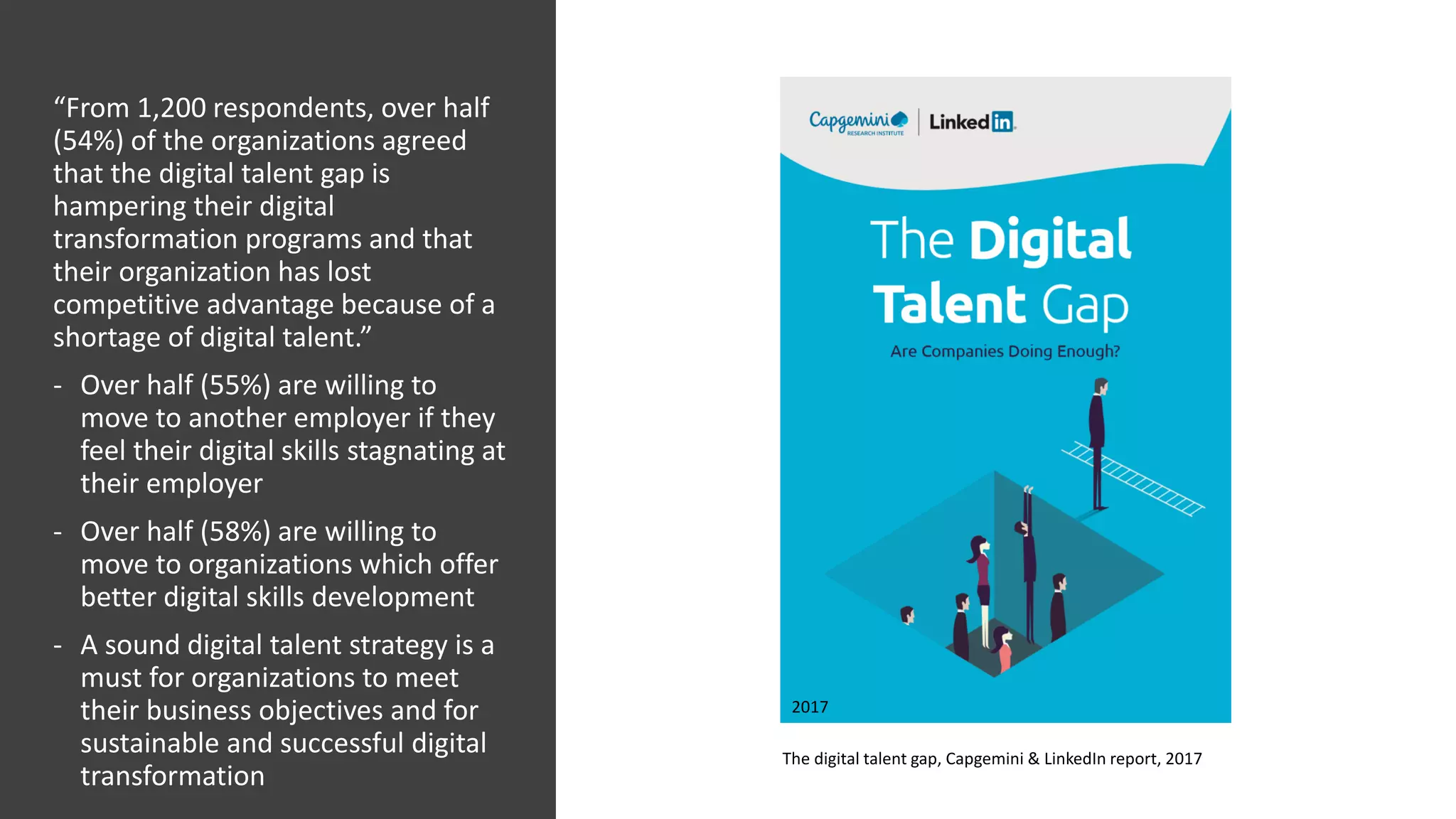
The digital talent gap, Capgemini & LinkedIn report, 2017
What is happening!
GCC visions: Digital Transformation is one critical success factor
GCC Digital Transformation Initiatives Demand
Highly Skilled Digital Talent
“Dubai will be the first city powered
By Blockchain by 2020”
25% autonomous transportation by 2030
“Make Dubai the happiest city on earth”
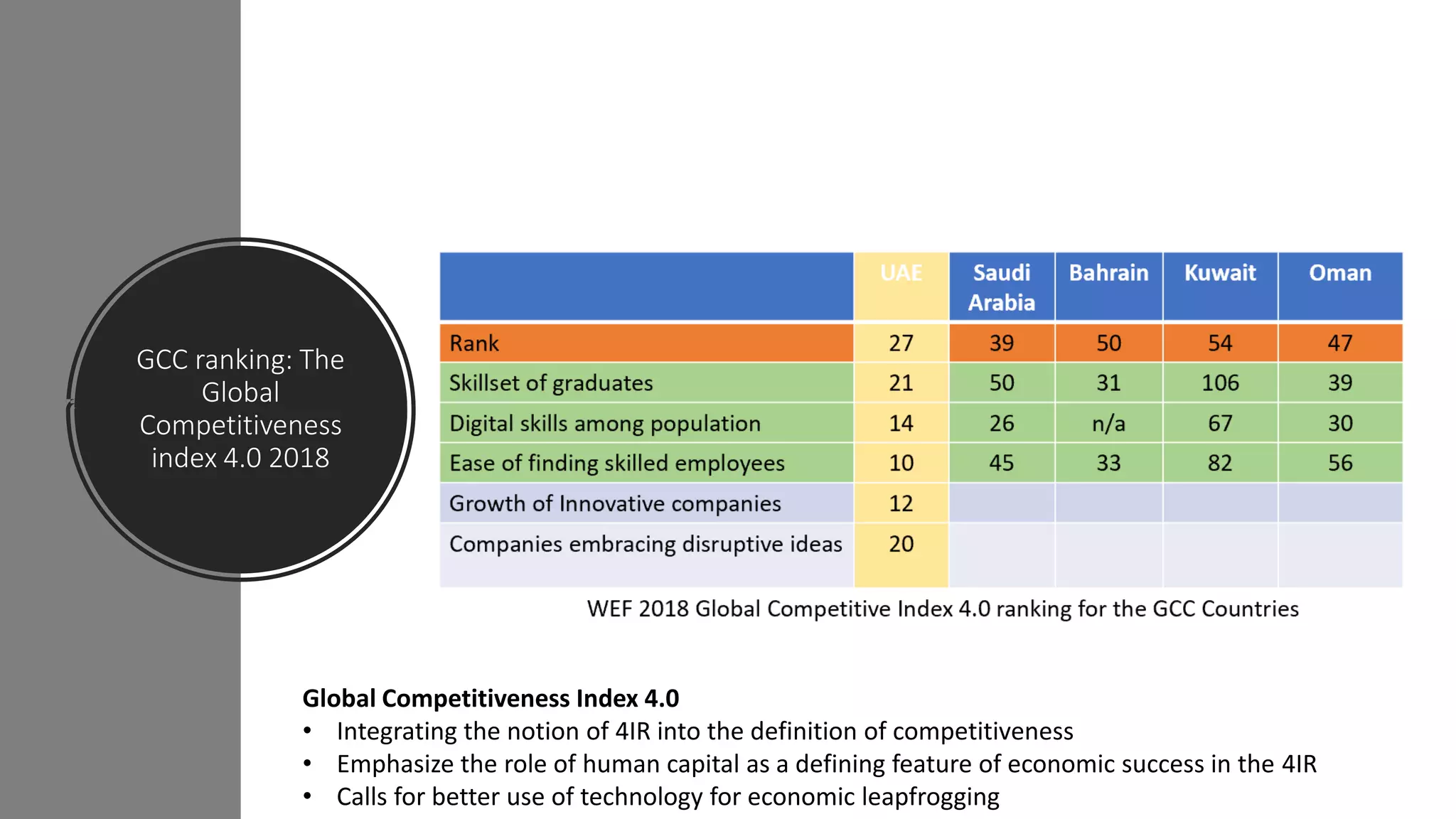
GCC ranking: The
Global
Competitiveness
index 4.0 2018
Global Competitiveness Index 4.0
• Integrating the notion of 4IR into the definition of competitiveness
• Emphasize the role of human capital as a defining feature of economic success in the 4IR
• Calls for better use of technology for economic leapfrogging
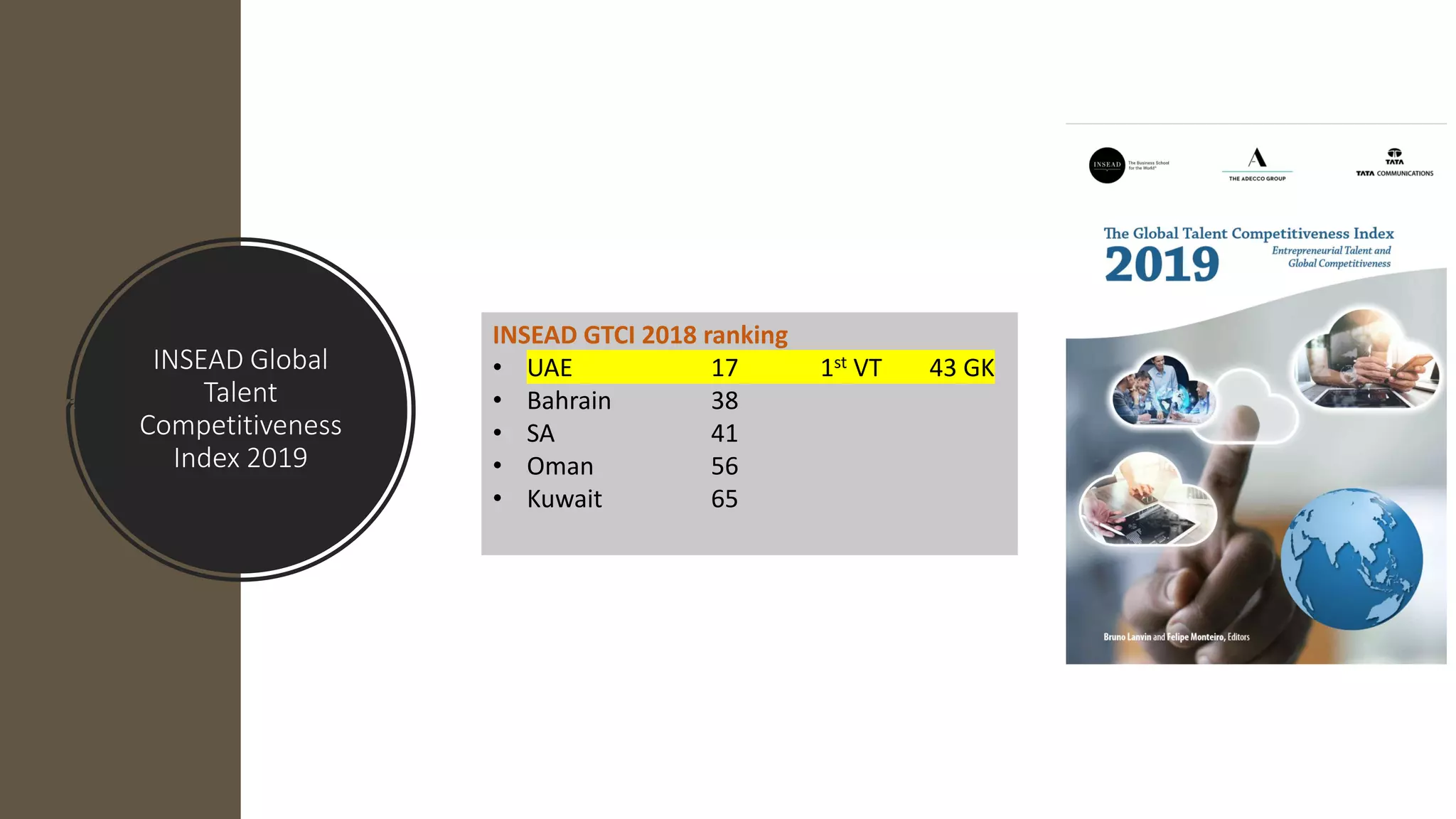
INSEAD Global
Talent
Competitiveness
Index 2019
INSEAD GTCI 2018 ranking
• UAE 17 1st VT 43 GK
• Bahrain 38
• SA 41
• Oman 56
• Kuwait 65
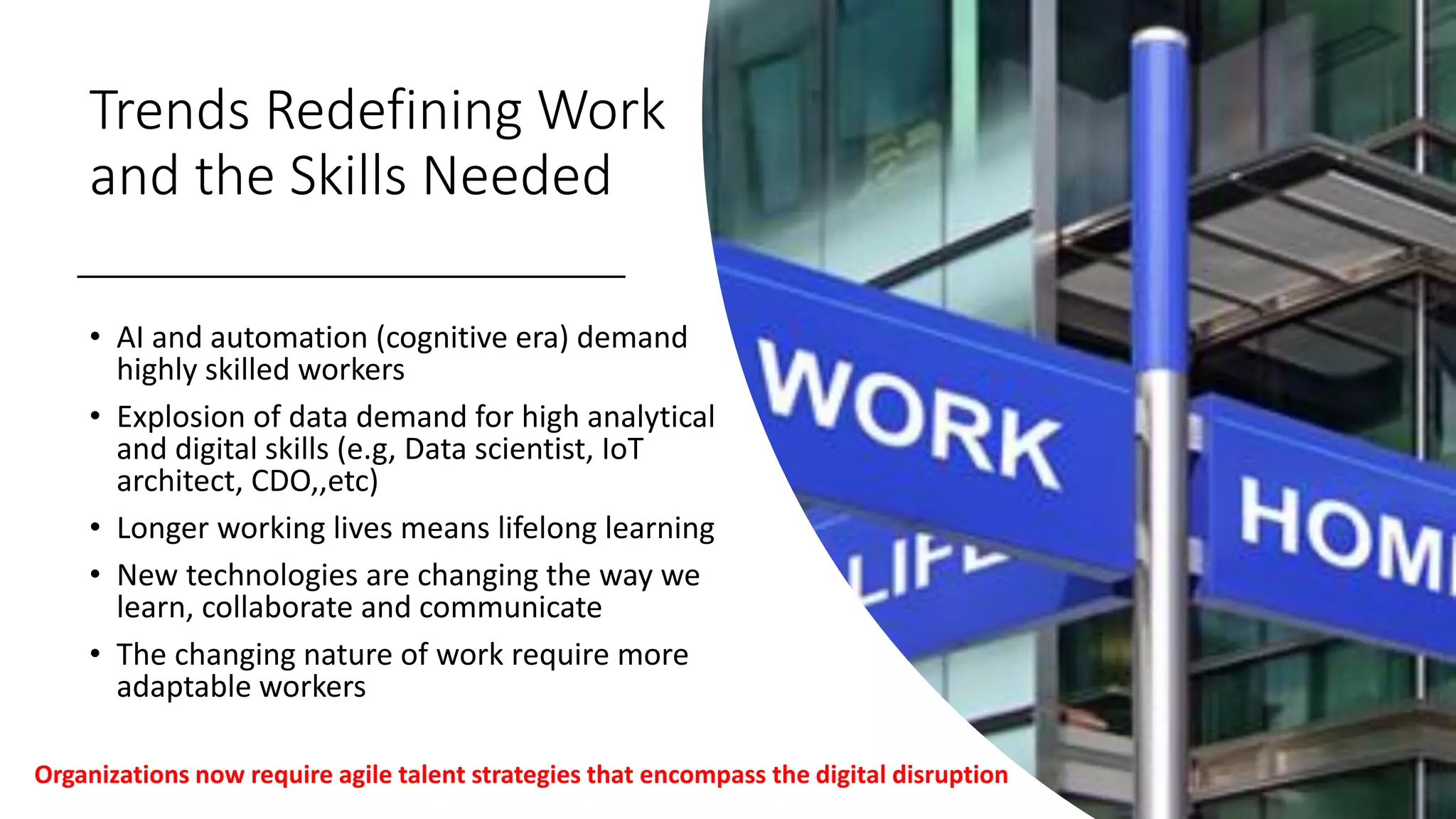
Trends Redefining Work
and the Skills Needed
• AI and automation (cognitive era) demand
highly skilled workers
• Explosion of data demand for high analytical
and digital skills (e.g, Data scientist, IoT
architect, CDO,,etc)
• Longer working lives means lifelong learning
• New technologies are changing the way we
learn, collaborate and communicate
• The changing nature of work require more
adaptable workers
Organizations now require agile talent strategies that encompass the digital disruption
Talented skilled people at the
heart of digital transformation
• Do you have the right people, talent, skills and
knowledge to support your vision, products, and
services?
• Digital jobs:
• Roles in the production, distribution,
implementation, or servicing of ICT
• Digital jobs continuously changing
• Next wave of digital jobs will be shaped by
emerging technologies: blockchain, 3D
printing, drones, virtual reality, augmented
reality, the Internet of Things, robotics, and
artificial intelligence.
Deloitte’s Digital Maturity assessment framework
Why Digital Jobs?
• Emerging technologies create more
digital jobs
• Sustainable (resilient jobs and more
adaptable)
• Higher value added roles
• Opportunities for self-employment
• more flexible work models –<
increase self-employment and
women participation
• Help to achieve national aspiration
The workforce becoming more connected
• Online talent forums
• Insight & transparency –< people
choose the best place that suits them
• Online talent marketplaces
• Opportunities for talent
• Flexibility for freelance jobs
• Corporate tools to source applicants
• Recommended algorithms
• Rating/endorsement of soft skills ->
individual trust rating
• Insight to assist HR recruit right talent
• Digital talent profiling
• Individuals to showcase their talent
• Orgs to source talent
GCC countries need to create
more digital jobs
• Developing the digital job market in
the region has the potential to
create 1.3 million additional digital
jobs in the GCC by 2025. Strategy&
and LinkedIn report 2017
• “Digital GCC professionals often lack
the advanced technical skills
necessary for the digital age.” Ali
Matar, LinkedIn
• Expatriates currently hold most
digital jobs in the GCC
Strategy& and LinkedIn report 2017
GCC countries face a gap of 3.1 million jobs for
nationals by 2025
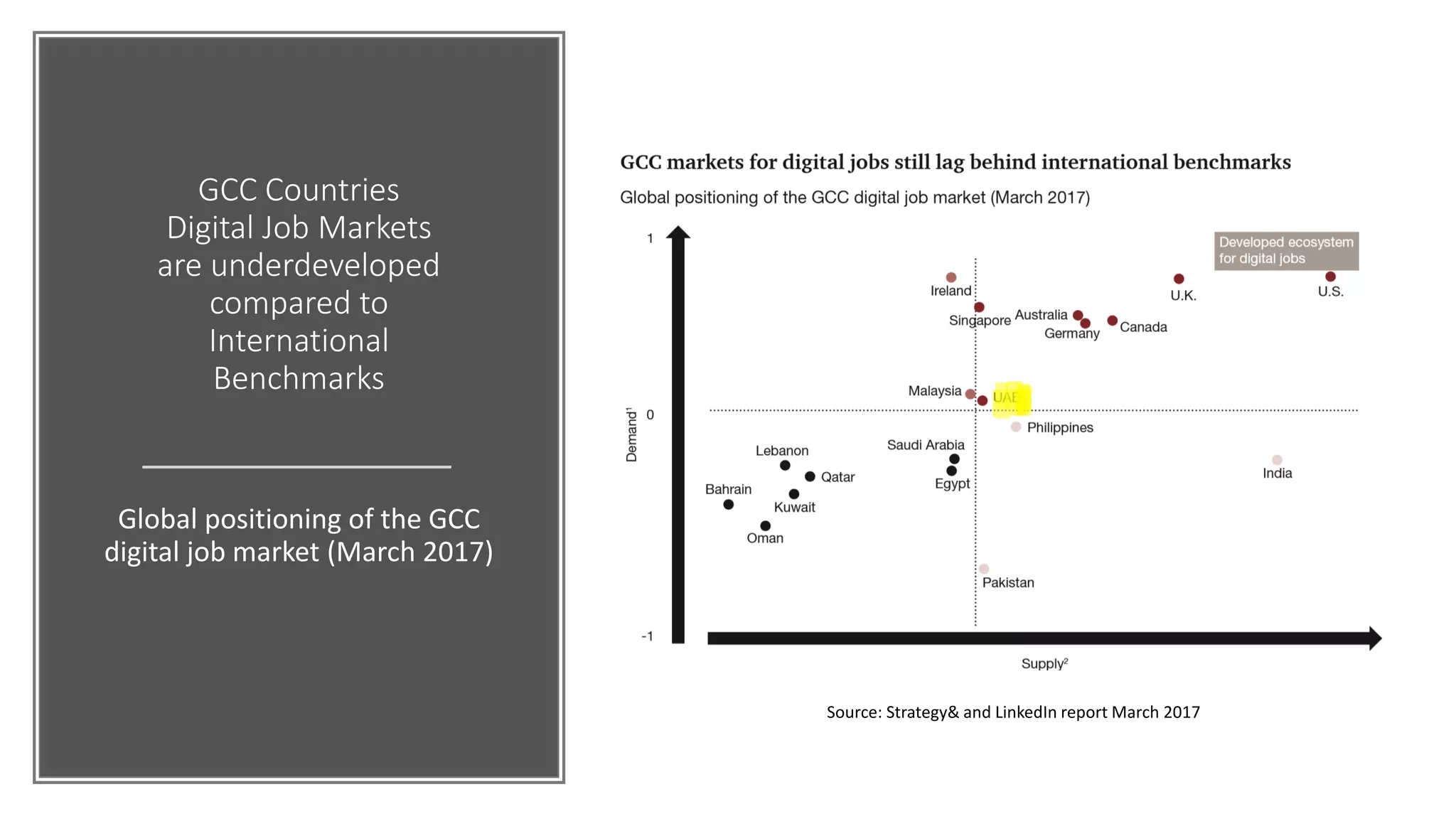
GCC Countries
Digital Job Markets
are underdeveloped
compared to
International
Benchmarks
Global positioning of the GCC
digital job market (March 2017)
Source: Strategy& and LinkedIn report March 2017
The GCC workforce
lacks the digital skills
that recruiters are
seeking
• The highly demanded digital
skills are almost absent
among GCC digital
professionals
• Has there been any change
since 2017!
Source: LinkedIn, Stratgey@
The digital talent gap, Capgemini & LinkedIn report, 2017
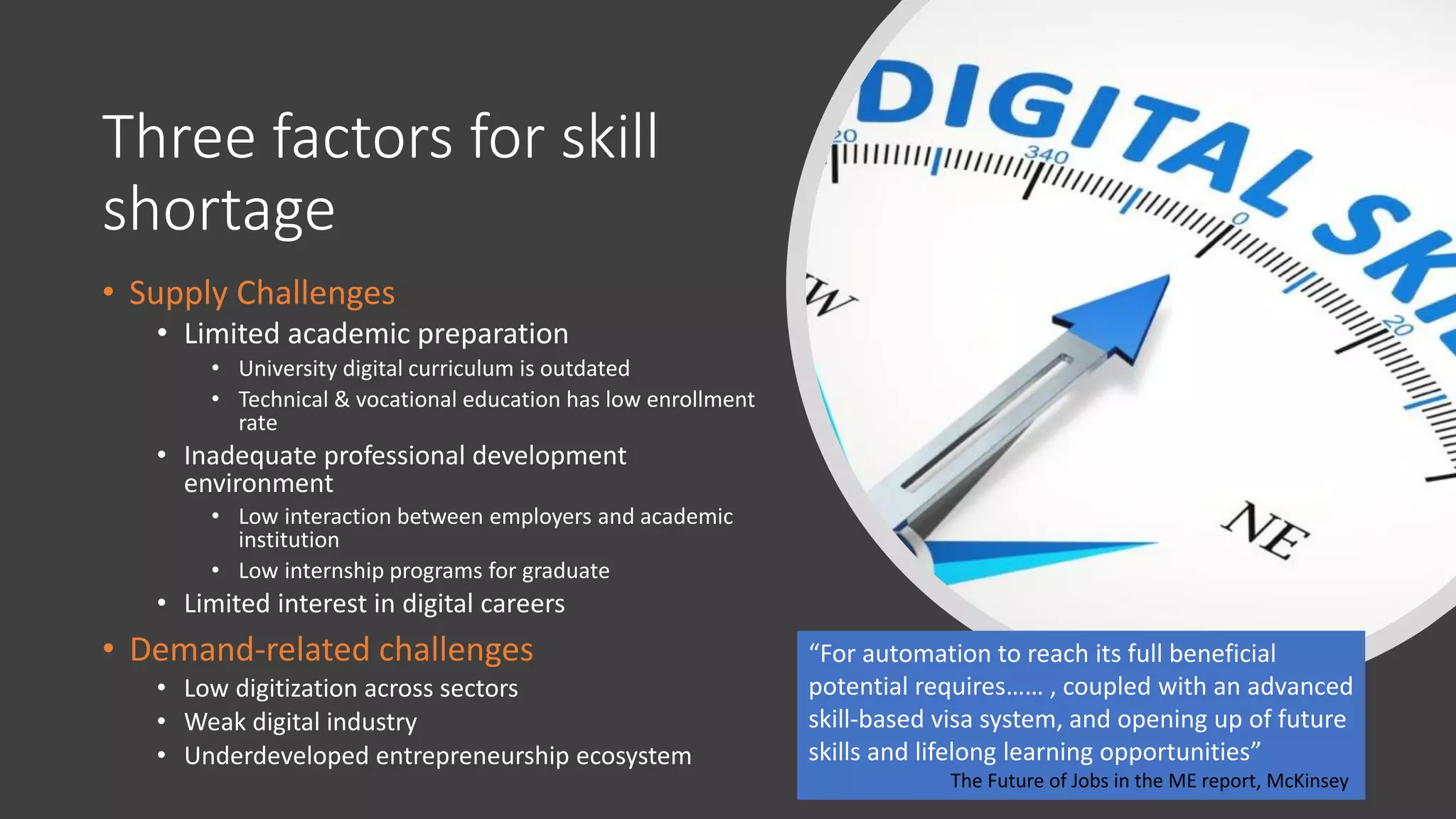
Three factors for skill
shortage
• Supply Challenges
• Limited academic preparation
• University digital curriculum is outdated
• Technical & vocational education has low enrollment
rate
• Inadequate professional development
environment
• Low interaction between employers and academic
institution
• Low internship programs for graduate
• Limited interest in digital careers
• Demand-related challenges
• Low digitization across sectors
• Weak digital industry
• Underdeveloped entrepreneurship ecosystem
“For automation to reach its full beneficial
potential requires…… , coupled with an advanced
skill-based visa system, and opening up of future
skills and lifelong learning opportunities”
The Future of Jobs in the ME report, McKinsey
A need for Digital
Talent Strategies
• Compelling vision is important
• Environment that prioritize and reward
learning
• Clear career development path
• Empower talent to implement change
• Provide flexible ways of working
• Policies to lower the barriers to attract
expat digital talent (e.g, talent visa…etc)
• HR to embrace disruptive technologies
• Attraction level: use online labour
platforms
• Onboarding and training level: Use digital
labout platforms to maximize employee
performance
• Retention level: Use predictive analytics
to identify employees who are likely to
leave
What GCC Countries
Need to Do
• Boosting supply & demand
• Partnerships between Gov,
academia and private sectors.
• Examples:
• The UAE national AI Plan
• CIOMajlis student
innovation challenge
Source: LinkedIn, Stratgey@
UAE Initiatives
UAE Initiatives
UAE Initiatives
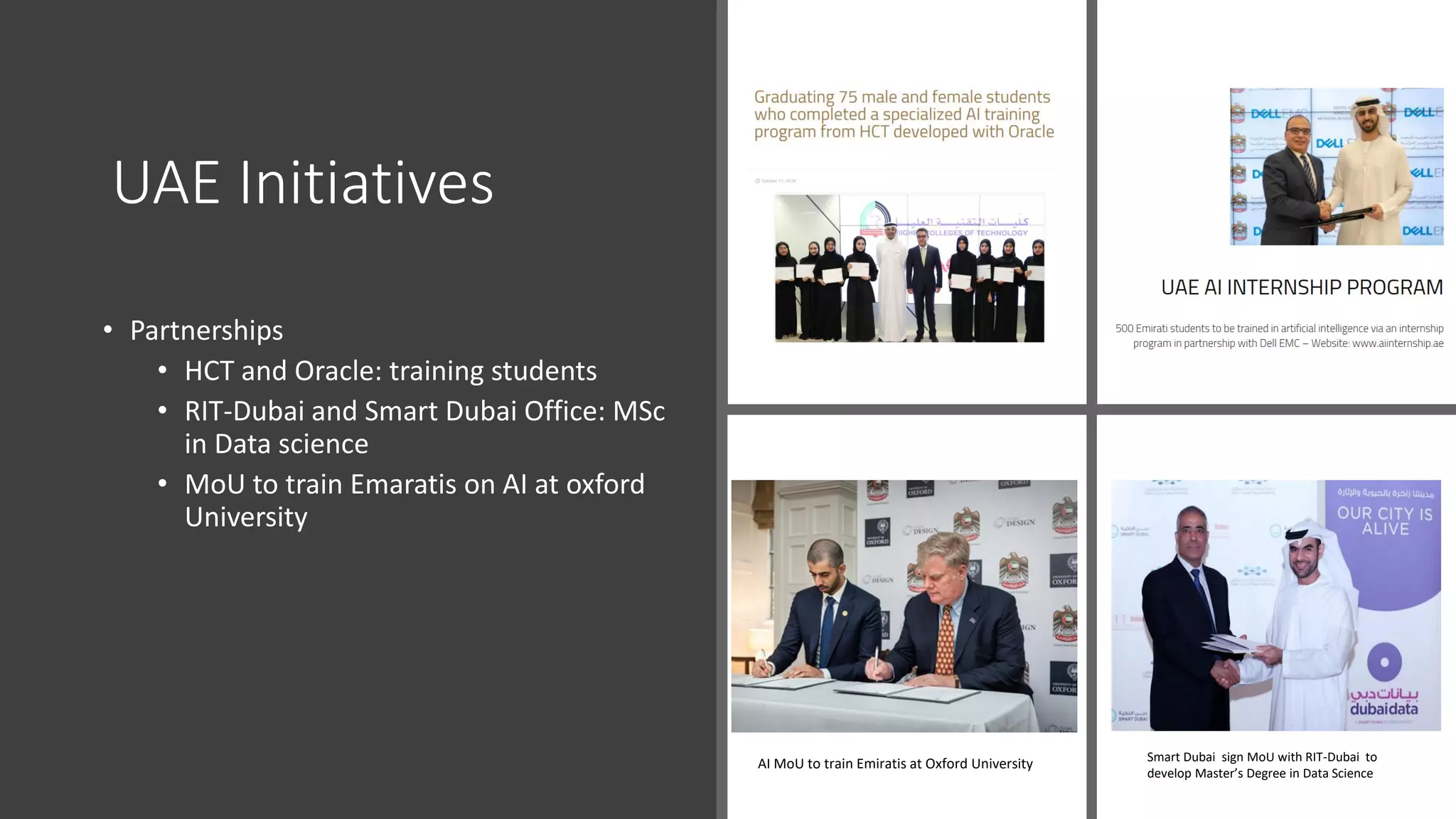
• Partnerships
• HCT and Oracle: training students
• RIT-Dubai and Smart Dubai Office: MSc
in Data science
• MoU to train Emaratis on AI at oxford
University
Smart Dubai sign MoU with RIT-Dubai to
develop Master’s Degree in Data Science
AI MoU to train Emiratis at Oxford University
UAE Initiatives
• 1 Million Arab coder program
• Sponsored by Hussain Sajawani
Damak Foundation and run by
Dubai Future Foundation
• More than 1 million Arabs
signed up
• 22,000 graduated by last year
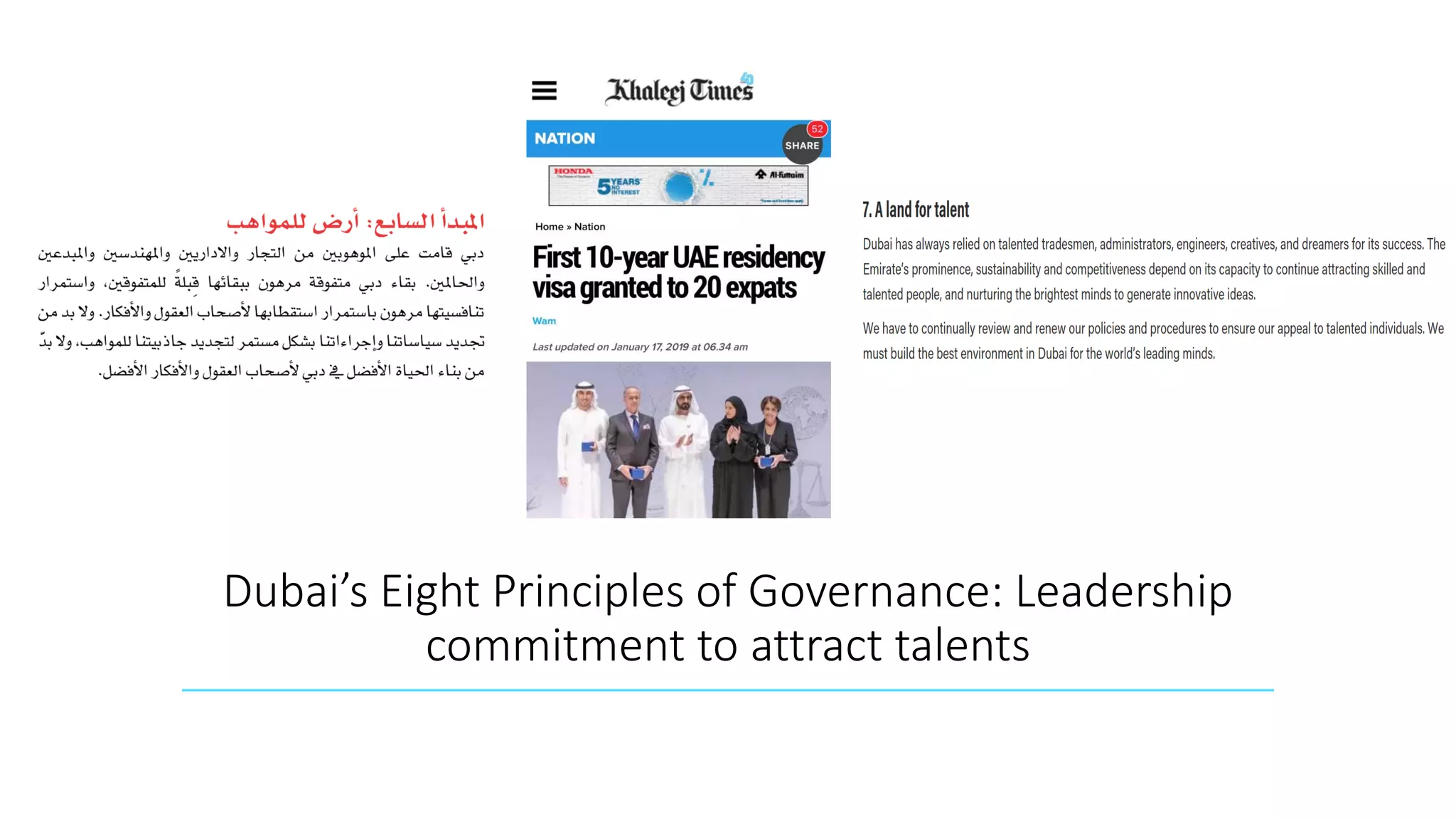
Dubai’s Eight Principles of Governance: Leadership
commitment to attract talents
GCC Digital Initiatives
• Misk Foundation Saudi Codes
initiative
• In line with Saudi vision 2030
• Partner with Ministry of C&IT and Saudi
Telecom
• Promotes culture of coding
• Java scripting, python, and app
development
• Doroob (Saudi initiative)
• National electronic training platform
• By Human Resources Development Fund
• Offers certificates in Data analysis and
other areas
• 1.6 million benefited users
recommendations
• GCC governments need to study the future of talent (talent forsight)
• GCC governments need to develop digital talent strategies
• GCC governments need to focus on developing national digital talent and
provide incentives for working in digital fields
• Building analytical & AI capabilities in HR will support talent strategies to
boost organizational performance and productivity
• GCC governments should partner with technology players, educational
institutions, the private sector, and entrepreneurs to launch initiatives that
grow the digital job market by helping the workforce to develop and retain
digital skills and creating high-value jobs.

Talent Strategies for the Digital Age

  • 1.
    ‫الرقمي‬ ‫العصر‬ ‫في‬‫المواهب‬ ‫إشتراتيجيات‬: ‫التعاون‬ ‫مجلس‬ ‫دول‬ ‫من‬ ‫المطلوب‬ ‫ما‬ Talent Strategies for The Digital Age: What The GCC Countries Need to Do Dr. Saeed K Aldhaheri Chiarman, Smartworld @DDsaeed 23 GCC HR Management in the Era of Knowledge Conference, Dubai, 6-7 February 2019
  • 2.
    “From 1,200 respondents,over half (54%) of the organizations agreed that the digital talent gap is hampering their digital transformation programs and that their organization has lost competitive advantage because of a shortage of digital talent.” - Over half (55%) are willing to move to another employer if they feel their digital skills stagnating at their employer - Over half (58%) are willing to move to organizations which offer better digital skills development - A sound digital talent strategy is a must for organizations to meet their business objectives and for sustainable and successful digital transformation 2017 The digital talent gap, Capgemini & LinkedIn report, 2017
  • 3.
  • 4.
    GCC visions: DigitalTransformation is one critical success factor
  • 5.
    GCC Digital TransformationInitiatives Demand Highly Skilled Digital Talent “Dubai will be the first city powered By Blockchain by 2020” 25% autonomous transportation by 2030 “Make Dubai the happiest city on earth”
  • 6.
    GCC ranking: The Global Competitiveness index4.0 2018 Global Competitiveness Index 4.0 • Integrating the notion of 4IR into the definition of competitiveness • Emphasize the role of human capital as a defining feature of economic success in the 4IR • Calls for better use of technology for economic leapfrogging
  • 7.
    INSEAD Global Talent Competitiveness Index 2019 INSEADGTCI 2018 ranking • UAE 17 1st VT 43 GK • Bahrain 38 • SA 41 • Oman 56 • Kuwait 65
  • 8.
    Trends Redefining Work andthe Skills Needed • AI and automation (cognitive era) demand highly skilled workers • Explosion of data demand for high analytical and digital skills (e.g, Data scientist, IoT architect, CDO,,etc) • Longer working lives means lifelong learning • New technologies are changing the way we learn, collaborate and communicate • The changing nature of work require more adaptable workers Organizations now require agile talent strategies that encompass the digital disruption
  • 9.
    Talented skilled peopleat the heart of digital transformation • Do you have the right people, talent, skills and knowledge to support your vision, products, and services? • Digital jobs: • Roles in the production, distribution, implementation, or servicing of ICT • Digital jobs continuously changing • Next wave of digital jobs will be shaped by emerging technologies: blockchain, 3D printing, drones, virtual reality, augmented reality, the Internet of Things, robotics, and artificial intelligence. Deloitte’s Digital Maturity assessment framework
  • 10.
    Why Digital Jobs? •Emerging technologies create more digital jobs • Sustainable (resilient jobs and more adaptable) • Higher value added roles • Opportunities for self-employment • more flexible work models –< increase self-employment and women participation • Help to achieve national aspiration
  • 11.
    The workforce becomingmore connected • Online talent forums • Insight & transparency –< people choose the best place that suits them • Online talent marketplaces • Opportunities for talent • Flexibility for freelance jobs • Corporate tools to source applicants • Recommended algorithms • Rating/endorsement of soft skills -> individual trust rating • Insight to assist HR recruit right talent • Digital talent profiling • Individuals to showcase their talent • Orgs to source talent
  • 12.
    GCC countries needto create more digital jobs • Developing the digital job market in the region has the potential to create 1.3 million additional digital jobs in the GCC by 2025. Strategy& and LinkedIn report 2017 • “Digital GCC professionals often lack the advanced technical skills necessary for the digital age.” Ali Matar, LinkedIn • Expatriates currently hold most digital jobs in the GCC Strategy& and LinkedIn report 2017
  • 13.
    GCC countries facea gap of 3.1 million jobs for nationals by 2025
  • 14.
    GCC Countries Digital JobMarkets are underdeveloped compared to International Benchmarks Global positioning of the GCC digital job market (March 2017) Source: Strategy& and LinkedIn report March 2017
  • 15.
    The GCC workforce lacksthe digital skills that recruiters are seeking • The highly demanded digital skills are almost absent among GCC digital professionals • Has there been any change since 2017! Source: LinkedIn, Stratgey@ The digital talent gap, Capgemini & LinkedIn report, 2017
  • 16.
    Three factors forskill shortage • Supply Challenges • Limited academic preparation • University digital curriculum is outdated • Technical & vocational education has low enrollment rate • Inadequate professional development environment • Low interaction between employers and academic institution • Low internship programs for graduate • Limited interest in digital careers • Demand-related challenges • Low digitization across sectors • Weak digital industry • Underdeveloped entrepreneurship ecosystem “For automation to reach its full beneficial potential requires…… , coupled with an advanced skill-based visa system, and opening up of future skills and lifelong learning opportunities” The Future of Jobs in the ME report, McKinsey
  • 17.
    A need forDigital Talent Strategies • Compelling vision is important • Environment that prioritize and reward learning • Clear career development path • Empower talent to implement change • Provide flexible ways of working • Policies to lower the barriers to attract expat digital talent (e.g, talent visa…etc) • HR to embrace disruptive technologies • Attraction level: use online labour platforms • Onboarding and training level: Use digital labout platforms to maximize employee performance • Retention level: Use predictive analytics to identify employees who are likely to leave
  • 18.
    What GCC Countries Needto Do • Boosting supply & demand • Partnerships between Gov, academia and private sectors. • Examples: • The UAE national AI Plan • CIOMajlis student innovation challenge Source: LinkedIn, Stratgey@
  • 19.
  • 20.
  • 21.
    UAE Initiatives • Partnerships •HCT and Oracle: training students • RIT-Dubai and Smart Dubai Office: MSc in Data science • MoU to train Emaratis on AI at oxford University Smart Dubai sign MoU with RIT-Dubai to develop Master’s Degree in Data Science AI MoU to train Emiratis at Oxford University
  • 22.
    UAE Initiatives • 1Million Arab coder program • Sponsored by Hussain Sajawani Damak Foundation and run by Dubai Future Foundation • More than 1 million Arabs signed up • 22,000 graduated by last year
  • 23.
    Dubai’s Eight Principlesof Governance: Leadership commitment to attract talents
  • 24.
    GCC Digital Initiatives •Misk Foundation Saudi Codes initiative • In line with Saudi vision 2030 • Partner with Ministry of C&IT and Saudi Telecom • Promotes culture of coding • Java scripting, python, and app development • Doroob (Saudi initiative) • National electronic training platform • By Human Resources Development Fund • Offers certificates in Data analysis and other areas • 1.6 million benefited users
  • 25.
    recommendations • GCC governmentsneed to study the future of talent (talent forsight) • GCC governments need to develop digital talent strategies • GCC governments need to focus on developing national digital talent and provide incentives for working in digital fields • Building analytical & AI capabilities in HR will support talent strategies to boost organizational performance and productivity • GCC governments should partner with technology players, educational institutions, the private sector, and entrepreneurs to launch initiatives that grow the digital job market by helping the workforce to develop and retain digital skills and creating high-value jobs.