1
Blockchains - The Next Gen Platform
for Digital TransformationBlockchain@Banking
BLOCKCHAIN
A distributed cryptographic ledger
PLATFORM APPROACH
Rapidly design, test and deploy applications
DIGITAL TRANSFORMATION
Drive digital change
FLOYD DCOSTA
@floyddcosta
2
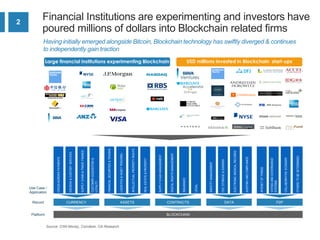
Financial Institutions are experimenting and investors have
poured millions of dollars into Blockchain related firms
Large financial institutions experimenting Blockchain
Ventures
Accelerator
USD millions invested in Blockchain start-ups
Having initially emerged alongside Bitcoin, Blockchain technology has swiftly diverged & continues
to independently gain traction
Source: CNN Money, Coindesk, Citi Research
Use Case /
Application
Record
BLOCKCHAINPlatform
CROSS-BORDERPAYMENTS
ESCROW&CUSTODYSERVICES
SUPPLYCHAIN&TRADEFINANCE
CUSTOMERACQUISITION&
LOYALTY
CURRENCY
FINANCIALSECURITIES&TRADING
LOGISTICS&ASSETTRACKING
INTELLECTUALPROPERTYRIGHTS
ASSETS
REALESTATE&PROPERTY
SUPPLYCHAINMANAGEMENT
DIGITALRIGHTSMANAGEMENT
INSURANCE
LEGAL
CONTRACTS
IDENTITYMANAGEMENT
FILESTORAGE&SHARING
ELECTRONICMEDICALRECORDS
AUDITINGANDCOMPLIANCE
DATA
INTENETOFTHINGS
VOTINGANDGOVERNANCE
SYSTEMS
COLLABORATIVEECONOMY
OTHERSTOBEDETERMINED
P2P
3
Blockchain technology, by its very nature, lends itself to the
digital transformation journey of a bank
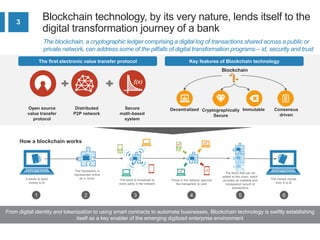
The blockchain, a cryptographic ledger comprising a digital log of transactions shared across a public or
private network, can address some of the pitfalls of digital transformation programs – id, security and trust
From digital identity and tokenization to using smart contracts to automate businesses, Blockchain technology is swiftly establishing
itself as a key enabler of the emerging digitized enterprise environment
How a blockchain works
ImmutableCryptographically
Secure
Blockchain
Consensus
driven
Open source
value transfer
protocol
Distributed
P2P network
Secure
math-based
system
Decentralized
The first electronic value transfer protocol
A wants to send
money to B
The transaction is
represented online
as a `block’
The block is broadcast to
every party in the network
Those in the network approve
the transaction is valid
The block that can be
added to the chain, which
provides an indelible and
transparent record of
transactions
The money moves
from A to B
1 2 3 4 5 6
Key features of Blockchain technology
4
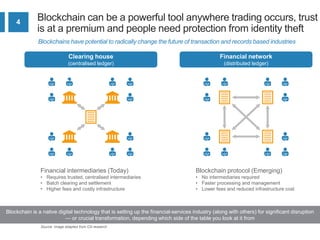
Blockchain can be a powerful tool anywhere trading occurs, trust
is at a premium and people need protection from identity theft
Blockchains have potential to radically change the future of transaction and records based industries
Blockchain is a native digital technology that is setting up the financial-services industry (along with others) for significant disruption
— or crucial transformation, depending which side of the table you look at it from
Financial intermediaries (Today)
• Requires trusted, centralised intermediaries
• Batch clearing and settlement
• Higher fees and costly infrastructure
Clearing house
(centralised ledger)
Financial network
(distributed ledger)
Blockchain protocol (Emerging)
• No intermediaries required
• Faster processing and management
• Lower fees and reduced infrastructure cost
Source: Image adapted from Citi research
5
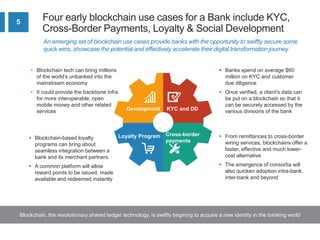
Four early blockchain use cases for a Bank include KYC,
Cross-Border Payments, Loyalty & Social Development
Blockchain, the revolutionary shared ledger technology, is swiftly begining to acquire a new identity in the banking world
An emerging set of blockchain use cases provide banks with the opportunity to swiftly secure some
quick wins, showcase the potential and effectively accelerate their digital transformation journey
Development KYC and DD
Loyalty Program Cross-border
payments
 From remittances to cross-border
wiring services, blockchains offer a
faster, effective and much lower-
cost alternative
 The emergence of consortia will
also quicken adoption intra-bank,
inter-bank and beyond
 Banks spend on average $60
million on KYC and customer
due diligence
 Once verified, a client's data can
be put on a blockchain so that it
can be securely accessed by the
various divisions of the bank
 Blockchain-based loyalty
programs can bring about
seamless integration between a
bank and its merchant partners
 A common platform will allow
reward points to be issued, made
available and redeemed instantly
 Blockchain tech can bring millions
of the world’s unbanked into the
mainstream economy
 It could provide the backbone infra
for more interoperable, open
mobile money and other related
services
6
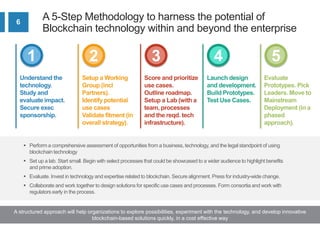
A 5-Step Methodology to harness the potential of
Blockchain technology within and beyond the enterprise
A structured approach will help organizations to explore possibilities, experiment with the technology, and develop innovative
blockchain-based solutions quickly, in a cost effective way
Understand the
technology.
Study and
evaluate impact.
Secure exec
sponsorship.
1
Setup a Working
Group (incl
Partners).
Identify potential
use cases
Validate fitment (in
overall strategy).
2
Score and prioritize
use cases.
Outline roadmap.
Setup a Lab (with a
team, processes
and the reqd. tech
infrastructure).
3
Launch design
and development.
Build Prototypes.
Test Use Cases.
4
Evaluate
Prototypes. Pick
Leaders. Move to
Mainstream
Deployment (in a
phased
approach).
5
 Perform a comprehensive assessment of opportunities from a business, technology, and the legal standpoint of using
blockchain technology
 Set up a lab. Start small. Begin with select processes that could be showcased to a wider audience to highlight benefits
and prime adoption.
 Evaluate. Invest in technology and expertise related to blockchain. Secure alignment. Press for industry-wide change.
 Collaborate and work together to design solutions for specific use cases and processes. Form consortia and work with
regulators early in the process.
7
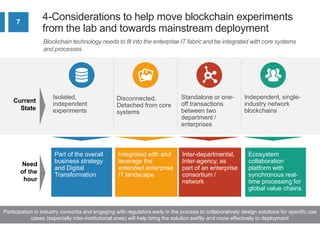
4-Considerations to help move blockchain experiments
from the lab and towards mainstream deployment
Blockchain technology needs to fit into the enterprise IT fabric and be integrated with core systems
and processes
Need
of the
hour
Current
State
Part of the overall
business strategy
and Digital
Transformation
Isolated,
independent
experiments
Integrated with and
leverage the
extended enterprise
IT landscape
Disconnected.
Detached from core
systems
Inter-departmental,
Inter-agency, as
part of an enterprise
consortium /
network
Standalone or one-
off transactions
between two
department /
enterprises
Ecosystem
collaboration
platform with
synchronous real-
time processing for
global value chains
Independent, single-
industry network
blockchains
Participation in industry consortia and engaging with regulators early in the process to collaboratively design solutions for specific use
cases (especially inter-institutional ones) will help bring the solution swiftly and more effectively to deployment
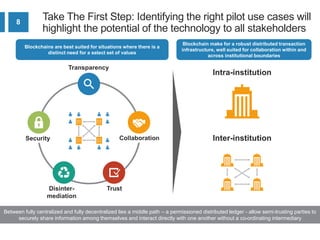
8
Take The First Step: Identifying the right pilot use cases will
highlight the potential of the technology to all stakeholders
Between fully centralized and fully decentralized lies a middle path – a permissioned distributed ledger - allow semi-trusting parties to
securely share information among themselves and interact directly with one another without a co-ordinating intermediary
Blockchains are best suited for situations where there is a
distinct need for a select set of values
Blockchain make for a robust distributed transaction
infrastructure, well suited for collaboration within and
across institutional boundaries
Intra-institution
Inter-institutionCollaborationSecurity
Trust
Transparency
Disinter-
mediation

Blockchain for Digital Transformation in Banking

  • 1.
    1 Blockchains - TheNext Gen Platform for Digital TransformationBlockchain@Banking BLOCKCHAIN A distributed cryptographic ledger PLATFORM APPROACH Rapidly design, test and deploy applications DIGITAL TRANSFORMATION Drive digital change FLOYD DCOSTA @floyddcosta
  • 2.
    2 Financial Institutions areexperimenting and investors have poured millions of dollars into Blockchain related firms Large financial institutions experimenting Blockchain Ventures Accelerator USD millions invested in Blockchain start-ups Having initially emerged alongside Bitcoin, Blockchain technology has swiftly diverged & continues to independently gain traction Source: CNN Money, Coindesk, Citi Research Use Case / Application Record BLOCKCHAINPlatform CROSS-BORDERPAYMENTS ESCROW&CUSTODYSERVICES SUPPLYCHAIN&TRADEFINANCE CUSTOMERACQUISITION& LOYALTY CURRENCY FINANCIALSECURITIES&TRADING LOGISTICS&ASSETTRACKING INTELLECTUALPROPERTYRIGHTS ASSETS REALESTATE&PROPERTY SUPPLYCHAINMANAGEMENT DIGITALRIGHTSMANAGEMENT INSURANCE LEGAL CONTRACTS IDENTITYMANAGEMENT FILESTORAGE&SHARING ELECTRONICMEDICALRECORDS AUDITINGANDCOMPLIANCE DATA INTENETOFTHINGS VOTINGANDGOVERNANCE SYSTEMS COLLABORATIVEECONOMY OTHERSTOBEDETERMINED P2P
  • 3.
    3 Blockchain technology, byits very nature, lends itself to the digital transformation journey of a bank The blockchain, a cryptographic ledger comprising a digital log of transactions shared across a public or private network, can address some of the pitfalls of digital transformation programs – id, security and trust From digital identity and tokenization to using smart contracts to automate businesses, Blockchain technology is swiftly establishing itself as a key enabler of the emerging digitized enterprise environment How a blockchain works ImmutableCryptographically Secure Blockchain Consensus driven Open source value transfer protocol Distributed P2P network Secure math-based system Decentralized The first electronic value transfer protocol A wants to send money to B The transaction is represented online as a `block’ The block is broadcast to every party in the network Those in the network approve the transaction is valid The block that can be added to the chain, which provides an indelible and transparent record of transactions The money moves from A to B 1 2 3 4 5 6 Key features of Blockchain technology
  • 4.
    4 Blockchain can bea powerful tool anywhere trading occurs, trust is at a premium and people need protection from identity theft Blockchains have potential to radically change the future of transaction and records based industries Blockchain is a native digital technology that is setting up the financial-services industry (along with others) for significant disruption — or crucial transformation, depending which side of the table you look at it from Financial intermediaries (Today) • Requires trusted, centralised intermediaries • Batch clearing and settlement • Higher fees and costly infrastructure Clearing house (centralised ledger) Financial network (distributed ledger) Blockchain protocol (Emerging) • No intermediaries required • Faster processing and management • Lower fees and reduced infrastructure cost Source: Image adapted from Citi research
  • 5.
    5 Four early blockchainuse cases for a Bank include KYC, Cross-Border Payments, Loyalty & Social Development Blockchain, the revolutionary shared ledger technology, is swiftly begining to acquire a new identity in the banking world An emerging set of blockchain use cases provide banks with the opportunity to swiftly secure some quick wins, showcase the potential and effectively accelerate their digital transformation journey Development KYC and DD Loyalty Program Cross-border payments  From remittances to cross-border wiring services, blockchains offer a faster, effective and much lower- cost alternative  The emergence of consortia will also quicken adoption intra-bank, inter-bank and beyond  Banks spend on average $60 million on KYC and customer due diligence  Once verified, a client's data can be put on a blockchain so that it can be securely accessed by the various divisions of the bank  Blockchain-based loyalty programs can bring about seamless integration between a bank and its merchant partners  A common platform will allow reward points to be issued, made available and redeemed instantly  Blockchain tech can bring millions of the world’s unbanked into the mainstream economy  It could provide the backbone infra for more interoperable, open mobile money and other related services
  • 6.
    6 A 5-Step Methodologyto harness the potential of Blockchain technology within and beyond the enterprise A structured approach will help organizations to explore possibilities, experiment with the technology, and develop innovative blockchain-based solutions quickly, in a cost effective way Understand the technology. Study and evaluate impact. Secure exec sponsorship. 1 Setup a Working Group (incl Partners). Identify potential use cases Validate fitment (in overall strategy). 2 Score and prioritize use cases. Outline roadmap. Setup a Lab (with a team, processes and the reqd. tech infrastructure). 3 Launch design and development. Build Prototypes. Test Use Cases. 4 Evaluate Prototypes. Pick Leaders. Move to Mainstream Deployment (in a phased approach). 5  Perform a comprehensive assessment of opportunities from a business, technology, and the legal standpoint of using blockchain technology  Set up a lab. Start small. Begin with select processes that could be showcased to a wider audience to highlight benefits and prime adoption.  Evaluate. Invest in technology and expertise related to blockchain. Secure alignment. Press for industry-wide change.  Collaborate and work together to design solutions for specific use cases and processes. Form consortia and work with regulators early in the process.
  • 7.
    7 4-Considerations to helpmove blockchain experiments from the lab and towards mainstream deployment Blockchain technology needs to fit into the enterprise IT fabric and be integrated with core systems and processes Need of the hour Current State Part of the overall business strategy and Digital Transformation Isolated, independent experiments Integrated with and leverage the extended enterprise IT landscape Disconnected. Detached from core systems Inter-departmental, Inter-agency, as part of an enterprise consortium / network Standalone or one- off transactions between two department / enterprises Ecosystem collaboration platform with synchronous real- time processing for global value chains Independent, single- industry network blockchains Participation in industry consortia and engaging with regulators early in the process to collaboratively design solutions for specific use cases (especially inter-institutional ones) will help bring the solution swiftly and more effectively to deployment
  • 8.
    8 Take The FirstStep: Identifying the right pilot use cases will highlight the potential of the technology to all stakeholders Between fully centralized and fully decentralized lies a middle path – a permissioned distributed ledger - allow semi-trusting parties to securely share information among themselves and interact directly with one another without a co-ordinating intermediary Blockchains are best suited for situations where there is a distinct need for a select set of values Blockchain make for a robust distributed transaction infrastructure, well suited for collaboration within and across institutional boundaries Intra-institution Inter-institutionCollaborationSecurity Trust Transparency Disinter- mediation