56
Price Determination: An Overview
Think
Plan
ExecuteAnalyse
Adapt
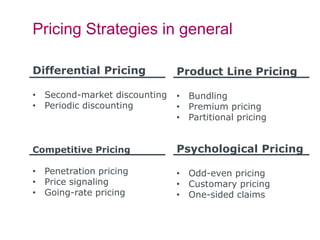
Pricing Strategies in general
Differential Pricing
• Second-market discounting
• Periodic discounting
Competitive Pricing
• Penetration pricing
• Price signaling
• Going-rate pricing
Psychological Pricing
• Odd-even pricing
• Customary pricing
• One-sided claims
Product Line Pricing
• Bundling
• Premium pricing
• Partitional pricing
58
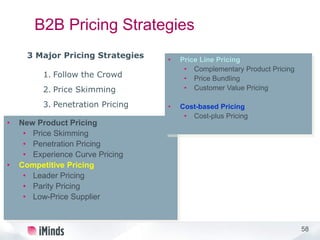
B2B Pricing Strategies
• New Product Pricing
• Price Skimming
• Penetration Pricing
• Experience Curve Pricing
• Competitive Pricing
• Leader Pricing
• Parity Pricing
• Low-Price Supplier
• Price Line Pricing
• Complementary Product Pricing
• Price Bundling
• Customer Value Pricing
• Cost-based Pricing
• Cost-plus Pricing
3 Major Pricing Strategies
1. Follow the Crowd
2. Price Skimming
3. Penetration Pricing
59
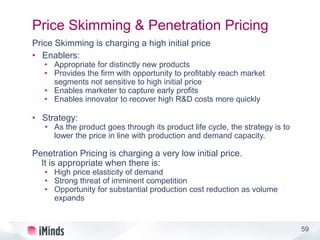
Price Skimming & Penetration Pricing
Price Skimming is charging a high initial price
• Enablers:
• Appropriate for distinctly new products
• Provides the firm with opportunity to profitably reach market
segments not sensitive to high initial price
• Enables marketer to capture early profits
• Enables innovator to recover high R&D costs more quickly
• Strategy:
• As the product goes through its product life cycle, the strategy is to
lower the price in line with production and demand capacity.
Penetration Pricing is charging a very low initial price.
It is appropriate when there is:
• High price elasticity of demand
• Strong threat of imminent competition
• Opportunity for substantial production cost reduction as volume
expands
60
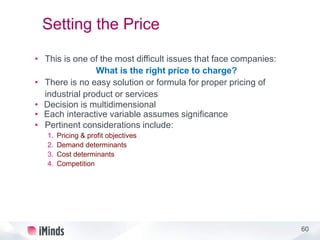
Setting the Price
• This is one of the most difficult issues that face companies:
What is the right price to charge?
• There is no easy solution or formula for proper pricing of
industrial product or services
• Decision is multidimensional
• Each interactive variable assumes significance
• Pertinent considerations include:
1. Pricing & profit objectives
2. Demand determinants
3. Cost determinants
4. Competition
61
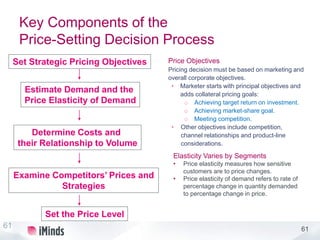
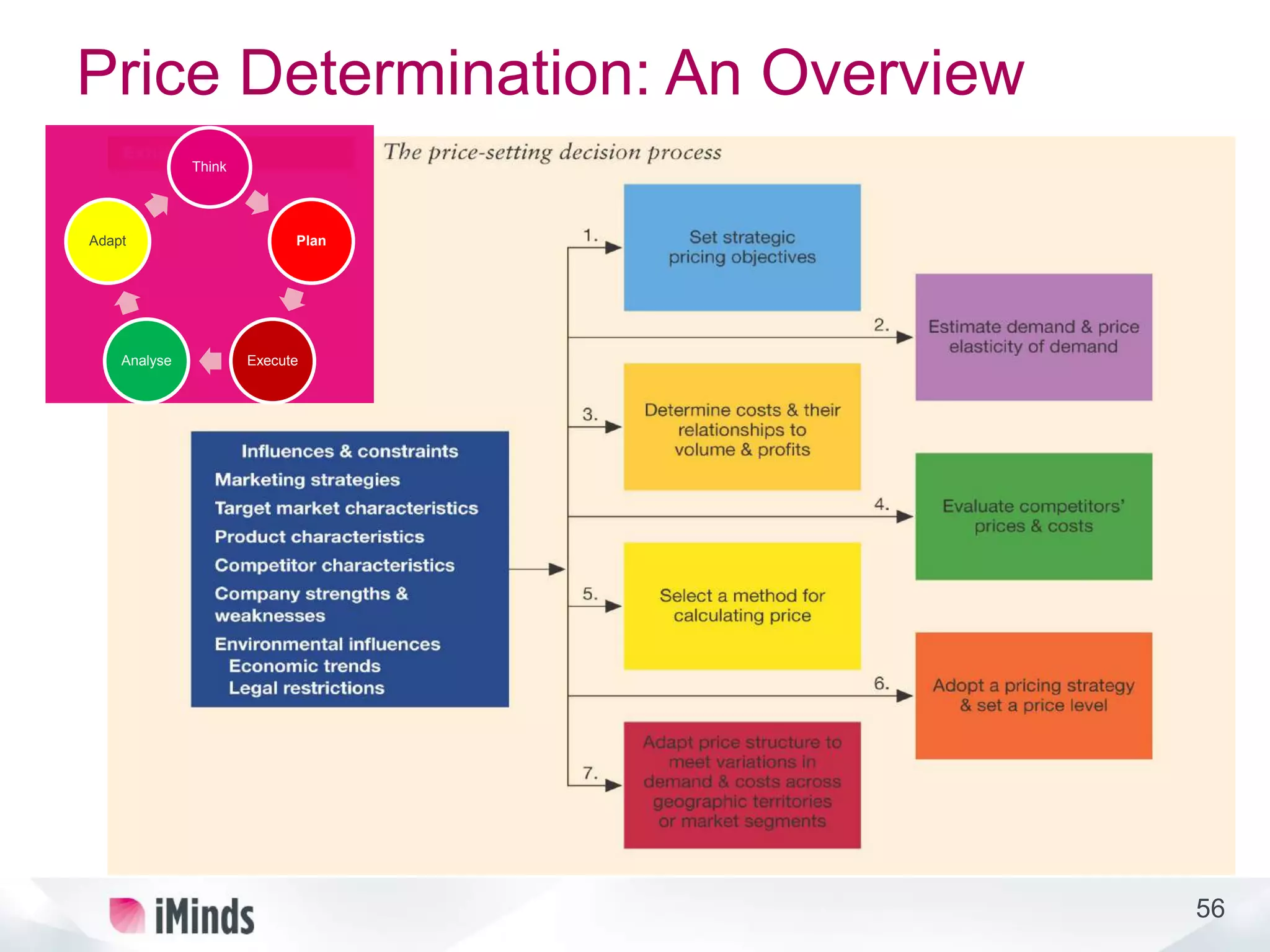
Key Components of the
Price-Setting Decision Process
61
Set Strategic Pricing Objectives
Estimate Demand and the
Price Elasticity of Demand
Determine Costs and
their Relationship to Volume
Examine Competitors’ Prices and
Strategies
Set the Price Level
Price Objectives
Pricing decision must be based on marketing and
overall corporate objectives.
• Marketer starts with principal objectives and
adds collateral pricing goals:
o Achieving target return on investment.
o Achieving market-share goal.
o Meeting competition.
• Other objectives include competition,
channel relationships and product-line
considerations.
Elasticity Varies by Segments
• Price elasticity measures how sensitive
customers are to price changes.
• Price elasticity of demand refers to rate of
percentage change in quantity demanded
to percentage change in price.
62
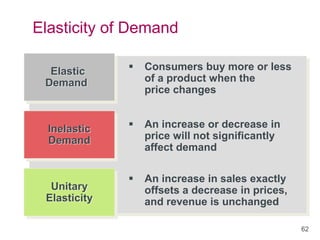
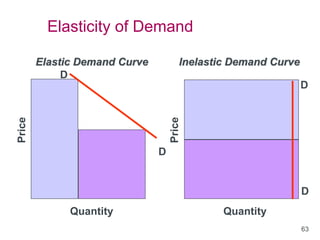
Elasticity of Demand
Elastic
Demand
 Consumers buy more or less
of a product when the
price changes
Inelastic
Demand
 An increase or decrease in
price will not significantly
affect demand
Unitary
Elasticity
 An increase in sales exactly
offsets a decrease in prices,
and revenue is unchanged
63
Elasticity of Demand
Elastic Demand Curve
D
D
Quantity
Price
D
D
Quantity
Price
Inelastic Demand Curve
64
Other Factors
• Satisfied customers are less price sensitive therefore one
strategy is to make our customers very satisfied so price isn’t as
much of a determinant.
• Switching costs is a consideration depending upon products.
The more sophisticated and unique the product is, and the more
vested interest (costs) in it is, the more apt for the customer to
not switch.
• End Use: How important is the product as in input into the total
cost of the end product?
• If cost is insignificant, then demand is inelastic.
• End-Market Focus: Since demand for many industrial products is
derived from the demand for the product of which they are a part,
STRONG end user focus is needed.
65
Derived Demand
• By understanding trends such as up or down markets,
up or down sectors, and knowing that not all segments
go up or down at one time, if one is able to plan for a
two-tiered market focus, which takes advantage of the
market variability…
• This strategy increases the chances for success.
• Value-Based Segmentation
 Some industrial product may serve different purposes for different markets.
 Each segment may value the product differently.
 By identifying applications where the firm has a clear advantage, and by
understanding the value of it to each segment, marketer may be able to
administer price differentiation in each segment.
“
”
66
The components of a Business Model
3. How do we sell ?
Message / Marcom Effort
See Roderick Workshop
67
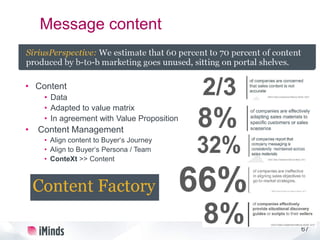
Message content
• Content
• Data
• Adapted to value matrix
• In agreement with Value Proposition
• Content Management
• Align content to Buyer‘s Journey
• Align to Buyer‘s Persona / Team
• ConteXt >> Content
68
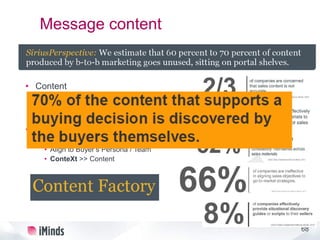
Message content
• Content
• Data
• Adapted to value matrix
• In agreement with Value Proposition
• Content Management
• Align content to Buyer‘s Journey
• Align to Buyer‘s Persona / Team
• ConteXt >> Content
69
70
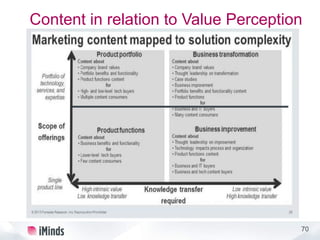
Content in relation to Value Perception
71
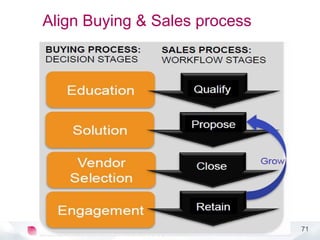
Align Buying & Sales process
“
”
72
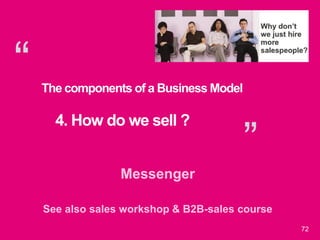
The components of a Business Model
4. How do we sell ?
Messenger
See also sales workshop & B2B-sales course
73
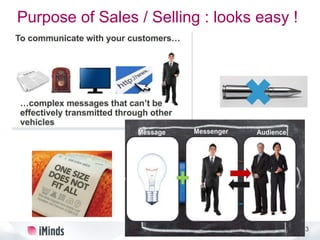
Purpose of Sales / Selling : looks easy !
74
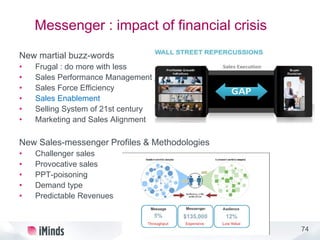
Messenger : impact of financial crisis
New martial buzz-words
• Frugal : do more with less
• Sales Performance Management
• Sales Force Efficiency
• Sales Enablement
• Selling System of 21st century
• Marketing and Sales Alignment
New Sales-messenger Profiles & Methodologies
• Challenger sales
• Provocative sales
• PPT-poisoning
• Demand type
• Predictable Revenues
75
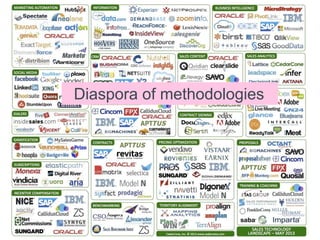
Diaspora of methodologies
76
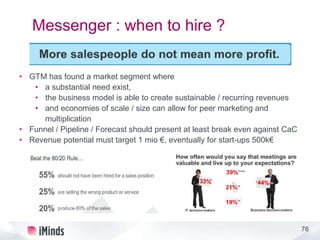
Messenger : when to hire ?
• GTM has found a market segment where
• a substantial need exist,
• the business model is able to create sustainable / recurring revenues
• and economies of scale / size can allow for peer marketing and
multiplication
• Funnel / Pipeline / Forecast should present at least break even against CaC
• Revenue potential must target 1 mio €, eventually for start-ups 500k€
77
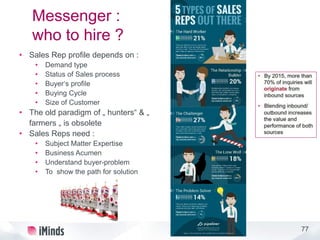
Messenger :
who to hire ?
• Sales Rep profile depends on :
• Demand type
• Status of Sales process
• Buyer‘s profile
• Buying Cycle
• Size of Customer
• The old paradigm of „ hunters“ & „
farmers „ is obsolete
• Sales Reps need :
• Subject Matter Expertise
• Business Acumen
• Understand buyer-problem
• To show the path for solution
78
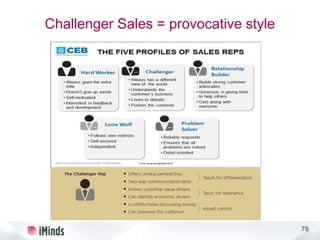
Challenger Sales = provocative style
“
”
79
The components of a Business Model
5. How do we sell ?
Buyer
80
Start-Up enigma
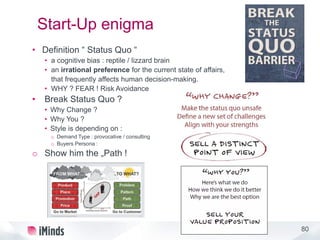
• Definition “ Status Quo “
• a cognitive bias : reptile / lizzard brain
• an irrational preference for the current state of affairs,
that frequently affects human decision-making.
• WHY ? FEAR ! Risk Avoidance
• Break Status Quo ?
• Why Change ?
• Why You ?
• Style is depending on :
o Demand Type : provocative / consulting
o Buyers Persona :
o Show him the „Path !
81
Buyer‘s Persona
• Buyer personas are examples of the real buyers who influence or make decisions
about the products, services or solutions you market.
• They are a tool that builds confidence in strategies to persuade buyers to choose
you rather than a competitor or the status quo.
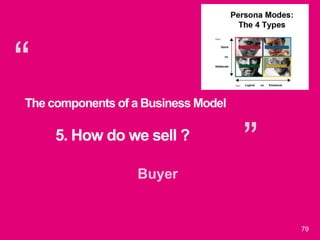
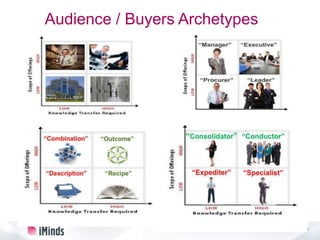
• 8 Types : Decisive “Driver” Collaborative “Consensus”
Relationship “Friend” Skeptical “Guardian”
Gradual “Tortoise” Warp “Change Agent”
Analytical “Spreadsheet” Innovator “Maverick”
General Rules :
• Buyers do not care :
• about what sales-rep does, but only on how to make themselves sucessful.
• they want to hear something they do not know already
• Buyer archetypes :
• Industry segment dependant
• Value perception matrix = f(complexity message )
• Different Decision Making drivers
82
83
Audience / Buyers Archetypes
84
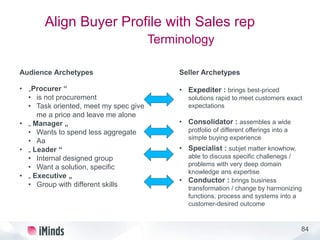
Align Buyer Profile with Sales rep
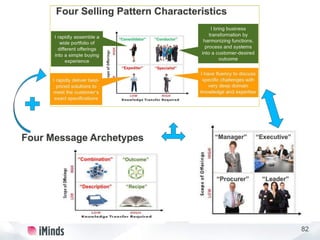
Terminology
Audience Archetypes
• „Procurer “
• is not procurement
• Task oriented, meet my spec give
me a price and leave me alone
• „ Manager „
• Wants to spend less aggregate
• Aa
• „ Leader “
• Internal designed group
• Want a solution, specific
• „ Executive „
• Group with different skills
Seller Archetypes
• Expediter : brings best-priced
solutions rapid to meet customers exact
expectations
• Consolidator : assembles a wide
protfolio of different offerings into a
simple buying experience
• Specialist : subjet matter knowhow,
able to discuss specific challenegs /
problems with very deep domain
knowledge ans expertise
• Conductor : brings business
transformation / change by harmonizing
functions, process and systems into a
customer-desired outcome
85
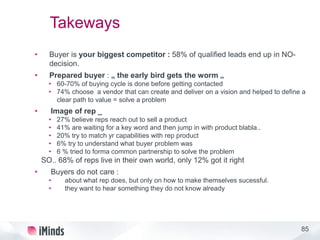
Takeways
• Buyer is your biggest competitor : 58% of qualified leads end up in NO-
decision.
• Prepared buyer : „ the early bird gets the worm „
• 60-70% of buying cycle is done before getting contacted
• 74% choose a vendor that can create and deliver on a vision and helped to define a
clear path to value = solve a problem
• Image of rep _
• 27% believe reps reach out to sell a product
• 41% are waiting for a key word and then jump in with product blabla..
• 20% try to match yr capabilities with rep product
• 6% try to understand what buyer problem was
• 6 % tried to forma common partnership to solve the problem
SO.. 68% of reps live in their own world, only 12% got it right
• Buyers do not care :
• about what rep does, but only on how to make themselves sucessful.
• they want to hear something they do not know already
“
”
86
The components of a Business Model
8. Use Workbook if necessary

Business model theory part 2

  • 1.
    56 Price Determination: AnOverview Think Plan ExecuteAnalyse Adapt
  • 2.
    Pricing Strategies ingeneral Differential Pricing • Second-market discounting • Periodic discounting Competitive Pricing • Penetration pricing • Price signaling • Going-rate pricing Psychological Pricing • Odd-even pricing • Customary pricing • One-sided claims Product Line Pricing • Bundling • Premium pricing • Partitional pricing
  • 3.
    58 B2B Pricing Strategies •New Product Pricing • Price Skimming • Penetration Pricing • Experience Curve Pricing • Competitive Pricing • Leader Pricing • Parity Pricing • Low-Price Supplier • Price Line Pricing • Complementary Product Pricing • Price Bundling • Customer Value Pricing • Cost-based Pricing • Cost-plus Pricing 3 Major Pricing Strategies 1. Follow the Crowd 2. Price Skimming 3. Penetration Pricing
  • 4.
    59 Price Skimming &Penetration Pricing Price Skimming is charging a high initial price • Enablers: • Appropriate for distinctly new products • Provides the firm with opportunity to profitably reach market segments not sensitive to high initial price • Enables marketer to capture early profits • Enables innovator to recover high R&D costs more quickly • Strategy: • As the product goes through its product life cycle, the strategy is to lower the price in line with production and demand capacity. Penetration Pricing is charging a very low initial price. It is appropriate when there is: • High price elasticity of demand • Strong threat of imminent competition • Opportunity for substantial production cost reduction as volume expands
  • 5.
    60 Setting the Price •This is one of the most difficult issues that face companies: What is the right price to charge? • There is no easy solution or formula for proper pricing of industrial product or services • Decision is multidimensional • Each interactive variable assumes significance • Pertinent considerations include: 1. Pricing & profit objectives 2. Demand determinants 3. Cost determinants 4. Competition
  • 6.
    61 Key Components ofthe Price-Setting Decision Process 61 Set Strategic Pricing Objectives Estimate Demand and the Price Elasticity of Demand Determine Costs and their Relationship to Volume Examine Competitors’ Prices and Strategies Set the Price Level Price Objectives Pricing decision must be based on marketing and overall corporate objectives. • Marketer starts with principal objectives and adds collateral pricing goals: o Achieving target return on investment. o Achieving market-share goal. o Meeting competition. • Other objectives include competition, channel relationships and product-line considerations. Elasticity Varies by Segments • Price elasticity measures how sensitive customers are to price changes. • Price elasticity of demand refers to rate of percentage change in quantity demanded to percentage change in price.
  • 7.
    62 Elasticity of Demand Elastic Demand Consumers buy more or less of a product when the price changes Inelastic Demand  An increase or decrease in price will not significantly affect demand Unitary Elasticity  An increase in sales exactly offsets a decrease in prices, and revenue is unchanged
  • 8.
    63 Elasticity of Demand ElasticDemand Curve D D Quantity Price D D Quantity Price Inelastic Demand Curve
  • 9.
    64 Other Factors • Satisfiedcustomers are less price sensitive therefore one strategy is to make our customers very satisfied so price isn’t as much of a determinant. • Switching costs is a consideration depending upon products. The more sophisticated and unique the product is, and the more vested interest (costs) in it is, the more apt for the customer to not switch. • End Use: How important is the product as in input into the total cost of the end product? • If cost is insignificant, then demand is inelastic. • End-Market Focus: Since demand for many industrial products is derived from the demand for the product of which they are a part, STRONG end user focus is needed.
  • 10.
    65 Derived Demand • Byunderstanding trends such as up or down markets, up or down sectors, and knowing that not all segments go up or down at one time, if one is able to plan for a two-tiered market focus, which takes advantage of the market variability… • This strategy increases the chances for success. • Value-Based Segmentation  Some industrial product may serve different purposes for different markets.  Each segment may value the product differently.  By identifying applications where the firm has a clear advantage, and by understanding the value of it to each segment, marketer may be able to administer price differentiation in each segment.
  • 11.
    “ ” 66 The components ofa Business Model 3. How do we sell ? Message / Marcom Effort See Roderick Workshop
  • 12.
    67 Message content • Content •Data • Adapted to value matrix • In agreement with Value Proposition • Content Management • Align content to Buyer‘s Journey • Align to Buyer‘s Persona / Team • ConteXt >> Content
  • 13.
    68 Message content • Content •Data • Adapted to value matrix • In agreement with Value Proposition • Content Management • Align content to Buyer‘s Journey • Align to Buyer‘s Persona / Team • ConteXt >> Content
  • 14.
  • 15.
    70 Content in relationto Value Perception
  • 16.
    71 Align Buying &Sales process
  • 17.
    “ ” 72 The components ofa Business Model 4. How do we sell ? Messenger See also sales workshop & B2B-sales course
  • 18.
    73 Purpose of Sales/ Selling : looks easy !
  • 19.
    74 Messenger : impactof financial crisis New martial buzz-words • Frugal : do more with less • Sales Performance Management • Sales Force Efficiency • Sales Enablement • Selling System of 21st century • Marketing and Sales Alignment New Sales-messenger Profiles & Methodologies • Challenger sales • Provocative sales • PPT-poisoning • Demand type • Predictable Revenues
  • 20.
  • 21.
    76 Messenger : whento hire ? • GTM has found a market segment where • a substantial need exist, • the business model is able to create sustainable / recurring revenues • and economies of scale / size can allow for peer marketing and multiplication • Funnel / Pipeline / Forecast should present at least break even against CaC • Revenue potential must target 1 mio €, eventually for start-ups 500k€
  • 22.
    77 Messenger : who tohire ? • Sales Rep profile depends on : • Demand type • Status of Sales process • Buyer‘s profile • Buying Cycle • Size of Customer • The old paradigm of „ hunters“ & „ farmers „ is obsolete • Sales Reps need : • Subject Matter Expertise • Business Acumen • Understand buyer-problem • To show the path for solution
  • 23.
    78 Challenger Sales =provocative style
  • 24.
    “ ” 79 The components ofa Business Model 5. How do we sell ? Buyer
  • 25.
    80 Start-Up enigma • Definition“ Status Quo “ • a cognitive bias : reptile / lizzard brain • an irrational preference for the current state of affairs, that frequently affects human decision-making. • WHY ? FEAR ! Risk Avoidance • Break Status Quo ? • Why Change ? • Why You ? • Style is depending on : o Demand Type : provocative / consulting o Buyers Persona : o Show him the „Path !
  • 26.
    81 Buyer‘s Persona • Buyerpersonas are examples of the real buyers who influence or make decisions about the products, services or solutions you market. • They are a tool that builds confidence in strategies to persuade buyers to choose you rather than a competitor or the status quo. • 8 Types : Decisive “Driver” Collaborative “Consensus” Relationship “Friend” Skeptical “Guardian” Gradual “Tortoise” Warp “Change Agent” Analytical “Spreadsheet” Innovator “Maverick” General Rules : • Buyers do not care : • about what sales-rep does, but only on how to make themselves sucessful. • they want to hear something they do not know already • Buyer archetypes : • Industry segment dependant • Value perception matrix = f(complexity message ) • Different Decision Making drivers
  • 27.
  • 28.
  • 29.
    84 Align Buyer Profilewith Sales rep Terminology Audience Archetypes • „Procurer “ • is not procurement • Task oriented, meet my spec give me a price and leave me alone • „ Manager „ • Wants to spend less aggregate • Aa • „ Leader “ • Internal designed group • Want a solution, specific • „ Executive „ • Group with different skills Seller Archetypes • Expediter : brings best-priced solutions rapid to meet customers exact expectations • Consolidator : assembles a wide protfolio of different offerings into a simple buying experience • Specialist : subjet matter knowhow, able to discuss specific challenegs / problems with very deep domain knowledge ans expertise • Conductor : brings business transformation / change by harmonizing functions, process and systems into a customer-desired outcome
  • 30.
    85 Takeways • Buyer isyour biggest competitor : 58% of qualified leads end up in NO- decision. • Prepared buyer : „ the early bird gets the worm „ • 60-70% of buying cycle is done before getting contacted • 74% choose a vendor that can create and deliver on a vision and helped to define a clear path to value = solve a problem • Image of rep _ • 27% believe reps reach out to sell a product • 41% are waiting for a key word and then jump in with product blabla.. • 20% try to match yr capabilities with rep product • 6% try to understand what buyer problem was • 6 % tried to forma common partnership to solve the problem SO.. 68% of reps live in their own world, only 12% got it right • Buyers do not care : • about what rep does, but only on how to make themselves sucessful. • they want to hear something they do not know already
  • 31.
    “ ” 86 The components ofa Business Model 8. Use Workbook if necessary