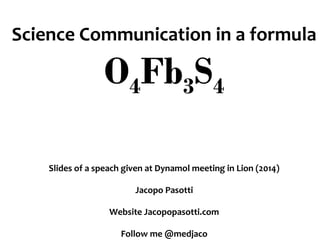
Science Communication in a formula
O4Fb3S4
The first element is for
Obstacles
What people think of scientists
What people know about science
What scientists think about the
public
What language scientists use
The 4 Obstacles
to Science Communication
Obstacle #1
The Draw-a-Scientist Test
Unvails a not too positive
Stereotype of
Scientist
Eccentric
Bordering with
madness
Evil intent
Middle-up class
Masculine
Socially inept
Caucasian
Scientist is either
a monster or a hero.
The stereotype of scientist
Needs to change.
Scientists are professionals,
normal people doing their job
Obstacle #2
The general level of scientific literacy
Is quite low
Look at what sort of questions
Specialists make to get a sense of
Scientific literacy
http://www.smithsonianmag.com/innovation/how-much-do-americans-know-
about-science-27747364/?no-ist=
Elctrons smaller than atoms: true 47%
Laser formed by sound waves: false 48%
Continents drift: true 77%
All radioactivity is human made: false 66%
17% refers to theory and experimentation
Obstacle #3
Scientists too represent an
Obstacle
To science communication
Scientists worry: public communication may badly
affect career
Scientists feel unable to communicate
3/4 scientists regard a lack of public knowledge,
education or interest in science as a barrier
1/3 scientists see the media as a barrier, not a mean
to reach out
Few scientists participated to communication
activities (public talks, speaking to media, open
days, writing)
Scientists fear speaking as death and void
Scientists do not feel free to talk (pressures from
leaders)
Obstacle #4
The language of science is obscure
Scientific concepts are obscure
To the public
Public finds
scientific debate, uncertainty, risk
confusing
Risk
statistically contructed
R = H x V
Vs.
socially contructed
What people think of scientists
What people know about science
What scientists think about the
public
Questions about language
The 4 Obstacles
to Science Communication
The second element is for
Facebook
Facebook has three good rules for
public engagement.
See them as a metaphore
for science communication
Fb on engagement:
1- Post video and pictures [in science
communication: show people objects,
people]
2- Ask questions [question their
knowledge, their beliefs, challenge them]
3- Make offers [in science communication:
invite them, visit them, prepare take home
objects, let them understand you are
offering something special]
The third element is for
Speak
I generally refer to speak as
speak out, reach out.
Here, I focus on
the act of
speaking
My
4
Tips for
Speaking out
Be
Inspired
Watch other speakers and analyse
their speach. What was strong in
their delivery? What was weak or
unconvincing? What could you try
Be
Respectful
Of your audience
Respect time - Be short
Adults – some 30 minutes
Kids – some 15 minutes
Be
physical
Eyeballing Move Voice Stance
Be
Organized
Prepare an outline
Beginning
Clarity
Body
Informative
Interesting
End
Shortness
The safe way:
Stand up
Tell them what you are going to tell
Tell them
Tell them what you have told
Sit down
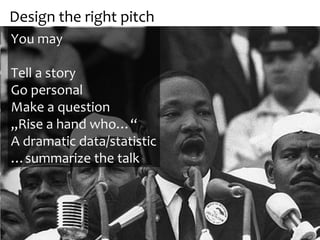
Design the right pitch
You may
Tell a story
Go personal
Make a question
„Rise a hand who…“
A dramatic data/statistic
…summarize the talk
We retain 25% of a speech…
Repeat
Repeat
Repeat
…key messages
This is not a conclusion
This is a bankrupt
Science Communication in a formula
O4Fb3S4
Slides of a speach given at Dynamol meeting in Lion (2014)
Jacopo Pasotti
Website Jacopopasotti.com
Follow me @medjaco

Science com in a formula