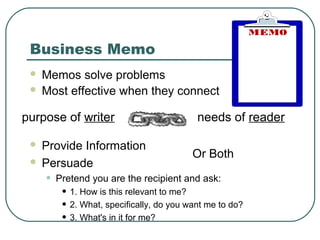
Business Memo
  Memos solve problems
  Most effective when they connect


purpose of writer                           needs of reader

  Provide Information
                                           Or Both
  Persuade

     •   Pretend you are the recipient and ask:
          • 1. How is this relevant to me?
          • 2. What, specifically, do you want me to do?
          • 3. What's in it for me?
Parts of a Memo


                  Heading
 The heading segment follows this general
  format:
 MEMO TO: (readers' names and job titles)
  FROM: (your name and job title)
  DATE: (complete and current date)
  SUBJECT: (what the memo is about)
In the heading, be Sure to…
 Address   the reader by correct name and
  job title.
 Be specific and concise in your subject
  line.
  • For example, "Rats" as a subject line
     • Could refer to production problem
     • Or personal frustration.
  • Instead, "Curtailing Rat Extremity Parts in our
    Product."
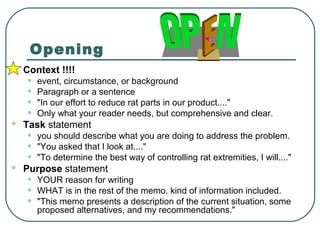
Opening
   Context !!!!
    •   event, circumstance, or background
    •   Paragraph or a sentence
    •   "In our effort to reduce rat parts in our product...."
    •   Only what your reader needs, but comprehensive and clear.
   Task statement
    •   you should describe what you are doing to address the problem.
    •   "You asked that I look at...."
    •   "To determine the best way of controlling rat extremities, I will...."
   Purpose statement
    •   YOUR reason for writing
    •   WHAT is in the rest of the memo. kind of information included.
    •   "This memo presents a description of the current situation, some
        proposed alternatives, and my recommendations."
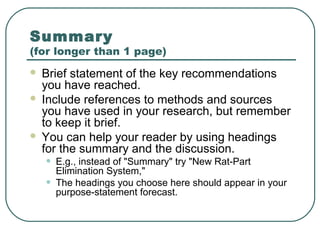
Summary
(for longer than 1 page)
 Brief statement of the key recommendations
  you have reached.
 Include references to methods and sources
  you have used in your research, but remember
  to keep it brief.
 You can help your reader by using headings
  for the summary and the discussion.
    •   E.g., instead of "Summary" try "New Rat-Part
        Elimination System,"
    •   The headings you choose here should appear in your
        purpose-statement forecast.
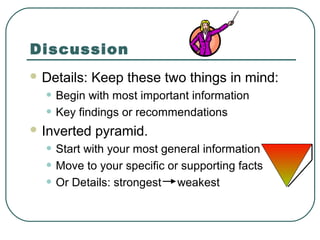
Discussion
 Details:   Keep these two things in mind:
  • Begin with most important information
  • Key findings or recommendations
 Inverted   pyramid.
  • Start with your most general information
  • Move to your specific or supporting facts
  • Or Details: strongest weakest
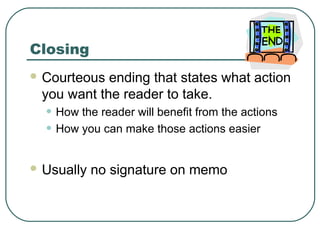
Closing
 Courteous ending that states what action
 you want the reader to take.
  • How the reader will benefit from the actions
  • How you can make those actions easier

 Usually   no signature on memo
Attachments
 Refer to attached documents, lists,
  graphs, tables, etc.
 E.g. “Attached: Several Complaints
  about Product, January - June 1997”
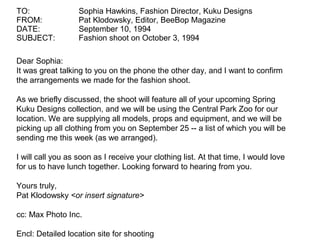
TO:                Sophia Hawkins, Fashion Director, Kuku Designs
FROM:              Pat Klodowsky, Editor, BeeBop Magazine
DATE:              September 10, 1994
SUBJECT:           Fashion shoot on October 3, 1994

Dear Sophia:
It was great talking to you on the phone the other day, and I want to confirm
the arrangements we made for the fashion shoot.

As we briefly discussed, the shoot will feature all of your upcoming Spring
Kuku Designs collection, and we will be using the Central Park Zoo for our
location. We are supplying all models, props and equipment, and we will be
picking up all clothing from you on September 25 -- a list of which you will be
sending me this week (as we arranged).

I will call you as soon as I receive your clothing list. At that time, I would love
for us to have lunch together. Looking forward to hearing from you.

Yours truly,
Pat Klodowsky <or insert signature>

cc: Max Photo Inc.

Encl: Detailed location site for shooting

Business Memo

  • 1.
    Business Memo Memos solve problems  Most effective when they connect purpose of writer needs of reader  Provide Information Or Both  Persuade • Pretend you are the recipient and ask: • 1. How is this relevant to me? • 2. What, specifically, do you want me to do? • 3. What's in it for me?
  • 2.
    Parts of aMemo Heading  The heading segment follows this general format:  MEMO TO: (readers' names and job titles) FROM: (your name and job title) DATE: (complete and current date) SUBJECT: (what the memo is about)
  • 3.
    In the heading,be Sure to…  Address the reader by correct name and job title.  Be specific and concise in your subject line. • For example, "Rats" as a subject line • Could refer to production problem • Or personal frustration. • Instead, "Curtailing Rat Extremity Parts in our Product."
  • 4.
    Opening  Context !!!! • event, circumstance, or background • Paragraph or a sentence • "In our effort to reduce rat parts in our product...." • Only what your reader needs, but comprehensive and clear.  Task statement • you should describe what you are doing to address the problem. • "You asked that I look at...." • "To determine the best way of controlling rat extremities, I will...."  Purpose statement • YOUR reason for writing • WHAT is in the rest of the memo. kind of information included. • "This memo presents a description of the current situation, some proposed alternatives, and my recommendations."
  • 5.
    Summary (for longer than1 page)  Brief statement of the key recommendations you have reached.  Include references to methods and sources you have used in your research, but remember to keep it brief.  You can help your reader by using headings for the summary and the discussion. • E.g., instead of "Summary" try "New Rat-Part Elimination System," • The headings you choose here should appear in your purpose-statement forecast.
  • 6.
    Discussion  Details: Keep these two things in mind: • Begin with most important information • Key findings or recommendations  Inverted pyramid. • Start with your most general information • Move to your specific or supporting facts • Or Details: strongest weakest
  • 7.
    Closing  Courteous endingthat states what action you want the reader to take. • How the reader will benefit from the actions • How you can make those actions easier  Usually no signature on memo
  • 8.
    Attachments  Refer toattached documents, lists, graphs, tables, etc.  E.g. “Attached: Several Complaints about Product, January - June 1997”
  • 9.
    TO: Sophia Hawkins, Fashion Director, Kuku Designs FROM: Pat Klodowsky, Editor, BeeBop Magazine DATE: September 10, 1994 SUBJECT: Fashion shoot on October 3, 1994 Dear Sophia: It was great talking to you on the phone the other day, and I want to confirm the arrangements we made for the fashion shoot. As we briefly discussed, the shoot will feature all of your upcoming Spring Kuku Designs collection, and we will be using the Central Park Zoo for our location. We are supplying all models, props and equipment, and we will be picking up all clothing from you on September 25 -- a list of which you will be sending me this week (as we arranged). I will call you as soon as I receive your clothing list. At that time, I would love for us to have lunch together. Looking forward to hearing from you. Yours truly, Pat Klodowsky <or insert signature> cc: Max Photo Inc. Encl: Detailed location site for shooting