THE  INDIAN CONTRACT ACT,  1872
CONTRACT
CONTRACT  -   According to sec.2(h), a contract is defined as an agreement enforceable before the  law. AGREEMENT  -   According to sec.2(e), every promise or set of promises forming consideration for each other. PROMISE  -   According to sec.2(b), when a person made a proposal to another to whom proposal is made, if proposal is assented there to.
OFFER -   According to Sec.2(a), when a person made a proposal, when he signifies to another his willingness to do or to abstain from doing something. AGREEMENT = OFFER + ACCEPTANCE CONSENSUS - AD – IDEM- According to Sec.13, meeting of minds or identity of minds or receiving the same thing in same sense at same time.
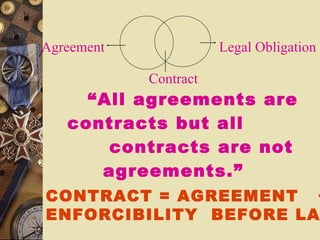
  Agreement   Legal Obligation   Contract   “All agreements are contracts but all    contracts are not agreements.”   CONTRACT = AGREEMENT  + ENFORCIBILITY  BEFORE LAW
ESSENTIAL ELEMENTS OF A VALID CONTRACT (Sec.10) 1. Offer & acceptance. 2.Intention to create legal relationship. 3.Consensus - ad - idem. 4.Consideration. 5.Capacity to contract. 6.Free consent. 7.Legality of object. 8.Possibility of performance. 9.Writing & registration.

TYPES OF CONTRACTS VALID CONTRACTS Absolute contract Contingent contract(Sec. 31-36) Express contract Implied/Quasi contract(Sec.68- 72)
Valid contract  -   If all the condition are fulfilled it is called as a valid contract. Contingent contract  -   In a contract to do or not to do something, if an event is collateral, does or doesn't happen. Express contract  -   When contracts are either in writing or in oral. Implied contract  -   When contracts are neither in writing nor in oral. Absolute contract  -   A contract which is not dependent on fulfillment of any condition.
INVALID CONTRACTS Void contract   Is void(Void - ab - initio)    Becomes void Voidable contract Illegal contract Unenforceable contract
Invalid contract  -   In a contact if any one condition is not fulfilled. Is void (Void-ab-initio)  -   An agreement which is not valid from the beginning. Becomes void  -   An agreement which is valid in the beginning but due to  some  supervening impossibility the contract becomes void.
Illegal contract  -   An agreement forbidden by law. Unenforceable contract  -   It is valid but due to some technical defect the contract becomes void. In case defects are removed  the contract is enforceable.(lack of registration, lack of signature etc.,) Voidable contract  -   A contract which is valid unless until avoided by either the party.
OTHER  TYPES  OF CONTRACTS Executed contract Executory contract Unilateral contract Bilateral contract
Executed contract   -   In a contract where both the parties have performed their obligation, there is remaining nothing to perform. Executory contract  -   In a contract where both the parties are yet to perform their obligation . Unilateral contract  -   In a contract one party has performed his obligation and other person is yet to perform his obligation. Bilateral contract  -   In a contract where both the parties have performed their obligation. Bilateral & Executory are same and inter - changeable.
OFFER
OFFER According to Sec.2(a), when a person made a proposal, when he signifies to another his willingness to do or to abstain from doing something.
TYPES OF OFFER Express offer Implied offer Specific offer General offer Cross offer Counter offer Standing offer
Express offer  -   When offer is given to another person either in writing or in oral. Implied offer  -   When offer is given to another person neither in writing   nor in oral. Specific offer  -   When offer is given to a specific person. General offer  -   When offer is given to entire world at a large.(Carlill Vs. Carbolic smoke ball Co.,)
Cross offer  -   When both the persons are making identical offers to eachother in ignorance of other’s offer. Counter offer  -   When both the persons are making offers to eachother which are not identical in ignorance of other’s offer. Standing offer  -   An offer which remains continuously enforceable for a certain period of time.
LEGAL RULES FOR OFFER Offer must be given with an intention to create a legal relationship.(Balfour Vs. Balfour) Offer must be definite.(Taylor Vs. Portington) There is a clear cut difference between offer, invitation to offer, invitation to sale. (Harris Vs. Nickerson)
Offer must be communicated. (Fitch Vs. Snedkar) Mere statement of price of price is not an offer.(Harvey Vs. Facey)
ACCEPTANCE
ACCEPTANCE According to sec.2(b), when a person made a proposal to another to whom proposal is made, if proposal is assented there to, it is called acceptance.
LEGAL RULES FOR ACCEPTANCE Acceptance must be given as per the mode prescribed by the offerer. Acceptance must be given before the lapse of time or within reasonable time. Acceptance must be unconditional. Acceptance may be given by any person in case of general offer.
Acceptance may be given by any specific person in case of specific offer. Acceptance must be communicated. (Bordgon Vs. Metropolitan Rly. Co.)  Mental acceptance is no acceptance or acceptance must not be derived from silence. Acceptance must not be precedent to offer.
CONSIDERATION
According  to  sec 2(d)  consideration  is  defined  as  “when  at  the  desire  of  the  promisor  , or  promisee  or  any  other  person  has  done  or  abstained  from  doing  or  does  or  abstains  from  doing  ,or  promises  to  do  or  to  abstain  from  doing  , something  , such  an  act  or  absinence  or  promise is  called  a  consideration  for  the  promise . CONSIDERATION
When  a  party  to  an  agreement  promises  to do something  he  must  get  “something”  in  return .This  “something”  is  defined  as  consideration. LEGAL  RULES  AS  TO  CONSIDERATION 1)It  must  move  at  the  desire  of  the  promisor.  [Durga Prasad  v. Baldeo ] 2)It  may  move  by  the  promisee . [Chinnaya v. Ramayya ] 3)It  must  be  past ,present  or  future . 4)It  need  not  be  adequate . 5)It  must  be  real . 6)It  must  not  be  illegal , immoral  or  opposed  to  public  policy .
STRANGER  TO  CONTRACT It  is  general  rule  of  contract  that  only  parties  to  contract  can  sue  &  be  sued  on  that  contract . This  rule  is  known  as  ‘Doctrine  of  privity’  i.e  relationship  between  the  parties  to  contract . Exceptions  1)A  trust  or  a  charge . 2)Marriage  settlement , partition  or  other  family  arrangements . 3)Estoppel 4)Assignment  of  contract . 5)Contract  with  agent . 6)Convenants  running  with  land .
Contract  without  consideration  is  void – Exceptions   Love  &  affection  .  [Venkataswamy  v. Rangaswamy] Compensation  for  voluntary  service . Promise  to  pay  a  time – barred  debt . Completed  gift . Agency  sec (185) . Charity . Contract  of  bailment  sec(148 ) .
No  consideration  no  contract   [Abdul  Aziz  v.  Masum  Ali] [Kedarnath  v.  Gauri  Mohamed ]
CAPACITY TO CONTRCT
Capacity  to  contract Following  are  the condition  for  a  person  to enter  into  contract  He  must  be  major He  must  be  sound  mind  He  must  not  be  disqualified  by  any  other  law.
Disqualified  persons  to  enter  into  a  contract a) Minor  b) unsound  person  c)others  i.e  alien  enemy, insolvent, convict, company/corporationagainst  MOA / AOA .
Minor According  to  Indian  majority  act  sec(3)  minor  is  defined  as  any  person  under  the  age  of  18  years . In  the  following  cases  a  person  is  said  to  be  minor  if  he  does  not  complete  the  age  of  21  years  a) any  person  under  the  guardian  &  wards  act ,1890 b)any  person  which  comes  under  superintendence  of  law/legal  representative
Rules  governing  minors  agreement Rule  1 : judges  are  counsellors , jury  is  the  servant , law  is  the  guardian . Rule  2:in  case  minor  entered  into  a  contract  which  is  unlawful , illegal , immoral  he  is  also  prosecutable  &  punishable  under  the  relevant  law.
Legal  rules   An  agreement  with  minor  is  void  ab  initio [Mohiri  Bibi v. Dharmadas  Ghase] Minor  can  be  promisee  [Shrafat  Ali  v.  Noor  Mohd] Minor  cannot  ratify  his  agreement  on  attaining  the  age  of  majority [Indra  Ramaswamy v. Anthiappa  Chettier]
Minor  as  a  shareholder , Minor  as  a  partner, Minor  as  a  agent , Minor  as  a  member  of  trade  union , No  estoppel  against  minor , He  can  plead  his  minority , He  can  enter  into  contract  for  his  necessary  [Robert v. Gray ] On  behalf  of  minor  his  parents  , guardian  or  any  other  person  can  enter  into  void  contract  to  acquire  movable  property.
Unsound  person   According  to  sec(12)  a  person  generally  sound , occasionally  unsound  can  enter  into  a  contract  when  he  of  sound  mind  A  person  generally  unsound  occasionally  sound  can  enter  onto  contract  when  he  is  sound  mind .
Persons  of  unsound  mind 1)Lunatic , 2)Idiots , 3)Drunken  or  intoxicated  persons .
FREE CONSENT
According to Sec 10 of the Indian Contract Act one of the essentials of a valid contract is “Free Consent” Sec 13 defines “consent” as “Two or more persons are said to consent when they agree upon the same thing in the same sense”.According to Sec 14, consent is said to be free when it is not caused by: 1.Coercion 2.Undue influence 3.Fraud 4.Misrepresentation 5.Mistake FREE CONSENT
According to Sec 15 coercion means “Committing or threaten to commit any act forbidden by Indian Penal Code 1860 or unlawful detaining or threating to detaining any other persons property with a view to enter into an agreement. It is immaterial whether the IPC is or is not in force where the coercion is employed”  The threat amounting to coercion need not necessarily be from a party to contract , it may also proceed from a stranger to the contract. COERCION
Consent is said to be caused by coercion when obtained by: 1.The committing or threatening to commit any act forbidden by the Indian Penal Code 2.The unlawful detaining or threatening to detain any property  It is not important whether the IPC is or not in force where the coercion is taking place.  For example A and B , both Indians are on a voyage trip to America when the ship is on the Atlantic ocean B threatens a that if doesn’t transfer his property to B’s name then he will push him into the water.now though the IPC is not in force on the Atlantic ocean it is still considered a coercion.
1.Chikkim Ammiraju vs. Seshamma: In this case a person threatened his wife  and son that he would suicide if she doesn’t transfer her property in his brother’s favour. The wife and son executed the release of the deed under the threat . Held the threat of suicide amounted to coercion within Sec  15 and the release deed was therefore voidable. This also is a very important case to prove that threat to commit  suicide amounts to coercion  Important cases:
2. Ranganayakamma vs. Alwar Setty: A young widowed girl of 13 years was forced to adopt a boy by her relatives who prevented the removal of his body for cremation until she consented. Held the consent was not free but was induces by coercion.Consequently the adoption was set aside.
3.Muthia vs. Muthu Karuppa: An agent refused to hand over the account books of a business to the new agent unless the principal released him from all liabilities.the principal had to give a release deed.held the deed was  given under coercion  and was voidable  at the option of the  principal.
4. Bansraj vs. Secretary of State: The government gave a threat of attachment against the property of P for the recovery of the fine due from his son. P paid the fine. Held contract was  induced by  coercion
UNDUE  INFLUENCE Sometimes a party is compelled to enter into a contract against his will as a result of unfair persuasion by the other party. Section 16 defines undue influence as follows A contract is said to be induced by “undue influence”where the relations subsisting between the parties are such that one of the parties is in a position to dominate the will of the other and uses that position to obtain an unfair advantage over the other
Essentials of undue influence There are two persons The relations are satisfying between them One must dominate the other There must be unfair advantage It involves the moral pressure
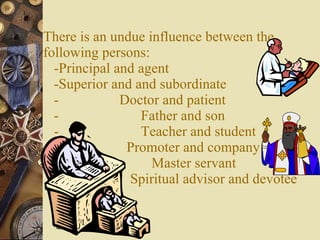
There is an undue influence between the following persons:   -Principal and agent   -Superior and and subordinate   -  Doctor and patient   -  Father and son   -  Teacher and student   -  Promoter and company   -  Master servant    -  Spiritual advisor and devotee
Among the following relations there is no undue influence 1.wife and husband 2.landlord and tenant 3.debtor and creditor CASE:  Raniannapurna vs. Swaminathan A poor Hindu widow was persuaded by a money lender to agree to pay 100% rate of interest on money lent by him. She needed the money to establish her right to maintenance.it was a clear case of undue influence and the court reduced the rate of interest to 24%
FRAUD According to Sec 17 fraud means and includes any of those acts committed by a party to contract or with his connivance or by his agent with an intent to deceive or induce a person to enter a contract: 1. The suggestion that a fact is true when it is not true and the person making it does not believe in itto be true 2. The active concealment of a fact by a person having knowledge or belief of the fact 3. A promise made without any intention of performing it 4. Any other act fitted to deceive 5. Any such act or omission as the law specially declares to be fraudulent
The essentials of fraud are: 1. There must be a representation or assertion and it must be false 2.The representation must relate to a fact 3.The representation must have been made with  the intention of inducing the other party to act upon it 4.the representation must have been made with a knowledge of its falsity 5.the other party must have subsequently suffered some loss
According to Sec 18 there is misrepresentation: When a person positively asserts a fact is true when his information does not warrant it to be so, though he believes it to be true When there is any Breach of duty by a person which brings an advantage to the person committing it by misleading another to his prejudice When a party causes however innocently the other party to the agreement to make a mistake as to the substance of the thing which s the subject of the agreement MISREPRESENTATION
Babul vs. R.A.Singh: M was a marriage broker who gave Y the photograph of a man and told him that the man was young and rich. Y conveyed the same to his daughter who agreed for the proposal. But on the day of marriage it was discovered that the man was the age of 60. There is fraud between M and Y. whereas the is misrepresentation between Y and his daughter. Important case:
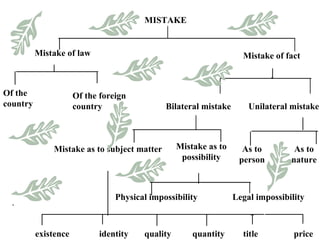
MISTAKE Mistake of fact Of the country Of the foreign country Bilateral mistake Unilateral mistake Mistake as to subject matter Mistake as to possibility As to person As to nature Physical impossibility Legal impossibility existence identity quality quantity title price Mistake of law
UNLAWFUL   OBJECTIVES  &  VOID AGREEMENTS
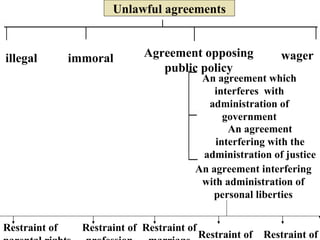
Unlawful agreements illegal immoral Agreement opposing public policy wager An agreement which interferes  with administration of government An agreement interfering with the administration of justice An agreement interfering with administration of personal liberties Restraint of parental rights Restraint of profession Restraint of marriage Restraint of trade Restraint of martial duties
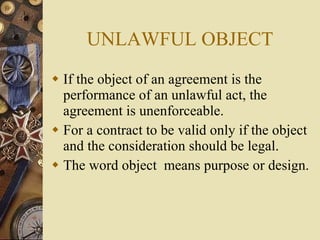
If the object of an agreement is the performance of an unlawful act, the agreement is unenforceable. For a contract to be valid only if the object and the consideration should be legal. The word object  means purpose or design. UNLAWFUL OBJECT
An agreement forbidden by law [Sec 23] An agreement defecting any provisions of law [Sec 24]  Case: Alexander vs. Rayson A leased a flat to R at a rent of 1,200 pounds.with the object of deceiving the rating authority two agreements were entered, one for 450 pounds and one for 750 pounds. A sued R for recovery of an installment of 750 pounds. Held A could not recover  and R was entitled to remain in possession of the flat. Unlawful agreements
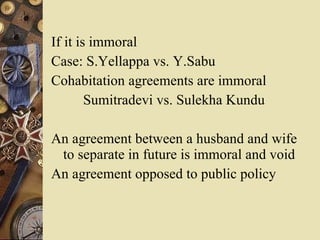
If it is immoral Case: S.Yellappa vs. Y.Sabu  Cohabitation agreements are immoral Sumitradevi vs. Sulekha Kundu An agreement between a husband and wife to separate in future is immoral and void An agreement opposed to public policy
If it is fraudulent If it is creating damage to person or property Case: Ramswaroop vs. Bansimandir B borrowed Rs. 100 from L and executed a bond promising to work for L without pay for a period of two years.In case of default B was to pay interest at a very exorbitant rate and the principal sum of once. Held the contract was void as it involved injury to the person of B.
ESSENTIAL ELEMENTS OF WAGER There are two persons. There must be an uncertain future event. No control over the event by both the parties. There must be a reciprocal promise. Others are not interested in the contract.
Wager Contract (Sec 30) A wager contract is a contract in which one person promises to another to pay money or money’s worth by the happening of an uncertain future event in consideration for other person’s promise to pay if the event does not happen.
Essential Elements of Wagering There are two persons. There must be an uncertain future event. No control over the event by both the parties. There must be a reciprocal promise. Others are not interested in the contract.
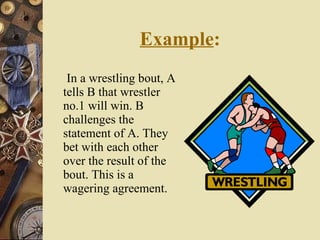
Example : In a wrestling bout, A tells B that wrestler no.1 will win. B challenges the statement of A. They bet with each other over the result of the bout. This is a wagering agreement.
CONTINGENT CONTRACTS
Contingent Contract(sec 31) A contingent contract is a contract to do or not to do something, if some event, collateral to such contract, does or does not happen. It is also called a conditional contract.
Essential Elements of a Contingent Contract : There are two persons. There must be an uncertain future event. Some control over the event but not absolute control. There is no reciprocal promise between the persons. Others may be interested in the contract. It is a valid contract.
Example: A  contracts to pay B Rs.10,000 if B’s house is burnt. This is a contingent contract.
Rules Regarding Contingent Contracts Contingent contracts dependent on happening of an uncertain future event cannot be enforced until the event has happened.( Sec 32 ) Where a contingent contracts is to be performed if a particular event does not happen, its performance can be enforced when the happening of that event becomes impossible.( Sec 33 ) If a contract is contingent upon how a person will act at an unspecified time, the event shall be considered to become impossible when such person does anything which renders it impossible that he should so act within any definite time, or otherwise than under further contingencies.( Sec 34)
Contingent contracts to do or not to do anything, if a specified uncertain event does not happen within a fixed time, may be enforced if the event does not happen or its happening becomes impossible before the expiry of that time.( Sec 35 ) Contingent agreements to do or not to do anything, if an impossible event happens, are void, whether or not the fact is known to the parties.  (Sec 36)
Differences Between a Wagering Agreement and a Contingent Agreement: Wager  agreement There is a reciprocal promise. It is a void contract. Others are not interested in the contract. It is contingent in nature. Contingent agreement There is no reciprocal promise. It is a valid contract. Others are interested in the contract.  It may not be wagering in nature.
DISCHARGE OF A CONTRACT
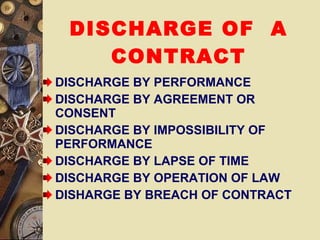
DISCHARGE OF  A CONTRACT DISCHARGE BY PERFORMANCE DISCHARGE BY AGREEMENT OR CONSENT  DISCHARGE BY IMPOSSIBILITY OF PERFORMANCE DISCHARGE BY LAPSE OF TIME  DISCHARGE BY OPERATION OF LAW DISHARGE BY BREACH OF CONTRACT
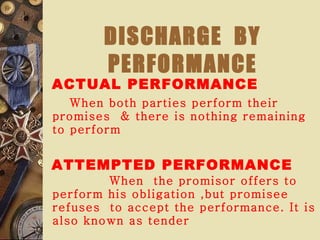
DISCHARGE  BY PERFORMANCE ACTUAL PERFORMANCE When both parties perform their promises  & there is nothing remaining to perform ATTEMPTED PERFORMANCE    When  the promisor offers to perform his obligation ,but promisee refuses  to accept the performance. It is also known as tender
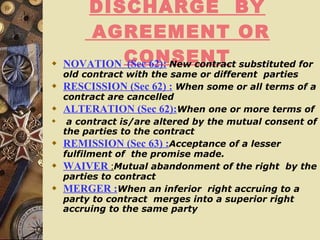
DISCHARGE  BY  AGREEMENT OR CONSENT NOVATION  (Sec 62):   New contract substituted for old contract with the same or different  parties RESCISSION (Sec 62) :   When some or all terms of a contract are cancelled ALTERATION (Sec 62): When one or more terms of  a contract is/are altered by the mutual consent of the parties to the contract REMISSION (Sec 63) : Acceptance of a lesser fulfilment of  the promise made. WAIVER  : Mutual abandonment of the right  by the parties to contract MERGER : When an inferior  right accruing to a party to contract  merges into a superior right accruing to the same party
DISCHARGE BY IMPOSSIBILITY OF PERFORMANCE KNOWN TO PARTIES  UNKNOWN TO PARTIES SUBSEQUENT IMPOSSIBILITY SUPERVENNING IMPOSSIBILITY (Sec 56) Destruction of subject matter   Non-existance of state of things   Death or incapacity of personal services   Change of law   Outbreak of war
DISCHARGE  BY LAPSE OF TIME THE LIMITATION ACT 1963, CLEARLY STATES THAT A CONTRACT SHOULD BE PERFORMED WITHIN A SPECIFIED TIME CALLED PERIOD OF LIMITATION IF IT IS NOT PERFORMED AND IF THE PROMISEE TAKES NO ACTION WITHIN THE LIMITATION TIME, THEN HE IS DEPRIVED OF HIS REMEDY AT LAW
DISCHARGE  BY OPERATION OF LAW DEATH MERGER INSOLVENCY UNAUTHORISED ALTERATION  OF THE TERMS OF  A WRITTEN AGREEMENT RIGHTS & LIABILITIES VESTING IN THE SAME PERSON
DISCHARGE  BY BREACH OF CONTRACT ACTUAL BREACH : At the time of performance  During the performance ANTICIPATORY BREACH By the act of promisor (implied repudation) By renunciation of obligation  (express repudation)
REMEDIES FOR BREACH OF CONTRACT
REMEDIES OF INJURED PARTY A remedy is a means given by law for the enforcement of a right Following are the remedies [1] Rescission of damages. [2] Suit upon quantum meruit. [3] Suit for specific performance. [4] Suit for injunction.
RESCISSION When a contract is broken by one party,the other party may sue to treat the contract as rescinded and refuse further performance.In such a case,he is absolved of all his obligations under the contract. The court may give rescission due to  1)contract is voidable.2)contract is unlawful The court may refuse to rescind if  1)Plaintiff has ratified the contract.2)Parties cannot be restored to the original position.3)The third party has acquired for value.4)When only a part is sought to be rescinded.(sec 27 of specific relief act 1937)
DAMAGES Damages are  a monetary compensation allowed to the injured party by the court for the loss or injury suffered by him by the breech of the contract.The objective of awarding damages for the breech of contract is to put the injured party in the same position as if he had not been injured.This is called the doctrine of restitution.The fundamental basis is awarding damages for the pecuniary loss.
QUANTUM MERUIT The phrase quantum meruit literally means ‘as much as earned’.A right to sue on a quantum meruit arises when a contract, partly performed by one party,has been discharged by breach of contract by the other party.This right is performed not on original contract but on implied promise by other party for what has been done.
SPECIFIC PERFORMANCE In certain cases of breach of contract damages are not an adequate remedy.The court may,in such cases,direct the party in breach to carry out his promise according to terms of the contract.This is a direction by the court for specific performance of the contract at the suit of the party not in breach Cases  for specific performance to be enforced 1)when the act agreed to be done is such that compensation is not adequate relief.2)when there is no standard for ascertaining the actual damage 3)when it is probable that compensation cannot  be agreed to be done.
INJUNCTION When a party is in breech of a negative term of contract the court may,by issuing an order,restrain him by doing what he promised  him not to do. Such an order of the court is called injunction Court refuses grant of injunction  [1] whereby  a promisor undertakes not to do something [2] which is negative in substance though not in form
QUASI CONTRACTS
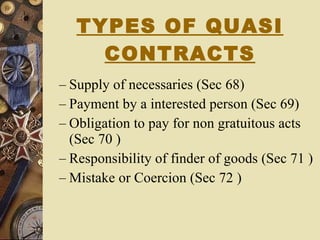
TYPES OF QUASI CONTRACTS Supply of necessaries (Sec 68) Payment by a interested person (Sec 69) Obligation to pay for non gratuitous acts (Sec 70 ) Responsibility of finder of goods (Sec 71 ) Mistake or Coercion (Sec 72 )
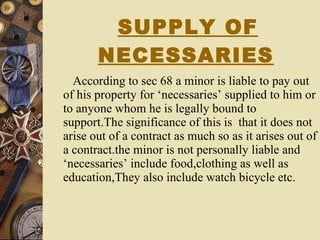
SUPPLY OF NECESSARIES   According to sec 68 a minor is liable to pay out of his property for ‘necessaries’ supplied to him or to anyone whom he is legally bound to support.The significance of this is  that it does not arise out of a contract as much so as it arises out of a contract.the minor is not personally liable and ‘necessaries’ include food,clothing as well as education,They also include watch bicycle etc.
OBLIGATION TO PAY FOR NON GRATUITOUS ACTS According to Sec 70 when a person lawfully does or delivers anything for the other ,not intending to do so gratuitously,and the person derives any benefit from it,he is liable to compensate,or restore the thing so done or delivered. Here three conditions must satisfy [1] The thing must have been done lawfully [2] The person intending to do it must not have done it  gratuitously [3] The person must have derived benefit from the act
PAYMENT BY A INTERESTED PERSON   According to Sec 69 a person who is interested in the payment of money which another is bound by law to pay,and who therefore pays it, is entitled to be reimbursed by the other. The essential elements center around  [1] The payment made should be bona fide of ones interest [2] The payment should not be a voluntary one [3] The payment must be such that the other is  bound by law to pay
RESPONSIBILITY OF THE FINDER OF GOODS According to Sec 71 a person who finds goods belonging to another and takes them into his custody is subject to the same responsibility as the bailee is bound to take as much care of the goods as a man of ordinary prudence would,In addition to that he must make efforts to trace the owner.If he does not ,he will be guilty of wrong conversation,and till the owner is found out the property will vest with the finder,he can sell in case of  [1] goods are or perishable nature [2] owner cannot be found out [3] when owner refuses to pay for the lawful charges [4] when the lawful charges amount to two thirds of thing
INDEMNITY
INDEMNITY (Sec 124) A CONTRACT BY WHICH ONE PARTY PROMISES TO ANOTHERR TO SAVE HIM FROM  LOSS CAUSED TO HIM BY THE CONDUCT OF THE PROMISOR HIMSELF , OR BY THE CONDUCT OF ANY OTHER PERSON IS CALLED A CONTRACT OF INDEMNITY
ESSENTIAL FEATURES OF INDEMNITY There are two persons , the indemnifier  the indemnified or the indemnity holder There must be loss either by the promisor’s conduct or by any other person’s conduct It is a contingent contract by nature It may be express or implied Sec125 deals with the commencement of the indemnifier’s liability. His liability commences when the event causing the loss occurs or when the event saving the indemnified from the loss becomes impossible
GUARANTEE
GUARANTEE (Sec 126) A CONTRACT OF GUARANTEE IS A CONTRACT TO PERFORM THE PROMISE, OR DISCHARGE THE LIABILITY,OF A THIRD PERSON  IN CASE OF HIS DEFAULT. THE PERSON WHO GIVES THE GUARANTEE IS KNOWN AS THE ‘SURETY’, THE PERSON IN RESPECT OF WHOM THE GUARANTEE IS GIVEN IS KNOWN AS THE ‘PRINCIPAL DEBTOR’, AND THE PERSON TO WHOM THE GUARANTEE IS GIVEN IS CALLED THE ‘CREDITOR’. A GUARANTEE MAY BE EITHER ORAL OR WRITTEN.
ESSENTIAL FEATURES OF GUARANTEE Concurrence of three contracts Primary liability is that of the principal debtor  In case the debtor is a minor , the surety’s liability becomes primary All the essentials of a valid contract It may be in writing or oral  There need not be full disclosure of facts to the surety before he gives the guarantee
TYPES OF GUARANTEE SPECIFIC GUARANTEE : When a guarantee extends to a single transaction or debt it is known as a specific or simple guarantee CONTINUING GUARANTEE : When a guarantee extends to a series of transactions  It is called continuing guarantee
BAILMENT
BAILMENT Sec 148 The word Bailment is derived from the French word “ballier” which means “to deliver” .  Bailment means delivery of goods by one person to another for some purpose ,upon a contract ,that they shall ,when the purpose is accomplished ,be returned or otherwise disposed of according to the instructions of the person delivering them. The person delivering the goods is called the  ‘bailor’  and the person to whom they are delivered is called the ‘ bailee’.
Essentials of bailment There are two persons namely Bailor and Bailee. Bailor means the person delivering the goods, Bailee means the person to whom the goods are delivered. Their must be delivery of goods . The goods must be in deliverable condition.
Only the goods are delivered but not the ownership of goods, their must be purpose. Bailey can use the goods. Goods must be returned or disposed off after the purpose is accomplished.
Duties and rights of Bailor and Bailee Duties of bailor. To disclose known faults. To bear extraordinary expenses of bailment. To indemnify bailee for loss in case of pre mature termination of gratuitous bailment. To receive back the goods. To indemnify the bailee.
Rights of bailor Enforcement of rights. Avoidance of contract.  (Sec153)   Return of goods lent gratuitously.  (Sec 159) Compensation from a wrong –doer.  (Sec 180)
Rights of bailee Delivery of goods to one of several joint   bailor of goods.   ( Sec 165). Delivery of goods to bailor without title.  (Sec 166). Right to apply to court to stop delivery.  (Sec 167) Right to action against trespassers.  (Sec 180) Bailee’ s lien.
PLEDGE
PLEDGE (SEC 172) The bailment of goods as security for payment of a  debt or performance of a promise is called “Pledge”. The bailor in this case is called the “pledger” or “pawnor” and the bailee is called the “pledgee” or “pawnee”
RIGHTS AND DUTIES OF PAWNOR AND PAWNEE Rights of Pawnee. Right of retainer. Right of retainer for subsequent advances. Right to extraordinary expenses. Right against true owner, when the Pawnor’s title is defective. Pawnee’s rights where pawnor makes default .
Rights of Pawnor Right to get back goods. Right to redeem debt. Presentation and maintenance of the goods. Rights of an ordinary debtor.
AGENCY
AGENT Sec 182 defines an agent as a person employed to do any act for another , or to represent  another in dealings with third personsthe person for whom such act is done is s called the principal
ESSENTIALS OF RELATIONSHIP OF AGENCY Agreement between principal & agent Intention of agent to act on behalf of the principal Anyone can be  an agent  Anyone can employ an agent
CREATION OF AGENCY BY EXPRESS AGREEMENT BY IMPLIED AGREEMENT Agency by estoppel   Agency by holding out Agency by neccesity AGENCY BY RATIFICATION AGENCY BY OPERATION OF LAW
REQUISITES OF VALID RATIFICATION Agent must act  as an agent for his principal Principal must be in existance at the time of contract Ratification must be with full knowledge of facts Ratification should be done within a reasonable  time of the performance of the act The act to be ratified should be of lawful nature  The ratification can be done only to the whole transaction & not any part of it (Sec 199) Ratification should be communicated with the party to contract Ratification should not cause any damages to a third party Ratification can only be of acts which principal had the right to do
SUB-AGENT  & SUBSTITUTED AGENT A  sub agent is  aperson employed & acting under the control of the agent in the business of the agency (Sec 191)  A substituted agent is a person named by the agent, on an express  or implied authority from the principal, to act for the principal (Sec 194)
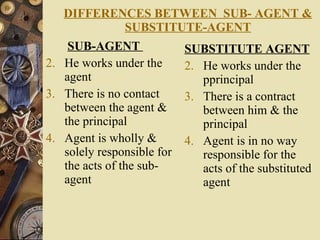
DIFFERENCES BETWEEN  SUB- AGENT & SUBSTITUTE-AGENT SUB-AGENT  He works under the agent There is no contact between the agent & the principal Agent is wholly & solely responsible for the acts of the sub-agent SUBSTITUTE AGENT He works under the pprincipal There is a contract between him & the principal Agent is in no way responsible for the acts of the substituted agent
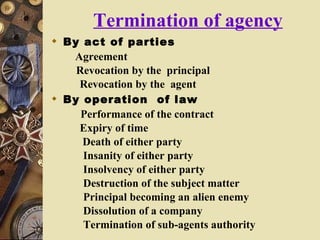
Termination of agency By act of parties  Agreement Revocation by the  principal   Revocation by the  agent By operation  of law Performance of the contract   Expiry of time   Death of either party Insanity of either party Insolvency of either party Destruction of the subject matter Principal becoming an alien enemy Dissolution of a company Termination of sub-agents authority
THANK YOU
R VIKRAM PURVA MALU MEENAKSHI VIJETHA KAKWANI N ADITHYA & S ANAND THIS PRESENTATIN IS BROUGHT TO YOU BY:


I.m.p

  • 1.
    THE INDIANCONTRACT ACT, 1872
  • 2.
  • 3.
    CONTRACT - According to sec.2(h), a contract is defined as an agreement enforceable before the law. AGREEMENT - According to sec.2(e), every promise or set of promises forming consideration for each other. PROMISE - According to sec.2(b), when a person made a proposal to another to whom proposal is made, if proposal is assented there to.
  • 4.
    OFFER - According to Sec.2(a), when a person made a proposal, when he signifies to another his willingness to do or to abstain from doing something. AGREEMENT = OFFER + ACCEPTANCE CONSENSUS - AD – IDEM- According to Sec.13, meeting of minds or identity of minds or receiving the same thing in same sense at same time.
  • 5.
    Agreement Legal Obligation Contract “All agreements are contracts but all contracts are not agreements.” CONTRACT = AGREEMENT + ENFORCIBILITY BEFORE LAW
  • 6.
    ESSENTIAL ELEMENTS OFA VALID CONTRACT (Sec.10) 1. Offer & acceptance. 2.Intention to create legal relationship. 3.Consensus - ad - idem. 4.Consideration. 5.Capacity to contract. 6.Free consent. 7.Legality of object. 8.Possibility of performance. 9.Writing & registration.
  • 7.
    TYPES OF CONTRACTSVALID CONTRACTS Absolute contract Contingent contract(Sec. 31-36) Express contract Implied/Quasi contract(Sec.68- 72)
  • 8.
    Valid contract - If all the condition are fulfilled it is called as a valid contract. Contingent contract - In a contract to do or not to do something, if an event is collateral, does or doesn't happen. Express contract - When contracts are either in writing or in oral. Implied contract - When contracts are neither in writing nor in oral. Absolute contract - A contract which is not dependent on fulfillment of any condition.
  • 9.
    INVALID CONTRACTS Voidcontract Is void(Void - ab - initio) Becomes void Voidable contract Illegal contract Unenforceable contract
  • 10.
    Invalid contract - In a contact if any one condition is not fulfilled. Is void (Void-ab-initio) - An agreement which is not valid from the beginning. Becomes void - An agreement which is valid in the beginning but due to some supervening impossibility the contract becomes void.
  • 11.
    Illegal contract - An agreement forbidden by law. Unenforceable contract - It is valid but due to some technical defect the contract becomes void. In case defects are removed the contract is enforceable.(lack of registration, lack of signature etc.,) Voidable contract - A contract which is valid unless until avoided by either the party.
  • 12.
    OTHER TYPES OF CONTRACTS Executed contract Executory contract Unilateral contract Bilateral contract
  • 13.
    Executed contract - In a contract where both the parties have performed their obligation, there is remaining nothing to perform. Executory contract - In a contract where both the parties are yet to perform their obligation . Unilateral contract - In a contract one party has performed his obligation and other person is yet to perform his obligation. Bilateral contract - In a contract where both the parties have performed their obligation. Bilateral & Executory are same and inter - changeable.
  • 14.
  • 15.
    OFFER According toSec.2(a), when a person made a proposal, when he signifies to another his willingness to do or to abstain from doing something.
  • 16.
    TYPES OF OFFERExpress offer Implied offer Specific offer General offer Cross offer Counter offer Standing offer
  • 17.
    Express offer - When offer is given to another person either in writing or in oral. Implied offer - When offer is given to another person neither in writing nor in oral. Specific offer - When offer is given to a specific person. General offer - When offer is given to entire world at a large.(Carlill Vs. Carbolic smoke ball Co.,)
  • 18.
    Cross offer - When both the persons are making identical offers to eachother in ignorance of other’s offer. Counter offer - When both the persons are making offers to eachother which are not identical in ignorance of other’s offer. Standing offer - An offer which remains continuously enforceable for a certain period of time.
  • 19.
    LEGAL RULES FOROFFER Offer must be given with an intention to create a legal relationship.(Balfour Vs. Balfour) Offer must be definite.(Taylor Vs. Portington) There is a clear cut difference between offer, invitation to offer, invitation to sale. (Harris Vs. Nickerson)
  • 20.
    Offer must becommunicated. (Fitch Vs. Snedkar) Mere statement of price of price is not an offer.(Harvey Vs. Facey)
  • 21.
  • 22.
    ACCEPTANCE According tosec.2(b), when a person made a proposal to another to whom proposal is made, if proposal is assented there to, it is called acceptance.
  • 23.
    LEGAL RULES FORACCEPTANCE Acceptance must be given as per the mode prescribed by the offerer. Acceptance must be given before the lapse of time or within reasonable time. Acceptance must be unconditional. Acceptance may be given by any person in case of general offer.
  • 24.
    Acceptance may begiven by any specific person in case of specific offer. Acceptance must be communicated. (Bordgon Vs. Metropolitan Rly. Co.) Mental acceptance is no acceptance or acceptance must not be derived from silence. Acceptance must not be precedent to offer.
  • 25.
  • 26.
    According to sec 2(d) consideration is defined as “when at the desire of the promisor , or promisee or any other person has done or abstained from doing or does or abstains from doing ,or promises to do or to abstain from doing , something , such an act or absinence or promise is called a consideration for the promise . CONSIDERATION
  • 27.
    When a party to an agreement promises to do something he must get “something” in return .This “something” is defined as consideration. LEGAL RULES AS TO CONSIDERATION 1)It must move at the desire of the promisor. [Durga Prasad v. Baldeo ] 2)It may move by the promisee . [Chinnaya v. Ramayya ] 3)It must be past ,present or future . 4)It need not be adequate . 5)It must be real . 6)It must not be illegal , immoral or opposed to public policy .
  • 28.
    STRANGER TO CONTRACT It is general rule of contract that only parties to contract can sue & be sued on that contract . This rule is known as ‘Doctrine of privity’ i.e relationship between the parties to contract . Exceptions 1)A trust or a charge . 2)Marriage settlement , partition or other family arrangements . 3)Estoppel 4)Assignment of contract . 5)Contract with agent . 6)Convenants running with land .
  • 29.
    Contract without consideration is void – Exceptions Love & affection . [Venkataswamy v. Rangaswamy] Compensation for voluntary service . Promise to pay a time – barred debt . Completed gift . Agency sec (185) . Charity . Contract of bailment sec(148 ) .
  • 30.
    No consideration no contract [Abdul Aziz v. Masum Ali] [Kedarnath v. Gauri Mohamed ]
  • 31.
  • 32.
    Capacity to contract Following are the condition for a person to enter into contract He must be major He must be sound mind He must not be disqualified by any other law.
  • 33.
    Disqualified persons to enter into a contract a) Minor b) unsound person c)others i.e alien enemy, insolvent, convict, company/corporationagainst MOA / AOA .
  • 34.
    Minor According to Indian majority act sec(3) minor is defined as any person under the age of 18 years . In the following cases a person is said to be minor if he does not complete the age of 21 years a) any person under the guardian & wards act ,1890 b)any person which comes under superintendence of law/legal representative
  • 35.
    Rules governing minors agreement Rule 1 : judges are counsellors , jury is the servant , law is the guardian . Rule 2:in case minor entered into a contract which is unlawful , illegal , immoral he is also prosecutable & punishable under the relevant law.
  • 36.
    Legal rules An agreement with minor is void ab initio [Mohiri Bibi v. Dharmadas Ghase] Minor can be promisee [Shrafat Ali v. Noor Mohd] Minor cannot ratify his agreement on attaining the age of majority [Indra Ramaswamy v. Anthiappa Chettier]
  • 37.
    Minor as a shareholder , Minor as a partner, Minor as a agent , Minor as a member of trade union , No estoppel against minor , He can plead his minority , He can enter into contract for his necessary [Robert v. Gray ] On behalf of minor his parents , guardian or any other person can enter into void contract to acquire movable property.
  • 38.
    Unsound person According to sec(12) a person generally sound , occasionally unsound can enter into a contract when he of sound mind A person generally unsound occasionally sound can enter onto contract when he is sound mind .
  • 39.
    Persons of unsound mind 1)Lunatic , 2)Idiots , 3)Drunken or intoxicated persons .
  • 40.
  • 41.
    According to Sec10 of the Indian Contract Act one of the essentials of a valid contract is “Free Consent” Sec 13 defines “consent” as “Two or more persons are said to consent when they agree upon the same thing in the same sense”.According to Sec 14, consent is said to be free when it is not caused by: 1.Coercion 2.Undue influence 3.Fraud 4.Misrepresentation 5.Mistake FREE CONSENT
  • 42.
    According to Sec15 coercion means “Committing or threaten to commit any act forbidden by Indian Penal Code 1860 or unlawful detaining or threating to detaining any other persons property with a view to enter into an agreement. It is immaterial whether the IPC is or is not in force where the coercion is employed” The threat amounting to coercion need not necessarily be from a party to contract , it may also proceed from a stranger to the contract. COERCION
  • 43.
    Consent is saidto be caused by coercion when obtained by: 1.The committing or threatening to commit any act forbidden by the Indian Penal Code 2.The unlawful detaining or threatening to detain any property It is not important whether the IPC is or not in force where the coercion is taking place. For example A and B , both Indians are on a voyage trip to America when the ship is on the Atlantic ocean B threatens a that if doesn’t transfer his property to B’s name then he will push him into the water.now though the IPC is not in force on the Atlantic ocean it is still considered a coercion.
  • 44.
    1.Chikkim Ammiraju vs.Seshamma: In this case a person threatened his wife and son that he would suicide if she doesn’t transfer her property in his brother’s favour. The wife and son executed the release of the deed under the threat . Held the threat of suicide amounted to coercion within Sec 15 and the release deed was therefore voidable. This also is a very important case to prove that threat to commit suicide amounts to coercion Important cases:
  • 45.
    2. Ranganayakamma vs.Alwar Setty: A young widowed girl of 13 years was forced to adopt a boy by her relatives who prevented the removal of his body for cremation until she consented. Held the consent was not free but was induces by coercion.Consequently the adoption was set aside.
  • 46.
    3.Muthia vs. MuthuKaruppa: An agent refused to hand over the account books of a business to the new agent unless the principal released him from all liabilities.the principal had to give a release deed.held the deed was given under coercion and was voidable at the option of the principal.
  • 47.
    4. Bansraj vs.Secretary of State: The government gave a threat of attachment against the property of P for the recovery of the fine due from his son. P paid the fine. Held contract was induced by coercion
  • 48.
    UNDUE INFLUENCESometimes a party is compelled to enter into a contract against his will as a result of unfair persuasion by the other party. Section 16 defines undue influence as follows A contract is said to be induced by “undue influence”where the relations subsisting between the parties are such that one of the parties is in a position to dominate the will of the other and uses that position to obtain an unfair advantage over the other
  • 49.
    Essentials of undueinfluence There are two persons The relations are satisfying between them One must dominate the other There must be unfair advantage It involves the moral pressure
  • 50.
    There is anundue influence between the following persons: -Principal and agent -Superior and and subordinate - Doctor and patient - Father and son - Teacher and student - Promoter and company - Master servant - Spiritual advisor and devotee
  • 51.
    Among the followingrelations there is no undue influence 1.wife and husband 2.landlord and tenant 3.debtor and creditor CASE: Raniannapurna vs. Swaminathan A poor Hindu widow was persuaded by a money lender to agree to pay 100% rate of interest on money lent by him. She needed the money to establish her right to maintenance.it was a clear case of undue influence and the court reduced the rate of interest to 24%
  • 52.
    FRAUD According toSec 17 fraud means and includes any of those acts committed by a party to contract or with his connivance or by his agent with an intent to deceive or induce a person to enter a contract: 1. The suggestion that a fact is true when it is not true and the person making it does not believe in itto be true 2. The active concealment of a fact by a person having knowledge or belief of the fact 3. A promise made without any intention of performing it 4. Any other act fitted to deceive 5. Any such act or omission as the law specially declares to be fraudulent
  • 53.
    The essentials offraud are: 1. There must be a representation or assertion and it must be false 2.The representation must relate to a fact 3.The representation must have been made with the intention of inducing the other party to act upon it 4.the representation must have been made with a knowledge of its falsity 5.the other party must have subsequently suffered some loss
  • 54.
    According to Sec18 there is misrepresentation: When a person positively asserts a fact is true when his information does not warrant it to be so, though he believes it to be true When there is any Breach of duty by a person which brings an advantage to the person committing it by misleading another to his prejudice When a party causes however innocently the other party to the agreement to make a mistake as to the substance of the thing which s the subject of the agreement MISREPRESENTATION
  • 55.
    Babul vs. R.A.Singh:M was a marriage broker who gave Y the photograph of a man and told him that the man was young and rich. Y conveyed the same to his daughter who agreed for the proposal. But on the day of marriage it was discovered that the man was the age of 60. There is fraud between M and Y. whereas the is misrepresentation between Y and his daughter. Important case:
  • 56.
    MISTAKE Mistake offact Of the country Of the foreign country Bilateral mistake Unilateral mistake Mistake as to subject matter Mistake as to possibility As to person As to nature Physical impossibility Legal impossibility existence identity quality quantity title price Mistake of law
  • 57.
    UNLAWFUL OBJECTIVES & VOID AGREEMENTS
  • 58.
    Unlawful agreements illegalimmoral Agreement opposing public policy wager An agreement which interferes with administration of government An agreement interfering with the administration of justice An agreement interfering with administration of personal liberties Restraint of parental rights Restraint of profession Restraint of marriage Restraint of trade Restraint of martial duties
  • 59.
    If the objectof an agreement is the performance of an unlawful act, the agreement is unenforceable. For a contract to be valid only if the object and the consideration should be legal. The word object means purpose or design. UNLAWFUL OBJECT
  • 60.
    An agreement forbiddenby law [Sec 23] An agreement defecting any provisions of law [Sec 24] Case: Alexander vs. Rayson A leased a flat to R at a rent of 1,200 pounds.with the object of deceiving the rating authority two agreements were entered, one for 450 pounds and one for 750 pounds. A sued R for recovery of an installment of 750 pounds. Held A could not recover and R was entitled to remain in possession of the flat. Unlawful agreements
  • 61.
    If it isimmoral Case: S.Yellappa vs. Y.Sabu Cohabitation agreements are immoral Sumitradevi vs. Sulekha Kundu An agreement between a husband and wife to separate in future is immoral and void An agreement opposed to public policy
  • 62.
    If it isfraudulent If it is creating damage to person or property Case: Ramswaroop vs. Bansimandir B borrowed Rs. 100 from L and executed a bond promising to work for L without pay for a period of two years.In case of default B was to pay interest at a very exorbitant rate and the principal sum of once. Held the contract was void as it involved injury to the person of B.
  • 63.
    ESSENTIAL ELEMENTS OFWAGER There are two persons. There must be an uncertain future event. No control over the event by both the parties. There must be a reciprocal promise. Others are not interested in the contract.
  • 64.
    Wager Contract (Sec30) A wager contract is a contract in which one person promises to another to pay money or money’s worth by the happening of an uncertain future event in consideration for other person’s promise to pay if the event does not happen.
  • 65.
    Essential Elements ofWagering There are two persons. There must be an uncertain future event. No control over the event by both the parties. There must be a reciprocal promise. Others are not interested in the contract.
  • 66.
    Example : Ina wrestling bout, A tells B that wrestler no.1 will win. B challenges the statement of A. They bet with each other over the result of the bout. This is a wagering agreement.
  • 67.
  • 68.
    Contingent Contract(sec 31)A contingent contract is a contract to do or not to do something, if some event, collateral to such contract, does or does not happen. It is also called a conditional contract.
  • 69.
    Essential Elements ofa Contingent Contract : There are two persons. There must be an uncertain future event. Some control over the event but not absolute control. There is no reciprocal promise between the persons. Others may be interested in the contract. It is a valid contract.
  • 70.
    Example: A contracts to pay B Rs.10,000 if B’s house is burnt. This is a contingent contract.
  • 71.
    Rules Regarding ContingentContracts Contingent contracts dependent on happening of an uncertain future event cannot be enforced until the event has happened.( Sec 32 ) Where a contingent contracts is to be performed if a particular event does not happen, its performance can be enforced when the happening of that event becomes impossible.( Sec 33 ) If a contract is contingent upon how a person will act at an unspecified time, the event shall be considered to become impossible when such person does anything which renders it impossible that he should so act within any definite time, or otherwise than under further contingencies.( Sec 34)
  • 72.
    Contingent contracts todo or not to do anything, if a specified uncertain event does not happen within a fixed time, may be enforced if the event does not happen or its happening becomes impossible before the expiry of that time.( Sec 35 ) Contingent agreements to do or not to do anything, if an impossible event happens, are void, whether or not the fact is known to the parties. (Sec 36)
  • 73.
    Differences Between aWagering Agreement and a Contingent Agreement: Wager agreement There is a reciprocal promise. It is a void contract. Others are not interested in the contract. It is contingent in nature. Contingent agreement There is no reciprocal promise. It is a valid contract. Others are interested in the contract. It may not be wagering in nature.
  • 74.
  • 75.
    DISCHARGE OF A CONTRACT DISCHARGE BY PERFORMANCE DISCHARGE BY AGREEMENT OR CONSENT DISCHARGE BY IMPOSSIBILITY OF PERFORMANCE DISCHARGE BY LAPSE OF TIME DISCHARGE BY OPERATION OF LAW DISHARGE BY BREACH OF CONTRACT
  • 76.
    DISCHARGE BYPERFORMANCE ACTUAL PERFORMANCE When both parties perform their promises & there is nothing remaining to perform ATTEMPTED PERFORMANCE When the promisor offers to perform his obligation ,but promisee refuses to accept the performance. It is also known as tender
  • 77.
    DISCHARGE BY AGREEMENT OR CONSENT NOVATION (Sec 62): New contract substituted for old contract with the same or different parties RESCISSION (Sec 62) : When some or all terms of a contract are cancelled ALTERATION (Sec 62): When one or more terms of a contract is/are altered by the mutual consent of the parties to the contract REMISSION (Sec 63) : Acceptance of a lesser fulfilment of the promise made. WAIVER : Mutual abandonment of the right by the parties to contract MERGER : When an inferior right accruing to a party to contract merges into a superior right accruing to the same party
  • 78.
    DISCHARGE BY IMPOSSIBILITYOF PERFORMANCE KNOWN TO PARTIES UNKNOWN TO PARTIES SUBSEQUENT IMPOSSIBILITY SUPERVENNING IMPOSSIBILITY (Sec 56) Destruction of subject matter Non-existance of state of things Death or incapacity of personal services Change of law Outbreak of war
  • 79.
    DISCHARGE BYLAPSE OF TIME THE LIMITATION ACT 1963, CLEARLY STATES THAT A CONTRACT SHOULD BE PERFORMED WITHIN A SPECIFIED TIME CALLED PERIOD OF LIMITATION IF IT IS NOT PERFORMED AND IF THE PROMISEE TAKES NO ACTION WITHIN THE LIMITATION TIME, THEN HE IS DEPRIVED OF HIS REMEDY AT LAW
  • 80.
    DISCHARGE BYOPERATION OF LAW DEATH MERGER INSOLVENCY UNAUTHORISED ALTERATION OF THE TERMS OF A WRITTEN AGREEMENT RIGHTS & LIABILITIES VESTING IN THE SAME PERSON
  • 81.
    DISCHARGE BYBREACH OF CONTRACT ACTUAL BREACH : At the time of performance During the performance ANTICIPATORY BREACH By the act of promisor (implied repudation) By renunciation of obligation (express repudation)
  • 82.
  • 83.
    REMEDIES OF INJUREDPARTY A remedy is a means given by law for the enforcement of a right Following are the remedies [1] Rescission of damages. [2] Suit upon quantum meruit. [3] Suit for specific performance. [4] Suit for injunction.
  • 84.
    RESCISSION When acontract is broken by one party,the other party may sue to treat the contract as rescinded and refuse further performance.In such a case,he is absolved of all his obligations under the contract. The court may give rescission due to 1)contract is voidable.2)contract is unlawful The court may refuse to rescind if 1)Plaintiff has ratified the contract.2)Parties cannot be restored to the original position.3)The third party has acquired for value.4)When only a part is sought to be rescinded.(sec 27 of specific relief act 1937)
  • 85.
    DAMAGES Damages are a monetary compensation allowed to the injured party by the court for the loss or injury suffered by him by the breech of the contract.The objective of awarding damages for the breech of contract is to put the injured party in the same position as if he had not been injured.This is called the doctrine of restitution.The fundamental basis is awarding damages for the pecuniary loss.
  • 86.
    QUANTUM MERUIT Thephrase quantum meruit literally means ‘as much as earned’.A right to sue on a quantum meruit arises when a contract, partly performed by one party,has been discharged by breach of contract by the other party.This right is performed not on original contract but on implied promise by other party for what has been done.
  • 87.
    SPECIFIC PERFORMANCE Incertain cases of breach of contract damages are not an adequate remedy.The court may,in such cases,direct the party in breach to carry out his promise according to terms of the contract.This is a direction by the court for specific performance of the contract at the suit of the party not in breach Cases for specific performance to be enforced 1)when the act agreed to be done is such that compensation is not adequate relief.2)when there is no standard for ascertaining the actual damage 3)when it is probable that compensation cannot be agreed to be done.
  • 88.
    INJUNCTION When aparty is in breech of a negative term of contract the court may,by issuing an order,restrain him by doing what he promised him not to do. Such an order of the court is called injunction Court refuses grant of injunction [1] whereby a promisor undertakes not to do something [2] which is negative in substance though not in form
  • 89.
  • 90.
    TYPES OF QUASICONTRACTS Supply of necessaries (Sec 68) Payment by a interested person (Sec 69) Obligation to pay for non gratuitous acts (Sec 70 ) Responsibility of finder of goods (Sec 71 ) Mistake or Coercion (Sec 72 )
  • 91.
    SUPPLY OF NECESSARIES According to sec 68 a minor is liable to pay out of his property for ‘necessaries’ supplied to him or to anyone whom he is legally bound to support.The significance of this is that it does not arise out of a contract as much so as it arises out of a contract.the minor is not personally liable and ‘necessaries’ include food,clothing as well as education,They also include watch bicycle etc.
  • 92.
    OBLIGATION TO PAYFOR NON GRATUITOUS ACTS According to Sec 70 when a person lawfully does or delivers anything for the other ,not intending to do so gratuitously,and the person derives any benefit from it,he is liable to compensate,or restore the thing so done or delivered. Here three conditions must satisfy [1] The thing must have been done lawfully [2] The person intending to do it must not have done it gratuitously [3] The person must have derived benefit from the act
  • 93.
    PAYMENT BY AINTERESTED PERSON According to Sec 69 a person who is interested in the payment of money which another is bound by law to pay,and who therefore pays it, is entitled to be reimbursed by the other. The essential elements center around [1] The payment made should be bona fide of ones interest [2] The payment should not be a voluntary one [3] The payment must be such that the other is bound by law to pay
  • 94.
    RESPONSIBILITY OF THEFINDER OF GOODS According to Sec 71 a person who finds goods belonging to another and takes them into his custody is subject to the same responsibility as the bailee is bound to take as much care of the goods as a man of ordinary prudence would,In addition to that he must make efforts to trace the owner.If he does not ,he will be guilty of wrong conversation,and till the owner is found out the property will vest with the finder,he can sell in case of [1] goods are or perishable nature [2] owner cannot be found out [3] when owner refuses to pay for the lawful charges [4] when the lawful charges amount to two thirds of thing
  • 95.
  • 96.
    INDEMNITY (Sec 124)A CONTRACT BY WHICH ONE PARTY PROMISES TO ANOTHERR TO SAVE HIM FROM LOSS CAUSED TO HIM BY THE CONDUCT OF THE PROMISOR HIMSELF , OR BY THE CONDUCT OF ANY OTHER PERSON IS CALLED A CONTRACT OF INDEMNITY
  • 97.
    ESSENTIAL FEATURES OFINDEMNITY There are two persons , the indemnifier the indemnified or the indemnity holder There must be loss either by the promisor’s conduct or by any other person’s conduct It is a contingent contract by nature It may be express or implied Sec125 deals with the commencement of the indemnifier’s liability. His liability commences when the event causing the loss occurs or when the event saving the indemnified from the loss becomes impossible
  • 98.
  • 99.
    GUARANTEE (Sec 126)A CONTRACT OF GUARANTEE IS A CONTRACT TO PERFORM THE PROMISE, OR DISCHARGE THE LIABILITY,OF A THIRD PERSON IN CASE OF HIS DEFAULT. THE PERSON WHO GIVES THE GUARANTEE IS KNOWN AS THE ‘SURETY’, THE PERSON IN RESPECT OF WHOM THE GUARANTEE IS GIVEN IS KNOWN AS THE ‘PRINCIPAL DEBTOR’, AND THE PERSON TO WHOM THE GUARANTEE IS GIVEN IS CALLED THE ‘CREDITOR’. A GUARANTEE MAY BE EITHER ORAL OR WRITTEN.
  • 100.
    ESSENTIAL FEATURES OFGUARANTEE Concurrence of three contracts Primary liability is that of the principal debtor In case the debtor is a minor , the surety’s liability becomes primary All the essentials of a valid contract It may be in writing or oral There need not be full disclosure of facts to the surety before he gives the guarantee
  • 101.
    TYPES OF GUARANTEESPECIFIC GUARANTEE : When a guarantee extends to a single transaction or debt it is known as a specific or simple guarantee CONTINUING GUARANTEE : When a guarantee extends to a series of transactions It is called continuing guarantee
  • 102.
  • 103.
    BAILMENT Sec 148The word Bailment is derived from the French word “ballier” which means “to deliver” . Bailment means delivery of goods by one person to another for some purpose ,upon a contract ,that they shall ,when the purpose is accomplished ,be returned or otherwise disposed of according to the instructions of the person delivering them. The person delivering the goods is called the ‘bailor’ and the person to whom they are delivered is called the ‘ bailee’.
  • 104.
    Essentials of bailmentThere are two persons namely Bailor and Bailee. Bailor means the person delivering the goods, Bailee means the person to whom the goods are delivered. Their must be delivery of goods . The goods must be in deliverable condition.
  • 105.
    Only the goodsare delivered but not the ownership of goods, their must be purpose. Bailey can use the goods. Goods must be returned or disposed off after the purpose is accomplished.
  • 106.
    Duties and rightsof Bailor and Bailee Duties of bailor. To disclose known faults. To bear extraordinary expenses of bailment. To indemnify bailee for loss in case of pre mature termination of gratuitous bailment. To receive back the goods. To indemnify the bailee.
  • 107.
    Rights of bailorEnforcement of rights. Avoidance of contract. (Sec153) Return of goods lent gratuitously. (Sec 159) Compensation from a wrong –doer. (Sec 180)
  • 108.
    Rights of baileeDelivery of goods to one of several joint bailor of goods. ( Sec 165). Delivery of goods to bailor without title. (Sec 166). Right to apply to court to stop delivery. (Sec 167) Right to action against trespassers. (Sec 180) Bailee’ s lien.
  • 109.
  • 110.
    PLEDGE (SEC 172)The bailment of goods as security for payment of a debt or performance of a promise is called “Pledge”. The bailor in this case is called the “pledger” or “pawnor” and the bailee is called the “pledgee” or “pawnee”
  • 111.
    RIGHTS AND DUTIESOF PAWNOR AND PAWNEE Rights of Pawnee. Right of retainer. Right of retainer for subsequent advances. Right to extraordinary expenses. Right against true owner, when the Pawnor’s title is defective. Pawnee’s rights where pawnor makes default .
  • 112.
    Rights of PawnorRight to get back goods. Right to redeem debt. Presentation and maintenance of the goods. Rights of an ordinary debtor.
  • 113.
  • 114.
    AGENT Sec 182defines an agent as a person employed to do any act for another , or to represent another in dealings with third personsthe person for whom such act is done is s called the principal
  • 115.
    ESSENTIALS OF RELATIONSHIPOF AGENCY Agreement between principal & agent Intention of agent to act on behalf of the principal Anyone can be an agent Anyone can employ an agent
  • 116.
    CREATION OF AGENCYBY EXPRESS AGREEMENT BY IMPLIED AGREEMENT Agency by estoppel Agency by holding out Agency by neccesity AGENCY BY RATIFICATION AGENCY BY OPERATION OF LAW
  • 117.
    REQUISITES OF VALIDRATIFICATION Agent must act as an agent for his principal Principal must be in existance at the time of contract Ratification must be with full knowledge of facts Ratification should be done within a reasonable time of the performance of the act The act to be ratified should be of lawful nature The ratification can be done only to the whole transaction & not any part of it (Sec 199) Ratification should be communicated with the party to contract Ratification should not cause any damages to a third party Ratification can only be of acts which principal had the right to do
  • 118.
    SUB-AGENT &SUBSTITUTED AGENT A sub agent is aperson employed & acting under the control of the agent in the business of the agency (Sec 191) A substituted agent is a person named by the agent, on an express or implied authority from the principal, to act for the principal (Sec 194)
  • 119.
    DIFFERENCES BETWEEN SUB- AGENT & SUBSTITUTE-AGENT SUB-AGENT He works under the agent There is no contact between the agent & the principal Agent is wholly & solely responsible for the acts of the sub-agent SUBSTITUTE AGENT He works under the pprincipal There is a contract between him & the principal Agent is in no way responsible for the acts of the substituted agent
  • 120.
    Termination of agencyBy act of parties Agreement Revocation by the principal Revocation by the agent By operation of law Performance of the contract Expiry of time Death of either party Insanity of either party Insolvency of either party Destruction of the subject matter Principal becoming an alien enemy Dissolution of a company Termination of sub-agents authority
  • 121.
  • 122.
    R VIKRAM PURVAMALU MEENAKSHI VIJETHA KAKWANI N ADITHYA & S ANAND THIS PRESENTATIN IS BROUGHT TO YOU BY:
  • 123.
  • 124.
  • 125.
  • 126.
  • 127.
  • 128.
  • 129.
  • 130.
  • 131.
  • 132.
  • 133.
  • 134.
  • 135.
  • 136.
  • 137.
  • 138.
  • 139.
  • 140.
  • 141.
  • 142.
  • 143.
  • 144.
  • 145.
  • 146.
  • 147.
  • 148.
  • 149.