Business Ethics
         School of Managerial and Logistic Sciences


    The German Jordanian University
                (GJU)
        Summer Semester 2012
              MGT 316

Ahmad Abo-Obid
Mohammad Arabiyat
8th May 2011
Part 2. The practice of Business Ethics

   Business Ethics A Real World Approach
         Andrew W. Ghillyer
                 2nd Edition


                New York, NY
            ISBN 9780071100656
Part 2. The practice of Business Ethics
        Chapter 6. The Role of Government

-   The Five Key Pieces of U.S Legislation
-   The purpose and significance of FCPA
-   The six key principles of DII
-   The three step process of the U.S FSGO
-   Advantages and disadvantages of SOX
-   The three key changes that made by Revised
    Federal Sentencing Guidelines for Organizations
Part 2. The practice of Business Ethics
           Chapter 6.            The Role of Government

                            Key legislation
Since the 1970s, there have been five key attempts at behavior modification
to discourage, if not prevent, illegal conduct within organizations:

1.   The Foreign Corrupt Practices Act (FCPA) (1977)
2.   The Defense Industry Initiatives (DII) (1986)
3.   The U.S. Federal Sentencing Guidelines for Organizations (FSGO) (1991)
4.   The Revised Federal Sentencing Guidelines for Organization (FSGO) (2004)
5.   The Sarbanes-Oxley Act (SOX) (2002)
1-The Foreign Corrupt Practices Act (FCPA)

• FCPA is legislation introduced to control bribery and
  other less obvious form of payment to foreign officials
  and politicians by American publicly trade companies.

• Prior to the passing of this law, the illegality of paying bribes
  was punishable only through ‘secondary’ sources of
  legislation:

1.    The Securities and Exchange Commission (SEC) could fine companies for
     failing to disclose such payments under their securities rules.
2.   The Bank Secrecy Act also required the full disclosure of funds that were
     taken out of or brought into the USA.
3.   The Mail Fraud Act made the use of the US Mail or wire communications
     to transact a fraudulent scheme illegal
1-The Foreign Corrupt Practices Act (FCPA)

• FCPA is enforced jointly by the US Department of Justice (DOJ)
  and the Securities and Exchange Commission (SEC)
• The Act encompassed all the ‘secondary’ measures that were
  currently in use to prohibit such behavior by focusing on two
  distinct areas:
1.   Disclosure the Act required corporations to fully disclose any and
     all transactions conducted with foreign officials and politicians, in
     line with the SEC provisions.
2.   Prohibition the Act incorporated the wording of the Bank Secrecy
     Act and the Mail Fraud Act to prohibit the movement of funds
     overseas for the express purpose of conducting a fraudulent
     scheme.
1-The Foreign Corrupt Practices Act (FCPA)

• FCPA formally recognizes facilitation payments, FCPA finds these
  payments acceptable (legal) provided they expedite or secure the
  performance of a routine governmental action

• Routine governmental action is any regular administrative process,
  excluding any action taken by foreign official in the decision to
  award new or continuing business.
  examples of routine governmental action include:
  -Providing permit, license or other officials document to qualify a
  person to do business in a foreign country.
  -processing governmental papers, such as visas and work orders.
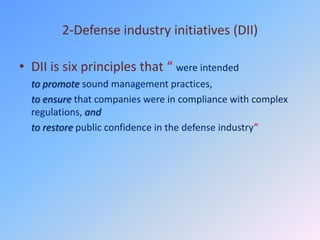
2-Defense industry initiatives (DII)

• DII is six principles that “ were intended
  to promote sound management practices,
  to ensure that companies were in compliance with complex
  regulations, and
  to restore public confidence in the defense industry”
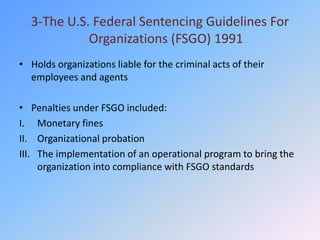
3-The U.S. Federal Sentencing Guidelines For
            Organizations (FSGO) 1991
• Holds organizations liable for the criminal acts of their
  employees and agents

• Penalties under FSGO included:
I. Monetary fines
II. Organizational probation
III. The implementation of an operational program to bring the
     organization into compliance with FSGO standards
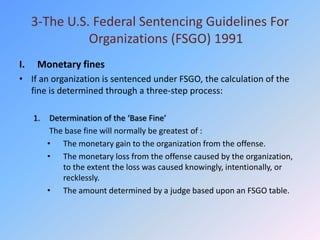
3-The U.S. Federal Sentencing Guidelines For
               Organizations (FSGO) 1991
I.    Monetary fines
• If an organization is sentenced under FSGO, the calculation of the
  fine is determined through a three-step process:

     1.    Determination of the ‘Base Fine’
           The base fine will normally be greatest of :
          • The monetary gain to the organization from the offense.
          • The monetary loss from the offense caused by the organization,
              to the extent the loss was caused knowingly, intentionally, or
              recklessly.
          • The amount determined by a judge based upon an FSGO table.
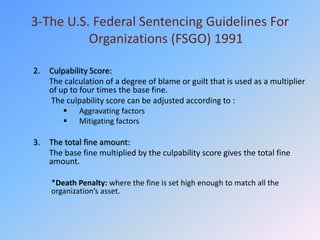
3-The U.S. Federal Sentencing Guidelines For
          Organizations (FSGO) 1991

2.   Culpability Score:
     The calculation of a degree of blame or guilt that is used as a multiplier
     of up to four times the base fine.
     The culpability score can be adjusted according to :
            Aggravating factors
            Mitigating factors

3.   The total fine amount:
     The base fine multiplied by the culpability score gives the total fine
     amount.

     *Death Penalty: where the fine is set high enough to match all the
     organization’s asset.
3-The U.S. Federal Sentencing Guidelines For
          Organizations (FSGO) 1991
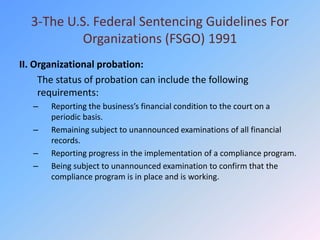
II. Organizational probation:
     The status of probation can include the following
     requirements:
   –   Reporting the business’s financial condition to the court on a
       periodic basis.
   –   Remaining subject to unannounced examinations of all financial
       records.
   –   Reporting progress in the implementation of a compliance program.
   –   Being subject to unannounced examination to confirm that the
       compliance program is in place and is working.
3-The U.S. Federal Sentencing Guidelines For
          Organizations (FSGO) 1991
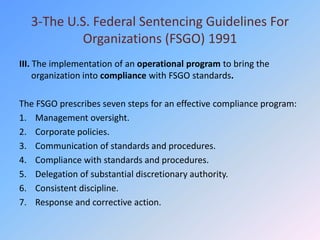
III. The implementation of an operational program to bring the
     organization into compliance with FSGO standards.

The FSGO prescribes seven steps for an effective compliance program:
1. Management oversight.
2. Corporate policies.
3. Communication of standards and procedures.
4. Compliance with standards and procedures.
5. Delegation of substantial discretionary authority.
6. Consistent discipline.
7. Response and corrective action.
4-Revised Federal Sentencing Guidelines For
          Organizations (FSGO) 2004
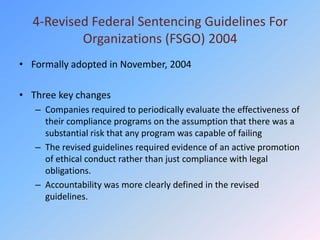
• Formally adopted in November, 2004

• Three key changes
   – Companies required to periodically evaluate the effectiveness of
     their compliance programs on the assumption that there was a
     substantial risk that any program was capable of failing
   – The revised guidelines required evidence of an active promotion
     of ethical conduct rather than just compliance with legal
     obligations.
   – Accountability was more clearly defined in the revised
     guidelines.
5-Sarbanes-Oxley Act (SOX) 2002

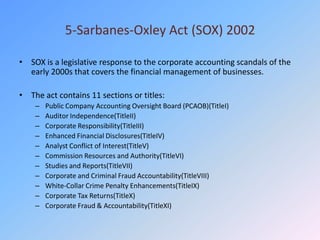
• SOX is a legislative response to the corporate accounting scandals of the
  early 2000s that covers the financial management of businesses.

• The act contains 11 sections or titles:
    –   Public Company Accounting Oversight Board (PCAOB)(TitleI)
    –   Auditor Independence(TitleII)
    –   Corporate Responsibility(TitleIII)
    –   Enhanced Financial Disclosures(TitleIV)
    –   Analyst Conflict of Interest(TitleV)
    –   Commission Resources and Authority(TitleVI)
    –   Studies and Reports(TitleVII)
    –   Corporate and Criminal Fraud Accountability(TitleVIII)
    –   White-Collar Crime Penalty Enhancements(TitleIX)
    –   Corporate Tax Returns(TitleX)
    –   Corporate Fraud & Accountability(TitleXI)

Business ethics part 2 - chapter 6

  • 1.
    Business Ethics School of Managerial and Logistic Sciences The German Jordanian University (GJU) Summer Semester 2012 MGT 316 Ahmad Abo-Obid Mohammad Arabiyat 8th May 2011
  • 2.
    Part 2. Thepractice of Business Ethics Business Ethics A Real World Approach Andrew W. Ghillyer 2nd Edition New York, NY ISBN 9780071100656
  • 3.
    Part 2. Thepractice of Business Ethics Chapter 6. The Role of Government - The Five Key Pieces of U.S Legislation - The purpose and significance of FCPA - The six key principles of DII - The three step process of the U.S FSGO - Advantages and disadvantages of SOX - The three key changes that made by Revised Federal Sentencing Guidelines for Organizations
  • 4.
    Part 2. Thepractice of Business Ethics Chapter 6. The Role of Government Key legislation Since the 1970s, there have been five key attempts at behavior modification to discourage, if not prevent, illegal conduct within organizations: 1. The Foreign Corrupt Practices Act (FCPA) (1977) 2. The Defense Industry Initiatives (DII) (1986) 3. The U.S. Federal Sentencing Guidelines for Organizations (FSGO) (1991) 4. The Revised Federal Sentencing Guidelines for Organization (FSGO) (2004) 5. The Sarbanes-Oxley Act (SOX) (2002)
  • 5.
    1-The Foreign CorruptPractices Act (FCPA) • FCPA is legislation introduced to control bribery and other less obvious form of payment to foreign officials and politicians by American publicly trade companies. • Prior to the passing of this law, the illegality of paying bribes was punishable only through ‘secondary’ sources of legislation: 1. The Securities and Exchange Commission (SEC) could fine companies for failing to disclose such payments under their securities rules. 2. The Bank Secrecy Act also required the full disclosure of funds that were taken out of or brought into the USA. 3. The Mail Fraud Act made the use of the US Mail or wire communications to transact a fraudulent scheme illegal
  • 6.
    1-The Foreign CorruptPractices Act (FCPA) • FCPA is enforced jointly by the US Department of Justice (DOJ) and the Securities and Exchange Commission (SEC) • The Act encompassed all the ‘secondary’ measures that were currently in use to prohibit such behavior by focusing on two distinct areas: 1. Disclosure the Act required corporations to fully disclose any and all transactions conducted with foreign officials and politicians, in line with the SEC provisions. 2. Prohibition the Act incorporated the wording of the Bank Secrecy Act and the Mail Fraud Act to prohibit the movement of funds overseas for the express purpose of conducting a fraudulent scheme.
  • 7.
    1-The Foreign CorruptPractices Act (FCPA) • FCPA formally recognizes facilitation payments, FCPA finds these payments acceptable (legal) provided they expedite or secure the performance of a routine governmental action • Routine governmental action is any regular administrative process, excluding any action taken by foreign official in the decision to award new or continuing business. examples of routine governmental action include: -Providing permit, license or other officials document to qualify a person to do business in a foreign country. -processing governmental papers, such as visas and work orders.
  • 8.
    2-Defense industry initiatives(DII) • DII is six principles that “ were intended to promote sound management practices, to ensure that companies were in compliance with complex regulations, and to restore public confidence in the defense industry”
  • 9.
    3-The U.S. FederalSentencing Guidelines For Organizations (FSGO) 1991 • Holds organizations liable for the criminal acts of their employees and agents • Penalties under FSGO included: I. Monetary fines II. Organizational probation III. The implementation of an operational program to bring the organization into compliance with FSGO standards
  • 10.
    3-The U.S. FederalSentencing Guidelines For Organizations (FSGO) 1991 I. Monetary fines • If an organization is sentenced under FSGO, the calculation of the fine is determined through a three-step process: 1. Determination of the ‘Base Fine’ The base fine will normally be greatest of : • The monetary gain to the organization from the offense. • The monetary loss from the offense caused by the organization, to the extent the loss was caused knowingly, intentionally, or recklessly. • The amount determined by a judge based upon an FSGO table.
  • 11.
    3-The U.S. FederalSentencing Guidelines For Organizations (FSGO) 1991 2. Culpability Score: The calculation of a degree of blame or guilt that is used as a multiplier of up to four times the base fine. The culpability score can be adjusted according to :  Aggravating factors  Mitigating factors 3. The total fine amount: The base fine multiplied by the culpability score gives the total fine amount. *Death Penalty: where the fine is set high enough to match all the organization’s asset.
  • 12.
    3-The U.S. FederalSentencing Guidelines For Organizations (FSGO) 1991 II. Organizational probation: The status of probation can include the following requirements: – Reporting the business’s financial condition to the court on a periodic basis. – Remaining subject to unannounced examinations of all financial records. – Reporting progress in the implementation of a compliance program. – Being subject to unannounced examination to confirm that the compliance program is in place and is working.
  • 13.
    3-The U.S. FederalSentencing Guidelines For Organizations (FSGO) 1991 III. The implementation of an operational program to bring the organization into compliance with FSGO standards. The FSGO prescribes seven steps for an effective compliance program: 1. Management oversight. 2. Corporate policies. 3. Communication of standards and procedures. 4. Compliance with standards and procedures. 5. Delegation of substantial discretionary authority. 6. Consistent discipline. 7. Response and corrective action.
  • 14.
    4-Revised Federal SentencingGuidelines For Organizations (FSGO) 2004 • Formally adopted in November, 2004 • Three key changes – Companies required to periodically evaluate the effectiveness of their compliance programs on the assumption that there was a substantial risk that any program was capable of failing – The revised guidelines required evidence of an active promotion of ethical conduct rather than just compliance with legal obligations. – Accountability was more clearly defined in the revised guidelines.
  • 15.
    5-Sarbanes-Oxley Act (SOX)2002 • SOX is a legislative response to the corporate accounting scandals of the early 2000s that covers the financial management of businesses. • The act contains 11 sections or titles: – Public Company Accounting Oversight Board (PCAOB)(TitleI) – Auditor Independence(TitleII) – Corporate Responsibility(TitleIII) – Enhanced Financial Disclosures(TitleIV) – Analyst Conflict of Interest(TitleV) – Commission Resources and Authority(TitleVI) – Studies and Reports(TitleVII) – Corporate and Criminal Fraud Accountability(TitleVIII) – White-Collar Crime Penalty Enhancements(TitleIX) – Corporate Tax Returns(TitleX) – Corporate Fraud & Accountability(TitleXI)