Read Anytime Anywhere Easy TestBank Download at testbankmall.com
Solution Manual for Government and Not-for-Profit
Accounting: Concepts and Practices, 8th Edition,
H. Granof
https://testbankmall.com/product/solution-manual-for-
government-and-not-for-profit-accounting-concepts-and-
practices-8th-edition-h-granof/
OR CLICK HERE
DOWLOAD EBOOK
Visit and Get More TestBank Download Instantly at https://testbankmall.com
Instant digital products (PDF, ePub, MOBI) ready for you
Download now and discover formats that fit your needs...
Start reading on any device today!
Government and Not-for-Profit Accounting Concepts and
Practices Granof 6th Edition Solutions Manual
https://testbankmall.com/product/government-and-not-for-profit-
accounting-concepts-and-practices-granof-6th-edition-solutions-manual/
testbankmall.com
Solution Manual for Government and Not For Profit
Accounting: Concepts and Practices, 6th Edition, Michael
H. Granof Saleha B. Khumawala
https://testbankmall.com/product/solution-manual-for-government-and-
not-for-profit-accounting-concepts-and-practices-6th-edition-michael-
h-granof-saleha-b-khumawala/
testbankmall.com
Government and Not-for-Profit Accounting Concepts and
Practices Granof Khumawala 5th Edition Solutions Manual
https://testbankmall.com/product/government-and-not-for-profit-
accounting-concepts-and-practices-granof-khumawala-5th-edition-
solutions-manual/
testbankmall.com
Test Bank for Government and Not for Profit Accounting
Concepts and Practices, 5th Edition: Granof
https://testbankmall.com/product/test-bank-for-government-and-not-for-
profit-accounting-concepts-and-practices-5th-edition-granof/
testbankmall.com
Solution manual for Government and Not-For-Profit
Accounting: Concepts and Practices, 7th Edition
https://testbankmall.com/product/solution-manual-for-government-and-
not-for-profit-accounting-concepts-and-practices-7th-edition/
testbankmall.com
Test Bank for Government and Not-for-Profit Accounting 8th
by Granof
https://testbankmall.com/product/test-bank-for-government-and-not-for-
profit-accounting-8th-by-granof/
testbankmall.com
Test Bank for Government and Not-For-Profit Accounting:
Concepts and Practices, 7th Edition
https://testbankmall.com/product/test-bank-for-government-and-not-for-
profit-accounting-concepts-and-practices-7th-edition/
testbankmall.com
Test Bank for Core Concepts of Government and Not-for-
Profit Accounting, 2nd Edition, Granof,
https://testbankmall.com/product/test-bank-for-core-concepts-of-
government-and-not-for-profit-accounting-2nd-edition-granof/
testbankmall.com
Solution Manual for Introduction to Governmental and Not-
for-Profit Accounting, 7/E 7th Edition
https://testbankmall.com/product/solution-manual-for-introduction-to-
governmental-and-not-for-profit-accounting-7-e-7th-edition/
testbankmall.com
Granof, Khumawala, Calabrese & Smith 8e, Government and Not-for-Profit Accounting
1-2
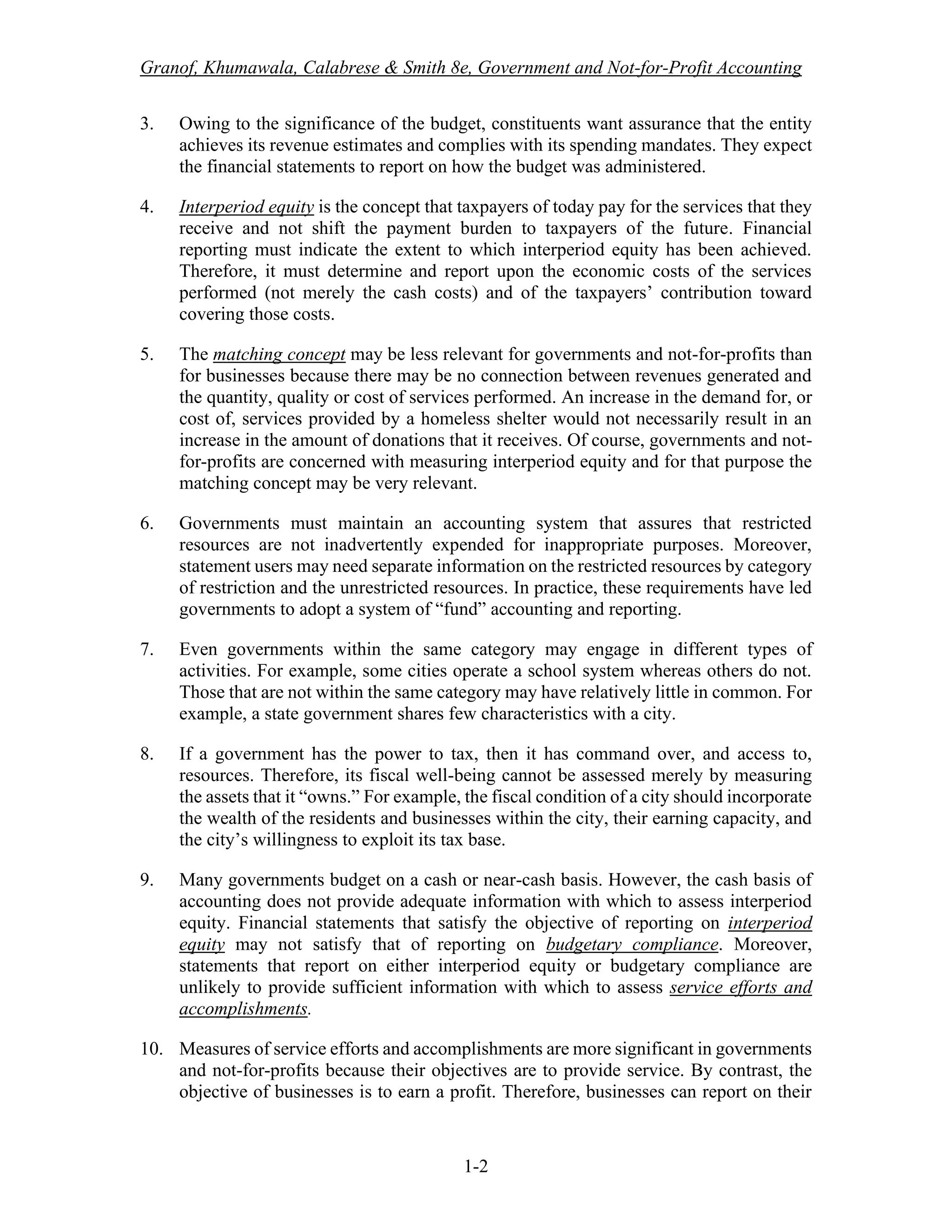
3. Owing to the significance of the budget, constituents want assurance that the entity
achieves its revenue estimates and complies with its spending mandates. They expect
the financial statements to report on how the budget was administered.
4. Interperiod equity is the concept that taxpayers of today pay for the services that they
receive and not shift the payment burden to taxpayers of the future. Financial
reporting must indicate the extent to which interperiod equity has been achieved.
Therefore, it must determine and report upon the economic costs of the services
performed (not merely the cash costs) and of the taxpayers’ contribution toward
covering those costs.
5. The matching concept may be less relevant for governments and not-for-profits than
for businesses because there may be no connection between revenues generated and
the quantity, quality or cost of services performed. An increase in the demand for, or
cost of, services provided by a homeless shelter would not necessarily result in an
increase in the amount of donations that it receives. Of course, governments and not-
for-profits are concerned with measuring interperiod equity and for that purpose the
matching concept may be very relevant.
6. Governments must maintain an accounting system that assures that restricted
resources are not inadvertently expended for inappropriate purposes. Moreover,
statement users may need separate information on the restricted resources by category
of restriction and the unrestricted resources. In practice, these requirements have led
governments to adopt a system of “fund” accounting and reporting.
7. Even governments within the same category may engage in different types of
activities. For example, some cities operate a school system whereas others do not.
Those that are not within the same category may have relatively little in common. For
example, a state government shares few characteristics with a city.
8. If a government has the power to tax, then it has command over, and access to,
resources. Therefore, its fiscal well-being cannot be assessed merely by measuring
the assets that it “owns.” For example, the fiscal condition of a city should incorporate
the wealth of the residents and businesses within the city, their earning capacity, and
the city’s willingness to exploit its tax base.
9. Many governments budget on a cash or near-cash basis. However, the cash basis of
accounting does not provide adequate information with which to assess interperiod
equity. Financial statements that satisfy the objective of reporting on interperiod
equity may not satisfy that of reporting on budgetary compliance. Moreover,
statements that report on either interperiod equity or budgetary compliance are
unlikely to provide sufficient information with which to assess service efforts and
accomplishments.
10. Measures of service efforts and accomplishments are more significant in governments
and not-for-profits because their objectives are to provide service. By contrast, the
objective of businesses is to earn a profit. Therefore, businesses can report on their
Granof, Khumawala, Calabrese & Smith 8e, Government and Not-for-Profit Accounting
1-3
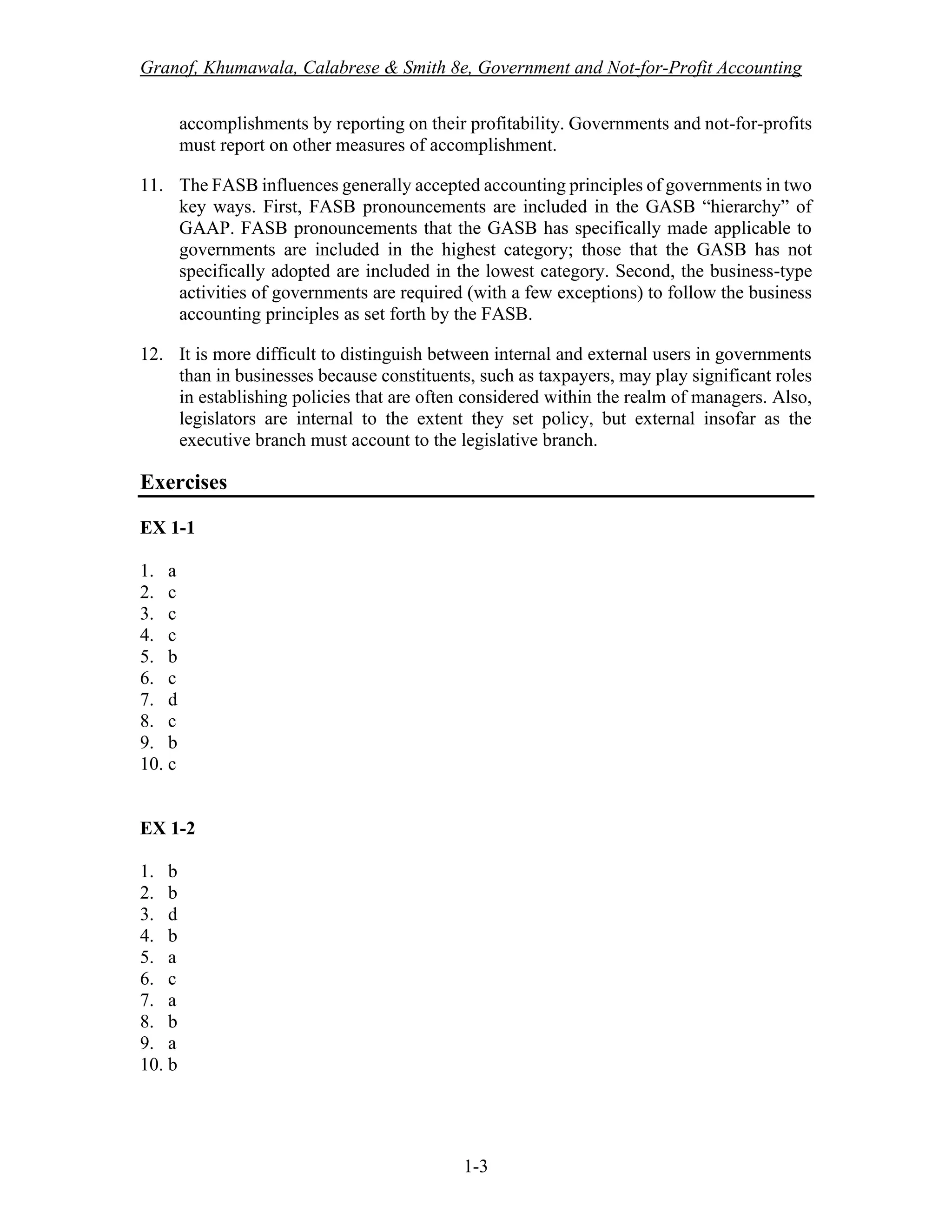
accomplishments by reporting on their profitability. Governments and not-for-profits
must report on other measures of accomplishment.
11. The FASB influences generally accepted accounting principles of governments in two
key ways. First, FASB pronouncements are included in the GASB “hierarchy” of
GAAP. FASB pronouncements that the GASB has specifically made applicable to
governments are included in the highest category; those that the GASB has not
specifically adopted are included in the lowest category. Second, the business-type
activities of governments are required (with a few exceptions) to follow the business
accounting principles as set forth by the FASB.
12. It is more difficult to distinguish between internal and external users in governments
than in businesses because constituents, such as taxpayers, may play significant roles
in establishing policies that are often considered within the realm of managers. Also,
legislators are internal to the extent they set policy, but external insofar as the
executive branch must account to the legislative branch.
Exercises
EX 1-1
1. a
2. c
3. c
4. c
5. b
6. c
7. d
8. c
9. b
10. c
EX 1-2
1. b
2. b
3. d
4. b
5. a
6. c
7. a
8. b
9. a
10. b
Granof, Khumawala, Calabrese & Smith 8e, Government and Not-for-Profit Accounting
1-4
EX 1-3
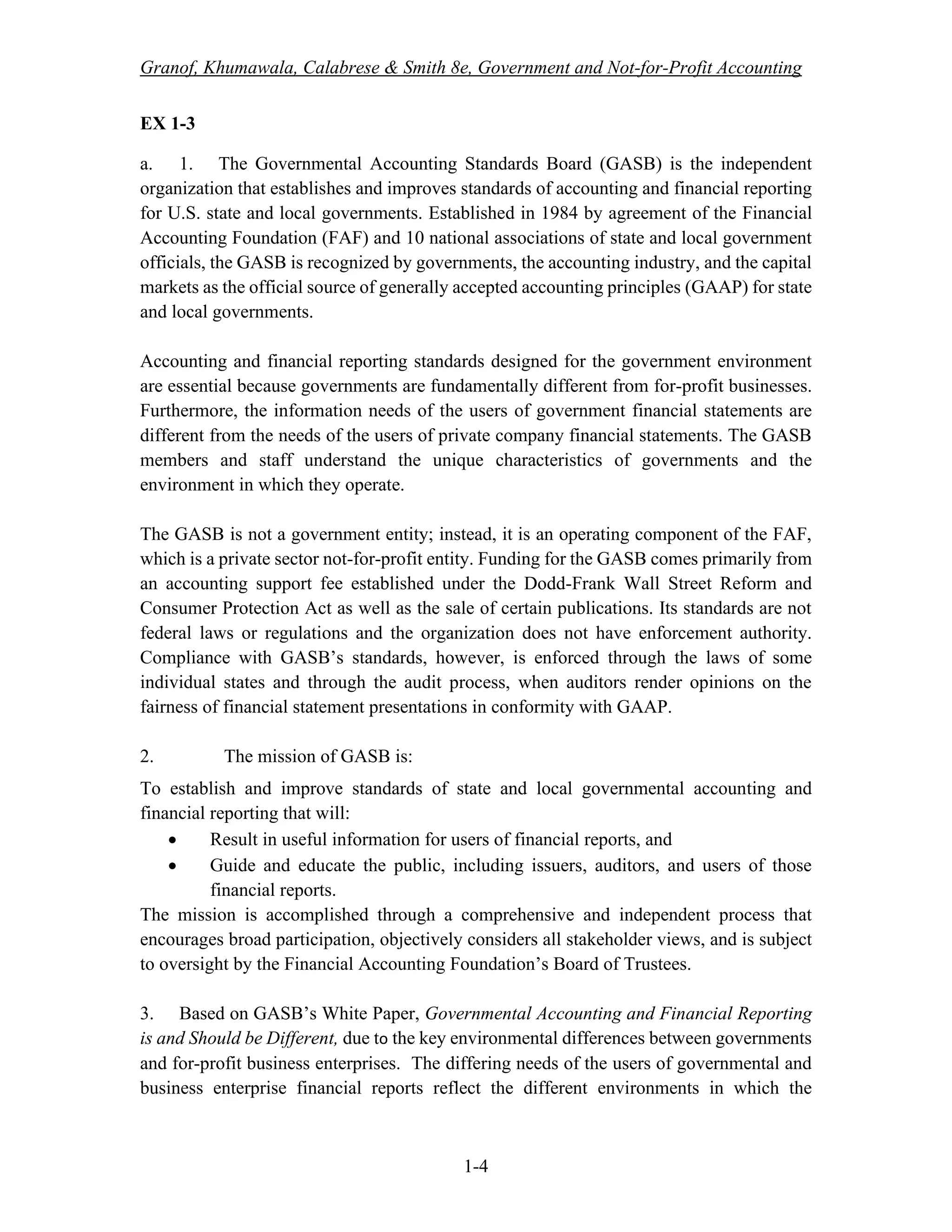
a. 1. The Governmental Accounting Standards Board (GASB) is the independent
organization that establishes and improves standards of accounting and financial reporting
for U.S. state and local governments. Established in 1984 by agreement of the Financial
Accounting Foundation (FAF) and 10 national associations of state and local government
officials, the GASB is recognized by governments, the accounting industry, and the capital
markets as the official source of generally accepted accounting principles (GAAP) for state
and local governments.
Accounting and financial reporting standards designed for the government environment
are essential because governments are fundamentally different from for-profit businesses.
Furthermore, the information needs of the users of government financial statements are
different from the needs of the users of private company financial statements. The GASB
members and staff understand the unique characteristics of governments and the
environment in which they operate.
The GASB is not a government entity; instead, it is an operating component of the FAF,
which is a private sector not-for-profit entity. Funding for the GASB comes primarily from
an accounting support fee established under the Dodd-Frank Wall Street Reform and
Consumer Protection Act as well as the sale of certain publications. Its standards are not
federal laws or regulations and the organization does not have enforcement authority.
Compliance with GASB’s standards, however, is enforced through the laws of some
individual states and through the audit process, when auditors render opinions on the
fairness of financial statement presentations in conformity with GAAP.
2. The mission of GASB is:
To establish and improve standards of state and local governmental accounting and
financial reporting that will:
• Result in useful information for users of financial reports, and
• Guide and educate the public, including issuers, auditors, and users of those
financial reports.
The mission is accomplished through a comprehensive and independent process that
encourages broad participation, objectively considers all stakeholder views, and is subject
to oversight by the Financial Accounting Foundation’s Board of Trustees.
3. Based on GASB’s White Paper, Governmental Accounting and Financial Reporting
is and Should be Different, due to the key environmental differences between governments
and for-profit business enterprises. The differing needs of the users of governmental and
business enterprise financial reports reflect the different environments in which the
Granof, Khumawala, Calabrese & Smith 8e, Government and Not-for-Profit Accounting
1-5
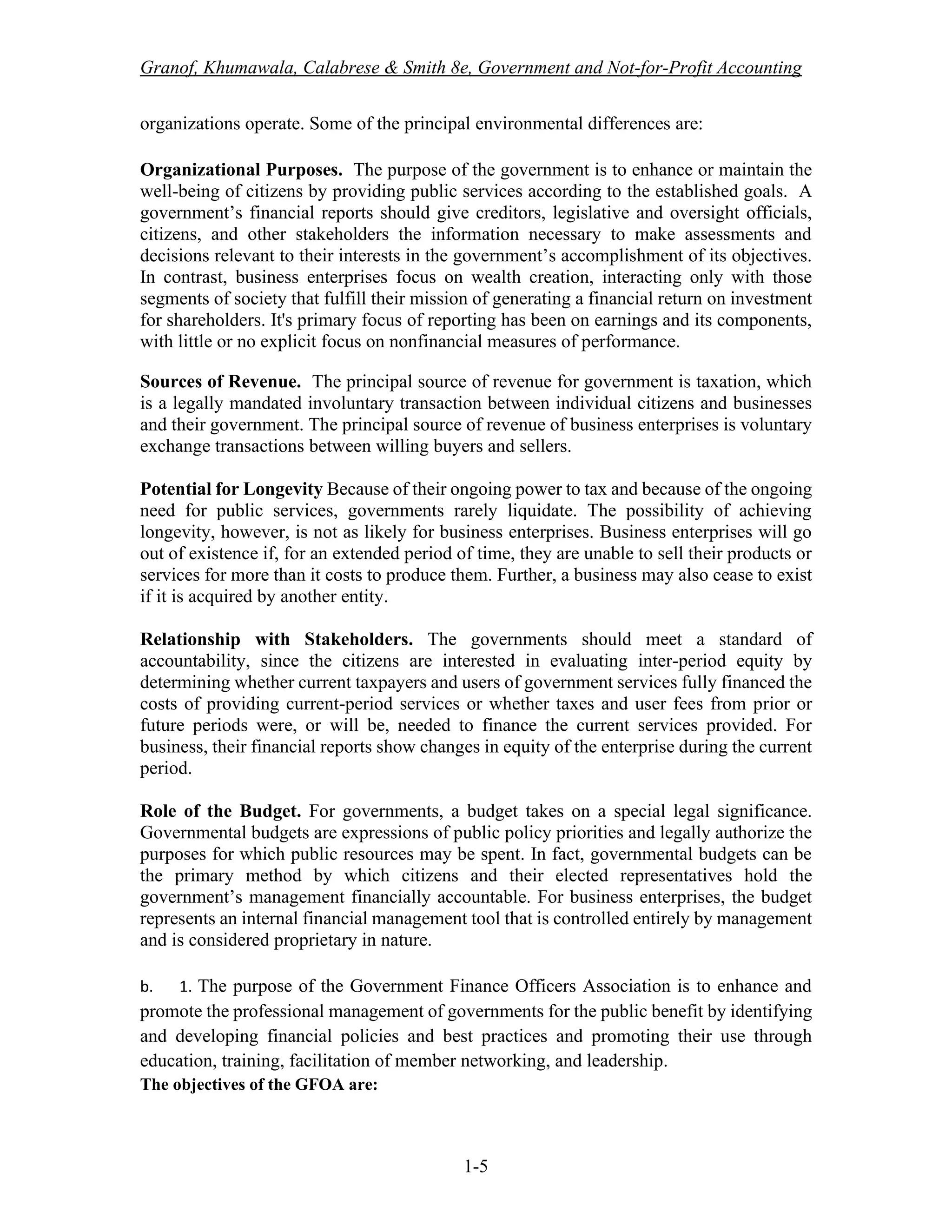
organizations operate. Some of the principal environmental differences are:
Organizational Purposes. The purpose of the government is to enhance or maintain the
well-being of citizens by providing public services according to the established goals. A
government’s financial reports should give creditors, legislative and oversight officials,
citizens, and other stakeholders the information necessary to make assessments and
decisions relevant to their interests in the government’s accomplishment of its objectives.
In contrast, business enterprises focus on wealth creation, interacting only with those
segments of society that fulfill their mission of generating a financial return on investment
for shareholders. It's primary focus of reporting has been on earnings and its components,
with little or no explicit focus on nonfinancial measures of performance.
Sources of Revenue. The principal source of revenue for government is taxation, which
is a legally mandated involuntary transaction between individual citizens and businesses
and their government. The principal source of revenue of business enterprises is voluntary
exchange transactions between willing buyers and sellers.
Potential for Longevity Because of their ongoing power to tax and because of the ongoing
need for public services, governments rarely liquidate. The possibility of achieving
longevity, however, is not as likely for business enterprises. Business enterprises will go
out of existence if, for an extended period of time, they are unable to sell their products or
services for more than it costs to produce them. Further, a business may also cease to exist
if it is acquired by another entity.
Relationship with Stakeholders. The governments should meet a standard of
accountability, since the citizens are interested in evaluating inter-period equity by
determining whether current taxpayers and users of government services fully financed the
costs of providing current-period services or whether taxes and user fees from prior or
future periods were, or will be, needed to finance the current services provided. For
business, their financial reports show changes in equity of the enterprise during the current
period.
Role of the Budget. For governments, a budget takes on a special legal significance.
Governmental budgets are expressions of public policy priorities and legally authorize the
purposes for which public resources may be spent. In fact, governmental budgets can be
the primary method by which citizens and their elected representatives hold the
government’s management financially accountable. For business enterprises, the budget
represents an internal financial management tool that is controlled entirely by management
and is considered proprietary in nature.
b. 1. The purpose of the Government Finance Officers Association is to enhance and
promote the professional management of governments for the public benefit by identifying
and developing financial policies and best practices and promoting their use through
education, training, facilitation of member networking, and leadership.
The objectives of the GFOA are:
Granof, Khumawala, Calabrese & Smith 8e, Government and Not-for-Profit Accounting
1-6
• Expert Knowledge. Continue to be recognized as a leading source of expert knowledge
in public financial management by exercising leadership in research, recommended
practice and policy development and information dissemination.
• Education and Training. Enhance the expertise and professionalism of financial
managers and policy makers and provide recognition for their achievements.
• Leadership Development. Engage in efforts to assist finance officers to develop the
skills and capabilities necessary to enable them to become organizational leaders as
well as technical experts.
• Raising Public Awareness of Sound Financial Policy and Practice. Take leadership in
promoting public awareness of policies and practices that enhance sound financial
management of public resources.
• Enhanced Cooperation. Cooperate with and complement the services provided by
other organizations (U.S., Canadian and international) to increase the effectiveness of
GFOA.
• Strategic Use of Technology. Provide information and analytical tools to help
governments identify and apply appropriate, economical technologies to support
efficient resource allocation, quality services and effective decision-making and to
promote citizen involvement.
• Association Operations. Conduct the operations of the Association in a manner that
exemplifies the highest standards of financial management and member service.
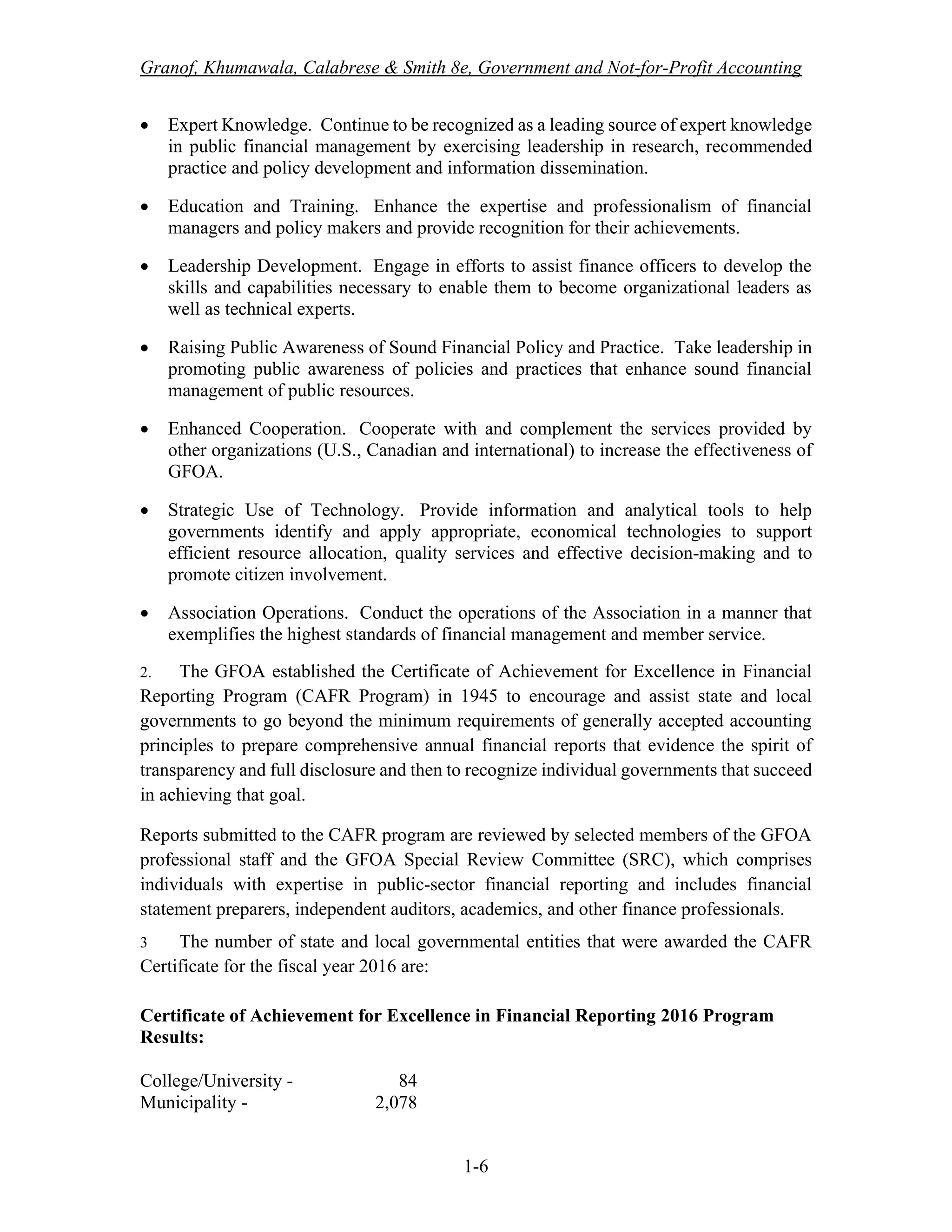
2. The GFOA established the Certificate of Achievement for Excellence in Financial
Reporting Program (CAFR Program) in 1945 to encourage and assist state and local
governments to go beyond the minimum requirements of generally accepted accounting
principles to prepare comprehensive annual financial reports that evidence the spirit of
transparency and full disclosure and then to recognize individual governments that succeed
in achieving that goal.
Reports submitted to the CAFR program are reviewed by selected members of the GFOA
professional staff and the GFOA Special Review Committee (SRC), which comprises
individuals with expertise in public-sector financial reporting and includes financial
statement preparers, independent auditors, academics, and other finance professionals.
3 The number of state and local governmental entities that were awarded the CAFR
Certificate for the fiscal year 2016 are:
Certificate of Achievement for Excellence in Financial Reporting 2016 Program
Results:
College/University - 84
Municipality - 2,078
Granof, Khumawala, Calabrese & Smith 8e, Government and Not-for-Profit Accounting
1-7
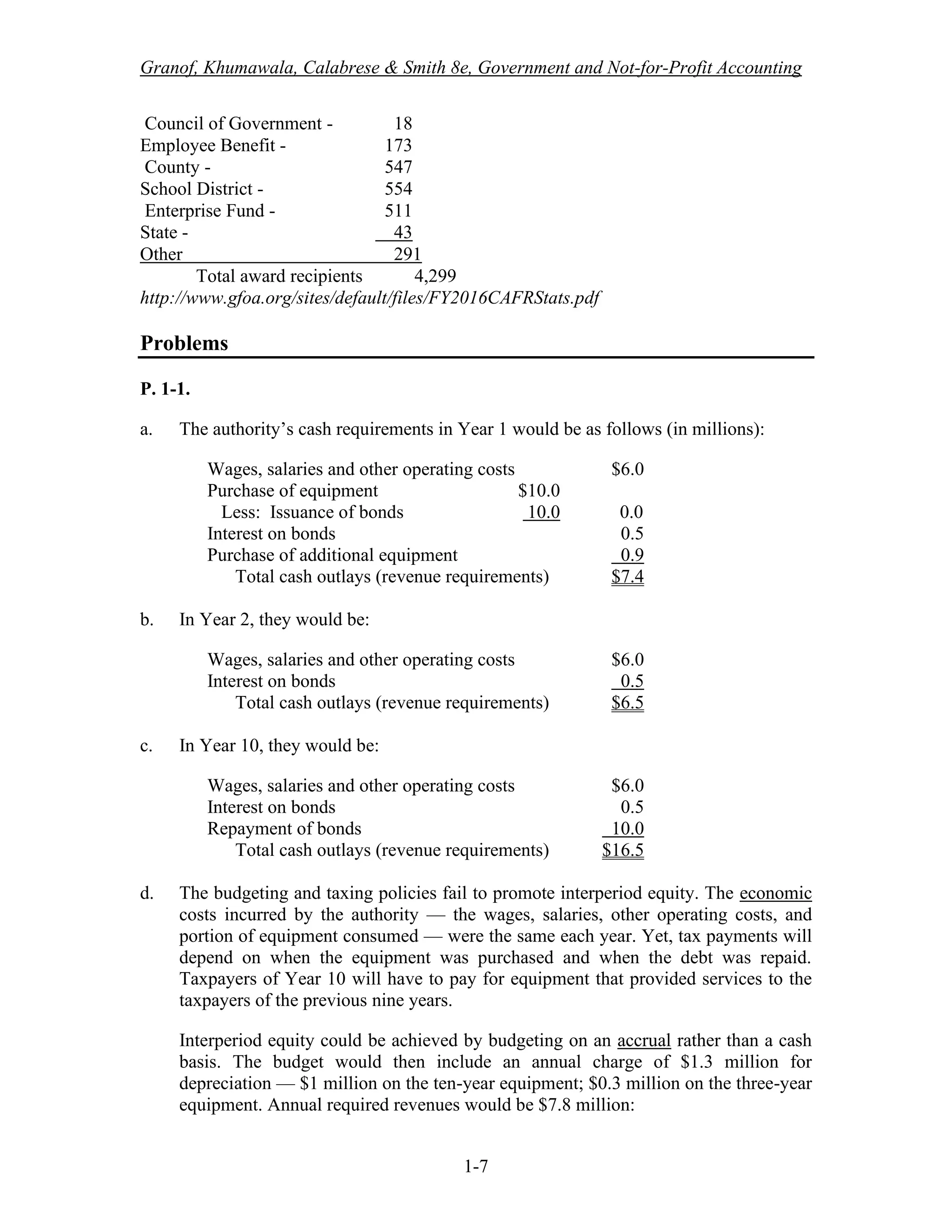
Council of Government - 18
Employee Benefit - 173
County - 547
School District - 554
Enterprise Fund - 511
State - 43
Other 291
Total award recipients 4,299
http://www.gfoa.org/sites/default/files/FY2016CAFRStats.pdf
Problems
P. 1-1.
a. The authority’s cash requirements in Year 1 would be as follows (in millions):
Wages, salaries and other operating costs $6.0
Purchase of equipment $10.0
Less: Issuance of bonds 10.0 0.0
Interest on bonds 0.5
Purchase of additional equipment 0.9
Total cash outlays (revenue requirements) $7.4
b. In Year 2, they would be:
Wages, salaries and other operating costs $6.0
Interest on bonds 0.5
Total cash outlays (revenue requirements) $6.5
c. In Year 10, they would be:
Wages, salaries and other operating costs $6.0
Interest on bonds 0.5
Repayment of bonds 10.0
Total cash outlays (revenue requirements) $16.5
d. The budgeting and taxing policies fail to promote interperiod equity. The economic
costs incurred by the authority — the wages, salaries, other operating costs, and
portion of equipment consumed — were the same each year. Yet, tax payments will
depend on when the equipment was purchased and when the debt was repaid.
Taxpayers of Year 10 will have to pay for equipment that provided services to the
taxpayers of the previous nine years.
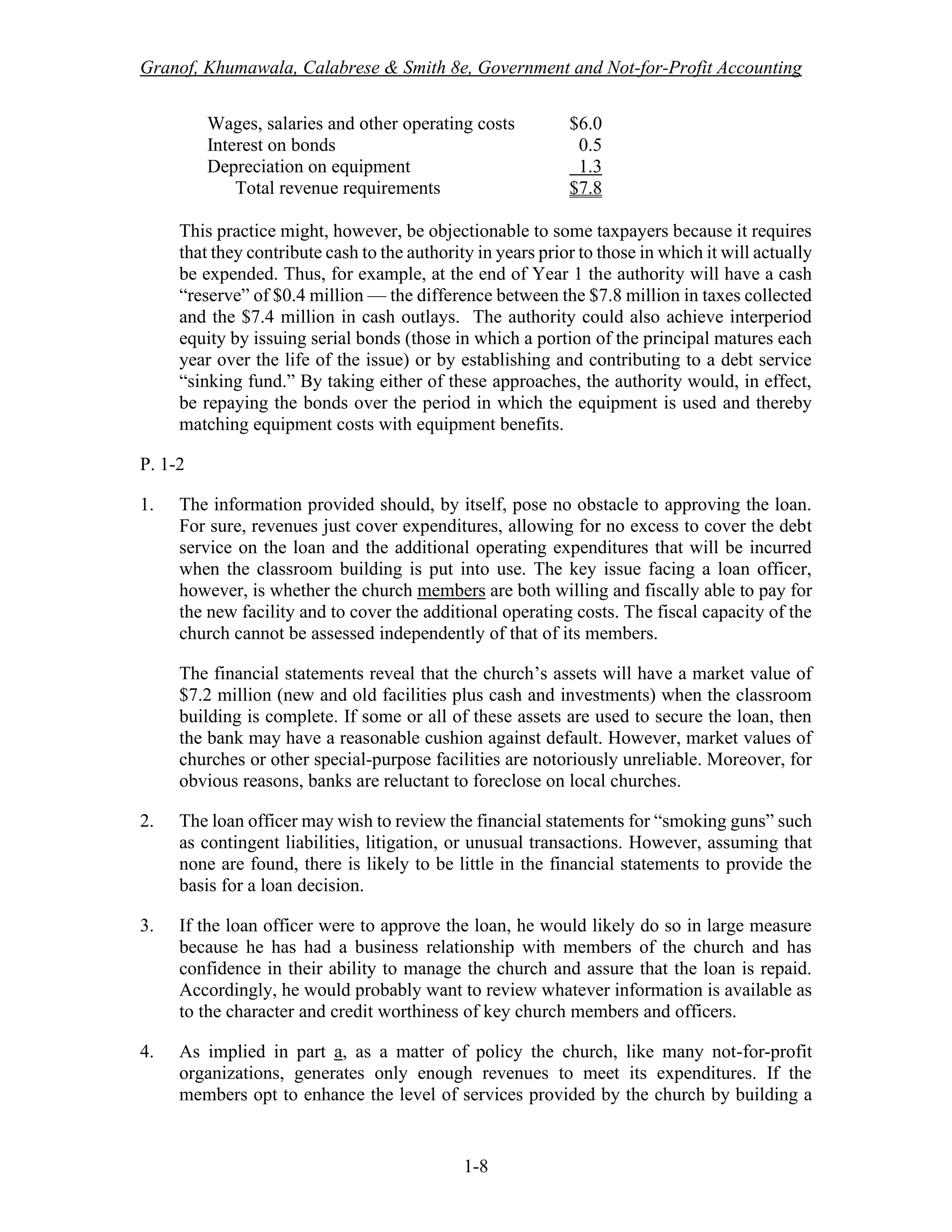
Interperiod equity could be achieved by budgeting on an accrual rather than a cash
basis. The budget would then include an annual charge of $1.3 million for
depreciation — $1 million on the ten-year equipment; $0.3 million on the three-year
equipment. Annual required revenues would be $7.8 million:
Granof, Khumawala, Calabrese & Smith 8e, Government and Not-for-Profit Accounting
1-8
Wages, salaries and other operating costs $6.0
Interest on bonds 0.5
Depreciation on equipment 1.3
Total revenue requirements $7.8
This practice might, however, be objectionable to some taxpayers because it requires
that they contribute cash to the authority in years prior to those in which it will actually
be expended. Thus, for example, at the end of Year 1 the authority will have a cash
“reserve” of $0.4 million — the difference between the $7.8 million in taxes collected
and the $7.4 million in cash outlays. The authority could also achieve interperiod
equity by issuing serial bonds (those in which a portion of the principal matures each
year over the life of the issue) or by establishing and contributing to a debt service
“sinking fund.” By taking either of these approaches, the authority would, in effect,
be repaying the bonds over the period in which the equipment is used and thereby
matching equipment costs with equipment benefits.
P. 1-2
1. The information provided should, by itself, pose no obstacle to approving the loan.
For sure, revenues just cover expenditures, allowing for no excess to cover the debt
service on the loan and the additional operating expenditures that will be incurred
when the classroom building is put into use. The key issue facing a loan officer,
however, is whether the church members are both willing and fiscally able to pay for
the new facility and to cover the additional operating costs. The fiscal capacity of the
church cannot be assessed independently of that of its members.
The financial statements reveal that the church’s assets will have a market value of
$7.2 million (new and old facilities plus cash and investments) when the classroom
building is complete. If some or all of these assets are used to secure the loan, then
the bank may have a reasonable cushion against default. However, market values of
churches or other special-purpose facilities are notoriously unreliable. Moreover, for
obvious reasons, banks are reluctant to foreclose on local churches.
2. The loan officer may wish to review the financial statements for “smoking guns” such
as contingent liabilities, litigation, or unusual transactions. However, assuming that
none are found, there is likely to be little in the financial statements to provide the
basis for a loan decision.
3. If the loan officer were to approve the loan, he would likely do so in large measure
because he has had a business relationship with members of the church and has
confidence in their ability to manage the church and assure that the loan is repaid.
Accordingly, he would probably want to review whatever information is available as
to the character and credit worthiness of key church members and officers.
4. As implied in part a, as a matter of policy the church, like many not-for-profit
organizations, generates only enough revenues to meet its expenditures. If the
members opt to enhance the level of services provided by the church by building a
Granof, Khumawala, Calabrese & Smith 8e, Government and Not-for-Profit Accounting
1-9
new facility — and thereby increase expenditures — then presumably they will also
increase their dues and contributions.
Financial statements of many not-for-profits are inadequate for making loan decisions
because they report only on the entities themselves. However, the entities’ true fiscal
condition cannot be determined apart from that of their constituents.
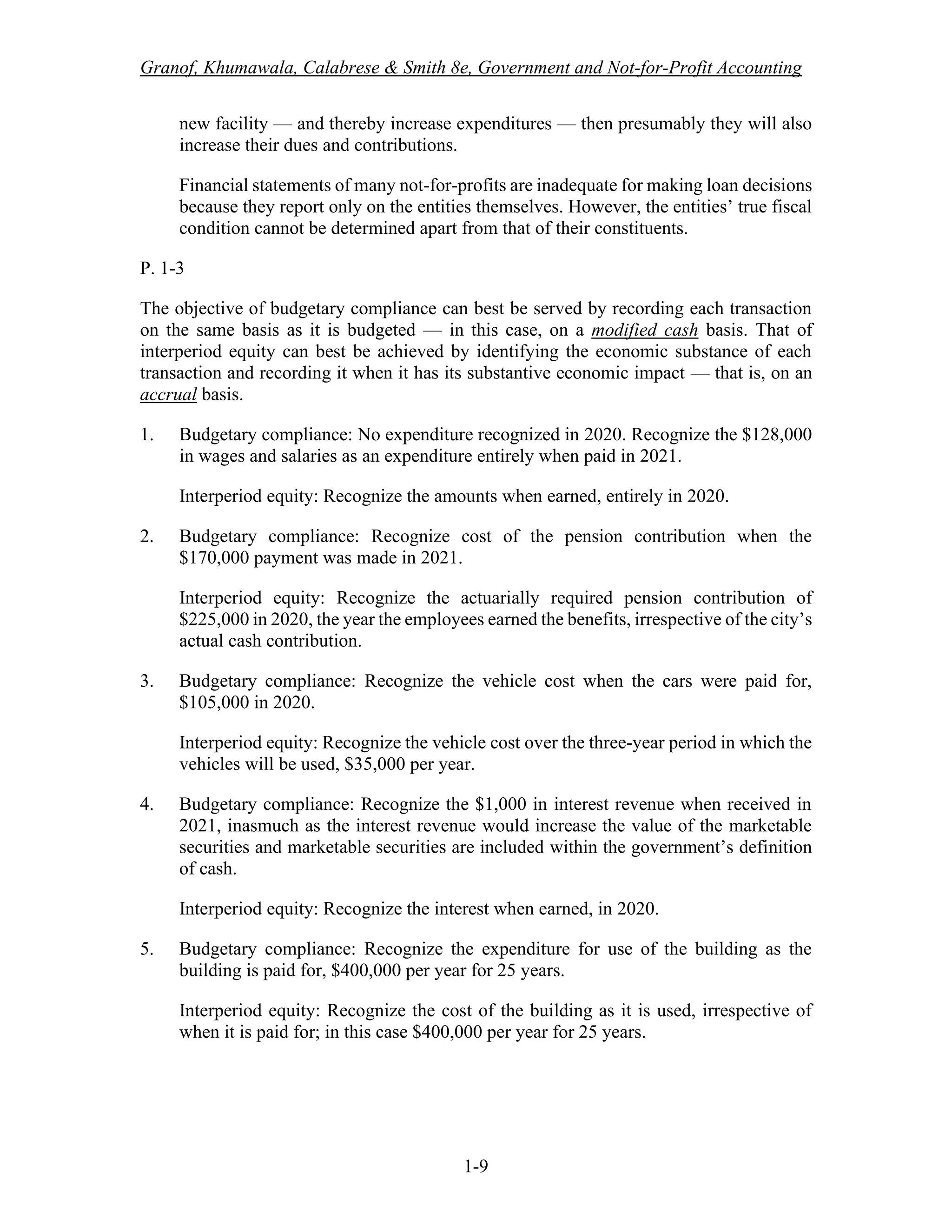
P. 1-3
The objective of budgetary compliance can best be served by recording each transaction
on the same basis as it is budgeted — in this case, on a modified cash basis. That of
interperiod equity can best be achieved by identifying the economic substance of each
transaction and recording it when it has its substantive economic impact — that is, on an
accrual basis.
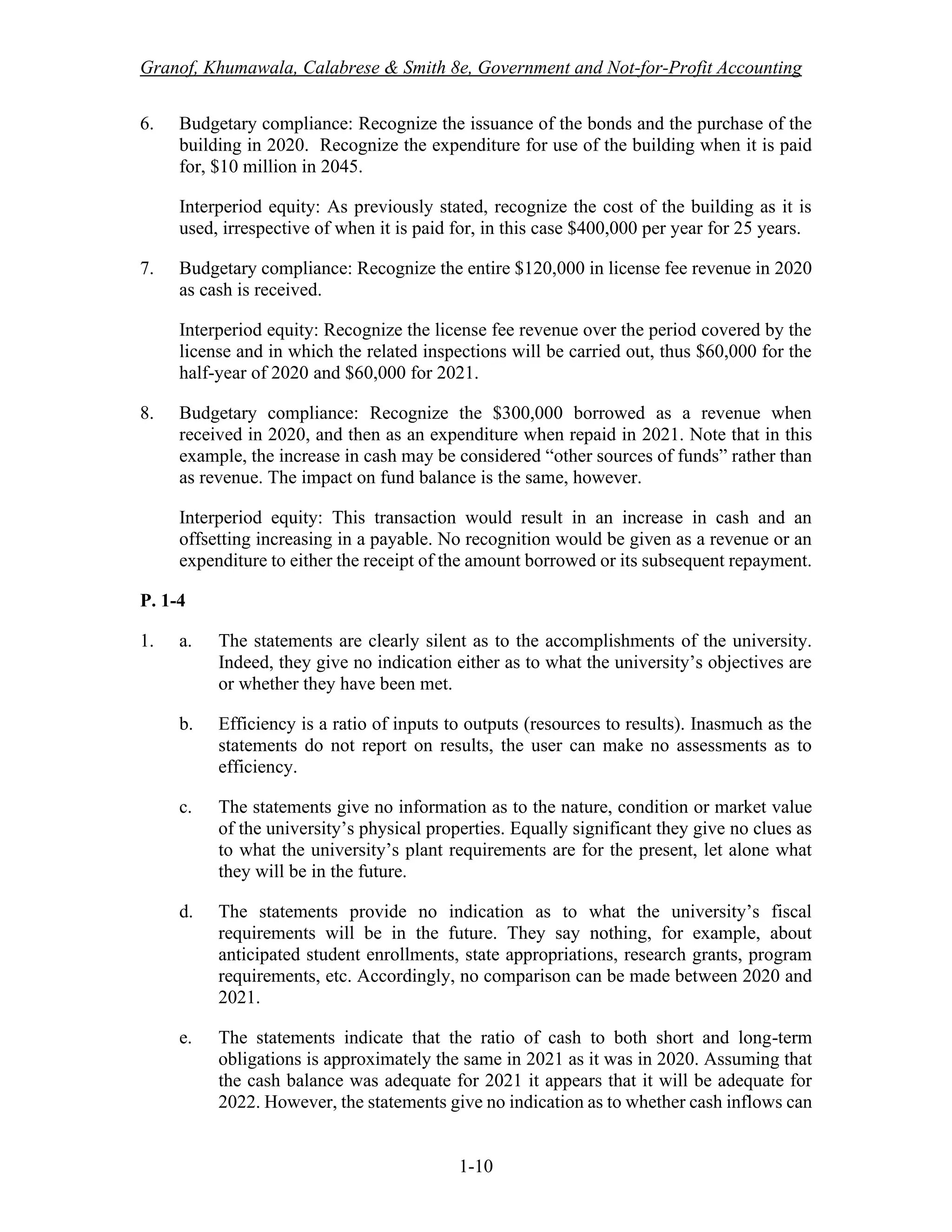
1. Budgetary compliance: No expenditure recognized in 2020. Recognize the $128,000
in wages and salaries as an expenditure entirely when paid in 2021.
Interperiod equity: Recognize the amounts when earned, entirely in 2020.
2. Budgetary compliance: Recognize cost of the pension contribution when the
$170,000 payment was made in 2021.
Interperiod equity: Recognize the actuarially required pension contribution of
$225,000 in 2020, the year the employees earned the benefits, irrespective of the city’s
actual cash contribution.
3. Budgetary compliance: Recognize the vehicle cost when the cars were paid for,
$105,000 in 2020.
Interperiod equity: Recognize the vehicle cost over the three-year period in which the
vehicles will be used, $35,000 per year.
4. Budgetary compliance: Recognize the $1,000 in interest revenue when received in
2021, inasmuch as the interest revenue would increase the value of the marketable
securities and marketable securities are included within the government’s definition
of cash.
Interperiod equity: Recognize the interest when earned, in 2020.
5. Budgetary compliance: Recognize the expenditure for use of the building as the
building is paid for, $400,000 per year for 25 years.
Interperiod equity: Recognize the cost of the building as it is used, irrespective of
when it is paid for; in this case $400,000 per year for 25 years.
Granof, Khumawala, Calabrese & Smith 8e, Government and Not-for-Profit Accounting
1-10
6. Budgetary compliance: Recognize the issuance of the bonds and the purchase of the
building in 2020. Recognize the expenditure for use of the building when it is paid
for, $10 million in 2045.
Interperiod equity: As previously stated, recognize the cost of the building as it is
used, irrespective of when it is paid for, in this case $400,000 per year for 25 years.
7. Budgetary compliance: Recognize the entire $120,000 in license fee revenue in 2020
as cash is received.
Interperiod equity: Recognize the license fee revenue over the period covered by the
license and in which the related inspections will be carried out, thus $60,000 for the
half-year of 2020 and $60,000 for 2021.
8. Budgetary compliance: Recognize the $300,000 borrowed as a revenue when
received in 2020, and then as an expenditure when repaid in 2021. Note that in this
example, the increase in cash may be considered “other sources of funds” rather than
as revenue. The impact on fund balance is the same, however.
Interperiod equity: This transaction would result in an increase in cash and an
offsetting increasing in a payable. No recognition would be given as a revenue or an
expenditure to either the receipt of the amount borrowed or its subsequent repayment.
P. 1-4
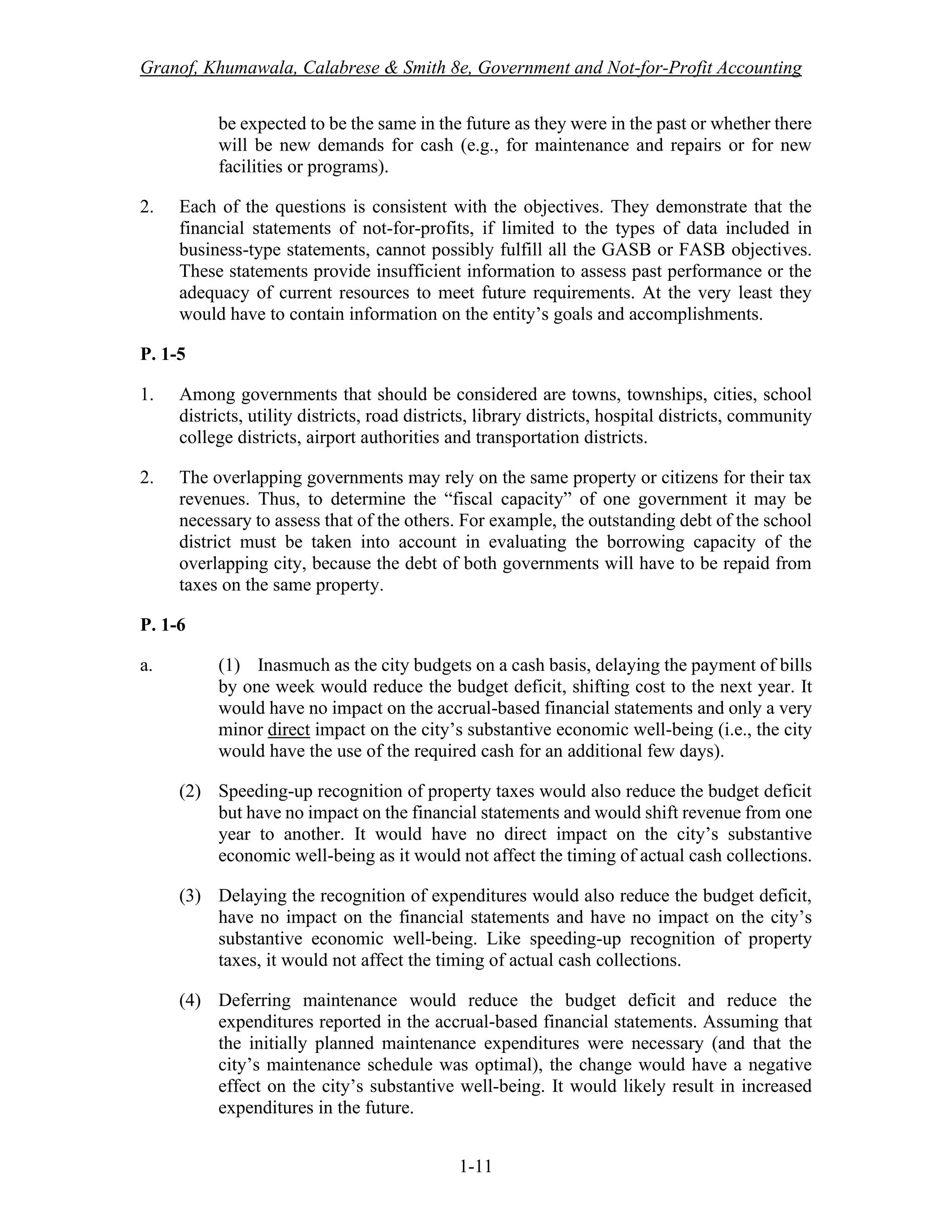
1. a. The statements are clearly silent as to the accomplishments of the university.
Indeed, they give no indication either as to what the university’s objectives are
or whether they have been met.
b. Efficiency is a ratio of inputs to outputs (resources to results). Inasmuch as the
statements do not report on results, the user can make no assessments as to
efficiency.
c. The statements give no information as to the nature, condition or market value
of the university’s physical properties. Equally significant they give no clues as
to what the university’s plant requirements are for the present, let alone what
they will be in the future.
d. The statements provide no indication as to what the university’s fiscal
requirements will be in the future. They say nothing, for example, about
anticipated student enrollments, state appropriations, research grants, program
requirements, etc. Accordingly, no comparison can be made between 2020 and
2021.
e. The statements indicate that the ratio of cash to both short and long-term
obligations is approximately the same in 2021 as it was in 2020. Assuming that
the cash balance was adequate for 2021 it appears that it will be adequate for
2022. However, the statements give no indication as to whether cash inflows can
Granof, Khumawala, Calabrese & Smith 8e, Government and Not-for-Profit Accounting
1-11
be expected to be the same in the future as they were in the past or whether there
will be new demands for cash (e.g., for maintenance and repairs or for new
facilities or programs).
2. Each of the questions is consistent with the objectives. They demonstrate that the
financial statements of not-for-profits, if limited to the types of data included in
business-type statements, cannot possibly fulfill all the GASB or FASB objectives.
These statements provide insufficient information to assess past performance or the
adequacy of current resources to meet future requirements. At the very least they
would have to contain information on the entity’s goals and accomplishments.
P. 1-5
1. Among governments that should be considered are towns, townships, cities, school
districts, utility districts, road districts, library districts, hospital districts, community
college districts, airport authorities and transportation districts.
2. The overlapping governments may rely on the same property or citizens for their tax
revenues. Thus, to determine the “fiscal capacity” of one government it may be
necessary to assess that of the others. For example, the outstanding debt of the school
district must be taken into account in evaluating the borrowing capacity of the
overlapping city, because the debt of both governments will have to be repaid from
taxes on the same property.
P. 1-6
a. (1) Inasmuch as the city budgets on a cash basis, delaying the payment of bills
by one week would reduce the budget deficit, shifting cost to the next year. It
would have no impact on the accrual-based financial statements and only a very
minor direct impact on the city’s substantive economic well-being (i.e., the city
would have the use of the required cash for an additional few days).
(2) Speeding-up recognition of property taxes would also reduce the budget deficit
but have no impact on the financial statements and would shift revenue from one
year to another. It would have no direct impact on the city’s substantive
economic well-being as it would not affect the timing of actual cash collections.
(3) Delaying the recognition of expenditures would also reduce the budget deficit,
have no impact on the financial statements and have no impact on the city’s
substantive economic well-being. Like speeding-up recognition of property
taxes, it would not affect the timing of actual cash collections.
(4) Deferring maintenance would reduce the budget deficit and reduce the
expenditures reported in the accrual-based financial statements. Assuming that
the initially planned maintenance expenditures were necessary (and that the
city’s maintenance schedule was optimal), the change would have a negative
effect on the city’s substantive well-being. It would likely result in increased
expenditures in the future.
Granof, Khumawala, Calabrese & Smith 8e, Government and Not-for-Profit Accounting
1-12
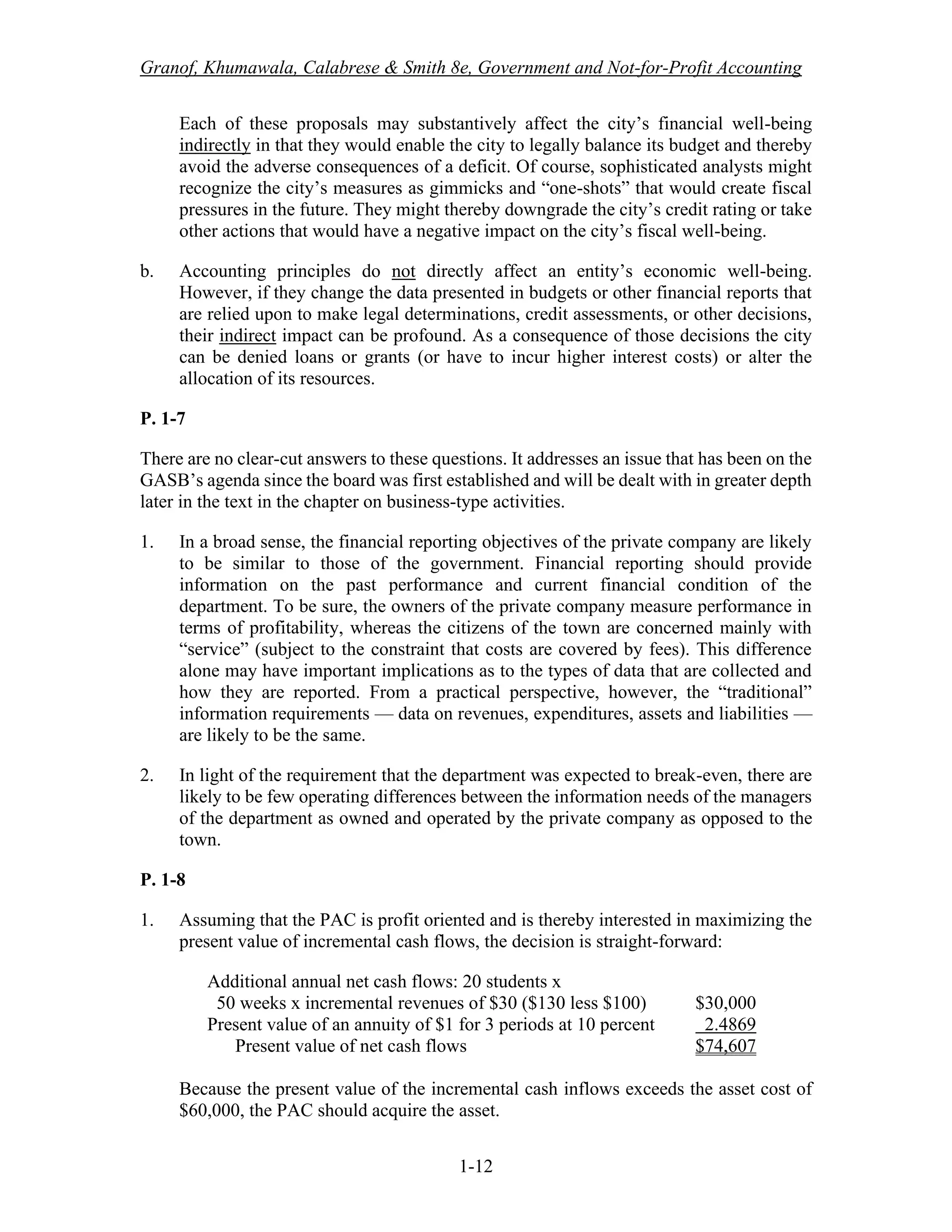
Each of these proposals may substantively affect the city’s financial well-being
indirectly in that they would enable the city to legally balance its budget and thereby
avoid the adverse consequences of a deficit. Of course, sophisticated analysts might
recognize the city’s measures as gimmicks and “one-shots” that would create fiscal
pressures in the future. They might thereby downgrade the city’s credit rating or take
other actions that would have a negative impact on the city’s fiscal well-being.
b. Accounting principles do not directly affect an entity’s economic well-being.
However, if they change the data presented in budgets or other financial reports that
are relied upon to make legal determinations, credit assessments, or other decisions,
their indirect impact can be profound. As a consequence of those decisions the city
can be denied loans or grants (or have to incur higher interest costs) or alter the
allocation of its resources.
P. 1-7
There are no clear-cut answers to these questions. It addresses an issue that has been on the
GASB’s agenda since the board was first established and will be dealt with in greater depth
later in the text in the chapter on business-type activities.
1. In a broad sense, the financial reporting objectives of the private company are likely
to be similar to those of the government. Financial reporting should provide
information on the past performance and current financial condition of the
department. To be sure, the owners of the private company measure performance in
terms of profitability, whereas the citizens of the town are concerned mainly with
“service” (subject to the constraint that costs are covered by fees). This difference
alone may have important implications as to the types of data that are collected and
how they are reported. From a practical perspective, however, the “traditional”
information requirements — data on revenues, expenditures, assets and liabilities —
are likely to be the same.
2. In light of the requirement that the department was expected to break-even, there are
likely to be few operating differences between the information needs of the managers
of the department as owned and operated by the private company as opposed to the
town.
P. 1-8
1. Assuming that the PAC is profit oriented and is thereby interested in maximizing the
present value of incremental cash flows, the decision is straight-forward:
Additional annual net cash flows: 20 students x
50 weeks x incremental revenues of $30 ($130 less $100) $30,000
Present value of an annuity of $1 for 3 periods at 10 percent 2.4869
Present value of net cash flows $74,607
Because the present value of the incremental cash inflows exceeds the asset cost of
$60,000, the PAC should acquire the asset.
Granof, Khumawala, Calabrese & Smith 8e, Government and Not-for-Profit Accounting
1-13
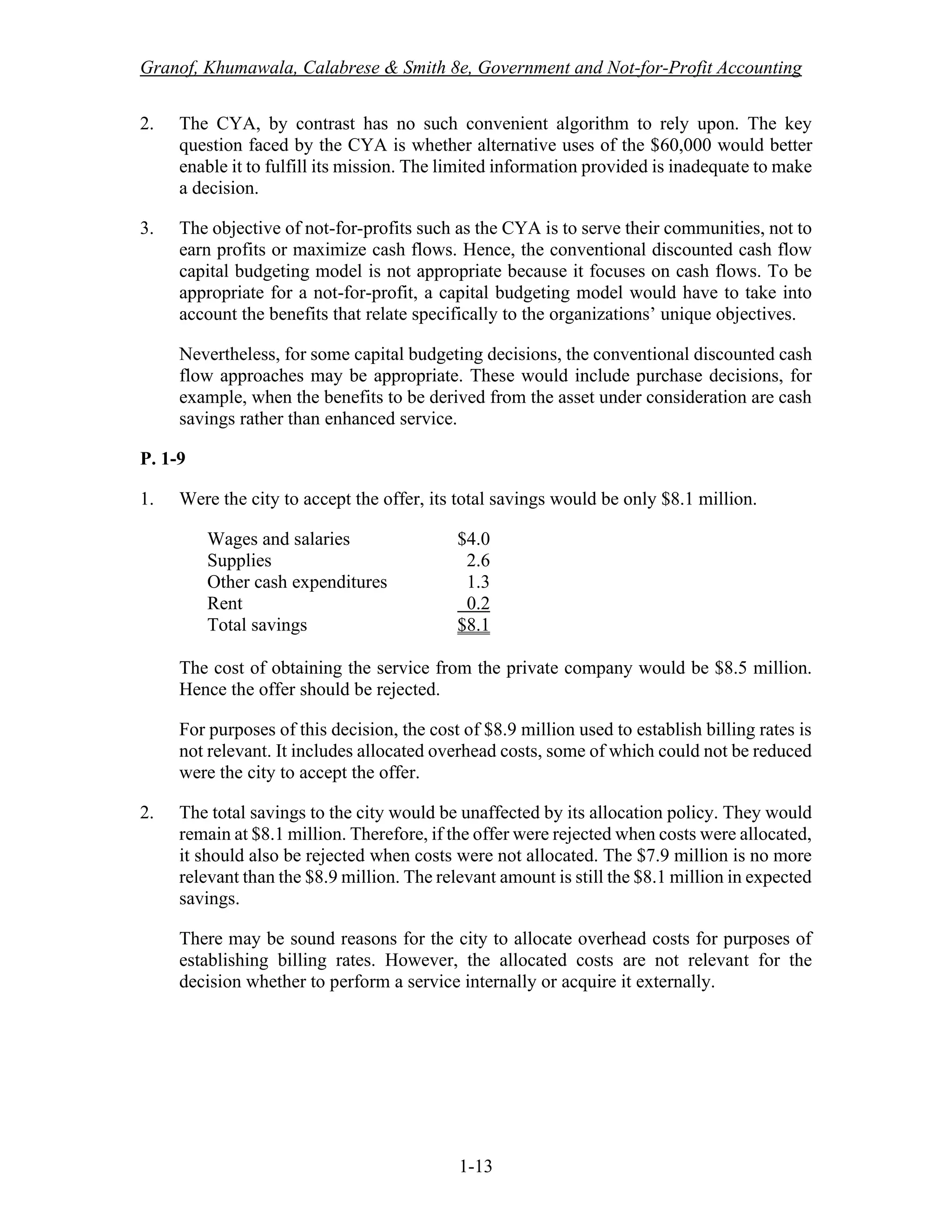
2. The CYA, by contrast has no such convenient algorithm to rely upon. The key
question faced by the CYA is whether alternative uses of the $60,000 would better
enable it to fulfill its mission. The limited information provided is inadequate to make
a decision.
3. The objective of not-for-profits such as the CYA is to serve their communities, not to
earn profits or maximize cash flows. Hence, the conventional discounted cash flow
capital budgeting model is not appropriate because it focuses on cash flows. To be
appropriate for a not-for-profit, a capital budgeting model would have to take into
account the benefits that relate specifically to the organizations’ unique objectives.
Nevertheless, for some capital budgeting decisions, the conventional discounted cash
flow approaches may be appropriate. These would include purchase decisions, for
example, when the benefits to be derived from the asset under consideration are cash
savings rather than enhanced service.
P. 1-9
1. Were the city to accept the offer, its total savings would be only $8.1 million.
Wages and salaries $4.0
Supplies 2.6
Other cash expenditures 1.3
Rent 0.2
Total savings $8.1
The cost of obtaining the service from the private company would be $8.5 million.
Hence the offer should be rejected.
For purposes of this decision, the cost of $8.9 million used to establish billing rates is
not relevant. It includes allocated overhead costs, some of which could not be reduced
were the city to accept the offer.
2. The total savings to the city would be unaffected by its allocation policy. They would
remain at $8.1 million. Therefore, if the offer were rejected when costs were allocated,
it should also be rejected when costs were not allocated. The $7.9 million is no more
relevant than the $8.9 million. The relevant amount is still the $8.1 million in expected
savings.
There may be sound reasons for the city to allocate overhead costs for purposes of
establishing billing rates. However, the allocated costs are not relevant for the
decision whether to perform a service internally or acquire it externally.
Granof, Khumawala, Calabrese & Smith 8e, Government and Not-for-Profit Accounting
1-14
P. 1-10
a.
1. The reported pension cost should be based on the actuarially required
contribution, not on the actual cash contribution.
2. The contribution to the rainy-day reserve should be accounted for as an internal
designation of resources. The accounting should make clear that total assets of
the government are not affected by the arbitrary, nonbinding management
decision to set aside cash for a particular purpose. Thus, the transfer should
affect only asset accounts, not revenues or expenditures.
3. The securities should be accounted for at market value. In that way the gain
would not be recognized entirely in the year of sale — a year in which increase
in market price did not necessarily take place — and management could not pick
the year to enhance its revenues.
4. The city could automatically report an annual maintenance expenditure equal to
some predetermined amount (perhaps an average of expenditures over the
previous five years.) The charge would be offset by a liability (e.g., “deferred
maintenance”), which would be reduced only by actual maintenance outlays.
b. A fundamental objective of financial reporting is to report on budgetary compliance.
To the extent that the financial reports are on an accrual basis whereas the budget is
on a cash basis, they would not achieve this objective. Moreover, the reported
expenditures, for both maintenance and (though to a lesser extent) pensions could be
considered arbitrary — that is, not based on specific transactions.
P. 1-11
1. Per capita debt (before change) = debt/population $1,200,000,000/800,000 = $1,500
2. Per capita debt (after change) = $1,800,000,000/800,000 = $2,250
3. a). The change in the accounting principle will increase the reported liability, but it
will have no direct impact on the city’s fiscal condition. The promises to employees
and retirees will remain the same; hence future cash flows will also remain the same.
Only the way “the story” is told will change.
b). Assuming that the notes to the financial statements provided the same
information that would now be reported on the balance sheet, there is no reason why
the analyst should change the city’s bond rating. The analyst would have been (or
most certainly should have been) aware of the existence, as well as the magnitude, of
the pension obligation. If, however, the new rules required that the liability be
computed differently and thereby better captured its true economic value the financial
Granof, Khumawala, Calabrese & Smith 8e, Government and Not-for-Profit Accounting
1-15
statements would have provided the analyst with improved information. This new information might
give the analyst reason to change the rating.
Questions for Research, Analysis and Discussion
1. The GASB in 2006 issued a “white paper,” “Why Governmental Accounting and
Financial Reporting Is—and Should Be—Different,” which as implied by the title sets
forth numerous reasons as to why governments are unique and therefore justify their
own standard-setting organization. The characteristics identified include:
• Organizational purposes
• Sources of revenue
• Relations with stakeholders
• Potential for longevity
• Role of the budget
In addition the report points to several other differences in how governmental
accounting differs from business accounting:
• The reporting model has several unique features.
• There are special issues of how to define the reporting entity.
• Long-lived assets have different purposes (e.g., in governments they are not
intended to generate cash flows).
• They engage in numerous types of nonexchange transactions.
The GASB white paper is available on the organization’s web site.
Not-for-profit entities, obviously have many of the characteristics of both governments
and businesses. Some, like agricultural cooperatives, country clubs or hospitals, are
virtually the same as businesses. Others, such as health and welfare organizations have
more of the characteristics of governments. In reality, not-for-profit entities could
legitimately be placed within the purview of either the GASB or the FASB. The
decision to place not-for-profits within the purview of the FASB was influenced more
by “political” considerations than by any fundamental organizational characteristics.
2. The GASB in its Concepts Statement No. 1, Objectives of Financial Reporting,
explicitly recognizes that “Financial reporting should provide information to assist
users in assessing the service efforts, costs, and accomplishments of the governmental
entity.” Moreover, it had devoted Concepts Statement No. 2, Service Efforts and
Accomplishments (SEA) Reporting entirely to this objective. After 20 years of
conducting research and constituent outreach on SEA reporting, GASB issued in 2009
the revised and updated version of its Concepts Statement No. 2, Service Efforts and
Accomplishments Reporting As Amended by GASB Concepts Statements No. 3 and No.
5 and offers the strongest endorsement to date of enhanced SEA reporting. It has long
been the position of many GASB members and constituents that information on service
Granof, Khumawala, Calabrese & Smith 8e, Government and Not-for-Profit Accounting
1-16
efforts and accomplishments (SEA) should indeed be incorporated into comprehensive
annual financial reports. Nevertheless, many other constituents of the GASB believe
that, even though, information on SEA is important, it does not relate directly to
financial reporting and should be reported in separate statements. Accordingly, the
GASB has not yet formally proposed incorporating SEA information in the
Comprehensive Annual Financial Report (CAFR).
Random documents with unrelated
content Scribd suggests to you:
The Project Gutenberg eBook of The Fly Leaf,
No. 2, Vol. 1, January 1896
This ebook is for the use of anyone anywhere in the United
States and most other parts of the world at no cost and with
almost no restrictions whatsoever. You may copy it, give it away
or re-use it under the terms of the Project Gutenberg License
included with this ebook or online at www.gutenberg.org. If you
are not located in the United States, you will have to check the
laws of the country where you are located before using this
eBook.
Title: The Fly Leaf, No. 2, Vol. 1, January 1896
Author: Various
Editor: Walter Blackburn Harte
Release date: June 19, 2020 [eBook #62430]
Most recently updated: October 18, 2024
Language: English
Credits: Produced by hekula03, David E. Brown, and the Online
Distributed Proofreading Team at
https://www.pgdp.net (This
book was produced from images made available by the
HathiTrust Digital Library.)
*** START OF THE PROJECT GUTENBERG EBOOK THE FLY LEAF,
NO. 2, VOL. 1, JANUARY 1896 ***
The Fly Leaf
A Pamphlet Periodical of
the New—the New Man,
New Woman, New Ideas,
Whimsies and Things.
Conducted by Walter Blackburn Harte.
With Picture Notes by
H. Marmaduke Russell.
Published Monthly by the Fly Leaf Publishing Co.,
Boston, Mass. Subscription One Dollar a Year.
Single Copies 10 Cents. January, 1896. Number Two.
A Word of Praise in Season.
Philip Hale, the well-known and brilliant Boston literary and musical
critic writes as follows:
“Walter Blackburn Harte is beyond doubt and peradventure the
leading essayist in Boston today. For Boston perhaps you had
better read ‘the United States.’ His matter is original and brave,
his style is clear, polished when effect is to be gained thereby,
blunt when the blow of the bludgeon should fall, and at times
delightfully whimsical, rambling, paradoxical, fantastical. But
read for yourself, Miss Eustacia; and Harte’s ‘Meditations in
Motley’ will remain one of your favorite books. And now Mr.
Harte is the editor of The Fly Leaf. The first number is out, and
let us earnestly call your attention to it.”
A vigorous writer and thoroughly animated by the idea that the
field of letters in this country should bloom with the genius of its
youth. If The Fly Leaf doesn’t achieve a great success it will not
be for lack of talent and energy on the part of its director.—The
Boston Traveller.
A new and wholly up to date brochure, The Fly Leaf, has just
appeared under the conductorship of Walter Blackburn Harte,
one of the brightest young men in American literature.—The
Boston Home Journal.
Promises to be something of a novelty in periodical literature,
for it is filled with piquant comments on current fads and
fashions, and contains some spicy and whimsical essays in
miniature, written in a vivid impressionistic manner.—The
Boston Transcript.
These are a few press notices. But all the young men and women in
every city and town in the United States are discussing The Fly Leaf
and spreading its fame.
The Fly Leaf
No. 2. January, 1896. Vol. 1.
THE MONK.
We were gay fellows, all of us,
And christened him “the Monk.”
He sat among us silently,
His wine was never drunk.
He heard the music passionate,
But did not join the dance,
Unmoved, he saw white arms and throats,
Unloving, caught Love’s glance.
I asked him why he cared to live,
“Because,” responded he,—
“I like to watch these pictures
Of the things inside of me.”
Claude F. Bragdon.
THE VISION OF YOUTH.
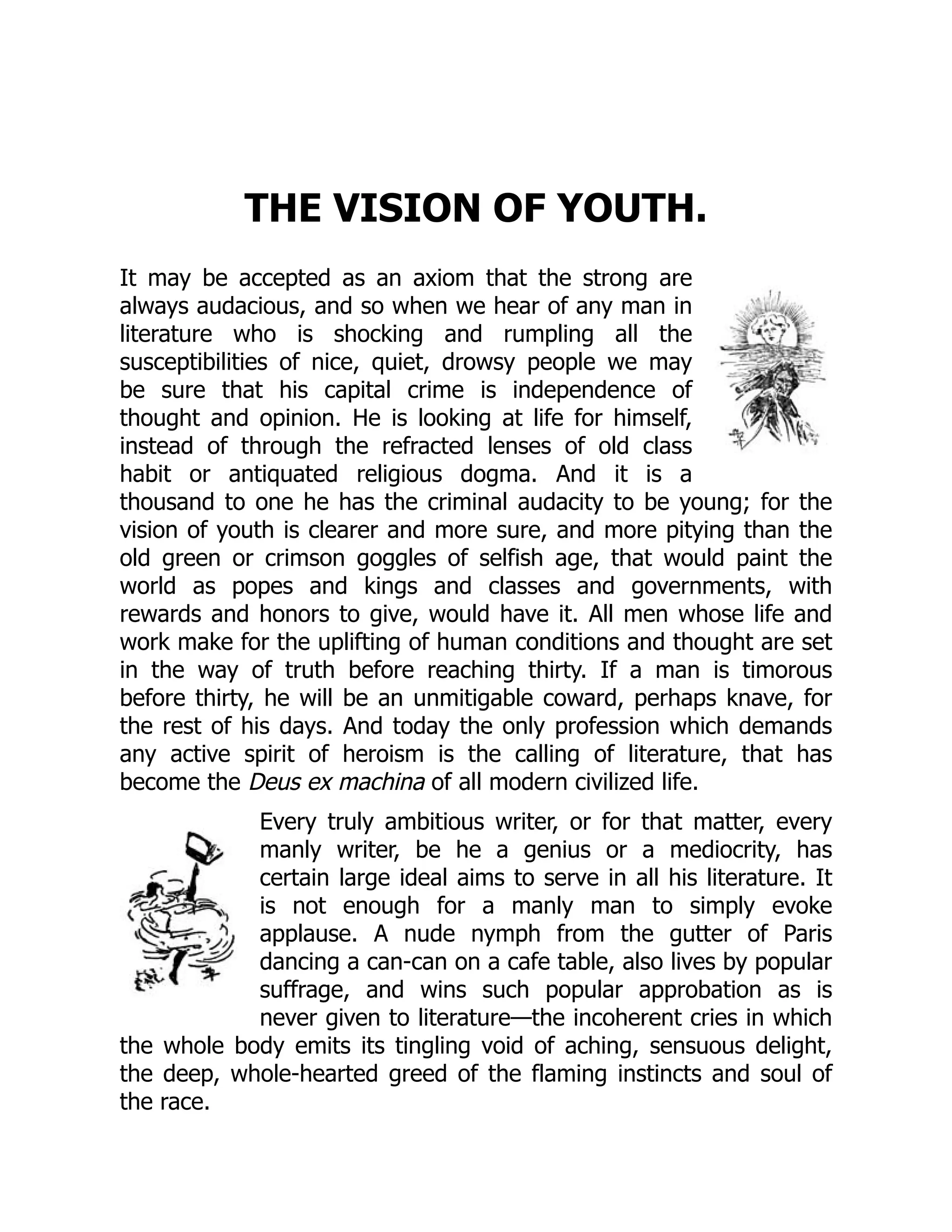
It may be accepted as an axiom that the strong are
always audacious, and so when we hear of any man in
literature who is shocking and rumpling all the
susceptibilities of nice, quiet, drowsy people we may
be sure that his capital crime is independence of
thought and opinion. He is looking at life for himself,
instead of through the refracted lenses of old class
habit or antiquated religious dogma. And it is a
thousand to one he has the criminal audacity to be young; for the
vision of youth is clearer and more sure, and more pitying than the
old green or crimson goggles of selfish age, that would paint the
world as popes and kings and classes and governments, with
rewards and honors to give, would have it. All men whose life and
work make for the uplifting of human conditions and thought are set
in the way of truth before reaching thirty. If a man is timorous
before thirty, he will be an unmitigable coward, perhaps knave, for
the rest of his days. And today the only profession which demands
any active spirit of heroism is the calling of literature, that has
become the Deus ex machina of all modern civilized life.
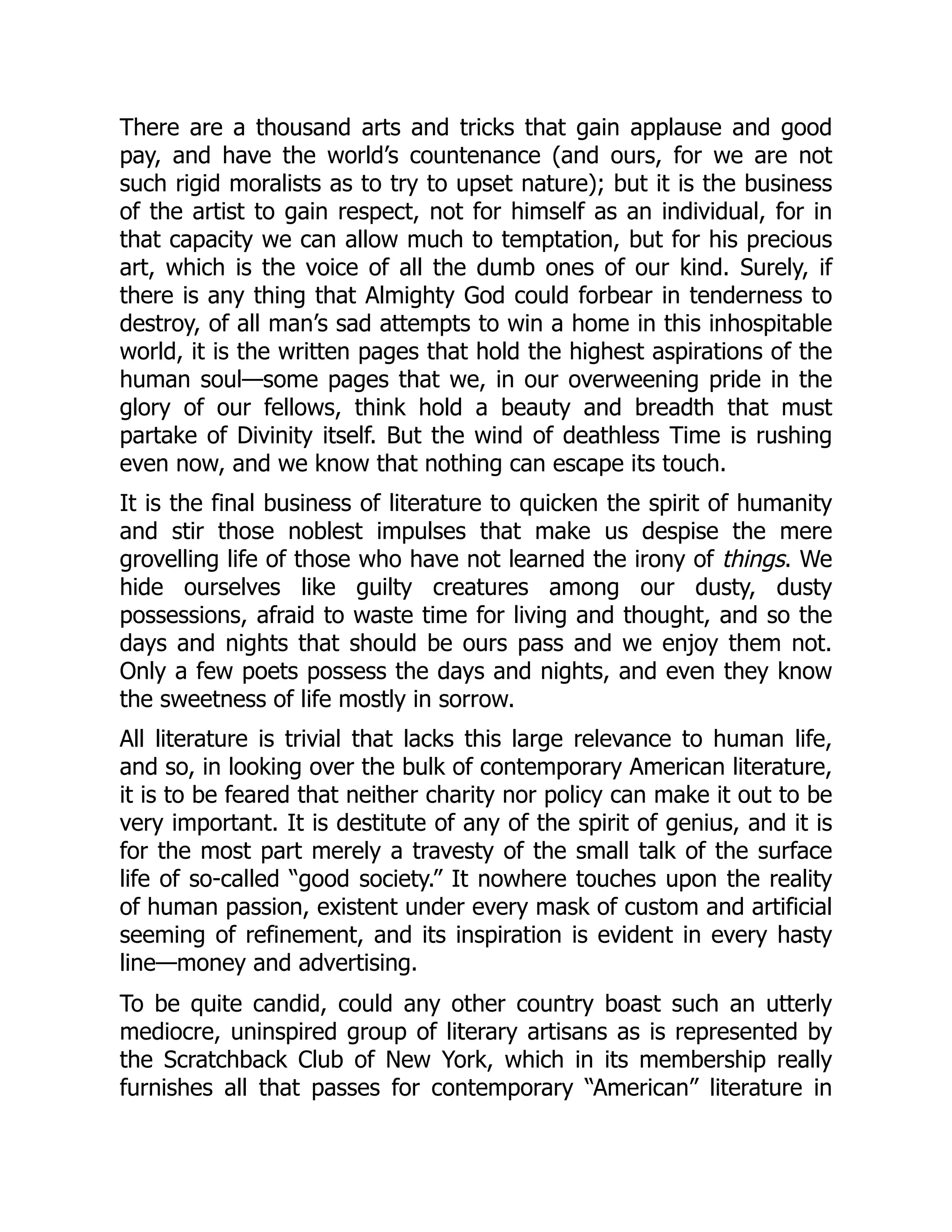
Every truly ambitious writer, or for that matter, every
manly writer, be he a genius or a mediocrity, has
certain large ideal aims to serve in all his literature. It
is not enough for a manly man to simply evoke
applause. A nude nymph from the gutter of Paris
dancing a can-can on a cafe table, also lives by popular
suffrage, and wins such popular approbation as is
never given to literature—the incoherent cries in which
the whole body emits its tingling void of aching, sensuous delight,
the deep, whole-hearted greed of the flaming instincts and soul of
the race.
There are a thousand arts and tricks that gain applause and good
pay, and have the world’s countenance (and ours, for we are not
such rigid moralists as to try to upset nature); but it is the business
of the artist to gain respect, not for himself as an individual, for in
that capacity we can allow much to temptation, but for his precious
art, which is the voice of all the dumb ones of our kind. Surely, if
there is any thing that Almighty God could forbear in tenderness to
destroy, of all man’s sad attempts to win a home in this inhospitable
world, it is the written pages that hold the highest aspirations of the
human soul—some pages that we, in our overweening pride in the
glory of our fellows, think hold a beauty and breadth that must
partake of Divinity itself. But the wind of deathless Time is rushing
even now, and we know that nothing can escape its touch.
It is the final business of literature to quicken the spirit of humanity
and stir those noblest impulses that make us despise the mere
grovelling life of those who have not learned the irony of things. We
hide ourselves like guilty creatures among our dusty, dusty
possessions, afraid to waste time for living and thought, and so the
days and nights that should be ours pass and we enjoy them not.
Only a few poets possess the days and nights, and even they know
the sweetness of life mostly in sorrow.
All literature is trivial that lacks this large relevance to human life,
and so, in looking over the bulk of contemporary American literature,
it is to be feared that neither charity nor policy can make it out to be
very important. It is destitute of any of the spirit of genius, and it is
for the most part merely a travesty of the small talk of the surface
life of so-called “good society.” It nowhere touches upon the reality
of human passion, existent under every mask of custom and artificial
seeming of refinement, and its inspiration is evident in every hasty
line—money and advertising.
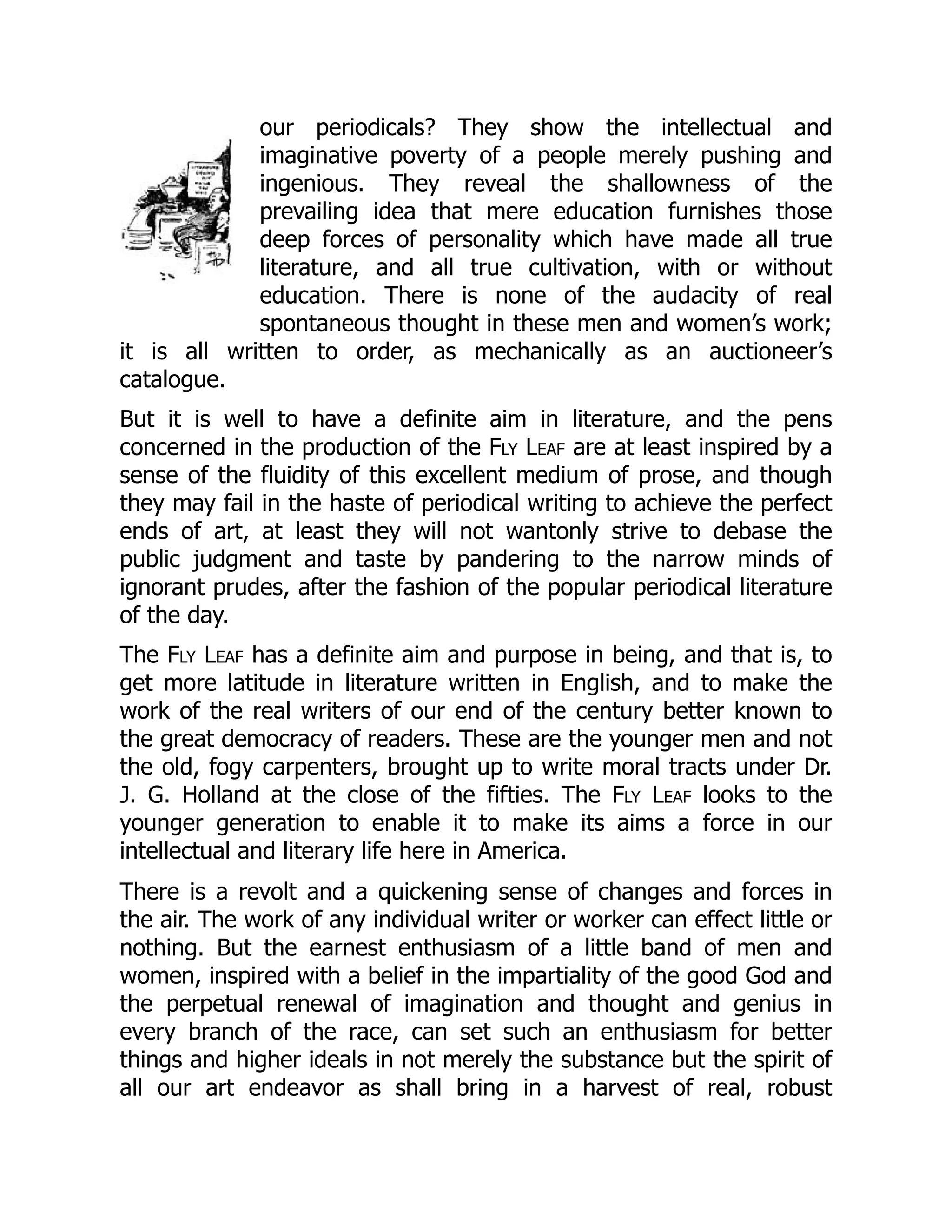
To be quite candid, could any other country boast such an utterly
mediocre, uninspired group of literary artisans as is represented by
the Scratchback Club of New York, which in its membership really
furnishes all that passes for contemporary “American” literature in
our periodicals? They show the intellectual and
imaginative poverty of a people merely pushing and
ingenious. They reveal the shallowness of the
prevailing idea that mere education furnishes those
deep forces of personality which have made all true
literature, and all true cultivation, with or without
education. There is none of the audacity of real
spontaneous thought in these men and women’s work;
it is all written to order, as mechanically as an auctioneer’s
catalogue.
But it is well to have a definite aim in literature, and the pens
concerned in the production of the Fly Leaf are at least inspired by a
sense of the fluidity of this excellent medium of prose, and though
they may fail in the haste of periodical writing to achieve the perfect
ends of art, at least they will not wantonly strive to debase the
public judgment and taste by pandering to the narrow minds of
ignorant prudes, after the fashion of the popular periodical literature
of the day.
The Fly Leaf has a definite aim and purpose in being, and that is, to
get more latitude in literature written in English, and to make the
work of the real writers of our end of the century better known to
the great democracy of readers. These are the younger men and not
the old, fogy carpenters, brought up to write moral tracts under Dr.
J. G. Holland at the close of the fifties. The Fly Leaf looks to the
younger generation to enable it to make its aims a force in our
intellectual and literary life here in America.
There is a revolt and a quickening sense of changes and forces in
the air. The work of any individual writer or worker can effect little or
nothing. But the earnest enthusiasm of a little band of men and
women, inspired with a belief in the impartiality of the good God and
the perpetual renewal of imagination and thought and genius in
every branch of the race, can set such an enthusiasm for better
things and higher ideals in not merely the substance but the spirit of
all our art endeavor as shall bring in a harvest of real, robust
literature from every quarter of this country—largely from the most
unsuspected quarters. It is this scattered interest in a nobler ideal
than obtains in our contemporary periodical literature that the Fly
Leaf will attempt to focus. At present nearly all the writers with any
individual style and force and robustness and largeness of aim are
shut out of American periodical literature, because such qualities in
literature are deemed too shocking nowadays.
The Fly Leaf believes there are still readers who appreciate boldness,
original conceptions, audacity of treatment, and the varied play of
fancy over the whole and not merely a part of human existence.
These are the qualities that gave us our standard English literature,
and in the early days inspired our greatest writers in America. They
must be the impulse and inspiration of today, if Americans are not
content to be represented in literature by snobbish boys trying to
write like “ladies,” and women who write without effort like the
deuce knows what.
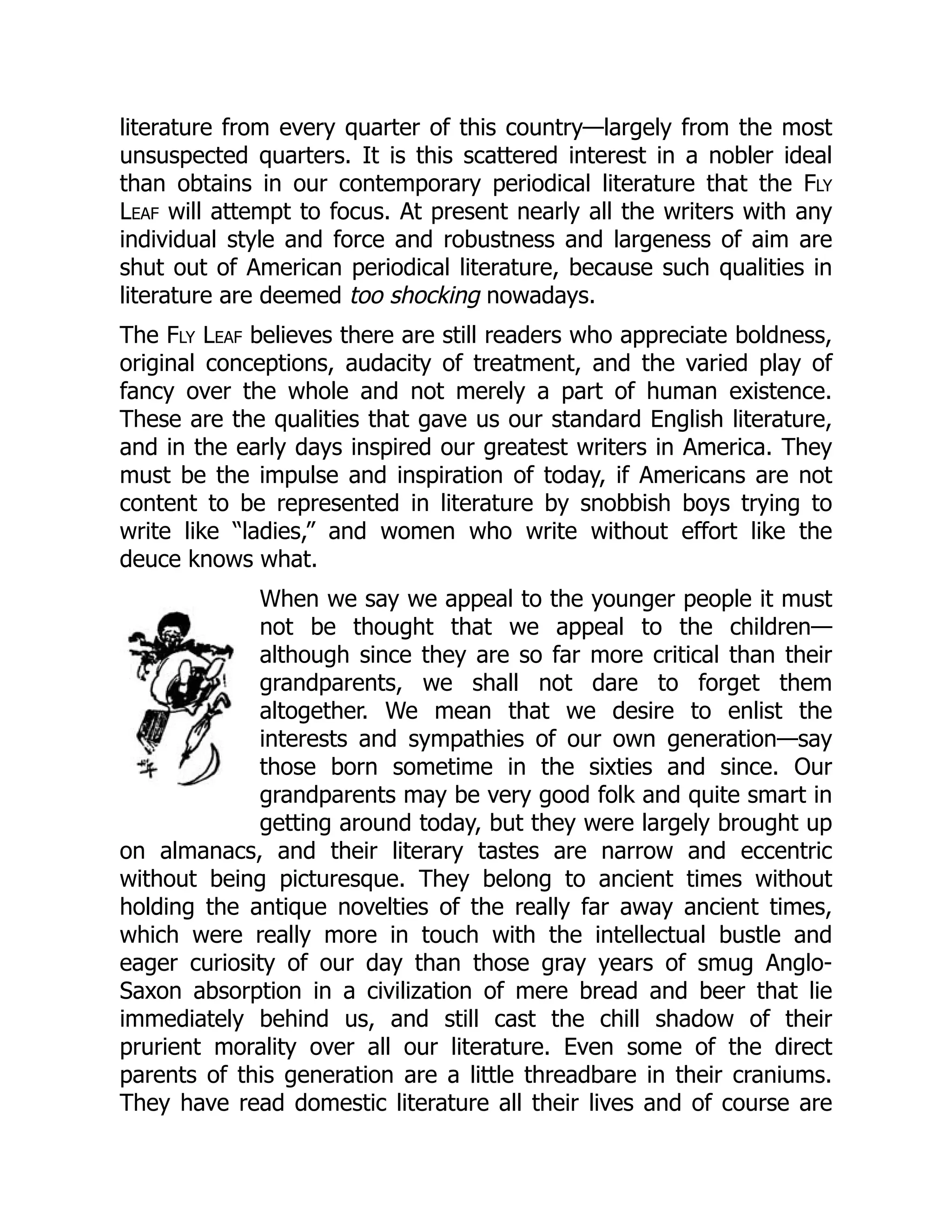
When we say we appeal to the younger people it must
not be thought that we appeal to the children—
although since they are so far more critical than their
grandparents, we shall not dare to forget them
altogether. We mean that we desire to enlist the
interests and sympathies of our own generation—say
those born sometime in the sixties and since. Our
grandparents may be very good folk and quite smart in
getting around today, but they were largely brought up
on almanacs, and their literary tastes are narrow and eccentric
without being picturesque. They belong to ancient times without
holding the antique novelties of the really far away ancient times,
which were really more in touch with the intellectual bustle and
eager curiosity of our day than those gray years of smug Anglo-
Saxon absorption in a civilization of mere bread and beer that lie
immediately behind us, and still cast the chill shadow of their
prurient morality over all our literature. Even some of the direct
parents of this generation are a little threadbare in their craniums.
They have read domestic literature all their lives and of course are
incapable of thought. The stirring gray matter is found in the heads
of those born not much further back, say, than ’49, the year of gold.
Let us resolve to make this fin de siecle the golden age of American
literature. And if there are, as I suspect there are, some belated
grandparents still on earth, animated with the spirit and ideals of
Milton and the Martyrs, young at heart in their enthusiasm for the
truth, for the art that touches and ennobles life, and for freedom of
thought and expression, these are of us also, and will gladly find in
the Fly Leaf, in its burst of youth, the ideals that have always
permeated robust and honest literature—especially in the old days
when a man might swing or burn for an audacious pamphlet. With
such old fogies we have no bone of contention. But the old fogies in
petticoats, the gingerbread writers, we shall probably toss up in a
blanket nine times as high as the moon—when we are not so
pressed for space and time.
GREY EYES.
Brown eyes for passion and blue eyes for life,
Pink eyes and green eyes and black eyes for strife,
But the eyes of my love are grey.
Bright eyes that are happy, dull eyes that are sad,
Wide innocent eyes and eyes to make mad,
But I love the soft eyes that are grey.
I love the soft eyes that are grey, love,
And grey’ll be the eyes of the angels above,
For in heaven your eyes will be grey.
Sherwin Cody.
A GEOLOGICAL PARABLE.
It was at the place afterwards called Solenhofen. The weather was
miserable, as Jurassic weather usually was. The rain beat steadily
down, and carbon dioxide was still upon the earth.
The Archaeopteryx was feeling pretty gloomy, for at that morning’s
meeting of the Amalgamated Association of Enaliosaurians he had
been blackballed. He was looked down upon by the Pterodactyl and
the Ichthyosaurus deigned not to notice him. Cast out by the
Reptilia, and Aves not being thought of, he became a wanderer upon
the face of the earth. “Alas!” sighed the poor Archaeopteryx, “this
world is no place for me.” And he laid him down and died; and
became imbedded in the rock.
And ages afterward a featherless biped, called man, dug him up, and
marvelled at him, crying, “Lo, the original Avis and fountain-head of
all our feathered flocks!” And they placed him with great reverence
in a case, and his name became a by-word in the land. But the
Archaeopteryx knew it not. And the descendant for whom he had
suffered and died strutted proudly about the barn-yard, crowing
lustily cock-a-doodle-do!
S. P. Carrick, Jr.
THE WAIL OF THE HACK WRITER.
Ah, dreary is the toil for dull
And shallow thought—the chaff-choked grain,
That comes from just beneath the skull,
Not from the brain within the brain.
But all the dull, chaff-nourished tribe
Must have its favorite food of bran,
And he who writes must let the scribe
Murder the poet in the man.
Oft must he stem the tides that roll
From thought’s interior deep, and, dead
To their far voices, sell his soul—
No, not for gold, for bread.
And he must leave the heights that shine
And hasten down their arduous steeps
To feed the million-throated swine,
That gulps its garbage and then sleeps.
Sam Walter Foss.
ADONIS IN TATTERS.
A PARABLE ON THE POWER OF BEAUTY.
The audience at a parlor lecture in a Beacon Street drawing room is
apt to be rather intense and rapt in its attention, and discreet in its
enthusiasm, with the emphasis of discernment which subdued, well-
bred applause confers. At Mrs. Reginald Beveridge Vincent’s this is
always particularly noticeable, for Mrs. Vincent is one of the social
law givers of the “smart” set, and her rooms on these occasions are
thronged with all sorts of ambitious social strugglers, who pay
insidious homage to their hostess in their admiration of the idols for
whom she stands sponsor. There are all sorts of people here, and
among them many of the great army of the small celebrities, who
are somewhat more distinguished than prosperous, and who would
fain pass from the appreciation of imaginative literature to the
serious consideration of dining. The fact is, the socially nebulous,
who rebel against their birth’s invidious bar and strive to get out of
the obscurity of the mass of humanity, are really the backbone of the
enthusiasm for letters in fashionable society. These rather dubious
folk, with no redeeming big bank account, are spurred by ambition
to attach themselves to some sort of superiority—the superiority not
always inherently residing in them; and so literature becomes their
easy spoil. They constitute the one stable element in all literary
gatherings out of Grub Street; and even Mrs. Vincent, with all her
social prestige, could not dispense with them. And so they come,
and dream of passing the rubicon, and so on to more important
functions. There are many who are considered good enough and
worthy to sit at a feast of reason and a flow of soul, who would
never be deemed eligible for the holier function of stuffing with
baked meats and wines. These literary afternoons, it may be noted,
for the benefit of the ambitious, serve an incidental purpose as a
sort of preliminary investigation into the character, standing and
desirability of new acquaintances. Many are called to the feast of
literature—but few are chosen to break bread at dinner. But the
success of parlor lectures, at the most dispiriting hour of the
afternoon in winter when the city streets are sunless and melancholy
and depressing, depends almost entirely upon the lure of social
hopes, that influence the more or less obscure to give up the
comfort of their mediocre leisure to swell the triumph of those who
secure the glory of the passing show of life. The woman who wants
to shine as a patron of the fine arts must not neglect these mixed
social elements, or her rooms will be empty. Exemplary activity in
church politics and an interest in letters, are the humble beginnings,
the corduroy roads, as it were, of many who ultimately shine with
more certain lustre as leaders of the german. Therefore, every wise
blue stocking is affable and accessible to the crowd of dubious
persons whose admirations may be depended upon—unless hope
burns stronger in some other quarter. One thing is certain: the grand
dames of the upper social heavens are not to be depended upon
when literature or philosophy is the only attraction offered, even
when a grand dame is herself holding the reception. There are so
many petty jealousies, and so many rival courts; and, moreover, the
grand dames have so many questions of social diplomacy to occupy
them—men, for instance (nice, eligible men are scarce);
consequently they do not often come under the spell of the literary
impressario, who gains a precarious subsistence in the lap of luxury;
and, besides, the afternoon is the meridian of the shopping fever.
The large drawing room was crowded on this particular afternoon,
and Mrs. Vincent was in high feather, for she had secured the new
poet of the season, Mr. Blanco Winterbourne, to give his lecture on
“Ideals of Beauty in Modern Life.” This was in itself a victory.
Winterbourne was a brand new poet, who had dropped straight from
the skies and been immediately accepted in London, so that he had
all the freshness and glamour of a debutante, and his reputation
being still in the making in the inner circles of society, the gold dust
was still upon his wings, unbrushed and untarnished by the chill
after-thoughts of envious Grub Street criticism.
Everybody sat in an attitude of rare rapture, and every time the
lecturer uttered some especially well sounding and uplifting
sentiment, and paused a moment for the rapid click of eyes, some
fine idealist in the group would fix the hostess’s wandering glance
with a gleam of appreciation. This was intended to isolate him in her
memory as a man of discernment and culture worthy of
remembrance in the Elysian domain of dining. There is indeed
something almost pathetic in this intense concentration of mind, this
painful anxiety of appreciation, which is so evidently the tribute to
the hostess and not to the new genius himself. Only so much rapture
goes to the lecturer as appearances demand. The glory of the
occasion belongs to the patron; for skill and talent are largely a
matter of labor and discipline, whereas the recognition of excellence
is the quick flash of pure intellect, genius! But the audience is
charitable enough, and the most terrible ordeal for the lecturer, fresh
from Parnassus or Grub Street, is the pervasive and distracting
rustling and swishing of silken skirts—a sound that is the most
tangible symbol of women’s potent whims in the sensuous
consciousness of man.
There was one exception to the general air of complete
absorption and satisfaction, and this was a queer, oval
cynical face, half in the light of the waning day, and
half in the shadow of the curtains. It belonged to a
young man, who leaned half forward in a rigid, high-
backed chair, and alternately glanced curiously from
face to face in the audience, and then turned completely about and
looked out across the bare tree-tops of the Common. A look of
weariness, and even of contempt, crept about his eyes and mouth,
as certain high-flown phrases reached his ears.
Here is a bit of rapid rhetoric that evoked the applause of the
company, and made him only curl his lip. “The dominion of beauty
obtains forever in the human heart, and so long as this is so, no
class nor humanity at large can be utterly bad; for the discernment
of beauty involves the recognition of moral feeling. All permanent
beauty is essentially moral and is sure of ready acceptance,
especially among women, in whom the religious instinct is strongest.
Modern life can never annihilate this innate and instinctive
perception of intellectual nobility and pure beauty. Nay, since the
form is the body of the soul, the finest type of pure physical beauty
will always rightly command our admiration. It breaks through all
creeds and castes, and holds the race in unity of feeling and
thought.”
The lecture closed in a culminating clapping of hands, and the
guests all moved forward to congratulate the lecturer and the
patron. The young man turned and studied the different groups with
an amused smile.
A lady, who had been watching the young man’s mocking comment
on the scene in the changing expression of his eyes and pursed lips,
suddenly arose from a divan in the angle of the room, and crossed
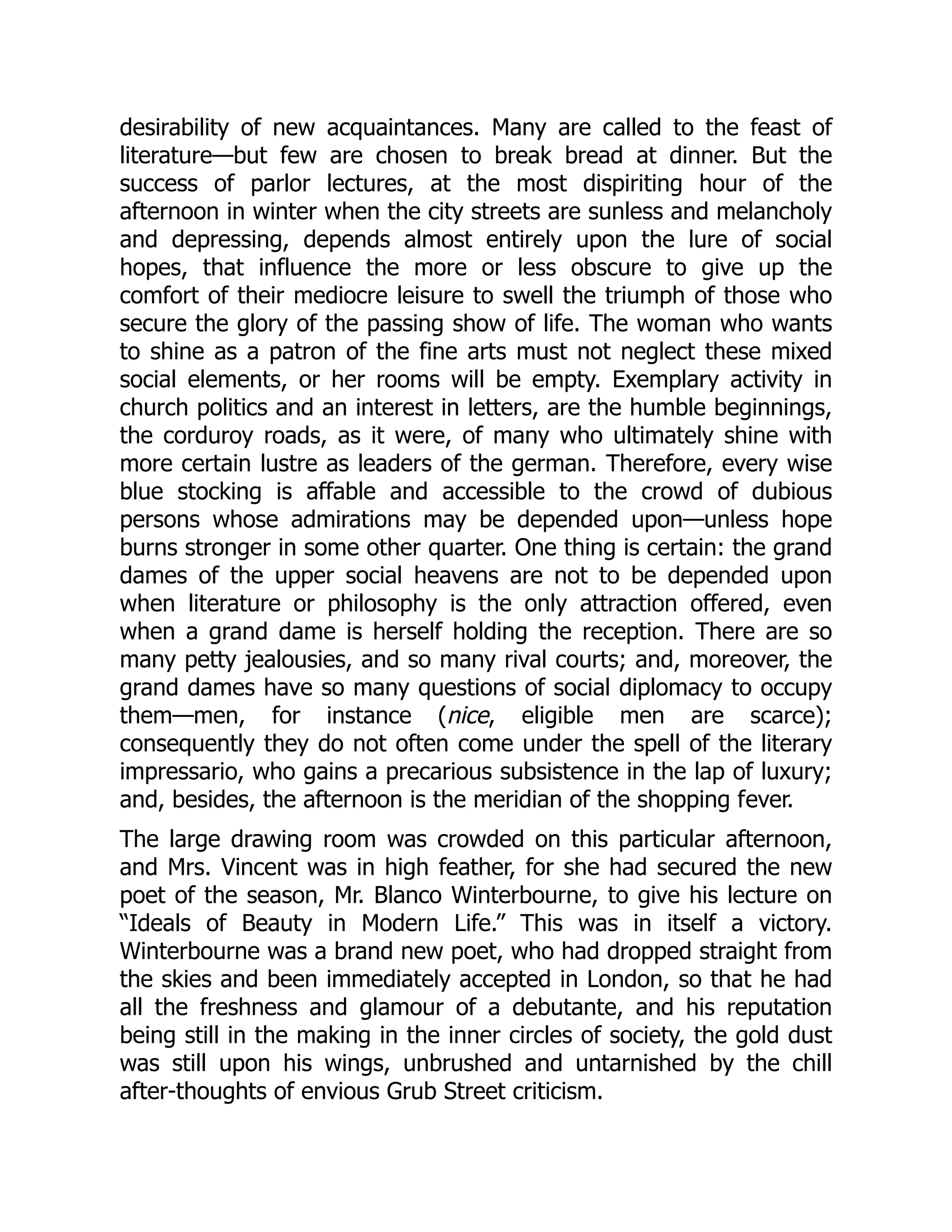
over to where he sat in the afternoon twilight.
She stopped him from arising with a gesture, and sank
down into a seat beside him.
“You do not seem particularly pleased with Mr. Blanco
Winterbourne’s lecture?”
“Well, it doesn’t interest me, because you see I come
into contact with life as it really is. I have heard all this
cant about the beauty of purity and character before so
many times, but when I see beauty of character in life
I find it always taken advantage of. And as for the
dignity of physical beauty, I need scarcely tell one of your sex the
difference between a beauty in rags and a beauty in silks.”
“Oh, but I protest, that although the world is gross, and the half of
us are mere Mammon worshippers, there is an instinct of delight,
and irresistible attraction for us, especially for we women, in sheer
beauty without any trappings of finery.”
“Ah, indeed; that sounds like the magnanimity of humanity,
universally asserted by popular moralists. But your sex is really the
least amenable, as I could easily prove to you.”
“Then prove it.”
“I will, if you can put on your hat and coat and come at once.”
“Well, I’m in a blaze of curiosity for the adventure.”
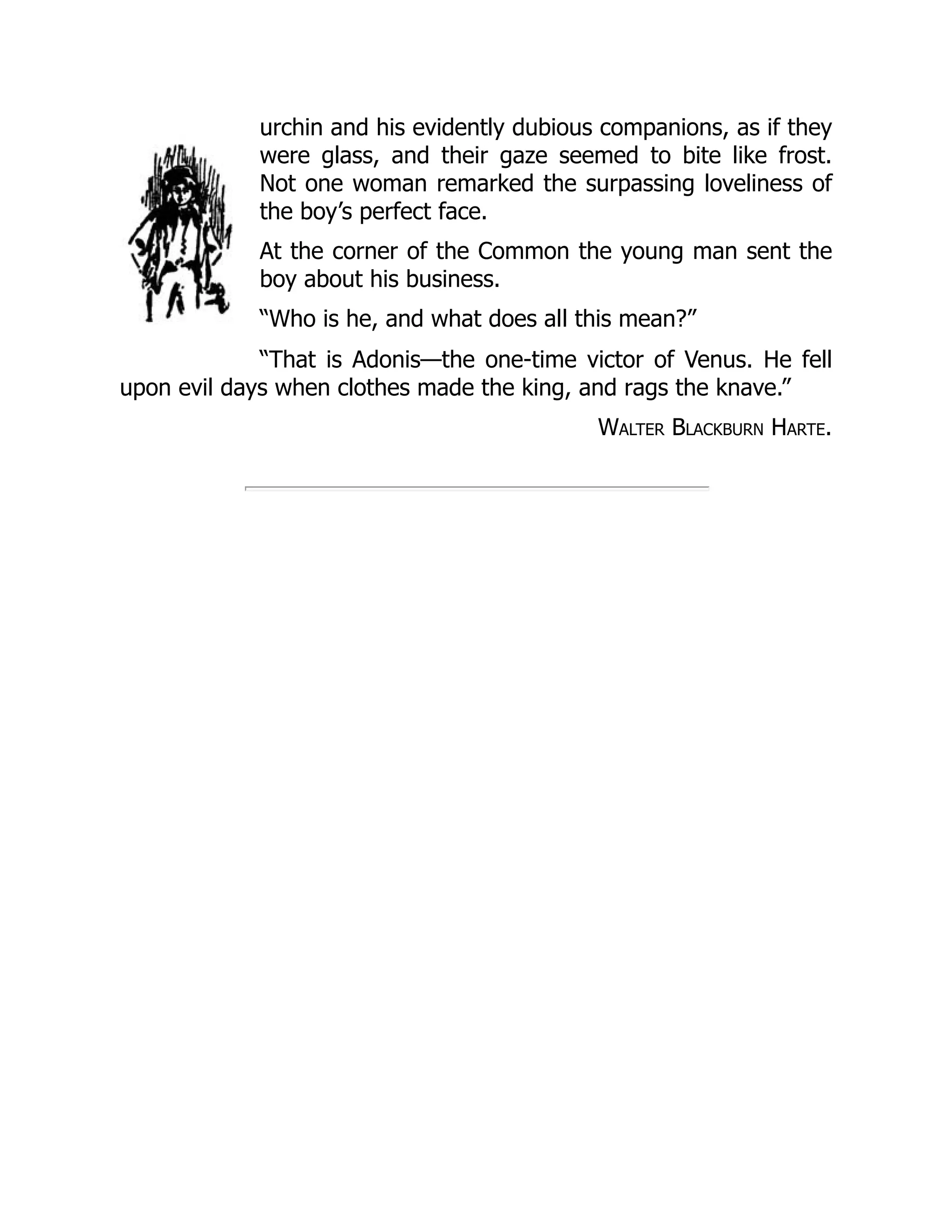
As they crossed Beacon Street a beggar boy stepped up to them,
and in piping tones of want asked the lady for alms. She glanced for
a moment into his face with a blank look of negation on her own,
and with a sort of comprehensive intake of his dirt and rags she
gathered her skirts about her and passed through the turnpike and
down the steps to the Common. But her companion lingered behind,
and presently joined her, half dragging the boy by his tattered
sleeve.
“Come here, Miss Lorillard, and look at the boy. I want to know if
this isn’t beauty?”
She turned and looked into the boy’s face, as her companion held it
up to the light between his two hands. The extraordinary and perfect
beauty of his features seized upon her in a sort of wonderment.
Where had she ever seen such a face before?—And her memory
swept through the galleries of Europe. In none of them. How was it
she had not noticed it at first? The dirt? It was incomparable—it
seemed superhuman in its sweetness and beauty, its appeal, and its
glow of divinity. God’s hand was plainly set in that face.
“This is the boy,” said the young man, laconically, watching her
expression. “Come along.”
And linking his arm in that of the ragged youngster, the trio
sauntered along with the fashionable throng coming out of the
matinees.
“Get out of my way, you ugly little sweep,” said one woman,
elbowing the boy off the pavement; and the men pushed him hither
and thither. The fashionable women looked right through the ragged
urchin and his evidently dubious companions, as if they
were glass, and their gaze seemed to bite like frost.
Not one woman remarked the surpassing loveliness of
the boy’s perfect face.
At the corner of the Common the young man sent the
boy about his business.
“Who is he, and what does all this mean?”
“That is Adonis—the one-time victor of Venus. He fell
upon evil days when clothes made the king, and rags the knave.”
Walter Blackburn Harte.
LIFE.
I sometimes think life is but a see-saw board, with hope at one end
and despair at the other. First hope goes up, and despair goes down,
and then it reverses. There seems to be no break in the steady rise
and fall. We live on, clinging to the belief that hope will outbalance
despair, but it does not, and men come and men go, and life still
teeters away.
Joseph Andrews Cone.
A SONNET FOR POETS.
Sometimes birds sing not though the morn is fair;
Sometimes flowers folded lie beneath the sun;
Sometimes no dew falls though the day is done;
Sometimes where fruit should grow the branch is bare;
Sometimes the truest poet must forbear
To make his music, though the hour is one
With perfect beauty ended and begun:
Sometimes his power has left him to despair,
Sometimes he standeth spelled and dumb, though all
Is great around him, though he plainly sees
The beauty, and the grand sound plainly hears.
But if, ere glories vanish, it befall
That his sweet tongue doth loosen; as it frees
He thrills with rapture, hymning through his tears.
William Francis Barnard.
Welcome to Our Bookstore - The Ultimate Destination for Book Lovers
Are you passionate about testbank and eager to explore new worlds of
knowledge? At our website, we offer a vast collection of books that
cater to every interest and age group. From classic literature to
specialized publications, self-help books, and children’s stories, we
have it all! Each book is a gateway to new adventures, helping you
expand your knowledge and nourish your soul
Experience Convenient and Enjoyable Book Shopping Our website is more
than just an online bookstore—it’s a bridge connecting readers to the
timeless values of culture and wisdom. With a sleek and user-friendly
interface and a smart search system, you can find your favorite books
quickly and easily. Enjoy special promotions, fast home delivery, and
a seamless shopping experience that saves you time and enhances your
love for reading.
Let us accompany you on the journey of exploring knowledge and
personal growth!
testbankmall.com

Solution Manual for Government and Not-for-Profit Accounting: Concepts and Practices, 8th Edition, H. Granof

  • 1.
    Read Anytime AnywhereEasy TestBank Download at testbankmall.com Solution Manual for Government and Not-for-Profit Accounting: Concepts and Practices, 8th Edition, H. Granof https://testbankmall.com/product/solution-manual-for- government-and-not-for-profit-accounting-concepts-and- practices-8th-edition-h-granof/ OR CLICK HERE DOWLOAD EBOOK Visit and Get More TestBank Download Instantly at https://testbankmall.com
  • 2.
    Instant digital products(PDF, ePub, MOBI) ready for you Download now and discover formats that fit your needs... Start reading on any device today! Government and Not-for-Profit Accounting Concepts and Practices Granof 6th Edition Solutions Manual https://testbankmall.com/product/government-and-not-for-profit- accounting-concepts-and-practices-granof-6th-edition-solutions-manual/ testbankmall.com Solution Manual for Government and Not For Profit Accounting: Concepts and Practices, 6th Edition, Michael H. Granof Saleha B. Khumawala https://testbankmall.com/product/solution-manual-for-government-and- not-for-profit-accounting-concepts-and-practices-6th-edition-michael- h-granof-saleha-b-khumawala/ testbankmall.com Government and Not-for-Profit Accounting Concepts and Practices Granof Khumawala 5th Edition Solutions Manual https://testbankmall.com/product/government-and-not-for-profit- accounting-concepts-and-practices-granof-khumawala-5th-edition- solutions-manual/ testbankmall.com Test Bank for Government and Not for Profit Accounting Concepts and Practices, 5th Edition: Granof https://testbankmall.com/product/test-bank-for-government-and-not-for- profit-accounting-concepts-and-practices-5th-edition-granof/ testbankmall.com
  • 3.
    Solution manual forGovernment and Not-For-Profit Accounting: Concepts and Practices, 7th Edition https://testbankmall.com/product/solution-manual-for-government-and- not-for-profit-accounting-concepts-and-practices-7th-edition/ testbankmall.com Test Bank for Government and Not-for-Profit Accounting 8th by Granof https://testbankmall.com/product/test-bank-for-government-and-not-for- profit-accounting-8th-by-granof/ testbankmall.com Test Bank for Government and Not-For-Profit Accounting: Concepts and Practices, 7th Edition https://testbankmall.com/product/test-bank-for-government-and-not-for- profit-accounting-concepts-and-practices-7th-edition/ testbankmall.com Test Bank for Core Concepts of Government and Not-for- Profit Accounting, 2nd Edition, Granof, https://testbankmall.com/product/test-bank-for-core-concepts-of- government-and-not-for-profit-accounting-2nd-edition-granof/ testbankmall.com Solution Manual for Introduction to Governmental and Not- for-Profit Accounting, 7/E 7th Edition https://testbankmall.com/product/solution-manual-for-introduction-to- governmental-and-not-for-profit-accounting-7-e-7th-edition/ testbankmall.com
  • 5.
    Granof, Khumawala, Calabrese& Smith 8e, Government and Not-for-Profit Accounting 1-2 3. Owing to the significance of the budget, constituents want assurance that the entity achieves its revenue estimates and complies with its spending mandates. They expect the financial statements to report on how the budget was administered. 4. Interperiod equity is the concept that taxpayers of today pay for the services that they receive and not shift the payment burden to taxpayers of the future. Financial reporting must indicate the extent to which interperiod equity has been achieved. Therefore, it must determine and report upon the economic costs of the services performed (not merely the cash costs) and of the taxpayers’ contribution toward covering those costs. 5. The matching concept may be less relevant for governments and not-for-profits than for businesses because there may be no connection between revenues generated and the quantity, quality or cost of services performed. An increase in the demand for, or cost of, services provided by a homeless shelter would not necessarily result in an increase in the amount of donations that it receives. Of course, governments and not- for-profits are concerned with measuring interperiod equity and for that purpose the matching concept may be very relevant. 6. Governments must maintain an accounting system that assures that restricted resources are not inadvertently expended for inappropriate purposes. Moreover, statement users may need separate information on the restricted resources by category of restriction and the unrestricted resources. In practice, these requirements have led governments to adopt a system of “fund” accounting and reporting. 7. Even governments within the same category may engage in different types of activities. For example, some cities operate a school system whereas others do not. Those that are not within the same category may have relatively little in common. For example, a state government shares few characteristics with a city. 8. If a government has the power to tax, then it has command over, and access to, resources. Therefore, its fiscal well-being cannot be assessed merely by measuring the assets that it “owns.” For example, the fiscal condition of a city should incorporate the wealth of the residents and businesses within the city, their earning capacity, and the city’s willingness to exploit its tax base. 9. Many governments budget on a cash or near-cash basis. However, the cash basis of accounting does not provide adequate information with which to assess interperiod equity. Financial statements that satisfy the objective of reporting on interperiod equity may not satisfy that of reporting on budgetary compliance. Moreover, statements that report on either interperiod equity or budgetary compliance are unlikely to provide sufficient information with which to assess service efforts and accomplishments. 10. Measures of service efforts and accomplishments are more significant in governments and not-for-profits because their objectives are to provide service. By contrast, the objective of businesses is to earn a profit. Therefore, businesses can report on their
  • 6.
    Granof, Khumawala, Calabrese& Smith 8e, Government and Not-for-Profit Accounting 1-3 accomplishments by reporting on their profitability. Governments and not-for-profits must report on other measures of accomplishment. 11. The FASB influences generally accepted accounting principles of governments in two key ways. First, FASB pronouncements are included in the GASB “hierarchy” of GAAP. FASB pronouncements that the GASB has specifically made applicable to governments are included in the highest category; those that the GASB has not specifically adopted are included in the lowest category. Second, the business-type activities of governments are required (with a few exceptions) to follow the business accounting principles as set forth by the FASB. 12. It is more difficult to distinguish between internal and external users in governments than in businesses because constituents, such as taxpayers, may play significant roles in establishing policies that are often considered within the realm of managers. Also, legislators are internal to the extent they set policy, but external insofar as the executive branch must account to the legislative branch. Exercises EX 1-1 1. a 2. c 3. c 4. c 5. b 6. c 7. d 8. c 9. b 10. c EX 1-2 1. b 2. b 3. d 4. b 5. a 6. c 7. a 8. b 9. a 10. b
  • 7.
    Granof, Khumawala, Calabrese& Smith 8e, Government and Not-for-Profit Accounting 1-4 EX 1-3 a. 1. The Governmental Accounting Standards Board (GASB) is the independent organization that establishes and improves standards of accounting and financial reporting for U.S. state and local governments. Established in 1984 by agreement of the Financial Accounting Foundation (FAF) and 10 national associations of state and local government officials, the GASB is recognized by governments, the accounting industry, and the capital markets as the official source of generally accepted accounting principles (GAAP) for state and local governments. Accounting and financial reporting standards designed for the government environment are essential because governments are fundamentally different from for-profit businesses. Furthermore, the information needs of the users of government financial statements are different from the needs of the users of private company financial statements. The GASB members and staff understand the unique characteristics of governments and the environment in which they operate. The GASB is not a government entity; instead, it is an operating component of the FAF, which is a private sector not-for-profit entity. Funding for the GASB comes primarily from an accounting support fee established under the Dodd-Frank Wall Street Reform and Consumer Protection Act as well as the sale of certain publications. Its standards are not federal laws or regulations and the organization does not have enforcement authority. Compliance with GASB’s standards, however, is enforced through the laws of some individual states and through the audit process, when auditors render opinions on the fairness of financial statement presentations in conformity with GAAP. 2. The mission of GASB is: To establish and improve standards of state and local governmental accounting and financial reporting that will: • Result in useful information for users of financial reports, and • Guide and educate the public, including issuers, auditors, and users of those financial reports. The mission is accomplished through a comprehensive and independent process that encourages broad participation, objectively considers all stakeholder views, and is subject to oversight by the Financial Accounting Foundation’s Board of Trustees. 3. Based on GASB’s White Paper, Governmental Accounting and Financial Reporting is and Should be Different, due to the key environmental differences between governments and for-profit business enterprises. The differing needs of the users of governmental and business enterprise financial reports reflect the different environments in which the
  • 8.
    Granof, Khumawala, Calabrese& Smith 8e, Government and Not-for-Profit Accounting 1-5 organizations operate. Some of the principal environmental differences are: Organizational Purposes. The purpose of the government is to enhance or maintain the well-being of citizens by providing public services according to the established goals. A government’s financial reports should give creditors, legislative and oversight officials, citizens, and other stakeholders the information necessary to make assessments and decisions relevant to their interests in the government’s accomplishment of its objectives. In contrast, business enterprises focus on wealth creation, interacting only with those segments of society that fulfill their mission of generating a financial return on investment for shareholders. It's primary focus of reporting has been on earnings and its components, with little or no explicit focus on nonfinancial measures of performance. Sources of Revenue. The principal source of revenue for government is taxation, which is a legally mandated involuntary transaction between individual citizens and businesses and their government. The principal source of revenue of business enterprises is voluntary exchange transactions between willing buyers and sellers. Potential for Longevity Because of their ongoing power to tax and because of the ongoing need for public services, governments rarely liquidate. The possibility of achieving longevity, however, is not as likely for business enterprises. Business enterprises will go out of existence if, for an extended period of time, they are unable to sell their products or services for more than it costs to produce them. Further, a business may also cease to exist if it is acquired by another entity. Relationship with Stakeholders. The governments should meet a standard of accountability, since the citizens are interested in evaluating inter-period equity by determining whether current taxpayers and users of government services fully financed the costs of providing current-period services or whether taxes and user fees from prior or future periods were, or will be, needed to finance the current services provided. For business, their financial reports show changes in equity of the enterprise during the current period. Role of the Budget. For governments, a budget takes on a special legal significance. Governmental budgets are expressions of public policy priorities and legally authorize the purposes for which public resources may be spent. In fact, governmental budgets can be the primary method by which citizens and their elected representatives hold the government’s management financially accountable. For business enterprises, the budget represents an internal financial management tool that is controlled entirely by management and is considered proprietary in nature. b. 1. The purpose of the Government Finance Officers Association is to enhance and promote the professional management of governments for the public benefit by identifying and developing financial policies and best practices and promoting their use through education, training, facilitation of member networking, and leadership. The objectives of the GFOA are:
  • 9.
    Granof, Khumawala, Calabrese& Smith 8e, Government and Not-for-Profit Accounting 1-6 • Expert Knowledge. Continue to be recognized as a leading source of expert knowledge in public financial management by exercising leadership in research, recommended practice and policy development and information dissemination. • Education and Training. Enhance the expertise and professionalism of financial managers and policy makers and provide recognition for their achievements. • Leadership Development. Engage in efforts to assist finance officers to develop the skills and capabilities necessary to enable them to become organizational leaders as well as technical experts. • Raising Public Awareness of Sound Financial Policy and Practice. Take leadership in promoting public awareness of policies and practices that enhance sound financial management of public resources. • Enhanced Cooperation. Cooperate with and complement the services provided by other organizations (U.S., Canadian and international) to increase the effectiveness of GFOA. • Strategic Use of Technology. Provide information and analytical tools to help governments identify and apply appropriate, economical technologies to support efficient resource allocation, quality services and effective decision-making and to promote citizen involvement. • Association Operations. Conduct the operations of the Association in a manner that exemplifies the highest standards of financial management and member service. 2. The GFOA established the Certificate of Achievement for Excellence in Financial Reporting Program (CAFR Program) in 1945 to encourage and assist state and local governments to go beyond the minimum requirements of generally accepted accounting principles to prepare comprehensive annual financial reports that evidence the spirit of transparency and full disclosure and then to recognize individual governments that succeed in achieving that goal. Reports submitted to the CAFR program are reviewed by selected members of the GFOA professional staff and the GFOA Special Review Committee (SRC), which comprises individuals with expertise in public-sector financial reporting and includes financial statement preparers, independent auditors, academics, and other finance professionals. 3 The number of state and local governmental entities that were awarded the CAFR Certificate for the fiscal year 2016 are: Certificate of Achievement for Excellence in Financial Reporting 2016 Program Results: College/University - 84 Municipality - 2,078
  • 10.
    Granof, Khumawala, Calabrese& Smith 8e, Government and Not-for-Profit Accounting 1-7 Council of Government - 18 Employee Benefit - 173 County - 547 School District - 554 Enterprise Fund - 511 State - 43 Other 291 Total award recipients 4,299 http://www.gfoa.org/sites/default/files/FY2016CAFRStats.pdf Problems P. 1-1. a. The authority’s cash requirements in Year 1 would be as follows (in millions): Wages, salaries and other operating costs $6.0 Purchase of equipment $10.0 Less: Issuance of bonds 10.0 0.0 Interest on bonds 0.5 Purchase of additional equipment 0.9 Total cash outlays (revenue requirements) $7.4 b. In Year 2, they would be: Wages, salaries and other operating costs $6.0 Interest on bonds 0.5 Total cash outlays (revenue requirements) $6.5 c. In Year 10, they would be: Wages, salaries and other operating costs $6.0 Interest on bonds 0.5 Repayment of bonds 10.0 Total cash outlays (revenue requirements) $16.5 d. The budgeting and taxing policies fail to promote interperiod equity. The economic costs incurred by the authority — the wages, salaries, other operating costs, and portion of equipment consumed — were the same each year. Yet, tax payments will depend on when the equipment was purchased and when the debt was repaid. Taxpayers of Year 10 will have to pay for equipment that provided services to the taxpayers of the previous nine years. Interperiod equity could be achieved by budgeting on an accrual rather than a cash basis. The budget would then include an annual charge of $1.3 million for depreciation — $1 million on the ten-year equipment; $0.3 million on the three-year equipment. Annual required revenues would be $7.8 million:
  • 11.
    Granof, Khumawala, Calabrese& Smith 8e, Government and Not-for-Profit Accounting 1-8 Wages, salaries and other operating costs $6.0 Interest on bonds 0.5 Depreciation on equipment 1.3 Total revenue requirements $7.8 This practice might, however, be objectionable to some taxpayers because it requires that they contribute cash to the authority in years prior to those in which it will actually be expended. Thus, for example, at the end of Year 1 the authority will have a cash “reserve” of $0.4 million — the difference between the $7.8 million in taxes collected and the $7.4 million in cash outlays. The authority could also achieve interperiod equity by issuing serial bonds (those in which a portion of the principal matures each year over the life of the issue) or by establishing and contributing to a debt service “sinking fund.” By taking either of these approaches, the authority would, in effect, be repaying the bonds over the period in which the equipment is used and thereby matching equipment costs with equipment benefits. P. 1-2 1. The information provided should, by itself, pose no obstacle to approving the loan. For sure, revenues just cover expenditures, allowing for no excess to cover the debt service on the loan and the additional operating expenditures that will be incurred when the classroom building is put into use. The key issue facing a loan officer, however, is whether the church members are both willing and fiscally able to pay for the new facility and to cover the additional operating costs. The fiscal capacity of the church cannot be assessed independently of that of its members. The financial statements reveal that the church’s assets will have a market value of $7.2 million (new and old facilities plus cash and investments) when the classroom building is complete. If some or all of these assets are used to secure the loan, then the bank may have a reasonable cushion against default. However, market values of churches or other special-purpose facilities are notoriously unreliable. Moreover, for obvious reasons, banks are reluctant to foreclose on local churches. 2. The loan officer may wish to review the financial statements for “smoking guns” such as contingent liabilities, litigation, or unusual transactions. However, assuming that none are found, there is likely to be little in the financial statements to provide the basis for a loan decision. 3. If the loan officer were to approve the loan, he would likely do so in large measure because he has had a business relationship with members of the church and has confidence in their ability to manage the church and assure that the loan is repaid. Accordingly, he would probably want to review whatever information is available as to the character and credit worthiness of key church members and officers. 4. As implied in part a, as a matter of policy the church, like many not-for-profit organizations, generates only enough revenues to meet its expenditures. If the members opt to enhance the level of services provided by the church by building a
  • 12.
    Granof, Khumawala, Calabrese& Smith 8e, Government and Not-for-Profit Accounting 1-9 new facility — and thereby increase expenditures — then presumably they will also increase their dues and contributions. Financial statements of many not-for-profits are inadequate for making loan decisions because they report only on the entities themselves. However, the entities’ true fiscal condition cannot be determined apart from that of their constituents. P. 1-3 The objective of budgetary compliance can best be served by recording each transaction on the same basis as it is budgeted — in this case, on a modified cash basis. That of interperiod equity can best be achieved by identifying the economic substance of each transaction and recording it when it has its substantive economic impact — that is, on an accrual basis. 1. Budgetary compliance: No expenditure recognized in 2020. Recognize the $128,000 in wages and salaries as an expenditure entirely when paid in 2021. Interperiod equity: Recognize the amounts when earned, entirely in 2020. 2. Budgetary compliance: Recognize cost of the pension contribution when the $170,000 payment was made in 2021. Interperiod equity: Recognize the actuarially required pension contribution of $225,000 in 2020, the year the employees earned the benefits, irrespective of the city’s actual cash contribution. 3. Budgetary compliance: Recognize the vehicle cost when the cars were paid for, $105,000 in 2020. Interperiod equity: Recognize the vehicle cost over the three-year period in which the vehicles will be used, $35,000 per year. 4. Budgetary compliance: Recognize the $1,000 in interest revenue when received in 2021, inasmuch as the interest revenue would increase the value of the marketable securities and marketable securities are included within the government’s definition of cash. Interperiod equity: Recognize the interest when earned, in 2020. 5. Budgetary compliance: Recognize the expenditure for use of the building as the building is paid for, $400,000 per year for 25 years. Interperiod equity: Recognize the cost of the building as it is used, irrespective of when it is paid for; in this case $400,000 per year for 25 years.
  • 13.
    Granof, Khumawala, Calabrese& Smith 8e, Government and Not-for-Profit Accounting 1-10 6. Budgetary compliance: Recognize the issuance of the bonds and the purchase of the building in 2020. Recognize the expenditure for use of the building when it is paid for, $10 million in 2045. Interperiod equity: As previously stated, recognize the cost of the building as it is used, irrespective of when it is paid for, in this case $400,000 per year for 25 years. 7. Budgetary compliance: Recognize the entire $120,000 in license fee revenue in 2020 as cash is received. Interperiod equity: Recognize the license fee revenue over the period covered by the license and in which the related inspections will be carried out, thus $60,000 for the half-year of 2020 and $60,000 for 2021. 8. Budgetary compliance: Recognize the $300,000 borrowed as a revenue when received in 2020, and then as an expenditure when repaid in 2021. Note that in this example, the increase in cash may be considered “other sources of funds” rather than as revenue. The impact on fund balance is the same, however. Interperiod equity: This transaction would result in an increase in cash and an offsetting increasing in a payable. No recognition would be given as a revenue or an expenditure to either the receipt of the amount borrowed or its subsequent repayment. P. 1-4 1. a. The statements are clearly silent as to the accomplishments of the university. Indeed, they give no indication either as to what the university’s objectives are or whether they have been met. b. Efficiency is a ratio of inputs to outputs (resources to results). Inasmuch as the statements do not report on results, the user can make no assessments as to efficiency. c. The statements give no information as to the nature, condition or market value of the university’s physical properties. Equally significant they give no clues as to what the university’s plant requirements are for the present, let alone what they will be in the future. d. The statements provide no indication as to what the university’s fiscal requirements will be in the future. They say nothing, for example, about anticipated student enrollments, state appropriations, research grants, program requirements, etc. Accordingly, no comparison can be made between 2020 and 2021. e. The statements indicate that the ratio of cash to both short and long-term obligations is approximately the same in 2021 as it was in 2020. Assuming that the cash balance was adequate for 2021 it appears that it will be adequate for 2022. However, the statements give no indication as to whether cash inflows can
  • 14.
    Granof, Khumawala, Calabrese& Smith 8e, Government and Not-for-Profit Accounting 1-11 be expected to be the same in the future as they were in the past or whether there will be new demands for cash (e.g., for maintenance and repairs or for new facilities or programs). 2. Each of the questions is consistent with the objectives. They demonstrate that the financial statements of not-for-profits, if limited to the types of data included in business-type statements, cannot possibly fulfill all the GASB or FASB objectives. These statements provide insufficient information to assess past performance or the adequacy of current resources to meet future requirements. At the very least they would have to contain information on the entity’s goals and accomplishments. P. 1-5 1. Among governments that should be considered are towns, townships, cities, school districts, utility districts, road districts, library districts, hospital districts, community college districts, airport authorities and transportation districts. 2. The overlapping governments may rely on the same property or citizens for their tax revenues. Thus, to determine the “fiscal capacity” of one government it may be necessary to assess that of the others. For example, the outstanding debt of the school district must be taken into account in evaluating the borrowing capacity of the overlapping city, because the debt of both governments will have to be repaid from taxes on the same property. P. 1-6 a. (1) Inasmuch as the city budgets on a cash basis, delaying the payment of bills by one week would reduce the budget deficit, shifting cost to the next year. It would have no impact on the accrual-based financial statements and only a very minor direct impact on the city’s substantive economic well-being (i.e., the city would have the use of the required cash for an additional few days). (2) Speeding-up recognition of property taxes would also reduce the budget deficit but have no impact on the financial statements and would shift revenue from one year to another. It would have no direct impact on the city’s substantive economic well-being as it would not affect the timing of actual cash collections. (3) Delaying the recognition of expenditures would also reduce the budget deficit, have no impact on the financial statements and have no impact on the city’s substantive economic well-being. Like speeding-up recognition of property taxes, it would not affect the timing of actual cash collections. (4) Deferring maintenance would reduce the budget deficit and reduce the expenditures reported in the accrual-based financial statements. Assuming that the initially planned maintenance expenditures were necessary (and that the city’s maintenance schedule was optimal), the change would have a negative effect on the city’s substantive well-being. It would likely result in increased expenditures in the future.
  • 15.
    Granof, Khumawala, Calabrese& Smith 8e, Government and Not-for-Profit Accounting 1-12 Each of these proposals may substantively affect the city’s financial well-being indirectly in that they would enable the city to legally balance its budget and thereby avoid the adverse consequences of a deficit. Of course, sophisticated analysts might recognize the city’s measures as gimmicks and “one-shots” that would create fiscal pressures in the future. They might thereby downgrade the city’s credit rating or take other actions that would have a negative impact on the city’s fiscal well-being. b. Accounting principles do not directly affect an entity’s economic well-being. However, if they change the data presented in budgets or other financial reports that are relied upon to make legal determinations, credit assessments, or other decisions, their indirect impact can be profound. As a consequence of those decisions the city can be denied loans or grants (or have to incur higher interest costs) or alter the allocation of its resources. P. 1-7 There are no clear-cut answers to these questions. It addresses an issue that has been on the GASB’s agenda since the board was first established and will be dealt with in greater depth later in the text in the chapter on business-type activities. 1. In a broad sense, the financial reporting objectives of the private company are likely to be similar to those of the government. Financial reporting should provide information on the past performance and current financial condition of the department. To be sure, the owners of the private company measure performance in terms of profitability, whereas the citizens of the town are concerned mainly with “service” (subject to the constraint that costs are covered by fees). This difference alone may have important implications as to the types of data that are collected and how they are reported. From a practical perspective, however, the “traditional” information requirements — data on revenues, expenditures, assets and liabilities — are likely to be the same. 2. In light of the requirement that the department was expected to break-even, there are likely to be few operating differences between the information needs of the managers of the department as owned and operated by the private company as opposed to the town. P. 1-8 1. Assuming that the PAC is profit oriented and is thereby interested in maximizing the present value of incremental cash flows, the decision is straight-forward: Additional annual net cash flows: 20 students x 50 weeks x incremental revenues of $30 ($130 less $100) $30,000 Present value of an annuity of $1 for 3 periods at 10 percent 2.4869 Present value of net cash flows $74,607 Because the present value of the incremental cash inflows exceeds the asset cost of $60,000, the PAC should acquire the asset.
  • 16.
    Granof, Khumawala, Calabrese& Smith 8e, Government and Not-for-Profit Accounting 1-13 2. The CYA, by contrast has no such convenient algorithm to rely upon. The key question faced by the CYA is whether alternative uses of the $60,000 would better enable it to fulfill its mission. The limited information provided is inadequate to make a decision. 3. The objective of not-for-profits such as the CYA is to serve their communities, not to earn profits or maximize cash flows. Hence, the conventional discounted cash flow capital budgeting model is not appropriate because it focuses on cash flows. To be appropriate for a not-for-profit, a capital budgeting model would have to take into account the benefits that relate specifically to the organizations’ unique objectives. Nevertheless, for some capital budgeting decisions, the conventional discounted cash flow approaches may be appropriate. These would include purchase decisions, for example, when the benefits to be derived from the asset under consideration are cash savings rather than enhanced service. P. 1-9 1. Were the city to accept the offer, its total savings would be only $8.1 million. Wages and salaries $4.0 Supplies 2.6 Other cash expenditures 1.3 Rent 0.2 Total savings $8.1 The cost of obtaining the service from the private company would be $8.5 million. Hence the offer should be rejected. For purposes of this decision, the cost of $8.9 million used to establish billing rates is not relevant. It includes allocated overhead costs, some of which could not be reduced were the city to accept the offer. 2. The total savings to the city would be unaffected by its allocation policy. They would remain at $8.1 million. Therefore, if the offer were rejected when costs were allocated, it should also be rejected when costs were not allocated. The $7.9 million is no more relevant than the $8.9 million. The relevant amount is still the $8.1 million in expected savings. There may be sound reasons for the city to allocate overhead costs for purposes of establishing billing rates. However, the allocated costs are not relevant for the decision whether to perform a service internally or acquire it externally.
  • 17.
    Granof, Khumawala, Calabrese& Smith 8e, Government and Not-for-Profit Accounting 1-14 P. 1-10 a. 1. The reported pension cost should be based on the actuarially required contribution, not on the actual cash contribution. 2. The contribution to the rainy-day reserve should be accounted for as an internal designation of resources. The accounting should make clear that total assets of the government are not affected by the arbitrary, nonbinding management decision to set aside cash for a particular purpose. Thus, the transfer should affect only asset accounts, not revenues or expenditures. 3. The securities should be accounted for at market value. In that way the gain would not be recognized entirely in the year of sale — a year in which increase in market price did not necessarily take place — and management could not pick the year to enhance its revenues. 4. The city could automatically report an annual maintenance expenditure equal to some predetermined amount (perhaps an average of expenditures over the previous five years.) The charge would be offset by a liability (e.g., “deferred maintenance”), which would be reduced only by actual maintenance outlays. b. A fundamental objective of financial reporting is to report on budgetary compliance. To the extent that the financial reports are on an accrual basis whereas the budget is on a cash basis, they would not achieve this objective. Moreover, the reported expenditures, for both maintenance and (though to a lesser extent) pensions could be considered arbitrary — that is, not based on specific transactions. P. 1-11 1. Per capita debt (before change) = debt/population $1,200,000,000/800,000 = $1,500 2. Per capita debt (after change) = $1,800,000,000/800,000 = $2,250 3. a). The change in the accounting principle will increase the reported liability, but it will have no direct impact on the city’s fiscal condition. The promises to employees and retirees will remain the same; hence future cash flows will also remain the same. Only the way “the story” is told will change. b). Assuming that the notes to the financial statements provided the same information that would now be reported on the balance sheet, there is no reason why the analyst should change the city’s bond rating. The analyst would have been (or most certainly should have been) aware of the existence, as well as the magnitude, of the pension obligation. If, however, the new rules required that the liability be computed differently and thereby better captured its true economic value the financial
  • 18.
    Granof, Khumawala, Calabrese& Smith 8e, Government and Not-for-Profit Accounting 1-15 statements would have provided the analyst with improved information. This new information might give the analyst reason to change the rating. Questions for Research, Analysis and Discussion 1. The GASB in 2006 issued a “white paper,” “Why Governmental Accounting and Financial Reporting Is—and Should Be—Different,” which as implied by the title sets forth numerous reasons as to why governments are unique and therefore justify their own standard-setting organization. The characteristics identified include: • Organizational purposes • Sources of revenue • Relations with stakeholders • Potential for longevity • Role of the budget In addition the report points to several other differences in how governmental accounting differs from business accounting: • The reporting model has several unique features. • There are special issues of how to define the reporting entity. • Long-lived assets have different purposes (e.g., in governments they are not intended to generate cash flows). • They engage in numerous types of nonexchange transactions. The GASB white paper is available on the organization’s web site. Not-for-profit entities, obviously have many of the characteristics of both governments and businesses. Some, like agricultural cooperatives, country clubs or hospitals, are virtually the same as businesses. Others, such as health and welfare organizations have more of the characteristics of governments. In reality, not-for-profit entities could legitimately be placed within the purview of either the GASB or the FASB. The decision to place not-for-profits within the purview of the FASB was influenced more by “political” considerations than by any fundamental organizational characteristics. 2. The GASB in its Concepts Statement No. 1, Objectives of Financial Reporting, explicitly recognizes that “Financial reporting should provide information to assist users in assessing the service efforts, costs, and accomplishments of the governmental entity.” Moreover, it had devoted Concepts Statement No. 2, Service Efforts and Accomplishments (SEA) Reporting entirely to this objective. After 20 years of conducting research and constituent outreach on SEA reporting, GASB issued in 2009 the revised and updated version of its Concepts Statement No. 2, Service Efforts and Accomplishments Reporting As Amended by GASB Concepts Statements No. 3 and No. 5 and offers the strongest endorsement to date of enhanced SEA reporting. It has long been the position of many GASB members and constituents that information on service
  • 19.
    Granof, Khumawala, Calabrese& Smith 8e, Government and Not-for-Profit Accounting 1-16 efforts and accomplishments (SEA) should indeed be incorporated into comprehensive annual financial reports. Nevertheless, many other constituents of the GASB believe that, even though, information on SEA is important, it does not relate directly to financial reporting and should be reported in separate statements. Accordingly, the GASB has not yet formally proposed incorporating SEA information in the Comprehensive Annual Financial Report (CAFR).
  • 20.
    Random documents withunrelated content Scribd suggests to you:
  • 24.
    The Project GutenbergeBook of The Fly Leaf, No. 2, Vol. 1, January 1896
  • 25.
    This ebook isfor the use of anyone anywhere in the United States and most other parts of the world at no cost and with almost no restrictions whatsoever. You may copy it, give it away or re-use it under the terms of the Project Gutenberg License included with this ebook or online at www.gutenberg.org. If you are not located in the United States, you will have to check the laws of the country where you are located before using this eBook. Title: The Fly Leaf, No. 2, Vol. 1, January 1896 Author: Various Editor: Walter Blackburn Harte Release date: June 19, 2020 [eBook #62430] Most recently updated: October 18, 2024 Language: English Credits: Produced by hekula03, David E. Brown, and the Online Distributed Proofreading Team at https://www.pgdp.net (This book was produced from images made available by the HathiTrust Digital Library.) *** START OF THE PROJECT GUTENBERG EBOOK THE FLY LEAF, NO. 2, VOL. 1, JANUARY 1896 ***
  • 27.
    The Fly Leaf APamphlet Periodical of the New—the New Man, New Woman, New Ideas, Whimsies and Things. Conducted by Walter Blackburn Harte. With Picture Notes by H. Marmaduke Russell. Published Monthly by the Fly Leaf Publishing Co., Boston, Mass. Subscription One Dollar a Year. Single Copies 10 Cents. January, 1896. Number Two.
  • 29.
    A Word ofPraise in Season. Philip Hale, the well-known and brilliant Boston literary and musical critic writes as follows: “Walter Blackburn Harte is beyond doubt and peradventure the leading essayist in Boston today. For Boston perhaps you had better read ‘the United States.’ His matter is original and brave, his style is clear, polished when effect is to be gained thereby, blunt when the blow of the bludgeon should fall, and at times delightfully whimsical, rambling, paradoxical, fantastical. But read for yourself, Miss Eustacia; and Harte’s ‘Meditations in Motley’ will remain one of your favorite books. And now Mr. Harte is the editor of The Fly Leaf. The first number is out, and let us earnestly call your attention to it.” A vigorous writer and thoroughly animated by the idea that the field of letters in this country should bloom with the genius of its youth. If The Fly Leaf doesn’t achieve a great success it will not be for lack of talent and energy on the part of its director.—The Boston Traveller. A new and wholly up to date brochure, The Fly Leaf, has just appeared under the conductorship of Walter Blackburn Harte, one of the brightest young men in American literature.—The Boston Home Journal. Promises to be something of a novelty in periodical literature, for it is filled with piquant comments on current fads and fashions, and contains some spicy and whimsical essays in miniature, written in a vivid impressionistic manner.—The Boston Transcript.
  • 30.
    These are afew press notices. But all the young men and women in every city and town in the United States are discussing The Fly Leaf and spreading its fame.
  • 31.
    The Fly Leaf No.2. January, 1896. Vol. 1.
  • 32.
    THE MONK. We weregay fellows, all of us, And christened him “the Monk.” He sat among us silently, His wine was never drunk. He heard the music passionate, But did not join the dance, Unmoved, he saw white arms and throats, Unloving, caught Love’s glance. I asked him why he cared to live, “Because,” responded he,— “I like to watch these pictures Of the things inside of me.” Claude F. Bragdon.
  • 33.
    THE VISION OFYOUTH. It may be accepted as an axiom that the strong are always audacious, and so when we hear of any man in literature who is shocking and rumpling all the susceptibilities of nice, quiet, drowsy people we may be sure that his capital crime is independence of thought and opinion. He is looking at life for himself, instead of through the refracted lenses of old class habit or antiquated religious dogma. And it is a thousand to one he has the criminal audacity to be young; for the vision of youth is clearer and more sure, and more pitying than the old green or crimson goggles of selfish age, that would paint the world as popes and kings and classes and governments, with rewards and honors to give, would have it. All men whose life and work make for the uplifting of human conditions and thought are set in the way of truth before reaching thirty. If a man is timorous before thirty, he will be an unmitigable coward, perhaps knave, for the rest of his days. And today the only profession which demands any active spirit of heroism is the calling of literature, that has become the Deus ex machina of all modern civilized life. Every truly ambitious writer, or for that matter, every manly writer, be he a genius or a mediocrity, has certain large ideal aims to serve in all his literature. It is not enough for a manly man to simply evoke applause. A nude nymph from the gutter of Paris dancing a can-can on a cafe table, also lives by popular suffrage, and wins such popular approbation as is never given to literature—the incoherent cries in which the whole body emits its tingling void of aching, sensuous delight, the deep, whole-hearted greed of the flaming instincts and soul of the race.
  • 34.
    There are athousand arts and tricks that gain applause and good pay, and have the world’s countenance (and ours, for we are not such rigid moralists as to try to upset nature); but it is the business of the artist to gain respect, not for himself as an individual, for in that capacity we can allow much to temptation, but for his precious art, which is the voice of all the dumb ones of our kind. Surely, if there is any thing that Almighty God could forbear in tenderness to destroy, of all man’s sad attempts to win a home in this inhospitable world, it is the written pages that hold the highest aspirations of the human soul—some pages that we, in our overweening pride in the glory of our fellows, think hold a beauty and breadth that must partake of Divinity itself. But the wind of deathless Time is rushing even now, and we know that nothing can escape its touch. It is the final business of literature to quicken the spirit of humanity and stir those noblest impulses that make us despise the mere grovelling life of those who have not learned the irony of things. We hide ourselves like guilty creatures among our dusty, dusty possessions, afraid to waste time for living and thought, and so the days and nights that should be ours pass and we enjoy them not. Only a few poets possess the days and nights, and even they know the sweetness of life mostly in sorrow. All literature is trivial that lacks this large relevance to human life, and so, in looking over the bulk of contemporary American literature, it is to be feared that neither charity nor policy can make it out to be very important. It is destitute of any of the spirit of genius, and it is for the most part merely a travesty of the small talk of the surface life of so-called “good society.” It nowhere touches upon the reality of human passion, existent under every mask of custom and artificial seeming of refinement, and its inspiration is evident in every hasty line—money and advertising. To be quite candid, could any other country boast such an utterly mediocre, uninspired group of literary artisans as is represented by the Scratchback Club of New York, which in its membership really furnishes all that passes for contemporary “American” literature in
  • 35.
    our periodicals? Theyshow the intellectual and imaginative poverty of a people merely pushing and ingenious. They reveal the shallowness of the prevailing idea that mere education furnishes those deep forces of personality which have made all true literature, and all true cultivation, with or without education. There is none of the audacity of real spontaneous thought in these men and women’s work; it is all written to order, as mechanically as an auctioneer’s catalogue. But it is well to have a definite aim in literature, and the pens concerned in the production of the Fly Leaf are at least inspired by a sense of the fluidity of this excellent medium of prose, and though they may fail in the haste of periodical writing to achieve the perfect ends of art, at least they will not wantonly strive to debase the public judgment and taste by pandering to the narrow minds of ignorant prudes, after the fashion of the popular periodical literature of the day. The Fly Leaf has a definite aim and purpose in being, and that is, to get more latitude in literature written in English, and to make the work of the real writers of our end of the century better known to the great democracy of readers. These are the younger men and not the old, fogy carpenters, brought up to write moral tracts under Dr. J. G. Holland at the close of the fifties. The Fly Leaf looks to the younger generation to enable it to make its aims a force in our intellectual and literary life here in America. There is a revolt and a quickening sense of changes and forces in the air. The work of any individual writer or worker can effect little or nothing. But the earnest enthusiasm of a little band of men and women, inspired with a belief in the impartiality of the good God and the perpetual renewal of imagination and thought and genius in every branch of the race, can set such an enthusiasm for better things and higher ideals in not merely the substance but the spirit of all our art endeavor as shall bring in a harvest of real, robust
  • 36.
    literature from everyquarter of this country—largely from the most unsuspected quarters. It is this scattered interest in a nobler ideal than obtains in our contemporary periodical literature that the Fly Leaf will attempt to focus. At present nearly all the writers with any individual style and force and robustness and largeness of aim are shut out of American periodical literature, because such qualities in literature are deemed too shocking nowadays. The Fly Leaf believes there are still readers who appreciate boldness, original conceptions, audacity of treatment, and the varied play of fancy over the whole and not merely a part of human existence. These are the qualities that gave us our standard English literature, and in the early days inspired our greatest writers in America. They must be the impulse and inspiration of today, if Americans are not content to be represented in literature by snobbish boys trying to write like “ladies,” and women who write without effort like the deuce knows what. When we say we appeal to the younger people it must not be thought that we appeal to the children— although since they are so far more critical than their grandparents, we shall not dare to forget them altogether. We mean that we desire to enlist the interests and sympathies of our own generation—say those born sometime in the sixties and since. Our grandparents may be very good folk and quite smart in getting around today, but they were largely brought up on almanacs, and their literary tastes are narrow and eccentric without being picturesque. They belong to ancient times without holding the antique novelties of the really far away ancient times, which were really more in touch with the intellectual bustle and eager curiosity of our day than those gray years of smug Anglo- Saxon absorption in a civilization of mere bread and beer that lie immediately behind us, and still cast the chill shadow of their prurient morality over all our literature. Even some of the direct parents of this generation are a little threadbare in their craniums. They have read domestic literature all their lives and of course are
  • 37.
    incapable of thought.The stirring gray matter is found in the heads of those born not much further back, say, than ’49, the year of gold. Let us resolve to make this fin de siecle the golden age of American literature. And if there are, as I suspect there are, some belated grandparents still on earth, animated with the spirit and ideals of Milton and the Martyrs, young at heart in their enthusiasm for the truth, for the art that touches and ennobles life, and for freedom of thought and expression, these are of us also, and will gladly find in the Fly Leaf, in its burst of youth, the ideals that have always permeated robust and honest literature—especially in the old days when a man might swing or burn for an audacious pamphlet. With such old fogies we have no bone of contention. But the old fogies in petticoats, the gingerbread writers, we shall probably toss up in a blanket nine times as high as the moon—when we are not so pressed for space and time.
  • 38.
    GREY EYES. Brown eyesfor passion and blue eyes for life, Pink eyes and green eyes and black eyes for strife, But the eyes of my love are grey. Bright eyes that are happy, dull eyes that are sad, Wide innocent eyes and eyes to make mad, But I love the soft eyes that are grey. I love the soft eyes that are grey, love, And grey’ll be the eyes of the angels above, For in heaven your eyes will be grey. Sherwin Cody.
  • 39.
    A GEOLOGICAL PARABLE. Itwas at the place afterwards called Solenhofen. The weather was miserable, as Jurassic weather usually was. The rain beat steadily down, and carbon dioxide was still upon the earth. The Archaeopteryx was feeling pretty gloomy, for at that morning’s meeting of the Amalgamated Association of Enaliosaurians he had been blackballed. He was looked down upon by the Pterodactyl and the Ichthyosaurus deigned not to notice him. Cast out by the Reptilia, and Aves not being thought of, he became a wanderer upon the face of the earth. “Alas!” sighed the poor Archaeopteryx, “this world is no place for me.” And he laid him down and died; and became imbedded in the rock. And ages afterward a featherless biped, called man, dug him up, and marvelled at him, crying, “Lo, the original Avis and fountain-head of all our feathered flocks!” And they placed him with great reverence in a case, and his name became a by-word in the land. But the Archaeopteryx knew it not. And the descendant for whom he had suffered and died strutted proudly about the barn-yard, crowing lustily cock-a-doodle-do! S. P. Carrick, Jr.
  • 40.
    THE WAIL OFTHE HACK WRITER. Ah, dreary is the toil for dull And shallow thought—the chaff-choked grain, That comes from just beneath the skull, Not from the brain within the brain. But all the dull, chaff-nourished tribe Must have its favorite food of bran, And he who writes must let the scribe Murder the poet in the man. Oft must he stem the tides that roll From thought’s interior deep, and, dead To their far voices, sell his soul— No, not for gold, for bread. And he must leave the heights that shine And hasten down their arduous steeps To feed the million-throated swine, That gulps its garbage and then sleeps. Sam Walter Foss.
  • 41.
    ADONIS IN TATTERS. APARABLE ON THE POWER OF BEAUTY. The audience at a parlor lecture in a Beacon Street drawing room is apt to be rather intense and rapt in its attention, and discreet in its enthusiasm, with the emphasis of discernment which subdued, well- bred applause confers. At Mrs. Reginald Beveridge Vincent’s this is always particularly noticeable, for Mrs. Vincent is one of the social law givers of the “smart” set, and her rooms on these occasions are thronged with all sorts of ambitious social strugglers, who pay insidious homage to their hostess in their admiration of the idols for whom she stands sponsor. There are all sorts of people here, and among them many of the great army of the small celebrities, who are somewhat more distinguished than prosperous, and who would fain pass from the appreciation of imaginative literature to the serious consideration of dining. The fact is, the socially nebulous, who rebel against their birth’s invidious bar and strive to get out of the obscurity of the mass of humanity, are really the backbone of the enthusiasm for letters in fashionable society. These rather dubious folk, with no redeeming big bank account, are spurred by ambition to attach themselves to some sort of superiority—the superiority not always inherently residing in them; and so literature becomes their easy spoil. They constitute the one stable element in all literary gatherings out of Grub Street; and even Mrs. Vincent, with all her social prestige, could not dispense with them. And so they come, and dream of passing the rubicon, and so on to more important functions. There are many who are considered good enough and worthy to sit at a feast of reason and a flow of soul, who would never be deemed eligible for the holier function of stuffing with baked meats and wines. These literary afternoons, it may be noted, for the benefit of the ambitious, serve an incidental purpose as a sort of preliminary investigation into the character, standing and
  • 42.
    desirability of newacquaintances. Many are called to the feast of literature—but few are chosen to break bread at dinner. But the success of parlor lectures, at the most dispiriting hour of the afternoon in winter when the city streets are sunless and melancholy and depressing, depends almost entirely upon the lure of social hopes, that influence the more or less obscure to give up the comfort of their mediocre leisure to swell the triumph of those who secure the glory of the passing show of life. The woman who wants to shine as a patron of the fine arts must not neglect these mixed social elements, or her rooms will be empty. Exemplary activity in church politics and an interest in letters, are the humble beginnings, the corduroy roads, as it were, of many who ultimately shine with more certain lustre as leaders of the german. Therefore, every wise blue stocking is affable and accessible to the crowd of dubious persons whose admirations may be depended upon—unless hope burns stronger in some other quarter. One thing is certain: the grand dames of the upper social heavens are not to be depended upon when literature or philosophy is the only attraction offered, even when a grand dame is herself holding the reception. There are so many petty jealousies, and so many rival courts; and, moreover, the grand dames have so many questions of social diplomacy to occupy them—men, for instance (nice, eligible men are scarce); consequently they do not often come under the spell of the literary impressario, who gains a precarious subsistence in the lap of luxury; and, besides, the afternoon is the meridian of the shopping fever. The large drawing room was crowded on this particular afternoon, and Mrs. Vincent was in high feather, for she had secured the new poet of the season, Mr. Blanco Winterbourne, to give his lecture on “Ideals of Beauty in Modern Life.” This was in itself a victory. Winterbourne was a brand new poet, who had dropped straight from the skies and been immediately accepted in London, so that he had all the freshness and glamour of a debutante, and his reputation being still in the making in the inner circles of society, the gold dust was still upon his wings, unbrushed and untarnished by the chill after-thoughts of envious Grub Street criticism.
  • 43.
    Everybody sat inan attitude of rare rapture, and every time the lecturer uttered some especially well sounding and uplifting sentiment, and paused a moment for the rapid click of eyes, some fine idealist in the group would fix the hostess’s wandering glance with a gleam of appreciation. This was intended to isolate him in her memory as a man of discernment and culture worthy of remembrance in the Elysian domain of dining. There is indeed something almost pathetic in this intense concentration of mind, this painful anxiety of appreciation, which is so evidently the tribute to the hostess and not to the new genius himself. Only so much rapture goes to the lecturer as appearances demand. The glory of the occasion belongs to the patron; for skill and talent are largely a matter of labor and discipline, whereas the recognition of excellence is the quick flash of pure intellect, genius! But the audience is charitable enough, and the most terrible ordeal for the lecturer, fresh from Parnassus or Grub Street, is the pervasive and distracting rustling and swishing of silken skirts—a sound that is the most tangible symbol of women’s potent whims in the sensuous consciousness of man. There was one exception to the general air of complete absorption and satisfaction, and this was a queer, oval cynical face, half in the light of the waning day, and half in the shadow of the curtains. It belonged to a young man, who leaned half forward in a rigid, high- backed chair, and alternately glanced curiously from face to face in the audience, and then turned completely about and looked out across the bare tree-tops of the Common. A look of weariness, and even of contempt, crept about his eyes and mouth, as certain high-flown phrases reached his ears. Here is a bit of rapid rhetoric that evoked the applause of the company, and made him only curl his lip. “The dominion of beauty obtains forever in the human heart, and so long as this is so, no class nor humanity at large can be utterly bad; for the discernment of beauty involves the recognition of moral feeling. All permanent beauty is essentially moral and is sure of ready acceptance,
  • 44.
    especially among women,in whom the religious instinct is strongest. Modern life can never annihilate this innate and instinctive perception of intellectual nobility and pure beauty. Nay, since the form is the body of the soul, the finest type of pure physical beauty will always rightly command our admiration. It breaks through all creeds and castes, and holds the race in unity of feeling and thought.” The lecture closed in a culminating clapping of hands, and the guests all moved forward to congratulate the lecturer and the patron. The young man turned and studied the different groups with an amused smile. A lady, who had been watching the young man’s mocking comment on the scene in the changing expression of his eyes and pursed lips, suddenly arose from a divan in the angle of the room, and crossed over to where he sat in the afternoon twilight. She stopped him from arising with a gesture, and sank down into a seat beside him. “You do not seem particularly pleased with Mr. Blanco Winterbourne’s lecture?” “Well, it doesn’t interest me, because you see I come into contact with life as it really is. I have heard all this cant about the beauty of purity and character before so many times, but when I see beauty of character in life I find it always taken advantage of. And as for the dignity of physical beauty, I need scarcely tell one of your sex the difference between a beauty in rags and a beauty in silks.” “Oh, but I protest, that although the world is gross, and the half of us are mere Mammon worshippers, there is an instinct of delight, and irresistible attraction for us, especially for we women, in sheer beauty without any trappings of finery.” “Ah, indeed; that sounds like the magnanimity of humanity, universally asserted by popular moralists. But your sex is really the least amenable, as I could easily prove to you.”
  • 45.
    “Then prove it.” “Iwill, if you can put on your hat and coat and come at once.” “Well, I’m in a blaze of curiosity for the adventure.” As they crossed Beacon Street a beggar boy stepped up to them, and in piping tones of want asked the lady for alms. She glanced for a moment into his face with a blank look of negation on her own, and with a sort of comprehensive intake of his dirt and rags she gathered her skirts about her and passed through the turnpike and down the steps to the Common. But her companion lingered behind, and presently joined her, half dragging the boy by his tattered sleeve. “Come here, Miss Lorillard, and look at the boy. I want to know if this isn’t beauty?” She turned and looked into the boy’s face, as her companion held it up to the light between his two hands. The extraordinary and perfect beauty of his features seized upon her in a sort of wonderment. Where had she ever seen such a face before?—And her memory swept through the galleries of Europe. In none of them. How was it she had not noticed it at first? The dirt? It was incomparable—it seemed superhuman in its sweetness and beauty, its appeal, and its glow of divinity. God’s hand was plainly set in that face. “This is the boy,” said the young man, laconically, watching her expression. “Come along.” And linking his arm in that of the ragged youngster, the trio sauntered along with the fashionable throng coming out of the matinees. “Get out of my way, you ugly little sweep,” said one woman, elbowing the boy off the pavement; and the men pushed him hither and thither. The fashionable women looked right through the ragged
  • 46.
    urchin and hisevidently dubious companions, as if they were glass, and their gaze seemed to bite like frost. Not one woman remarked the surpassing loveliness of the boy’s perfect face. At the corner of the Common the young man sent the boy about his business. “Who is he, and what does all this mean?” “That is Adonis—the one-time victor of Venus. He fell upon evil days when clothes made the king, and rags the knave.” Walter Blackburn Harte.
  • 47.
    LIFE. I sometimes thinklife is but a see-saw board, with hope at one end and despair at the other. First hope goes up, and despair goes down, and then it reverses. There seems to be no break in the steady rise and fall. We live on, clinging to the belief that hope will outbalance despair, but it does not, and men come and men go, and life still teeters away. Joseph Andrews Cone.
  • 48.
    A SONNET FORPOETS. Sometimes birds sing not though the morn is fair; Sometimes flowers folded lie beneath the sun; Sometimes no dew falls though the day is done; Sometimes where fruit should grow the branch is bare; Sometimes the truest poet must forbear To make his music, though the hour is one With perfect beauty ended and begun: Sometimes his power has left him to despair, Sometimes he standeth spelled and dumb, though all Is great around him, though he plainly sees The beauty, and the grand sound plainly hears. But if, ere glories vanish, it befall That his sweet tongue doth loosen; as it frees He thrills with rapture, hymning through his tears. William Francis Barnard.
  • 49.
    Welcome to OurBookstore - The Ultimate Destination for Book Lovers Are you passionate about testbank and eager to explore new worlds of knowledge? At our website, we offer a vast collection of books that cater to every interest and age group. From classic literature to specialized publications, self-help books, and children’s stories, we have it all! Each book is a gateway to new adventures, helping you expand your knowledge and nourish your soul Experience Convenient and Enjoyable Book Shopping Our website is more than just an online bookstore—it’s a bridge connecting readers to the timeless values of culture and wisdom. With a sleek and user-friendly interface and a smart search system, you can find your favorite books quickly and easily. Enjoy special promotions, fast home delivery, and a seamless shopping experience that saves you time and enhances your love for reading. Let us accompany you on the journey of exploring knowledge and personal growth! testbankmall.com