Continuity and Resilience (CORE)
ISO 22301 BCM Consulting Firm
Presentations by speakers at the
4th India Business & IT Resilience Summit
7th October, 2016 | Hotel Hilton, Mumbai India
Our Contact Details:
INDIA UAE
Continuity and Resilience
Level 15,Eros Corporate Tower
Nehru Place ,New Delhi-110019
Tel: +91 11 41055534/ +91 11 41613033
Fax: ++91 11 41055535
Email: ms@continuityandresilience.com
Continuity and Resilience
P. O. Box 127557
Abu Dhabi, United Arab Emirates
Mobile:+971 50 8460530
Tel: +971 2 8152831
Fax: +971 2 8152888
Email: info@continuityandresilience.com
BCM Program-
Getting started
S Seshadri
Head – Consulting, CORE
4th Biz & IT Resilience Summit, Mumbai
October 7, 2016 2
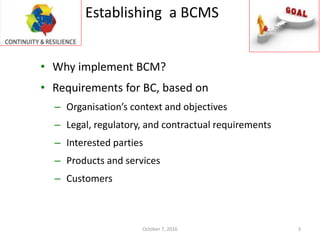
Establishing a BCMS
• Why implement BCM?
• Requirements for BC, based on
– Organisation’s context and objectives
– Legal, regulatory, and contractual requirements
– Interested parties
– Products and services
– Customers
October 7, 2016 3
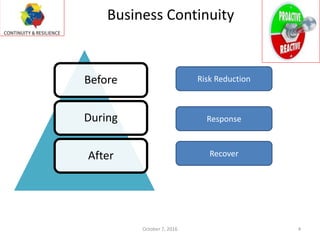
Business Continuity
Before
During
After
Risk Reduction
Response
Recover
4October 7, 2016
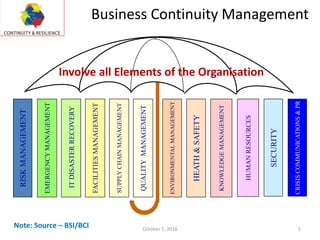
Business Continuity Management
EMERGENCYMANAGEMENT
ITDISASTERRECOVERY
FACILITIESMANAGEMENT
HUMANRESOURCES
SECURITY
CRISISCOMMUNICATIONS&PR
KNOWLEDGEMANAGEMENT
SUPPLYCHAINMANAGEMENT
QUALITYMANAGEMENT
HEATH&SAFETY
RISKMANAGEMENT
ENVIRONMENTALMANAGEMENT
Involve all Elements of the Organisation
Note: Source – BSI/BCI 5October 7, 2016
• BCM is based on a ‘lifecycle’ – it is a continuous
process
• Must become part of the organizational culture
• Commitment from the top, and throughout the
organisation
• Based on impacts – not just threats
• BCM must be proven by exercise and lessons
learnt
• BCM must be maintained in a changing
environment
Key Elements of the Standard
October 7, 2016 6
Key Program Initiation Issues
• Identifying the Scope
• Aligning with organization’s objectives
• Issuance of BCM Policy
• Ownership and accountability
• Roles and responsibilities
• Skills and competencies
• Assumption and limitations
• Schedule and Budget
• Implementation
• Ongoing support
7October 7, 2016
• What are their requirements and perceptions?
• Who are they?
• Shareholders, Customers, Employees and Suppliers
• Regulators, Financial Investors, Insurers, Auditors,
Professional Bodies, Trade Associations,
Government Departments
• Competitors, the Community, Media and ‘Vested
Interest’ Groups
Interested Parties
October 7, 2016 8
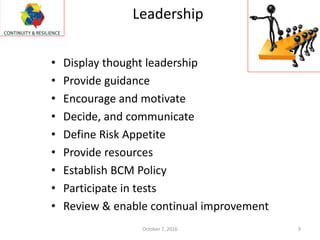
Leadership
October 7, 2016 9
• Display thought leadership
• Provide guidance
• Encourage and motivate
• Decide, and communicate
• Define Risk Appetite
• Provide resources
• Establish BCM Policy
• Participate in tests
• Review & enable continual improvement
Planning
October 7, 2016 10
• Procedure/ methodology for
• Risk Appetite
• Regulatory Requirements
• Business Impact Analysis
• Risk Assessment
• Strategies Development
• Plan Development
• Exercising
• Reviewing and monitoring
• Performance Evaluation
• Continual improvement
• Management Review
• Internal Audit
• Corrections and CAPA
Support
October 7, 2016 11
• The organisation shall commit to support
its BCMS by providing the following
– Resources
– Competence
– Awareness
– Communication
– Documented information
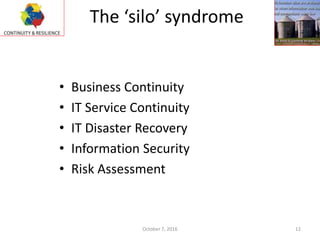
The ‘silo’ syndrome
• Business Continuity
• IT Service Continuity
• IT Disaster Recovery
• Information Security
• Risk Assessment
October 7, 2016 12
October 7, 2016 13

Getting Started with BCM Program

  • 1.
    Continuity and Resilience(CORE) ISO 22301 BCM Consulting Firm Presentations by speakers at the 4th India Business & IT Resilience Summit 7th October, 2016 | Hotel Hilton, Mumbai India Our Contact Details: INDIA UAE Continuity and Resilience Level 15,Eros Corporate Tower Nehru Place ,New Delhi-110019 Tel: +91 11 41055534/ +91 11 41613033 Fax: ++91 11 41055535 Email: ms@continuityandresilience.com Continuity and Resilience P. O. Box 127557 Abu Dhabi, United Arab Emirates Mobile:+971 50 8460530 Tel: +971 2 8152831 Fax: +971 2 8152888 Email: info@continuityandresilience.com
  • 2.
    BCM Program- Getting started SSeshadri Head – Consulting, CORE 4th Biz & IT Resilience Summit, Mumbai October 7, 2016 2
  • 3.
    Establishing a BCMS •Why implement BCM? • Requirements for BC, based on – Organisation’s context and objectives – Legal, regulatory, and contractual requirements – Interested parties – Products and services – Customers October 7, 2016 3
  • 4.
  • 5.
  • 6.
    • BCM isbased on a ‘lifecycle’ – it is a continuous process • Must become part of the organizational culture • Commitment from the top, and throughout the organisation • Based on impacts – not just threats • BCM must be proven by exercise and lessons learnt • BCM must be maintained in a changing environment Key Elements of the Standard October 7, 2016 6
  • 7.
    Key Program InitiationIssues • Identifying the Scope • Aligning with organization’s objectives • Issuance of BCM Policy • Ownership and accountability • Roles and responsibilities • Skills and competencies • Assumption and limitations • Schedule and Budget • Implementation • Ongoing support 7October 7, 2016
  • 8.
    • What aretheir requirements and perceptions? • Who are they? • Shareholders, Customers, Employees and Suppliers • Regulators, Financial Investors, Insurers, Auditors, Professional Bodies, Trade Associations, Government Departments • Competitors, the Community, Media and ‘Vested Interest’ Groups Interested Parties October 7, 2016 8
  • 9.
    Leadership October 7, 20169 • Display thought leadership • Provide guidance • Encourage and motivate • Decide, and communicate • Define Risk Appetite • Provide resources • Establish BCM Policy • Participate in tests • Review & enable continual improvement
  • 10.
    Planning October 7, 201610 • Procedure/ methodology for • Risk Appetite • Regulatory Requirements • Business Impact Analysis • Risk Assessment • Strategies Development • Plan Development • Exercising • Reviewing and monitoring • Performance Evaluation • Continual improvement • Management Review • Internal Audit • Corrections and CAPA
  • 11.
    Support October 7, 201611 • The organisation shall commit to support its BCMS by providing the following – Resources – Competence – Awareness – Communication – Documented information
  • 12.
    The ‘silo’ syndrome •Business Continuity • IT Service Continuity • IT Disaster Recovery • Information Security • Risk Assessment October 7, 2016 12
  • 13.