It Takes A Village School, Business, Community & Post-Secondary Partnerships Urban Education Partnership
Curriculum High School Teachers offer… A Standards-based, Academic Curriculum High School Graduation Requirements A-G Requirements … and A Standards-based, CTE Curriculum A Sequence of CTE Courses
But… Are we doing enough? Are we exposing our students to the many pathways in our industry sector? Are we integrating academic standards with career technical standards? Are we integrating industry expectations into our curriculum – academic & CTE? Are we developing collaborative learners & workers? Are we providing authentic project-based learning experiences? Are we academically enabling students to chose the next phase of their career prep: Entry level position? AA Degree? Post-secondary education? Are we meeting the new 3 R’s of education – rigor, relevance, relationships?
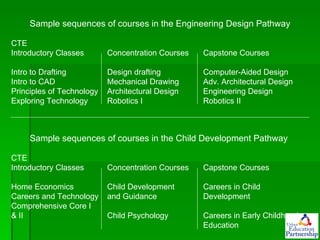
Sample sequences of courses in the Engineering Design Pathway CTE  Introductory Classes Concentration Courses Capstone Courses Intro to Drafting Design drafting Computer-Aided Design Intro to CAD Mechanical Drawing Adv. Architectural Design Principles of Technology Architectural Design Engineering Design Exploring Technology Robotics I Robotics II Sample sequences of courses in the Child Development Pathway CTE  Introductory Classes Concentration Courses Capstone Courses Home Economics Child Development Careers in Child Careers and Technology and Guidance Development Comprehensive Core I & II Child Psychology Careers in Early Childhood Education
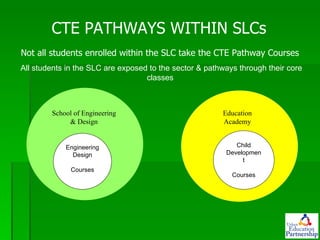
CTE PATHWAYS WITHIN SLCs Not all students enrolled within the SLC take the CTE Pathway Courses  All students in the SLC are exposed to the sector & pathways through their core classes  School of Engineering & Design Engineering Design Courses Courses Education Academy Child Development Courses
We need to work with our business, community, and post-secondary partners in order to… Create a Future Work Force Together
In This Type of Partnership, Schools will Provide- Students equipped to enter the world of work and to pursue post-secondary education  Opportunities for service & work-based learning Community volunteers Ethical, responsible workers A liaison between school & the Partnership Students who are collaborators, critical thinkers, and creative problem solvers
PARTNERSHIPS SUPPORT AND SUPPLEMENT CTE Collaborate with teachers to produce a curriculum that provides students hands-on, work-based learning  Collaborate with teachers to design projects & work-based learning that reinforce the California academic and CTE standards  Help students understand the role of personal integrity and ethical behavior in the workplace setting  Help students understand the basic attitudes and skills needed to be a successful worker, including linking problem-solving methods to desired outcomes and understanding various leadership styles and accountability
Partners provide- Internships  Speakers Advisors/Industry Standards Advocacy Soft Skills Field Trips Curriculum Development Technical & Design Assistance  ROC, ROP & College Courses
Knowledge of  entry-level requirements working conditions salary training advancement needed post-secondary training Project Mentors Increased Academic Rigor Relevance Extended Relationships
How does one begin? Contact your local council person Contact local business organizations Contact the California Dept. of Education seeking to identify California Partnership academy recipients in your area in your area Contact the School
Four Phase Approach  to Business, Community, Post-secondary Partnerships
Phase One – 9th grade Introduction to “soft skills” including responsibility, ethics, dress, speech, etc., via classroom speakers from local business and post-secondary partners Local college visits –  intro to post-secondary possibilities Project mentors
Phase Two – 10th grade Introduction to local businesses, career pathways and specific post-secondary programs via teacher instruction, business/community speakers, introductory tours, project mentors Participation with local business through summer internships for selected students Interdisciplinary academic and CTE instruction Job shadowing
Phase Three – 11th grade Internships for all 11th graders: i.e. four hours per day, once a week for six weeks; 6-8 weeks during summer  Continue classroom speakers, field trips to local businesses and colleges, and project mentoring and advisement Interdisciplinary academic and CTE instruction
Phase Four – 12th grade Summer, paid internships and/or apprenticeships between 11th and 12th grade for selected 12th graders Work experience opportunities for eligible 12th graders Concurrent enrollment in college courses for eligible 12th graders Continue classroom speakers, field trips to local businesses and colleges, and project mentoring and advisement Interdisciplinary academic and CTE instruction
Sounds like a lot of work!! Protocols for conducting your partnership meetings
Designing your internship program A special note about internships
A WINNING COMBINATION Business/Community/Post-Secondary Partnerships CTE Sectors and Pathways CTE Dollars Interdisciplinary academic and CTE instruction

Business Collaboratives UEP

  • 1.
    It Takes AVillage School, Business, Community & Post-Secondary Partnerships Urban Education Partnership
  • 2.
    Curriculum High SchoolTeachers offer… A Standards-based, Academic Curriculum High School Graduation Requirements A-G Requirements … and A Standards-based, CTE Curriculum A Sequence of CTE Courses
  • 3.
    But… Are wedoing enough? Are we exposing our students to the many pathways in our industry sector? Are we integrating academic standards with career technical standards? Are we integrating industry expectations into our curriculum – academic & CTE? Are we developing collaborative learners & workers? Are we providing authentic project-based learning experiences? Are we academically enabling students to chose the next phase of their career prep: Entry level position? AA Degree? Post-secondary education? Are we meeting the new 3 R’s of education – rigor, relevance, relationships?
  • 4.
    Sample sequences ofcourses in the Engineering Design Pathway CTE Introductory Classes Concentration Courses Capstone Courses Intro to Drafting Design drafting Computer-Aided Design Intro to CAD Mechanical Drawing Adv. Architectural Design Principles of Technology Architectural Design Engineering Design Exploring Technology Robotics I Robotics II Sample sequences of courses in the Child Development Pathway CTE Introductory Classes Concentration Courses Capstone Courses Home Economics Child Development Careers in Child Careers and Technology and Guidance Development Comprehensive Core I & II Child Psychology Careers in Early Childhood Education
  • 5.
    CTE PATHWAYS WITHINSLCs Not all students enrolled within the SLC take the CTE Pathway Courses All students in the SLC are exposed to the sector & pathways through their core classes School of Engineering & Design Engineering Design Courses Courses Education Academy Child Development Courses
  • 6.
    We need towork with our business, community, and post-secondary partners in order to… Create a Future Work Force Together
  • 7.
    In This Typeof Partnership, Schools will Provide- Students equipped to enter the world of work and to pursue post-secondary education Opportunities for service & work-based learning Community volunteers Ethical, responsible workers A liaison between school & the Partnership Students who are collaborators, critical thinkers, and creative problem solvers
  • 8.
    PARTNERSHIPS SUPPORT ANDSUPPLEMENT CTE Collaborate with teachers to produce a curriculum that provides students hands-on, work-based learning Collaborate with teachers to design projects & work-based learning that reinforce the California academic and CTE standards Help students understand the role of personal integrity and ethical behavior in the workplace setting Help students understand the basic attitudes and skills needed to be a successful worker, including linking problem-solving methods to desired outcomes and understanding various leadership styles and accountability
  • 9.
    Partners provide- Internships Speakers Advisors/Industry Standards Advocacy Soft Skills Field Trips Curriculum Development Technical & Design Assistance ROC, ROP & College Courses
  • 10.
    Knowledge of entry-level requirements working conditions salary training advancement needed post-secondary training Project Mentors Increased Academic Rigor Relevance Extended Relationships
  • 11.
    How does onebegin? Contact your local council person Contact local business organizations Contact the California Dept. of Education seeking to identify California Partnership academy recipients in your area in your area Contact the School
  • 12.
    Four Phase Approach to Business, Community, Post-secondary Partnerships
  • 13.
    Phase One –9th grade Introduction to “soft skills” including responsibility, ethics, dress, speech, etc., via classroom speakers from local business and post-secondary partners Local college visits – intro to post-secondary possibilities Project mentors
  • 14.
    Phase Two –10th grade Introduction to local businesses, career pathways and specific post-secondary programs via teacher instruction, business/community speakers, introductory tours, project mentors Participation with local business through summer internships for selected students Interdisciplinary academic and CTE instruction Job shadowing
  • 15.
    Phase Three –11th grade Internships for all 11th graders: i.e. four hours per day, once a week for six weeks; 6-8 weeks during summer Continue classroom speakers, field trips to local businesses and colleges, and project mentoring and advisement Interdisciplinary academic and CTE instruction
  • 16.
    Phase Four –12th grade Summer, paid internships and/or apprenticeships between 11th and 12th grade for selected 12th graders Work experience opportunities for eligible 12th graders Concurrent enrollment in college courses for eligible 12th graders Continue classroom speakers, field trips to local businesses and colleges, and project mentoring and advisement Interdisciplinary academic and CTE instruction
  • 17.
    Sounds like alot of work!! Protocols for conducting your partnership meetings
  • 18.
    Designing your internshipprogram A special note about internships
  • 19.
    A WINNING COMBINATIONBusiness/Community/Post-Secondary Partnerships CTE Sectors and Pathways CTE Dollars Interdisciplinary academic and CTE instruction