
Business Card
Etiquettes
Armaan Farshori
MCA IV
A1000716001
What are Etiquettes
Etiquette is a code of behavior that delineates expectations for
social behavior according to contemporary conventional
norms within a society, social class, or group.
Why Business Etiquette?
● Differentiates you from others in a competitive job market.
● Enables you to be confident in a variety of settings with a
variety of people.
● Honors commitment to excellence and quality.
● Modifies distracting behaviors and develops admired conduct.
● Exhibit Professionalism and develop a polished image “Be one
step ahead, practice the social skills necessary to help you
make a great first impression and stand out in a competitive job
market”.
Business Card
They act as a vehicle to get your
contact information to your
potential future boss and might
be your key to a new job, but
hey—they're just paper, right?
Believe it or not !!!!
● Have been around since the
1600’s
● Favorite networking sidekick for
the past few centuries
● Also referred as “Trade Cards”
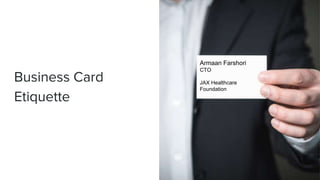
Business Card
Etiquette
Armaan Farshori
CTO
JAX Healthcare
Foundation
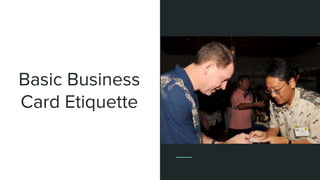
Basic Business
Card Etiquette
● You should take a good supply of cards with you.
● If you are travelling to a country whose main language is not
English, you should also have one side of the card translated
into the language of the country you’re visiting and always
present your business card with the foreign version side up, not
the English side.
● It’s considered disrespectful if you immediately put the card you
are offered straight into your pocket.
● You should study it for several seconds and comment on it or
clarify any information on it before putting it away.
● You’d usually offer a business card at the beginning or the end
of a meeting.
Different Cultures
and
Business Card Etiquettes
India
● In addition to your name and
job title, your business cards
should also state any university
qualifications you have or any
other kind of honour.
● Always use your right hand
when offering a business card.
Japan
● To give and receive business
cards in Japan is quite
ceremonial.
● Whilst it’s perfectly acceptable
to give your card with one hand,
make sure you accept one with
both hands.
● Don’t put it away in your pocket
at a meeting. Keep it on the
table in front of you.
● Treat both the giving and
receiving of business cards with
the same degree of respect as
you would show the person him
or herself.
China
● Have one side of your business
card translated into Chinese
and in gold coloured lettering
as that is considered
auspicious.
● Cantonese or Mandarin and
have the card tailored
specifically for the same.
● When offering the card, you
should do so with both hands
● If you’re receiving a card, make
sure you study it and comment
on it – don’t just stuff it in your
jacket pocket.
Middle East ● Always present your card with
your right hand, never your left.
● As you can, therefore, see – the way certain
other cultures perceive business cards is
different from our’s.
● The fact that you have taken the time and
trouble to observe the correct etiquette will
have indicated the respect you have for
your hosts.
Some Points to Ponder
● Always have a business card.
● Have it in a good shape and updated.
● Have it readily available.
● Be selective about distributing.
● Present it in a appropriate time and manner.
Thank You!

Business card etiquettes

  • 1.
  • 2.
    What are Etiquettes Etiquetteis a code of behavior that delineates expectations for social behavior according to contemporary conventional norms within a society, social class, or group.
  • 3.
    Why Business Etiquette? ●Differentiates you from others in a competitive job market. ● Enables you to be confident in a variety of settings with a variety of people. ● Honors commitment to excellence and quality. ● Modifies distracting behaviors and develops admired conduct. ● Exhibit Professionalism and develop a polished image “Be one step ahead, practice the social skills necessary to help you make a great first impression and stand out in a competitive job market”.
  • 4.
    Business Card They actas a vehicle to get your contact information to your potential future boss and might be your key to a new job, but hey—they're just paper, right? Believe it or not !!!! ● Have been around since the 1600’s ● Favorite networking sidekick for the past few centuries ● Also referred as “Trade Cards”
  • 5.
  • 6.
  • 7.
    ● You shouldtake a good supply of cards with you. ● If you are travelling to a country whose main language is not English, you should also have one side of the card translated into the language of the country you’re visiting and always present your business card with the foreign version side up, not the English side. ● It’s considered disrespectful if you immediately put the card you are offered straight into your pocket. ● You should study it for several seconds and comment on it or clarify any information on it before putting it away. ● You’d usually offer a business card at the beginning or the end of a meeting.
  • 8.
  • 9.
    India ● In additionto your name and job title, your business cards should also state any university qualifications you have or any other kind of honour. ● Always use your right hand when offering a business card.
  • 10.
    Japan ● To giveand receive business cards in Japan is quite ceremonial. ● Whilst it’s perfectly acceptable to give your card with one hand, make sure you accept one with both hands. ● Don’t put it away in your pocket at a meeting. Keep it on the table in front of you. ● Treat both the giving and receiving of business cards with the same degree of respect as you would show the person him or herself.
  • 11.
    China ● Have oneside of your business card translated into Chinese and in gold coloured lettering as that is considered auspicious. ● Cantonese or Mandarin and have the card tailored specifically for the same. ● When offering the card, you should do so with both hands ● If you’re receiving a card, make sure you study it and comment on it – don’t just stuff it in your jacket pocket.
  • 12.
    Middle East ●Always present your card with your right hand, never your left.
  • 13.
    ● As youcan, therefore, see – the way certain other cultures perceive business cards is different from our’s. ● The fact that you have taken the time and trouble to observe the correct etiquette will have indicated the respect you have for your hosts.
  • 14.
    Some Points toPonder ● Always have a business card. ● Have it in a good shape and updated. ● Have it readily available. ● Be selective about distributing. ● Present it in a appropriate time and manner.
  • 15.