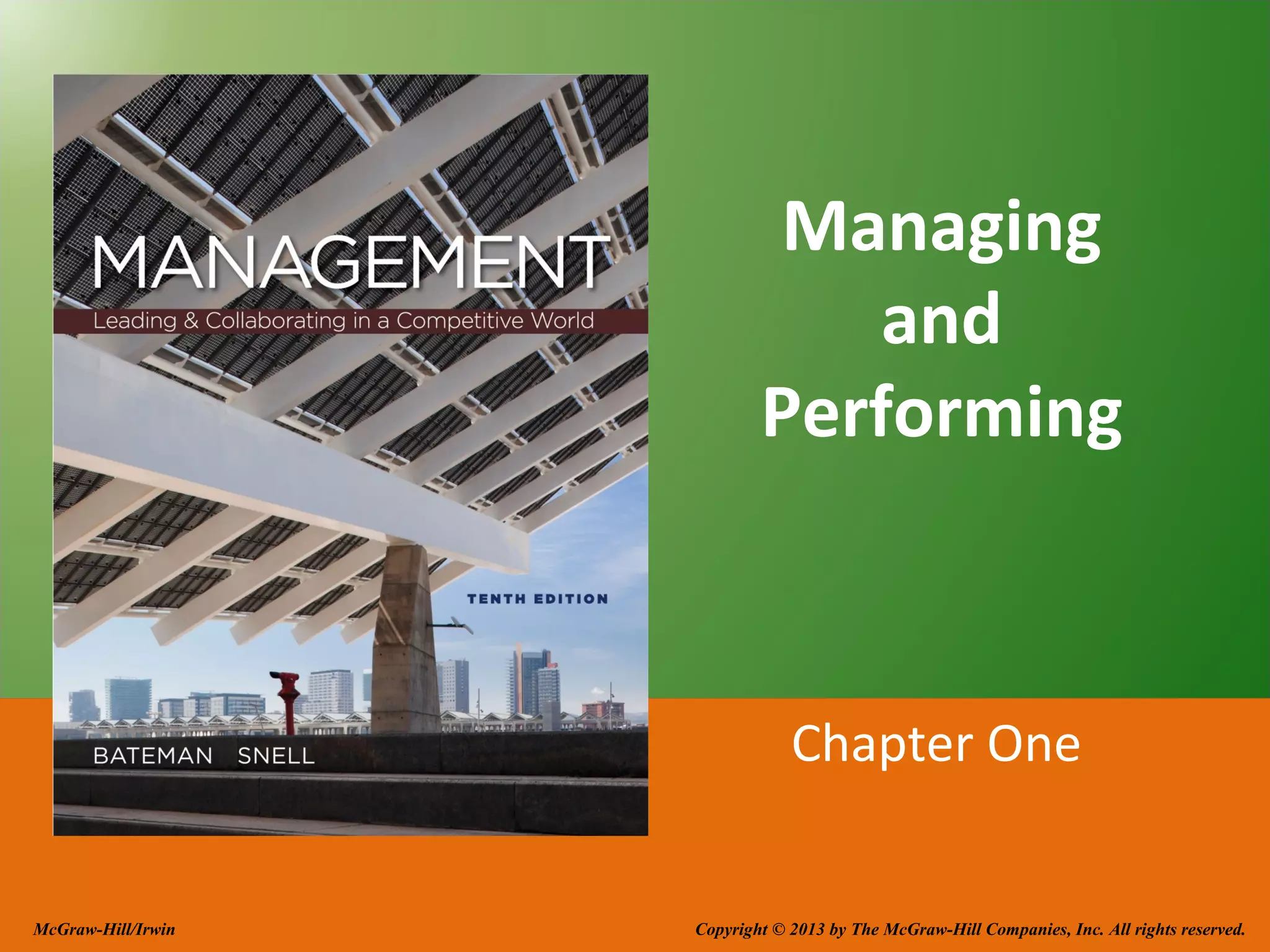
Managing
and
Performing

Chapter One

McGraw-Hill/Irwin

Copyright © 2013 by The McGraw-Hill Companies, Inc. All rights reserved.
Learning Objectives
LO 1 Summarize the major challenges of managing
in the new competitive landscape.
LO 2 Describe the sources of competitive advantage
for a company.
LO 3 Explain how the functions of management are
evolving in today’s business environment.
LO 4 Compare how the nature of management
varies at different organizational levels.
LO 5 Define the skills you need to be an effective
manager.
LO 6 Discuss the principles that will help you
manage your career.
1-2
Globalization
Today’s enterprises are global, with
offices and production facilities in
countries all over the world
Means that a company’s talent can come
from anywhere
Internet makes globalization inevitable

1-3
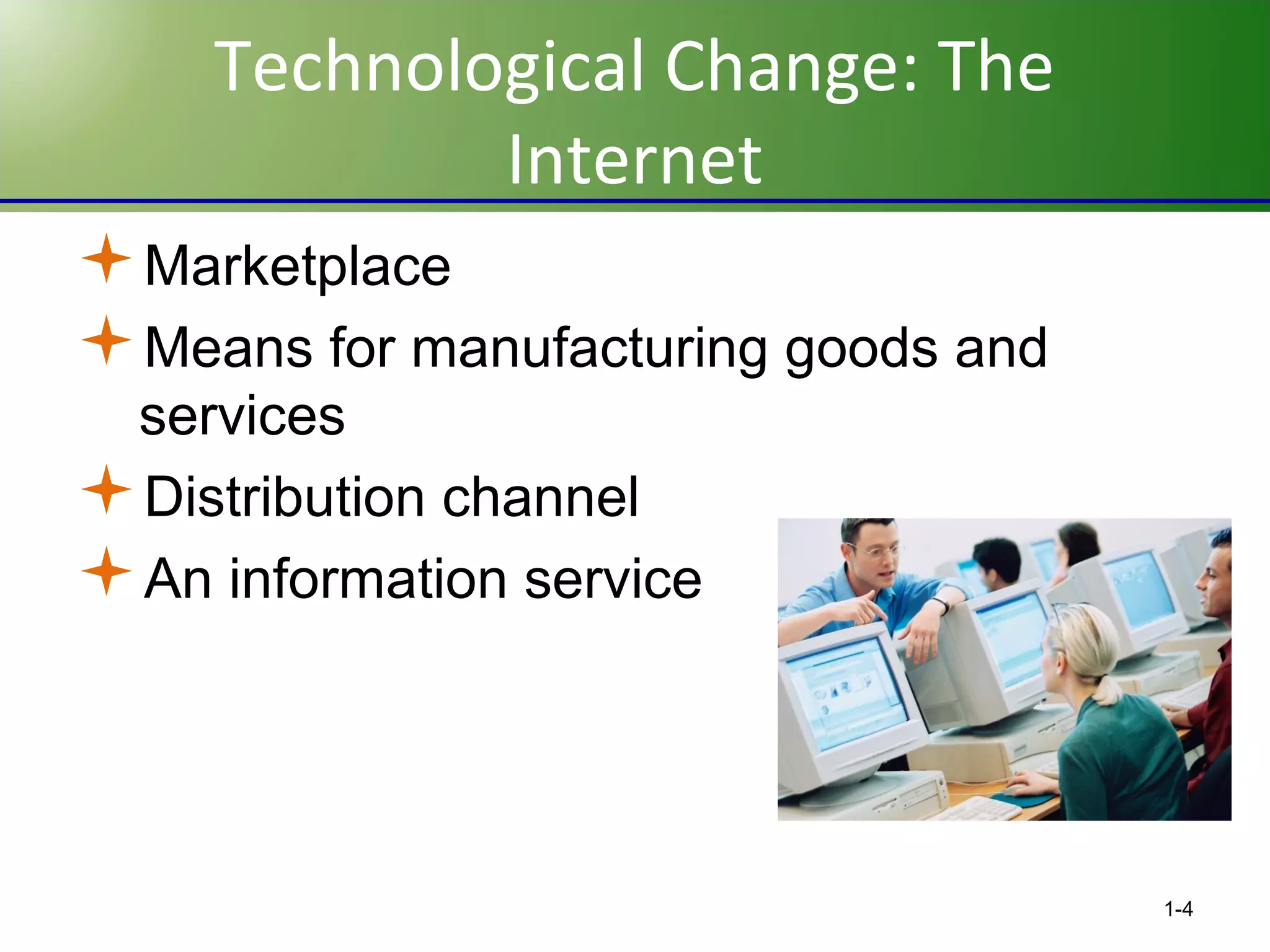
Technological Change: The
Internet
Marketplace
Means for manufacturing goods and
services
Distribution channel
An information service

1-4
Technological Change: The
Internet
Drives down costs and speeds up
globalization.
Improves efficiency of decision making.
Facilitates design of new products, from
pharmaceuticals to financial services

1-5
Knowledge Management
Knowledge
management
 Practices aimed at
discovering and
harnessing an
organization’s
intellectual
resources

1-6
Knowledge Management
Knowledge workers
 Workers whose primary contributions are
ideas and problem-solving expertise

Knowledge managers find these human
assets, help people collaborate and learn,
help people generate new ideas, and harness
those ideas into successful innovations.

1-7
Knowledge Management
Knowledge management is about finding,
unlocking, sharing, and altogether
capitalizing on the most precious
resources of an organization: people’s
expertise, skills, wisdom, and
relationships.

1-8
Collaboration across “Boundaries”
Requires productive communications
among different departments, divisions, or
other subunits of the organization

1-9
Collaboration across “Boundaries”
Companies today must motivate and
capitalize on the ideas of people outside
the organization e.g. its consultants, ad
agencies, and suppliers

1-10
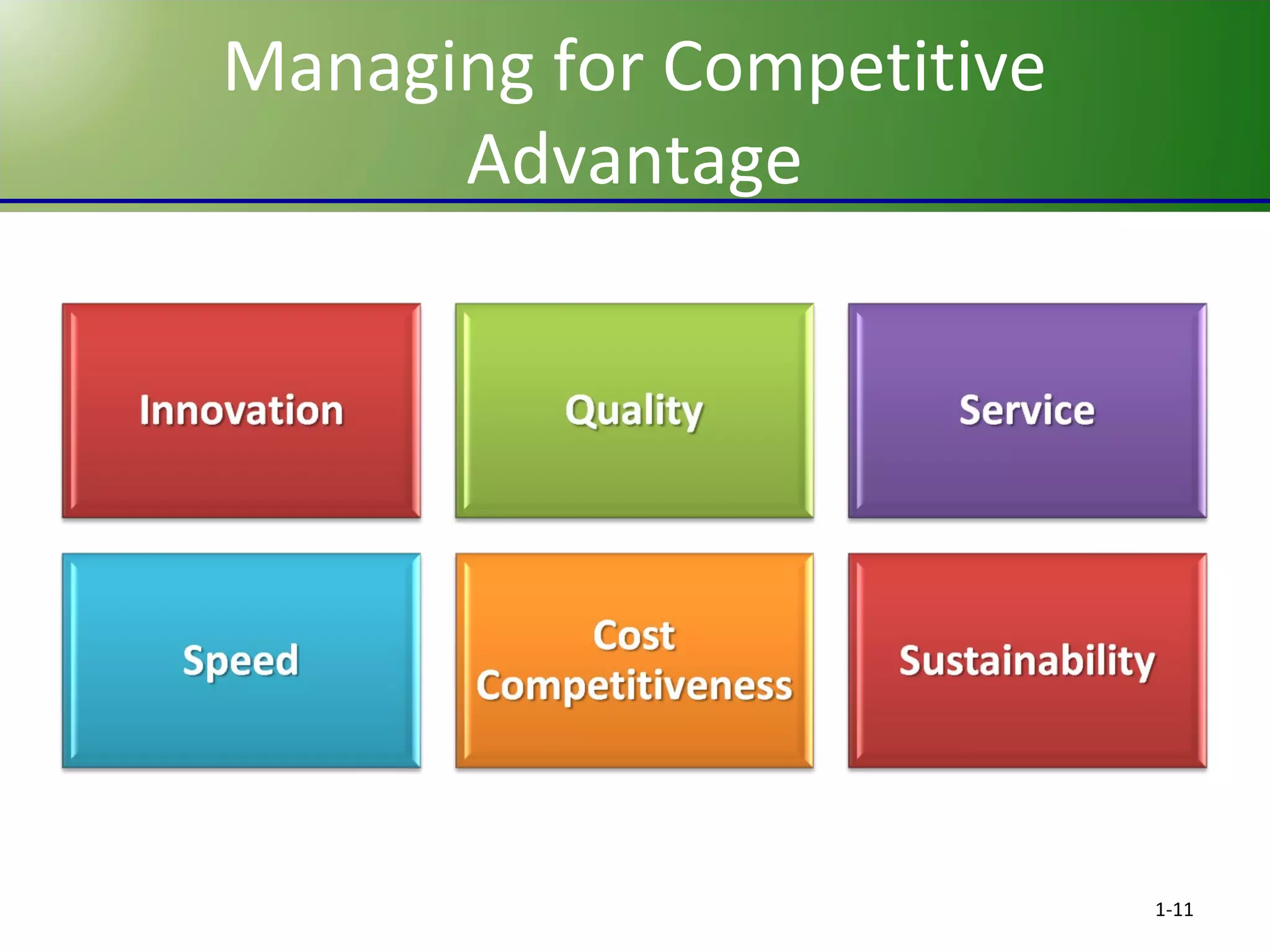
Managing for Competitive
Advantage

1-11
Question
___________ is the fast and timely
execution, response, and delivery of
results.
A.Innovation
B.Quality
C.Speed
D.Service
1-12
Managing for Competitive
Advantage
Innovation
 the introduction of new goods and services

A firm must:
 adapt to changes in consumer demands and
to new competitors.
 be ready with new ways to communicate with
customers and deliver the products to them.

1-13
Managing for Competitive
Advantage
Quality
 The excellence of your product (goods or
services)
 Historically, quality referred to attractiveness,
lack of defects, reliability, and long-term
dependability

1-14
Managing for Competitive
Advantage
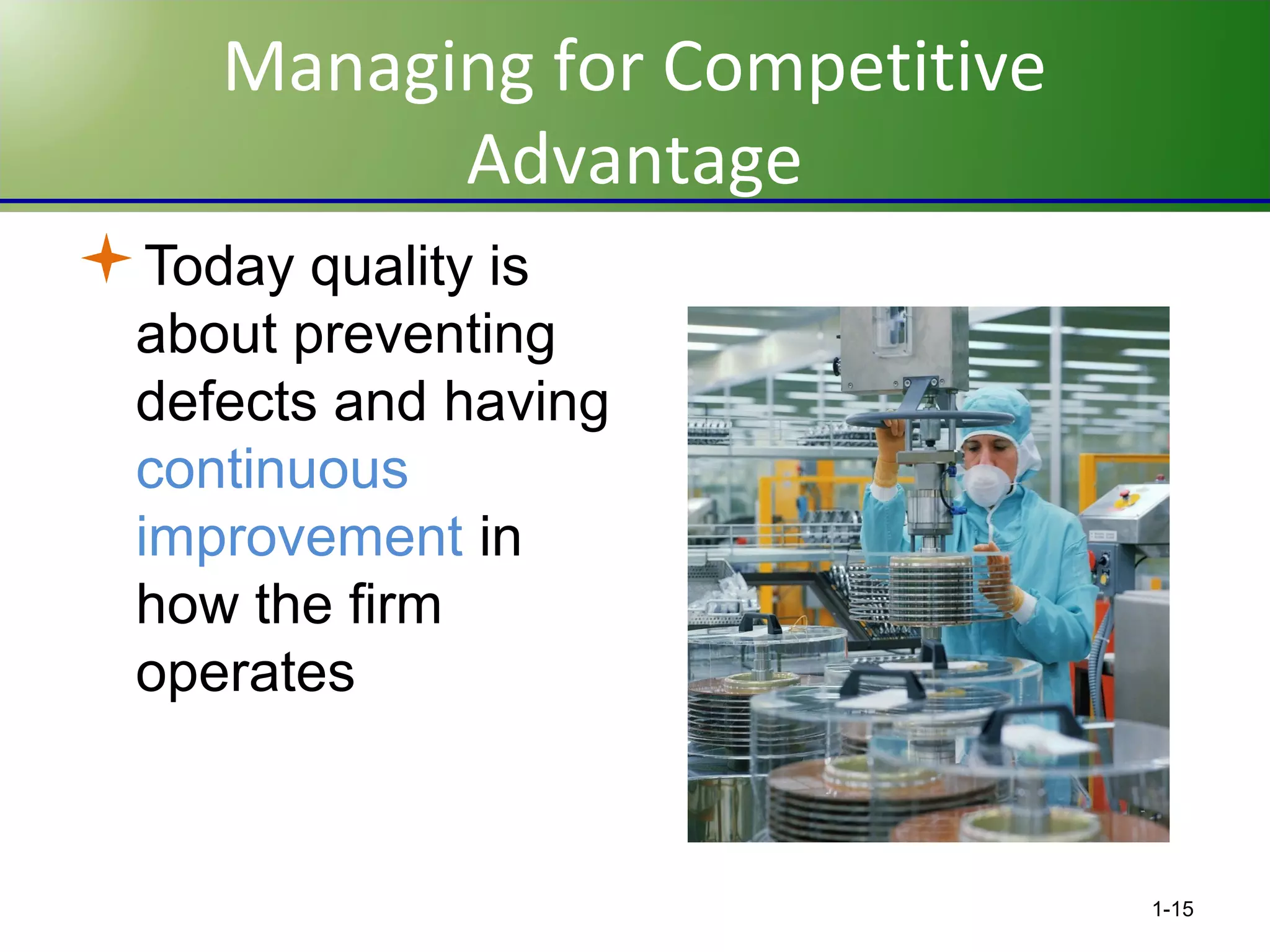
Today quality is
about preventing
defects and having
continuous
improvement in
how the firm
operates

1-15
Managing for Competitive
Advantage
Service
 giving customers what they want or need,
when they want it
 focused on continually meeting the needs of
customers to establish mutually beneficial
long-term relationships.

Speed
 Fast and timely execution, response, and
delivery of results.
1-16
Managing for Competitive
Advantage
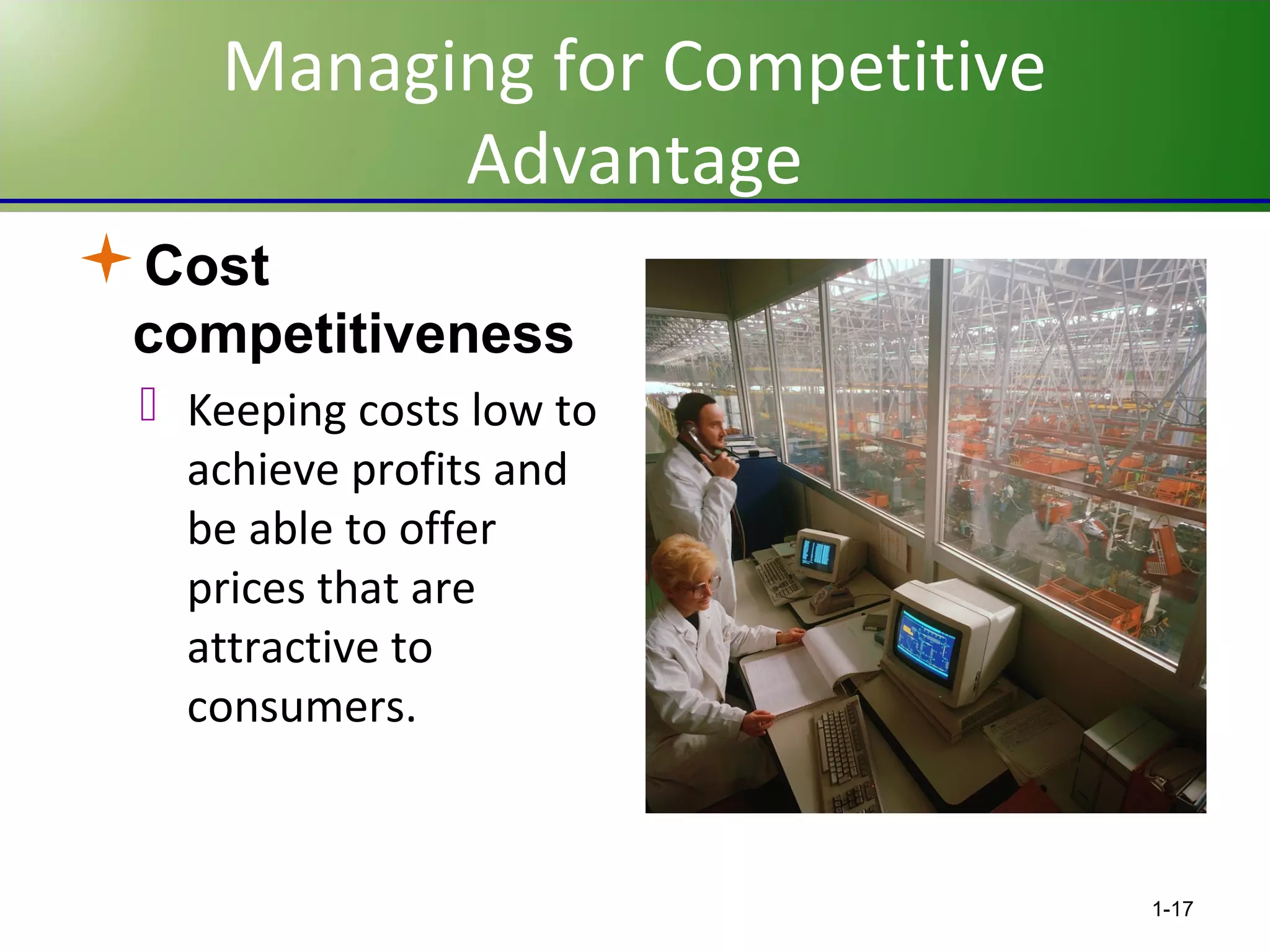
Cost
competitiveness
 Keeping costs low to
achieve profits and
be able to offer
prices that are
attractive to
consumers.

1-17
Managing for Competitive
Advantage
Sustainability
 The effort to minimize the use of resources,
especially those that are polluting and
nonrenewable.

1-18
The Functions of Management
Management
 The process of working with people and
resources to accomplish organizational goals
 Efficiently, effectively

1-19
Question
____________ is monitoring performance
and making needed changes.
A.Planning
B.Organizing
C.Leading
D.Controlling

1-20
The Functions of Management
Planning
 Systematically making decisions about the
goals and activities that an individual, a
group, a work unit, or the overall organization
will pursue
 analyzing current situations, anticipating the
future, determining objectives, deciding in
what types of activities the company will
engage
1-21
The Functions of Management
Organizing
 assembling and coordinating the human,
financial, physical, informational, and other
resources needed to achieve goals
 specifying job responsibilities, grouping jobs
into work units, marshaling and allocating
resources,

1-22
The Functions of Management
Leading
 stimulating people to be high performers

Controlling
 monitoring performance and making needed
changes.

1-23
Performing All Four Management
Functions
A typical day for a manager is not neatly
divided into the four functions
Days are busy and fractionated, and
spent dealing with interruptions, meetings,
and firefighting

1-24
Performing All Four Management
Functions
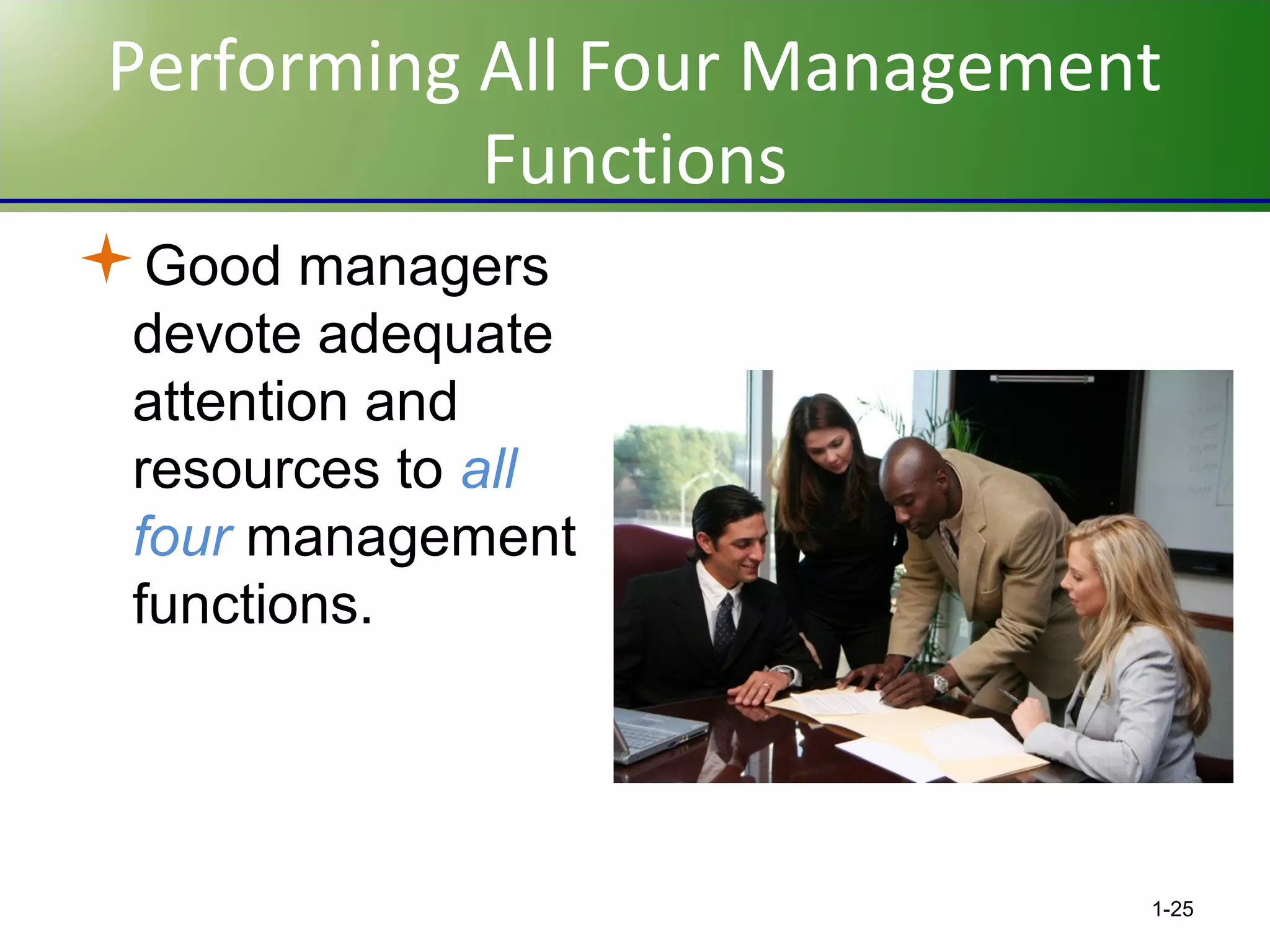
Good managers
devote adequate
attention and
resources to all
four management
functions.

1-25
Management Levels and Skills

1-26
Management Levels and Skills
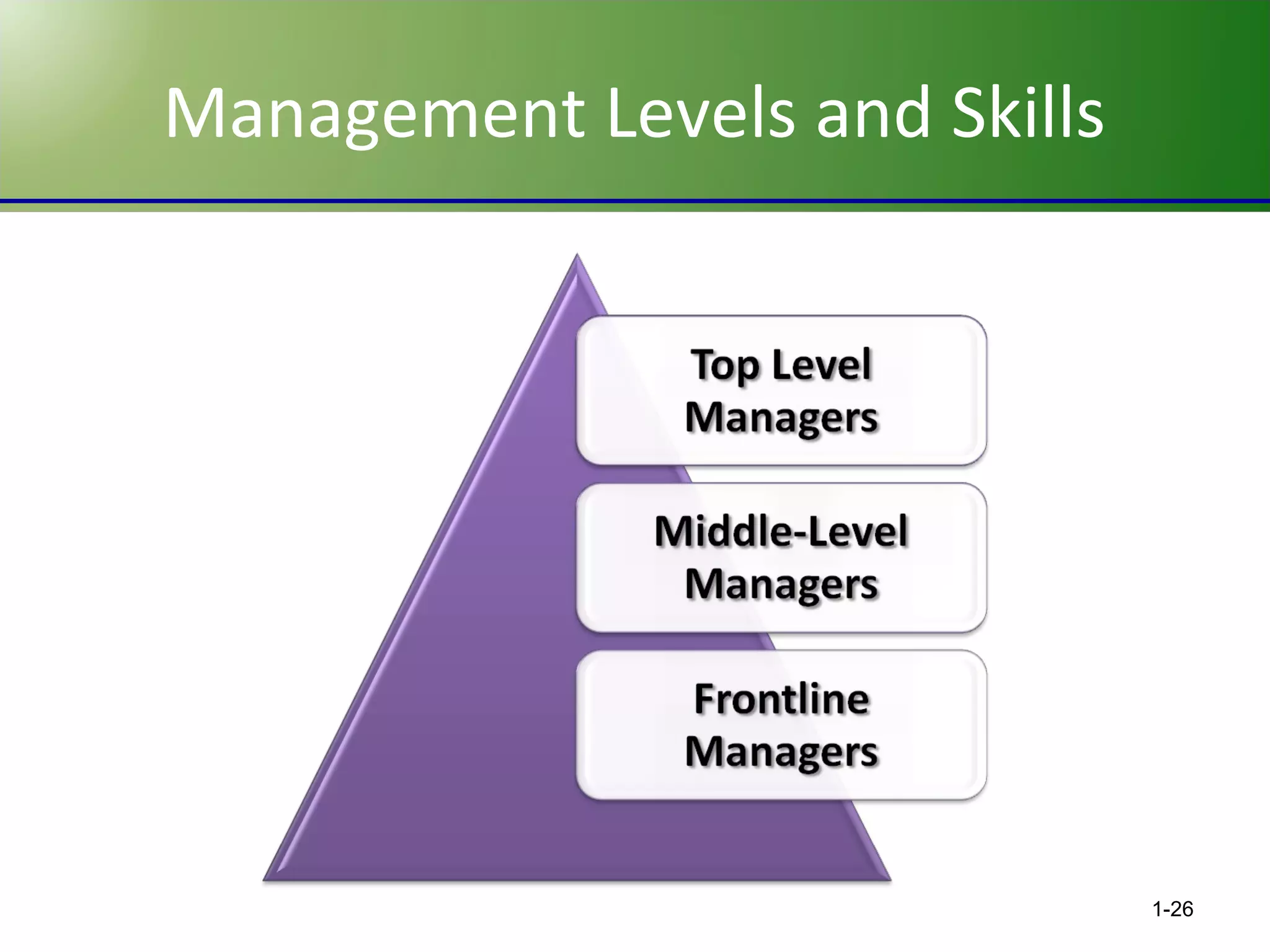
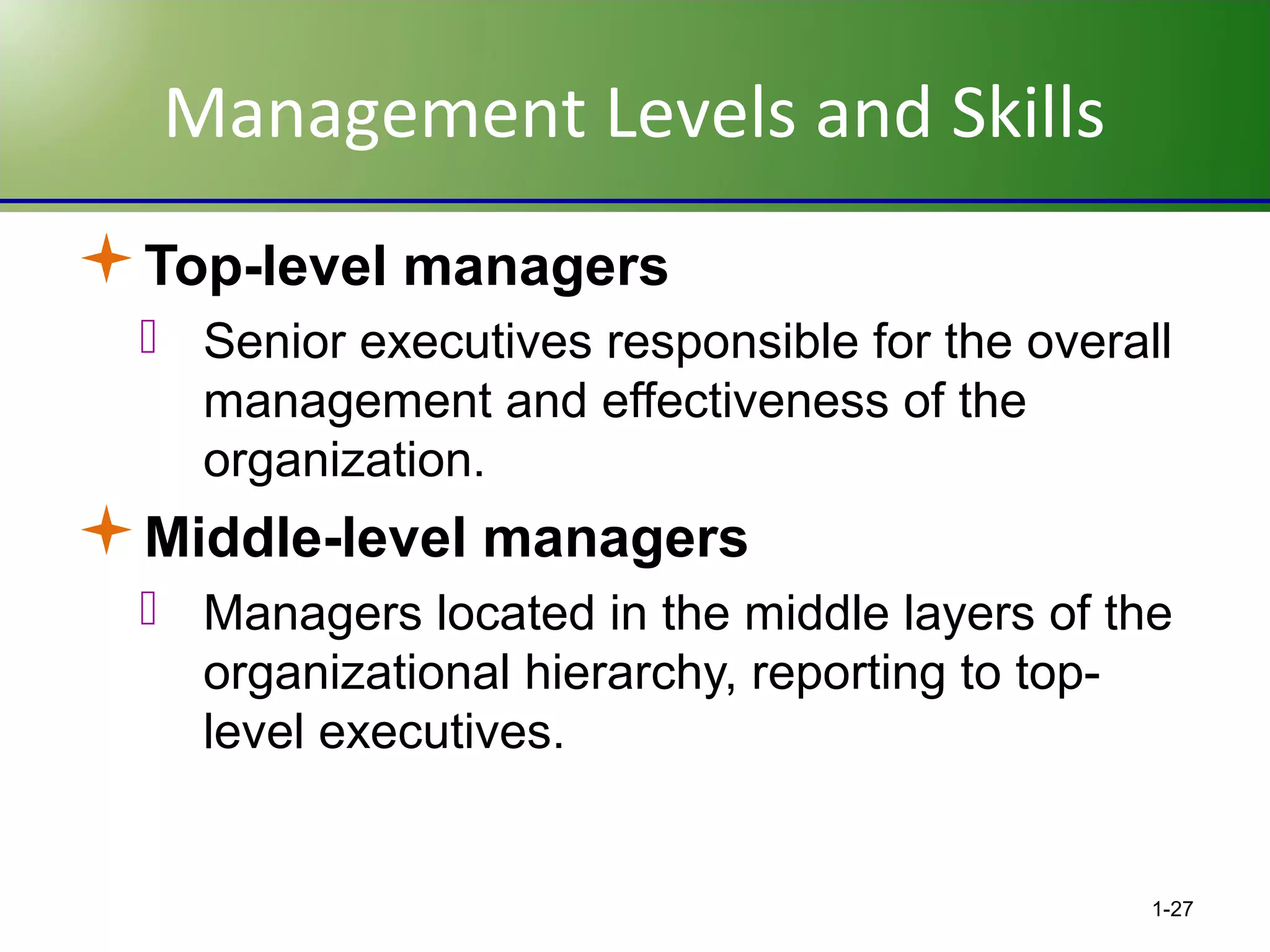
Top-level managers
 Senior executives responsible for the overall
management and effectiveness of the
organization.

Middle-level managers
 Managers located in the middle layers of the
organizational hierarchy, reporting to toplevel executives.

1-27
Management Levels and Skills
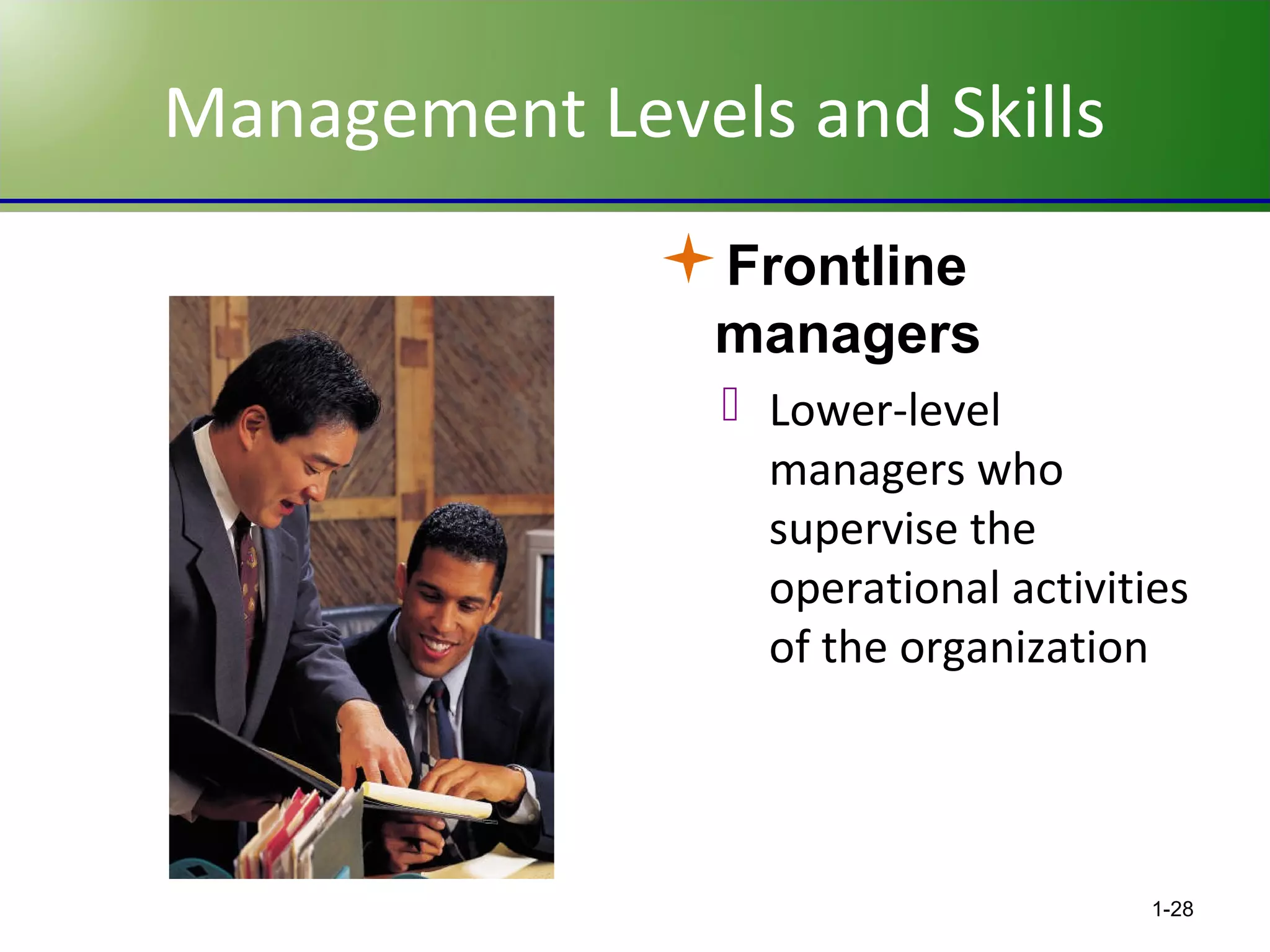
Frontline
managers
 Lower-level
managers who
supervise the
operational activities
of the organization

1-28
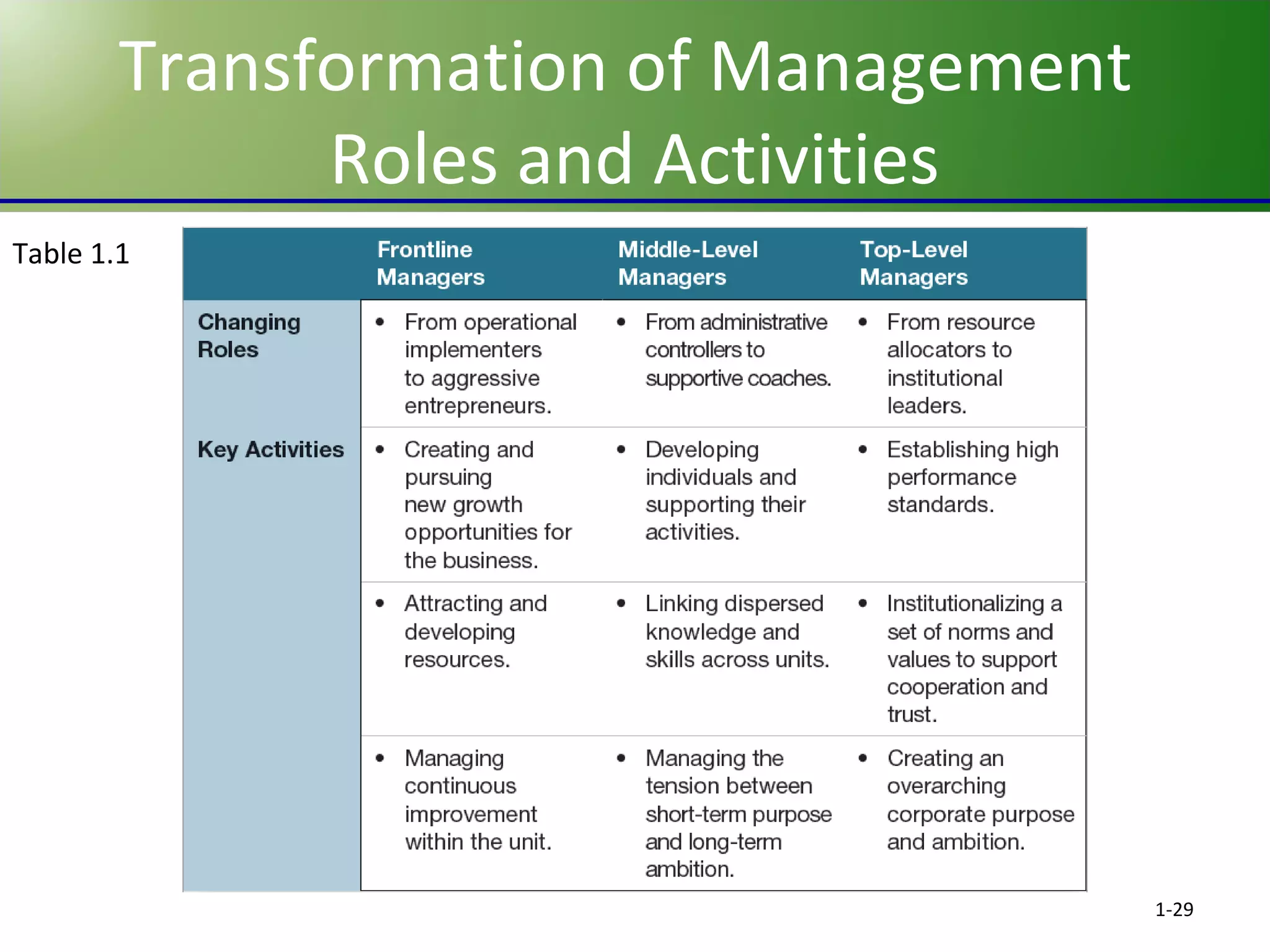
Transformation of Management
Roles and Activities
Table 1.1

1-29
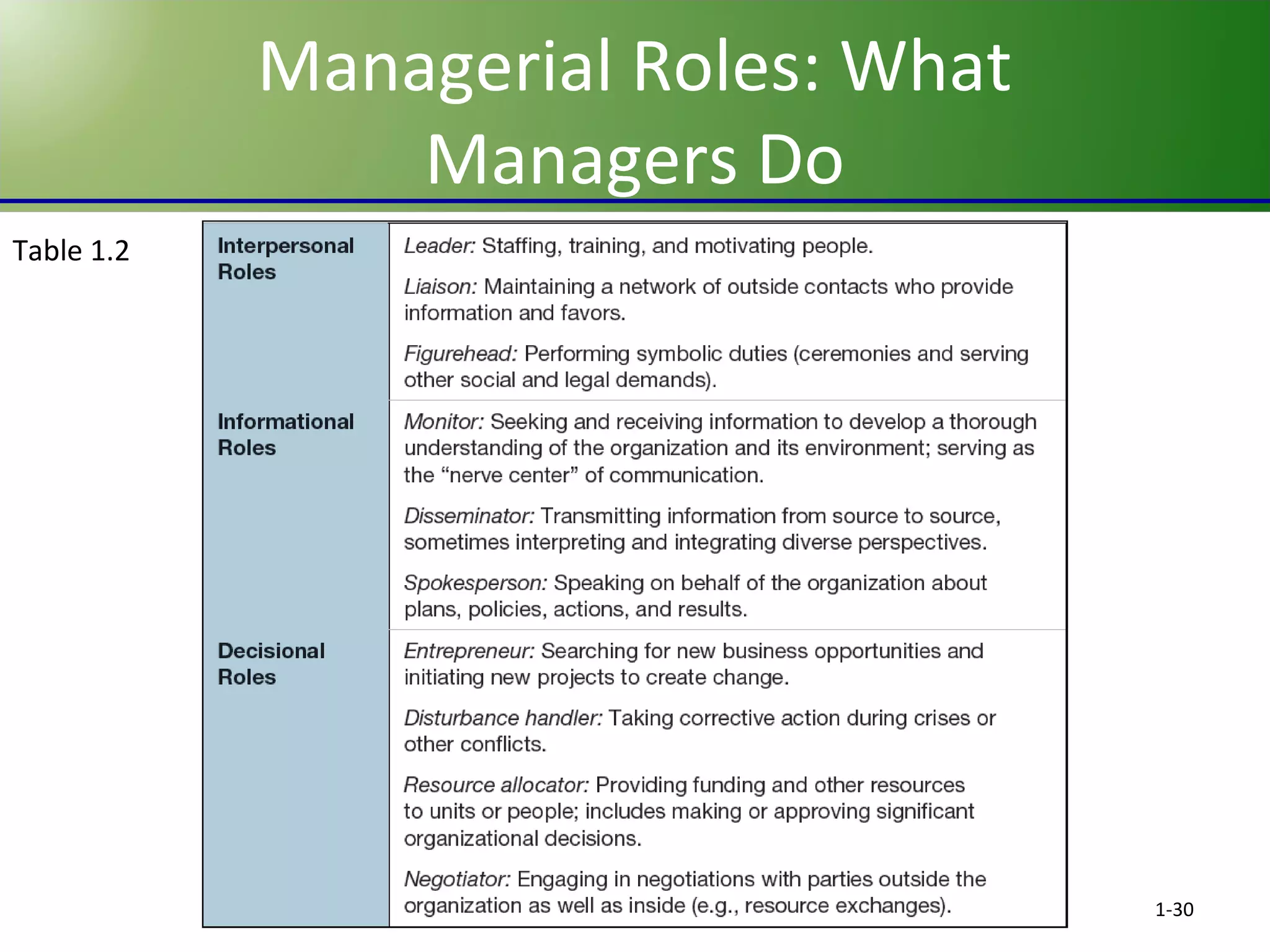
Managerial Roles: What
Managers Do
Table 1.2

1-30
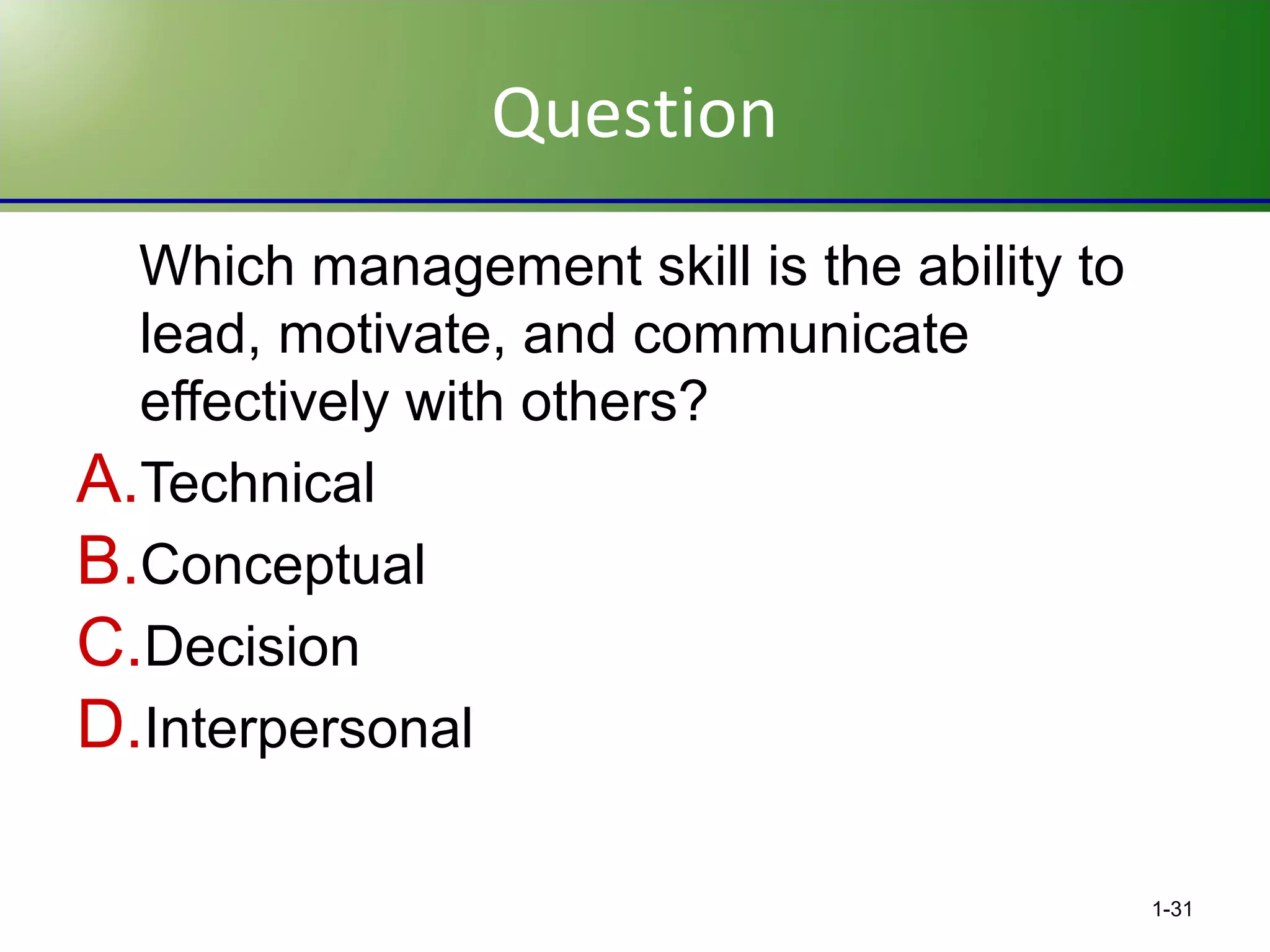
Question
Which management skill is the ability to
lead, motivate, and communicate
effectively with others?
A.Technical
B.Conceptual
C.Decision
D.Interpersonal
1-31
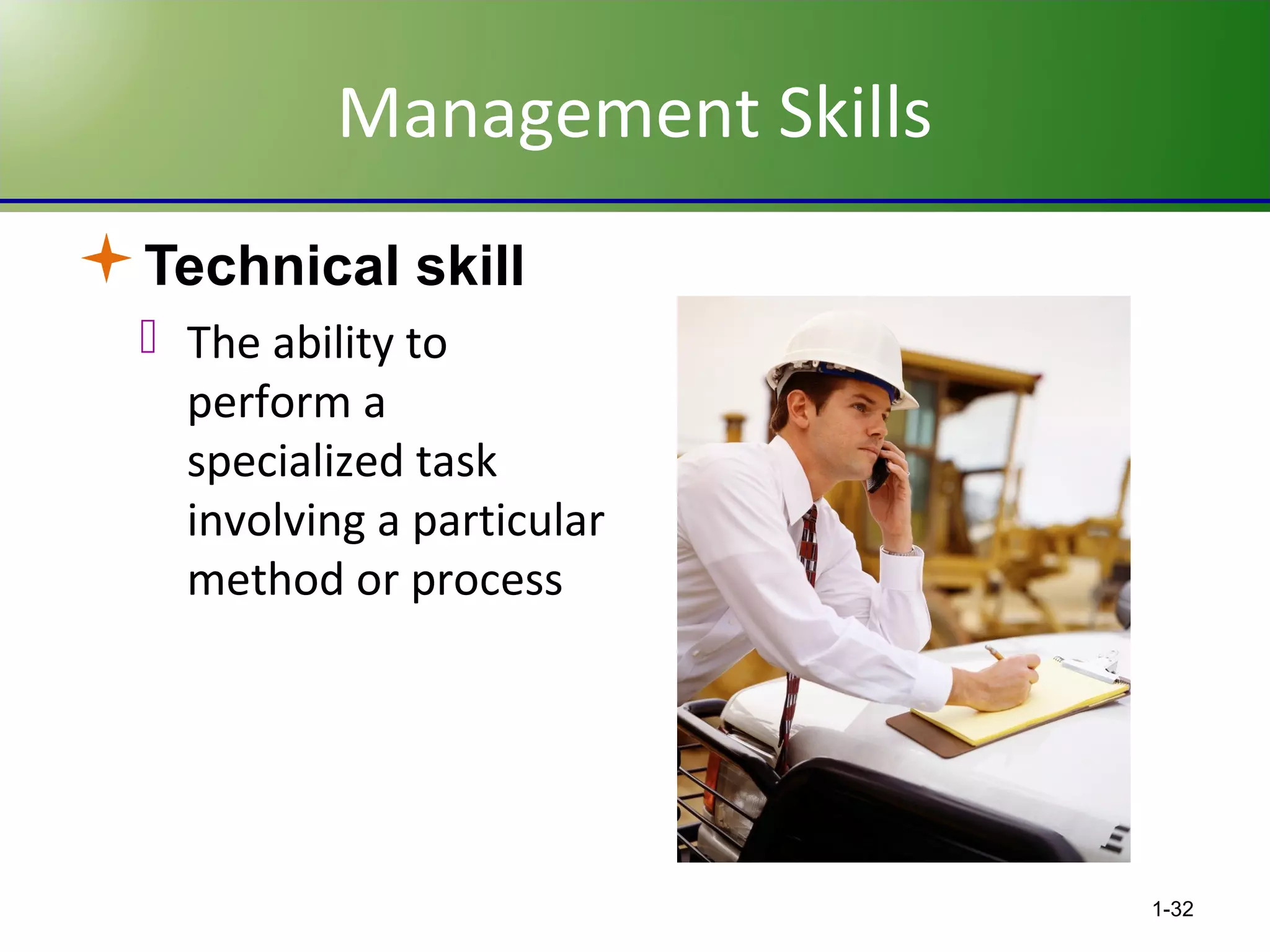
Management Skills
Technical skill
 The ability to
perform a
specialized task
involving a particular
method or process

1-32
Management Skills
Conceptual and decision skills
 Skills pertaining to the ability to identify and
resolve problems for the benefit of the
organization and its members.

1-33
Management Skills
Interpersonal and communication
skills
 People skills; the ability to lead, motivate,
and communicate effectively with others.

1-34
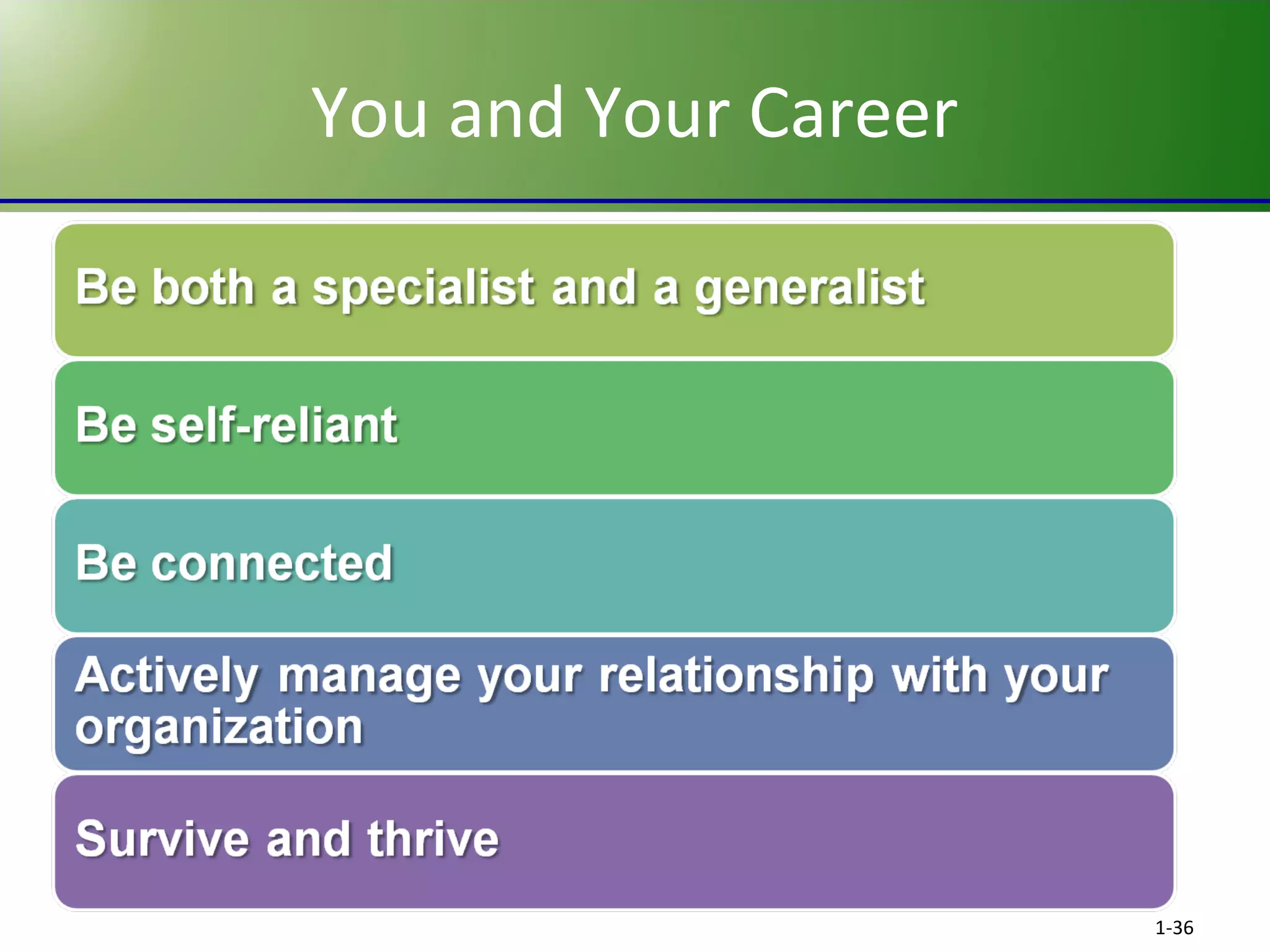
You and Your Career
Emotional
intelligence
 The skills of
understanding
yourself, managing
yourself, and dealing
effectively with
others.

Social capital
 Goodwill stemming
from your social
relationships

1-35
You and Your Career

1-36
Two Relationships:
Which Will You Choose?
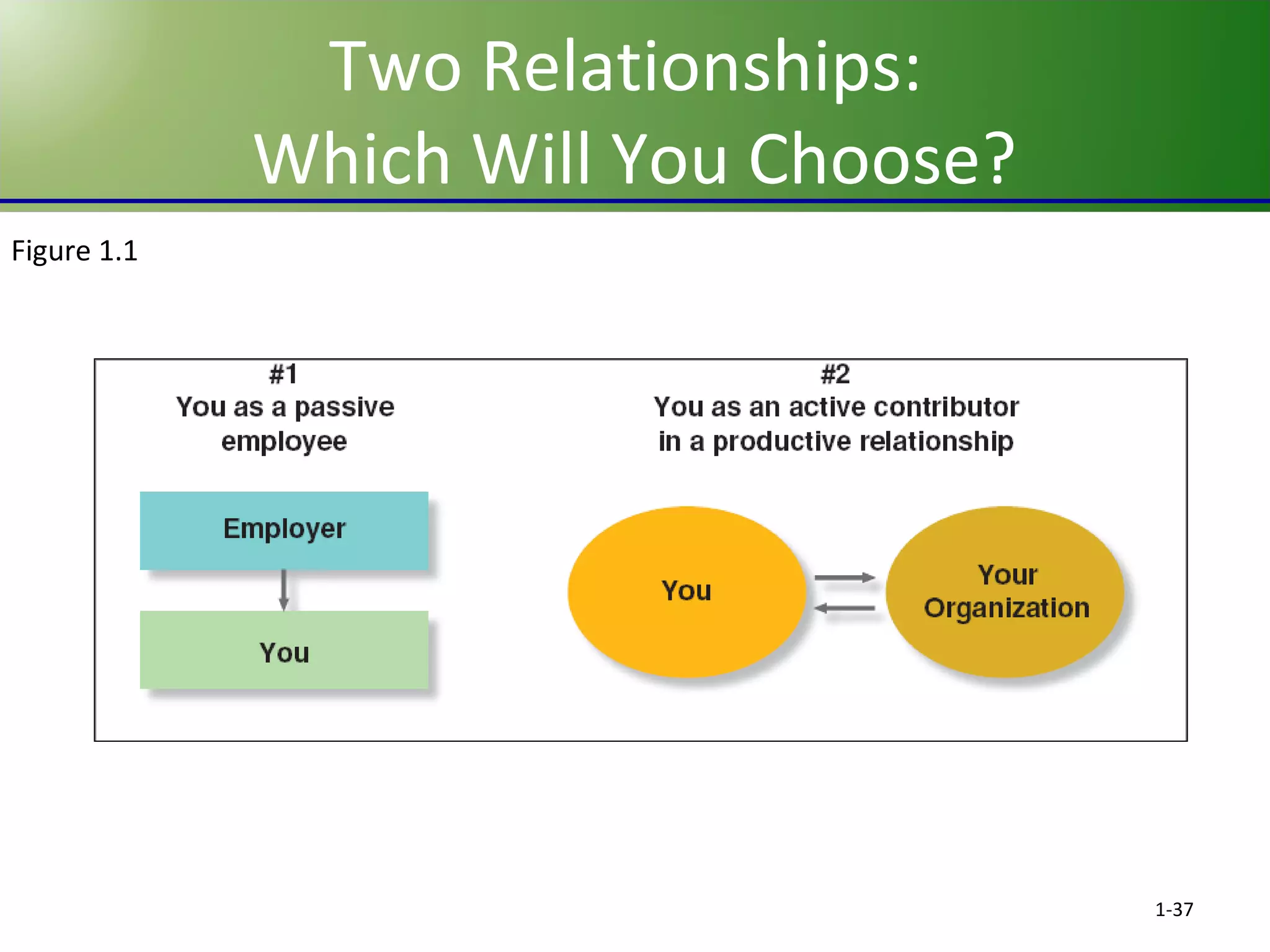
Figure 1.1

1-37
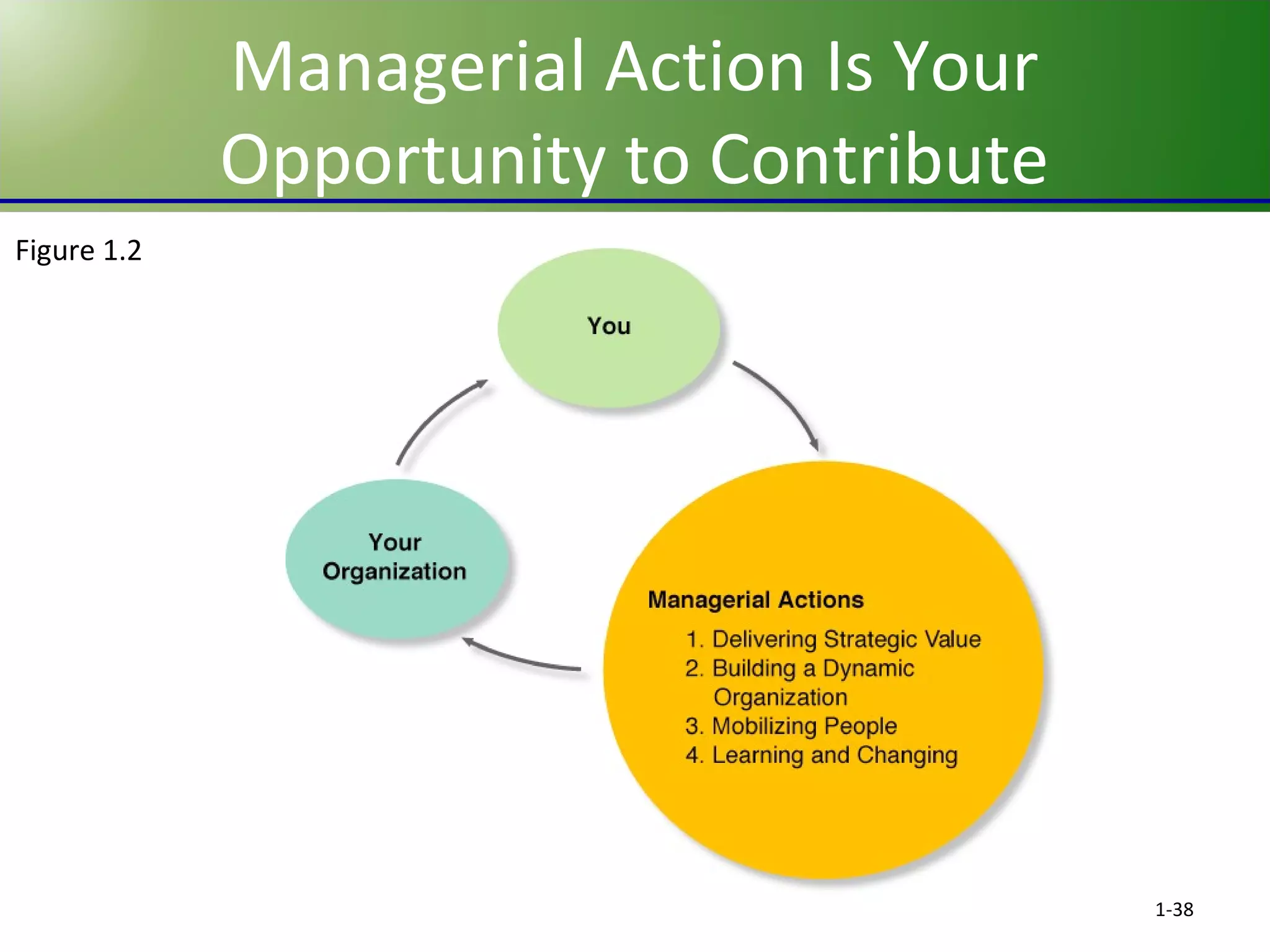
Managerial Action Is Your
Opportunity to Contribute
Figure 1.2

1-38
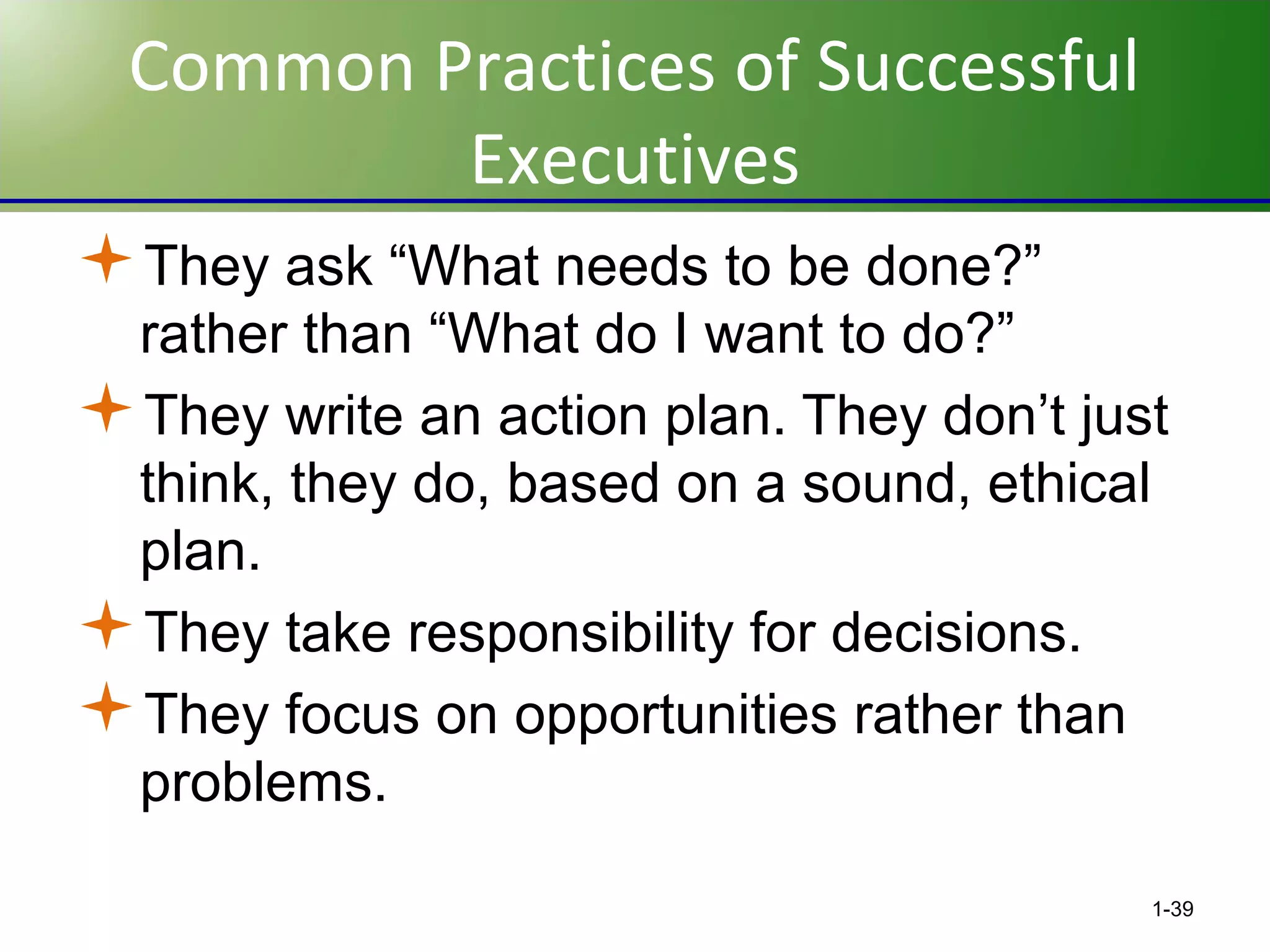
Common Practices of Successful
Executives
They ask “What needs to be done?”
rather than “What do I want to do?”
They write an action plan. They don’t just
think, they do, based on a sound, ethical
plan.
They take responsibility for decisions.
They focus on opportunities rather than
problems.
1-39
Video Case: AFLAC and Dan Amos
Why does AFLAC CEO, Dan Amos, want
shareholders to vote on his compensation
package?
What are the consequences of paying an
underperforming CEO an exorbitant
severance package?

1-40

Managing and Performing

  • 1.
    Managing and Performing Chapter One McGraw-Hill/Irwin Copyright ©2013 by The McGraw-Hill Companies, Inc. All rights reserved.
  • 2.
    Learning Objectives LO 1Summarize the major challenges of managing in the new competitive landscape. LO 2 Describe the sources of competitive advantage for a company. LO 3 Explain how the functions of management are evolving in today’s business environment. LO 4 Compare how the nature of management varies at different organizational levels. LO 5 Define the skills you need to be an effective manager. LO 6 Discuss the principles that will help you manage your career. 1-2
  • 3.
    Globalization Today’s enterprises areglobal, with offices and production facilities in countries all over the world Means that a company’s talent can come from anywhere Internet makes globalization inevitable 1-3
  • 4.
    Technological Change: The Internet Marketplace Meansfor manufacturing goods and services Distribution channel An information service 1-4
  • 5.
    Technological Change: The Internet Drivesdown costs and speeds up globalization. Improves efficiency of decision making. Facilitates design of new products, from pharmaceuticals to financial services 1-5
  • 6.
    Knowledge Management Knowledge management  Practicesaimed at discovering and harnessing an organization’s intellectual resources 1-6
  • 7.
    Knowledge Management Knowledge workers Workers whose primary contributions are ideas and problem-solving expertise Knowledge managers find these human assets, help people collaborate and learn, help people generate new ideas, and harness those ideas into successful innovations. 1-7
  • 8.
    Knowledge Management Knowledge managementis about finding, unlocking, sharing, and altogether capitalizing on the most precious resources of an organization: people’s expertise, skills, wisdom, and relationships. 1-8
  • 9.
    Collaboration across “Boundaries” Requiresproductive communications among different departments, divisions, or other subunits of the organization 1-9
  • 10.
    Collaboration across “Boundaries” Companiestoday must motivate and capitalize on the ideas of people outside the organization e.g. its consultants, ad agencies, and suppliers 1-10
  • 11.
  • 12.
    Question ___________ is thefast and timely execution, response, and delivery of results. A.Innovation B.Quality C.Speed D.Service 1-12
  • 13.
    Managing for Competitive Advantage Innovation the introduction of new goods and services A firm must:  adapt to changes in consumer demands and to new competitors.  be ready with new ways to communicate with customers and deliver the products to them. 1-13
  • 14.
    Managing for Competitive Advantage Quality The excellence of your product (goods or services)  Historically, quality referred to attractiveness, lack of defects, reliability, and long-term dependability 1-14
  • 15.
    Managing for Competitive Advantage Todayquality is about preventing defects and having continuous improvement in how the firm operates 1-15
  • 16.
    Managing for Competitive Advantage Service giving customers what they want or need, when they want it  focused on continually meeting the needs of customers to establish mutually beneficial long-term relationships. Speed  Fast and timely execution, response, and delivery of results. 1-16
  • 17.
    Managing for Competitive Advantage Cost competitiveness Keeping costs low to achieve profits and be able to offer prices that are attractive to consumers. 1-17
  • 18.
    Managing for Competitive Advantage Sustainability The effort to minimize the use of resources, especially those that are polluting and nonrenewable. 1-18
  • 19.
    The Functions ofManagement Management  The process of working with people and resources to accomplish organizational goals  Efficiently, effectively 1-19
  • 20.
    Question ____________ is monitoringperformance and making needed changes. A.Planning B.Organizing C.Leading D.Controlling 1-20
  • 21.
    The Functions ofManagement Planning  Systematically making decisions about the goals and activities that an individual, a group, a work unit, or the overall organization will pursue  analyzing current situations, anticipating the future, determining objectives, deciding in what types of activities the company will engage 1-21
  • 22.
    The Functions ofManagement Organizing  assembling and coordinating the human, financial, physical, informational, and other resources needed to achieve goals  specifying job responsibilities, grouping jobs into work units, marshaling and allocating resources, 1-22
  • 23.
    The Functions ofManagement Leading  stimulating people to be high performers Controlling  monitoring performance and making needed changes. 1-23
  • 24.
    Performing All FourManagement Functions A typical day for a manager is not neatly divided into the four functions Days are busy and fractionated, and spent dealing with interruptions, meetings, and firefighting 1-24
  • 25.
    Performing All FourManagement Functions Good managers devote adequate attention and resources to all four management functions. 1-25
  • 26.
  • 27.
    Management Levels andSkills Top-level managers  Senior executives responsible for the overall management and effectiveness of the organization. Middle-level managers  Managers located in the middle layers of the organizational hierarchy, reporting to toplevel executives. 1-27
  • 28.
    Management Levels andSkills Frontline managers  Lower-level managers who supervise the operational activities of the organization 1-28
  • 29.
    Transformation of Management Rolesand Activities Table 1.1 1-29
  • 30.
  • 31.
    Question Which management skillis the ability to lead, motivate, and communicate effectively with others? A.Technical B.Conceptual C.Decision D.Interpersonal 1-31
  • 32.
    Management Skills Technical skill The ability to perform a specialized task involving a particular method or process 1-32
  • 33.
    Management Skills Conceptual anddecision skills  Skills pertaining to the ability to identify and resolve problems for the benefit of the organization and its members. 1-33
  • 34.
    Management Skills Interpersonal andcommunication skills  People skills; the ability to lead, motivate, and communicate effectively with others. 1-34
  • 35.
    You and YourCareer Emotional intelligence  The skills of understanding yourself, managing yourself, and dealing effectively with others. Social capital  Goodwill stemming from your social relationships 1-35
  • 36.
    You and YourCareer 1-36
  • 37.
    Two Relationships: Which WillYou Choose? Figure 1.1 1-37
  • 38.
    Managerial Action IsYour Opportunity to Contribute Figure 1.2 1-38
  • 39.
    Common Practices ofSuccessful Executives They ask “What needs to be done?” rather than “What do I want to do?” They write an action plan. They don’t just think, they do, based on a sound, ethical plan. They take responsibility for decisions. They focus on opportunities rather than problems. 1-39
  • 40.
    Video Case: AFLACand Dan Amos Why does AFLAC CEO, Dan Amos, want shareholders to vote on his compensation package? What are the consequences of paying an underperforming CEO an exorbitant severance package? 1-40

Editor's Notes

  • #7 Knowledge management is about finding, unlocking, sharing, and altogether capitalizing on the most precious resources of an organization: people’s expertise, skills, wisdom, and relationships.
  • #13 The correct answer is c – speed. See slide 1-15
  • #21 The correct answer is D – controlling. See slide 1-21
  • #32 The correct answer is D – interpersonal. See slide 1-32