Case conference
Ratchan Jariengprasert
CASE
Patient profile : Thai elderly woman, 68 years old
Chief complaint : ถูก MC เฉี่ยว ล้มศีรษะกระแทกพื้น
8/11/59 11.00 น.
Primary survey
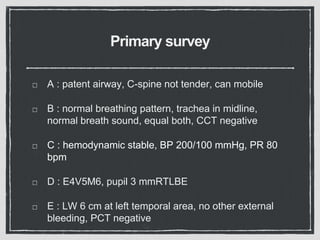
A : patent airway, C-spine not tender, can mobile
B : normal breathing pattern, trachea in midline,
normal breath sound, equal both, CCT negative
C : hemodynamic stable, BP 200/100 mmHg, PR 80
bpm
D : E4V5M6, pupil 3 mmRTLBE
E : LW 6 cm at left temporal area, no other external
bleeding, PCT negative
secondary survey
A : none
M : Underlying disease DM, HT
P : ไม่เคยเข้านอน รพ. ไม่เคยผ่าตัดอะไรมาก่อน
L : 17.00
E : ระหว่างเดินจูงจักรยานข้ามถนน รถMC เฉียว ล้มศีรษะกระแทก สลบ จาไม่
เหตุการณ์ไม่ได้ อาเจียนสองครั้ง มีเลือดออกจากหูซ้าย มีแผลที่ศีรษะด้านซ้าย
physical examination
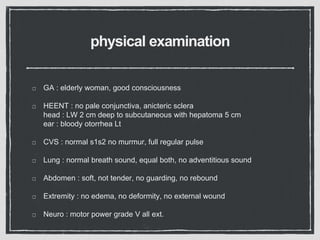
GA : elderly woman, good consciousness
HEENT : no pale conjunctiva, anicteric sclera
head : LW 2 cm deep to subcutaneous with hepatoma 5 cm
ear : bloody otorrhea Lt
CVS : normal s1s2 no murmur, full regular pulse
Lung : normal breath sound, equal both, no adventitious sound
Abdomen : soft, not tender, no guarding, no rebound
Extremity : no edema, no deformity, no external wound
Neuro : motor power grade V all ext.
Diagnosis + management
Severe head injury (high risk)
r/o base of skull fracture
Refer จากรพ.ด่านขุนทด
consult neuro surgery
CT brain non contrast
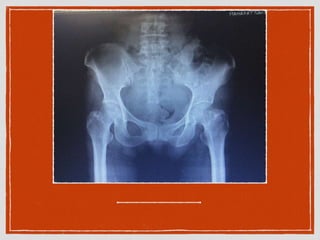
pelvis AP, Chest x-ray
CT brain NC
Left parieto-temporal bone fracture
SAH along bilateral temporal sulci
Admit
observe neuro sign 2 day
refer กลับด่านขุนทด
CC : ปวดขา ปวดหลัง ลุกนั่งแล้วปวด ลงมาเดินไม่ได้
PI : ตื่นดี ไม่ปวดหัว ไม่อ่อนแรง ไม่ชา ไม่มีปวดร้าวลงขา กลั้นปัสสาวะอุจจาระ
ได้
ล้อหน้าจักรยานกระแทกขาขวา เจ็บด้านข้าง
thoracolumbar spine : midline back pain level L1L2
motor power grade V all, except Rt leg
DTR 2+ all extremities, intact PPS
PR : tight sphincter tone, perianal sensation intact
Ext. - tender Rt leg, can flex/extend knee
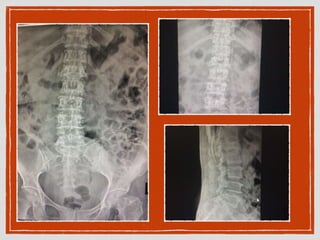
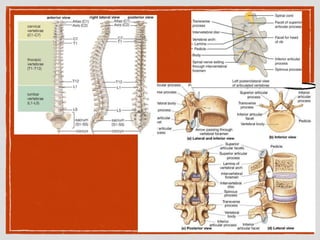
A - alignment : 4 line ant/post. vertebral
body/lamina/spinous
no subluxation, no stepping, loss of kyphosis/lordosis
spondylolithisis,retrolithisis
B - bone : vertebral height, shape(square/wedge),
density(osteolytic, osteoblastic lesion), homogenous
end plate involve, subchondal sclerosis, marginal
osteophyte
C - cartilage : disc narrowing, vacuum disc, facet joint
D - distance : interpedicular distance (เพิ่มขึ้นจากบนลงล่าง ให้เทียบ
กับอันล่าง ถ้ากว้างกว่าแปลว่า+)
E - external soft tissue : paravertebral soft tissue, psoas
muscle
Refer
R/o compression fracture L1
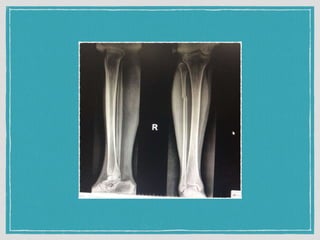
Close isolated fracture of Right proximal 1/3 fibular
on short leg slab
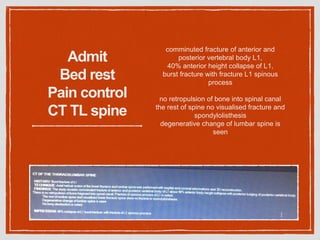
Admit
Bed rest
Pain control
CT TL spine
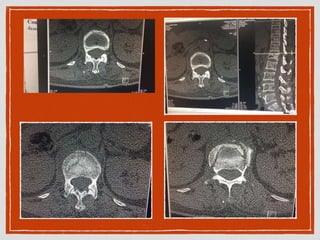
comminuted fracture of anterior and
posterior vertebral body L1,
40% anterior height collapse of L1,
burst fracture with fracture L1 spinous
process
no retropulsion of bone into spinal canal
the rest of spine no visualised fracture and
spondylolisthesis
degenerative change of lumbar spine is
seen
-??????-
“Burst fracture”
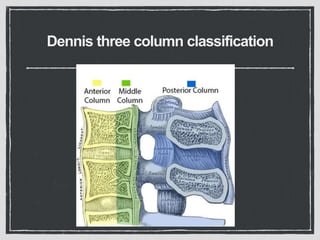
Dennis three column classification
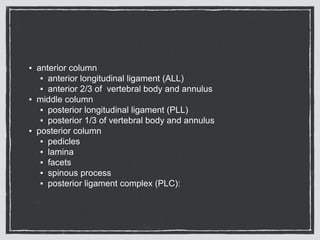
▪ anterior column
▪ anterior longitudinal ligament (ALL)
▪ anterior 2/3 of vertebral body and annulus
▪ middle column
▪ posterior longitudinal ligament (PLL)
▪ posterior 1/3 of vertebral body and annulus
▪ posterior column
▪ pedicles
▪ lamina
▪ facets
▪ spinous process
▪ posterior ligament complex (PLC):
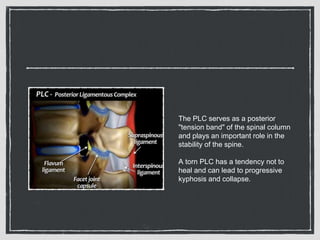
The PLC serves as a posterior
"tension band" of the spinal column
and plays an important role in the
stability of the spine.
A torn PLC has a tendency not to
heal and can lead to progressive
kyphosis and collapse.
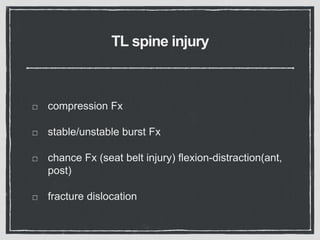
TL spine injury
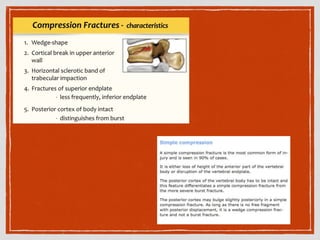
compression Fx
stable/unstable burst Fx
chance Fx (seat belt injury) flexion-distraction(ant,
post)
fracture dislocation
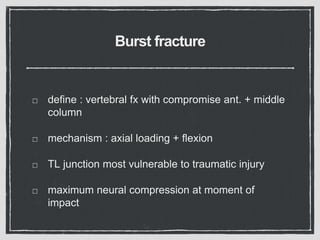
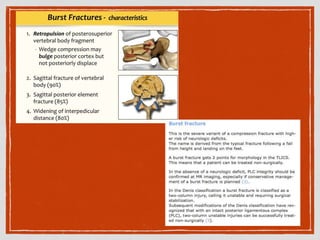
Burst fracture
define : vertebral fx with compromise ant. + middle
column
mechanism : axial loading + flexion
TL junction most vulnerable to traumatic injury
maximum neural compression at moment of
impact
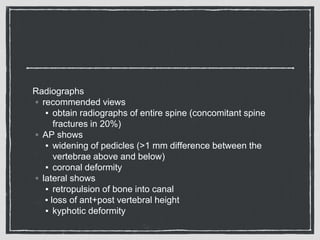
Radiographs
◦ recommended views
▪ obtain radiographs of entire spine (concomitant spine
fractures in 20%)
◦ AP shows
▪ widening of pedicles (>1 mm difference between the
vertebrae above and below)
▪ coronal deformity
◦ lateral shows
▪ retropulsion of bone into canal
▪ loss of ant+post vertebral height
▪ kyphotic deformity
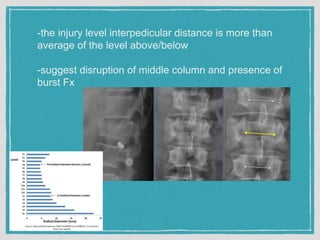
-the injury level interpedicular distance is more than
average of the level above/below
-suggest disruption of middle column and presence of
burst Fx
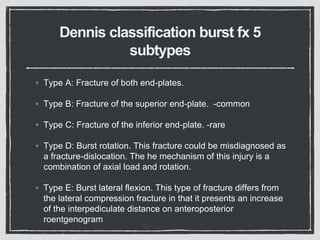
Dennis classification burst fx 5
subtypes
◦ Type A: Fracture of both end-plates.
◦ Type B: Fracture of the superior end-plate. -common
◦ Type C: Fracture of the inferior end-plate. -rare
◦ Type D: Burst rotation. This fracture could be misdiagnosed as
a fracture-dislocation. The he mechanism of this injury is a
combination of axial load and rotation.
◦ Type E: Burst lateral flexion. This type of fracture differs from
the lateral compression fracture in that it presents an increase
of the interpediculate distance on anteroposterior
roentgenogram
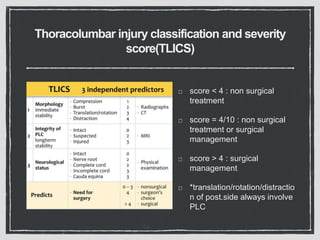
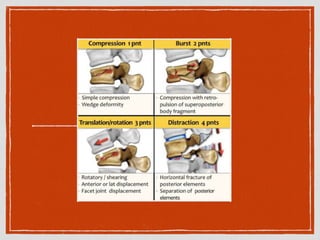
Thoracolumbar injury classification and severity
score(TLICS)
score < 4 : non surgical
treatment
score = 4/10 : non surgical
treatment or surgical
management
score > 4 : surgical
management
*translation/rotation/distractio
n of post.side always involve
PLC
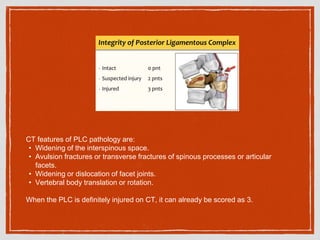
CT features of PLC pathology are:
• Widening of the interspinous space.
• Avulsion fractures or transverse fractures of spinous processes or articular
facets.
• Widening or dislocation of facet joints.
• Vertebral body translation or rotation.
When the PLC is definitely injured on CT, it can already be scored as 3.
TLICS = 4-5
compression fracture + burst
no neurodeficit
+- PCL indeterminate/injury
Surgical treatment
◦ surgical decompression & spinal stabilization
▪ indications
▪ neurologic deficits with radiographic evidence of cord/thecal sac
compression
▪ both complete and incomplete spinal cord injuries require
decompression and stabilization to facilitate rehabilitation
▪ TLICS score = 5 or higher
▪ unstable fracture pattern as defined by
▪ injury to the Posterior Ligament Complex (PLC)
▪ progressive kyphosis
▪ > 30°kyphosis (controversial)
▪ > 50% loss of vertebral body height (controversial)
▪ > 50% canal compromise (controversial)
Nonsurgical treatment
◦ ambulation as tolerated with or without a thoracolumbosacral
orthosis
▪ indications
▪ patients that are neurologically intact and mechanically stable
▪ posterior ligament complex preserved
▪ kyphosis < 30° (controversial)
▪ vertebral body has lost < 50% of body height (controversial)
▪ TLICS score = 3 or lower
▪ thoracolumbar orthosis
▪ recent evidence shows no clear advantage of TLSO on
outcomes
▪ if it provides symptomatic relief, may be beneficial for patient
▪ outcomes
▪ retropulsed fragments resorb over time and usually do not
cause neurologic deterioration
Comparison
comparison between operative and non operative for
thoracolumbar burst fracture with no neurological deficit :
There is no difference in kyphosis, residual back pain, cost
of hospitalization and return to work between operative and
non-operative approaches, but increased disability and
complications with operative treatment.
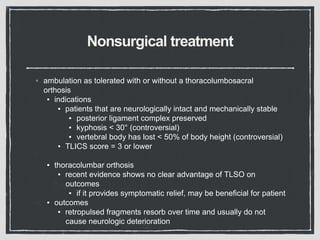
Spine orthosis
Jewett brace - prevent flex >
extend
Taylor brace - prevent extend >
flex
Jewett brace
symptomatic relief of compression fracture
immobilisation after surgical stabilisation of TL fx
limit flexion T6-L1
contraindication : instability type
compression fx above T6
compression fx cause by
osteoporosis
Bed rest 6 weeks
TLSO until fracture union (3 months)
prevent pressure sore
breathing exercise
exercise upper and lower extremities
Reference
http://www.orthobullets.com/spine/2022/thoracolu
mbar-burst-fractures#5630
http://www.radiologyassistant.nl/en/p54885e620ee
46/spine-injury-tlics-classification.html
uptodate

Burst fracture

  • 1.
  • 2.
    CASE Patient profile :Thai elderly woman, 68 years old Chief complaint : ถูก MC เฉี่ยว ล้มศีรษะกระแทกพื้น 8/11/59 11.00 น.
  • 3.
    Primary survey A :patent airway, C-spine not tender, can mobile B : normal breathing pattern, trachea in midline, normal breath sound, equal both, CCT negative C : hemodynamic stable, BP 200/100 mmHg, PR 80 bpm D : E4V5M6, pupil 3 mmRTLBE E : LW 6 cm at left temporal area, no other external bleeding, PCT negative
  • 4.
    secondary survey A :none M : Underlying disease DM, HT P : ไม่เคยเข้านอน รพ. ไม่เคยผ่าตัดอะไรมาก่อน L : 17.00 E : ระหว่างเดินจูงจักรยานข้ามถนน รถMC เฉียว ล้มศีรษะกระแทก สลบ จาไม่ เหตุการณ์ไม่ได้ อาเจียนสองครั้ง มีเลือดออกจากหูซ้าย มีแผลที่ศีรษะด้านซ้าย
  • 5.
    physical examination GA :elderly woman, good consciousness HEENT : no pale conjunctiva, anicteric sclera head : LW 2 cm deep to subcutaneous with hepatoma 5 cm ear : bloody otorrhea Lt CVS : normal s1s2 no murmur, full regular pulse Lung : normal breath sound, equal both, no adventitious sound Abdomen : soft, not tender, no guarding, no rebound Extremity : no edema, no deformity, no external wound Neuro : motor power grade V all ext.
  • 6.
    Diagnosis + management Severehead injury (high risk) r/o base of skull fracture Refer จากรพ.ด่านขุนทด consult neuro surgery CT brain non contrast pelvis AP, Chest x-ray
  • 8.
    CT brain NC Leftparieto-temporal bone fracture SAH along bilateral temporal sulci Admit observe neuro sign 2 day refer กลับด่านขุนทด
  • 9.
    CC : ปวดขาปวดหลัง ลุกนั่งแล้วปวด ลงมาเดินไม่ได้ PI : ตื่นดี ไม่ปวดหัว ไม่อ่อนแรง ไม่ชา ไม่มีปวดร้าวลงขา กลั้นปัสสาวะอุจจาระ ได้ ล้อหน้าจักรยานกระแทกขาขวา เจ็บด้านข้าง
  • 10.
    thoracolumbar spine :midline back pain level L1L2 motor power grade V all, except Rt leg DTR 2+ all extremities, intact PPS PR : tight sphincter tone, perianal sensation intact Ext. - tender Rt leg, can flex/extend knee
  • 12.
    A - alignment: 4 line ant/post. vertebral body/lamina/spinous no subluxation, no stepping, loss of kyphosis/lordosis spondylolithisis,retrolithisis B - bone : vertebral height, shape(square/wedge), density(osteolytic, osteoblastic lesion), homogenous end plate involve, subchondal sclerosis, marginal osteophyte C - cartilage : disc narrowing, vacuum disc, facet joint D - distance : interpedicular distance (เพิ่มขึ้นจากบนลงล่าง ให้เทียบ กับอันล่าง ถ้ากว้างกว่าแปลว่า+) E - external soft tissue : paravertebral soft tissue, psoas muscle
  • 14.
    Refer R/o compression fractureL1 Close isolated fracture of Right proximal 1/3 fibular on short leg slab
  • 15.
    Admit Bed rest Pain control CTTL spine comminuted fracture of anterior and posterior vertebral body L1, 40% anterior height collapse of L1, burst fracture with fracture L1 spinous process no retropulsion of bone into spinal canal the rest of spine no visualised fracture and spondylolisthesis degenerative change of lumbar spine is seen
  • 17.
  • 19.
    Dennis three columnclassification
  • 20.
    ▪ anterior column ▪anterior longitudinal ligament (ALL) ▪ anterior 2/3 of vertebral body and annulus ▪ middle column ▪ posterior longitudinal ligament (PLL) ▪ posterior 1/3 of vertebral body and annulus ▪ posterior column ▪ pedicles ▪ lamina ▪ facets ▪ spinous process ▪ posterior ligament complex (PLC):
  • 21.
    The PLC servesas a posterior "tension band" of the spinal column and plays an important role in the stability of the spine. A torn PLC has a tendency not to heal and can lead to progressive kyphosis and collapse.
  • 22.
    TL spine injury compressionFx stable/unstable burst Fx chance Fx (seat belt injury) flexion-distraction(ant, post) fracture dislocation
  • 24.
    Burst fracture define :vertebral fx with compromise ant. + middle column mechanism : axial loading + flexion TL junction most vulnerable to traumatic injury maximum neural compression at moment of impact
  • 25.
    Radiographs ◦ recommended views ▪obtain radiographs of entire spine (concomitant spine fractures in 20%) ◦ AP shows ▪ widening of pedicles (>1 mm difference between the vertebrae above and below) ▪ coronal deformity ◦ lateral shows ▪ retropulsion of bone into canal ▪ loss of ant+post vertebral height ▪ kyphotic deformity
  • 27.
    -the injury levelinterpedicular distance is more than average of the level above/below -suggest disruption of middle column and presence of burst Fx
  • 28.
    Dennis classification burstfx 5 subtypes ◦ Type A: Fracture of both end-plates. ◦ Type B: Fracture of the superior end-plate. -common ◦ Type C: Fracture of the inferior end-plate. -rare ◦ Type D: Burst rotation. This fracture could be misdiagnosed as a fracture-dislocation. The he mechanism of this injury is a combination of axial load and rotation. ◦ Type E: Burst lateral flexion. This type of fracture differs from the lateral compression fracture in that it presents an increase of the interpediculate distance on anteroposterior roentgenogram
  • 29.
    Thoracolumbar injury classificationand severity score(TLICS) score < 4 : non surgical treatment score = 4/10 : non surgical treatment or surgical management score > 4 : surgical management *translation/rotation/distractio n of post.side always involve PLC
  • 31.
    CT features ofPLC pathology are: • Widening of the interspinous space. • Avulsion fractures or transverse fractures of spinous processes or articular facets. • Widening or dislocation of facet joints. • Vertebral body translation or rotation. When the PLC is definitely injured on CT, it can already be scored as 3.
  • 32.
    TLICS = 4-5 compressionfracture + burst no neurodeficit +- PCL indeterminate/injury
  • 33.
    Surgical treatment ◦ surgicaldecompression & spinal stabilization ▪ indications ▪ neurologic deficits with radiographic evidence of cord/thecal sac compression ▪ both complete and incomplete spinal cord injuries require decompression and stabilization to facilitate rehabilitation ▪ TLICS score = 5 or higher ▪ unstable fracture pattern as defined by ▪ injury to the Posterior Ligament Complex (PLC) ▪ progressive kyphosis ▪ > 30°kyphosis (controversial) ▪ > 50% loss of vertebral body height (controversial) ▪ > 50% canal compromise (controversial)
  • 34.
    Nonsurgical treatment ◦ ambulationas tolerated with or without a thoracolumbosacral orthosis ▪ indications ▪ patients that are neurologically intact and mechanically stable ▪ posterior ligament complex preserved ▪ kyphosis < 30° (controversial) ▪ vertebral body has lost < 50% of body height (controversial) ▪ TLICS score = 3 or lower ▪ thoracolumbar orthosis ▪ recent evidence shows no clear advantage of TLSO on outcomes ▪ if it provides symptomatic relief, may be beneficial for patient ▪ outcomes ▪ retropulsed fragments resorb over time and usually do not cause neurologic deterioration
  • 35.
    Comparison comparison between operativeand non operative for thoracolumbar burst fracture with no neurological deficit : There is no difference in kyphosis, residual back pain, cost of hospitalization and return to work between operative and non-operative approaches, but increased disability and complications with operative treatment.
  • 36.
    Spine orthosis Jewett brace- prevent flex > extend Taylor brace - prevent extend > flex
  • 37.
    Jewett brace symptomatic reliefof compression fracture immobilisation after surgical stabilisation of TL fx limit flexion T6-L1 contraindication : instability type compression fx above T6 compression fx cause by osteoporosis
  • 38.
    Bed rest 6weeks TLSO until fracture union (3 months) prevent pressure sore breathing exercise exercise upper and lower extremities
  • 39.