Bullying Presenter: Jerry L. Painter   General Counsel Washington Education Association
Primary and Secondary Dimensions of Diversity Age Sexual/ Affectional Orientation Physical  Abilities/ Qualities/ Disabilities Race Ethnicity Gender Sexual Behavior Parental Status Education Geographic Location Military Experience Religious Beliefs Marital Status Income Work Background
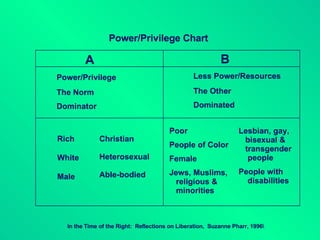
In the Time of the Right:  Reflections on Liberation,  Suzanne Pharr, 1996\ Power/Privilege Chart A B Power/Privilege The Norm Dominator Less Power/Resources The Other Dominated Rich White Male Christian Heterosexual Able-bodied Poor People of Color Female Jews, Muslims, religious &  minorities Lesbian, gay, bisexual & transgender people People with disabilities
Targets of Harassment in School Bisexual and gay/lesbian respondents were more likely to report harassment than heterosexual youth for each type of harassment Multi-ethnic and American Indian adolescents were most likely to be targets of each type of harassment 4 out of 5 students who were harassed on the basis of sexual orientation identified as heterosexual Half of European-American girls and nearly one-half of boys were targets of racial slurs, even in schools where they were the ethnic “ majority” 1995 Seattle Teen Health Survey
Victims Everyday 160,000 children stay home from school because they are afraid of being bullied
Victims 77% students report being victims 14% suffered severe reaction
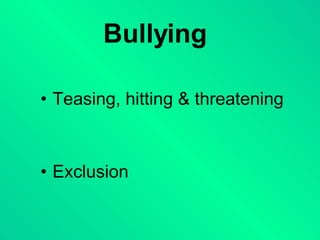
Bullying Teasing, hitting & threatening Exclusion
Anatomy of bullying Starts verbal - teasing and  put-downs Progresses to physical
Frequency Hitting and threatening increase through elementary and peaks in middle school Verbal abuse remains constant throughout
Bullying Incidents Two times as high in elementary as secondary In elementary 2 times as much bullying in school as to or from school In junior high there are 3 times as much bullying in school as to or from school From:  Childhood Bullying and Teasing, Dorothea M. Ross, 1996
Locations Areas where little or no adult supervision hallways locker rooms restrooms cafeterias playgrounds buses and bus stops
Politically Correct Students less likely to make derogatory statements about others’ religion or race than appearance and behavior NICHD Survey Report
Boys Boys engage in and are victims more frequently than girls
Girls Tend to bully indirectly Manipulating friends Ostracizing classmates Spreading rumors
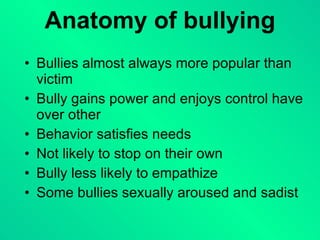
Anatomy of bullying Bullies almost always more popular than victim Bully gains power and enjoys control have over other Behavior satisfies needs Not likely to stop on their own Bully less likely to empathize Some bullies sexually aroused and sadist
Bullies Tend To... Achieve little in school Leave school early Be in trouble with the law Perform below potential Abuse their partners and children Become violent parents/guardians Female bullies become mothers of bullies
Bullies Strong correlation between bullying and having legal or criminal troubles
Criminal Records 60% of the boys identified as bullies in grades 6 to 9 had one criminal conviction by age 24, and 40% had 3 or more arrests  Olweus, 1991   Boys identified as bullies at age 8 had a 1 in 4 chance of having a criminal record by age 30 Eron and Huessman, 1987 Normal is 1 in 20
Victims Typically anxious, insecure, cautious, and suffer low self-esteem Become target usually because of appearance
Educational Impact Not  wanting  to go to school Not talking up in class Unable to pay attention (distracted) Stay home - cut class Lower grades
Victims - signs Torn clothing Bruises Withdrawal Running home to use bathroom
Victims Both bullies and onlookers believe victim is partially responsible
Who Is Guilty? Bully:  cool and in control Victim:  crying and upset
Spectators 43% attempt to help 33% feel they should help  but don’t 24% feel bullying is none of their business
Bystander Students become desensitized to abuse when appears to be condoned Less likely to empathize More likely to join in Has more powerful effect than violent video games and movies
Adults Underestimate importance See it as normal part of growing up
Administrators Buy into belief bullying normal Children better working out problems on own Victim bring on self Discipline victim for fighting By the time complaint reaches teachers/staff, it’s a last resort
Teacher 70% students feel teachers handle episodes of bullying poorly Teachers sometimes feel powerless to stop bullying
Successful Intervention Must involve entire school community Can’t just focus on bully and victims
Stopping Bullying Survey: students teachers/staff principals cafeteria workers bus drivers custodians parents/guardians
Stopping Bullying Must have buy-in from school board and administration Approach must be sustained and supported Involve everyone at school and community
Stopping Bullying The ones to reach are the children who aren’t bullies or victims Let bully know behavior isn’t acceptable
What Parents Can Do   Talk with their children Report incidents Keep written records Go to school Encourage friendships outside the home Be aware of rights and responsibilities
A Model For Making Our Children Safe Safe Schools Safe Families Safe Communities Safe  Children
It’s All About . . . School climate School culture School interactions
School Culture that Encourages Bullying Elitism/Privilege/Cultural Racism Competition Dynamic of Violence
School Culture that Encourages Bullying Schools are not democratic Anonymity Strict gender roles -- especially for boys
Euro-American (White) students were significantly more likely to be referred for: Smoking Leaving without permission Obscene language Vandalism U.S. Department of Education 1998 - 1999
African-American (Black) students were significantly more likely to be referred for: Disrespect Excessive noise Threatening Loitering U.S. Department of Education 1998 - 1999
FAILURE TO PROTECT PRESENTED BY: JERRY L. PAINTER WEA GENERAL COUNSEL
SEXUAL HARASSMENT Presenter Jerry L. Painter General Counsel
Failure to Protect Growing area of litigation Area schools are most vulnerable Both State and Federal causes of action Must name individual in federal cases
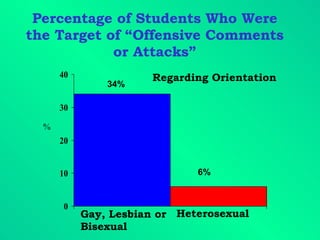
Percentage of Students Who Were the Target of “Offensive Comments or Attacks” Gay, Lesbian or Bisexual Heterosexual 34% 6% Regarding Orientation %
Percentage of Students Who Were the Target of “Offensive Comments or Attacks” Regarding Gender 51% 17% Female Male %
Percentage of Students Who Were the Target of “Offensive Comments or Attacks” 51% 51% 48% 45% 41% 36% 35% Regarding Race Latino Multi- ethnic White Amer. Indian Asian Amer. African Amer. SE Asian %
Categories Religion Physical disability Sexual Orientation Sexual Harassment
Untested Grounds Persons of size Disfigured persons Poverty
Free Speech vs. Legitimate Regulation
School Districts have  compelling interest to  eliminate discrimination  and harassment
Anti-harassment policies must be carefully written Does not punish speech, opinions or belief Punishes impermissible conduct
Targeted Speech Speech that targets a person for assault threat or vandalism Based on race, religion, nation origin, disability, gender, or sexual orientation
Non-targeting Speech Intensive and pervasive Creates hostile environment Hinders ability of a person to get education
Overbroad Any statements that offends Student may express beliefs
School Employees May be required to fulfill job descriptions and requirements Treat all students with respect and without regard to race, religion, sexual orientation, etc. Enforce rule to keep students safe
What can a school district do? Adopt policy Advertise policy Uniformly enforce policy  Conduct in service

Bullying(3)

  • 1.
    Bullying Presenter: JerryL. Painter General Counsel Washington Education Association
  • 2.
    Primary and SecondaryDimensions of Diversity Age Sexual/ Affectional Orientation Physical Abilities/ Qualities/ Disabilities Race Ethnicity Gender Sexual Behavior Parental Status Education Geographic Location Military Experience Religious Beliefs Marital Status Income Work Background
  • 3.
    In the Timeof the Right: Reflections on Liberation, Suzanne Pharr, 1996\ Power/Privilege Chart A B Power/Privilege The Norm Dominator Less Power/Resources The Other Dominated Rich White Male Christian Heterosexual Able-bodied Poor People of Color Female Jews, Muslims, religious & minorities Lesbian, gay, bisexual & transgender people People with disabilities
  • 4.
    Targets of Harassmentin School Bisexual and gay/lesbian respondents were more likely to report harassment than heterosexual youth for each type of harassment Multi-ethnic and American Indian adolescents were most likely to be targets of each type of harassment 4 out of 5 students who were harassed on the basis of sexual orientation identified as heterosexual Half of European-American girls and nearly one-half of boys were targets of racial slurs, even in schools where they were the ethnic “ majority” 1995 Seattle Teen Health Survey
  • 5.
    Victims Everyday 160,000children stay home from school because they are afraid of being bullied
  • 6.
    Victims 77% studentsreport being victims 14% suffered severe reaction
  • 7.
    Bullying Teasing, hitting& threatening Exclusion
  • 8.
    Anatomy of bullyingStarts verbal - teasing and put-downs Progresses to physical
  • 9.
    Frequency Hitting andthreatening increase through elementary and peaks in middle school Verbal abuse remains constant throughout
  • 10.
    Bullying Incidents Twotimes as high in elementary as secondary In elementary 2 times as much bullying in school as to or from school In junior high there are 3 times as much bullying in school as to or from school From: Childhood Bullying and Teasing, Dorothea M. Ross, 1996
  • 11.
    Locations Areas wherelittle or no adult supervision hallways locker rooms restrooms cafeterias playgrounds buses and bus stops
  • 12.
    Politically Correct Studentsless likely to make derogatory statements about others’ religion or race than appearance and behavior NICHD Survey Report
  • 13.
    Boys Boys engagein and are victims more frequently than girls
  • 14.
    Girls Tend tobully indirectly Manipulating friends Ostracizing classmates Spreading rumors
  • 15.
    Anatomy of bullyingBullies almost always more popular than victim Bully gains power and enjoys control have over other Behavior satisfies needs Not likely to stop on their own Bully less likely to empathize Some bullies sexually aroused and sadist
  • 16.
    Bullies Tend To...Achieve little in school Leave school early Be in trouble with the law Perform below potential Abuse their partners and children Become violent parents/guardians Female bullies become mothers of bullies
  • 17.
    Bullies Strong correlationbetween bullying and having legal or criminal troubles
  • 18.
    Criminal Records 60%of the boys identified as bullies in grades 6 to 9 had one criminal conviction by age 24, and 40% had 3 or more arrests Olweus, 1991 Boys identified as bullies at age 8 had a 1 in 4 chance of having a criminal record by age 30 Eron and Huessman, 1987 Normal is 1 in 20
  • 19.
    Victims Typically anxious,insecure, cautious, and suffer low self-esteem Become target usually because of appearance
  • 20.
    Educational Impact Not wanting to go to school Not talking up in class Unable to pay attention (distracted) Stay home - cut class Lower grades
  • 21.
    Victims - signsTorn clothing Bruises Withdrawal Running home to use bathroom
  • 22.
    Victims Both bulliesand onlookers believe victim is partially responsible
  • 23.
    Who Is Guilty?Bully: cool and in control Victim: crying and upset
  • 24.
    Spectators 43% attemptto help 33% feel they should help but don’t 24% feel bullying is none of their business
  • 25.
    Bystander Students becomedesensitized to abuse when appears to be condoned Less likely to empathize More likely to join in Has more powerful effect than violent video games and movies
  • 26.
    Adults Underestimate importanceSee it as normal part of growing up
  • 27.
    Administrators Buy intobelief bullying normal Children better working out problems on own Victim bring on self Discipline victim for fighting By the time complaint reaches teachers/staff, it’s a last resort
  • 28.
    Teacher 70% studentsfeel teachers handle episodes of bullying poorly Teachers sometimes feel powerless to stop bullying
  • 29.
    Successful Intervention Mustinvolve entire school community Can’t just focus on bully and victims
  • 30.
    Stopping Bullying Survey:students teachers/staff principals cafeteria workers bus drivers custodians parents/guardians
  • 31.
    Stopping Bullying Musthave buy-in from school board and administration Approach must be sustained and supported Involve everyone at school and community
  • 32.
    Stopping Bullying Theones to reach are the children who aren’t bullies or victims Let bully know behavior isn’t acceptable
  • 33.
    What Parents CanDo Talk with their children Report incidents Keep written records Go to school Encourage friendships outside the home Be aware of rights and responsibilities
  • 34.
    A Model ForMaking Our Children Safe Safe Schools Safe Families Safe Communities Safe Children
  • 35.
    It’s All About. . . School climate School culture School interactions
  • 36.
    School Culture thatEncourages Bullying Elitism/Privilege/Cultural Racism Competition Dynamic of Violence
  • 37.
    School Culture thatEncourages Bullying Schools are not democratic Anonymity Strict gender roles -- especially for boys
  • 38.
    Euro-American (White) studentswere significantly more likely to be referred for: Smoking Leaving without permission Obscene language Vandalism U.S. Department of Education 1998 - 1999
  • 39.
    African-American (Black) studentswere significantly more likely to be referred for: Disrespect Excessive noise Threatening Loitering U.S. Department of Education 1998 - 1999
  • 40.
    FAILURE TO PROTECTPRESENTED BY: JERRY L. PAINTER WEA GENERAL COUNSEL
  • 41.
    SEXUAL HARASSMENT PresenterJerry L. Painter General Counsel
  • 42.
    Failure to ProtectGrowing area of litigation Area schools are most vulnerable Both State and Federal causes of action Must name individual in federal cases
  • 43.
    Percentage of StudentsWho Were the Target of “Offensive Comments or Attacks” Gay, Lesbian or Bisexual Heterosexual 34% 6% Regarding Orientation %
  • 44.
    Percentage of StudentsWho Were the Target of “Offensive Comments or Attacks” Regarding Gender 51% 17% Female Male %
  • 45.
    Percentage of StudentsWho Were the Target of “Offensive Comments or Attacks” 51% 51% 48% 45% 41% 36% 35% Regarding Race Latino Multi- ethnic White Amer. Indian Asian Amer. African Amer. SE Asian %
  • 46.
    Categories Religion Physicaldisability Sexual Orientation Sexual Harassment
  • 47.
    Untested Grounds Personsof size Disfigured persons Poverty
  • 48.
    Free Speech vs.Legitimate Regulation
  • 49.
    School Districts have compelling interest to eliminate discrimination and harassment
  • 50.
    Anti-harassment policies mustbe carefully written Does not punish speech, opinions or belief Punishes impermissible conduct
  • 51.
    Targeted Speech Speechthat targets a person for assault threat or vandalism Based on race, religion, nation origin, disability, gender, or sexual orientation
  • 52.
    Non-targeting Speech Intensiveand pervasive Creates hostile environment Hinders ability of a person to get education
  • 53.
    Overbroad Any statementsthat offends Student may express beliefs
  • 54.
    School Employees Maybe required to fulfill job descriptions and requirements Treat all students with respect and without regard to race, religion, sexual orientation, etc. Enforce rule to keep students safe
  • 55.
    What can aschool district do? Adopt policy Advertise policy Uniformly enforce policy Conduct in service