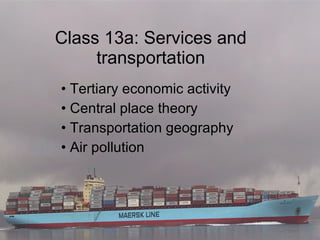
Class 13a: Services and transportation Tertiary economic activity Central place theory Transportation geography  Air pollution
What are services? No tangible product “ Leftover” economic activity Consumer vs. business vs. public Retail vs. personal Producer vs. transportation
 
What are services? Bifurcated wages, skills Labor more important, but fewer unions More women (“pink-collar” workers) Tertiary, quaternary, or quinary
Where are services? From local to global More developed = more service jobs “ Post-industrial” economies


Central place theory How are services distributed? Why does a regular pattern exist? How are large and small cities connected? Central place: market center for region
Central place theory Range: how far are you willing to travel for a service? Threshold: how many customers do you need? Assume shortest distance possible Threshold < range Market area, not city size, matters
 
Central place theory Hexagonal market areas Cover all space No overlap First order: largest threshold and range Second order, etc.
First order Range
First order Range
First order New range
First order Second order
First order Second order New range
First order Second order Third order New range
First order Second order Third order
-- 179.2 0 0-1 6 94.0 89.6 3 2-3 5 49.6 44.8 9 10 4 23.6 22.4 39 39 3 10.3 11.2 153 154 2 Actual spacing Theoretical spacing Actual number Theoretical number Order
Central place theory Accessibility based on time, not distance Administrative principle Political boundaries affect consumers Lower taxes, more permissive rules
So what? Model for regional development Explains decline as well as growth Neighborhood or city scale The point is not the hexagons, but the hierarchy and interconnectedness of places
 
Transportation Enables all other economic activity Derived demand   Important in its own right Accessibility: existence of opportunities Mobility: ability to get there Equity of accessibility and mobility
 
Transportation geography Shrinking distance Changing technology Changing accessibility and mobility Impact on landscape
 
Transportation geography New technology: container shipping No break-of-bulk Less labor needed Less “slippage” Concentration on a few ports
Rotterdam
 

Class13a

  • 1.
    Class 13a: Servicesand transportation Tertiary economic activity Central place theory Transportation geography Air pollution
  • 2.
    What are services?No tangible product “ Leftover” economic activity Consumer vs. business vs. public Retail vs. personal Producer vs. transportation
  • 3.
  • 4.
    What are services?Bifurcated wages, skills Labor more important, but fewer unions More women (“pink-collar” workers) Tertiary, quaternary, or quinary
  • 5.
    Where are services?From local to global More developed = more service jobs “ Post-industrial” economies
  • 6.
  • 7.
  • 8.
  • 9.
    Central place theoryHow are services distributed? Why does a regular pattern exist? How are large and small cities connected? Central place: market center for region
  • 10.
    Central place theoryRange: how far are you willing to travel for a service? Threshold: how many customers do you need? Assume shortest distance possible Threshold < range Market area, not city size, matters
  • 11.
  • 12.
    Central place theoryHexagonal market areas Cover all space No overlap First order: largest threshold and range Second order, etc.
  • 13.
  • 14.
  • 15.
  • 16.
  • 17.
  • 18.
    First order Secondorder New range
  • 19.
    First order Secondorder Third order New range
  • 20.
    First order Secondorder Third order
  • 21.
    First order Secondorder Third order
  • 22.
    -- 179.2 00-1 6 94.0 89.6 3 2-3 5 49.6 44.8 9 10 4 23.6 22.4 39 39 3 10.3 11.2 153 154 2 Actual spacing Theoretical spacing Actual number Theoretical number Order
  • 23.
    Central place theoryAccessibility based on time, not distance Administrative principle Political boundaries affect consumers Lower taxes, more permissive rules
  • 24.
    So what? Modelfor regional development Explains decline as well as growth Neighborhood or city scale The point is not the hexagons, but the hierarchy and interconnectedness of places
  • 25.
  • 26.
    Transportation Enables allother economic activity Derived demand Important in its own right Accessibility: existence of opportunities Mobility: ability to get there Equity of accessibility and mobility
  • 27.
  • 28.
    Transportation geography Shrinkingdistance Changing technology Changing accessibility and mobility Impact on landscape
  • 29.
  • 30.
    Transportation geography Newtechnology: container shipping No break-of-bulk Less labor needed Less “slippage” Concentration on a few ports
  • 31.
  • 32.