BULLVALENE
BY
T.Ramkumar
Roll No:19PGCH10
CLASS:1ST M.Sc CHMEISTRY
Guide by
Dr.M.Saravanakumar
Assistant professor
1
INTRODUCTION
• Bullvalene is a hydrocarbon with chemical formula is C10H10.
• The molecule has a cage-like structure formed by the fusion of
one cyclopropane and three cycloheptadiene rings.
• Bullvalene is unusual as an organic molecule due to the C-C and
C=C bonds forming and breaking rapidly on the NMR
• In bullvalene all C–C bonds are in continuous movement due to
multiple and fast degenerated Cope rearrangements
• It is a structure that is part of the fluctional molecules
2
Structure
IUBAC Name
• Tricyclo[3.3.2.02,8]deca-3,6,9-
triene
3
Synthesis of Bullvalenes
• This molecule was serendipitously obtained in 1963 by
Schröder and co-workers while exploring the
photochemistry of cyclooctatetraene dimers. Despite the
low overall yield (6%), this two-step synthesis of
bullvalene (1),
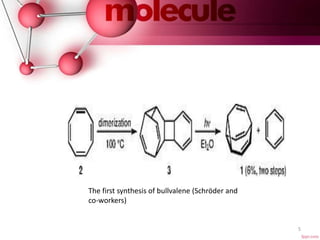
• The dimerization of cyclooctatetraene (2) at 100 °C and
subsequent photochemical opening of the dimer(3)
(Scheme 1) with the consequential formation of benzene
as byproduct
4
The first synthesis of bullvalene (Schröder and
co-workers)
5
another synthesis
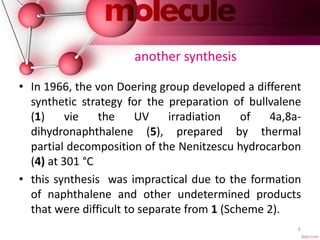
• In 1966, the von Doering group developed a different
synthetic strategy for the preparation of bullvalene
(1) vie the UV irradiation of 4a,8a-
dihydronaphthalene (5), prepared by thermal
partial decomposition of the Nenitzescu hydrocarbon
(4) at 301 °C
• this synthesis was impractical due to the formation
of naphthalene and other undetermined products
that were difficult to separate from 1 (Scheme 2).
6
Scheme 2 Synthesis of bullvalene (von Doering
group)
7
Stereodynamics
• The bullvalene molecule is a cyclopropane platform
with three vinyl arms conjoined at a methine group
• As a fluxional molecule,bullvalene is subject to
degenerate cope rearrangements,with the result that
all carbon atoms and hydrogen atoms appear
equivalent on the NMR timescale
• The number of possible valence tautomers is 1,209,600
8
Five of the bullvalene tautomers and some Cope
rearrangements between them.
9
10
Physical Properties
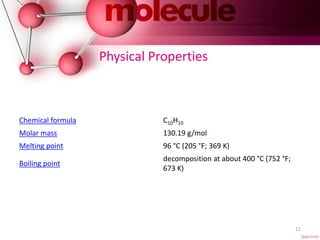
Chemical formula C10H10
Molar mass 130.19 g/mol
Melting point 96 °C (205 °F; 369 K)
Boiling point
decomposition at about 400 °C (752 °F;
673 K)
11
Related compounds
• Bullvalones
• Semibullvalene(C8H8)
• Barbaralane
12
Reference
1. I.L.Finer, Organic chemistry.
2. J.March, Advanced organic chemistry.
13

Bullvalene

  • 1.
    BULLVALENE BY T.Ramkumar Roll No:19PGCH10 CLASS:1ST M.ScCHMEISTRY Guide by Dr.M.Saravanakumar Assistant professor 1
  • 2.
    INTRODUCTION • Bullvalene isa hydrocarbon with chemical formula is C10H10. • The molecule has a cage-like structure formed by the fusion of one cyclopropane and three cycloheptadiene rings. • Bullvalene is unusual as an organic molecule due to the C-C and C=C bonds forming and breaking rapidly on the NMR • In bullvalene all C–C bonds are in continuous movement due to multiple and fast degenerated Cope rearrangements • It is a structure that is part of the fluctional molecules 2
  • 3.
  • 4.
    Synthesis of Bullvalenes •This molecule was serendipitously obtained in 1963 by Schröder and co-workers while exploring the photochemistry of cyclooctatetraene dimers. Despite the low overall yield (6%), this two-step synthesis of bullvalene (1), • The dimerization of cyclooctatetraene (2) at 100 °C and subsequent photochemical opening of the dimer(3) (Scheme 1) with the consequential formation of benzene as byproduct 4
  • 5.
    The first synthesisof bullvalene (Schröder and co-workers) 5
  • 6.
    another synthesis • In1966, the von Doering group developed a different synthetic strategy for the preparation of bullvalene (1) vie the UV irradiation of 4a,8a- dihydronaphthalene (5), prepared by thermal partial decomposition of the Nenitzescu hydrocarbon (4) at 301 °C • this synthesis was impractical due to the formation of naphthalene and other undetermined products that were difficult to separate from 1 (Scheme 2). 6
  • 7.
    Scheme 2 Synthesisof bullvalene (von Doering group) 7
  • 8.
    Stereodynamics • The bullvalenemolecule is a cyclopropane platform with three vinyl arms conjoined at a methine group • As a fluxional molecule,bullvalene is subject to degenerate cope rearrangements,with the result that all carbon atoms and hydrogen atoms appear equivalent on the NMR timescale • The number of possible valence tautomers is 1,209,600 8
  • 9.
    Five of thebullvalene tautomers and some Cope rearrangements between them. 9
  • 10.
  • 11.
    Physical Properties Chemical formulaC10H10 Molar mass 130.19 g/mol Melting point 96 °C (205 °F; 369 K) Boiling point decomposition at about 400 °C (752 °F; 673 K) 11
  • 12.
    Related compounds • Bullvalones •Semibullvalene(C8H8) • Barbaralane 12
  • 13.
    Reference 1. I.L.Finer, Organicchemistry. 2. J.March, Advanced organic chemistry. 13