Speaker
Prof. M. U. Kabir Chowdhury FRCP
Visiting Professor of Dermatology
Dhaka Medical College
Holy Family Red Crescent Medical College Hospital
Adviser, Founder Principal and Visiting Professor
MH Samorita Hospital and Medical College
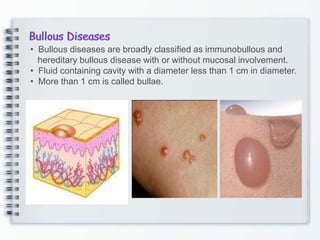
• Bullous diseases are broadly classified as immunobullous and
hereditary bullous disease with or without mucosal involvement.
• Fluid containing cavity with a diameter less than 1 cm in diameter.
• More than 1 cm is called bullae.
Immunobullous diseases:
Intraepidermal
• Pemphigus
Subepidermal
• Bullous pemphigoid
• Dermatitis herpetiformis
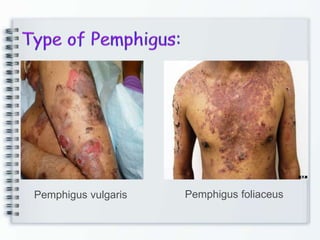
Pemphigus vulgaris Pemphigus foliaceus
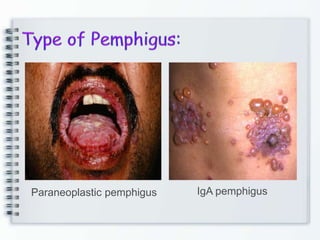
Paraneoplastic pemphigus IgA pemphigus
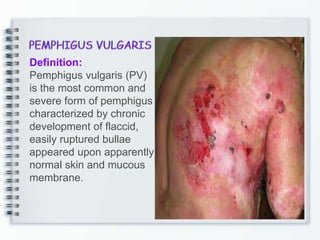
Definition:
Pemphigus vulgaris (PV)
is the most common and
severe form of pemphigus
characterized by chronic
development of flaccid,
easily ruptured bullae
appeared upon apparently
normal skin and mucous
membrane.
Epidemiology:
• Both sexes equally
• 40-60 years
• Rarely in children and younger persons
Aetiology:
• Unknown
• Autoimmune disease
• HLA-DR4, HLA-DR6 and HLA-DQ phenotypes
• Penicillamine, captopril, enalapril, penicillin, thiopronile,
nifedipine, piroxicam, interleukin-2, rifampicin
Pathogenesis:
• Auto immune
• Dsg 1 and Dsg 3
Mechanism of blister formation-
- Cellular and humoral autoimmunity
- Antibody can alone produce acantholysis
Clinical features:
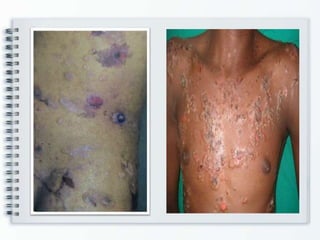
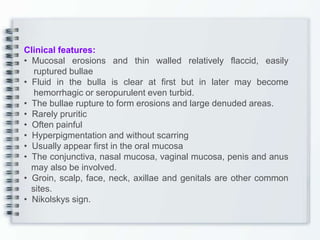
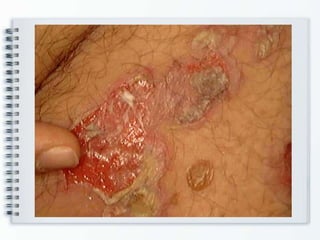
• Mucosal erosions and thin walled relatively flaccid, easily
ruptured bullae
• Fluid in the bulla is clear at first but in later may become
hemorrhagic or seropurulent even turbid.
• The bullae rupture to form erosions and large denuded areas.
• Rarely pruritic
• Often painful
• Hyperpigmentation and without scarring
• Usually appear first in the oral mucosa
• The conjunctiva, nasal mucosa, vaginal mucosa, penis and anus
may also be involved.
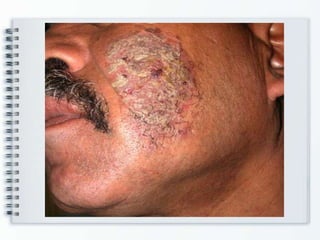
• Groin, scalp, face, neck, axillae and genitals are other common
sites.
• Nikolskys sign.
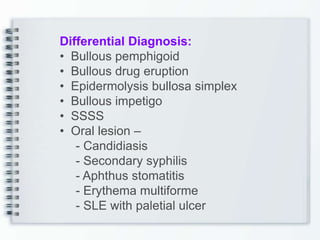
Differential Diagnosis:
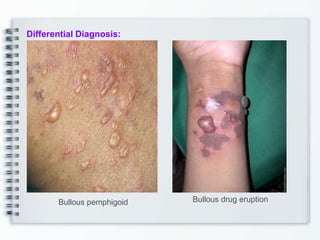
• Bullous pemphigoid
• Bullous drug eruption
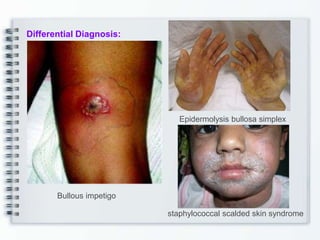
• Epidermolysis bullosa simplex
• Bullous impetigo
• SSSS
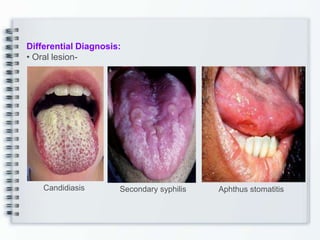
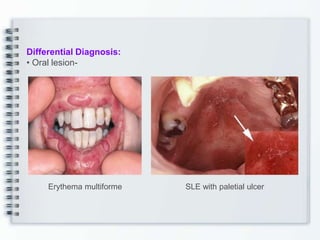
• Oral lesion –
- Candidiasis
- Secondary syphilis
- Aphthus stomatitis
- Erythema multiforme
- SLE with paletial ulcer
Differential Diagnosis:
Bullous pemphigoid Bullous drug eruption
Epidermolysis bullosa simplex
Bullous impetigo
Differential Diagnosis:
staphylococcal scalded skin syndrome
Differential Diagnosis:
• Oral lesion-
Secondary syphilis
Candidiasis Aphthus stomatitis
Differential Diagnosis:
• Oral lesion-
Erythema multiforme SLE with paletial ulcer
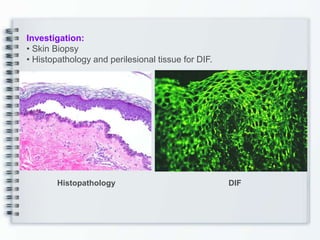
Investigation:
• Skin Biopsy
• Histopathology and perilesional tissue for DIF.
Histopathology DIF
Management:
General:
• Severe patient to be hospitalized
• Adequate nutrition, maintenance of fluid electrolyte balance and
control of infection is important.
Topical treatment:
• Prolong daily bath is helpful in removing the crust.
• Antiseptic mouthwash.
• Topical corticosteroids and tacrolimas in localized disease.
Management:
Systemic therapy:
Corticosteroids:
• High dose (100-150mg)
• 1mg/kg/day
• Intravenous pulse therapy- 1gm/day over a period of 2 to 3 hours
daily for 5 days.
Immunosuppressive agents:
• Azathioprine
• Cyclophosphamide
• Azathioprin - It is relatively safer
• 2.5 to 5 mg /kg/day
• Mycophenolate mofetil
• Cyclophosphamide
Other modalities of treatment:
• Intravenous use of gamma globulin
• Infliximab and Rituximab
Prognosis:
• Before the advent of glucocorticoid therapy,
pemphigus vulgaris was almost invariably fatal
• As soon as the diagnosis is established prognosis
is favorable.
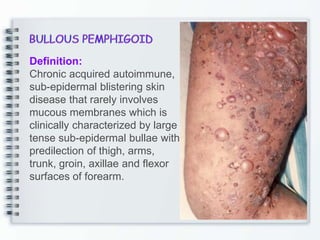
Definition:
Chronic acquired autoimmune,
sub-epidermal blistering skin
disease that rarely involves
mucous membranes which is
clinically characterized by large
tense sub-epidermal bullae with
predilection of thigh, arms,
trunk, groin, axillae and flexor
surfaces of forearm.
Epidemiology:
• Usally begins after age 60 years
Aetiology and Pathogenesis:
• This is an autoimmune disease and autoantibody is directed
against basement membrane zone (BMZ).
Clinical features:
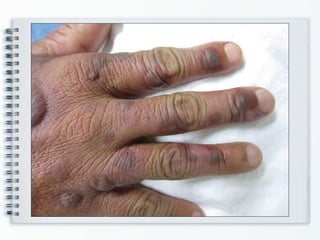
• Bullous pemphigoid clinically manifested with large, tense, bullae
which arises on normal skin or on erythematous surface.
Eruption may be localized or generalized usually scattered
• Tendency to heal without scar.
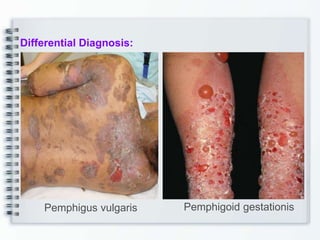
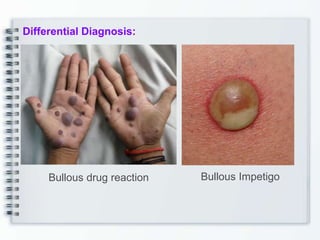
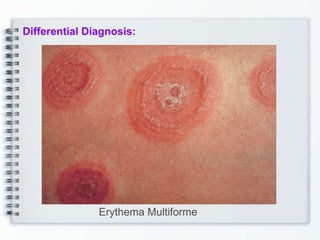
Differential Diagnosis:
• Pemphigus vulgaris
• Pemphigoid gestationis
• Bullous drug reaction
• Bullous impetigo
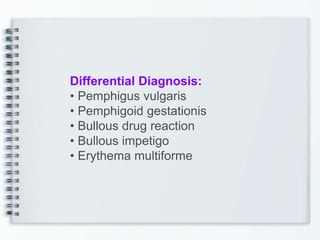
• Erythema multiforme
Differential Diagnosis:
Pemphigus vulgaris Pemphigoid gestationis
Differential Diagnosis:
Bullous Impetigo
Bullous drug reaction
Differential Diagnosis:
Erythema Multiforme
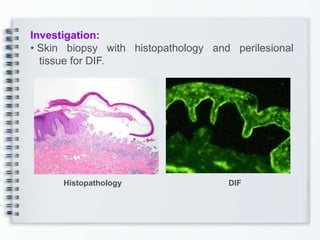
Investigation:
• Skin biopsy with histopathology and perilesional
tissue for DIF.
Histopathology DIF
Management:
Topical therapy
• Topical potent steroid like clobetasole propionate, halobetasole
propionate and topical tactolimus
Systemic therapy
• Prednisolone 50-100mg/day alone or combined with azathioprine
150mg daily till the lesion is cleared.
• Tetracycline and nicotinamide also successfully used.
• Dapsone and sulphapyridine also used with good control of
disease.
• Plasmapheresis, methotrexate, mycophenolate mofetil,
intravenous gama globulin, and chlorambucil is used if
unresponsive to above therapy.
Prognosis:
• Bullous pemphigoid is usually self limited disease
• Remission may occurred within 5-6 years
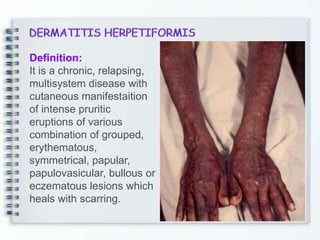
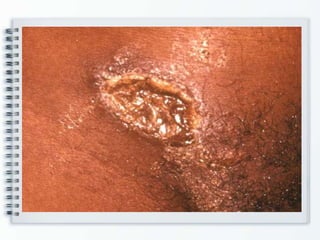
Definition:
It is a chronic, relapsing,
multisystem disease with
cutaneous manifestaition
of intense pruritic
eruptions of various
combination of grouped,
erythematous,
symmetrical, papular,
papulovasicular, bullous or
eczematous lesions which
heals with scarring.
Epidemiology:
• 3 to 4th decade but may occur in children.
• M:F - 2:1
Aetiology and pathogenesis:
• Unknown
• Gluten enteropathy
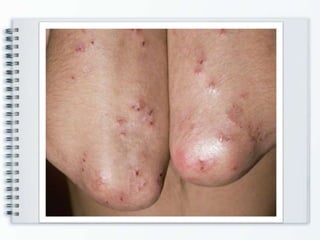
Clinical features:
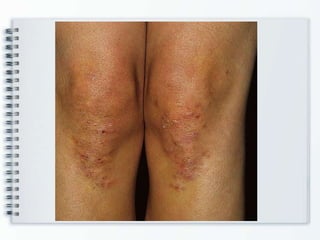
• Manifested with recurrent pruritic lesion in symmetrical
distribution over extensor surface of body such as elbow,
knee, buttocks, shoulders and scalp.
• The eruptions on erythematous base which may be papular,
papulovesicular, vesicobullous, bullous, urticarial.
• The continuous appearance and disappearance of lesions
may results in hyper or hypopigmentation.
• A few patients may have coexistence gluten-sensitive
enteropathy manifested with diarrhoea.
Differential Diagnosis:
• Prurigo nodularis
• Papular Urticaria
• Pemphigus herpetiformis
• Bullous pemphigoid
• Neurotic excoriation
• Atopic dermatitis
• Pemphigoid gestationis
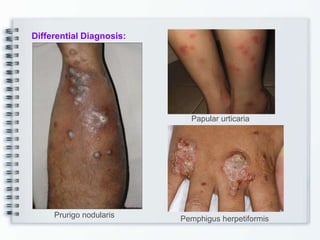
Differential Diagnosis:
Prurigo nodularis
Papular urticaria
Pemphigus herpetiformis
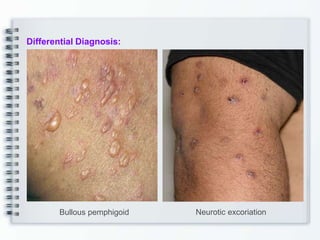
Differential Diagnosis:
Bullous pemphigoid Neurotic excoriation
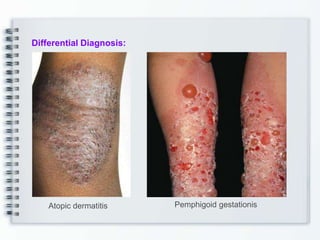
Differential Diagnosis:
Atopic dermatitis Pemphigoid gestationis
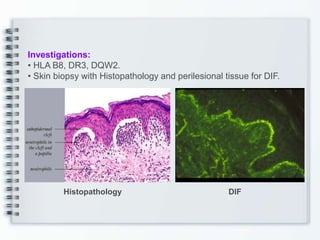
Investigations:
• HLA B8, DR3, DQW2.
• Skin biopsy with Histopathology and perilesional tissue for DIF.
Histopathology DIF
Management:
• Dapsone is the drug of choice
• The dose varies between 50-300mg/day.
• Patients are strictly advised to avoid gluten in diet such as
wheat, barley, and rye which will help to suppress the disease
and to reduce dose of dapsone or sulfapyridine.
Prognosis:
• The disease is prolonged for many years with one third
patients may have spontaneous remission.
BULLOUS_DISEASES presentation and management

BULLOUS_DISEASES presentation and management

  • 1.
    Speaker Prof. M. U.Kabir Chowdhury FRCP Visiting Professor of Dermatology Dhaka Medical College Holy Family Red Crescent Medical College Hospital Adviser, Founder Principal and Visiting Professor MH Samorita Hospital and Medical College
  • 2.
    • Bullous diseasesare broadly classified as immunobullous and hereditary bullous disease with or without mucosal involvement. • Fluid containing cavity with a diameter less than 1 cm in diameter. • More than 1 cm is called bullae.
  • 3.
    Immunobullous diseases: Intraepidermal • Pemphigus Subepidermal •Bullous pemphigoid • Dermatitis herpetiformis
  • 4.
  • 5.
  • 6.
    Definition: Pemphigus vulgaris (PV) isthe most common and severe form of pemphigus characterized by chronic development of flaccid, easily ruptured bullae appeared upon apparently normal skin and mucous membrane.
  • 7.
    Epidemiology: • Both sexesequally • 40-60 years • Rarely in children and younger persons Aetiology: • Unknown • Autoimmune disease • HLA-DR4, HLA-DR6 and HLA-DQ phenotypes • Penicillamine, captopril, enalapril, penicillin, thiopronile, nifedipine, piroxicam, interleukin-2, rifampicin Pathogenesis: • Auto immune • Dsg 1 and Dsg 3 Mechanism of blister formation- - Cellular and humoral autoimmunity - Antibody can alone produce acantholysis
  • 9.
    Clinical features: • Mucosalerosions and thin walled relatively flaccid, easily ruptured bullae • Fluid in the bulla is clear at first but in later may become hemorrhagic or seropurulent even turbid. • The bullae rupture to form erosions and large denuded areas. • Rarely pruritic • Often painful • Hyperpigmentation and without scarring • Usually appear first in the oral mucosa • The conjunctiva, nasal mucosa, vaginal mucosa, penis and anus may also be involved. • Groin, scalp, face, neck, axillae and genitals are other common sites. • Nikolskys sign.
  • 11.
    Differential Diagnosis: • Bullouspemphigoid • Bullous drug eruption • Epidermolysis bullosa simplex • Bullous impetigo • SSSS • Oral lesion – - Candidiasis - Secondary syphilis - Aphthus stomatitis - Erythema multiforme - SLE with paletial ulcer
  • 12.
  • 13.
    Epidermolysis bullosa simplex Bullousimpetigo Differential Diagnosis: staphylococcal scalded skin syndrome
  • 14.
    Differential Diagnosis: • Orallesion- Secondary syphilis Candidiasis Aphthus stomatitis
  • 15.
    Differential Diagnosis: • Orallesion- Erythema multiforme SLE with paletial ulcer
  • 16.
    Investigation: • Skin Biopsy •Histopathology and perilesional tissue for DIF. Histopathology DIF
  • 17.
    Management: General: • Severe patientto be hospitalized • Adequate nutrition, maintenance of fluid electrolyte balance and control of infection is important. Topical treatment: • Prolong daily bath is helpful in removing the crust. • Antiseptic mouthwash. • Topical corticosteroids and tacrolimas in localized disease.
  • 18.
    Management: Systemic therapy: Corticosteroids: • Highdose (100-150mg) • 1mg/kg/day • Intravenous pulse therapy- 1gm/day over a period of 2 to 3 hours daily for 5 days. Immunosuppressive agents: • Azathioprine • Cyclophosphamide • Azathioprin - It is relatively safer • 2.5 to 5 mg /kg/day • Mycophenolate mofetil • Cyclophosphamide Other modalities of treatment: • Intravenous use of gamma globulin • Infliximab and Rituximab
  • 20.
    Prognosis: • Before theadvent of glucocorticoid therapy, pemphigus vulgaris was almost invariably fatal • As soon as the diagnosis is established prognosis is favorable.
  • 21.
    Definition: Chronic acquired autoimmune, sub-epidermalblistering skin disease that rarely involves mucous membranes which is clinically characterized by large tense sub-epidermal bullae with predilection of thigh, arms, trunk, groin, axillae and flexor surfaces of forearm.
  • 23.
    Epidemiology: • Usally beginsafter age 60 years Aetiology and Pathogenesis: • This is an autoimmune disease and autoantibody is directed against basement membrane zone (BMZ). Clinical features: • Bullous pemphigoid clinically manifested with large, tense, bullae which arises on normal skin or on erythematous surface. Eruption may be localized or generalized usually scattered • Tendency to heal without scar.
  • 25.
    Differential Diagnosis: • Pemphigusvulgaris • Pemphigoid gestationis • Bullous drug reaction • Bullous impetigo • Erythema multiforme
  • 26.
  • 27.
  • 28.
  • 29.
    Investigation: • Skin biopsywith histopathology and perilesional tissue for DIF. Histopathology DIF
  • 30.
    Management: Topical therapy • Topicalpotent steroid like clobetasole propionate, halobetasole propionate and topical tactolimus Systemic therapy • Prednisolone 50-100mg/day alone or combined with azathioprine 150mg daily till the lesion is cleared. • Tetracycline and nicotinamide also successfully used. • Dapsone and sulphapyridine also used with good control of disease. • Plasmapheresis, methotrexate, mycophenolate mofetil, intravenous gama globulin, and chlorambucil is used if unresponsive to above therapy. Prognosis: • Bullous pemphigoid is usually self limited disease • Remission may occurred within 5-6 years
  • 31.
    Definition: It is achronic, relapsing, multisystem disease with cutaneous manifestaition of intense pruritic eruptions of various combination of grouped, erythematous, symmetrical, papular, papulovasicular, bullous or eczematous lesions which heals with scarring.
  • 32.
    Epidemiology: • 3 to4th decade but may occur in children. • M:F - 2:1 Aetiology and pathogenesis: • Unknown • Gluten enteropathy Clinical features: • Manifested with recurrent pruritic lesion in symmetrical distribution over extensor surface of body such as elbow, knee, buttocks, shoulders and scalp. • The eruptions on erythematous base which may be papular, papulovesicular, vesicobullous, bullous, urticarial. • The continuous appearance and disappearance of lesions may results in hyper or hypopigmentation. • A few patients may have coexistence gluten-sensitive enteropathy manifested with diarrhoea.
  • 35.
    Differential Diagnosis: • Prurigonodularis • Papular Urticaria • Pemphigus herpetiformis • Bullous pemphigoid • Neurotic excoriation • Atopic dermatitis • Pemphigoid gestationis
  • 36.
    Differential Diagnosis: Prurigo nodularis Papularurticaria Pemphigus herpetiformis
  • 37.
  • 38.
  • 39.
    Investigations: • HLA B8,DR3, DQW2. • Skin biopsy with Histopathology and perilesional tissue for DIF. Histopathology DIF
  • 40.
    Management: • Dapsone isthe drug of choice • The dose varies between 50-300mg/day. • Patients are strictly advised to avoid gluten in diet such as wheat, barley, and rye which will help to suppress the disease and to reduce dose of dapsone or sulfapyridine. Prognosis: • The disease is prolonged for many years with one third patients may have spontaneous remission.