1.4 Buildings
By Lau Wei Ling
Buildings are defined as structures with walls and roofs.
However, buildings are definitely more than structures, walls and
roofs. Generally, buildings are built to adapt different functions and
reasons according to human needs.
 Building Functions
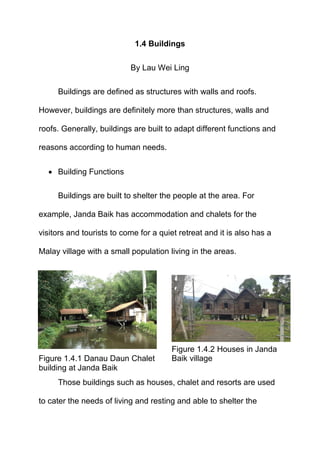
Buildings are built to shelter the people at the area. For
example, Janda Baik has accommodation and chalets for the
visitors and tourists to come for a quiet retreat and it is also has a
Malay village with a small population living in the areas.

Figure 1.4.1 Danau Daun Chalet
building at Janda Baik

Figure 1.4.2 Houses in Janda
Baik village

Those buildings such as houses, chalet and resorts are used
to cater the needs of living and resting and able to shelter the
people from the nasty weather and animals, or even provide places
for the people to rest and carry out activities.

 Building Materials
The buildings at Janda Baik are built by using timbers,
bamboos, rocks and concrete. Rocks, timbers and bamboos are
widely used due to the easy availability while concrete are used to
build the base of the building. As rainforest around Janda Baik
gives the moistures in the air and the lands, the buildings also adapt
to have concrete floors or base to increase the lifespan of the
timber buildings.
 Buildings Features
The buildings at Janda Baik are mostly single storeys
bungalows due to lower land prices. Their buildings do not require
high workmanship and strong materials.
Figure 1.4.3
Small single
storey
bungalow at
one of the
village in
Janda Baik.
Higher altitude of the location promises Janda Baik with cool
and sunny weather, providing the places temperature around 28
degrees Celsius. Architects and builders use this feature to build a
house with large opening or window to have ventilation.

Figure 1.4.4
Siamese
Resort at J.B.
with large
opening.

 Architecture
The buildings at Janda Baik are influenced by traditional
Malay Architecture. The buildings supported by stilts which allow
cross-ventilating breeze beneath the buildings and protect them
from flood are features of traditional Malay Architecture. These
buildings can be found in most of the Malays Village at Janda Baik.
Ashida Villa is one of the resorts in Janda Baik which sorts
Siamese Architecture Style in its buildings. They have double
pitched gable roof on their buildings.
The cultural village in Janda Baik also contains beautiful
architectural buildings. In the village, the buildings vary from timber
buildings to masonry buildings.

Figure
1.4.5
Cultural
village
building
s
The high pitched roofs of the buildings (refer to Figure 1.4.5)
have frames at the sides and edges that formed decorative
ornaments which demonstrate the traditional Malay Architecture.
Their buildings also have the knitted pattern that shows attractive
design on their walls. (refer to Figure 1.4.6)

Figure 1.4.6
Figure 1.4.7 Masonry Building
Some of the buildings in the cultural village are built using
rocks. The buildings have beautiful textures that increase the
aesthetics value.

Buildings rural

  • 1.
    1.4 Buildings By LauWei Ling Buildings are defined as structures with walls and roofs. However, buildings are definitely more than structures, walls and roofs. Generally, buildings are built to adapt different functions and reasons according to human needs.  Building Functions Buildings are built to shelter the people at the area. For example, Janda Baik has accommodation and chalets for the visitors and tourists to come for a quiet retreat and it is also has a Malay village with a small population living in the areas. Figure 1.4.1 Danau Daun Chalet building at Janda Baik Figure 1.4.2 Houses in Janda Baik village Those buildings such as houses, chalet and resorts are used to cater the needs of living and resting and able to shelter the
  • 2.
    people from thenasty weather and animals, or even provide places for the people to rest and carry out activities.  Building Materials The buildings at Janda Baik are built by using timbers, bamboos, rocks and concrete. Rocks, timbers and bamboos are widely used due to the easy availability while concrete are used to build the base of the building. As rainforest around Janda Baik gives the moistures in the air and the lands, the buildings also adapt to have concrete floors or base to increase the lifespan of the timber buildings.  Buildings Features The buildings at Janda Baik are mostly single storeys bungalows due to lower land prices. Their buildings do not require high workmanship and strong materials. Figure 1.4.3 Small single storey bungalow at one of the village in Janda Baik.
  • 3.
    Higher altitude ofthe location promises Janda Baik with cool and sunny weather, providing the places temperature around 28 degrees Celsius. Architects and builders use this feature to build a house with large opening or window to have ventilation. Figure 1.4.4 Siamese Resort at J.B. with large opening.  Architecture The buildings at Janda Baik are influenced by traditional Malay Architecture. The buildings supported by stilts which allow cross-ventilating breeze beneath the buildings and protect them from flood are features of traditional Malay Architecture. These buildings can be found in most of the Malays Village at Janda Baik.
  • 4.
    Ashida Villa isone of the resorts in Janda Baik which sorts Siamese Architecture Style in its buildings. They have double pitched gable roof on their buildings. The cultural village in Janda Baik also contains beautiful architectural buildings. In the village, the buildings vary from timber buildings to masonry buildings. Figure 1.4.5 Cultural village building s
  • 5.
    The high pitchedroofs of the buildings (refer to Figure 1.4.5) have frames at the sides and edges that formed decorative ornaments which demonstrate the traditional Malay Architecture. Their buildings also have the knitted pattern that shows attractive design on their walls. (refer to Figure 1.4.6) Figure 1.4.6
  • 6.
    Figure 1.4.7 MasonryBuilding Some of the buildings in the cultural village are built using rocks. The buildings have beautiful textures that increase the aesthetics value.