SCHOOL OF ARCHITECTURE, BUILDING & DESIGN
BACHELOR OF QUANTITY SURVEYING (HONOURS)
BUILDING SERVICES (BLD60503)
INDIVIDUAL ASSIGNMENT
Student Name : Nicole Thain Huey Wei
Student ID : 0325697
Lecturer : Dr. Kam Kenn Jhun
Date of Submission : 29/5/2017
Assignment Title : Enhancement of green technology via air conditioning system
Word Count : 1991 words
There has been an increasing global awareness on environmental issues, centering on the
ideas of "sustainability" and "reducing the carbon footprint". The drive toward "green
technology" is a result of these two ideas. Both of these ideas are based on the fact that the
population of earth is increasing and along with this increase, more and more of earth's limited
resources will be drained without any form of replacement in sight. Alarmists have warned that
the depletion of earth's limited resources can trigger the extinction of humankind, at least on
earth.
In order to maximize the usage of earth's limited resources, new and innovative ways to
maximize the efficiency of current equipment must be created to avoid undue wastage. At the
same time, renewable resources must be explored and exploited. As the name suggests,
renewable resources are resources that can be renewed. These are currently in the form of, but
not limited to energy sources such as sunlight, wind or the natural flow of water or tide levels.
"Green Technology" is the way forward, where efficient use of earth's resources must be
maximized and usage of renewable resources highly encouraged, if not mandated.
One of the most demanded forms of energy is electricity. However, in order to generate
electricity, motion must be created and maintained in a generator. To create motion, raw
resources such as petroleum or coal must be used. Renewable forms of raw resources to create
motion can be obtained from flowing water such as rivers, tide levels and wind. Direct
conversion of sunlight to electricity is gaining momentum where the conversion efficiency is the
major hurdle. The major use of electricity in a modern society is in air conditioning systems for
buildings, be it for commercial, industrial or residential. In a hot and humid country such as
Malaysia, it is no longer an option, especially in buildings with a high population density. Long
gone are the days of low density dwellings such as a house surrounded by trees with cool breeze
through the windows. In fact, the improvement in the efficiency of these air conditioning systems
is paramount to reduce the carbon footprint of these buildings.
1
The air conditioning technology is old, and every single one is still based on the principle
of "moving the heat outside". Essentially, heat is moved away from areas where it is not wanted
via a liquid refrigerant. These excess heat is then "dumped" in another area where the increase in
temperature due to this dumping can be tolerated. Increasing the efficiency of these "heat
moving" systems is the primary drive for better air conditioning systems. The prime example of
a system with better efficiency is the so-called "inverter" system. Therefore, there are various
types of air conditioning systems and the ways and means to achieve the target of "green
technology".
One of them is the ​absorption chiller​, which is a non-electric chiller that uses primary
heat such as waste fuel to produce chilled water for the cooling systems. A liquid refrigerant or
sorbent solution and a heat source is used in a thermal compression of the refrigerant to replace
the electric power consumption of a mechanical compressor. The main components of an1
absorption chiller are the generator, the condenser, the evaporator and the absorber.
1
GmbH, t. (n.d.). Absorption Chillers - Solair. [online] Solair-project.eu. Available at:
http://www.solair-project.eu/143.0.html [Accessed 21 May 2017]
2
Figure 1.1 This is a schematic drawing of an absorption chiller.2
Basically, the absorption chiller works by absorbing and releasing water vapor in and out
of the liquid refrigerant, normally liquid ammonia (NH3) or lithium bromide (LiBr) applied with
water. During this cycle, high pressure will prevail inside generator and condenser, while low
pressure will be inside the evaporator and absorber. The cycle starts with applying waste heat in
the generator so the solution in the generator will be separated into refrigerant and weak solution.
The refrigerant in the vapour form will go into condenser and change into liquid. Since there is a
pressure difference between condenser and evaporator, the solution part will enter absorber and
refrigerant will flow inside evaporator and absorbs heat from cooled water that is in circulation
inside evaporator. Therefore, the temperature of circulated water decreases and then it is used for
air-conditioning purpose. The evaporated refrigerant will then enter absorber where it will be
mixed with weak solution, the mixture will then get into the liquid state and finally it will enter
generator and the cycle is repeated. Hence, absorption chiller do not use chlorofluorocarbons or
hydrochlorofluorocarbons (CFCs or HCFCs, also known as Freon), refrigerants that contributes
to ozone depletion. As there is no compressor in this system to consume power, it reduced the
consumption of electricity significantly. The main benefit of the absorption chiller system is that
it can be used in places where there are no source of electrical supply because it does not require
electricity to work. This system works well on natural gas and solar energy. Besides, this system
is very quiet as there is no mechanical compression used during the cooling process so it is
suitable to use in hospitals, schools and office building where noise and vibration levels are an
issues.
The ​inverter air conditioning which is becoming more popular due to its environmental
friendly and energy savings approach has become the latest technology in the HVAC field. It is
also quieter than conventional air conditioners and more economical to operate. An inverter is
used to control the speed of the compressor motor, so it can constantly regulate the temperature.
2
Absorptionchiller.(n.d.). What Is An Absorption Chiller? [online] Available at:
http://absorptionchiller4u.blogspot.my/2013/01/what-is-absorption-chiller-system.html
3
The DC Inverter unit has a variable-frequency drive that comprises an adjustable electrical
inverter to control the speed of the electromotor, which means the compressor and the cooling or
heating output. The drive converts the incoming AC current to DC and then through a
modulation in an electrical inverter produces current of desired frequency. A microcontroller3
can sample each ambient air temperature and adjust accordingly the speed of the compressor to
maintain the desired temperature.
The inverter air conditioning has increased efficiency in contraction to traditional air
conditioners, extended life of their parts and the sharp fluctuations in the load are eliminated.
This causes the inverter AC units quieter, with lower operating cost and with less broke downs.
Lower energy bills are balanced by the inverter AC unit even though it would be more expensive
than the constant speed air conditioners. The payback time is approximately two years depending
on the usage. The other benefits of the inverter air conditioner are the start up time is quicker, so
the desired temperature can be achieved faster. Thus, it can also maximizes the comfort level of
the air inside the room as there are no temperature fluctuation. Moreover, inverter air conditioner
is energy efficient because it has less power consumption. It can save energy up to 30%
compared to the non-inverter air conditioner. When the inverter air conditioner reached the set
temperature, the compressor speed will slow down. Hence, the refrigerant rate will drop and
work at a lower capacity. The non-inverter air conditioner will consume more power because the
temperature need to be adjusted by turning on and off the motor.
Ice storage air conditioning is using one of the thermal energy storage (TES)
technology which stocks thermal energy by heating or cooling a storage medium and use the
stored energy at a later time for heating and cooling process. It uses standard cooling equipment
and an energy storage tank to alter all or a portion of a building's cooling needs to off-peak or
3
Inventor (n.d.). What is the Inverter technology in air conditioners? - Inventor. [online]
Inventorairconditioner.com. Available at:
https://www.inventorairconditioner.com/blog/faq/what-is-the-inverter-technology-in-air-conditioners
[Accessed 28 May 2017].
4
nighttime hours. During off-peak hours, ice is made and stored inside IceBank energy storage
tanks.
Figure 1.2 Ice storage air conditioning works during off peak season and peak demand
system by Ice energy.
A company called Ice Energy has produced an ice powered A/C unit, the Ice Bear which
allows six to seven hours of continuous cooling and automatically alternates with the
conventional A/C unit to continue the cooling process. Ice Energy has declared it to be the first4
product to effectively resolve the loss-less energy issue. Two types of Ice bear unit has designed
by this company, which are Ice Bear 30 and Ice Bear 20 to suit the needs of commercial,
industrial and residential customers. Ice bear 30 is the commercial ice battery that attach to 4 to
20 tons commercial air conditioning units. Meanwhile, Ice Bear 20 is the home battery that can
integrates with ductwork or ductless mini-split systems inside the home. Ice storage air
conditioning that does not requires AC unit to work during the night time has lowered the
demand for electricity and the electricity is cleaner, making this system more energy efficient.
4
Ice Energy.(n.d.).Technology - Ice Energy. [online] Available at: https://www.ice-energy.com/technology/
[Accessed 28 May 2017].
5
This system eliminates the need for expensive fossil-fuel peaker plants and supporting renewable
energy, which reduces the greenhouse gas emissions without producing any hazardous waste or
toxic material. It does not only helps to reduce the impact on the environment, but also reduce
the cooling bills of the owners.
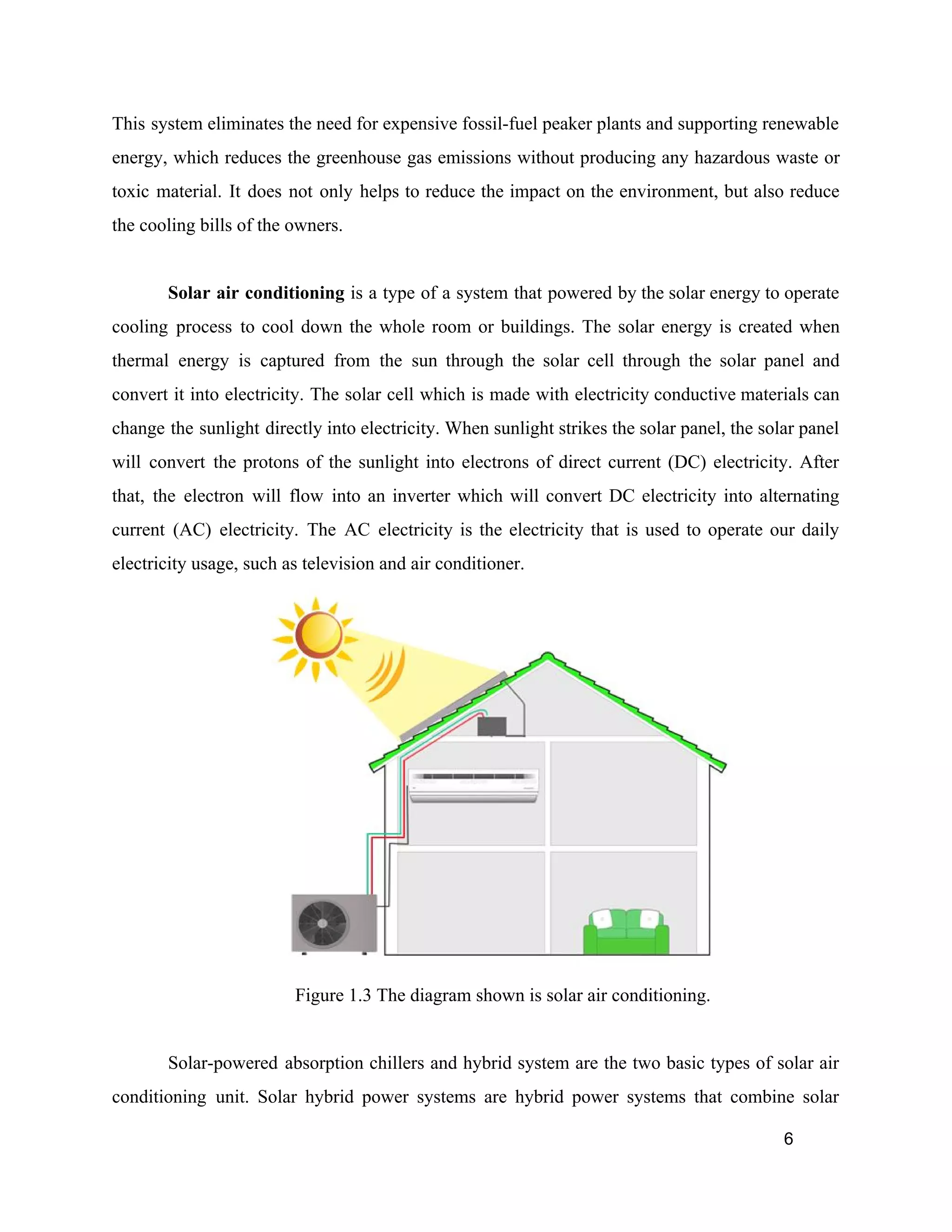
Solar air conditioning is a type of a system that powered by the solar energy to operate
cooling process to cool down the whole room or buildings. The solar energy is created when
thermal energy is captured from the sun through the solar cell through the solar panel and
convert it into electricity. The solar cell which is made with electricity conductive materials can
change the sunlight directly into electricity. When sunlight strikes the solar panel, the solar panel
will convert the protons of the sunlight into electrons of direct current (DC) electricity. After
that, the electron will flow into an inverter which will convert DC electricity into alternating
current (AC) electricity. The AC electricity is the electricity that is used to operate our daily
electricity usage, such as television and air conditioner.
Figure 1.3 The diagram shown is solar air conditioning.
Solar-powered absorption chillers and hybrid system are the two basic types of solar air
conditioning unit. Solar hybrid power systems are hybrid power systems that combine solar
6
power from a photovoltaic system with another power generating energy source. It automatically
switches between solar and battery power as needed. When it is set to hybrid mode, the system
will charge the battery when there is sunlight; when it isn’t, the system will run on battery
backup while charging its batteries through AC power. For the solar powered absorption chiller,
which also known as evaporative coolers works by heating and cooling the water through
evaporation and condensation. They reduce the air temperature by blowing it over a saturated
material. The motor and fan is powered by the solar energy.
Solar air conditioning provides significant environmental benefits. Both hybrid solar air
conditioning and solar powered absorption chillers reduced the demand for electricity which is
generated via the consumption of non-renewable resources, also releasing carbon dioxide and
other pollutants into the air. Thus, a reduced or eliminated dependence on this type of energy
holds many valuable benefits for the environment, including the conservation of natural
resources and a smaller impact on climate change. However, solar air conditioning is still
considered a new product in the domestic appliances category. It is sold at a price that is 4 times
higher than conventional air conditioners due to their limited numbers. Although it is very costly,
it will definitely benefit the owners and the environment in the long run.
In a nutshell, there are many air conditioning design that have been shown to utilize
energy more efficiently while keeping the quality and flow of clean air comparable to the current
standard. The implementation of green technology helps reduce carbon footprint, reduces waste,
and consumes reduced energy as compared to traditional technologies..Therefore, the
government and relevant authorities should raise the public awareness by introducing these
environment-friendly alternative. In fact, problems like global warming and energy crisis can not
be solved within a short period so it really requires determination and continue effort in
improving the situation. Green technology will certainly be the resolution that gets the potential
to solve those problems and improve the environment.
7
Bibliography
1.GmbH, t. (n.d.). Absorption Chillers - Solair. [online] Solair-project.eu. Available at:
http://www.solair-project.eu/143.0.html [Accessed 28 May 2017].
2.Absorptionchiller. (n.d.). What Is An Absorption Chiller ?. [online] Available at:
http://absorptionchiller4u.blogspot.my/2013/01/what-is-absorption-chiller-system.html
[Accessed 28 May 2017].
3.Science, E. and Technologies, S.(n.d.). How Solar Air Conditioners Work. [online]
HowStuffWorks. Available at:
http://science.howstuffworks.com/environmental/green-tech/sustainable/solar-air-conditioner1.ht
m [Accessed 28 May 2017].
4. Bhattacharjee, A. (n.d.). The Advantages of Solar Air Conditioning. [online] ABC of Solar.
Available at: http://abcofsolar.com/solar-air-conditioning/ [Accessed 28 May 2017].
5.Ice Energy. (2017). Technology - Ice Energy. [online] Available at:
https://www.ice-energy.com/technology/ [Accessed 28 May 2017].
6. Explain that Stuff. (n.d.). How do solar cells work?. [online] Available at:
http://www.explainthatstuff.com/solarcells.html [Accessed 28 May 2017].
7. Deepgreenrobot.org. (n.d.). ​Green Technology Definition – What is Green Technology About​.
[online] Available at: http://www.deepgreenrobot.org/green-technology-definition.html
[Accessed 29 May 2017].
8

Building services

  • 1.
    SCHOOL OF ARCHITECTURE,BUILDING & DESIGN BACHELOR OF QUANTITY SURVEYING (HONOURS) BUILDING SERVICES (BLD60503) INDIVIDUAL ASSIGNMENT Student Name : Nicole Thain Huey Wei Student ID : 0325697 Lecturer : Dr. Kam Kenn Jhun Date of Submission : 29/5/2017 Assignment Title : Enhancement of green technology via air conditioning system Word Count : 1991 words
  • 2.
    There has beenan increasing global awareness on environmental issues, centering on the ideas of "sustainability" and "reducing the carbon footprint". The drive toward "green technology" is a result of these two ideas. Both of these ideas are based on the fact that the population of earth is increasing and along with this increase, more and more of earth's limited resources will be drained without any form of replacement in sight. Alarmists have warned that the depletion of earth's limited resources can trigger the extinction of humankind, at least on earth. In order to maximize the usage of earth's limited resources, new and innovative ways to maximize the efficiency of current equipment must be created to avoid undue wastage. At the same time, renewable resources must be explored and exploited. As the name suggests, renewable resources are resources that can be renewed. These are currently in the form of, but not limited to energy sources such as sunlight, wind or the natural flow of water or tide levels. "Green Technology" is the way forward, where efficient use of earth's resources must be maximized and usage of renewable resources highly encouraged, if not mandated. One of the most demanded forms of energy is electricity. However, in order to generate electricity, motion must be created and maintained in a generator. To create motion, raw resources such as petroleum or coal must be used. Renewable forms of raw resources to create motion can be obtained from flowing water such as rivers, tide levels and wind. Direct conversion of sunlight to electricity is gaining momentum where the conversion efficiency is the major hurdle. The major use of electricity in a modern society is in air conditioning systems for buildings, be it for commercial, industrial or residential. In a hot and humid country such as Malaysia, it is no longer an option, especially in buildings with a high population density. Long gone are the days of low density dwellings such as a house surrounded by trees with cool breeze through the windows. In fact, the improvement in the efficiency of these air conditioning systems is paramount to reduce the carbon footprint of these buildings. 1
  • 3.
    The air conditioningtechnology is old, and every single one is still based on the principle of "moving the heat outside". Essentially, heat is moved away from areas where it is not wanted via a liquid refrigerant. These excess heat is then "dumped" in another area where the increase in temperature due to this dumping can be tolerated. Increasing the efficiency of these "heat moving" systems is the primary drive for better air conditioning systems. The prime example of a system with better efficiency is the so-called "inverter" system. Therefore, there are various types of air conditioning systems and the ways and means to achieve the target of "green technology". One of them is the ​absorption chiller​, which is a non-electric chiller that uses primary heat such as waste fuel to produce chilled water for the cooling systems. A liquid refrigerant or sorbent solution and a heat source is used in a thermal compression of the refrigerant to replace the electric power consumption of a mechanical compressor. The main components of an1 absorption chiller are the generator, the condenser, the evaporator and the absorber. 1 GmbH, t. (n.d.). Absorption Chillers - Solair. [online] Solair-project.eu. Available at: http://www.solair-project.eu/143.0.html [Accessed 21 May 2017] 2
  • 4.
    Figure 1.1 Thisis a schematic drawing of an absorption chiller.2 Basically, the absorption chiller works by absorbing and releasing water vapor in and out of the liquid refrigerant, normally liquid ammonia (NH3) or lithium bromide (LiBr) applied with water. During this cycle, high pressure will prevail inside generator and condenser, while low pressure will be inside the evaporator and absorber. The cycle starts with applying waste heat in the generator so the solution in the generator will be separated into refrigerant and weak solution. The refrigerant in the vapour form will go into condenser and change into liquid. Since there is a pressure difference between condenser and evaporator, the solution part will enter absorber and refrigerant will flow inside evaporator and absorbs heat from cooled water that is in circulation inside evaporator. Therefore, the temperature of circulated water decreases and then it is used for air-conditioning purpose. The evaporated refrigerant will then enter absorber where it will be mixed with weak solution, the mixture will then get into the liquid state and finally it will enter generator and the cycle is repeated. Hence, absorption chiller do not use chlorofluorocarbons or hydrochlorofluorocarbons (CFCs or HCFCs, also known as Freon), refrigerants that contributes to ozone depletion. As there is no compressor in this system to consume power, it reduced the consumption of electricity significantly. The main benefit of the absorption chiller system is that it can be used in places where there are no source of electrical supply because it does not require electricity to work. This system works well on natural gas and solar energy. Besides, this system is very quiet as there is no mechanical compression used during the cooling process so it is suitable to use in hospitals, schools and office building where noise and vibration levels are an issues. The ​inverter air conditioning which is becoming more popular due to its environmental friendly and energy savings approach has become the latest technology in the HVAC field. It is also quieter than conventional air conditioners and more economical to operate. An inverter is used to control the speed of the compressor motor, so it can constantly regulate the temperature. 2 Absorptionchiller.(n.d.). What Is An Absorption Chiller? [online] Available at: http://absorptionchiller4u.blogspot.my/2013/01/what-is-absorption-chiller-system.html 3
  • 5.
    The DC Inverterunit has a variable-frequency drive that comprises an adjustable electrical inverter to control the speed of the electromotor, which means the compressor and the cooling or heating output. The drive converts the incoming AC current to DC and then through a modulation in an electrical inverter produces current of desired frequency. A microcontroller3 can sample each ambient air temperature and adjust accordingly the speed of the compressor to maintain the desired temperature. The inverter air conditioning has increased efficiency in contraction to traditional air conditioners, extended life of their parts and the sharp fluctuations in the load are eliminated. This causes the inverter AC units quieter, with lower operating cost and with less broke downs. Lower energy bills are balanced by the inverter AC unit even though it would be more expensive than the constant speed air conditioners. The payback time is approximately two years depending on the usage. The other benefits of the inverter air conditioner are the start up time is quicker, so the desired temperature can be achieved faster. Thus, it can also maximizes the comfort level of the air inside the room as there are no temperature fluctuation. Moreover, inverter air conditioner is energy efficient because it has less power consumption. It can save energy up to 30% compared to the non-inverter air conditioner. When the inverter air conditioner reached the set temperature, the compressor speed will slow down. Hence, the refrigerant rate will drop and work at a lower capacity. The non-inverter air conditioner will consume more power because the temperature need to be adjusted by turning on and off the motor. Ice storage air conditioning is using one of the thermal energy storage (TES) technology which stocks thermal energy by heating or cooling a storage medium and use the stored energy at a later time for heating and cooling process. It uses standard cooling equipment and an energy storage tank to alter all or a portion of a building's cooling needs to off-peak or 3 Inventor (n.d.). What is the Inverter technology in air conditioners? - Inventor. [online] Inventorairconditioner.com. Available at: https://www.inventorairconditioner.com/blog/faq/what-is-the-inverter-technology-in-air-conditioners [Accessed 28 May 2017]. 4
  • 6.
    nighttime hours. Duringoff-peak hours, ice is made and stored inside IceBank energy storage tanks. Figure 1.2 Ice storage air conditioning works during off peak season and peak demand system by Ice energy. A company called Ice Energy has produced an ice powered A/C unit, the Ice Bear which allows six to seven hours of continuous cooling and automatically alternates with the conventional A/C unit to continue the cooling process. Ice Energy has declared it to be the first4 product to effectively resolve the loss-less energy issue. Two types of Ice bear unit has designed by this company, which are Ice Bear 30 and Ice Bear 20 to suit the needs of commercial, industrial and residential customers. Ice bear 30 is the commercial ice battery that attach to 4 to 20 tons commercial air conditioning units. Meanwhile, Ice Bear 20 is the home battery that can integrates with ductwork or ductless mini-split systems inside the home. Ice storage air conditioning that does not requires AC unit to work during the night time has lowered the demand for electricity and the electricity is cleaner, making this system more energy efficient. 4 Ice Energy.(n.d.).Technology - Ice Energy. [online] Available at: https://www.ice-energy.com/technology/ [Accessed 28 May 2017]. 5
  • 7.
    This system eliminatesthe need for expensive fossil-fuel peaker plants and supporting renewable energy, which reduces the greenhouse gas emissions without producing any hazardous waste or toxic material. It does not only helps to reduce the impact on the environment, but also reduce the cooling bills of the owners. Solar air conditioning is a type of a system that powered by the solar energy to operate cooling process to cool down the whole room or buildings. The solar energy is created when thermal energy is captured from the sun through the solar cell through the solar panel and convert it into electricity. The solar cell which is made with electricity conductive materials can change the sunlight directly into electricity. When sunlight strikes the solar panel, the solar panel will convert the protons of the sunlight into electrons of direct current (DC) electricity. After that, the electron will flow into an inverter which will convert DC electricity into alternating current (AC) electricity. The AC electricity is the electricity that is used to operate our daily electricity usage, such as television and air conditioner. Figure 1.3 The diagram shown is solar air conditioning. Solar-powered absorption chillers and hybrid system are the two basic types of solar air conditioning unit. Solar hybrid power systems are hybrid power systems that combine solar 6
  • 8.
    power from aphotovoltaic system with another power generating energy source. It automatically switches between solar and battery power as needed. When it is set to hybrid mode, the system will charge the battery when there is sunlight; when it isn’t, the system will run on battery backup while charging its batteries through AC power. For the solar powered absorption chiller, which also known as evaporative coolers works by heating and cooling the water through evaporation and condensation. They reduce the air temperature by blowing it over a saturated material. The motor and fan is powered by the solar energy. Solar air conditioning provides significant environmental benefits. Both hybrid solar air conditioning and solar powered absorption chillers reduced the demand for electricity which is generated via the consumption of non-renewable resources, also releasing carbon dioxide and other pollutants into the air. Thus, a reduced or eliminated dependence on this type of energy holds many valuable benefits for the environment, including the conservation of natural resources and a smaller impact on climate change. However, solar air conditioning is still considered a new product in the domestic appliances category. It is sold at a price that is 4 times higher than conventional air conditioners due to their limited numbers. Although it is very costly, it will definitely benefit the owners and the environment in the long run. In a nutshell, there are many air conditioning design that have been shown to utilize energy more efficiently while keeping the quality and flow of clean air comparable to the current standard. The implementation of green technology helps reduce carbon footprint, reduces waste, and consumes reduced energy as compared to traditional technologies..Therefore, the government and relevant authorities should raise the public awareness by introducing these environment-friendly alternative. In fact, problems like global warming and energy crisis can not be solved within a short period so it really requires determination and continue effort in improving the situation. Green technology will certainly be the resolution that gets the potential to solve those problems and improve the environment. 7
  • 9.
    Bibliography 1.GmbH, t. (n.d.).Absorption Chillers - Solair. [online] Solair-project.eu. Available at: http://www.solair-project.eu/143.0.html [Accessed 28 May 2017]. 2.Absorptionchiller. (n.d.). What Is An Absorption Chiller ?. [online] Available at: http://absorptionchiller4u.blogspot.my/2013/01/what-is-absorption-chiller-system.html [Accessed 28 May 2017]. 3.Science, E. and Technologies, S.(n.d.). How Solar Air Conditioners Work. [online] HowStuffWorks. Available at: http://science.howstuffworks.com/environmental/green-tech/sustainable/solar-air-conditioner1.ht m [Accessed 28 May 2017]. 4. Bhattacharjee, A. (n.d.). The Advantages of Solar Air Conditioning. [online] ABC of Solar. Available at: http://abcofsolar.com/solar-air-conditioning/ [Accessed 28 May 2017]. 5.Ice Energy. (2017). Technology - Ice Energy. [online] Available at: https://www.ice-energy.com/technology/ [Accessed 28 May 2017]. 6. Explain that Stuff. (n.d.). How do solar cells work?. [online] Available at: http://www.explainthatstuff.com/solarcells.html [Accessed 28 May 2017]. 7. Deepgreenrobot.org. (n.d.). ​Green Technology Definition – What is Green Technology About​. [online] Available at: http://www.deepgreenrobot.org/green-technology-definition.html [Accessed 29 May 2017]. 8