SCHOOL OF ARCHITECTURE, BUILDING AND
DESIGN
BACHELOR OF QUANTITY SURVEYING (HONOURS)
BUILDING SERVICES 2 (BLD60503)
INDIVIDUAL ASSIGNMENT 1
NAME: LOH MUN TONG
STUDENT ID: 0323680
TUTORIAL SESSION: SECTION 2
LECTURER: DR. KAM KENN JHUN
SUBMISSION DATE: 29 MAY 2017
WORD COUNT: 2024
1. The National Green Technology Policy. (2017)
2. Kettha.gov.my. (2017)
Green technology is defined as the development and application of products,
equipment and systems used to conserve the natural environment and resources, which
minimizes and reduces the negative impact of human activities. The launch of the National
Green Technology Policy (NGTP) in 2009 indicates the initiative of the government’s in
implementing “green” measures for the country. The initiatives include intensification of
green technology research and innovation towards commercialization, promotion and
awareness of green technology to the public. According to the Ministry of Energy, Green
Technology and Water (KeTTHA), the functions and objectives of the National Green
Technology Policy are to minimise growth of energy consumption while enhancing economic
development, to facilitate the growth of the Green Technology industry and enhance its
contribution to the national economy, to increase national capability and capacity for
innovation in Green Technology development and enhance Malaysia’s competitiveness in
Green Technology in the global arena. In addition, the Green Technology also helps to ensure
sustainable development and conserve the environment for future generations and to enhance
public education and awareness on Green Technology and encourage its widespread use. This
policy focuses on four pillars. The first two pillars are energy and environment, where the
policy serves to attain energy independence, promote efficient utilisation, conserve and
minimize the impact on the environment. Next is economy, where it enhances the national
economic development using technology. The last will be the social pillar where it improves
the quality of life for all. In line with the green technology’s policy, there are various air
conditioning systems can enhance green technology.
1. Chromasun. (2013)
2. Lavelle, Arkin and Biron (2011)
1.0 Solar-Enhances System
One of the air conditioning systems that can enhance green technology is the solar-
enhances systems. Solar cooling is one of an array ideas for greener air-conditioning by
making better use of the forces of nature. The application of thermally driven chillers is also a
lower cost alternative compared to electricity driven air-conditioning which is expensive. The
chillers can utilize solar thermal energy to drive them. The use of double effect chillers is the
key efficiency of the system. However, it requires high temperature approximately at 177
degree Celsius as a driving temperature, such temperature is beyond the capability of normal
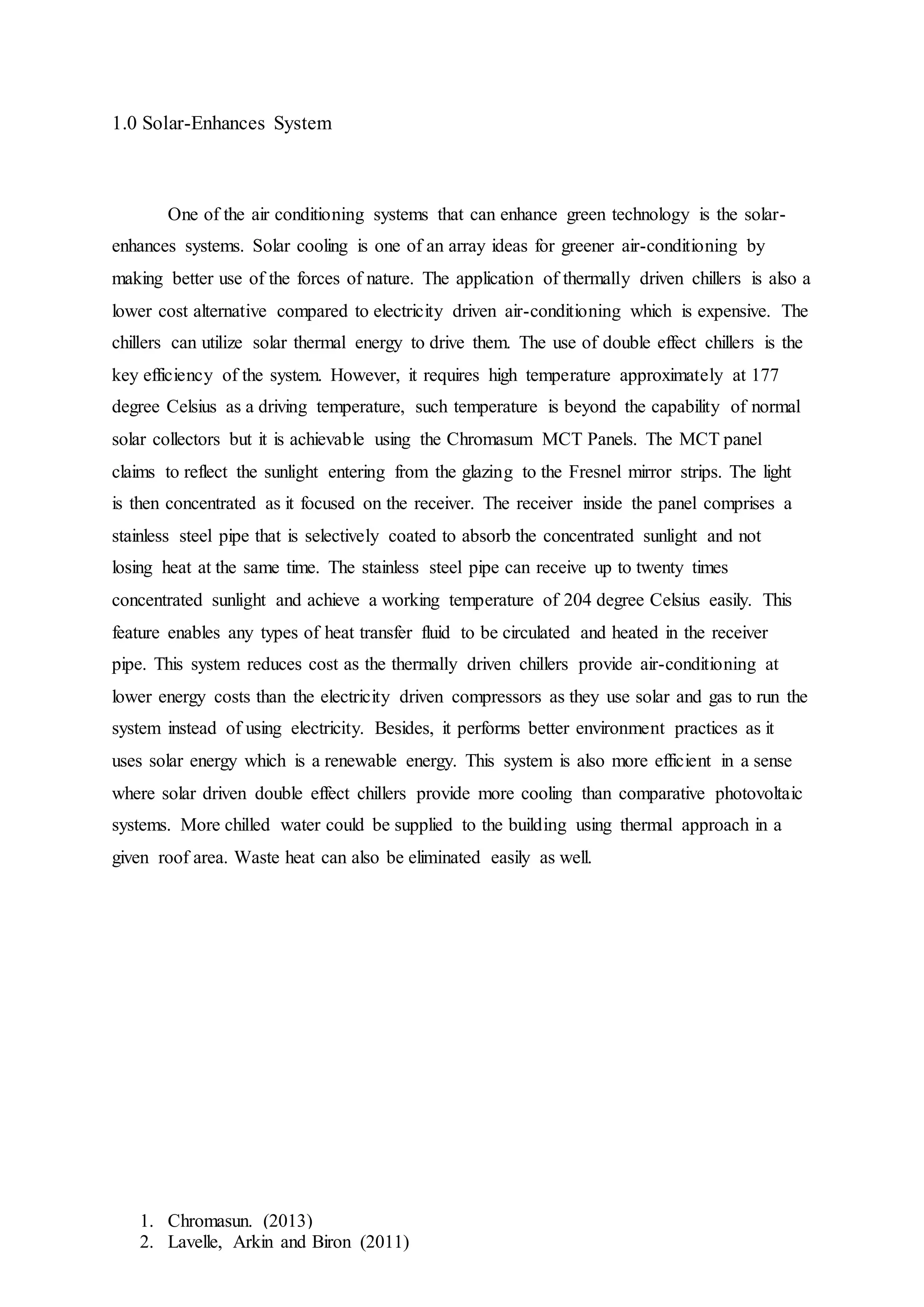
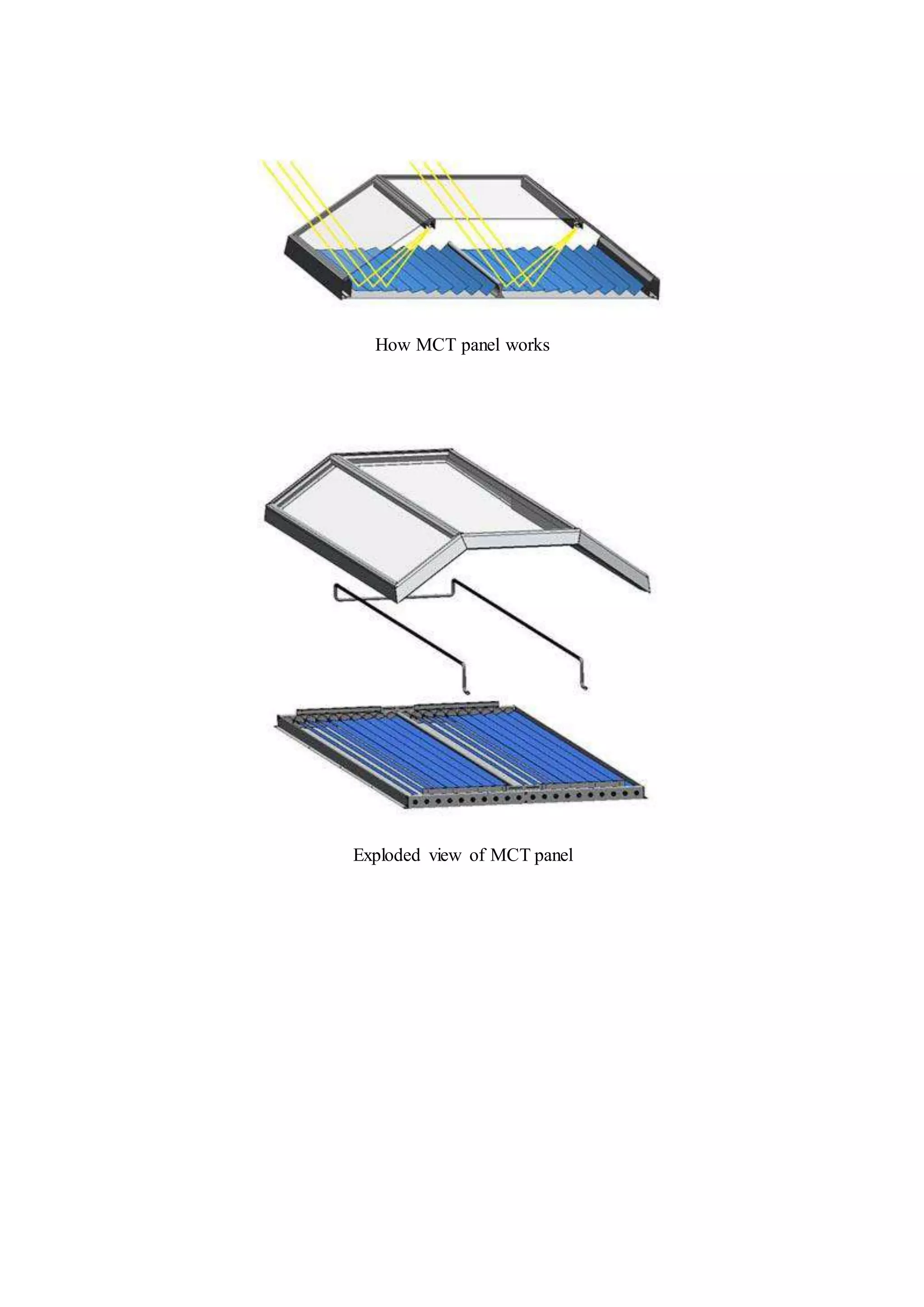
solar collectors but it is achievable using the Chromasum MCT Panels. The MCT panel
claims to reflect the sunlight entering from the glazing to the Fresnel mirror strips. The light
is then concentrated as it focused on the receiver. The receiver inside the panel comprises a
stainless steel pipe that is selectively coated to absorb the concentrated sunlight and not
losing heat at the same time. The stainless steel pipe can receive up to twenty times
concentrated sunlight and achieve a working temperature of 204 degree Celsius easily. This
feature enables any types of heat transfer fluid to be circulated and heated in the receiver
pipe. This system reduces cost as the thermally driven chillers provide air-conditioning at
lower energy costs than the electricity driven compressors as they use solar and gas to run the
system instead of using electricity. Besides, it performs better environment practices as it
uses solar energy which is a renewable energy. This system is also more efficient in a sense
where solar driven double effect chillers provide more cooling than comparative photovoltaic
systems. More chilled water could be supplied to the building using thermal approach in a
given roof area. Waste heat can also be eliminated easily as well.
How MCT panel works
Exploded view of MCT panel
1. Ice Energy. (2016)
2. IceBear30. (2016)
3. Garden, H., Improvement, H. and Construction, G. (2017)
2.0 Ice-powered air conditioner
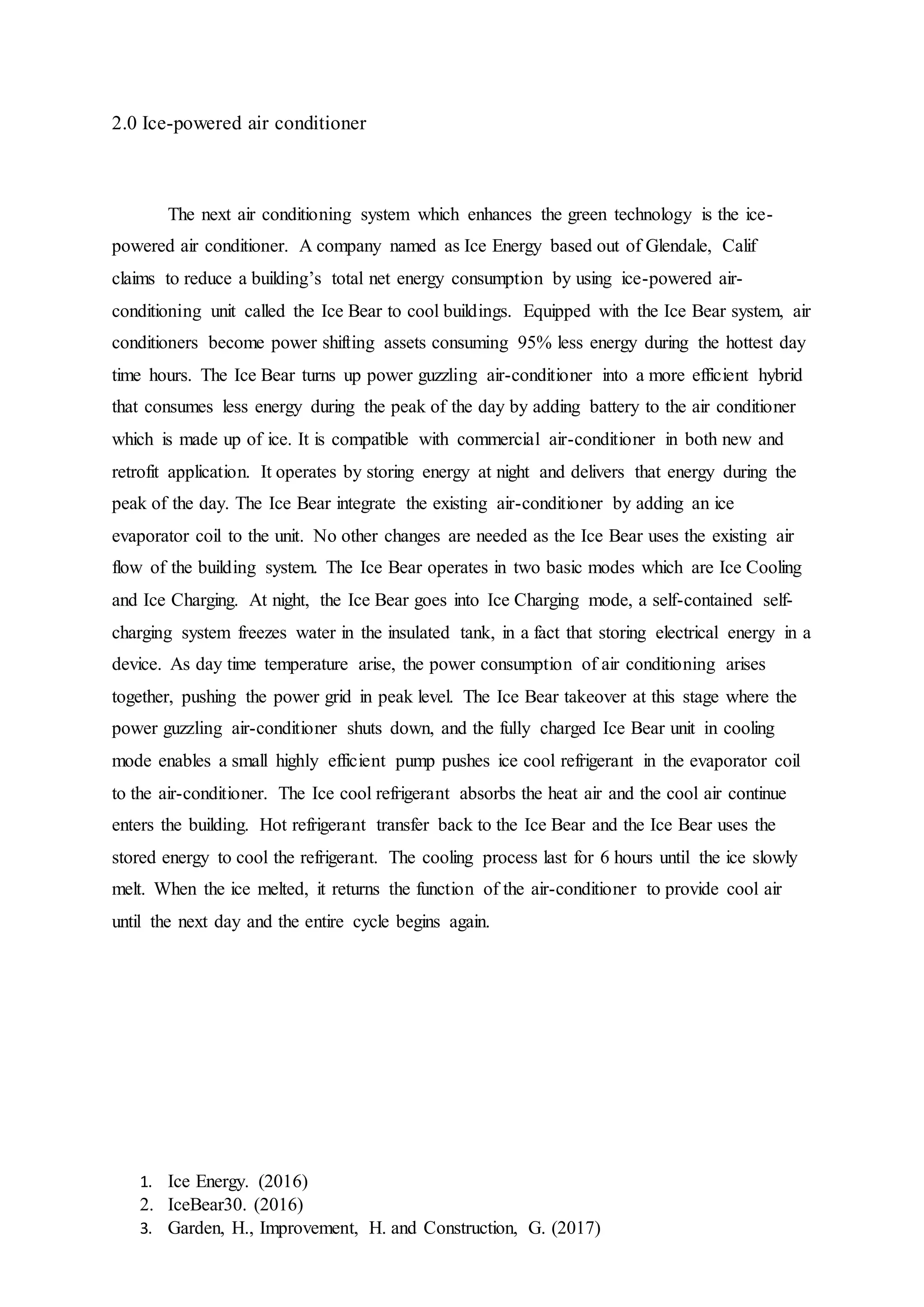
The next air conditioning system which enhances the green technology is the ice-
powered air conditioner. A company named as Ice Energy based out of Glendale, Calif
claims to reduce a building’s total net energy consumption by using ice-powered air-
conditioning unit called the Ice Bear to cool buildings. Equipped with the Ice Bear system, air
conditioners become power shifting assets consuming 95% less energy during the hottest day
time hours. The Ice Bear turns up power guzzling air-conditioner into a more efficient hybrid
that consumes less energy during the peak of the day by adding battery to the air conditioner
which is made up of ice. It is compatible with commercial air-conditioner in both new and
retrofit application. It operates by storing energy at night and delivers that energy during the
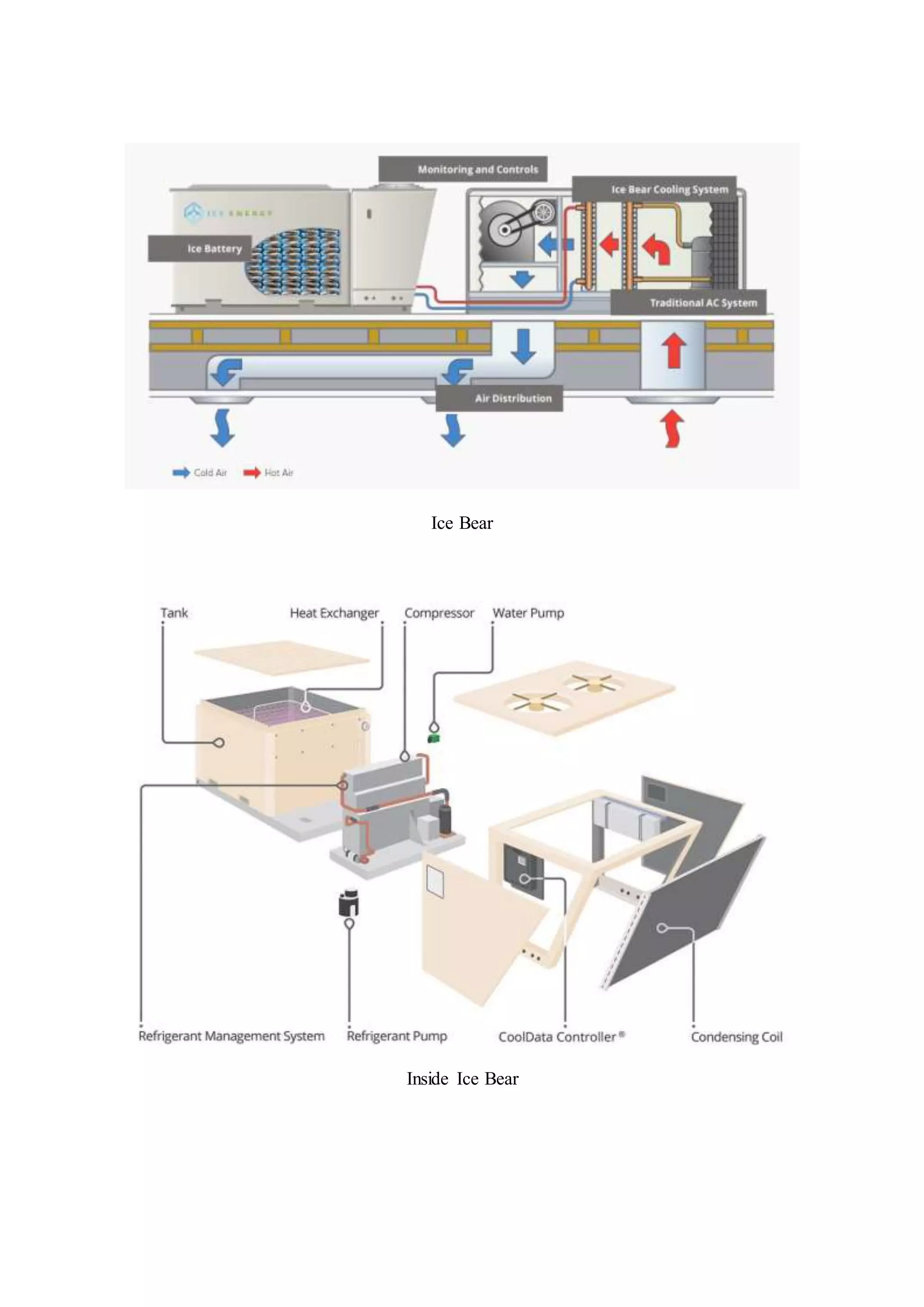
peak of the day. The Ice Bear integrate the existing air-conditioner by adding an ice
evaporator coil to the unit. No other changes are needed as the Ice Bear uses the existing air
flow of the building system. The Ice Bear operates in two basic modes which are Ice Cooling
and Ice Charging. At night, the Ice Bear goes into Ice Charging mode, a self-contained self-
charging system freezes water in the insulated tank, in a fact that storing electrical energy in a
device. As day time temperature arise, the power consumption of air conditioning arises
together, pushing the power grid in peak level. The Ice Bear takeover at this stage where the
power guzzling air-conditioner shuts down, and the fully charged Ice Bear unit in cooling
mode enables a small highly efficient pump pushes ice cool refrigerant in the evaporator coil
to the air-conditioner. The Ice cool refrigerant absorbs the heat air and the cool air continue
enters the building. Hot refrigerant transfer back to the Ice Bear and the Ice Bear uses the
stored energy to cool the refrigerant. The cooling process last for 6 hours until the ice slowly
melt. When the ice melted, it returns the function of the air-conditioner to provide cool air
until the next day and the entire cycle begins again.
Ice Bear
Inside Ice Bear
1. Creative, B. (2017).
2. GmbH, S. (2017).
3. Refrigerants.danfoss.com. (n.d.).
3.0 Natural Refrigerant
Besides, the use of natural refrigerant in air conditioning system could enhance green
technology. Natural refrigerants are nontoxic refrigerants that have no ozone depleting
properties and with minimal global warming potential. The most common natural refrigerant
hydrocarbon refrigerant such as R600A isobutane, R290 Propane, R1270 Propylene and
carbon dioxide gas. Despite being good for the environment, natural refrigerants can save up
to 54% on energy costs. Air-conditioning systems are the largest consumers of electricity.
The energy used in cooling accounts for 60% of buildings total energy consumption. The
conversion to natural refrigerants enables substantial energy savings. Natural refrigerants are
50% more efficient conductors of heat than Fluorocarbon refrigerants. Their operating
pressures are about 20% lower than Fluorocarbon refrigerants. These lower operating
discharge pressures reduce the work of compressor and thus reducing wear and tear. This also
result in lesser pressure on pipe work, joints, hoses, fittings and reduce the likelihood of
leaks. In addition, it can also extend the shelf life of the equipment. Natural refrigerants
reduce harmful greenhouse gases in two ways. First, direct greenhouse gas (GHG) emissions
significantly decreased due to the low Global Warming Potential (GWP) rating of
hydrocarbon. For instance, in a typical supermarket, where between 5 and 10 percent of total
refrigerants are vented into local atmosphere, the use of natural refrigerant such as
hydrocarbon refrigerant as a replacement refrigerant can cut annual gas emission by tons.
Secondly, the feature of a hydrocarbon refrigerant where it has low condensing point,
positive thermodynamic attributes, and superior Coefficient of Performance act in
combination to optimize energy-efficient operation. These hydrocarbon refrigerants have no
ozone damage implications, could greatly reduce Green House Gas emission, has a greater
energy efficiency and low Global Warming Potential (GWP) ratings which results in low
global warming effects. On the other hand, carbon dioxide has a low compression pressure
ratio where it is 20 to 50% less than hydrofluorocarbons (HCFCs), which improves
volumetric efficiency. As an example, with evaporation temperature in the range of -55 ºC to
0 ºC, the volumetric performance of carbon dioxide is approximately 4 to 5 times better than
ammonia, which allow compressors with smaller swept volumes to be used.
1. Inventor Discover Technology. (2016).
2. Daikin. (2017).
4.0 Inverter technology
Inverter technology is a technology concerning the electro motors of the compressors.
It is a device in the air conditioner that controls frequency of power supplied to compressor
motor. The rotational speed is control by the compressor motor and the compressor ensures
refrigerant flow correspondent with the cooling requirement of the space. The difference
between inverter and non-inverter air conditioners is that the non-inverter conditioners have
fixed compressors that cannot increase or decrease their speed and refrigerant flow rate as per
cooling requirement of the space and it work at one given capacity only. Therefore, the
variable speed of the compressor ensures not only better temperature control but they also
reduce power consumption up to 71%. In contrast with non-inverter air conditioners which
have only one, fixed capacity that unable to increase the refrigerant flow rate. The desired
temperature consumes more time compare to inverter conditioner, the inverter air
conditioners operate at maximum capacity on starting. Resulting increase refrigerant flow and
enables desired temperature to reach quicker. Besides, on achieving a desired temperature,
the speed of compressor in inverter air conditioners slows down and the refrigerant rate drops
which in turn lower average power is consumed and saves the energy up to 71% as compared
to non-inverter air conditioners which stops on reaching the desired temperature and when
the temperature rises again the compressor and refrigerant flow restart which consumes
higher power consumption. Therefore, inverter technology can enhance green technology in a
sense that it is eco-friendly with low electrical consumption and can save energy
1. (Fagilde, n.d.)
5.0 Heating, Ventilation and air conditioning (HVAC) occupancy sensors
In addition, green technology can be enhanced by incorporating Heating, Ventilation
and air conditioning (HVAC) occupancy sensors in air conditioning systems. The types of
occupancy sensors include demand-controlled ventilation, exact reading occupancy sensors,
temperature and humidity sensors and programmable thermostats. Demand-controlled
ventilation read the number of occupants in a room using carbon dioxide sensors in which the
carbon dioxide levels resulting from human exhalation and adjust the air ventilation outside
based on the demands of the room or space. Exact reading occupancy sensors use exact
measurements of the number of people in a space to determine cooling, ventilation and
heating needs. Next, the temperature and humidity sensors operate in two ways where they
use occupancy readings to increase or decrease heating, air conditioning or ventilation to
indoor spaces and read room temperatures to make automatic adjustments based on settings
such as time and preferred climate at the same time. Programmable thermostats are
thermostats that are preprogramed 365-day calendar software in combination with installed
door switches to result in consistent temperature and carbon dioxide levels. It projects to
reduce approximately 4% in electrical consumption. HVAC occupancy sensors is most
suitable for commercial applications which enable business to reduce waste and operational
cost. It helps to lower maintenance expenses and provide a comfortable atmosphere for
employees and customers.
1. (Olanrewaju and Abdul-Aziz, 2015)
2. (Choon Aun, 2014)
As a conclusion, there are several ways of how air conditioning systems can enhance
green technology. There are many benefits that could be obtained from implementation of
green air conditioning system. However, it is still not widely implemented in our country
despite of knowing the benefits of green technology in air conditioning systems. It is crucial
to understand and identify the obstacles that hinder the application and implementation of
green technology in construction to help us find ways to promote green technology in
Malaysia. In process of adapting green technology in air conditioning systems, the traditional
practice and technique may be outdated and it requires new skill, ability and knowledge.
Therefore, it is important for the industry workers to update with skill, knowledge,
competencies and capabilities that are required in implementing and adapting green
technology in air conditioning. However, the main problem and obstacle preventing the
implementation of green concept is financial constraint. Sustainable practices increase project
cost as higher capital upfront needed. However, the initial cost can be minimized and
significant saving on operation and maintenance can be realized over the life of the
equipment if strategies on the green technology air conditioning implementation are well
designed. Green technology is critical to the future of our society. The use of green
technology fundamentally reduces the amount of waste and pollution that is created during
the process of consumption and production. With the undisputed importance of green
technology for the progress of our society, it is vital to engage and prepare the future
generations in education and to excite them about the career opportunities together with the
role they can play towards the conservation and preservation of the earth’s resources and
environment.
2024 WORDS
BIBLIOGRAPHY
Books
Olanrewaju, A. and Abdul-Aziz, A. (2015). Building Maintenance Processes and Practices.
1st ed. Singapore: Springer.
Internet Resources
The National Green Technology Policy. (2017). 1st ed. [ebook] Kementerian Tenaga
Teknologi Hijau dan Air, pp.4-5. Available at:
http://portal.ppj.gov.my/c/document_library/get_file?p_l_id=17335&folderId=27605&name=
DLFE-4709.pdf [Accessed 28 May 2017].
Kettha.gov.my. (2017). Laman Web Rasmi Kementerian Tenaga, Teknologi Hijau dan Air.
[online] Available at:
http://www.kettha.gov.my/portal/index.php?r=kandungan/index&menu1_id=3&menu2_id=3
1&menu3_id=119# [Accessed 25 May 2017].
Chromasun. (2013). Air Conditioning. [online] Available at:
http://chromasun.com/CHW.html [Accessed 28 May 2017].
Lavelle, M., Arkin, A. and Biron, L. (2011). Pictures: In Search of Green Air-Conditioning.
[online] News.nationalgeographic.com. Available at:
http://news.nationalgeographic.com/news/energy/2011/08/pictures/110803-green-air-
conditioning-systems/ [Accessed 25 May 2017].
Ice Energy. (2016). Technology - Ice Energy. [online] Available at: https://www.ice-
energy.com/technology/ [Accessed 22 May 2017].
IceBear30. (2016). 1st ed. [ebook] Santa Barbara, California, United States: IceEnergy, p.1.
Available at: https://www.ice-energy.com/wp-content/uploads/2016/03/ICE-BEAR-30-
Product-Sheet.pdf [Accessed 28 May 2017].
Garden, H., Improvement, H. and Construction, G. (2017). Top 10 Green Heating and
Cooling Technologies. [online] HowStuffWorks. Available at:
http://home.howstuffworks.com/home-improvement/construction/green/10-green-heating-
and-cooling-technologies8.htm [Accessed 25 May 2017].
Creative, B. (2017). About Hydrocarbon Refrigerants - engas Australasia. [online] engas
Australasia. Available at: http://www.engas.com.au/about/about-hydrocarbon-refrigerants/
[Accessed 25 May 2017].
GmbH, S. (2017). Hydrocarbons refrigerants - An eco-friendly alternative to the
CFC/HCFC/HFC fluorocarbons. [online] Secop.com. Available at:
http://www.secop.com/products/compressor-basics/hydrocarbons.html [Accessed 25 May
2017].
Refrigerants.danfoss.com. (n.d.). CO₂ Refrigerant | Natural Refrigerants | Energy Efficient |
Danfoss. [online] Available at: http://refrigerants.danfoss.com/co2/#/ [Accessed 19 May
2017].
Inventor Discover Technology. (2016). What is the Inverter technology in air conditioners?.
[online] Available at: https://www.inventorairconditioner.com/blog/faq/what-is-the-inverter-
technology-in-air-conditioners [Accessed 15 May 2017].
Daikin. (2017). Inverter Technology. [online] Available at:
http://www.daikinindia.com/inverter-technology [Accessed 25 May 2017].
Fagilde, G. (n.d.). Ways HVAC Occupancy Sensors Can Save Your Business Money. [online]
PG&E. Available at:
https://www.pge.com/en/mybusiness/save/smbblog/article/SensorSave.page [Accessed 16
May 2017].
Choon Aun, N. (2014). Focus on green technology. [online] The Star Online. Available at:
http://www.thestar.com.my/news/education/2014/10/19/focus-on-green-technology/
[Accessed 26 May 2017].

Individual assignment final

  • 1.
    SCHOOL OF ARCHITECTURE,BUILDING AND DESIGN BACHELOR OF QUANTITY SURVEYING (HONOURS) BUILDING SERVICES 2 (BLD60503) INDIVIDUAL ASSIGNMENT 1 NAME: LOH MUN TONG STUDENT ID: 0323680 TUTORIAL SESSION: SECTION 2 LECTURER: DR. KAM KENN JHUN SUBMISSION DATE: 29 MAY 2017 WORD COUNT: 2024
  • 2.
    1. The NationalGreen Technology Policy. (2017) 2. Kettha.gov.my. (2017) Green technology is defined as the development and application of products, equipment and systems used to conserve the natural environment and resources, which minimizes and reduces the negative impact of human activities. The launch of the National Green Technology Policy (NGTP) in 2009 indicates the initiative of the government’s in implementing “green” measures for the country. The initiatives include intensification of green technology research and innovation towards commercialization, promotion and awareness of green technology to the public. According to the Ministry of Energy, Green Technology and Water (KeTTHA), the functions and objectives of the National Green Technology Policy are to minimise growth of energy consumption while enhancing economic development, to facilitate the growth of the Green Technology industry and enhance its contribution to the national economy, to increase national capability and capacity for innovation in Green Technology development and enhance Malaysia’s competitiveness in Green Technology in the global arena. In addition, the Green Technology also helps to ensure sustainable development and conserve the environment for future generations and to enhance public education and awareness on Green Technology and encourage its widespread use. This policy focuses on four pillars. The first two pillars are energy and environment, where the policy serves to attain energy independence, promote efficient utilisation, conserve and minimize the impact on the environment. Next is economy, where it enhances the national economic development using technology. The last will be the social pillar where it improves the quality of life for all. In line with the green technology’s policy, there are various air conditioning systems can enhance green technology.
  • 3.
    1. Chromasun. (2013) 2.Lavelle, Arkin and Biron (2011) 1.0 Solar-Enhances System One of the air conditioning systems that can enhance green technology is the solar- enhances systems. Solar cooling is one of an array ideas for greener air-conditioning by making better use of the forces of nature. The application of thermally driven chillers is also a lower cost alternative compared to electricity driven air-conditioning which is expensive. The chillers can utilize solar thermal energy to drive them. The use of double effect chillers is the key efficiency of the system. However, it requires high temperature approximately at 177 degree Celsius as a driving temperature, such temperature is beyond the capability of normal solar collectors but it is achievable using the Chromasum MCT Panels. The MCT panel claims to reflect the sunlight entering from the glazing to the Fresnel mirror strips. The light is then concentrated as it focused on the receiver. The receiver inside the panel comprises a stainless steel pipe that is selectively coated to absorb the concentrated sunlight and not losing heat at the same time. The stainless steel pipe can receive up to twenty times concentrated sunlight and achieve a working temperature of 204 degree Celsius easily. This feature enables any types of heat transfer fluid to be circulated and heated in the receiver pipe. This system reduces cost as the thermally driven chillers provide air-conditioning at lower energy costs than the electricity driven compressors as they use solar and gas to run the system instead of using electricity. Besides, it performs better environment practices as it uses solar energy which is a renewable energy. This system is also more efficient in a sense where solar driven double effect chillers provide more cooling than comparative photovoltaic systems. More chilled water could be supplied to the building using thermal approach in a given roof area. Waste heat can also be eliminated easily as well.
  • 4.
    How MCT panelworks Exploded view of MCT panel
  • 5.
    1. Ice Energy.(2016) 2. IceBear30. (2016) 3. Garden, H., Improvement, H. and Construction, G. (2017) 2.0 Ice-powered air conditioner The next air conditioning system which enhances the green technology is the ice- powered air conditioner. A company named as Ice Energy based out of Glendale, Calif claims to reduce a building’s total net energy consumption by using ice-powered air- conditioning unit called the Ice Bear to cool buildings. Equipped with the Ice Bear system, air conditioners become power shifting assets consuming 95% less energy during the hottest day time hours. The Ice Bear turns up power guzzling air-conditioner into a more efficient hybrid that consumes less energy during the peak of the day by adding battery to the air conditioner which is made up of ice. It is compatible with commercial air-conditioner in both new and retrofit application. It operates by storing energy at night and delivers that energy during the peak of the day. The Ice Bear integrate the existing air-conditioner by adding an ice evaporator coil to the unit. No other changes are needed as the Ice Bear uses the existing air flow of the building system. The Ice Bear operates in two basic modes which are Ice Cooling and Ice Charging. At night, the Ice Bear goes into Ice Charging mode, a self-contained self- charging system freezes water in the insulated tank, in a fact that storing electrical energy in a device. As day time temperature arise, the power consumption of air conditioning arises together, pushing the power grid in peak level. The Ice Bear takeover at this stage where the power guzzling air-conditioner shuts down, and the fully charged Ice Bear unit in cooling mode enables a small highly efficient pump pushes ice cool refrigerant in the evaporator coil to the air-conditioner. The Ice cool refrigerant absorbs the heat air and the cool air continue enters the building. Hot refrigerant transfer back to the Ice Bear and the Ice Bear uses the stored energy to cool the refrigerant. The cooling process last for 6 hours until the ice slowly melt. When the ice melted, it returns the function of the air-conditioner to provide cool air until the next day and the entire cycle begins again.
  • 6.
  • 7.
    1. Creative, B.(2017). 2. GmbH, S. (2017). 3. Refrigerants.danfoss.com. (n.d.). 3.0 Natural Refrigerant Besides, the use of natural refrigerant in air conditioning system could enhance green technology. Natural refrigerants are nontoxic refrigerants that have no ozone depleting properties and with minimal global warming potential. The most common natural refrigerant hydrocarbon refrigerant such as R600A isobutane, R290 Propane, R1270 Propylene and carbon dioxide gas. Despite being good for the environment, natural refrigerants can save up to 54% on energy costs. Air-conditioning systems are the largest consumers of electricity. The energy used in cooling accounts for 60% of buildings total energy consumption. The conversion to natural refrigerants enables substantial energy savings. Natural refrigerants are 50% more efficient conductors of heat than Fluorocarbon refrigerants. Their operating pressures are about 20% lower than Fluorocarbon refrigerants. These lower operating discharge pressures reduce the work of compressor and thus reducing wear and tear. This also result in lesser pressure on pipe work, joints, hoses, fittings and reduce the likelihood of leaks. In addition, it can also extend the shelf life of the equipment. Natural refrigerants reduce harmful greenhouse gases in two ways. First, direct greenhouse gas (GHG) emissions significantly decreased due to the low Global Warming Potential (GWP) rating of hydrocarbon. For instance, in a typical supermarket, where between 5 and 10 percent of total refrigerants are vented into local atmosphere, the use of natural refrigerant such as hydrocarbon refrigerant as a replacement refrigerant can cut annual gas emission by tons. Secondly, the feature of a hydrocarbon refrigerant where it has low condensing point, positive thermodynamic attributes, and superior Coefficient of Performance act in combination to optimize energy-efficient operation. These hydrocarbon refrigerants have no ozone damage implications, could greatly reduce Green House Gas emission, has a greater energy efficiency and low Global Warming Potential (GWP) ratings which results in low global warming effects. On the other hand, carbon dioxide has a low compression pressure ratio where it is 20 to 50% less than hydrofluorocarbons (HCFCs), which improves volumetric efficiency. As an example, with evaporation temperature in the range of -55 ºC to 0 ºC, the volumetric performance of carbon dioxide is approximately 4 to 5 times better than ammonia, which allow compressors with smaller swept volumes to be used.
  • 8.
    1. Inventor DiscoverTechnology. (2016). 2. Daikin. (2017). 4.0 Inverter technology Inverter technology is a technology concerning the electro motors of the compressors. It is a device in the air conditioner that controls frequency of power supplied to compressor motor. The rotational speed is control by the compressor motor and the compressor ensures refrigerant flow correspondent with the cooling requirement of the space. The difference between inverter and non-inverter air conditioners is that the non-inverter conditioners have fixed compressors that cannot increase or decrease their speed and refrigerant flow rate as per cooling requirement of the space and it work at one given capacity only. Therefore, the variable speed of the compressor ensures not only better temperature control but they also reduce power consumption up to 71%. In contrast with non-inverter air conditioners which have only one, fixed capacity that unable to increase the refrigerant flow rate. The desired temperature consumes more time compare to inverter conditioner, the inverter air conditioners operate at maximum capacity on starting. Resulting increase refrigerant flow and enables desired temperature to reach quicker. Besides, on achieving a desired temperature, the speed of compressor in inverter air conditioners slows down and the refrigerant rate drops which in turn lower average power is consumed and saves the energy up to 71% as compared to non-inverter air conditioners which stops on reaching the desired temperature and when the temperature rises again the compressor and refrigerant flow restart which consumes higher power consumption. Therefore, inverter technology can enhance green technology in a sense that it is eco-friendly with low electrical consumption and can save energy
  • 9.
    1. (Fagilde, n.d.) 5.0Heating, Ventilation and air conditioning (HVAC) occupancy sensors In addition, green technology can be enhanced by incorporating Heating, Ventilation and air conditioning (HVAC) occupancy sensors in air conditioning systems. The types of occupancy sensors include demand-controlled ventilation, exact reading occupancy sensors, temperature and humidity sensors and programmable thermostats. Demand-controlled ventilation read the number of occupants in a room using carbon dioxide sensors in which the carbon dioxide levels resulting from human exhalation and adjust the air ventilation outside based on the demands of the room or space. Exact reading occupancy sensors use exact measurements of the number of people in a space to determine cooling, ventilation and heating needs. Next, the temperature and humidity sensors operate in two ways where they use occupancy readings to increase or decrease heating, air conditioning or ventilation to indoor spaces and read room temperatures to make automatic adjustments based on settings such as time and preferred climate at the same time. Programmable thermostats are thermostats that are preprogramed 365-day calendar software in combination with installed door switches to result in consistent temperature and carbon dioxide levels. It projects to reduce approximately 4% in electrical consumption. HVAC occupancy sensors is most suitable for commercial applications which enable business to reduce waste and operational cost. It helps to lower maintenance expenses and provide a comfortable atmosphere for employees and customers.
  • 10.
    1. (Olanrewaju andAbdul-Aziz, 2015) 2. (Choon Aun, 2014) As a conclusion, there are several ways of how air conditioning systems can enhance green technology. There are many benefits that could be obtained from implementation of green air conditioning system. However, it is still not widely implemented in our country despite of knowing the benefits of green technology in air conditioning systems. It is crucial to understand and identify the obstacles that hinder the application and implementation of green technology in construction to help us find ways to promote green technology in Malaysia. In process of adapting green technology in air conditioning systems, the traditional practice and technique may be outdated and it requires new skill, ability and knowledge. Therefore, it is important for the industry workers to update with skill, knowledge, competencies and capabilities that are required in implementing and adapting green technology in air conditioning. However, the main problem and obstacle preventing the implementation of green concept is financial constraint. Sustainable practices increase project cost as higher capital upfront needed. However, the initial cost can be minimized and significant saving on operation and maintenance can be realized over the life of the equipment if strategies on the green technology air conditioning implementation are well designed. Green technology is critical to the future of our society. The use of green technology fundamentally reduces the amount of waste and pollution that is created during the process of consumption and production. With the undisputed importance of green technology for the progress of our society, it is vital to engage and prepare the future generations in education and to excite them about the career opportunities together with the role they can play towards the conservation and preservation of the earth’s resources and environment. 2024 WORDS
  • 11.
    BIBLIOGRAPHY Books Olanrewaju, A. andAbdul-Aziz, A. (2015). Building Maintenance Processes and Practices. 1st ed. Singapore: Springer. Internet Resources The National Green Technology Policy. (2017). 1st ed. [ebook] Kementerian Tenaga Teknologi Hijau dan Air, pp.4-5. Available at: http://portal.ppj.gov.my/c/document_library/get_file?p_l_id=17335&folderId=27605&name= DLFE-4709.pdf [Accessed 28 May 2017]. Kettha.gov.my. (2017). Laman Web Rasmi Kementerian Tenaga, Teknologi Hijau dan Air. [online] Available at: http://www.kettha.gov.my/portal/index.php?r=kandungan/index&menu1_id=3&menu2_id=3 1&menu3_id=119# [Accessed 25 May 2017]. Chromasun. (2013). Air Conditioning. [online] Available at: http://chromasun.com/CHW.html [Accessed 28 May 2017]. Lavelle, M., Arkin, A. and Biron, L. (2011). Pictures: In Search of Green Air-Conditioning. [online] News.nationalgeographic.com. Available at: http://news.nationalgeographic.com/news/energy/2011/08/pictures/110803-green-air- conditioning-systems/ [Accessed 25 May 2017]. Ice Energy. (2016). Technology - Ice Energy. [online] Available at: https://www.ice- energy.com/technology/ [Accessed 22 May 2017].
  • 12.
    IceBear30. (2016). 1sted. [ebook] Santa Barbara, California, United States: IceEnergy, p.1. Available at: https://www.ice-energy.com/wp-content/uploads/2016/03/ICE-BEAR-30- Product-Sheet.pdf [Accessed 28 May 2017]. Garden, H., Improvement, H. and Construction, G. (2017). Top 10 Green Heating and Cooling Technologies. [online] HowStuffWorks. Available at: http://home.howstuffworks.com/home-improvement/construction/green/10-green-heating- and-cooling-technologies8.htm [Accessed 25 May 2017]. Creative, B. (2017). About Hydrocarbon Refrigerants - engas Australasia. [online] engas Australasia. Available at: http://www.engas.com.au/about/about-hydrocarbon-refrigerants/ [Accessed 25 May 2017]. GmbH, S. (2017). Hydrocarbons refrigerants - An eco-friendly alternative to the CFC/HCFC/HFC fluorocarbons. [online] Secop.com. Available at: http://www.secop.com/products/compressor-basics/hydrocarbons.html [Accessed 25 May 2017]. Refrigerants.danfoss.com. (n.d.). CO₂ Refrigerant | Natural Refrigerants | Energy Efficient | Danfoss. [online] Available at: http://refrigerants.danfoss.com/co2/#/ [Accessed 19 May 2017]. Inventor Discover Technology. (2016). What is the Inverter technology in air conditioners?. [online] Available at: https://www.inventorairconditioner.com/blog/faq/what-is-the-inverter- technology-in-air-conditioners [Accessed 15 May 2017]. Daikin. (2017). Inverter Technology. [online] Available at: http://www.daikinindia.com/inverter-technology [Accessed 25 May 2017].
  • 13.
    Fagilde, G. (n.d.).Ways HVAC Occupancy Sensors Can Save Your Business Money. [online] PG&E. Available at: https://www.pge.com/en/mybusiness/save/smbblog/article/SensorSave.page [Accessed 16 May 2017]. Choon Aun, N. (2014). Focus on green technology. [online] The Star Online. Available at: http://www.thestar.com.my/news/education/2014/10/19/focus-on-green-technology/ [Accessed 26 May 2017].