Building an AI
Organisation
Vikash Mishra
Artificial intelligence is reshaping business, and the time is ripe for
companies to capitalise AI. The organisation can use AI to move their
focus from discrete business problems to significant business
challenges.
An organisation should use ML and Data Science to drive digital
transformation for more back-office operational efficiency, better user/
engagement, smoother onboarding, and better ROI by lowering cost
and bring more data-driven taking mechanism for transparency.
AI will be a valuable, transformational change agent not only to the way
business is done but to the way people live their daily lives if it isn't
perceived as a plug-and-play technology with immediate returns but
more like a long term solution to rewire the organisation.
FROM TO[ ] [ ]
Interdisciplinary Collaboration
VISION
Siloed Working Culture
Agile, Experimental and
Adaptable
Rigid and Risk-Averse
Data-driven decision
making at frontline
Experience based leader-
driven decisions
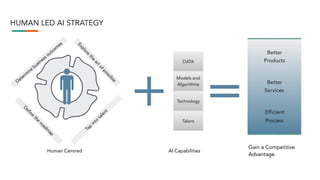
HUMAN LED AI STRATEGY
Determ
ine
business outcom
es
Tap
into
talent
D
efine
the
roadm
ap
Explore
the
artofpossible
+
Human Centred
DATA
Models and
Algorithms
Technology
Talent
AI Capabilities
=
Better
Products
Better
Services
Efficient
Process
Gain a Competitive
Advantage
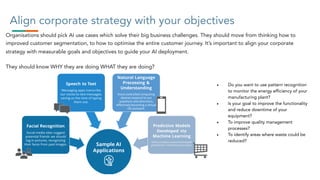
• Do you want to use pattern recognition
to monitor the energy efficiency of your
manufacturing plant?
• Is your goal to improve the functionality
and reduce downtime of your
equipment?
• To improve quality management
processes?
• To identify areas where waste could be
reduced?
Align corporate strategy with your objectives
Organisations should pick AI use cases which solve their big business challenges. They should move from thinking how to
improved customer segmentation, to how to optimise the entire customer journey. It’s important to align your corporate
strategy with measurable goals and objectives to guide your AI deployment.
They should know WHY they are doing WHAT they are doing?
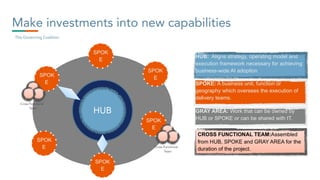
The Governing Coalition
Make investments into new capabilities
SPOK
E
SPOK
E
SPOK
E
SPOK
E
SPOK
E
Cross Functional
Team
SPOK
E
Cross Functional
Team
HUB
HUB: Aligns strategy, operating model and
execution framework necessary for achieving
business-wide AI adoption
SPOKE: A business unit, function or
geography which oversees the execution of
delivery teams.
GRAY AREA: Work that can be owned by
HUB or SPOKE or can be shared with IT.
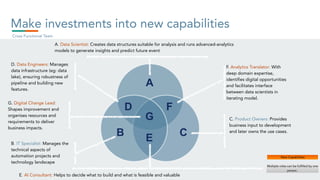
Make investments into new capabilities
Cross Functional Team
A
B C
D F
G
E
A. Data Scientist: Creates data structures suitable for analysis and runs advanced-analytics
models to generate insights and predict future event
B. IT Specialist: Manages the
technical aspects of
automation projects and
technology landscape
E. AI Consultant: Helps to decide what to build and what is feasible and valuable
F. Analytics Translator: With
deep domain expertise,
identifies digital opportunities
and facilitates interface
between data scientists in
iterating model.
C. Product Owners: Provides
business input to development
and later owns the use cases.
D. Data Engineers: Manages
data infrastructure (eg: data
lake), ensuring robustness of
pipeline and building new
features.
G. Digital Change Lead:
Shapes improvement and
organises resources and
requirements to deliver
business impacts.
New Capabilities
Multiple roles can be fulfilled by one
person.
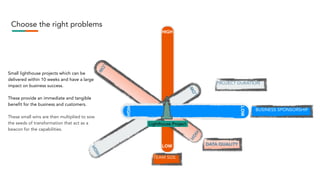
Choose the right problems
TEAM SIZE
BUSINESS SPONSORSHIP
PROJECT DURATION
HIGH
LOW
HIGH
LOWHIGH
LOW
LOW
HIGH Lighthouse Project
Small lighthouse projects which can be
delivered within 10 weeks and have a large
impact on business success. 
These provide an immediate and tangible
benefit for the business and customers.
These small wins are then multiplied to sow
the seeds of transformation that act as a
beacon for the capabilities.
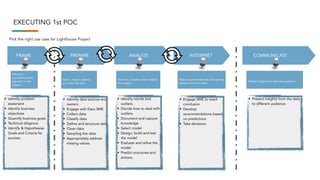
EXECUTING 1st POC
FRAME PREPARE ANALYZE INTERPRET COMMUNICATE
Develop a
hypothesis-driven
approach to the
analysis
Select, import, explore,
and clean the data
Structure, visualise and complete
the analysis
Make recommendations and business
decisions from the data
Present insights from the data audience
• Identify problem
statement
• Identify business
objectives
• Quantify business goals
• Technical diligence
• Identify & Hypothesise
Goals and Criteria for
success.
• Identify data sources and
owners
• Engage with Data SME
• Collect data
• Classify data
• Define and structure data
• Clean data
• Sampling the data
• Appropriately address
missing values.
• Identify trends and
outliers
• Decide how to deal with
outliers
• Document and capture
knowledge
• Select model
• Design, build and test
the model
• Evaluate and refine the
model
• Predict outcomes and
actions.
• Engage SME to reach
conclusion
• Develop
recommendations based
on predictions
• Take decisions
• Present insights from the data
to different audience
Pick the right use case for Lighthouse Project
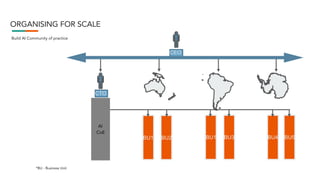
ORGANISING FOR SCALE
CEO
CTO
BU1 BU2
`
BU1 BU3 BU4 BU5
AI
CoE
*BU - Business Unit
Build AI Community of practice
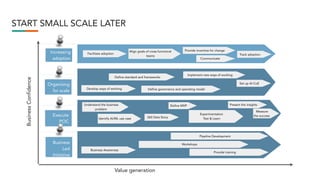
START SMALL SCALE LATER
BusinessConfidence
Value generation
Business Hackathons
Workshops
Pipeline Development
Business Awareness
Provide training
Identify AI/ML use case 360 Data Story
Define MVPUnderstand the business
problem
Experimentation
Test & Learn
Present the insights
Measure
the success
Set up AI CoE
Develop ways of working
Define standard and frameworks
Define governance and operating model
Implement new ways of working
Track adoptionFacilitate adoption
Provide incentive for changeAlign goals of cross-functional
teams
Communicate
Increasing
adoption
Organising
for scale
Execute
POC
Business
Led
Initiative
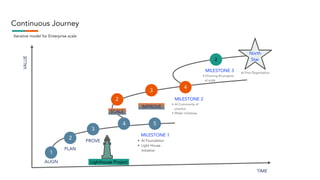
Continuous Journey
Iterative model for Enterprise scale
1
2
3
4 5
ALIGN
PLAN
PROVE
SCALE
MILESTONE 1
• AI Foundation
• Light House
initiative
2
3
4
MILESTONE 2
• AI Community of
practice
• Wider initiatives
Lighthouse Project
IMPROVE
2
MILESTONE 3
• Churning AI projects
at scale
North
Star
AI First Organisation
TIME
VALUE
Thank you.

Building an AI organisation

  • 1.
  • 2.
    Artificial intelligence isreshaping business, and the time is ripe for companies to capitalise AI. The organisation can use AI to move their focus from discrete business problems to significant business challenges. An organisation should use ML and Data Science to drive digital transformation for more back-office operational efficiency, better user/ engagement, smoother onboarding, and better ROI by lowering cost and bring more data-driven taking mechanism for transparency. AI will be a valuable, transformational change agent not only to the way business is done but to the way people live their daily lives if it isn't perceived as a plug-and-play technology with immediate returns but more like a long term solution to rewire the organisation. FROM TO[ ] [ ] Interdisciplinary Collaboration VISION Siloed Working Culture Agile, Experimental and Adaptable Rigid and Risk-Averse Data-driven decision making at frontline Experience based leader- driven decisions
  • 3.
    HUMAN LED AISTRATEGY Determ ine business outcom es Tap into talent D efine the roadm ap Explore the artofpossible + Human Centred DATA Models and Algorithms Technology Talent AI Capabilities = Better Products Better Services Efficient Process Gain a Competitive Advantage
  • 4.
    • Do youwant to use pattern recognition to monitor the energy efficiency of your manufacturing plant? • Is your goal to improve the functionality and reduce downtime of your equipment? • To improve quality management processes? • To identify areas where waste could be reduced? Align corporate strategy with your objectives Organisations should pick AI use cases which solve their big business challenges. They should move from thinking how to improved customer segmentation, to how to optimise the entire customer journey. It’s important to align your corporate strategy with measurable goals and objectives to guide your AI deployment. They should know WHY they are doing WHAT they are doing?
  • 5.
    The Governing Coalition Makeinvestments into new capabilities SPOK E SPOK E SPOK E SPOK E SPOK E Cross Functional Team SPOK E Cross Functional Team HUB HUB: Aligns strategy, operating model and execution framework necessary for achieving business-wide AI adoption SPOKE: A business unit, function or geography which oversees the execution of delivery teams. GRAY AREA: Work that can be owned by HUB or SPOKE or can be shared with IT.
  • 6.
    Make investments intonew capabilities Cross Functional Team A B C D F G E A. Data Scientist: Creates data structures suitable for analysis and runs advanced-analytics models to generate insights and predict future event B. IT Specialist: Manages the technical aspects of automation projects and technology landscape E. AI Consultant: Helps to decide what to build and what is feasible and valuable F. Analytics Translator: With deep domain expertise, identifies digital opportunities and facilitates interface between data scientists in iterating model. C. Product Owners: Provides business input to development and later owns the use cases. D. Data Engineers: Manages data infrastructure (eg: data lake), ensuring robustness of pipeline and building new features. G. Digital Change Lead: Shapes improvement and organises resources and requirements to deliver business impacts. New Capabilities Multiple roles can be fulfilled by one person.
  • 7.
    Choose the rightproblems TEAM SIZE BUSINESS SPONSORSHIP PROJECT DURATION HIGH LOW HIGH LOWHIGH LOW LOW HIGH Lighthouse Project Small lighthouse projects which can be delivered within 10 weeks and have a large impact on business success.  These provide an immediate and tangible benefit for the business and customers. These small wins are then multiplied to sow the seeds of transformation that act as a beacon for the capabilities.
  • 8.
    EXECUTING 1st POC FRAMEPREPARE ANALYZE INTERPRET COMMUNICATE Develop a hypothesis-driven approach to the analysis Select, import, explore, and clean the data Structure, visualise and complete the analysis Make recommendations and business decisions from the data Present insights from the data audience • Identify problem statement • Identify business objectives • Quantify business goals • Technical diligence • Identify & Hypothesise Goals and Criteria for success. • Identify data sources and owners • Engage with Data SME • Collect data • Classify data • Define and structure data • Clean data • Sampling the data • Appropriately address missing values. • Identify trends and outliers • Decide how to deal with outliers • Document and capture knowledge • Select model • Design, build and test the model • Evaluate and refine the model • Predict outcomes and actions. • Engage SME to reach conclusion • Develop recommendations based on predictions • Take decisions • Present insights from the data to different audience Pick the right use case for Lighthouse Project
  • 9.
    ORGANISING FOR SCALE CEO CTO BU1BU2 ` BU1 BU3 BU4 BU5 AI CoE *BU - Business Unit Build AI Community of practice
  • 10.
    START SMALL SCALELATER BusinessConfidence Value generation Business Hackathons Workshops Pipeline Development Business Awareness Provide training Identify AI/ML use case 360 Data Story Define MVPUnderstand the business problem Experimentation Test & Learn Present the insights Measure the success Set up AI CoE Develop ways of working Define standard and frameworks Define governance and operating model Implement new ways of working Track adoptionFacilitate adoption Provide incentive for changeAlign goals of cross-functional teams Communicate Increasing adoption Organising for scale Execute POC Business Led Initiative
  • 11.
    Continuous Journey Iterative modelfor Enterprise scale 1 2 3 4 5 ALIGN PLAN PROVE SCALE MILESTONE 1 • AI Foundation • Light House initiative 2 3 4 MILESTONE 2 • AI Community of practice • Wider initiatives Lighthouse Project IMPROVE 2 MILESTONE 3 • Churning AI projects at scale North Star AI First Organisation TIME VALUE
  • 12.