Customer Conference
May 2014
BUILDING A SOLID
FOUNDATION TO
SUPPORT YOUR
CUSTOMER EXPERIENCE
JOURNEY
Taking CX to a whole new level www.ideqa.co.nz
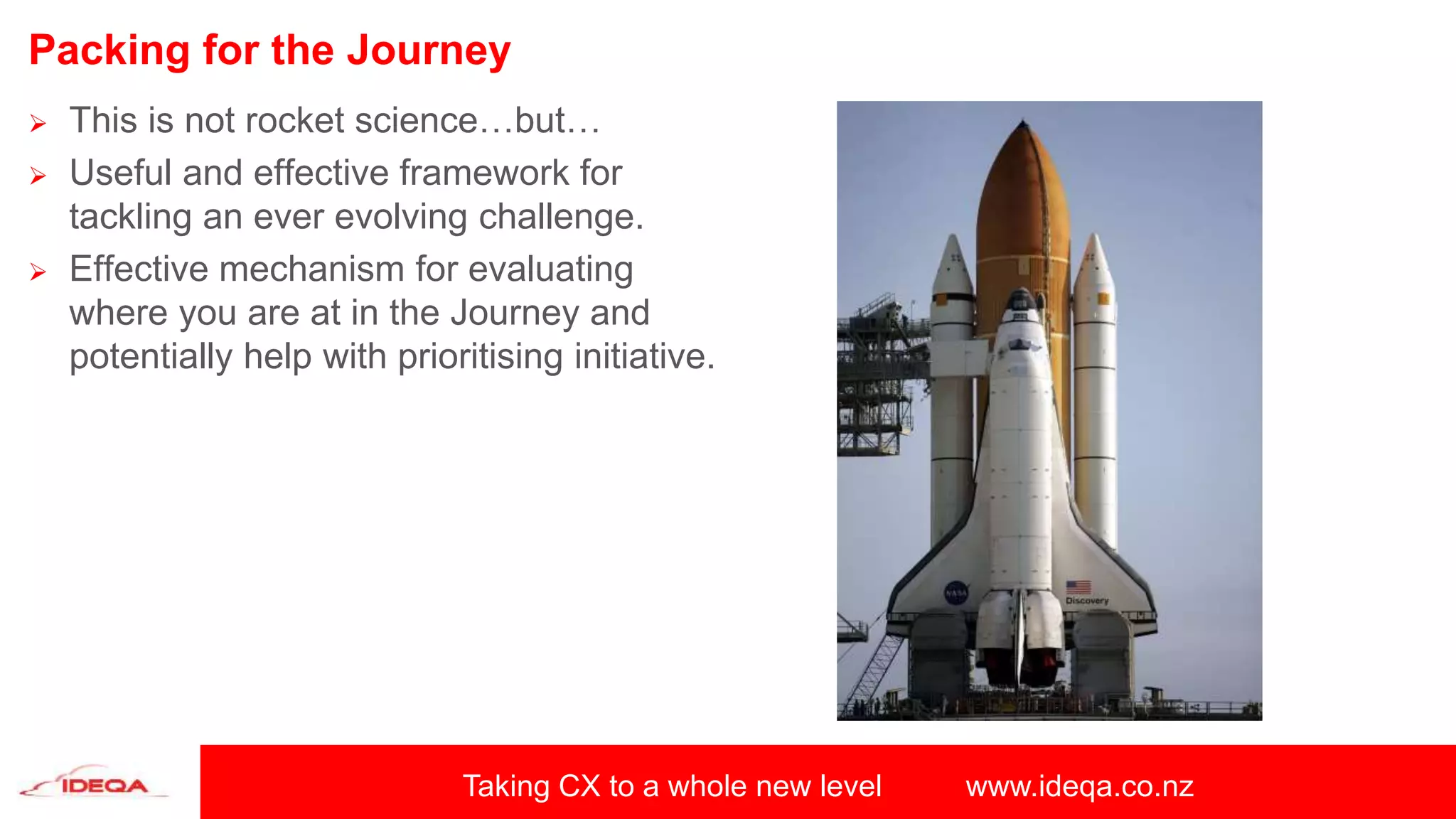
Packing for the Journey
 This is not rocket science…but…
 Useful and effective framework for
tackling an ever evolving challenge.
 Effective mechanism for evaluating
where you are at in the Journey and
potentially help with prioritising initiative.
Taking CX to a whole new level www.ideqa.co.nz
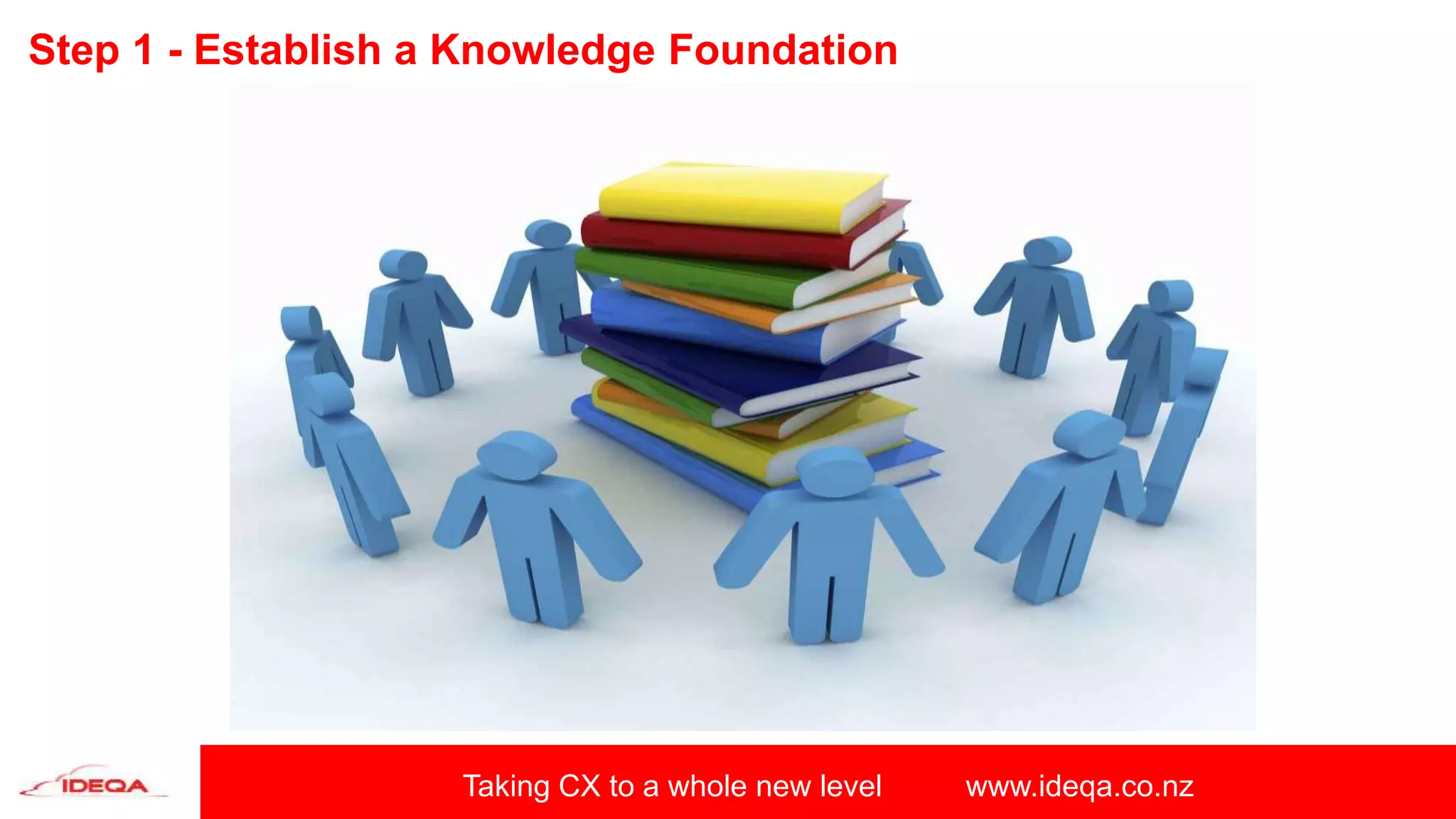
Step 1 - Establish a Knowledge Foundation
Taking CX to a whole new level www.ideqa.co.nz
Step 1 - Establish a Knowledge Foundation
Customers want complete, accurate, and
relevant answers
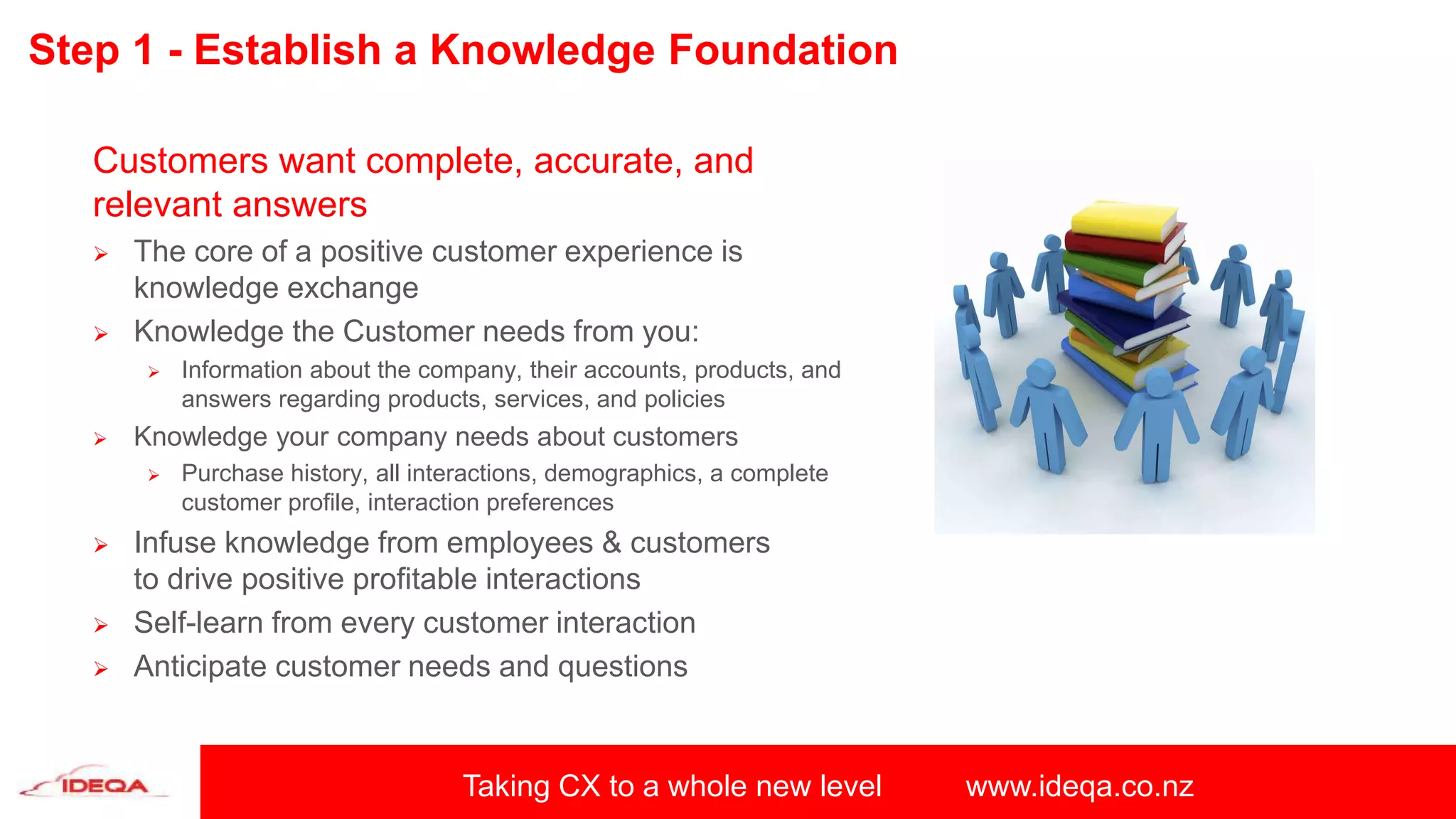
 The core of a positive customer experience is
knowledge exchange
 Knowledge the Customer needs from you:
 Information about the company, their accounts, products, and
answers regarding products, services, and policies
 Knowledge your company needs about customers
 Purchase history, all interactions, demographics, a complete
customer profile, interaction preferences
 Infuse knowledge from employees & customers
to drive positive profitable interactions
 Self-learn from every customer interaction
 Anticipate customer needs and questions
Taking CX to a whole new level www.ideqa.co.nz
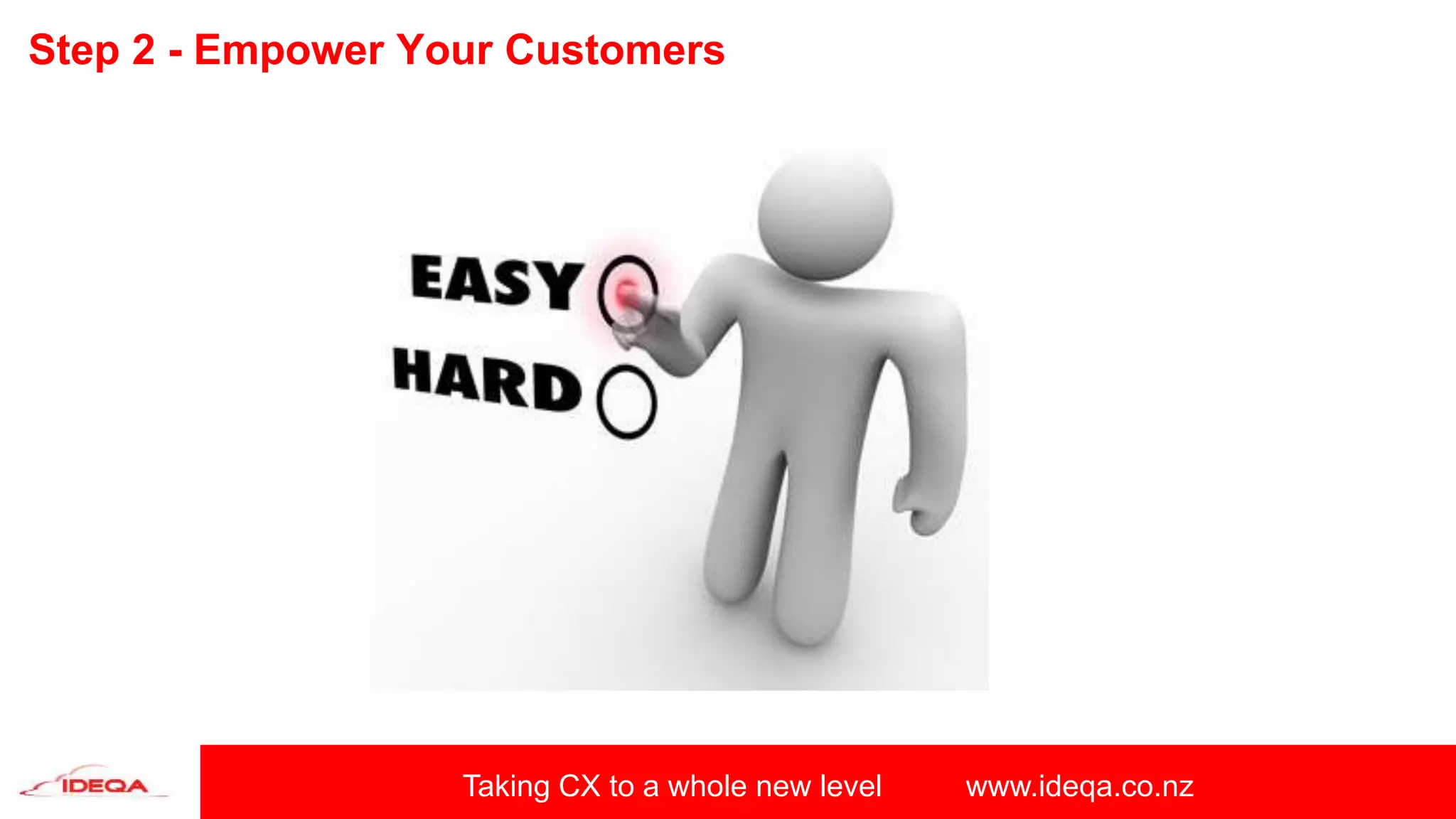
Step 2 - Empower Your Customers
Taking CX to a whole new level www.ideqa.co.nz
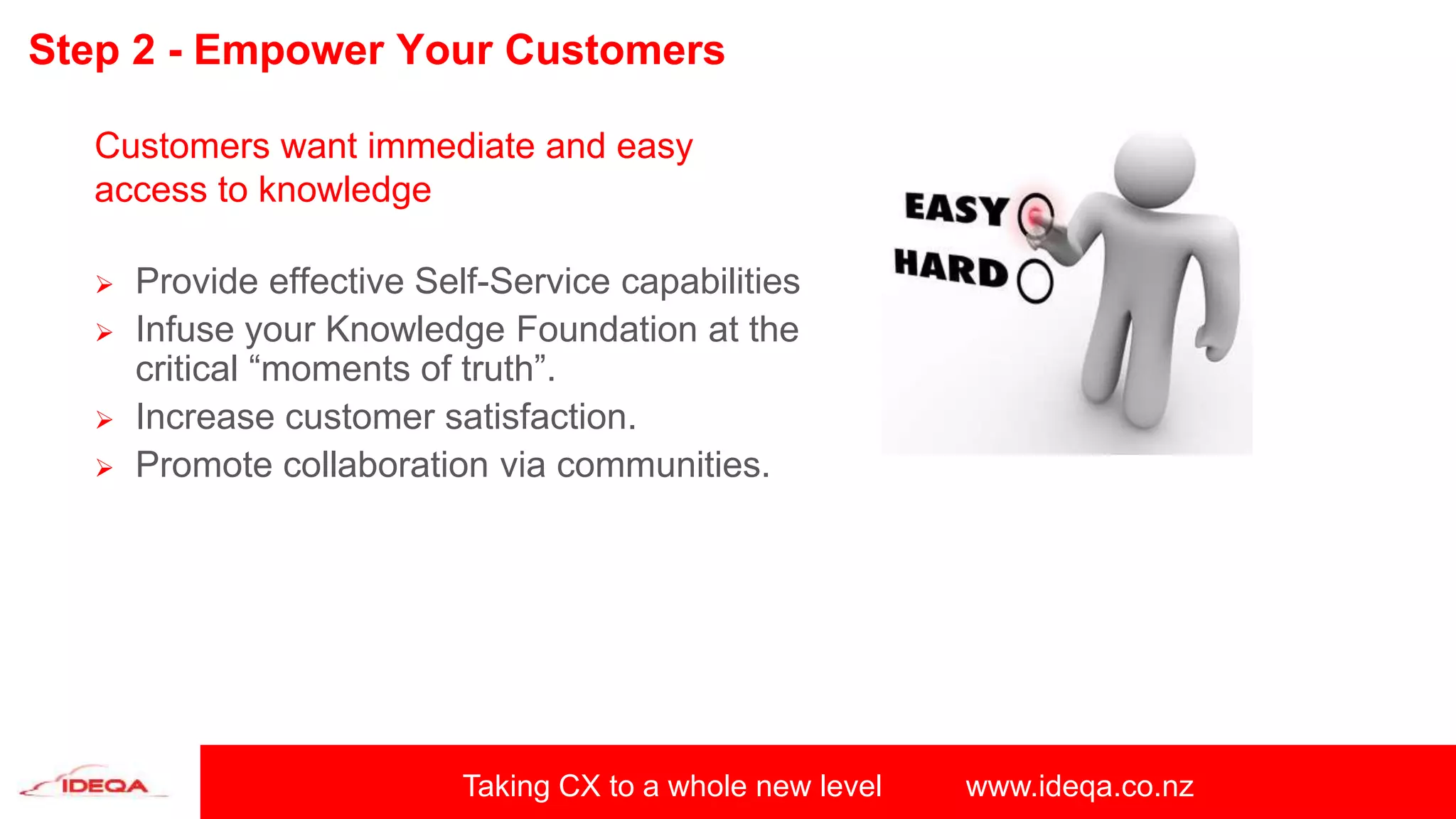
Step 2 - Empower Your Customers
Customers want immediate and easy
access to knowledge
 Provide effective Self-Service capabilities
 Infuse your Knowledge Foundation at the
critical “moments of truth”.
 Increase customer satisfaction.
 Promote collaboration via communities.
Taking CX to a whole new level www.ideqa.co.nz
Step 3 - Empower Frontline Employees
Taking CX to a whole new level www.ideqa.co.nz
Step 3 - Empower Frontline Employees
Customers want immediate assistance and resolution
 Real-time access to needed information.
 Increase front-line efficiency.
 Reduce call durations.
 Reduce training time.
 Reduce escalations.
Taking CX to a whole new level www.ideqa.co.nz
Step 4 - Offer Multi-Channel & Cross Channel Choice
Taking CX to a whole new level www.ideqa.co.nz
Step 4 - Offer Multi-Channel & Cross Channel Choice
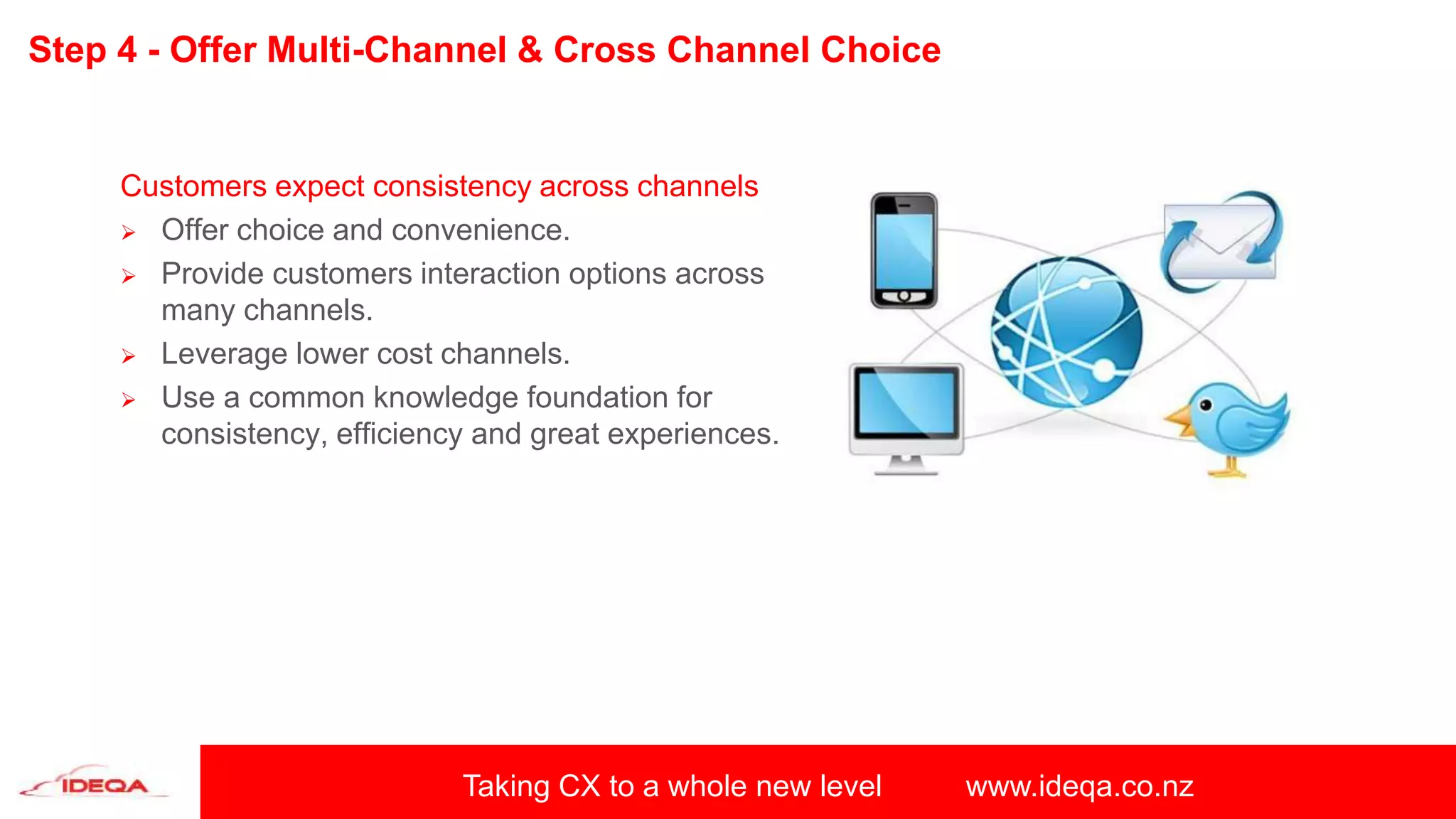
Customers expect consistency across channels
 Offer choice and convenience.
 Provide customers interaction options across
many channels.
 Leverage lower cost channels.
 Use a common knowledge foundation for
consistency, efficiency and great experiences.
Taking CX to a whole new level www.ideqa.co.nz
Step 5 - Listen to Your Customers
Taking CX to a whole new level www.ideqa.co.nz
Step 5 - Listen to Your Customers
Customers want their voices heard and action
taken
 Learn what customers are thinking.
 Capture and act on feedback.
 Grow your knowledge foundation.
Taking CX to a whole new level www.ideqa.co.nz
Step 6 - Design Seamless Experiences
Taking CX to a whole new level www.ideqa.co.nz
Step 6 - Design Seamless Experiences
Customers want to explain themselves only once
 Provide transparent cross-departmental
experiences.
 Ensure smooth hand-offs between departments.
 Instil confidence by presenting coordinated
transitions.
Taking CX to a whole new level www.ideqa.co.nz
Step 7 - Engage Proactively
Taking CX to a whole new level www.ideqa.co.nz
Step 7 - Engage Proactively
Customers want personal and relevant interactions
 Leverage knowledge to segment customers and their
experiences.
 All inbound and outbound communications context
sensitive.
 Proactively notify customers of product or service issues.
 Present relevant offers in-line and increase revenue.
 Proactively listen and respond to conversation in the
social web
Taking CX to a whole new level www.ideqa.co.nz
Step 8 - Measure and Improve Continuously
.
Taking CX to a whole new level www.ideqa.co.nz
Step 8 - Measure and Improve Continuously
Customers want an organisation that adapts to them
 Evaluate your key “moments of truth”.
 Baseline your customers’ perception of how
you are doing.
 Identify gaps, prioritize, and act.
 Measure continuously.
 Build customer loyalty and advocacy.
.
Taking CX to a whole new level www.ideqa.co.nz
1. Establish a Knowledge Foundation
2. Empower Your Customers
3. Empower Frontline Employees
4. Offer Multi-Channel & Cross Channel Choice
5. Listen to Your Customers
6. Design Seamless Experiences
7. Engage Proactively
8. Measure and Improve Continuously
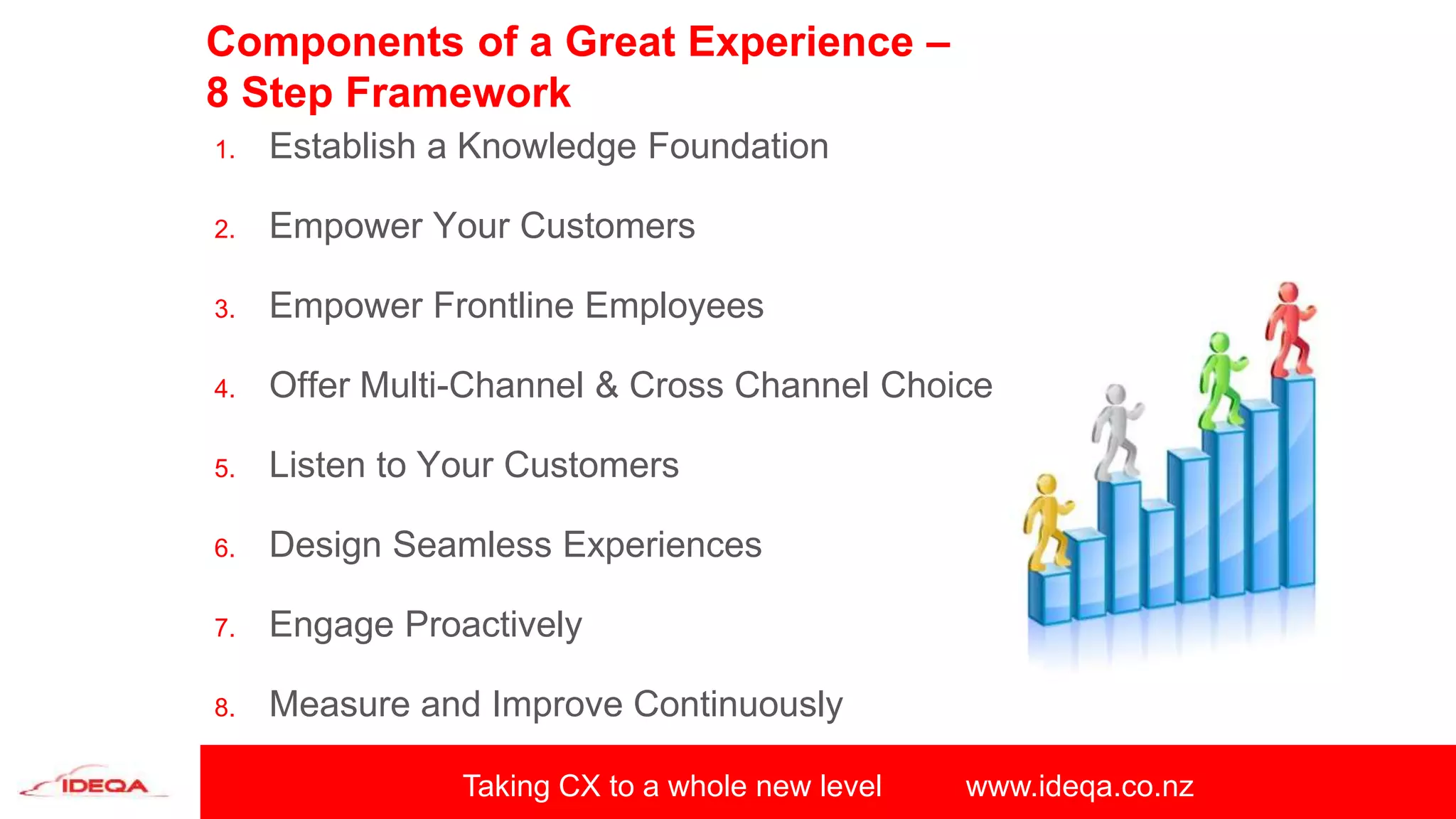
Components of a Great Experience –
8 Step Framework
Taking CX to a whole new level www.ideqa.co.nz
Enjoy the Journey!

Building a solid foundation to support your customer journey

  • 1.
    Customer Conference May 2014 BUILDINGA SOLID FOUNDATION TO SUPPORT YOUR CUSTOMER EXPERIENCE JOURNEY
  • 2.
    Taking CX toa whole new level www.ideqa.co.nz Packing for the Journey  This is not rocket science…but…  Useful and effective framework for tackling an ever evolving challenge.  Effective mechanism for evaluating where you are at in the Journey and potentially help with prioritising initiative.
  • 3.
    Taking CX toa whole new level www.ideqa.co.nz Step 1 - Establish a Knowledge Foundation
  • 4.
    Taking CX toa whole new level www.ideqa.co.nz Step 1 - Establish a Knowledge Foundation Customers want complete, accurate, and relevant answers  The core of a positive customer experience is knowledge exchange  Knowledge the Customer needs from you:  Information about the company, their accounts, products, and answers regarding products, services, and policies  Knowledge your company needs about customers  Purchase history, all interactions, demographics, a complete customer profile, interaction preferences  Infuse knowledge from employees & customers to drive positive profitable interactions  Self-learn from every customer interaction  Anticipate customer needs and questions
  • 5.
    Taking CX toa whole new level www.ideqa.co.nz Step 2 - Empower Your Customers
  • 6.
    Taking CX toa whole new level www.ideqa.co.nz Step 2 - Empower Your Customers Customers want immediate and easy access to knowledge  Provide effective Self-Service capabilities  Infuse your Knowledge Foundation at the critical “moments of truth”.  Increase customer satisfaction.  Promote collaboration via communities.
  • 7.
    Taking CX toa whole new level www.ideqa.co.nz Step 3 - Empower Frontline Employees
  • 8.
    Taking CX toa whole new level www.ideqa.co.nz Step 3 - Empower Frontline Employees Customers want immediate assistance and resolution  Real-time access to needed information.  Increase front-line efficiency.  Reduce call durations.  Reduce training time.  Reduce escalations.
  • 9.
    Taking CX toa whole new level www.ideqa.co.nz Step 4 - Offer Multi-Channel & Cross Channel Choice
  • 10.
    Taking CX toa whole new level www.ideqa.co.nz Step 4 - Offer Multi-Channel & Cross Channel Choice Customers expect consistency across channels  Offer choice and convenience.  Provide customers interaction options across many channels.  Leverage lower cost channels.  Use a common knowledge foundation for consistency, efficiency and great experiences.
  • 11.
    Taking CX toa whole new level www.ideqa.co.nz Step 5 - Listen to Your Customers
  • 12.
    Taking CX toa whole new level www.ideqa.co.nz Step 5 - Listen to Your Customers Customers want their voices heard and action taken  Learn what customers are thinking.  Capture and act on feedback.  Grow your knowledge foundation.
  • 13.
    Taking CX toa whole new level www.ideqa.co.nz Step 6 - Design Seamless Experiences
  • 14.
    Taking CX toa whole new level www.ideqa.co.nz Step 6 - Design Seamless Experiences Customers want to explain themselves only once  Provide transparent cross-departmental experiences.  Ensure smooth hand-offs between departments.  Instil confidence by presenting coordinated transitions.
  • 15.
    Taking CX toa whole new level www.ideqa.co.nz Step 7 - Engage Proactively
  • 16.
    Taking CX toa whole new level www.ideqa.co.nz Step 7 - Engage Proactively Customers want personal and relevant interactions  Leverage knowledge to segment customers and their experiences.  All inbound and outbound communications context sensitive.  Proactively notify customers of product or service issues.  Present relevant offers in-line and increase revenue.  Proactively listen and respond to conversation in the social web
  • 17.
    Taking CX toa whole new level www.ideqa.co.nz Step 8 - Measure and Improve Continuously .
  • 18.
    Taking CX toa whole new level www.ideqa.co.nz Step 8 - Measure and Improve Continuously Customers want an organisation that adapts to them  Evaluate your key “moments of truth”.  Baseline your customers’ perception of how you are doing.  Identify gaps, prioritize, and act.  Measure continuously.  Build customer loyalty and advocacy. .
  • 19.
    Taking CX toa whole new level www.ideqa.co.nz 1. Establish a Knowledge Foundation 2. Empower Your Customers 3. Empower Frontline Employees 4. Offer Multi-Channel & Cross Channel Choice 5. Listen to Your Customers 6. Design Seamless Experiences 7. Engage Proactively 8. Measure and Improve Continuously Components of a Great Experience – 8 Step Framework
  • 20.
    Taking CX toa whole new level www.ideqa.co.nz Enjoy the Journey!

Editor's Notes

  • #4 If you don’t remember anything else today, remember this. IDEQA consistently finds that knowledge is at the core of every positive customer experience. What do I mean by this? Every time a company interacts with a customer, there is an exchange of knowledge. Knowledge may flow from the company to the customer, from the customer to the company, or both. The quality of this knowledge exchange directly impacts the quality of the customer experience. The bottom line is, establishing a strong knowledge foundation is key delivering a great customer experience. Without complete, accurate, relevant, and current knowledge, accessed via a knowledge foundation—sometimes known as a knowledge base—you can’t serve customers or prospects in a compelling manner, in the manner they expect. Let’s explore what constitutes a strong knowledge foundation. Two types of knowledge underlie a strong knowledge foundation: - Knowledge that the customer needs from you, such as information about the company, their accounts, products, and answers regarding products, services, and policies - Knowledge your company needs about your customers, such as purchase history, all interactions, demographics, a complete customer profile, interaction preferences, and more Key Components are the Knowledge need to be Accurate – Out of date, in consistent content is no use at all and leads to poor experience at the point of exchange Relevant – Providing the correct Knowledge at the point of relevance is key in ensuring the knowledge transfer results in a positive experience. The ability of your Knowledge Foundation to adapt to the changing needs of your customers and frontline staff and anticipate their needs and questions becomes crucial in delivering great experiences Accessiable – A knowledge foundation isn’t very useful if it isn’t accessible to those who need it in real time—your employees and customers. Infusinbg the Knowledge Foundation across your organisations frontline staff and within the customer touchpoint channels in manner that enables easy access is the third key aspect in establishing your Knowledge Foundation In summary, a strong knowledge foundation is central to providing a great customer experience. Lets now move on to discuss how the frontlines use a knowledge foundation.
  • #6 When customers come to you looking for service, they want immediate and easy access to accurate, relevant knowledge. That defines a superior service experience. One of the most powerful and immediately rewarding ways to achieve this is by providing customers effective self-service capabilities. We live in a 24/7 365 day a year world where customers expectations are constantly rising. The principle behind self-service is simple. Instead of customers waiting to interact with your next available service employee, customers find the information they need themselves in an effective and efficient manner resulting in a better experience. Typically this is done via your Web Self Service channels….we live in the google age right. However more and more we turn to our peers and friends for this information so communities and social arenas have become key sources of information for us all for knowledge about your products, services policies By infusing the Knowledge Foundation into these self service interaction point at the “Moment of Truth” we give ourselves the best chance of providing effective and positive self service experiences Finally, no matter how good a self-service system is, it will never cover 100% of customer issues. So a means must be in place for customers to easily escalate their problem to a live agent. Self-service can significantly improve your customer experience while substantially reducing costs. But you can’t stop there, because much of your customer experience will still involve interactions between customers and the people on the frontlines of your business. To fully optimize your customer experience, you must fully empower frontline employees with knowledge also.
  • #8  If your frontline can’t answer questions, then you have a customer experience problem, because your customers think they are talking to an expert when they call the contact center. They expect immediate, accurate, and complete answers, and they expect your agents to be fully empowered to resolve the issue quickly.. Sky TV example By empowering your frontline staff with Easily accessible , digestible and relevant Knowledege there are the obvious Customer Experience impact but from an efficiency perspective there are huge gains to be made here to. Effectively empowering your frontline staff will have significant impact of things like training time, agent efficiency and productivity as well as over all staff engagement. These aspects have direct impact on your bottom line
  • #10 Customers expect choice and convenience—this is a prerequisite for a superior customer experience. The channel I choose to interact with your organization today may be very different from the channel I chose yesterday, last week or a month ago. By offering this choice what we are trying to do is make it as easy as possible for our cutomers to engage with us. Talk about Isabella and her channels of choice Providing these channels of choice is becoming more and more important however a key component in ensuring a multi channel strategy enhances your Customer Experience strategy is to unify these channel. Easy to say…harder to do right. How often do we find inconsistencies in the messaging that we get through different channels….don’t like the answer I got via the phone, lets try chatting with someone…still not happy lets see what the social team say? Again insuring all channels are leveraging off and are infused with a common Knowledge Foundation that is accurate, relevant and easily accessiable helps to ensure that regardless of channel the experience you receive is consistent and hopefully a positive one. We’ve just discussed how a multi-channel environment optimizes the customer’s experience by providing them choice and convenience. A multi-channel environment also provides companies important other advantages, because it gives them the flexibility to reduce and align communication costs by “right channeling”. In other words, you drive your customers to the most cost-effective channel considering the interaction type and customer segment. Let me be elaborate. Every customer interaction has a cost. That cost depends, in part, upon the particular channel being used. A phone call is more expensive than an email, and an email is more expensive than a web self-service interaction. You can save a lot of money by if you can get customers to use less expensive channels. But, it’s not that simple either. What you need to do is ensure that more expensive and less expensive channels are used whenever they are most appropriate. For example, if you’re selling a customer a $40 pair of jeans, you’ll eat into your profits much more by taking a phone call from them than if you’re selling them a $2,000 tailored suit. So you need to be smart about how to interact with your different customer segments. You probably will want the customer buying jeans to use self-service, while you would want the person buying a tailored suit—or expensive car with a servicing and maintenance opportunities—to call you in person. Fortunately, there are many ways to drive customer interactions to lower-cost self-service channels, just as there are a variety of ways to drive customers to the most suitable channels for any given interaction type. Over the last few slides we’ve spoken of some best practices for delivering a superior experience. There’s really no way to know whether or not you’re really making customers happy until you proactively seek out their feedback, and act upon what you hear. This brings us to our next slide.
  • #12 Companies cannot meet or exceed customer expectations if they don’t know what those expectations are. It’s critical then to proactively seek out and understand the customer voice, to act on that voice, and to let the customer know you acted on it. Understanding if you have met or not met those expectations at the moment of truth. We have all heard through out this conference about survey and feedback techniques such as Net Promoter etc The real key here is to ensure that this feedback is effectively integrated into the business and can be actioned on otherwise its just dum data right? Understanding where you are at in the eyes of your customers and feeding that back into the business iand the Knowledge Foundation is another key component in driving great experiences
  • #14 We have all had the experience of being pushed around from one part of an organisation to another constantly having to re explain ourselves and seemingly going in circles all the while getting more and more frustrated. As consumers we don’t see…or at least we don’t want to have to see…the different silos within an organisation. We have an expectation that when I deal with Company X they know me and everything about my dealings with you right? Techniques such as Customer Journey Mapping have become very popular in assisting organisations to walk in the shoes of their customers and help to design what we would describe as seamless experiences Empowering Frointline staff at the relevant points within these experience with Knowledge again becomes critical
  • #16 By leveraging Knowledge about our customers and the interactions they have with our organisation we have the ability to engage with our customers in a more proactive and effective manner Every marketer I know wants rich data with which they can segment there customer and prospects to provide relevant and compelling offers to right As consumers if we are approached by an organisation we want that interaction to be of value, where busy right. I recently had a door to door rep come to my house looking to convert us to their company as a service provider. How valued as a customer did I feel when I saw that they were from a company that I was already a customer of. Its an extreme example but again without leveraging the knowledge foundation that contained information about me a customer the result was a poor experience.
  • #18 Finally Customer Experience as we all now is not a static thing. Our customers needs are ever evolving as are our business. Ensuring we have the ability to measure how we are performing and feed that back to make continuous improvement is crucial in ensuring that great experiences are provided. If you can’t measure it you can’t improve it right?