Building a Mission-Infused
Finance Function in Your Non-
Profit
Russ Pomeranz
CEO, Claverack Advisory Group
rcpomeranz@gmail.com
What to Think About?
1. What role can I play in driving the mission,
goals, and priorities in alignment with the
organization’s financial goals?
2. How do I get to play a role or make sure I play
a role?
3. What do I expect from the finance function and
likewise what should the finance function
expect from all organizational partners?
2
Mission and Finance Working
Together
• Why is the mission infused financial function critical
to the organization?
• What qualities and skills should we expect from the
mission infused financial function?
• What strategies, tactics, and tools best align mission
and finance by partner?
• What organizational investments are necessary to
move the organization forward?
3
Why is the Mission-Infused Financial
Function Critical to the
Organization?
• Organizational trajectory in a much more
competitive non profit world
• Finance plays a key role in defining
organizational success
• Key organizational roles actually care about
finance to achieve mission goals
4
Organizational Trajectory in a Much
More Competitive Non Profit World
• Spiral Up or Spiral Down
• There is no middle path
• Much more competition for resources
• Non profits are more strategic; they have to be
• Reliance on results, impact and outcomes to funders
5
Finance Plays a Key Role in Defining
Organizational Success
• Need to break even and seek unrestricted net asset
surpluses
• Need to efficiently and effectively manage
resources
• Need to build up capital to invest in a sustainable
business model
• Need to manage cash and debt to avoid existential
challenges
6
Key Organizational Roles who Actually
Care About Finance to Achieve Mission
Goals
• CEO/Executive Director
▫ Partner
• Board and Finance Committees
▫ Fiduciary responsibility while understanding and taking risk
• Program Staff
▫ Programmatic/mission impact
• Non Profit CFO's Organizational trajectory
▫ Future CFOs
7
What qualities and skills should we
expect from the Mission-Infused
Financial Function?
1. Tangible Skill Set
2. Intangible Skill Set
3. Priorities and Focus
8
Tangible Skill Set
• Understanding of:
▫ Underlying non profit accounting and financial principles
▫ Budgetary options, trade-offs, ramifications of choices
▫ The potential of the MPA
• Ability to:
▫ Define and convey the business model of the organization, short
and long term
▫ Use financial statements to tell short and long term financial
stories
▫ Translate organizational goals into FY budgets
9
Intangible Skill Set
• Curiosity
▫ How do things work?
• Asking Questions
▫ “What are you talking about?” and “Why?”
• Communication
▫ Need PR capacity
• Written and oral Communication Skills
▫ Telling a compelling story
10
Priorities and Focus
• Unrestricted Net Income (Statement of activities)
• Unrestricted Net Assets (Statement of financial
position)
• Revenue growth and expense structure
strategie
• Cash and access to capital
11
What strategies, tactics and tools
best align Mission and Finance by
partner?
• Finance and Program
• Finance and Finance Team
• Finance and Executive Leadership
• Finance and Audit/Finance/Investment Committees
• Finance and Development
12
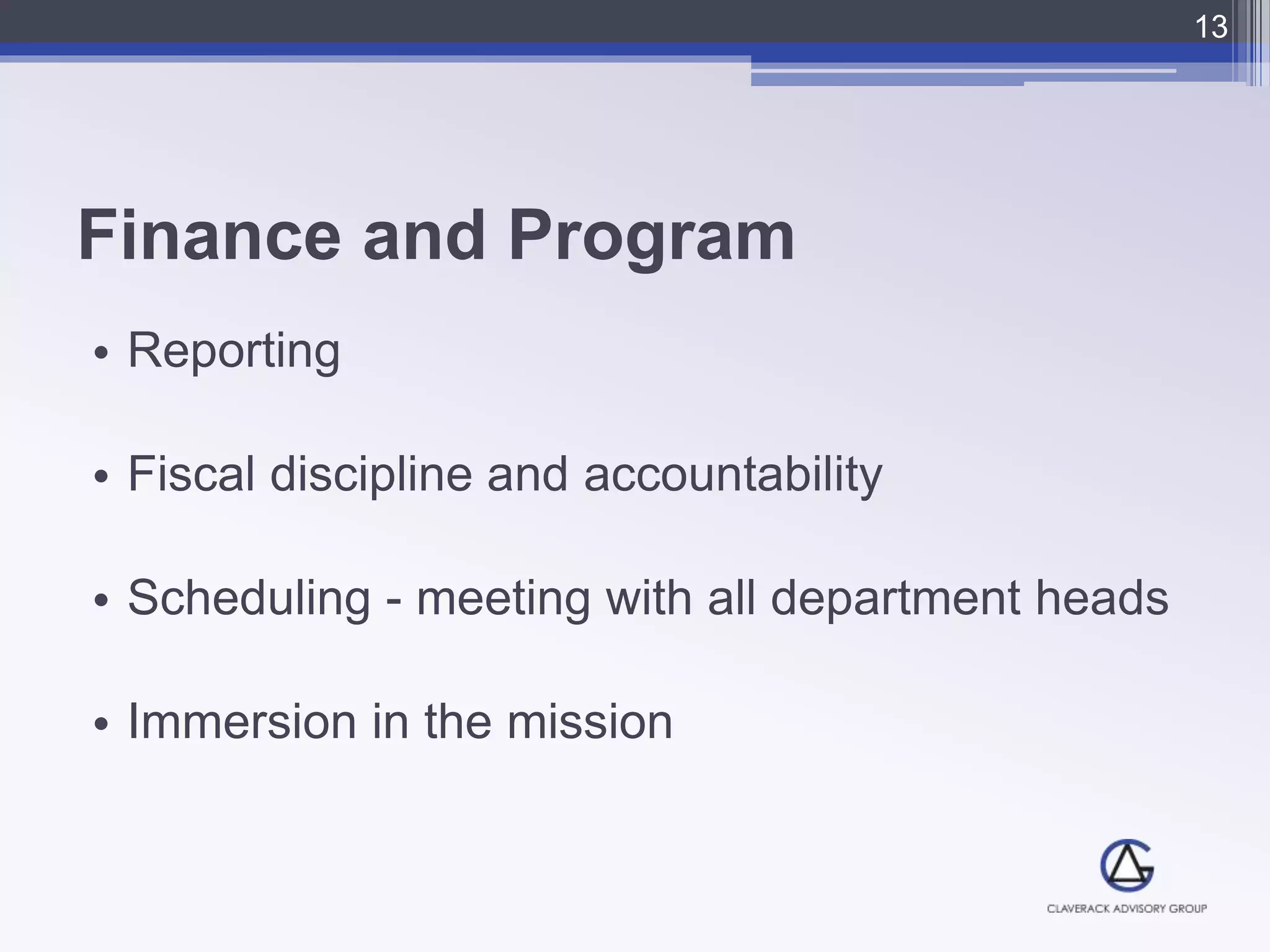
Finance and Program
• Reporting
• Fiscal discipline and accountability
• Scheduling - meeting with all department heads
• Immersion in the mission
13
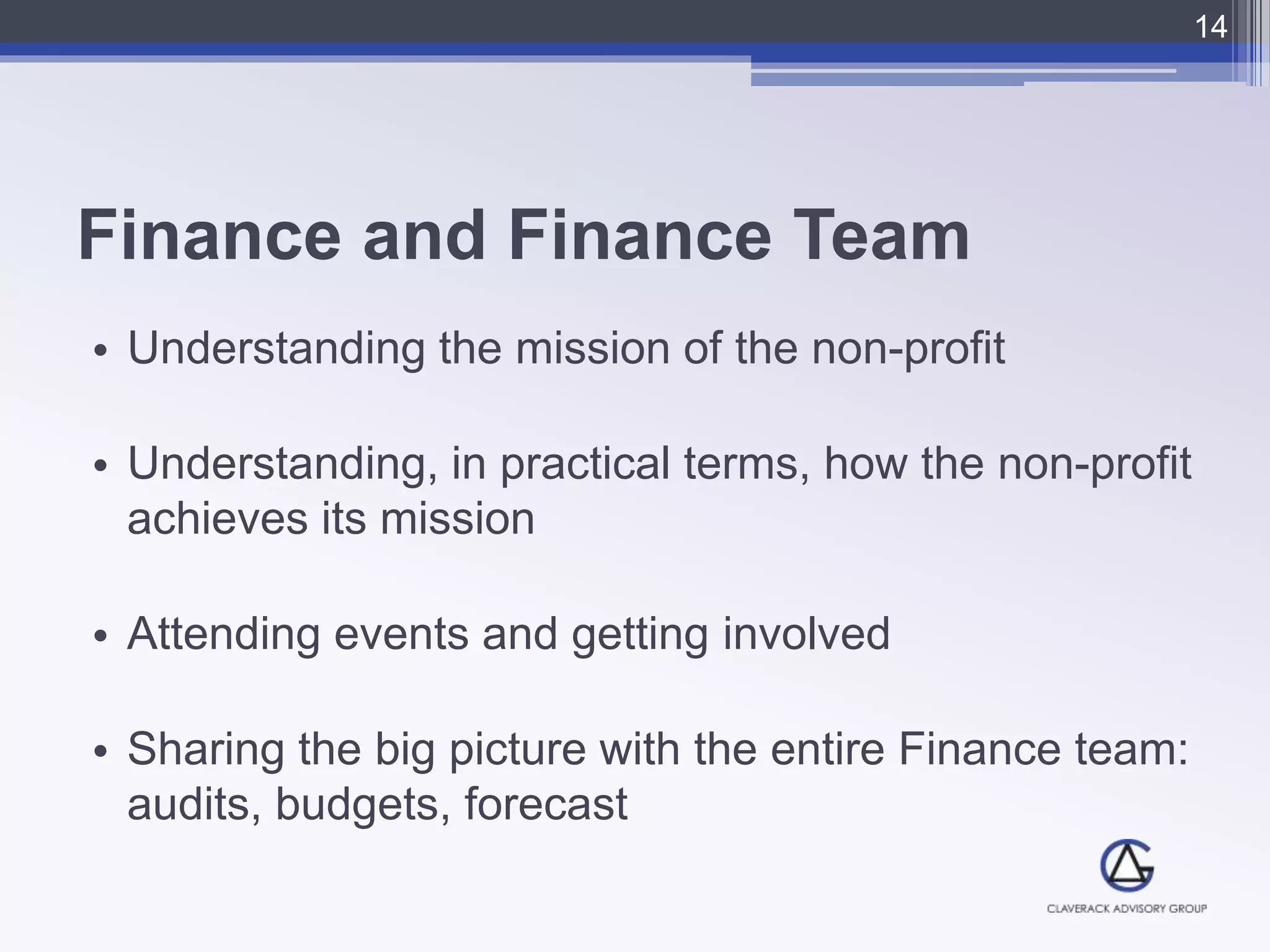
Finance and Finance Team
• Understanding the mission of the non-profit
• Understanding, in practical terms, how the non-profit
achieves its mission
• Attending events and getting involved
• Sharing the big picture with the entire Finance team:
audits, budgets, forecast
14
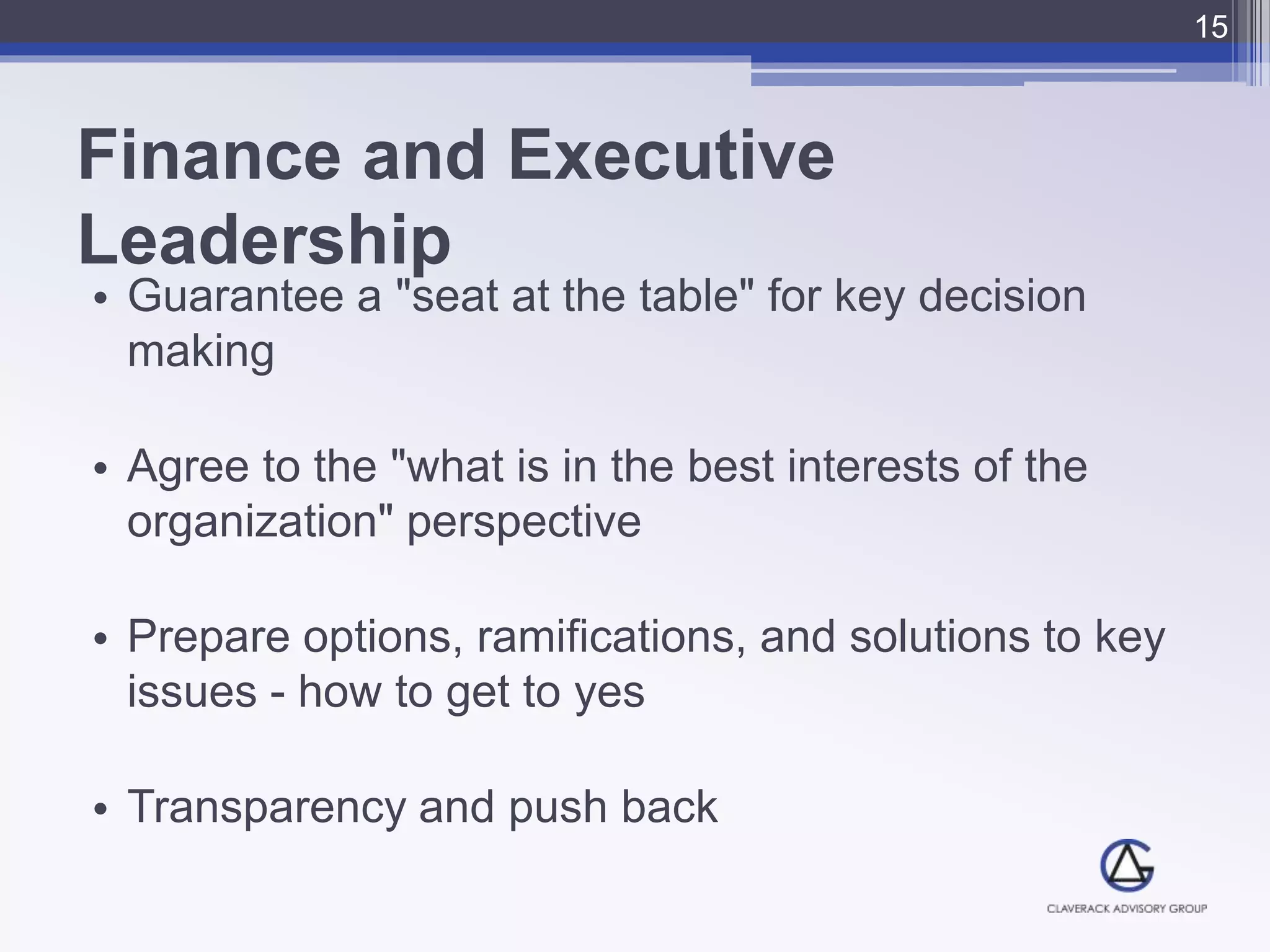
Finance and Executive
Leadership
• Guarantee a "seat at the table" for key decision
making
• Agree to the "what is in the best interests of the
organization" perspective
• Prepare options, ramifications, and solutions to key
issues - how to get to yes
• Transparency and push back
15
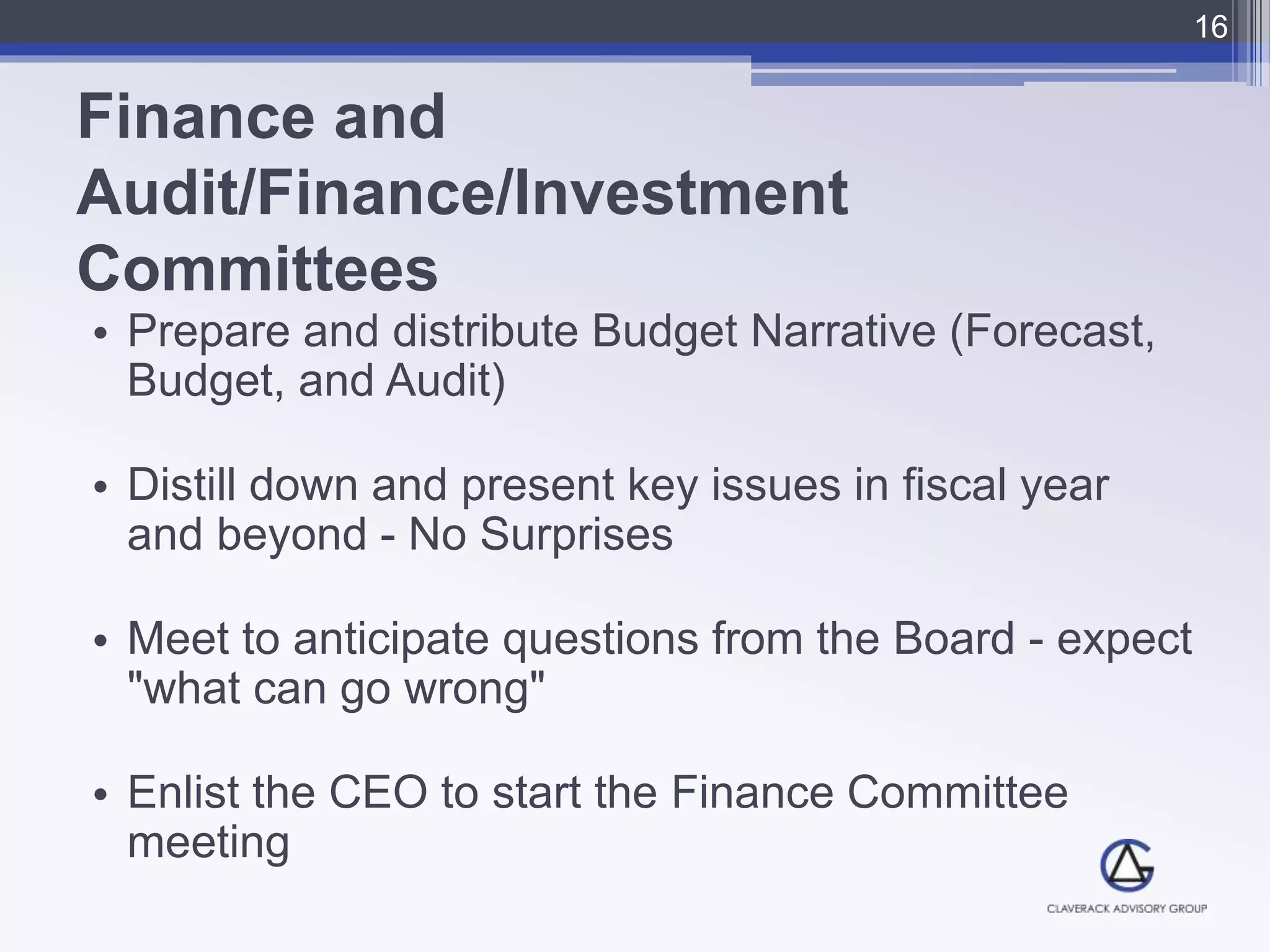
Finance and
Audit/Finance/Investment
Committees
• Prepare and distribute Budget Narrative (Forecast,
Budget, and Audit)
• Distill down and present key issues in fiscal year
and beyond - No Surprises
• Meet to anticipate questions from the Board - expect
"what can go wrong"
• Enlist the CEO to start the Finance Committee
meeting
16
Finance and Development
• Reconcile restricted and unrestricted grants and
contracts
• Align development strategies with organizational
financial needs
• Manage expectations and returns over time
• Make a compelling case for development capacity
17
Question:
How have you resolved or navigated a
relationship issue to ultimately align Finance and
Mission? Where might you find common ground
on issues such as the following?
18
• Choosing a new space
• Small but important program seems to be losing
money year after year
• Finance and HR are trying to think through reducing
salary and fringe expenses due to organizational
financial pressures
• Financial function surprise
 What can the financial function do to help grow program?
 What financial resources can be invested to achieve
organizational mission goals
19
Organizational Investment
(Programs, Infrastructure, Strategy)
• What organizational investments are worth
pursuing
• Why are they worth pursuing?
• How do organizational investments actually
happen and not wait for next year ?
20
What organizational investments are
worth pursuing?
• Expansion and replication of programs
• Space (new, improved, less)
• Administrative and development capacity
• Research and evaluation
• Building organizational unrestricted reserves
• Planning and strategic initiatives to control
organizational destiny
21
Why are they worth pursuing?
• Strategic capacity to pursue organization's mission
initiatives
• Build financially sustainable organization
▫ Why wait for someone else's money?
• Grow mission driven programs and impact
• Build and maintain talented staff to increase probability
of mission success
• Organization suffers if lack of decision making and
ultimate investment impacts competitive position
• Get off the short- and long-term organizational financial
treadmill
22
How to make organizational investments
actually happen and not wait until next year?
• Tell a compelling story
 Why investment must happen to fulfill the mission
• Connect to organization’s financial position and
sustainability over time
• Build into organizational budget
• Map out all steps leading to success
 Who does what and how are they accountable
• Determine capital requirements and how to achieve
them
23
Workshop for Your Future:
The compelling investment story and its impact on the
organization (see audited financial statements)
• What are three investments your organization or
department wants to make?
• What will be their impact in the short and long term?
• What available financial resources will make
this investment happen?
• What is the compelling case made to the board to justify
the investment option given potential trade-offs?
24
Thank you! Questions?
25

Building A Mission-Infused Finance Function In Your Nonprofit

  • 1.
    Building a Mission-Infused FinanceFunction in Your Non- Profit Russ Pomeranz CEO, Claverack Advisory Group rcpomeranz@gmail.com
  • 2.
    What to ThinkAbout? 1. What role can I play in driving the mission, goals, and priorities in alignment with the organization’s financial goals? 2. How do I get to play a role or make sure I play a role? 3. What do I expect from the finance function and likewise what should the finance function expect from all organizational partners? 2
  • 3.
    Mission and FinanceWorking Together • Why is the mission infused financial function critical to the organization? • What qualities and skills should we expect from the mission infused financial function? • What strategies, tactics, and tools best align mission and finance by partner? • What organizational investments are necessary to move the organization forward? 3
  • 4.
    Why is theMission-Infused Financial Function Critical to the Organization? • Organizational trajectory in a much more competitive non profit world • Finance plays a key role in defining organizational success • Key organizational roles actually care about finance to achieve mission goals 4
  • 5.
    Organizational Trajectory ina Much More Competitive Non Profit World • Spiral Up or Spiral Down • There is no middle path • Much more competition for resources • Non profits are more strategic; they have to be • Reliance on results, impact and outcomes to funders 5
  • 6.
    Finance Plays aKey Role in Defining Organizational Success • Need to break even and seek unrestricted net asset surpluses • Need to efficiently and effectively manage resources • Need to build up capital to invest in a sustainable business model • Need to manage cash and debt to avoid existential challenges 6
  • 7.
    Key Organizational Roleswho Actually Care About Finance to Achieve Mission Goals • CEO/Executive Director ▫ Partner • Board and Finance Committees ▫ Fiduciary responsibility while understanding and taking risk • Program Staff ▫ Programmatic/mission impact • Non Profit CFO's Organizational trajectory ▫ Future CFOs 7
  • 8.
    What qualities andskills should we expect from the Mission-Infused Financial Function? 1. Tangible Skill Set 2. Intangible Skill Set 3. Priorities and Focus 8
  • 9.
    Tangible Skill Set •Understanding of: ▫ Underlying non profit accounting and financial principles ▫ Budgetary options, trade-offs, ramifications of choices ▫ The potential of the MPA • Ability to: ▫ Define and convey the business model of the organization, short and long term ▫ Use financial statements to tell short and long term financial stories ▫ Translate organizational goals into FY budgets 9
  • 10.
    Intangible Skill Set •Curiosity ▫ How do things work? • Asking Questions ▫ “What are you talking about?” and “Why?” • Communication ▫ Need PR capacity • Written and oral Communication Skills ▫ Telling a compelling story 10
  • 11.
    Priorities and Focus •Unrestricted Net Income (Statement of activities) • Unrestricted Net Assets (Statement of financial position) • Revenue growth and expense structure strategie • Cash and access to capital 11
  • 12.
    What strategies, tacticsand tools best align Mission and Finance by partner? • Finance and Program • Finance and Finance Team • Finance and Executive Leadership • Finance and Audit/Finance/Investment Committees • Finance and Development 12
  • 13.
    Finance and Program •Reporting • Fiscal discipline and accountability • Scheduling - meeting with all department heads • Immersion in the mission 13
  • 14.
    Finance and FinanceTeam • Understanding the mission of the non-profit • Understanding, in practical terms, how the non-profit achieves its mission • Attending events and getting involved • Sharing the big picture with the entire Finance team: audits, budgets, forecast 14
  • 15.
    Finance and Executive Leadership •Guarantee a "seat at the table" for key decision making • Agree to the "what is in the best interests of the organization" perspective • Prepare options, ramifications, and solutions to key issues - how to get to yes • Transparency and push back 15
  • 16.
    Finance and Audit/Finance/Investment Committees • Prepareand distribute Budget Narrative (Forecast, Budget, and Audit) • Distill down and present key issues in fiscal year and beyond - No Surprises • Meet to anticipate questions from the Board - expect "what can go wrong" • Enlist the CEO to start the Finance Committee meeting 16
  • 17.
    Finance and Development •Reconcile restricted and unrestricted grants and contracts • Align development strategies with organizational financial needs • Manage expectations and returns over time • Make a compelling case for development capacity 17
  • 18.
    Question: How have youresolved or navigated a relationship issue to ultimately align Finance and Mission? Where might you find common ground on issues such as the following? 18
  • 19.
    • Choosing anew space • Small but important program seems to be losing money year after year • Finance and HR are trying to think through reducing salary and fringe expenses due to organizational financial pressures • Financial function surprise  What can the financial function do to help grow program?  What financial resources can be invested to achieve organizational mission goals 19
  • 20.
    Organizational Investment (Programs, Infrastructure,Strategy) • What organizational investments are worth pursuing • Why are they worth pursuing? • How do organizational investments actually happen and not wait for next year ? 20
  • 21.
    What organizational investmentsare worth pursuing? • Expansion and replication of programs • Space (new, improved, less) • Administrative and development capacity • Research and evaluation • Building organizational unrestricted reserves • Planning and strategic initiatives to control organizational destiny 21
  • 22.
    Why are theyworth pursuing? • Strategic capacity to pursue organization's mission initiatives • Build financially sustainable organization ▫ Why wait for someone else's money? • Grow mission driven programs and impact • Build and maintain talented staff to increase probability of mission success • Organization suffers if lack of decision making and ultimate investment impacts competitive position • Get off the short- and long-term organizational financial treadmill 22
  • 23.
    How to makeorganizational investments actually happen and not wait until next year? • Tell a compelling story  Why investment must happen to fulfill the mission • Connect to organization’s financial position and sustainability over time • Build into organizational budget • Map out all steps leading to success  Who does what and how are they accountable • Determine capital requirements and how to achieve them 23
  • 24.
    Workshop for YourFuture: The compelling investment story and its impact on the organization (see audited financial statements) • What are three investments your organization or department wants to make? • What will be their impact in the short and long term? • What available financial resources will make this investment happen? • What is the compelling case made to the board to justify the investment option given potential trade-offs? 24
  • 25.