BUILDING A
HEALTHCARE SYSTEM FROM
SCRATCH
DR SILVIA PFEIFFER
COVIU
SYDNEY, AUSTRALIA
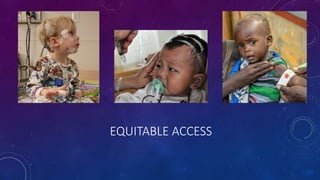
EQUITABLE ACCESS
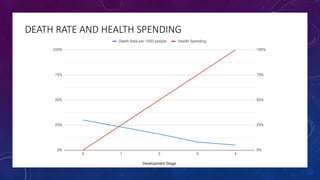
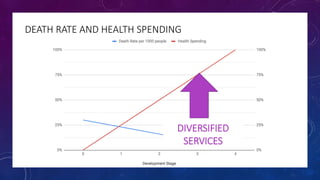
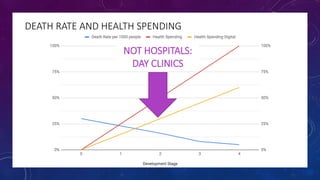
DEATH RATE AND HEALTH SPENDING
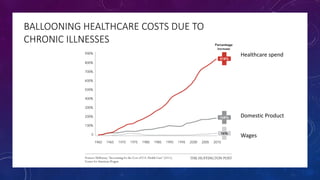
Domestic Product
Healthcare spend
Wages
BALLOONING HEALTHCARE COSTS DUE TO
CHRONIC ILLNESSES
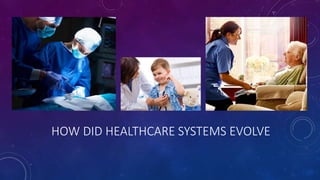
HOW DID HEALTHCARE SYSTEMS EVOLVE
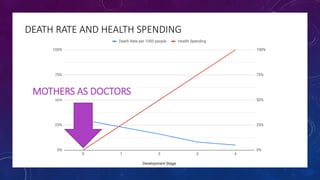
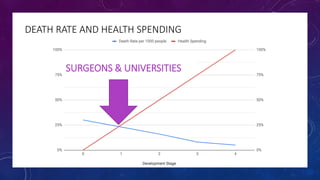
DEATH RATE AND HEALTH SPENDING
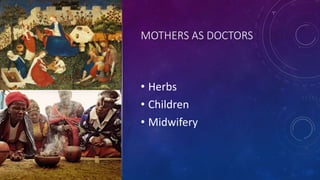
MOTHERS AS DOCTORS
MOTHERS AS DOCTORS
• Herbs
• Children
• Midwifery
DEATH RATE AND HEALTH SPENDING
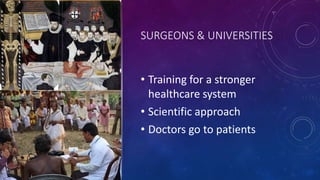
SURGEONS & UNIVERSITIES
• Training for a stronger
healthcare system
• Scientific approach
• Doctors go to patients
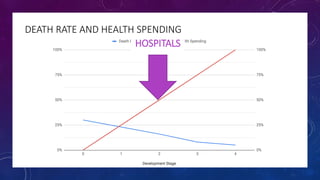
DEATH RATE AND HEALTH SPENDING
HOSPITALS
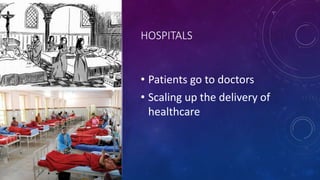
HOSPITALS
• Patients go to doctors
• Scaling up the delivery of
healthcare
DEATH RATE AND HEALTH SPENDING
DIVERSIFIED
SERVICES
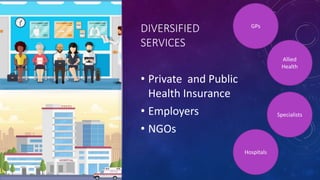
DIVERSIFIED
SERVICES
• Private and Public
Health Insurance
• Employers
• NGOs
Specialists
Hospitals
Allied
Health
GPs
PATTERNS
EXISTING HEALTHCARE SYSTEMS ARE BUILT FOR
TREATING THE SICK.
EXISTING HEALTHCARE SYSTEMS ARE BUILT FOR
EPISODES OF SICKNESS.
WE HAVE TO CARE FOR THE HEALTH OF THE
HEALTHY BEFORE THEY GET SICK.
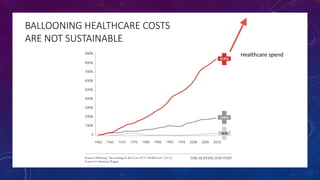
Healthcare spend
BALLOONING HEALTHCARE COSTS
ARE NOT SUSTAINABLE
WHAT IS THE CORE PROBLEM?
WE HAVE CREATED PATIENTS THAT DON’T FEEL
RESPONSIBLE FOR THEIR HEALTH.
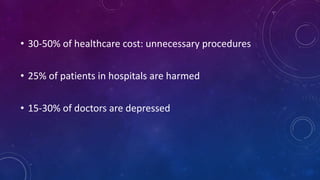
• 30-50% of healthcare cost: unnecessary procedures
• 25% of patients in hospitals are harmed
• 15-30% of doctors are depressed
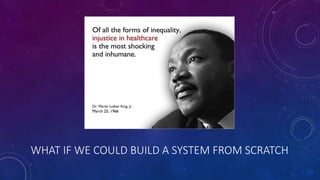
WHAT IF WE COULD BUILD A SYSTEM FROM SCRATCH
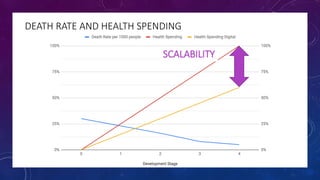
DEATH RATE AND HEALTH SPENDING
SCALABILITY
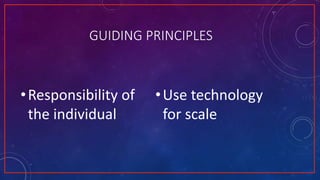
GUIDING PRINCIPLES
•Responsibility of
the individual
•Use technology
for scale
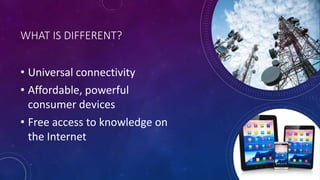
WHAT IS DIFFERENT?
• Universal connectivity
• Affordable, powerful
consumer devices
• Free access to knowledge on
the Internet
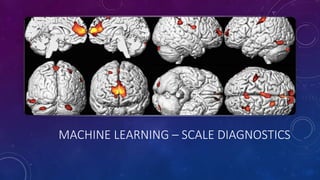
MACHINE LEARNING – SCALE DIAGNOSTICS
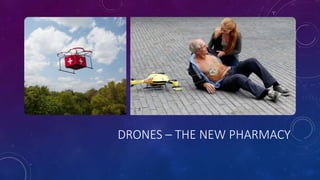
DRONES – THE NEW PHARMACY
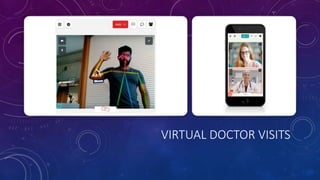
VIRTUAL DOCTOR VISITS
DEATH RATE AND HEALTH SPENDING
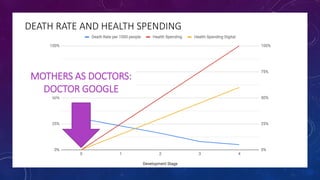
MOTHERS AS DOCTORS:
DOCTOR GOOGLE
MOTHERS AS DOCTORS:
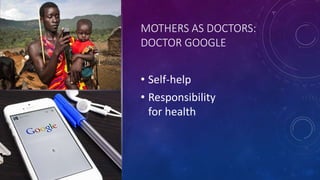
DOCTOR GOOGLE
• Self-help
• Responsibility
for health
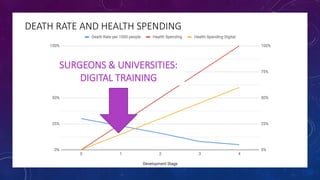
SURGEONS & UNIVERSITIES:
DIGITAL TRAINING
DEATH RATE AND HEALTH SPENDING
SURGEONS & UNIVERSITIES:
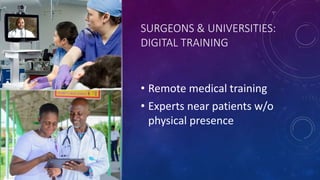
DIGITAL TRAINING
• Remote medical training
• Experts near patients w/o
physical presence
NOT HOSPITALS:
DAY CLINICS
DEATH RATE AND HEALTH SPENDING
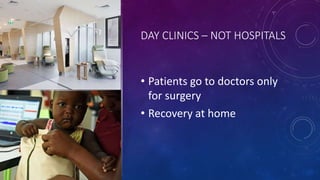
DAY CLINICS – NOT HOSPITALS
• Patients go to doctors only
for surgery
• Recovery at home
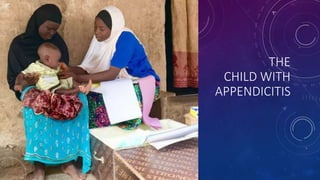
THE
CHILD WITH
APPENDICITIS
DEATH RATE AND HEALTH SPENDING
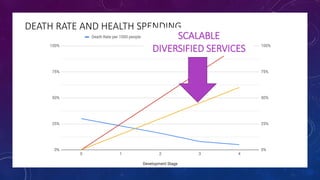
SCALABLE
DIVERSIFIED SERVICES
DIVERSIFIED
SERVICES
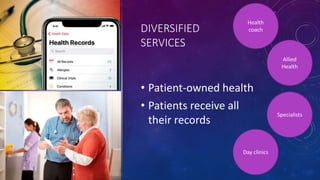
• Patient-owned health
• Patients receive all
their records
Specialists
Day clinics
Allied
Health
Health
coach
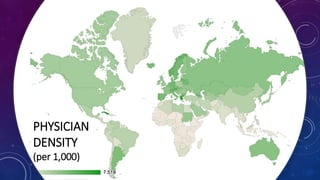
PHYSICIAN
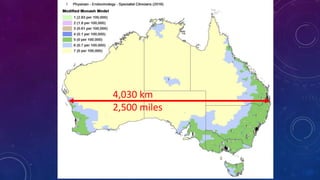
DENSITY
(per 1,000)
4,030 km
2,500 miles
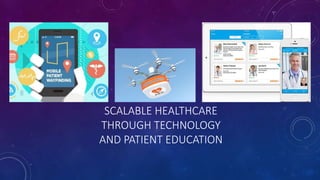
SCALABLE HEALTHCARE
THROUGH TECHNOLOGY
AND PATIENT EDUCATION
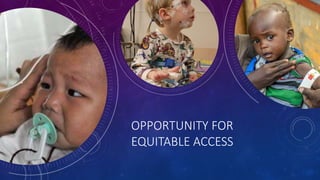
OPPORTUNITY FOR
EQUITABLE ACCESS
HOME: THE NEXT FRONTIER OF HEALTHCARE
silvia@coviu.com
@CoviuApp
www.coviu.com
Raising Series A
March 2019

Building a Healthcare System from Scratch

Editor's Notes

  • #2 Hi I’m Silvia Pfeiffer and I get to talk to you today about a subject that is very dear to my heart: healthcare systems. My company Coviu sells telemedicine software to enable part of the future of healthcare. I’d like to take you through a thought experiment today: what if we could build a healthcare system from scratch in today’s technology context, taking into account all our past experiences. What would we do differently.
  • #3 Let’s start with the goal of every country’s healthcare system: The goal of every healthcare system is to provide equitable access to healthcare for all its citizens. Yet, all healthcare systems fail patients all over the world every single day. How can we do better?
  • #4 Let’s learn from the past first. The development of basically every healthcare system in the world goes through different phases. As we watch countries evolve from a non-existing healthcare systems to a highly sophisticated system, they follow such a graph or similar. The blue line is the death rate, the red aggregate health spending of the country. As health spending increases, the death rate reduces and people live longer, changing the challenges of the healthcare system.
  • #5 This graph is for the US, but it is representative. Countries eventually hit the chronic illnesses problem that causes a huge drag on the healthcare system.
  • #6 So how did we get here? How did our healthcare systems evolve?
  • #7 At the beginning without a healthcare system, it is the family unit that takes care of the health of its own. Typically it falls to the mothers to look after the health of family members.
  • #8 This was the case back in the middle ages…as much as in modern developing countries. Mothers do what they can to heal family members with herbs, help each other heal children and give birth safely. But there is no scientific knowledge – the knowledge is shared through the generations only.
  • #9 Surgeons are the first to evolve, mostly driven by country leaders. They become a profession and share scientific knowledge at universities.
  • #10 This was the case in the middle ages for Europe as much as it happens today. Clinicians also start providing services back to the larger population. Doctors go to the patients at this stage to extend the reach of the universities.
  • #11 In the next step, hospitals are created to be able to scale up the efficiency of the clinicians.
  • #12 This was the case back in the middle ages as it is today. For efficiency, no patients come to the doctors.
  • #13 The creation of rural hospitals is just the first step in diversifying the healthcare system.
  • #14 As more illnesses are treated, more specialisations are created: GPs evolve as the local health support and they triage people to the specialists or hospitals. To fund this, diverse institutions concern themselves with paying for patients’ health. This is the golden standard of today’s healthcare.
  • #15 So, what are the patterns that we see in the history of healthcare system development?
  • #16 Well, for one, healthcare systems are built for the sick. We jump to action when it’s too late, particularly with chronic illness.
  • #17 On the way from having mothers look after the health of family members in a holistic fashion to diversified specialized health services, we have lost the holistic view of the health of the individual. We built healthcare for episodes of sickness.
  • #18 It is now clear that we have to care for the health of the healthy BEFORE they get sick.
  • #19 Particularly because this has led to a situation of ballooning health care costs that is not sustainable, mostly because of one issue: chronic illnesses.
  • #20 I believe there is one issue that is at the core of all this that, if we can break it, it will change everything.
  • #21 I believe we have created patients that don’t feel responsible for their health. We have built an expectation that the health of our bodies is up to the doctors to fix. We have taken responsibility away from the individual and put it in the hands of the doctors because they know better. But do they?
  • #22 We are not only spending money unnecessarily, but we are also creating avoidable harm. Modern healthcare systems are so inhumane that even the doctors are affected.
  • #23 What if we could start over in today’s time – could we build a system that is scalable and provides equitable access to everyone?
  • #24 Our goal is to build a healthcare system that provides better coverage at a lower price. Since we know that the biggest cost to a mature healthcare system is chronic illness, how can we prepare for this challenge from the start?
  • #25 I believe that the solution is in two guiding principles: responsibility and technology. It is technology that allows us to put the responsibility for their health back in the hands of the individual. That is the only way to scale healthcare affordably. This goes to the core of the topic of our conference: women and technology, since women maintain to be responsible for the health of the family.
  • #26 Technology makes all the difference in empowering the individual to be more responsible for their health. We have near-universal connectivity and affordable devices that give us access to the free knowledge shared on the Internet.
  • #27 We have machine learning to increase the scale of diagnostics.
  • #28 We have drones to get pharmaceuticals and devices fast to the locations that they are needed at.
  • #29 And we have video technology to bridge the access gap to expertise.
  • #30 As we develop our new hypothetical healthcare system, we again start at the family entity. Now our caring mothers have a powerful helper: “Doctor Google”.
  • #31 I visited the Masai in Africa in January this year and to my amazement, everyone had a smart phone. There is now access to knowledge that allows families to ask questions about their health and take responsibility.
  • #32 Of course this is not sufficient and many issues will be beyond the understanding of an untrained individual. We still need medical education, we still need experts.
  • #33 But now we can make the experts the source of patient empowerment. We can use technology to improve patient education and elevate individual community members with medical training. Experts can be present across larger areas without having to be physically present.
  • #34 Finally, if we need surgery, we can get it at day clinics without having to spend our recovery time in the unhappy, unhealthy environment of a hospital.
  • #35 Patients only spend a minimal time in clinics and recover at home.
  • #36 Let’s look at the example of a child with appendicitis in a rural area: Mother Googles the pain Mother gets help via video on the phone to diagnose Family receives medication via drones A couple of days later, they attend day surgery There are no hospital-acquired infections (10% of people get infected in hospitals) The patient returns with an app to control their medication and diet The family is able to video call a nurse or doctor as required Reduced anxiety of patient and family Better care, better food, better sleep, better recovery
  • #37 A system that has the individual and their family responsible for their healthcare can result in more patient-driven, more scalable and affordable diversified services.
  • #38 Underpinning all this is the goal for patients to own their health. Many digital systems need to come together to make this possible – allow the patient to keep track of their health, receive and manage all their records, and take some of the stress away from the experts that are increasingly feeling the mental pressure of the responsibility that lies on their shoulders. A diversified service can evolve where the first point of call is not when you are sick (as it is with GPs), but is a health coach that helps you stay healthy.
  • #39 Physicians are a rare commodity on our planet – most countries have only about 4 physicians per 1,000 inhabitants. And that physician density is not uniform across the country.
  • #40 For example, in Australia, physician density depends on population density. Many rural and remote areas don’t have access to specialists at all. In this picture, endocrinologists are the little black exclamation mark. See how there’s a single one in the centre of Australia while all the others are at the edges? None to the North and South of it and the closest colleague is about 2,000 km away.
  • #41 There’s not really a choice – in today’s world we can only achieve scalable and affordable healthcare through technology and through patient education.
  • #42 We need to build the healthcare systems of the future for the healthy. Then we may finally achieve universal equitable access.
  • #43 Thank you very much – are there any questions? Feel free to contact me via email if you’d like to discuss further.