Healthcare systems around
the world (Part I)
Dr. Esraa Mohammed Soltan
Lecturer of Nursing Administration-Suez Canal University
Diploma of Health Professions Education (DHPE)
Outline:
• Introduction.
• Important concepts.
• Goals of healthcare systems.
• Elementscomponents of healthcare systems.
• Healthcare systems typesmodels.
• Performance of healthcare systems.
• Summary.
Introduction:
Healthcare systems are made up of multiple interacting
components including organisations, people, and actions.
They perform several functions: delivering healthcare
services; maintaining and improving health; protecting
households from the costs of illness; enabling economic
functioning; and shaping societal norms and values. They
are also sites of competition and contestation between
actors with different interests and visions.
Important concepts:
• healthcare system
• healthcare services
• healthcare provider
• healthcare law
• healthcare coverage
• healthcare expenses
• healthcare facility
• healthcare worker
Definition of healthcare system:
Healthcare systems are “ all the organizations,
institutions, and resources that are devoted to
producing health actions” (WHO, 2000).
Definition of healthcare system:
The World Health Organization asserts that a
healthcare system “consists of all organizations,
people, and actions whose primary intent is to
promote, restore or maintain health” (WHO, 2007), as
well as compensating for permanent disabilities,
regardless of whether health agents are public,
governmental, nongovernmental, or private.
Definition of healthcare system:
It means any public or private entity whose function
or purpose is the management of, processing of,
enrolment of individuals for, or payment for, in full or
in part, healthcare services or healthcare data or
healthcare information for its participants.
Definition of healthcare services:
It means any services or products included in the
furnishing to any individual of medical care or
hospitalization, or incidental to the furnishing of such
care or hospitalization, as well as the furnishing to
any person of any other services or products for the
purpose of preventing, alleviating, curing or healing
human illness or injury.
Definition of healthcare provider:
It means a person or healthcare facility licensed,
certified, or otherwise authorized or permitted by law
to administer healthcare in the ordinary course of
business or practice of a profession.
Definition of healthcare law:
It means any applicable law regulating the
acquisition, construction, operation, maintenance, or
management of a healthcare practice, facility,
provider, or payer.
Definition of healthcare coverage:
It means a fee for service, health maintenance
organization, preferred provider organization, or
another type of private health care coverage or public
health care coverage.
Definition of healthcare expenses:
It means expenses of health maintenance
organizations associated with the delivery of health
care services which are analogous to incurred losses
of insurers. Such expenses shall not include: (1) home
office and overhead costs; (2) advertising costs; (3)
commissions and other acquisition costs; (4) taxes;
(5) capital costs;
Definition of healthcare facility:
It means an office or institution providing care or
treatment of diseases, whether physical, mental, or
emotional, or other medical, physiological, or
psychological conditions, including but not limited to,
hospitals, rehabilitation hospitals or other clinics,
including weight control clinics, nursing homes, long-
term care facilities, homes for the aging or chronically ill,
laboratories, and offices of surgeons, chiropractors,
physical therapists, physicians, psychiatrists, dentists, and
all specialists within these professions. This definition
shall include all waiting rooms, hallways, private rooms,
semiprivate rooms, and wards within health care
facilities.
Definition of healthcare worker:
It means a person other than a healthcare professional
who provides medical, dental, or other health-related
care or treatment under the direction of a healthcare
professional with the authority to direct that
individual's activities, including medical technicians,
medical assistants, dental assistants, orderlies, aides,
and individuals acting in similar capacities.
What are the goals of
healthcare systems?
What are the goals of healthcare
systems?
The WHO defines the goals of health as:
•To improve and protect public health.
•Responsiveness to the expectations of the population.
•Fair financial contribution.
In order to last, the system must be
•Self-sustainable in terms of personnel and funding
system.
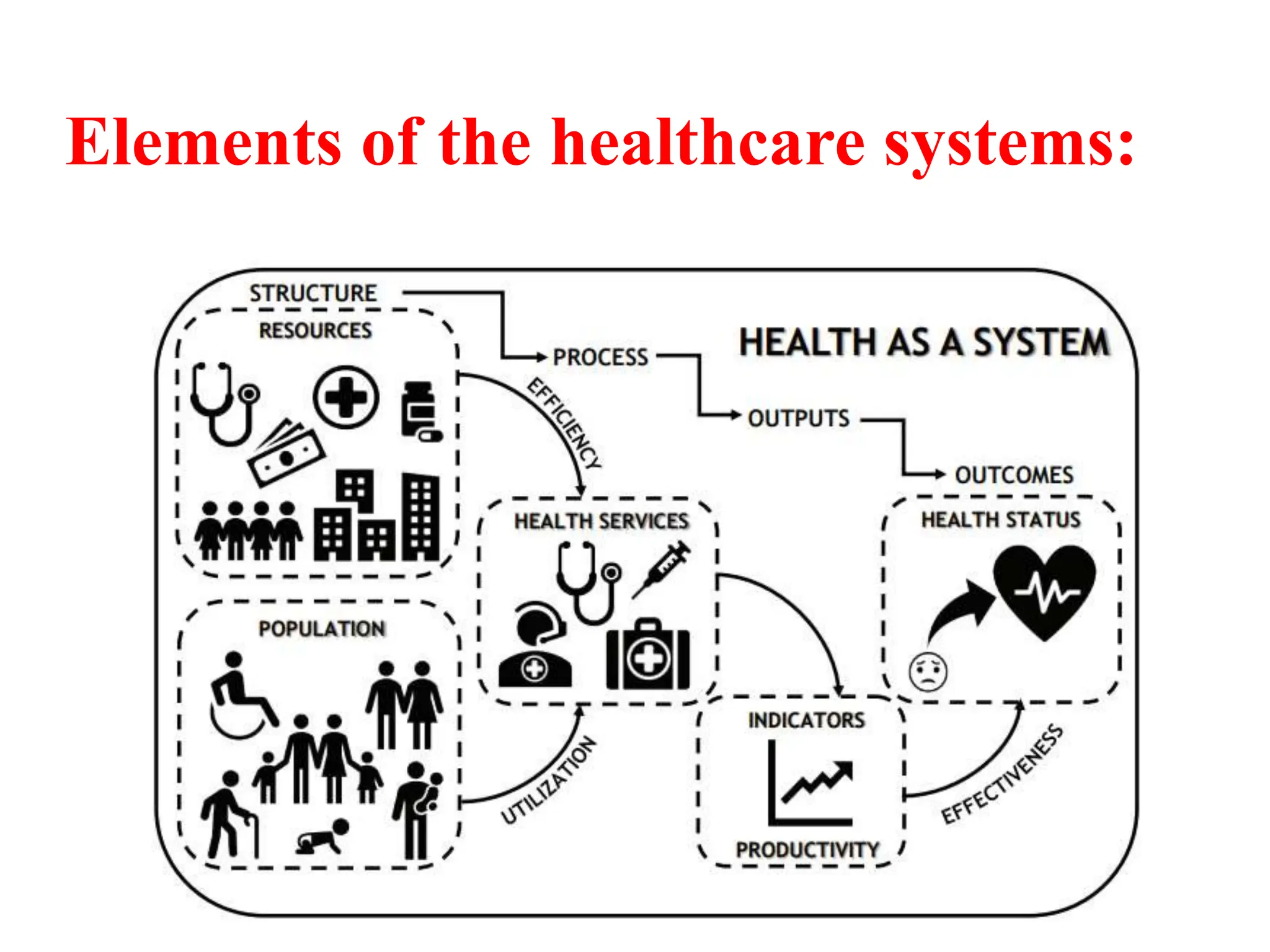
Elements of the healthcare systems:
Components
of healthcare
systems:
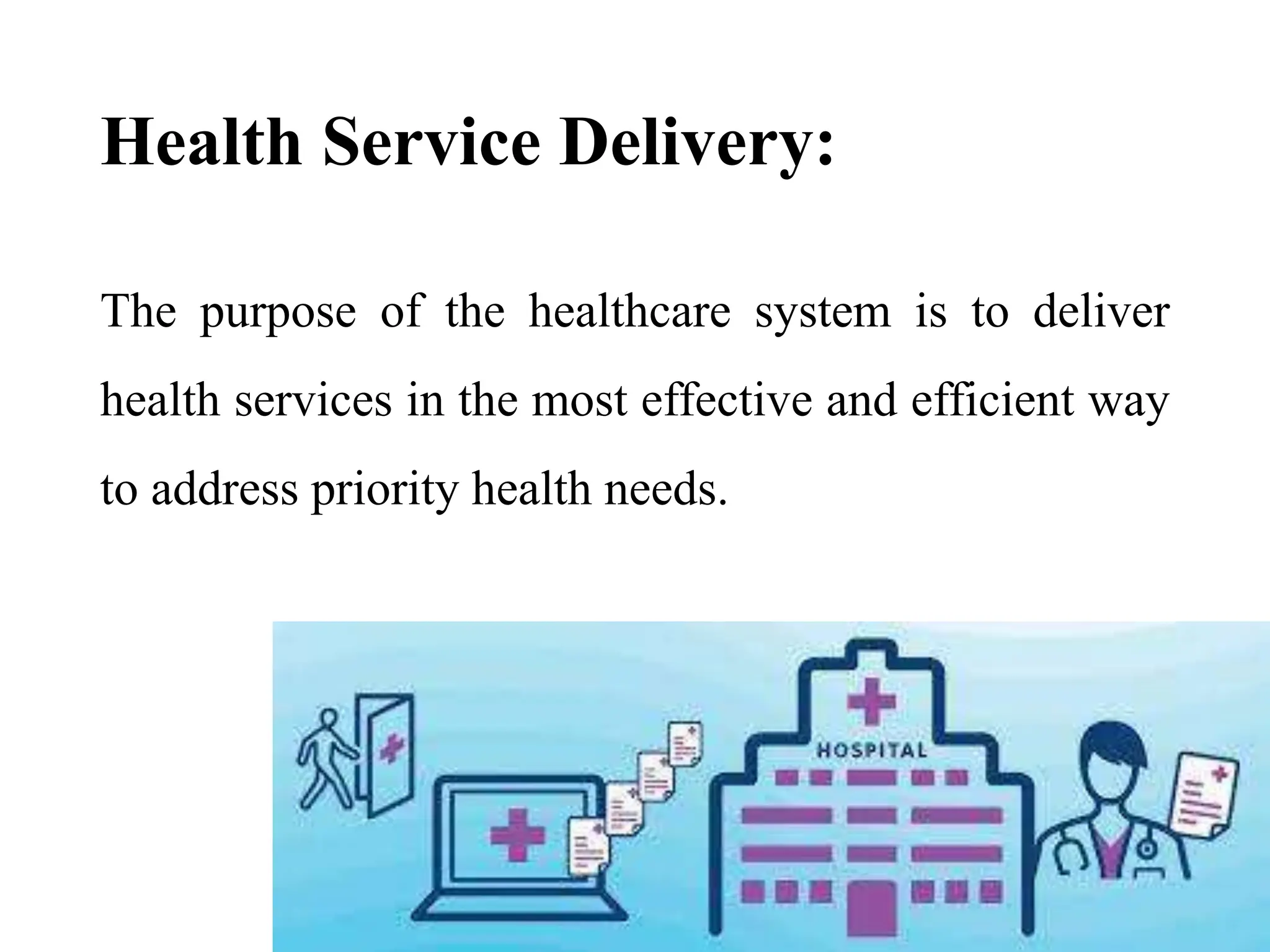
Health Service Delivery:
The purpose of the healthcare system is to deliver
health services in the most effective and efficient way
to address priority health needs.
Health Service Delivery:
Health service delivery is a complex issue, requiring
consideration of:
a) What types of health services are needed and at
what level?
b) What relationships should exist between health
services?
c) Where should health services be provided?
d) Who should own the health service institutions?
e) What level of quality should health services
maintain?
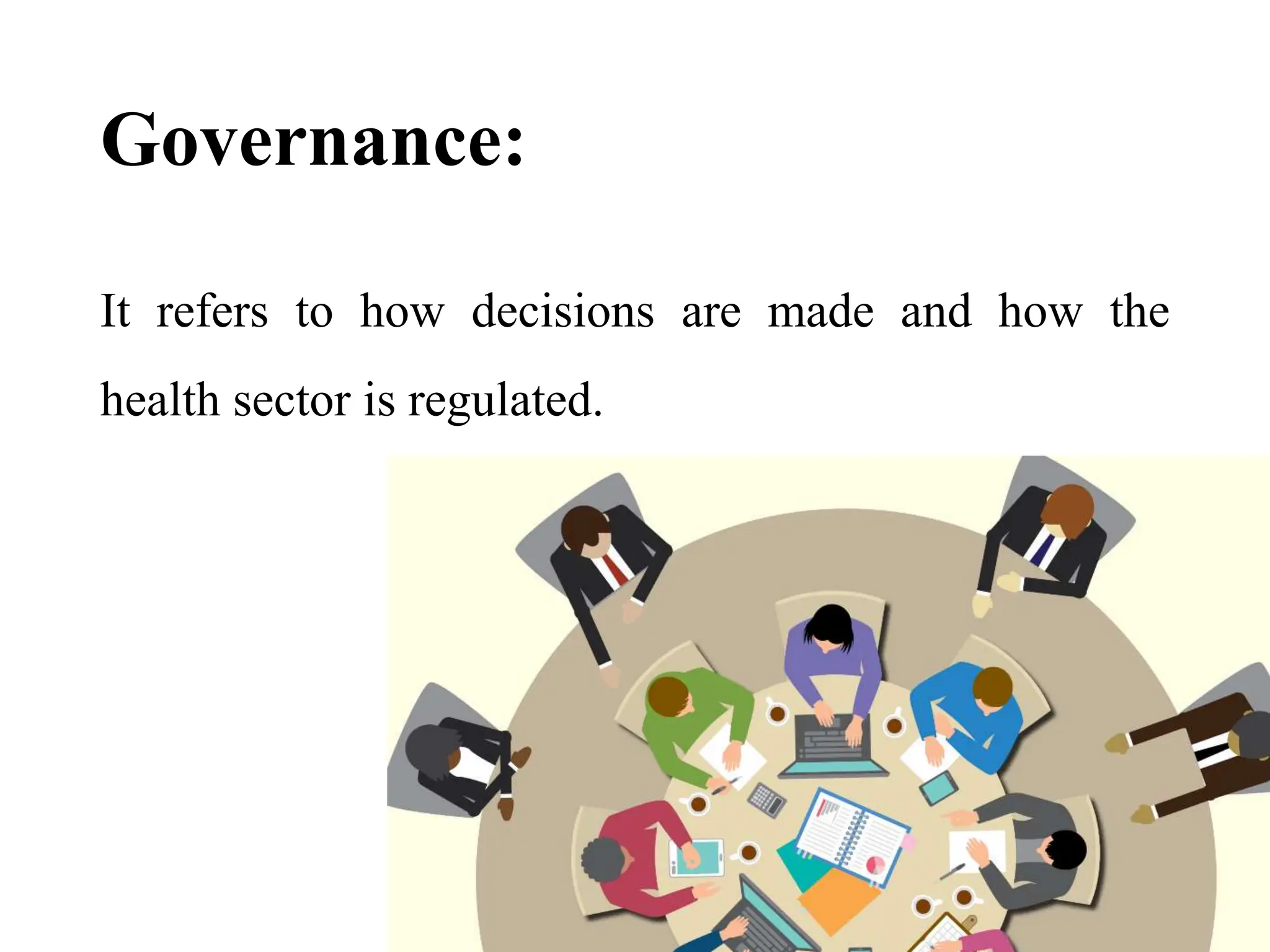
Governance:
It refers to how decisions are made and how the
health sector is regulated.
Governance:
Key questions around governance include the following:
• What are the underlying values of the healthcare system?
• Who makes decisions and to whom are the decision-makers
accountable?
• How transparent and inclusive is the decision-making
process?
• How effective and efficient are the management and
planning processes in identifying and responding to needs?
• How are different entities (individuals or institutions
associated with the health system) brought together?
• What should the appropriate balance be between regulations
in the form of control versus incentives?
Resources and Support Systems:
Resources and support systems are vital in underpinning the
delivery of services.
For "front-line" professionals providing health services,
resources, and support systems may be taken for granted but is
critical to the professionals' abilities to work effectively.
Crucial resources and support systems for services include
human and financial resources, infrastructure and
transportation, medical supplies, and information.
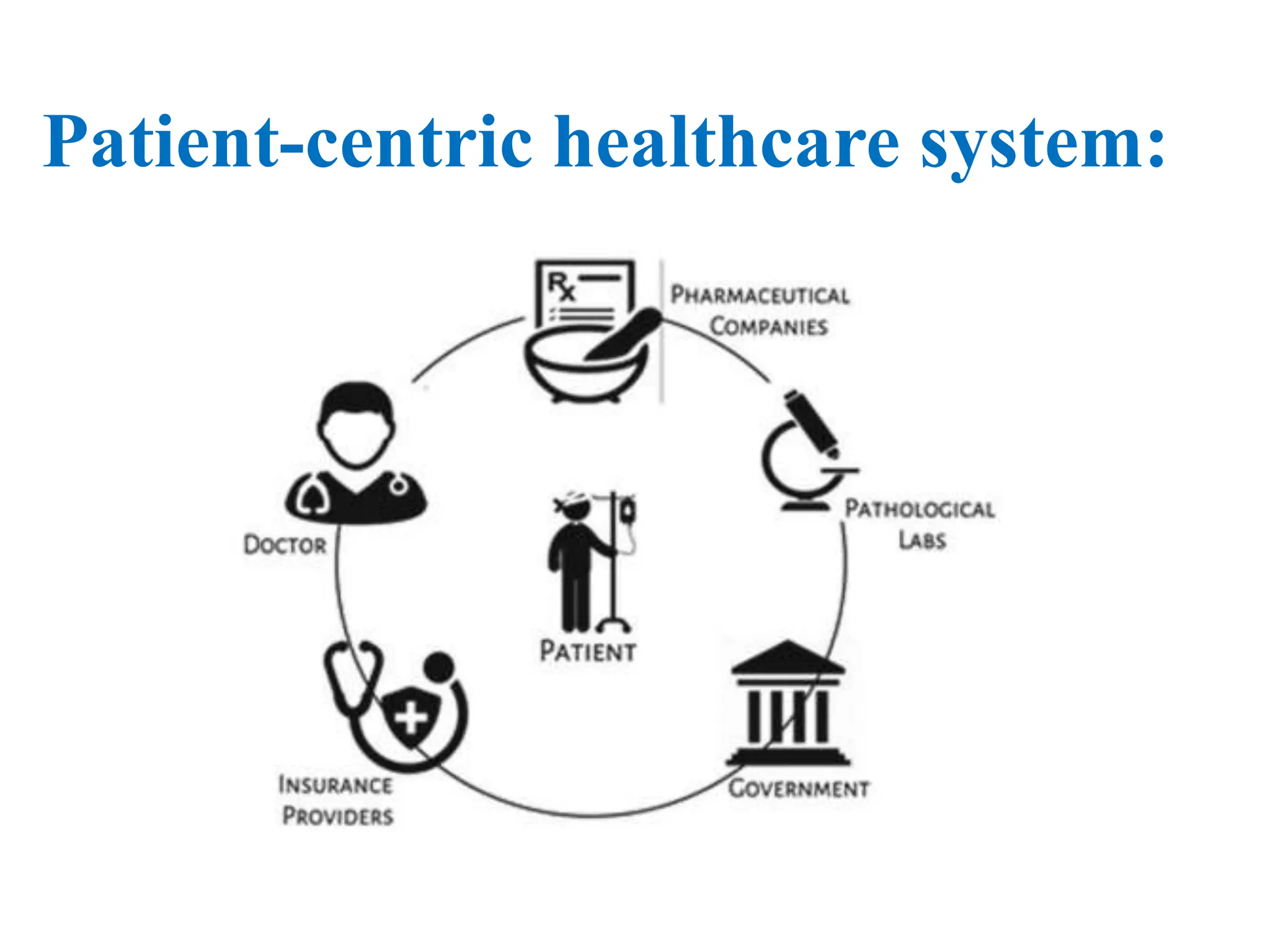
Patient-centric healthcare system:
Healthcare systems typesmodels:
• The Beveridge model
• The Bismark model
• The national health insurance model
• The out-of-pocket model
The Beveridge model:
Also known as socialized medicine, in which health care is
both financed by and provided by the government.
The government employs healthcare practitioners, owns
healthcare facilities, and administers the healthcare system.
The health systems of Cuba and the United Kingdom are
examples of the Beveridge model, which is named after the
British social reformer who inspired the United Kingdom's
National Health Service.
The Beveridge model:
The Bismark model:
Also referred to as a decentralized national health program, in
which employers and employees are required to obtain private
health insurance, usually provided by nongovernment
insurance companies.
Hospitals and clinics are privately owned.
Germany created the first decentralized national health
program.
Other countries with similar models include Japan and
Switzerland.
The Bismark model:
The national health insurance model:
Also known as a socialized insurance model, in which
a single, government-run insurance program finances
healthcare services that are provided by private
payers with negotiated reimbursement.
Canada and, more recently, Taiwan are examples of
countries with a socialized insurance model.
The out-of-pocket model:
The out-of-pocket model is common in developing
countries in which there is a lack of private health
insurance and no government-sponsored healthcare
system.
This lack of private or government health insurance is
usually accompanied by shortages of health-care
facilities, low expenditures, and poor health outcomes.
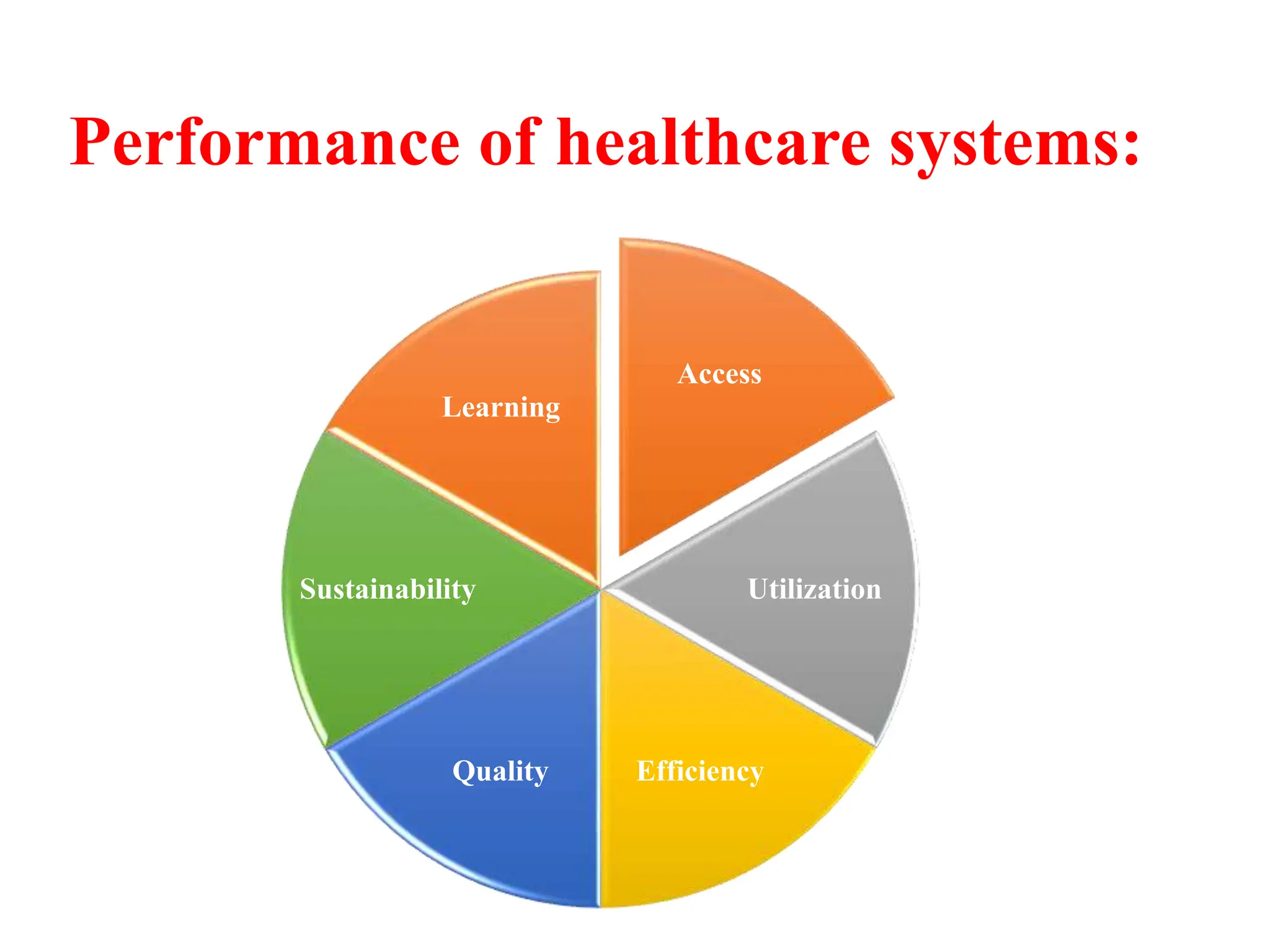
Performance of healthcare systems:
The World Bank report examined six core performance
domains:
1. Access
2. Utilization
3. Efficiency
4. Quality
5. Sustainability
6. Learning
Access:
Access incorporates several dimensions—physical access,
financial access, linguistic access, and information
access—that are supplemented by service availability and
the provision of non-discriminatory services.
Equitable treatment should be provided regardless of
gender, race, ethnicity, religion, age, or any other physical
or socioeconomic condition.
Utilization:
Utilization includes dimensions of patient or
procedure volume relative to capacity or population
health characteristics.
Efficiency:
Efficiency is determined by cost- or staff-to-service
ratios and by patient or procedure volume.
Quality:
Quality includes clinical and management quality, as
well as patient experience.
Sustainability:
Sustainability in healthcare can be defined as “the
capacity of health services to function with efficiency,
including the financial, environment and social
interaction that guaranties an effective service now and in
the future, with a minimum of external intervention and
without limiting the capacity of future generations to
fulfill their needs” (Ramirez, Oetjen, and Malvey 2011,
134).
Learning:
The learning domain empowers the organization to adapt
to change and to explore and adopt innovations.
It incorporates efforts to use data audit and feedback
processes, to distribute relevant information and provide
patient education through partnerships with the
constituency, and to implement training and continuing
education initiatives for the healthcare workforce.
Performance of healthcare systems:
Access
Utilization
Efficiency
Quality
Sustainability
Learning
Summary:
• Introduction.
• Important concepts.
• Goals of healthcare systems.
• Elements of healthcare systems.
• Components of healthcare systems.
• Healthcare systems typesmodels.
• Performance of healthcare systems.
Healthcare systems around the world (Part I)

Healthcare systems around the world (Part I)

  • 1.
    Healthcare systems around theworld (Part I) Dr. Esraa Mohammed Soltan Lecturer of Nursing Administration-Suez Canal University Diploma of Health Professions Education (DHPE)
  • 2.
    Outline: • Introduction. • Importantconcepts. • Goals of healthcare systems. • Elementscomponents of healthcare systems. • Healthcare systems typesmodels. • Performance of healthcare systems. • Summary.
  • 3.
    Introduction: Healthcare systems aremade up of multiple interacting components including organisations, people, and actions. They perform several functions: delivering healthcare services; maintaining and improving health; protecting households from the costs of illness; enabling economic functioning; and shaping societal norms and values. They are also sites of competition and contestation between actors with different interests and visions.
  • 4.
    Important concepts: • healthcaresystem • healthcare services • healthcare provider • healthcare law • healthcare coverage • healthcare expenses • healthcare facility • healthcare worker
  • 5.
    Definition of healthcaresystem: Healthcare systems are “ all the organizations, institutions, and resources that are devoted to producing health actions” (WHO, 2000).
  • 6.
    Definition of healthcaresystem: The World Health Organization asserts that a healthcare system “consists of all organizations, people, and actions whose primary intent is to promote, restore or maintain health” (WHO, 2007), as well as compensating for permanent disabilities, regardless of whether health agents are public, governmental, nongovernmental, or private.
  • 7.
    Definition of healthcaresystem: It means any public or private entity whose function or purpose is the management of, processing of, enrolment of individuals for, or payment for, in full or in part, healthcare services or healthcare data or healthcare information for its participants.
  • 8.
    Definition of healthcareservices: It means any services or products included in the furnishing to any individual of medical care or hospitalization, or incidental to the furnishing of such care or hospitalization, as well as the furnishing to any person of any other services or products for the purpose of preventing, alleviating, curing or healing human illness or injury.
  • 9.
    Definition of healthcareprovider: It means a person or healthcare facility licensed, certified, or otherwise authorized or permitted by law to administer healthcare in the ordinary course of business or practice of a profession.
  • 10.
    Definition of healthcarelaw: It means any applicable law regulating the acquisition, construction, operation, maintenance, or management of a healthcare practice, facility, provider, or payer.
  • 11.
    Definition of healthcarecoverage: It means a fee for service, health maintenance organization, preferred provider organization, or another type of private health care coverage or public health care coverage.
  • 12.
    Definition of healthcareexpenses: It means expenses of health maintenance organizations associated with the delivery of health care services which are analogous to incurred losses of insurers. Such expenses shall not include: (1) home office and overhead costs; (2) advertising costs; (3) commissions and other acquisition costs; (4) taxes; (5) capital costs;
  • 13.
    Definition of healthcarefacility: It means an office or institution providing care or treatment of diseases, whether physical, mental, or emotional, or other medical, physiological, or psychological conditions, including but not limited to, hospitals, rehabilitation hospitals or other clinics, including weight control clinics, nursing homes, long- term care facilities, homes for the aging or chronically ill, laboratories, and offices of surgeons, chiropractors, physical therapists, physicians, psychiatrists, dentists, and all specialists within these professions. This definition shall include all waiting rooms, hallways, private rooms, semiprivate rooms, and wards within health care facilities.
  • 14.
    Definition of healthcareworker: It means a person other than a healthcare professional who provides medical, dental, or other health-related care or treatment under the direction of a healthcare professional with the authority to direct that individual's activities, including medical technicians, medical assistants, dental assistants, orderlies, aides, and individuals acting in similar capacities.
  • 15.
    What are thegoals of healthcare systems?
  • 16.
    What are thegoals of healthcare systems? The WHO defines the goals of health as: •To improve and protect public health. •Responsiveness to the expectations of the population. •Fair financial contribution. In order to last, the system must be •Self-sustainable in terms of personnel and funding system.
  • 17.
    Elements of thehealthcare systems:
  • 18.
  • 19.
    Health Service Delivery: Thepurpose of the healthcare system is to deliver health services in the most effective and efficient way to address priority health needs.
  • 21.
    Health Service Delivery: Healthservice delivery is a complex issue, requiring consideration of: a) What types of health services are needed and at what level? b) What relationships should exist between health services? c) Where should health services be provided? d) Who should own the health service institutions? e) What level of quality should health services maintain?
  • 22.
    Governance: It refers tohow decisions are made and how the health sector is regulated.
  • 23.
    Governance: Key questions aroundgovernance include the following: • What are the underlying values of the healthcare system? • Who makes decisions and to whom are the decision-makers accountable? • How transparent and inclusive is the decision-making process? • How effective and efficient are the management and planning processes in identifying and responding to needs? • How are different entities (individuals or institutions associated with the health system) brought together? • What should the appropriate balance be between regulations in the form of control versus incentives?
  • 24.
    Resources and SupportSystems: Resources and support systems are vital in underpinning the delivery of services. For "front-line" professionals providing health services, resources, and support systems may be taken for granted but is critical to the professionals' abilities to work effectively. Crucial resources and support systems for services include human and financial resources, infrastructure and transportation, medical supplies, and information.
  • 25.
  • 26.
    Healthcare systems typesmodels: •The Beveridge model • The Bismark model • The national health insurance model • The out-of-pocket model
  • 27.
    The Beveridge model: Alsoknown as socialized medicine, in which health care is both financed by and provided by the government. The government employs healthcare practitioners, owns healthcare facilities, and administers the healthcare system. The health systems of Cuba and the United Kingdom are examples of the Beveridge model, which is named after the British social reformer who inspired the United Kingdom's National Health Service.
  • 28.
  • 29.
    The Bismark model: Alsoreferred to as a decentralized national health program, in which employers and employees are required to obtain private health insurance, usually provided by nongovernment insurance companies. Hospitals and clinics are privately owned. Germany created the first decentralized national health program. Other countries with similar models include Japan and Switzerland.
  • 30.
  • 31.
    The national healthinsurance model: Also known as a socialized insurance model, in which a single, government-run insurance program finances healthcare services that are provided by private payers with negotiated reimbursement. Canada and, more recently, Taiwan are examples of countries with a socialized insurance model.
  • 32.
    The out-of-pocket model: Theout-of-pocket model is common in developing countries in which there is a lack of private health insurance and no government-sponsored healthcare system. This lack of private or government health insurance is usually accompanied by shortages of health-care facilities, low expenditures, and poor health outcomes.
  • 33.
    Performance of healthcaresystems: The World Bank report examined six core performance domains: 1. Access 2. Utilization 3. Efficiency 4. Quality 5. Sustainability 6. Learning
  • 34.
    Access: Access incorporates severaldimensions—physical access, financial access, linguistic access, and information access—that are supplemented by service availability and the provision of non-discriminatory services. Equitable treatment should be provided regardless of gender, race, ethnicity, religion, age, or any other physical or socioeconomic condition.
  • 35.
    Utilization: Utilization includes dimensionsof patient or procedure volume relative to capacity or population health characteristics.
  • 36.
    Efficiency: Efficiency is determinedby cost- or staff-to-service ratios and by patient or procedure volume.
  • 37.
    Quality: Quality includes clinicaland management quality, as well as patient experience.
  • 38.
    Sustainability: Sustainability in healthcarecan be defined as “the capacity of health services to function with efficiency, including the financial, environment and social interaction that guaranties an effective service now and in the future, with a minimum of external intervention and without limiting the capacity of future generations to fulfill their needs” (Ramirez, Oetjen, and Malvey 2011, 134).
  • 39.
    Learning: The learning domainempowers the organization to adapt to change and to explore and adopt innovations. It incorporates efforts to use data audit and feedback processes, to distribute relevant information and provide patient education through partnerships with the constituency, and to implement training and continuing education initiatives for the healthcare workforce.
  • 40.
    Performance of healthcaresystems: Access Utilization Efficiency Quality Sustainability Learning
  • 41.
    Summary: • Introduction. • Importantconcepts. • Goals of healthcare systems. • Elements of healthcare systems. • Components of healthcare systems. • Healthcare systems typesmodels. • Performance of healthcare systems.