Budgeting: Cost estimates for a research project, funding sources e.g. USAID, HEC, DoST,
HED, PMRC, WWF, PSF
When budgeting for a research project, it’s essential to carefully estimate all costs and identify
potential funding sources. Below are guidelines on cost estimation and some common funding
sources like USAID, HEC, DoST, HED, PMRC, WWF, and PSF.
1. Cost Estimates for a Research Project
Cost estimation is crucial for ensuring that the project is feasible within available resources. The
main components of a research project budget typically include the following categories:
A. Personnel Costs
• Salaries and Wages: For researchers, assistants, technical staff, and administrative
personnel.
• Fringe Benefits: Health insurance, retirement contributions, and other benefits.
B. Equipment Costs
• Lab Equipment: Specialized machines, testing instruments, or any equipment required
for conducting experiments.
• Computers/Software: Computers, hardware, and specific software for data analysis,
modeling, or other project needs.
• Field Equipment: Tools and devices used in fieldwork (e.g., GPS devices, sensors).
C. Consumables and Materials
• Lab Supplies: Chemicals, reagents, glassware, etc.
• Field Supplies: Notebooks, sample containers, measurement instruments.
• Other Materials: Any materials specific to the project.
D. Travel Expenses
• Fieldwork Travel: Expenses for researchers traveling to field sites (transport,
accommodation, meals).
• Conferences/Workshops: Costs for attending or presenting at conferences.
• Collaborative Visits: Travel costs for visiting partner institutions or collaborating
researchers.
E. Data Collection and Analysis
• Survey Costs: Data collection via surveys, including printing, postage, or digital tools.
• Interview Costs: Incentives for participants, transcription services.
• Data Processing: Costs for hiring analysts or using specialized data processing services.
F. Publication and Dissemination
• Publication Fees: Open access journal fees, copyright fees.
• Report Printing: Printing and binding final reports or disseminating findings.
• Workshop Costs: Organizing seminars to share results.
G. Indirect Costs (Overheads)
• Institutional Overheads: A percentage charged by institutions for administration,
facilities, and utilities.
2. Potential Funding Sources
Several local, national, and international funding agencies provide financial support for research
projects in various fields. Below are key funding sources:
A. International Funding Sources
1. USAID (United States Agency for International Development):
o Focuses on global development and humanitarian assistance.
o Funds projects in agriculture, education, environment, health, and social sciences.
o Supports collaborative research projects between U.S. and international
institutions.
B. National Funding Agencies in Pakistan
1. HEC (Higher Education Commission):
o Provides funding for university-level research in Pakistan.
o Offers research grants through programs like the National Research Program
for Universities (NRPU), Grand Challenge Fund (GCF), and Technology
Development Fund (TDF).
o Fields: Science, engineering, social sciences, arts, and humanities.
2. DoST (Department of Science and Technology):
o Funds projects in science, technology, and innovation to promote R&D in
Pakistan.
o Encourages projects that drive economic development and solve societal
challenges.
3. HED (Higher Education Department):
o Offers support for educational research and projects that enhance higher education
infrastructure and capacity.
4. PMRC (Pakistan Medical Research Council):
o Specializes in funding biomedical and health-related research.
o Focuses on public health, disease prevention, and improving healthcare systems.
5. PSF (Pakistan Science Foundation):
o Provides funding for scientific research and development.
o Supports research in natural sciences, engineering, and technology.
o Encourages student research programs through initiatives like the Science Talent
Farming Scheme.
C. International Environmental Funding Sources
1. WWF (World Wide Fund for Nature):
o Focuses on environmental conservation projects.
o Offers grants for biodiversity, climate change, freshwater, and ecosystem
conservation research.
o Funding is typically available for projects in areas related to environmental
sustainability and species preservation.
3. Tips for Budgeting and Applying for Funding
• Justify Costs: Clearly explain why each cost is necessary for the project’s success.
• Seek Multiple Sources: Combine funds from multiple agencies if possible to cover the
entire project.
• Follow Guidelines: Each funding agency has specific guidelines for submitting proposals
and budgets. Follow these strictly.
• Plan for Overheads: Some agencies allow institutions to claim indirect costs; be sure to
include these if applicable.
• Be Realistic: Provide accurate cost estimates and timelines to improve the chances of
funding approval.
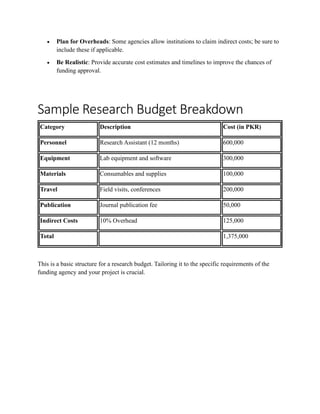
Sample Research Budget Breakdown
Category Description Cost (in PKR)
Personnel Research Assistant (12 months) 600,000
Equipment Lab equipment and software 300,000
Materials Consumables and supplies 100,000
Travel Field visits, conferences 200,000
Publication Journal publication fee 50,000
Indirect Costs 10% Overhead 125,000
Total 1,375,000
This is a basic structure for a research budget. Tailoring it to the specific requirements of the
funding agency and your project is crucial.

Budgeting Cost estimates for a research project

  • 1.
    Budgeting: Cost estimatesfor a research project, funding sources e.g. USAID, HEC, DoST, HED, PMRC, WWF, PSF When budgeting for a research project, it’s essential to carefully estimate all costs and identify potential funding sources. Below are guidelines on cost estimation and some common funding sources like USAID, HEC, DoST, HED, PMRC, WWF, and PSF. 1. Cost Estimates for a Research Project Cost estimation is crucial for ensuring that the project is feasible within available resources. The main components of a research project budget typically include the following categories: A. Personnel Costs • Salaries and Wages: For researchers, assistants, technical staff, and administrative personnel. • Fringe Benefits: Health insurance, retirement contributions, and other benefits. B. Equipment Costs • Lab Equipment: Specialized machines, testing instruments, or any equipment required for conducting experiments. • Computers/Software: Computers, hardware, and specific software for data analysis, modeling, or other project needs. • Field Equipment: Tools and devices used in fieldwork (e.g., GPS devices, sensors). C. Consumables and Materials • Lab Supplies: Chemicals, reagents, glassware, etc. • Field Supplies: Notebooks, sample containers, measurement instruments. • Other Materials: Any materials specific to the project. D. Travel Expenses • Fieldwork Travel: Expenses for researchers traveling to field sites (transport, accommodation, meals). • Conferences/Workshops: Costs for attending or presenting at conferences. • Collaborative Visits: Travel costs for visiting partner institutions or collaborating researchers.
  • 2.
    E. Data Collectionand Analysis • Survey Costs: Data collection via surveys, including printing, postage, or digital tools. • Interview Costs: Incentives for participants, transcription services. • Data Processing: Costs for hiring analysts or using specialized data processing services. F. Publication and Dissemination • Publication Fees: Open access journal fees, copyright fees. • Report Printing: Printing and binding final reports or disseminating findings. • Workshop Costs: Organizing seminars to share results. G. Indirect Costs (Overheads) • Institutional Overheads: A percentage charged by institutions for administration, facilities, and utilities. 2. Potential Funding Sources Several local, national, and international funding agencies provide financial support for research projects in various fields. Below are key funding sources: A. International Funding Sources 1. USAID (United States Agency for International Development): o Focuses on global development and humanitarian assistance. o Funds projects in agriculture, education, environment, health, and social sciences. o Supports collaborative research projects between U.S. and international institutions. B. National Funding Agencies in Pakistan 1. HEC (Higher Education Commission): o Provides funding for university-level research in Pakistan. o Offers research grants through programs like the National Research Program for Universities (NRPU), Grand Challenge Fund (GCF), and Technology Development Fund (TDF). o Fields: Science, engineering, social sciences, arts, and humanities. 2. DoST (Department of Science and Technology):
  • 3.
    o Funds projectsin science, technology, and innovation to promote R&D in Pakistan. o Encourages projects that drive economic development and solve societal challenges. 3. HED (Higher Education Department): o Offers support for educational research and projects that enhance higher education infrastructure and capacity. 4. PMRC (Pakistan Medical Research Council): o Specializes in funding biomedical and health-related research. o Focuses on public health, disease prevention, and improving healthcare systems. 5. PSF (Pakistan Science Foundation): o Provides funding for scientific research and development. o Supports research in natural sciences, engineering, and technology. o Encourages student research programs through initiatives like the Science Talent Farming Scheme. C. International Environmental Funding Sources 1. WWF (World Wide Fund for Nature): o Focuses on environmental conservation projects. o Offers grants for biodiversity, climate change, freshwater, and ecosystem conservation research. o Funding is typically available for projects in areas related to environmental sustainability and species preservation. 3. Tips for Budgeting and Applying for Funding • Justify Costs: Clearly explain why each cost is necessary for the project’s success. • Seek Multiple Sources: Combine funds from multiple agencies if possible to cover the entire project. • Follow Guidelines: Each funding agency has specific guidelines for submitting proposals and budgets. Follow these strictly.
  • 4.
    • Plan forOverheads: Some agencies allow institutions to claim indirect costs; be sure to include these if applicable. • Be Realistic: Provide accurate cost estimates and timelines to improve the chances of funding approval. Sample Research Budget Breakdown Category Description Cost (in PKR) Personnel Research Assistant (12 months) 600,000 Equipment Lab equipment and software 300,000 Materials Consumables and supplies 100,000 Travel Field visits, conferences 200,000 Publication Journal publication fee 50,000 Indirect Costs 10% Overhead 125,000 Total 1,375,000 This is a basic structure for a research budget. Tailoring it to the specific requirements of the funding agency and your project is crucial.