BSBFIM601
Manage finances
Technical Education Australia – Mapping
Version Date: April 2015 Trainer Muna Haider Page | 1
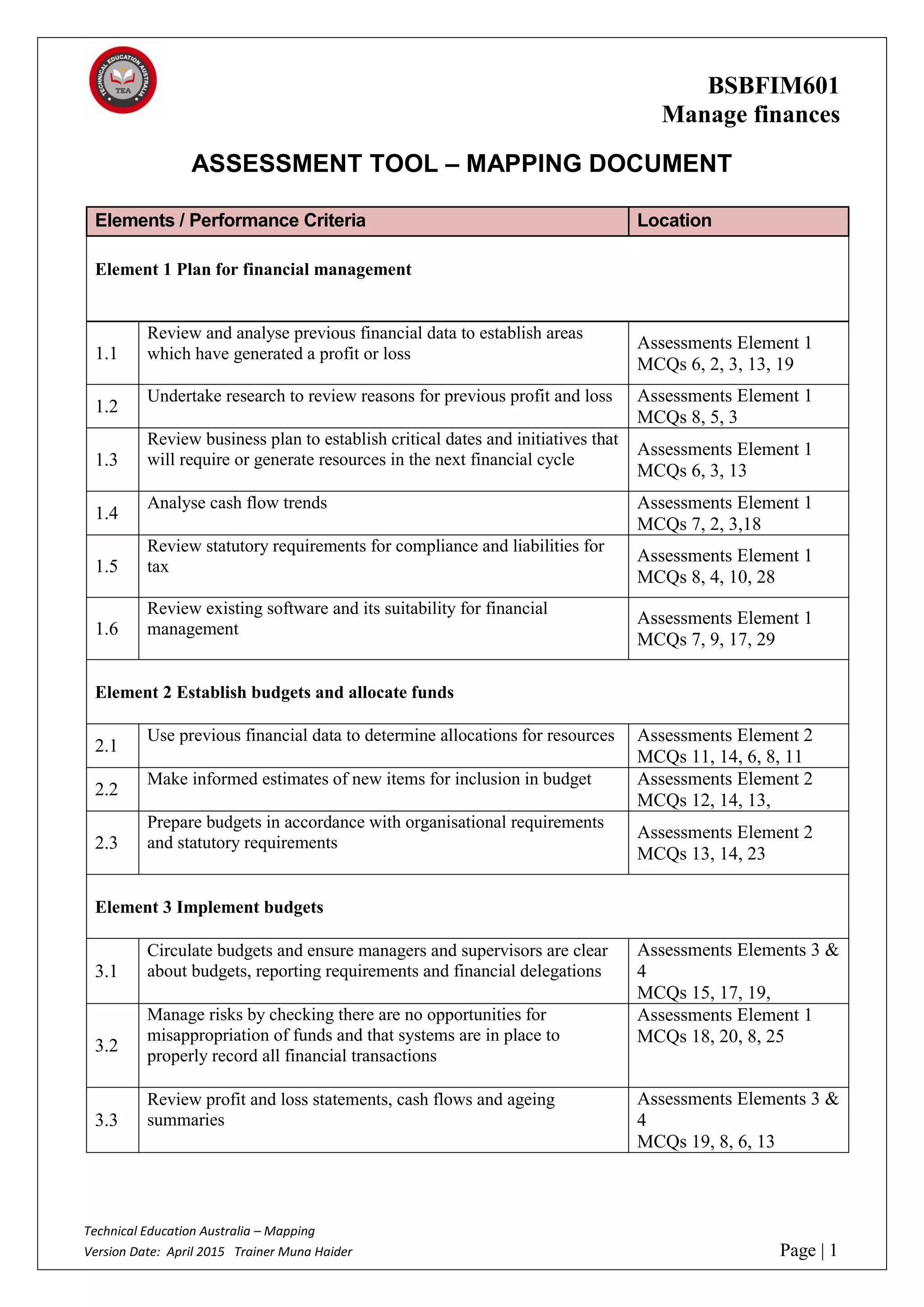
ASSESSMENT TOOL – MAPPING DOCUMENT
Elements / Performance Criteria Location
Element 1 Plan for financial management
1.1
Review and analyse previous financial data to establish areas
which have generated a profit or loss
Assessments Element 1
MCQs 6, 2, 3, 13, 19
1.2
Undertake research to review reasons for previous profit and loss Assessments Element 1
MCQs 8, 5, 3
1.3
Review business plan to establish critical dates and initiatives that
will require or generate resources in the next financial cycle
Assessments Element 1
MCQs 6, 3, 13
1.4
Analyse cash flow trends Assessments Element 1
MCQs 7, 2, 3,18
1.5
Review statutory requirements for compliance and liabilities for
tax
Assessments Element 1
MCQs 8, 4, 10, 28
1.6
Review existing software and its suitability for financial
management
Assessments Element 1
MCQs 7, 9, 17, 29
Element 2 Establish budgets and allocate funds
2.1
Use previous financial data to determine allocations for resources Assessments Element 2
MCQs 11, 14, 6, 8, 11
2.2
Make informed estimates of new items for inclusion in budget Assessments Element 2
MCQs 12, 14, 13,
2.3
Prepare budgets in accordance with organisational requirements
and statutory requirements
Assessments Element 2
MCQs 13, 14, 23
Element 3 Implement budgets
3.1
Circulate budgets and ensure managers and supervisors are clear
about budgets, reporting requirements and financial delegations
Assessments Elements 3 &
4
MCQs 15, 17, 19,
3.2
Manage risks by checking there are no opportunities for
misappropriation of funds and that systems are in place to
properly record all financial transactions
Assessments Element 1
MCQs 18, 20, 8, 25
3.3
Review profit and loss statements, cash flows and ageing
summaries
Assessments Elements 3 &
4
MCQs 19, 8, 6, 13
BSBFIM601
Manage finances
Technical Education Australia – Mapping
Version Date: April 2015 Trainer Muna Haider Page | 2
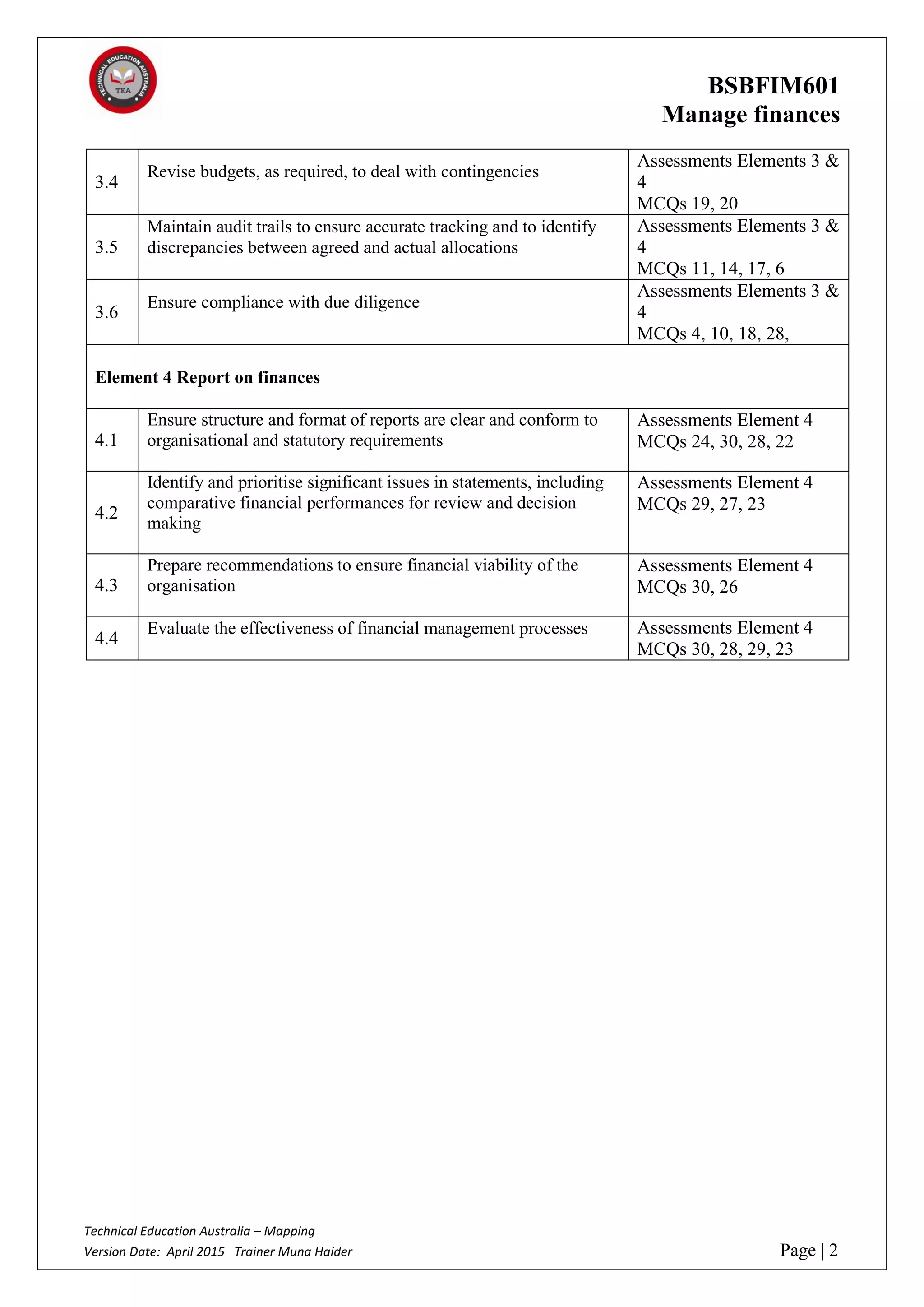
3.4
Revise budgets, as required, to deal with contingencies
Assessments Elements 3 &
4
MCQs 19, 20
3.5
Maintain audit trails to ensure accurate tracking and to identify
discrepancies between agreed and actual allocations
Assessments Elements 3 &
4
MCQs 11, 14, 17, 6
3.6
Ensure compliance with due diligence
Assessments Elements 3 &
4
MCQs 4, 10, 18, 28,
Element 4 Report on finances
4.1
Ensure structure and format of reports are clear and conform to
organisational and statutory requirements
Assessments Element 4
MCQs 24, 30, 28, 22
4.2
Identify and prioritise significant issues in statements, including
comparative financial performances for review and decision
making
Assessments Element 4
MCQs 29, 27, 23
4.3
Prepare recommendations to ensure financial viability of the
organisation
Assessments Element 4
MCQs 30, 26
4.4
Evaluate the effectiveness of financial management processes Assessments Element 4
MCQs 30, 28, 29, 23
BSBFIM601
Manage finances
Technical Education Australia – Mapping
Version Date: April 2015 Trainer Muna Haider Page | 3
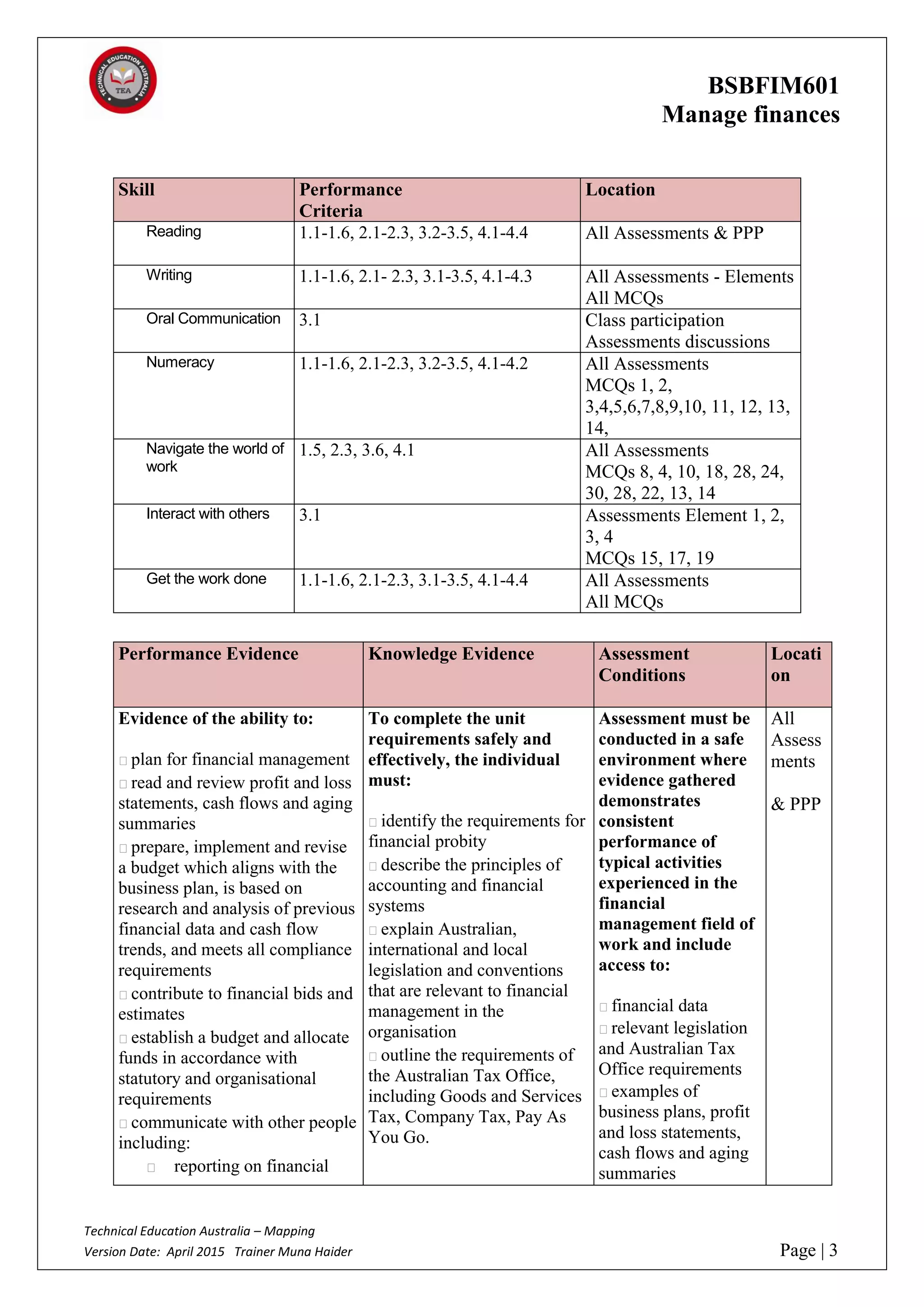
Skill Performance
Criteria
Location
Reading 1.1-1.6, 2.1-2.3, 3.2-3.5, 4.1-4.4 All Assessments & PPP
Writing 1.1-1.6, 2.1- 2.3, 3.1-3.5, 4.1-4.3 All Assessments - Elements
All MCQs
Oral Communication 3.1 Class participation
Assessments discussions
Numeracy 1.1-1.6, 2.1-2.3, 3.2-3.5, 4.1-4.2 All Assessments
MCQs 1, 2,
3,4,5,6,7,8,9,10, 11, 12, 13,
14,
Navigate the world of
work
1.5, 2.3, 3.6, 4.1 All Assessments
MCQs 8, 4, 10, 18, 28, 24,
30, 28, 22, 13, 14
Interact with others 3.1 Assessments Element 1, 2,
3, 4
MCQs 15, 17, 19
Get the work done 1.1-1.6, 2.1-2.3, 3.1-3.5, 4.1-4.4 All Assessments
All MCQs
Performance Evidence Knowledge Evidence Assessment
Conditions
Locati
on
Evidence of the ability to:
plan for financial management
read and review profit and loss
statements, cash flows and aging
summaries
prepare, implement and revise
a budget which aligns with the
business plan, is based on
research and analysis of previous
financial data and cash flow
trends, and meets all compliance
requirements
contribute to financial bids and
estimates
establish a budget and allocate
funds in accordance with
statutory and organisational
requirements
communicate with other people
including:
reporting on financial
To complete the unit
requirements safely and
effectively, the individual
must:
identify the requirements for
financial probity
describe the principles of
accounting and financial
systems
explain Australian,
international and local
legislation and conventions
that are relevant to financial
management in the
organisation
outline the requirements of
the Australian Tax Office,
including Goods and Services
Tax, Company Tax, Pay As
You Go.
Assessment must be
conducted in a safe
environment where
evidence gathered
demonstrates
consistent
performance of
typical activities
experienced in the
financial
management field of
work and include
access to:
financial data
relevant legislation
and Australian Tax
Office requirements
examples of
business plans, profit
and loss statements,
cash flows and aging
summaries
All
Assess
ments
& PPP
BSBFIM601
Manage finances
Technical Education Australia – Mapping
Version Date: April 2015 Trainer Muna Haider Page | 4
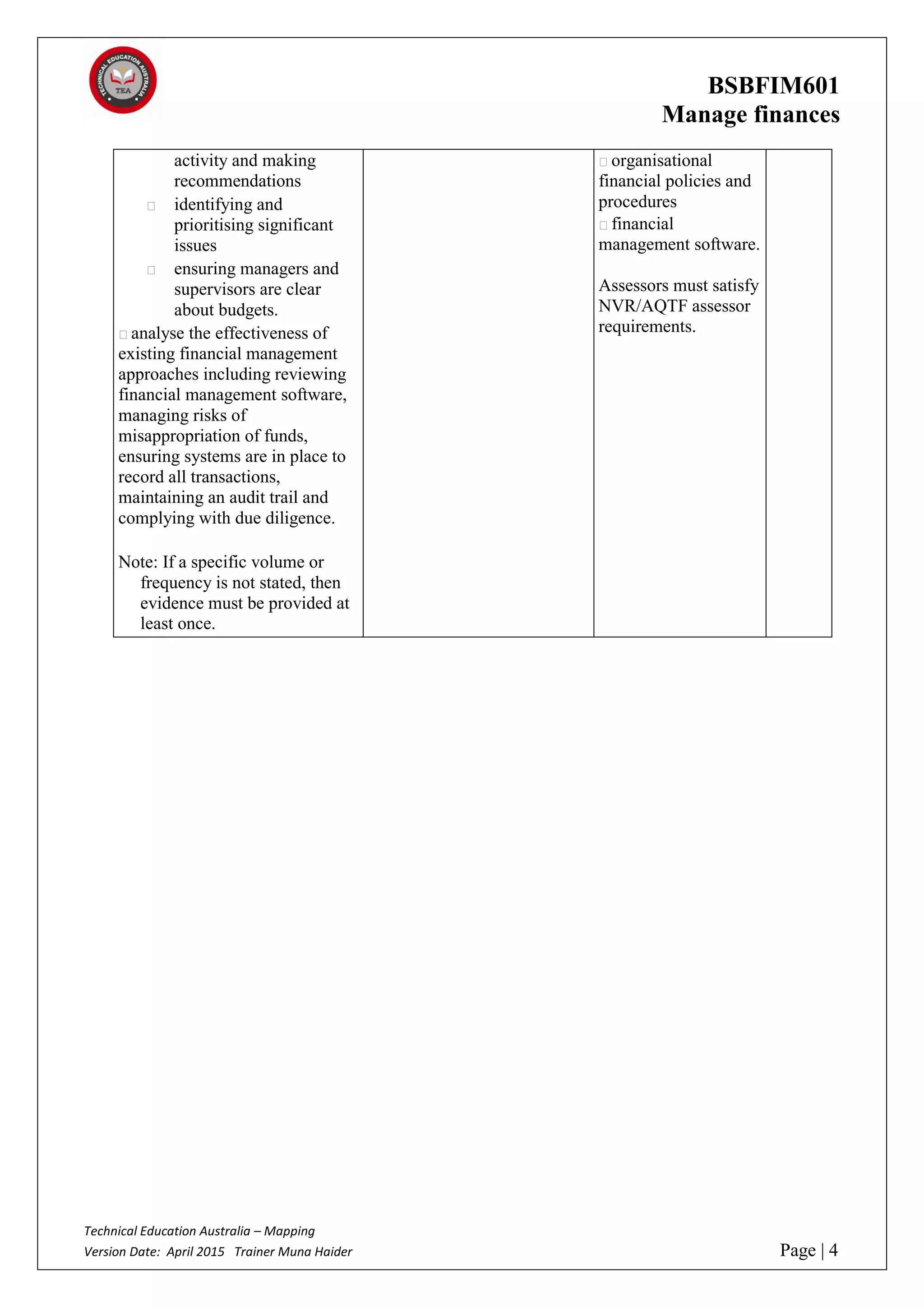
activity and making
recommendations
identifying and
prioritising significant
issues
ensuring managers and
supervisors are clear
about budgets.
analyse the effectiveness of
existing financial management
approaches including reviewing
financial management software,
managing risks of
misappropriation of funds,
ensuring systems are in place to
record all transactions,
maintaining an audit trail and
complying with due diligence.
Note: If a specific volume or
frequency is not stated, then
evidence must be provided at
least once.
organisational
financial policies and
procedures
financial
management software.
Assessors must satisfy
NVR/AQTF assessor
requirements.

BSBFIM601 Mapping 2015 Manage finances

  • 1.
    BSBFIM601 Manage finances Technical EducationAustralia – Mapping Version Date: April 2015 Trainer Muna Haider Page | 1 ASSESSMENT TOOL – MAPPING DOCUMENT Elements / Performance Criteria Location Element 1 Plan for financial management 1.1 Review and analyse previous financial data to establish areas which have generated a profit or loss Assessments Element 1 MCQs 6, 2, 3, 13, 19 1.2 Undertake research to review reasons for previous profit and loss Assessments Element 1 MCQs 8, 5, 3 1.3 Review business plan to establish critical dates and initiatives that will require or generate resources in the next financial cycle Assessments Element 1 MCQs 6, 3, 13 1.4 Analyse cash flow trends Assessments Element 1 MCQs 7, 2, 3,18 1.5 Review statutory requirements for compliance and liabilities for tax Assessments Element 1 MCQs 8, 4, 10, 28 1.6 Review existing software and its suitability for financial management Assessments Element 1 MCQs 7, 9, 17, 29 Element 2 Establish budgets and allocate funds 2.1 Use previous financial data to determine allocations for resources Assessments Element 2 MCQs 11, 14, 6, 8, 11 2.2 Make informed estimates of new items for inclusion in budget Assessments Element 2 MCQs 12, 14, 13, 2.3 Prepare budgets in accordance with organisational requirements and statutory requirements Assessments Element 2 MCQs 13, 14, 23 Element 3 Implement budgets 3.1 Circulate budgets and ensure managers and supervisors are clear about budgets, reporting requirements and financial delegations Assessments Elements 3 & 4 MCQs 15, 17, 19, 3.2 Manage risks by checking there are no opportunities for misappropriation of funds and that systems are in place to properly record all financial transactions Assessments Element 1 MCQs 18, 20, 8, 25 3.3 Review profit and loss statements, cash flows and ageing summaries Assessments Elements 3 & 4 MCQs 19, 8, 6, 13
  • 2.
    BSBFIM601 Manage finances Technical EducationAustralia – Mapping Version Date: April 2015 Trainer Muna Haider Page | 2 3.4 Revise budgets, as required, to deal with contingencies Assessments Elements 3 & 4 MCQs 19, 20 3.5 Maintain audit trails to ensure accurate tracking and to identify discrepancies between agreed and actual allocations Assessments Elements 3 & 4 MCQs 11, 14, 17, 6 3.6 Ensure compliance with due diligence Assessments Elements 3 & 4 MCQs 4, 10, 18, 28, Element 4 Report on finances 4.1 Ensure structure and format of reports are clear and conform to organisational and statutory requirements Assessments Element 4 MCQs 24, 30, 28, 22 4.2 Identify and prioritise significant issues in statements, including comparative financial performances for review and decision making Assessments Element 4 MCQs 29, 27, 23 4.3 Prepare recommendations to ensure financial viability of the organisation Assessments Element 4 MCQs 30, 26 4.4 Evaluate the effectiveness of financial management processes Assessments Element 4 MCQs 30, 28, 29, 23
  • 3.
    BSBFIM601 Manage finances Technical EducationAustralia – Mapping Version Date: April 2015 Trainer Muna Haider Page | 3 Skill Performance Criteria Location Reading 1.1-1.6, 2.1-2.3, 3.2-3.5, 4.1-4.4 All Assessments & PPP Writing 1.1-1.6, 2.1- 2.3, 3.1-3.5, 4.1-4.3 All Assessments - Elements All MCQs Oral Communication 3.1 Class participation Assessments discussions Numeracy 1.1-1.6, 2.1-2.3, 3.2-3.5, 4.1-4.2 All Assessments MCQs 1, 2, 3,4,5,6,7,8,9,10, 11, 12, 13, 14, Navigate the world of work 1.5, 2.3, 3.6, 4.1 All Assessments MCQs 8, 4, 10, 18, 28, 24, 30, 28, 22, 13, 14 Interact with others 3.1 Assessments Element 1, 2, 3, 4 MCQs 15, 17, 19 Get the work done 1.1-1.6, 2.1-2.3, 3.1-3.5, 4.1-4.4 All Assessments All MCQs Performance Evidence Knowledge Evidence Assessment Conditions Locati on Evidence of the ability to: plan for financial management read and review profit and loss statements, cash flows and aging summaries prepare, implement and revise a budget which aligns with the business plan, is based on research and analysis of previous financial data and cash flow trends, and meets all compliance requirements contribute to financial bids and estimates establish a budget and allocate funds in accordance with statutory and organisational requirements communicate with other people including: reporting on financial To complete the unit requirements safely and effectively, the individual must: identify the requirements for financial probity describe the principles of accounting and financial systems explain Australian, international and local legislation and conventions that are relevant to financial management in the organisation outline the requirements of the Australian Tax Office, including Goods and Services Tax, Company Tax, Pay As You Go. Assessment must be conducted in a safe environment where evidence gathered demonstrates consistent performance of typical activities experienced in the financial management field of work and include access to: financial data relevant legislation and Australian Tax Office requirements examples of business plans, profit and loss statements, cash flows and aging summaries All Assess ments & PPP
  • 4.
    BSBFIM601 Manage finances Technical EducationAustralia – Mapping Version Date: April 2015 Trainer Muna Haider Page | 4 activity and making recommendations identifying and prioritising significant issues ensuring managers and supervisors are clear about budgets. analyse the effectiveness of existing financial management approaches including reviewing financial management software, managing risks of misappropriation of funds, ensuring systems are in place to record all transactions, maintaining an audit trail and complying with due diligence. Note: If a specific volume or frequency is not stated, then evidence must be provided at least once. organisational financial policies and procedures financial management software. Assessors must satisfy NVR/AQTF assessor requirements.