Applying for an NIHR
fellowship: My
PhD experience
Seema Singh
Renal Dietitian
NIHR Clinical doctoral research fellow
Clinical Academic Training Programme for Nurses, Midwives and Allied Health Professionals
Why I decided to do a PhD
Career choice:
Researcher or manager
Service delivery
Quality of care
Theory & practice
Patient contact
Clinical Outcomes
Changing practise
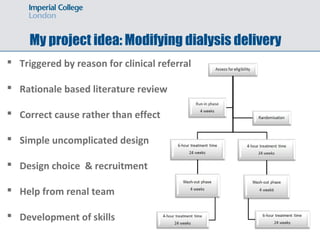
My project idea: Modifying dialysis delivery
 Triggered by reason for clinical referral
 Rationale based literature review
 Correct cause rather than effect
 Simple uncomplicated design
 Design choice & recruitment
 Help from renal team
 Development of skills
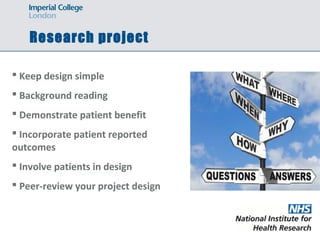
Research project
 Keep design simple
 Background reading
 Demonstrate patient benefit
 Incorporate patient reported
outcomes
 Involve patients in design
 Peer-review your project design
Completing the application
form
 Past research experience
 Use additional info section to sell yourself
 Suggest agreed or possible collaborations
 Advertise use of patient involvement
 Support career intentions
 Supervisors – accessible & approachable
 Get help with costing & finance form
 Allow plenty of time
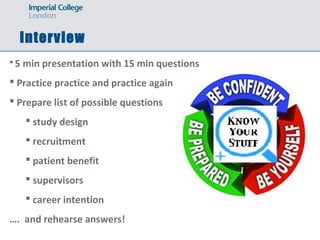
Interview
 5 min presentation with 15 min questions
 Practice practice and practice again
 Prepare list of possible questions
 study design
 recruitment
 patient benefit
 supervisors
 career intention
…. and rehearse answers!
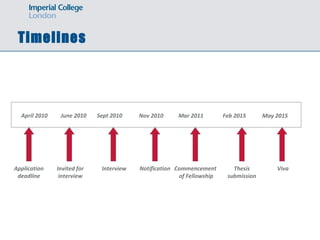
Timelines
April 2010 June 2010
Application
deadline
Invited for
interview
Sept 2010
Interview
Nov 2010
Notification
Mar 2011
Thesis
submission
Commencement
of Fellowship
Feb 2015 May 2015
Viva
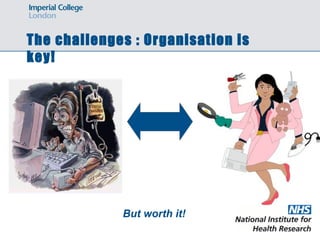
But worth it!
The challenges : Organisation is
key!
New experiences
 Acquiring & mastering new skills
 Novel project & unexpected findings
 Esteem indicators
 Networking
 Involvement in external initiatives
Good support is crucial

Seema Singh- Insights from a recent successful applicant

  • 1.
    Applying for anNIHR fellowship: My PhD experience Seema Singh Renal Dietitian NIHR Clinical doctoral research fellow Clinical Academic Training Programme for Nurses, Midwives and Allied Health Professionals
  • 2.
    Why I decidedto do a PhD Career choice: Researcher or manager Service delivery Quality of care Theory & practice Patient contact Clinical Outcomes Changing practise
  • 3.
    My project idea:Modifying dialysis delivery  Triggered by reason for clinical referral  Rationale based literature review  Correct cause rather than effect  Simple uncomplicated design  Design choice & recruitment  Help from renal team  Development of skills
  • 4.
    Research project  Keepdesign simple  Background reading  Demonstrate patient benefit  Incorporate patient reported outcomes  Involve patients in design  Peer-review your project design
  • 5.
    Completing the application form Past research experience  Use additional info section to sell yourself  Suggest agreed or possible collaborations  Advertise use of patient involvement  Support career intentions  Supervisors – accessible & approachable  Get help with costing & finance form  Allow plenty of time
  • 6.
    Interview  5 minpresentation with 15 min questions  Practice practice and practice again  Prepare list of possible questions  study design  recruitment  patient benefit  supervisors  career intention …. and rehearse answers!
  • 7.
    Timelines April 2010 June2010 Application deadline Invited for interview Sept 2010 Interview Nov 2010 Notification Mar 2011 Thesis submission Commencement of Fellowship Feb 2015 May 2015 Viva
  • 8.
    But worth it! Thechallenges : Organisation is key!
  • 9.
    New experiences  Acquiring& mastering new skills  Novel project & unexpected findings  Esteem indicators  Networking  Involvement in external initiatives
  • 10.

Editor's Notes

  • #2 My name is Seema Singh I’m a renal dietitian and have just finished my NIHR fellowship and awaiting viva I’m going to give you an insight into my project, highlighting the things I found challenging but also what I’ve got out of the whole experience so far. I’ve been a real dietitian for over 20 years but in the last 15 I have been analysing clinical outcomes and involved in translational research. So although I had a number of publication as 2nd and 3rd author and presented at international and national conferences. I hadn’t ever set up a research project from start to finish
  • #3 My clinical quality outcomes and registry role came about from reaching what I perceived to be a glass ceiling. I was no longer learning or experiencing new challenges. The conventional next step from being the lead renal dietitian at St Marys was to go into management and I could think of nothing worse! So I involved myself in every audit and research project that I could. Often doing all data collection for renal registrars / consultants who then wrote up the work and very kindly gifted me with 2nd and 3rd authorship on publications. That’s when I knew that research was really what I wanted to do But I had a family and mortgage and couldn’t just go back to being a full time student so I did an MSc St Marys then merged with the Hammersmith in 2005 and I took advice /advantage of a more academic and motivated dietetic dept. I took advice from Mary Hickson and ended up applying for an NIHR fellowship which pays your salary and all research and training costs I knew that these areas were important to me and motivated my work so I decided to take the 2nd road and see how I got on
  • #4 In my opinion the research project is paramount. Others applied at the same time and they were arguable better dietitians but may have just opted for too big or complicated a project. At doctoral level they are expecting a project which is realistic and doable.
  • #5 Background and rational are important as patient benefit is an assessment criteria. Also a PhD project is supposed to be novel so carrying out a literature review will make sure someone hasn’t done something similar already It’s very important to involve patients in both study design. For example I did a patient questionnaire to find out how many patients would even agree to do a 6 hour dialysis so I “coverred” my self wrt to question on recruitment. You can contact specialist support groups to gauge opinion The other thing is also to review patient experience or have patients reporting their own outcomes or perception. I conducted quality of life questionnaires and also patient interviews. Get other mdt members to review your project idea and take their advice, including costings.
  • #6 Plug any past research or audit experience and use the additional info sections to sell yourself. The aim is to create a research specialist who will interact and collaborate with others to promote both patient benefit within the speciality and profession. I contacted a unit which specialises in long dialysis and provisionally agreed to visit the unit to learn from their practises. Make sure that you advertise your efforts to involve patients in design and ask opinions of your patients. Try and put some info on how you believe the project will develop your clinical skills – will you be using a technique that you don’t currently have access to – I incorporated body composition. The monitors are expensive and so were not widely used. Try and demonstrate how developing your skills will support future career intentions Make sure you choose supervisors you find approachable and who actually have time and interest in you. No point in picking the best in the field if they are away presenting and lecturing all year round and you never see them or equally have such a heavy clinical commitment. Get help with costing – include attending conferences Finally allow plenty of time – the forms require signatures etc and with my luck the will be on holiday the one day I need them or else the trust it system will crash on submission day
  • #7 All shortlisted candidates are invited to interview. Its strictly timed and I would just say that the panel are actually very positive and aren’t looking to catch you out they just want you to show them that the aren’t wasting their NHS money. I was conducting a clinical trail but dialysis is not novel I was just slowing it down and lengthening it and so I didn’t complete an additional form and one of the panel members pointed that out and I remember thinking I wont get it now I have nothing to lose. I rehearsed my presentation to anyone that would listen. I probably did it 6/7 times to a panel audience ad tweaked it a bit each time – that might seem disheartening but ultimately leads to a really polished powerpoint. Also prepare a list of possible questions and prep gold standard answers.
  • #8 It took a few months to refine the project idea and get the application completed so start as early as possible. I elected to undertake my fellowship part time at 75% and so took 4 years instead of 3. I don’t think there’s any advantage either way its very much an individual choice. I personally felt that I didn’t want to lose touch with the service changes.
  • #9 I don’t particularly enjoy stress so my OCD went into over drive. No matter what you have on the next day –an oral presentation or abstract submission. Muddy Rugby kit still needs washing and beautiful daughter still needs to get to piano practice etc. Life goes on and you have to make sure its not a endurance exercise. Organising my time let me enjoy time with my family with I was away from work or my desk and made me focus when I least wanted to
  • #10 Learn to trouble shoot, finding solutions to logistical problems. I’m recruiting from 4 sites I was alarmed to find blood samples in the pathology lab fridge not analysed from the night before. The lab explained their difficulties & we have now agreed that they will batch analyse samples. Putting an application into ethics was a new experience for me and I learnt that being a clinician and being a researcher involve different practices. Collation and storage of clinical data as a researcher is more rigorous and legislated very differently than as a clinician. These range from centrifuging blood samples, to using new equipment such as BIA machine to organisation skills which go to a different level altogether when you are working from so many sites. Also you have to remember that a novel project may have unexpected findings. I found that there was variance in recruitment rate & that effect on treatment schedules were impacting. So now part of my study is surveying staff and organisation aspects regarding feasibility Incorporating presentations and
  • #11 Good support is crucial. Thanks for listening